Big Freedia talks about her second collaboration with Beyoncé on Renaissance, explains bounce music's call-and-response style rooted in New Orleans, and reflects on coming out as gay in a city that wasn't always accepting. Her mother's support let her live authentically and now she's an activist for LGBTQ+ youth.
Chapters
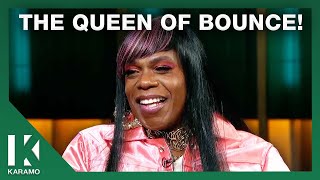
Welcome back, friends. My next guest is a music icon and an activist for the LGBT+ community. And I want to talk to him about what he's been through in his life. Everyone, please welcome the queen of bounce, Big Freedia.
Hey! Hey, my baby! What's going on? Oh my gosh, I love you. I love you. Take a seat. Yes, yes.
So I just have to take a moment because anywhere I go, y'all need to know, I give you your flowers. I love you and have loved you since day one. So let's get right into it. This is your second time, number two, teaming up with Beyoncé. What was this experience like for you?
I mean, it was amazing just to be able to be called by Beyoncé for a second time for a song. I am forever grateful to Beyoncé. You know, right now, this Renaissance project is something that's needed around the world. And "Break My Soul" has broke charts and—
You number one, baby.
Yes, it is.
Okay.
I want for everyone who doesn't know, what is New Orleans bounce? What is bounce music? Because you are the queen of bounce and I know, but explain bounce.
So in New Orleans, we call it shaking. You know, we shake, we wiggle, we wobble.
Yes.
We bust open, bend over, we do it all.
Hey, baby.
Hey, baby.
But when I define bounce music, it's up-tempo, it's heavy, Bass is call and respond type music. It's a New Orleans-based music. And it, you know, from babies to grandmothers, it's a part of our culture and it's what we love and what we do down there. So the world is finally catching on.
Yes. So to us, we know you as Big Freedia. We know you as the Queen of Bounce. But when you are home in New Orleans, they know you and will always respect you as Freddie Ross.
Most def.
Yes. Tell us about your experience growing up in New Orleans.
You know, growing up as a little Black boy off of Josephine, I did it all. I saw it all. You know, New Orleans is what helped me to be who I am. You know, from the neighborhoods to my church home, to my high school, my middle school, to my family and friends who helped, you know, nourish me and, you know, make me the person that I am. Once I left Josephine Street, I also, you know, my next house was on Music Street.
Really?
Like actually music? Yeah, it's like I stayed on music street.
Better manifest.
You never know how your journey may go. And God already had this being my destiny to be in the music game and to do what I do to bring all different walks of life together. The power of what I do at my shows and the joy I bring to people in their lives.
Millions of people.
Yeah. We all have a purpose in life. And when you learn your purpose and know what your purpose is, you fulfill those things and God will keep on blessing you.
Can you tell me about the bond that you had with your mother growing up in New Orleans?
Oh God, I mean, my mother was my biggest cheerleader. She was my protector. She was my everything. I mean, anything that I wanted to do, she had my back. She supported me in all of my many things. I mean, she kept me in line. And made me respect myself and respect others. She also kept everybody else in line who may have tried to bully me or anything. I mean, she fought for me like no other. And you know, growing up, especially being gay, when you have your mother's support, you don't need no validation from anybody else.
Amen.
You know? And so she allowed me to be who I was. She allowed me to live in my truth.
So being gay in New Orleans when you were coming up, how is that different from what you've experienced now?
So growing up in New Orleans back then, you know, being gay wasn't accepted like it is now. I mean, I had to fight, you know, I had people who tried to bully me. I had, you know, to fight for to be who I wanted to be. I also had a mission that I was gonna be the first New Orleans gay person that, any boy could come to and not feel like I'm stepping out of line with them. I can be their partner, they can dap me off. So I wanted to have relationships with everybody. And so I worked really hard at that for many, many years. I fought all my life and I'm gonna continue to fight to be able to open doors for the next generation of people that walks like me and talk like me. And anything that I can do to help the community and make the world a better place, I'm down and I'm fighting for my people. Anything that's fighting for a great cause, I'm down for it.
Freedia, we are so thankful for the work you do, for the fights you make, and for the fact that you give us great music to release our days and it feel good. Everyone, please give it up for icon, big Freedia.
Thank you. We're gonna let Karamo go. Okay, what I do?
Look, I'm gonna do something real easy.
Yes, okay.
Where you just kind of do a little side to side.
Hold on. Where you going? I'll tell you where you're going. Right here to subscribe and right here to watch more period.