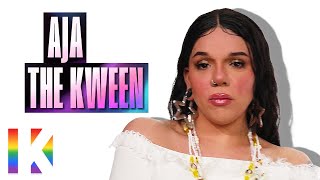
Aja, a trans woman from Drag Race, talks about discovering ballroom culture as a kid, how appearing on the show amplified her platform, and a severe mental-health crisis during London Pride in 2019 that made her step back from social media to recover.
Chapters
It really cleared up my depression a lot, but I think I wasn't truly undepressed. I don't know if that's a word or not, but hello, Merriam-Webster. Hi, I'm Aja. My pronouns are she and her. I am an Afro-Latino woman from Brooklyn, New York. I am a media mogul. I mean, I'm reality TV, a musician, a model. I'm whatever you're paying me to do, but, you know, don't get crazy. Pride is literally just being yourself unapologetically. Like, to me, it's so self-explanatory. It's just be you and not think about it, not worry about it, and not feel like you have to hide it. I celebrate Pride by existing, honestly. It's a really tough time right now for trans women, especially trans women of color, and especially Black trans women. And I think that, like, just being able to be alive in this climate, it's a protest in a way. I wear that with pride because I'm just like, y'all not It's not gonna get me. I think people need to understand that trans people have been here, you know, before 2023, the 2000s. We've been here forever and we're only becoming more because people are realizing that it is what it is. You can just be yourself. I feel like the definition of queer has changed so much over the years because I feel like at some point it was derogatory and it was supposed to be like against the norms of society and binary, but I feel like Right now, well, I feel like it kinda still means that. I feel like, but it's just people are wearing it as a badge of honor instead of in shame. And it's no longer an insult to call someone queer. Now it's like, okay, you know, calling someone queer is acknowledging that they are not conforming to society's standards, especially within the binary. It's doing you unapologetically. I got exposed to ballroom when I was very young. I was like 12, 13. I was on MySpace, you know, back in the day. This one person was like, "Hey, you should come to the Village," and I'm over here like, "What's that?" I'm lying, I'm telling everybody I'm 16, but I'm really 12. I find my way out into the city, I'm getting in trouble every weekend because I'm in the Village every Saturday and I'm learning how to vogue on the pier, and, you know, I start meeting people from the ballroom scene. Ballroom culture has been around since the '60s, and it basically started off as a form of civil rights within the queer pageant scene, and then it turned into an an entire Afro-Latino movement, which it was led by mainly Black and Latino trans women, and then it just exploded into this huge thing where it was minorities who are queer getting together, creating families, and creating opportunities, and creating just a place for you to be yourself without dying, being judged, without, you know, and being able to live the fantasy. But, you know, now ballroom has become so known to society and people are acknowledging things like voguing. And even though, you know, ballroom is so much more than that, a lot of people love the vogue. They love it. Being on Drag Race was such a life-changing experience. People get to see you and they get to see your art form and you get put on a platform. And that, that is a huge protest because it's, it's visibility. And now people who that maybe didn't relate with anybody else before get to see you, learn your story, and maybe they relate with you and you can save someone's life by just being. My whole drag identity and artistry was so based on things that I feared and things that I wanted. I think I was running away from my femininity for a long time. In 2018, '19, I really stepped back from the idea and concept of doing drag because I didn't want people to just look at me as some sort of like, clown or like drag. I didn't want to just be a drag queen. I was like, I want people to look at me as an artist. And I didn't understand that that was so rooted in me running away from my transness. I felt like when people were referring to me as drag, they were kind of saying like my womanhood is performative. So I did the complete opposite thing of what I should have done, and I just like forced an entire hyper-masculine identity on myself for 2, 3 years, and then I don't know, one day I'm just like, okay, well, I think it's time, and here I am. It's crazy, a lot of people don't even know that I have transitioned. People see me and they're like, oh, you've had so much plastic surgery. I'm like, I have not had one cut on this face. This is God. But I don't let too much people into my transition because, you know, it's personal. Celebrities undergo, you know, gender-affirming surgeries and procedures all the time. Getting breast implants is gender-affirming. Getting a BBL is gender affirming. Even the male surgeries are all gender affirming. So like, why is it such a crazy thing when we do it? The Karamo Show asked me about a time in my life where I had to overcome. It would just have to be in 2019. That was such a hard year for me because when I was really pushing myself away from the drag world and RuPaul's Drag Race and trying not to be associated with that brand because I was so ashamed of being a drag artist because I was scared to transition. Particularly, there was one time I went to London for London Pride. I was in the terrible hotel room that the promoter had booked. I was just sitting there. I just had like a whole breakdown. And like, I was like, I can't do this. This was all internal. And that's what made it worse, was that I didn't say nothing. I think that as I was imploding, I really for a second just realized that at that moment I was like, I don't wanna live anymore. Like, I don't feel like life is worth living. It was kind of hard to be in that moment because I just didn't know what to do. And I just thought, well, if I'm just trying to be myself and that's such a problem for people who are supposed to be my supporters, then what's the point? What's the easy way out? I think what I realized after that though was that the way that I was handling the situation was maybe not the best way to do it publicly. And because I was addressing it publicly, And I realized I didn't need to do that. And as I kind of took steps away from social media, I realized that it was healthier for me to not engage so much when it came to my personal identity and who I was and to debate my artistry because I didn't need to do that. And in the wise words of Lady Gaga, that's why you are the public and I am the artist. I started to kind of like go by that, but once I started physically affirming my womanhood, I felt that's when I became happier. Yeah, I'm here. I'm alive. If you're watching this, just do you. Do not be afraid. If we live in fear, we will never persevere. Like, we just won't. We have to live brave and just take it as it comes. Just know that people have died for us to be here. People have paved the way with their blood, sweat, and tears, and We're going to keep doing the same for those who come after us. It's not going to be easy, but just know that us living makes it easier for the generation after us and the one after that and the one after that. Hold up, hold up. Where are you going? I know you wanna watch more Karamo, so click here to subscribe and click here to watch more so we can keep talking and growing, friends. I love you.