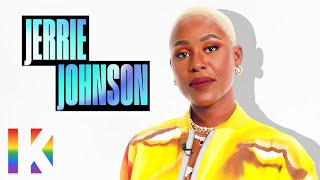
Actress Jerrie Johnson talks queerness as freedom and radical self-determination for Black women. She landed her first role as a fully realized Black queer character on Amazon's Harlem, and grew up as the first in her family to attend college. Johnson urges young queer people to embrace joy and self-love, and calls for more authentic Black queer representation in mainstream stories.
Chapters
And I was like, well, Mom, you know I'm gay. And she was like, don't say you gay, just say you like women. And I was like, OK, I like women. And then she told me to find a nice, rich Italian woman. Hello, my name is Jerri Johnson. I am 6 feet tall for all those who think that I'm short. I am an actress, an art doula, a lover. My pronouns are she/they. And I'm just an all-around bad bitch. Queer to me is liberation. Queer is freedom. Queer is following your sexual identity wherever that takes you, whether you're sapiosexual, a lesbian, a bisexual, and not really having limitations on queerness. I'm also a non-monogamous person, a polyamorous person, and so queerness also fits under that umbrella that my relationships, my love is not gonna look like anything else but what I think it should look like. And I think as a queer Black woman, that's a radical act just to even take power of how I express myself romantically and sexually. If queerness wasn't a powerful thing, there wouldn't be 417 conversations about it. I do think that there is this beautiful expansion and liberation in queerness that people who want to maintain power can't let persist, or else white supremacy, or else the patriarchy doesn't get to live on. Queer people right now can continue to live in their fullest authenticity. It doesn't matter how many bills are signed. We are more powerful. And as long as we're continuing to uplift each other, to continue to liberate each other, continue to live in our truths, right? That is the most powerful thing. Our allies can support us by having conversations with their fathers, having conversations with people who they know have views that are anti-queer, anti-LGBTQ, that are harmful. We aren't the ones that need to be convinced. Pride to me means excitement about exploring and celebrating everybody's authentic self, whatever that is. I don't think that Pride is limited to queerness, but I do think it's important for queer people to celebrate Pride and for queer people to be celebrated. For me, I like to be around the people that I love. I like to be vocal about what queerness means to me, what love means to me, and I like to go to parties and shake my ass. So I play Ty on the hit Amazon series Harlem, and Ty is very much a go-getter, She has a great mixture of feminine and masculine energy. Playing Ty just made sense. It was the first time that I read a script that had a Black queer woman that I felt was full. She's not the first Black queer woman to be on TV, but the way that she exists and the freedom that she exists with in the friend group that she has, it's special. And I'm glad that she exists because I feel like, oh, this is the kind of way I live my life. This is how I am with my friends. And so it feels actually quite authentic. I want to see more Black queer women being the bosses in stories doing mundane things. Like, why can't an Emily in Paris be Black? I think sometimes we think of a certain kind of person doing a certain kind of thing. I'm interested in that being dismantled. So here at the Karamo Show, I was asked to tell a story about how I have overcome adversity. I'm from North Philadelphia, and I grew up one of 7 children. We all have different fathers, single mother. I'm number 5, the youngest girl. And no one in my family went to college. I'm the first one to ever, to ever live outside of my mother's house in a place that wasn't prison. And so when I went to school, I knew what the risk might be, but I also knew that I had to, like I always was running on the gas of you need to do this or what? You know, like there was no going back home, there was no calling back home. And so I remember my first year of college and I had no money, so I started working at the cafeteria so that I can get free food because all I could afford was these 75-cent peanut butter and jelly sandwiches. It was difficult, but you're living in a townhouse, right? Like, it's hard, but you have a bed that you don't have to share with anybody. It's hard, but you can take a shower in hot water. And so I've always been grateful for the simple beauties of life. I always say to people, God gave me a hard childhood so I can live my best fabulous life. Even being here today is an overcoming of adversity. But I do think that it's made me the visionary that I am. It's made me very inventive and creative, and it has given me a deep, deep, deep well of empathy and compassion just for humanness, because I ultimately think we're all trying our best. The advice that I would give a young queer person watching this is it's fun. It's fun to have fun, to not take things so seriously because queerness is more ancient and more natural than any other thing, right? I would say living in your confidence, living in your truth, and never let anybody allow you to second-guess yourself or to compromise your self-love or to get off your center based off of a hate that they have. It's not personal at all. You know, sometimes it's inherent, but for us, we have to be living in joy. We have to be imagining the kind of life that we want, the kind of world that we want, and living as if that world exists.
Hold up, hold up, where are you going? I know you want to watch more Karamo, so click here to subscribe and click here to watch more so we can keep talking and growing, friends. I love you.