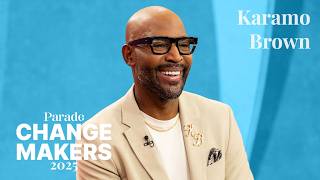
Karamo Brown grew up Afro-Latino in white neighborhoods and changed his name because people wouldn't pronounce it. He argues that cancel culture doesn't work, that LGBTQIA+ people should "let people in" rather than "come out," and that real change requires curiosity about intersecting identities, not just race.
Chapters
When I think of the word changemaker, I think of somebody who has the courage to know that what we are today is not the final stop. We must keep going. And I think that every day when you're motivated by knowing that tomorrow must be better, that's what changemaker's about. I am excited to be a Parade changemaker.
I want to start with your childhood. Specifically in elementary school where I read that you actually went by the initials KK rather than Karamo growing up. So I wanted to ask, why was that?
I went by KK because of the fact that I grew up in predominantly white neighborhoods and unfortunately they would act as if they didn't know how to pronounce my name. And so out of frustration and out of embarrassment, I just decided to go by initials because it was easier. And I look back on it now and I'm always like, ugh, you know, I wish I would've had the courage in my young self to say, no, you have to learn how to pronounce my name. You have to respect my name, the name that was given to me.
As a young Afro-Latino looking back, how do you feel like maybe those experiences, especially growing up like that, impacted the person you'd later become?
Well, I gotta tell you, being in those neighborhoods and having the identities that I hold so true to my heart and so thankful for, it taught me how important it was to not be afraid of where I come from, to not be afraid of using my voice and speaking up. Now, I used to tell people the story that like when I was going to school and I had brought my lunch, I didn't bring like the normal peanut butter and jelly sandwich like other kids because in my household, you know, my mother cooked a big meal. And so whatever the meal was the night before was what my lunch was the next day. And so I'm bringing in Tupperware in middle school, you know, with like rice and beans and like some type of meat because that's what I had. And I remember for the longest I was ashamed of that. And so looking back, it's just this reminder that you should always be proud of where you come from, of your background, of your experiences because they make you who you are. And young me didn't understand that.
On top of that, I know firsthand too, you have your own experiences with your own background and your own culture. And then of course, I know being a gay person and you, I know that you in high school, you dated women at the time. And I wanted to talk to just about your later experience coming out. 'Cause I know that that can be twofold, especially when culturally you're trying to accept yourself. And then also with your sexual orientation as well.
First, let me say this. One of the things that are part of like my mission on this earth, and I've been saying this for years, is that I want to destroy the term coming out. And I think the actual act that LGBTQIA people do is letting people in. And so I started letting people in when I was 15, actually. And I started letting in family members that I thought I could trust. And some of those family members immediately betrayed me. And it taught me that if I do not protect myself and love myself and create my own safety and security, then I would always be at the mercy of somebody else saying, you're safe today and not tomorrow.
You are a father, as you mentioned. And I wanted to talk to you about how stepping into that role too with your culture, with your sexuality. And I know that your son also came out as pansexual as well. Talk to me a little bit about that role in your life.
When my son let me into that he identifies as pansexual, I did not react the way you would think I reacted. I actually, for about 4 seconds, was like, "What are you talking about? No, you're not." And I hung up the phone. And I tell people this, the internalized homophobia that I experienced was inside of me. I realized the reason that that internalized homophobia jumped out is because even though I'm a part of the LGBTQI community, We sometimes don't learn about every part of our own community. And so when he told me he was pansexual, I had never met anybody who was pansexual. And so I was afraid of what I didn't know. It taught me when I'm speaking to parents of LGBTQI kids who don't understand to take a pause and before you react, be educated. I think that sometimes people get stuck in their ignorance because they're afraid to find the knowledge. And if you found the knowledge, Through the knowledge comes empathy and understanding.
We all are thrust into these biases. We're always unlearning these things. And I think it's important sometimes to maybe have a little grace. You said you should swap cancel culture for council culture. And I feel like that is a really great way of saying that.
I still don't believe in cancel culture, but I also don't know if council culture ever works anymore. And I say that because Most people aren't taking the time to be informed or educated enough so that you can counsel them because you can talk to somebody till you're blue in the face, but without the proper education and understanding of the information you're giving them, they still stay stuck.
I know for you firsthand too. I mean, you launched an 8-part DEI lesson series for companies, and now we're seeing the timing of this interview is just blowing my mind. All these companies just rolling back their policies like it was nothing.
It is sad because again, I think most Most people, when they heard DEI, they assumed race. And they forgot that this was something that included women. This is something that included individuals who are disabled. This is something that included so many of us. And for some reason, we minimized it to one thing because of talking points. But you have to be curious enough to see what's in the middle. Because if you can, that's where the love, that's where the hope, that's where tomorrow lives.
I mean, looking back 20 years ago, you were cast in The Real World. And for a lot of people, that was the first time they ever saw a gay Black man, you know? So like, do you look back now and just think about like, are you able to realize and kind of sit in how important that casting was?
Did you just call me old? Did you just call me old? No, I'm joking. I would never call you old. No, never, never. I'm joking. I'm joking. I'm joking. I'm joking. 20 years ago for this to be on, at the moment, I didn't know how important that casting was. To be the first openly gay African-American on reality television, I'm so thankful that someone had the foresight to say, let's include this voice. And what the real world has taught me, and as I go through, and especially like anytime I'm on television, anything I'm doing in my own personal life, is what voice is not being included. And I think that's a constant reminder to me that there are other voices that need to be seen. When voices come together, it's the most beautiful thing. When do we start to think that a singular voice being added to the group now somehow takes away someone else's. No, it becomes harmonious and beautiful. And if people can remember that, there'd be less fearful of a new voice being added and realize all it's going to do is add something beautiful to the music that we're already making together.