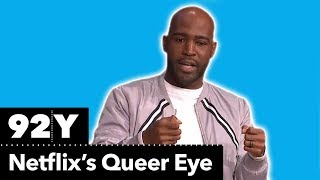
Karamo Brown traces toxic masculinity back to his Caribbean upbringing, where hyper-masculinity meant safety. He recalls a coach telling him to walk off a football injury and describes being the first openly gay Black person on MTV's The Real World, where he faced homophobia from white roommates. Meeting people where they are, he says, works better than hate in response.
Chapters
Actually, Karamo, so much of what you're doing on the show is trying to tackle toxic masculinity, and you've been very frank in interviews about how you had to overcome those demons yourself in your own journey.
100%. You know, I grew up in a Caribbean household. I'm first-generation American, family is Jamaican and Cuban, and the thing is that in my household, the more masculine I could present meant that I was safe. And that I could achieve whatever my brothers and cousins and whoever else could achieve. And I just remember always thinking, why do I have to present this way to feel confident? Why can't I just be who I am, whatever that means? And, you know, Jonathan brought up earlier, I talk about the intersectionalities of our personalities. We have so many different parts of ourselves, but yet society says check that at the door if you want to be successful. And that's why we have so many toxic men in the world, because they're told to check that. There's a story that I tell. I used to play football in high school, and the first time I got hurt, my coach said, "Don't cry. Walk it off." And I was like— like every bit of queen that was in me that I was suppressing was coming out. I was like— Karamo doesn't like any type of physical pain. I don't, at all.
I nearly killed him waxing his beard.
He did!
Like, we didn't even get— like, I had to, like, baby oil the wax off, 'cause he, like, couldn't— like, he wouldn't let me rip it off. I can't remember what happened.
But keep—
this is a good story.
But I was walking towards the locker room, and I remember on the track, there was a young woman that was running hurdles, and she got hit by a hurdle and fell. And literally, that same coach that was telling me to walk it off ran to her and was like, "Baby, what's wrong? Are you okay? Everyone—" And I was like, "Bitch!" Like, every bit of me was like— And those were the first reminders or the first inclinations that I had of this behavior is wrong and I have to figure out a way, whether it was on television, whether it was when I became a social worker and a psychotherapist, it was like I have to counter this behavior in a way because we cannot have future generations still believing this is the right way to behave. So when we hear that millennial young men have distrust in gay men, It's because there's a resurgence of that toxic behavior because there is no representation. And that's why visibility is so important. And us 5 showing up and showing up proud and loud and saying we are going to be here, but yet we are also going to love you, is how we're trying to combat that. Hmm. That's interesting.
No, I have to say, you've been on television for a long time.
Are you about to date me, hoe? Okay. I'm joking, I'm joking. I'm the oldest of the cast.
And also I'm like the only one that's allowed to really like make a thing about that. Like I can make fun of that, but like you can't really say that. I'm joking.
I know that's not what you're doing.
I know that's not what you're doing.
Like I can do it. I know the only reason is because I read a lot about The Real World. Yes. And so Karamo was on The Real World.
Give us some Real World thumbs up. I know.
And that also made you the first openly gay black person on reality television. I was. I am.
Yes.
What do you think, looking— I mean, looking back on that experience and looking back on the Karamo who was like doing the confessionals, what do you think of him? And because he's such a different man than the person who's sitting here today.
Oh, he was a train wreck. Are you kidding me? Yeah, he was. Oh my gosh, I was 22 years old on a reality television program, fresh out of college, and was like, where's the booze and the men. Like, there was nothing about that experience. All I wanted to do was get in hot tubs and, you know, and I had culturally relevant— hot tub, men. I had some moments on that show where, you know, my straight white roommates would make comments about gay men that forced me to then have to have conversations with them them, and they also made comments about race. And when I think back about how young Karamo handled that, I'm so thankful for the mentors I have in my life because they taught me that approaching hate with more hate is never gonna win the battle. And that was the biggest lesson I learned. And so as I've grown and I've matriculated through life, I've learned that listening is more important and meeting someone where they're at. So that I can have a conversation with them to reach their heart. Because if you spend your time trying to reach somebody's brain, it's already set. They're not going to have it. You reach their heart, and then they're going to change their own mind. So that is—