All the ways you can claim R&D Tax Credits and never realised
Karen Green hosts Alex from Advalorem on R&D tax credits for food and drink businesses. Learn which costs qualify: staff, materials, heat and light, subcontractors. Real examples include vegan reformulations, packaging changes, and new product development.
Chapters
Hello.
Hello, how you doing?
How are you?
I'm very well, thank you. How are you? Can you hear me all right?
We can, yeah.
You're a bit echoey, I'll turn you up a bit. We've had quite an influx of people certainly join up on Zoom. We've got 17 in now, which is a bit better than the 3 when I spoke to Steph yesterday.
Good, good. How's quarantine going? Are you alright?
Yeah, yeah, yeah, I am. I'm just, I'm still waiting for my day 2 test results, which still haven't arrived yet. They've just texted me to say, oh, we've just had your test, and I'm like, I sent it to you 2 days ago.
Any danger in a result?
Yeah, so I think there is a high probability on day 5, if they come looking for me when I've moved to Nottingham, then I might get fined, but anyway.
A few hundred quid, you'll be fine.
It's just money, just numbers on a spreadsheet. So have we got the presentation there?
Do you want to—
how do you want to test share?
Yeah, give me 2 seconds.
Just because 17 have joined doesn't mean anyone's going to turn up, but we'll run it anyway.
Share screen. So it says host disabled participation screen sharing.
Hang on.
All panelists.
All panelists.
That should be— you should be able to share now.
Yeah, it's now letting me. So let me— and then if I go to presentation, hopefully That works?
Yep.
Perfect.
Good, we've got one attendee, that's good. We're off.
Do you want me to take that off so you can do the intros, um, and then I'll share it up once we're ready?
Um, you can leave it up there, I think.
No problem.
Okay, so let's see if Fiona— hi Fiona! Let you speak.
Unmute.
Okay, everybody's starting to come on now. This is a little bit different to another one I've done where you kind of bring people in, whereas I think people are working out. I'm allowing people to speak, so please speak, Charlotte, Fiona, 2 of you at the moment, so not just—
There we are.
Gallery as well. Oh, that's starting to look like more like normal.
That's good.
You're coming on.
Super duper. So is it raining where you are? It's absolutely bucketing here for once in the UK. I can't go look at my lovely hot weather. It's freezing.
It's not pretty. It's not pretty at all here. It's windy, rainy.
Grey, miserable.
I've succumbed to putting the heating on, and I'm not ashamed to admit it.
I'm actually under half a duvet here, you just can't see.
The joys of a Zoom thing, you'd never be able to do that if you're doing it, you know, you're in a boardroom, just get a duvet over your legs.
Yeah, duvet out, get under jumpers. It's, um, yes.
Yeah, we're hosting a— we're sponsoring an event at Silverstone, so we're bouncing to Silverstone after this, and I do think The weather is— I've already had the influx of texts saying, can you bring umbrellas? Can you bring extra coats?
Can you—
When's the hot weather? When's the weather, like the heat wave, coming? We had it like last week. Okey-dokey, right, well, we've got, we've got 3 people on so far. I know a lot of people said they wanted to come along and can we record it, so we are obviously recording it. And hopefully that's all right with everybody. So what I suggest is we get started, and I have enabled everyone who's on to talk, so if any of you guys want to— another one going on— if any of you want to say anything, please do. If you can mute yourself during the presentation, that would be helpful, and we will get started. For those of you who don't know me, my name is Karen Green. I work as a food mentor with anything from people who've got an idea about a food business right up to multi-million pound food and drink businesses. I specialise in helping them grow and also work with Advalorem to help my clients claim R&D tax credits, and it's been very good. I think we've had 3 go through the process and make back a decent amount of money. And only yesterday Steve from Cossack Cuisine got in touch with me to say that he's just claimed— he's based up in Sheffield, did some R&D over lockdown, wasn't— I'm not really quite sure what he's done, but anyway he's got £9,000 back for it. So, you know, that's a decent amount of money either to enable you to carry on doing things and reinvest that back into marketing or even to plan for your next stage of MPD. So it's a great thing and I think it would be really— it's going to be really good today to understand exactly what you can claim for because I know when I first— I mean right back when I was working at Ichiban and then somebody said, oh, you can claim this, and I looked at it and went, no, we don't do any of that. And then we ended up claiming £60,000 but it's a much bigger turnover business but interesting. So if I could introduce Alex to you from Advalorem. Alex, do you want to tell us a bit about your background?
Yeah, definitely. So I started out as an accounts assistant here at Advalorem about 10 years ago. So I worked my way through our accounts department, became a fully qualified ACCA accountant, and I was a client manager for a number of years. Our then head of R&D left and she went and joined an industry. She went to work in the finance department of an industry presented an amazing opportunity to join the R&D team here. Joined the R&D team and quickly fell in love with it because I get to go out every single day and talk to amazing innovative business owners about the best thing they do in their business and all the great and wonderful innovations and challenges they're facing. And it was just really engaging and getting to talk to people about their passion projects. Absolutely fell in love with it and the benefit of helping them get some money back from HMRC for once instead of telling them their tax liability made it a much friendlier conversation to have. So yeah, I started running the R&D team 2 years ago, and since then we've grown about 5 to 6 fold. We've now got 14 members of staff dedicated just to helping people claim back tax credits and process about 500 claims a year for our clients. So it's really enjoyable. It's a great sector to be in, and HMRC have recently pledged to make it 3.2% of GDP by 2027. So we know scheme's looking to continue for at least another 6 years, and I'd be surprised if it doesn't go beyond.
Awesome, brilliant. So I'm gonna hand over to you. I know you've got some slides, so what we'll do is, um, if you want to go through the presentation, anybody who— well, I'll be monitoring the chat, so if there's any questions, um, feel free to interrupt. It's a small group, so we don't have to sort of sit here all quiet and good. Um, and, uh, yeah. Take it away, let's learn.
Amazing.
I'll quickly, before I start, just introduce my colleague Steph. So Steph is part of our BDM team, so as and when you guys reach out, if you've got any questions or want to think about how can we help you, Steph's going to be the, the person you'll talk to first and foremost, and she'll answer any questions you might have on that side. I'll let Steph cap off at the end.
Yeah, cool. Yeah, I'm the gatekeeper, you have to get through and then I'll let you, let you talk to these guys. So kind of our initial have a chat with you about what you guys are doing, if we kind of think there's scope there for R&D, and then we'll pass you through to these guys who will help you get the claim underway.
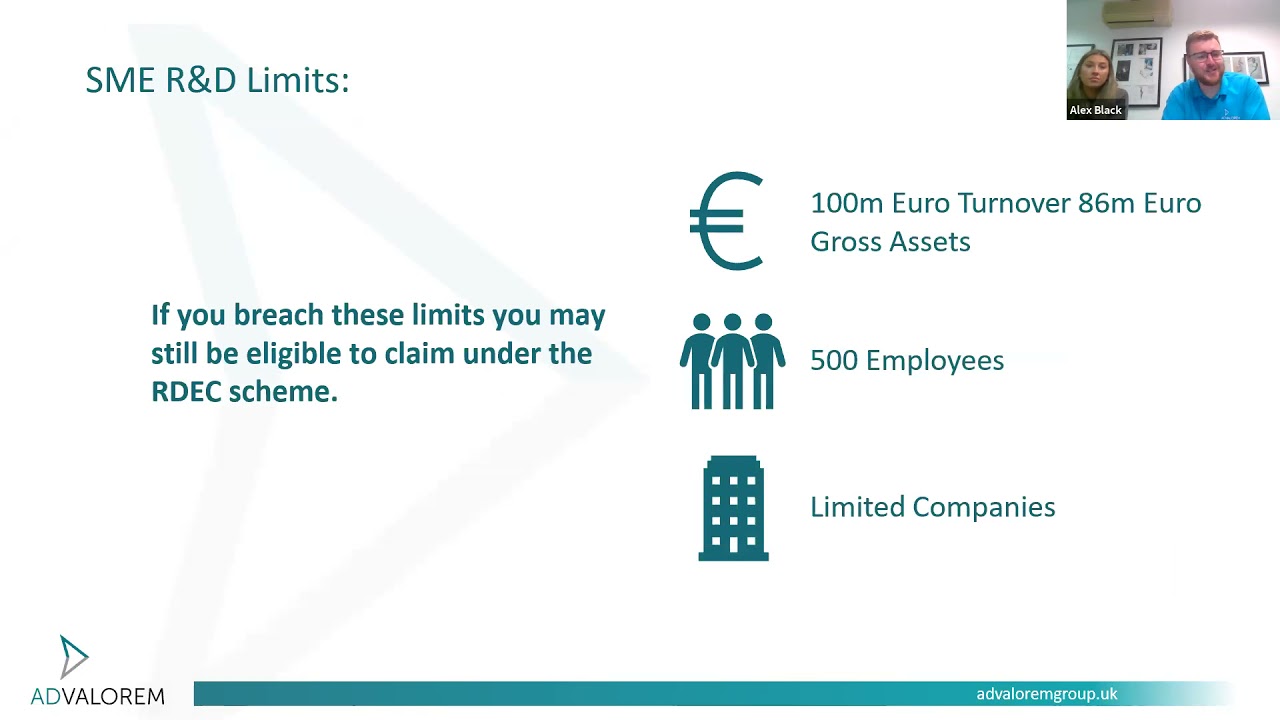
Perfect. So I suppose we start with what is R&D? It's nice and clear, HMRC make it, or as clear as they make anything. Effectively, HMRC's definition is any company that's seeking to make a technological advance, technological scientific advancement. In order to do that, they have to overcome technological or scientific uncertainty. I'll break down those terms a little bit later on, but they're looking to support companies that are innovating, looking at the status quo and saying, I want to do it a little bit better. I think that could be done differently, and this is why, and this is how. And it's really important— we'll recap on this later on— but it is seeking an advancement, so you don't have to have achieved it yet. So you could be halfway through a project. And it might take you over a number of accounting periods, or you could have actually failed a project and you've sought an advancement that you just couldn't achieve. That's not a problem, we can still claim for those costs. As I said, today focus primarily on SME businesses. So there are 2 schemes, and we're going to be primarily talking about the SME scheme today. Their limits for SMEs are extremely high. I've never seen such high limits in any other area of accounting and tax. So it's €100 million turnover, €86 million gross assets, so that is your fixed assets and your current assets added together, or 500 employees. If you breach any of those thresholds, then you'll go into what we call the large company or the ARDEC scheme. It's still— you can still make a claim, there's just slightly different rules and it tends to be slightly less beneficial. The SME scheme on average will let you claim about 24.7 pence the pound back that you spend. The RDEX scheme is about 10.8 pence on the pound back, so it's still worth doing a claim, it just operates very differently. If you've got any questions about that afterwards, please do not hesitate to let me know, but we're going to be going through the SME scheme today. The other important thing to note is you do need to be a limited company in order to make this claim. It is a corporation tax scheme, so it only affects corporation tax at the moment. HMRC have been pretty receptive to some feedback. So this is quite a new scheme in the, in the grand scheme of tax and how it works. It's been around for about 20 years, so compared to some of the other stuff that's been kicking around for significantly longer, it's quite— it's in its infancy. HMRC are still developing it. So there was a consultation document put out by them to people that claim it and to advisors such as ourselves that help people claim it on How could the scheme be improved? And we have levied a fair number of, um, points to them that how could they improve it, and one of those was to expand it to sole traders and partnerships, but that has not been done yet. Next question we normally get asked is what can I claim on, what are the costs, what am I looking at? Um, so it is based on your cost or your spend in the year, um, and there is a paid requirement. So as at the point of making the claim These costs must have been paid and settled. We can't just have outstanding invoices. The primary costs that we focus on are your staff costs, so your time, any of your employees' time, and we look to estimate their percentage of time spent in the period. So what we'll do is we'll calculate all of the employment costs from the payroll reports, and then we'll have a conversation with yourself to say, for a reasonable estimate, how much of this person's time is spent working on R&D, overcoming uncertainties? HMRC don't expect you to keep really rigorous time logs, normally because time logs for the purpose of your business won't necessarily match up with time logs for the purpose of R&D. So they will accept reasonable estimates for all of these things. And we've got multiple staff here that are more than qualified to help you go through what is a reasonable estimate, what kind of time am I looking at, and really break down on the day-to-day basis of your guys who did what and how does that qualify.
I think just to put a point in here which I think is really important, because I've got a couple of clients, and I think a lot of people are in this boat, who are not paying themselves because they're a director of a business, and one in particular has spent a lot of time doing R&D, but because they're not taking any money out of the business, they couldn't claim that chunk. Is that right? Is that something we should be thinking about?
That is, yeah, that's definitely correct. So when we say staff costs, the costs we're looking at are your gross salary, employers' National Insurance, employers' pension contributions, and for a lot of directors, they will have employer pension and separate director pensions set up. So where you're remunerating yourself primarily through dividends, unfortunately, we're not able to claim on those costs because HMRC deem them as a reward on investment rather than a cost of employment.
Yeah.
So it's definitely something we should factor in. We can do calculations, so where people say, this is how much money I'm looking to take out over the year, This is how much R&D I do. We've got, as I mentioned earlier on, we're an accounting practice, we've got an in-house accounts and personal tax team. We can help with calculations to say if you were to do it by dividend route, this would be the tax effect. If you were instead to do a salary or a large pension contribution, this is the effect and the tax effect of that, and this is kind of the outcome. So we can, in advance, we can help plan for that.
Yeah, because part of the point as I say, of doing this is to help, help you plan to claim your R&D tax credits, not just do it retrospectively.
Yeah, definitely.
I just wanted to get that point in because it's— I know it's been a problem for a couple of mine.
No, it's really important because it is one of those things that a lot of people see this as a retrospective claim or adjustment to a tax, in which in the first year it normally is. So within the first year of claiming, they are allowed to go back 2 accounting periods. So for example, if your year-end was July then today would be the absolute deadline for submitting your July 2019 claim because you get 2 years after your year-end date in order to get your claim in. So for example, if you've got an August year-end, you've got until the end of next month to do your 2019 and your 2020 claim. So in that period, you've obviously— those years have gone by and they're quite significantly gone by, so they are retrospective. We are kind of looking at what happened in that period and how we can do that claim, but we also work really closely with our clients to plan future years. You know, how should I be capturing my data? What, what, and we'll look at what software do you use, and is there a way that we can help enable that software, such as Xero, and has the ability to enable tracking accounts so you can start to track costs based on project if you so wish, and make it really easy at your year end just to run a report really quickly. These are all the costs I spent. So the other costs that are on this tab that we're talking about, especially within this industry, is going to be materials. So that is Anything that's consumed or wasted throughout the R&D process so that you couldn't resell on or that wasn't a usable product. So when you guys are trying, as Karen showed, on new product development and you make prototypes in different batches and you give them out for testing and even with packaging testing, all of that cost of those materials is wasted. You can't use it. So we can claim on all of those costs. Heat and light. So again, if you've got a space, a commercial kitchen, a space that you use for your research and development, we can look to claim a proportion of those running costs and any subcontracted costs. So again, if you're using food scientists or any external subcontractors to help you achieve your R&D, we can claim a proportion of their costs. Subcontractor costs are capped at 65%. So for example, if you had a subcontractor that was wholly for R&D and they charged you £100, the maximum we'd be able to include in the claim is £65. And the reason for that is that subcontractors can fall under the RDE scheme themselves, so it's to ensure that they're not claiming costs you're claiming on. So we cap the cost we can claim on so that they can claim the rest if they so wish. So I said I'd recap to the, um, the nice bit of what is R&D, the crux of, uh, the matter. So as I said, HMRC break down the scheme into kind of 2 main sections, which is advancement and uncertainty. They give us these extended definitions of advancement, technological and scientific advancement. So I will endeavour to break down ABCD into sort of layman's terms and give some examples. So A is talking about the extension of overall knowledge. So this is a theoretical advancement. This is extension of knowledge in terms of— a really good example in recent years is the COVID vaccine. You know, how theoretically could the new type of vaccination work? How would it attack it? They've not put any of this into practice. They've done a lot of research into how could this work in advancing the overall industry knowledge of how that might work. And I know a few of my clients in the food industry did similar stuff a number of years ago when the vegan movement was really big, and how can we replace some of these animal products within products with vegan products, and how would that potentially affect the consistency and the makeup of that product? We don't see an awful lot of that. I mean, most people will think of that as sort of guys in white coats in labs somewhere coming up with these new amazing things, and it's quite rare. It's quite expensive, it's quite rare, especially within the SME sector. B is the creation of something brand new, so never been seen before, a brand new material, device, product, service which incorporates or represents an advanced in science or technology. So again, these are the things that you think traditionally of when you think R&D. So this is going to be your brand new, never-before-seen iPhone, the first time it ever hit the market. Wow, that's phenomenal. Or an engineer somewhere making this new device that no one really understands how it works. Again, quite rare. We don't tend to see a lot of that within the SME market. Again, it's quite expensive to do, and they say there's no such thing as an original idea anymore. A lot of what we see actually falls into the next category, which is taking a known, what we like to call a baseline product, service, material, or device, and then putting an improvement above and beyond that. So an appreciable improvement on top of that product. So I mentioned the iPhone a minute ago. If you think about these subsequent iPhones, they're not brand new, revolutionary, never been seen before. They've taken a baseline concept of the previous model and they've tried to introduce some improvements above and beyond that, be it capability or spec of certain things. If that was deemed to be a technological advancement, then that would potentially be eligible for an R&D claim. So again, within the food sector, taking something that already exists and making it— potentially even making it vegan, as I mentioned earlier on, could be this, could be an improvement. We know what it looks like, we want to make it slightly better. Or taking some of those nasties that are involved in it out, that could be an improvement above it. We've made it— I think there's some buzzwords in a moment— we've made it more eco-friendly, more efficient to produce. healthier, all of these things where we're saying that's better than the baseline, then that kind of comes under that C category. So HMRC have got their 2 pillars of advancement and certainty. I like to add 2 more on top of that. So the other one is baseline, especially when we're looking at C and D. What's the rest of the market doing? What is the industry standard for this? And how have we taken that and kind of elevated it above and beyond? So number D, or letter D, sorry, is to— this is one of the hardest ones to explain, actually. It's to just replicate the effects of an existing material, product, or device, but in a fundamentally different way. So we know what we want to achieve. We want to replicate this, but we don't want to do it in the same way. We've got to do it in a fundamentally different way. I was trying to think of a relevant food example for that before this webinar. And I think the best thing I could come up with was potentially Coke Zero. So their advert was same Coke, same great Coke taste. I don't know if everyone quite agrees with that, but with zero sugar. So they know what they want to produce. They want to produce this product that's as close to their original as possible, but they want to do it in a fundamentally different way, taking out all of that sugar. So all of the R&D work that they'd have done to get there potentially is eligible under that D category. Has anyone got any questions on A, B, C, or D at this point?
Alex, hi, it's Fiona speaking. Am I allowed to just speak, Karen? Is that okay? It's really interesting. This seems as though it has the scope to be a much wider catchment than traditional R&D schemes, which are pure innovation as I've seen them. So is there a— do you submit to the tax office prior to starting it and saying we want to make an improvement, we want to do something. Karen's shaking her head, so, you know, I mean, it's much— it seems much more accessible than things I've had innovation grants for previously.
Yeah, so we don't tend to submit pre-applications to HMRC. There is a scheme for those that have never claimed R&D before, so it's their first ever time, and there are a few other criteria that make it a little bit more difficult claim, but there is kind of a pre-approval scheme. It's quite rigid, it's quite difficult to go through. HMRC don't really administer it themselves very well, so I've never actually seen someone go through that pre-app process because the accessibility of making a claim itself is actually quite easy compared to the pre-app and then the claim process. But there is that route for those that are either a bit more risk-averse or that have larger projects that are spanning numbers of years and they want to make sure that they've got that scope tied down first. And that is something we can help with if you're looking to do it. But what we do do as part of our claim, and again, we're not the only ones that do this, I've seen some providers doing, some that don't, is we put together a technical report. So we will go, we'll do an interview traditionally with yourself, either via Teams or now the world's opening up, we'd love to come out and see people. And we sit down and we will talk through what was the scope. So what was the original scope of the project? And we really try and zone in on, you know, if we're looking at B or C, C or D here, What was the baseline? What are other people within the industry doing? What's the readily available methods that are being used? And really try and understand that starting point. How are we going above and beyond that? What are we considering the advancement that our product is offering over and above that baseline? And really try to understand that. Then what comes into next is the uncertainty. So just making advancement on its own isn't enough. It's the uncertainty element is, could a competent professional So if it's, you know, in, in the development of new food products, could a food scientist, could, could a competent professional in this area have done that with readily deducible information? Could they have followed a step-by-step guide and got there, no problems? Could they have, you know, Googled it and said, how do I do this? And Google tells them and they can do that, no problems. Then there's no uncertainty in how you do that. However, if a competent professional within the industry says this is an advancement over and above the baseline, it's better than it was before, and in order to achieve that advancement, it wasn't easy, we had to do a bit of trial and error, we had to really look through different methods and try and pull some stuff from other areas and incorporate it into this one, then that's when we're really starting to look into the realms of making an R&D claim.
Okay, very interesting. And so you would, you would just do that as part of a end-of-year tax evaluation process, but you'd submit the claim but submit the supporting evidence simultaneously.
Yes, so there is a— they've actually just recently added—
Write it down effectively.
Yeah, so they've actually— up until this year it was just one box on your tax return that you put a number in. HMRC have added actually an additional section to the CT600 now, so there's a few more boxes to fill out. The statutory requirement only requires you to fill out those boxes with numbers, and they don't require you to show your workings or submit a report. We don't necessarily agree with that, and we think we've got an extremely low enquiry rate here at Havelore, and we like to believe that's because we provide all that information upfront to HMRC. So along with making the amendment on your tax return, we'd submit that technical report that we discussed earlier on, and we also submit calculations of how we've reached our numbers. So we break down all of the staff that we've included within the claim, What percentage we've included them at, any materials would break that down and show our workings there, and also any subcontractors to show this is why we consider this to be R&D. This is what our client has done. This is what was difficult about it. These are the competent professionals that are involved. This is why we consider it to be R&D, and these are all the costs we've looked at and the percentages and how we've deemed them eligible. We submit that as an attachment along with the CT600, and HMRC review that. Their turnaround time at the moment is approximately 28 days, and traditionally they'll ask questions at that point. So if they've got any concerns, as you raised, you know, the scope's a bit wider than what people traditionally deem R&D to be, they'll raise them at that point. They'll— can we have a bit more information on this or a bit more information on that? And at that point, if we haven't got that on the recording from the first meeting we had, if they had a really niche question, we would then come back to yourselves, gather that information, and provide that back to them. And we fully support the claim throughout the whole process of You know, from first meeting with yourselves through to you've got the money in your bank and HMRC are satisfied.
And so rejection rate or failure rate, do you— you've never had a rejection?
So yeah, touch wood, up to this point we're at a 0% rejection rate. We've got quite a rigorous scoping, and so we'll say no. So if we had a conversation and we've gone through and you said, this is my project, we, you know, we wouldn't say enough about— we'd find out more about it and go through those questions. But if when we got to the end of that conversation, it's normally about an hour, an hour and a half, if we didn't think there was a claim, or if we didn't think there was a claim yet, we would have that conversation with you and explain why. We think it's really important to be transparent at that point because you're trusting us to put this in for you. So we've got quite a rigorous process to make sure that we're supporting you as best we can before we put that into HMRC. Luckily, up till now, it seems to have worked. We've not had any rejections. But if there was one, we'd fully deal with that as well and fight back with HMRC.
Thank you.
Another question. Thanks, Fiona, that's really good to clarify. Will we— can I claim R&D tax credit for a product, a new product variety in existing— in addition to the existing range? So if you've got a new flavour or a new recipe, Does that count?
Potentially. So it's the question we always like to answer potentially. So it depends on the individual aspects of it. So if it was simply I've put a new flavour, so now it's chocolate instead of vanilla, and ultimately it wasn't that difficult to do, you know, you knew that if I added this much cocoa powder, I would get a chocolate flavour rather than a vanilla flavour. And although I've got a new variety, the uncertainty wasn't there, a competent professional within that that place could do that. If it was more complex than that and I've got a new flavor, I don't know, pick a fruit or a vegetable, and actually I couldn't just add that ingredient in, it then changed the viscosity and the consistency of my product, it started to mess with some other parts of it, and I had to really delve into how do I develop this, then there's a potential for a claim.
Yeah, cool. Okay, right. On we go.
So as I mentioned, there's a few buzzwords there. I mean, we try to put in as much as we can. Not all of these are definitely going to be R&D, as we just said there, but these could be some of the things that we're looking at when you're talking about that new product. Have we increased shelf life somehow? You know, have we got a new, better taste? Have we taken out some of the bits that people don't necessarily want to see in their foods anymore? And what kind of challenges did that present us? Was that easy to do so? And that also kind of ties in with the legal and regulatory change. I know every now and again they'll make changes as to what you're allowed to do and how you're allowed to do it. If we have to then redesign existing formulas and products in order to meet those, and that wasn't easy, then there's potential for a claim there as well. A big part in the food and drink industry that we've seen is packaging. You know, in the recent years, how can we eliminate plastic from our packaging but ensure our product is still presented and protected in the best possible way? HMRC don't accept cosmetic or aesthetic improvements to be advancements, so where there are cosmetic elements, we have to look beyond that as to to what were the challenges faced and were they technological or scientific. But I had a client that was doing Easter eggs and they wanted to completely remove, and this was a number of years ago, completely remove plastic. And they needed to ensure that the Easter egg, it was quite a high-end product, was still protected and wouldn't get broken, but without the plastic insert that you would traditionally see. And they did quite a lot of work on how did they do that. And it wasn't necessarily how it looked, but it was how did it protect my product. So we've got a few examples. I always find examples to be a good, a better way to get the point across than just talking through numbers. So we've got a few clients in the alcohol industry and they again have been pushed in recent years to do new and wonderful things. People are finding new and wonderful ways that they want their alcohol to be and to taste and to look. So these guys use unique ingredients. ingredients that I've never seen used before within the alcohol market, and the way they did it was just phenomenal. They had to go through so much trial and error of how does this interact with that, how does that then affect the shelf life and the distillation process, and all of these different bits. So just putting in a new ingredient had about, you know, 10 knock-on effects to other elements of the product that they needed to consider. So potentially the element itself wasn't necessarily complex, but you've kind of got system uncertainty of how does that work within the system of the entire product and how does that change all these other parts. They also decided, I believe this one is in gin, and they wanted to use fresh botanicals. So I know I'm not a gin expert, it's not my tipple of choice, but traditionally, I believe at this point people were using already taken extracts or distilled down parts of the product and putting that in. They wanted to use completely fresh ingredients. So in order to do that, they completely changed their distillation method and process, and they did quite a lot of trial and error on that. The final part of this one was a flute-necked bottle with a transparent stopper. So I've included this because it was a cosmetic advancement they wanted to achieve. It was more on brand for them. They wanted to have a very unique bottle design. And in and of itself, when I first heard that, I thought, that sounds great, but it's likely to be a cosmetic advancement. It's unlikely to be R&D. But when I went further into that project with them, it was actually the manufacturing process for the transparent stopper part of it. It was extremely difficult to do. They found suppliers and manufacturers that could do that on a very small batch run because it was handmade. But when they wanted to take that to a larger run and have that mass-produced, the molds just simply didn't exist in order to do it. They'd have had to invest and develop brand new molds in order to do that. And at that point, it was considered non-financially viable. But the advancement in that situation wasn't actually the look of what it was, but it was how do we take that and mass-produce that? How do we improve that manufacturing process? Second one, and I won't spend too long on it, is a fizzy milkshake. Normally when I bring up fizzy milkshake, most people kind of go, oh. I'm not quite sure why they wanted to make a fizzy milkshake, but they did. And they did probably more work than I would have done on how to achieve it. And pretty much every single iteration failed because, as you can imagine, when you try and carbonate milk, it doesn't go too well. And most people don't want to drink it. So the reason this one's in here is it was a complete bust. The project failed and they never achieved what they were setting out to achieve. But they did spend a fair amount of money along the way and we were able to help them recoup some of their losses via an R&D project. I've got a couple more on the other side. As I kind of alluded to earlier on, there's been a big movement in recent years for veganism, vegetarianism. I know one of my clients is a bakery, family-run bakery, been going for 150 years, and they completely redesigned their entire product line to be completely vegan. So they actually achieved a vegan sausage roll before Greggs did, but they had nowhere near as good publicity about it. And going through with them and sitting and talking about it is when you take those animal products out of it, you completely change your melting point. You completely change your consistency and the texture of your food. So it's not necessarily about making it the taste or improving taste, because that can be quite subjective to say this tastes better. But to take those integral parts of either a sausage roll or a cherry Bakewell out of the process, achieve the same outcome, so people, when they bite into it, can't tell the difference by using vegetable products was a massive amount of work. And trying to get there, they had some long nights and I think he pulled a few hairs out. So they tend to be the best moments to kind of spark your mind for R&D. What were the biggest challenges I faced? What were the biggest pains throughout the year that really kept me up at night? And they tend to be what I like to refer to as spikes. They're the kind of parts of that product development that probably contain the most R&D. Just over to the right again, more of the same, similar, but massive things we've been seeing in recent years is to kind of take out palm oils due to their environmental impact, sugar and salts. And again, how do we go through about replacing those to ensure that the product's still to the same high quality and standard? How do we maintain shelf life? I know one of the ones I worked with Karen previously, there was a massive focus on having a clean deck. And it was one of the underlying principles of the entire company and the product. So to try and make sure that we've got a viable product that Tesco will put on their shelves and will stay there for how long it needs to, but without compromising the ethics and morals, is a massive, massive undertaking. I'm going to go on to some numbers in a second to show you how it can transpose into monetary terms. So has anyone got any further questions at this point? point on any of the examples or anything they're thinking about would disqualify? Not a problem, we can recap at the end. So numbers, again, I tend to split most people down the middle here. Half the people are going, oh, this is what I've been waiting for all along, and the other half of you go, oh, there's a lot of numbers on that screen. Steph tends to be in the latter half. So I've tried to— I'm an accountant, as I've said, for my sins, so I'm not very imaginative when it comes to numbers. We've used nice round numbers to try and make it nice and easy. So the same company across 3 scenarios. So no R&D, they've made a £500,000 taxable profit in the year, that gets charged at 19%, and they end up with a nice corporation tax liability of £95,000. Same company, but this time they've spoken to us and we've identified £100,000 worth of qualifying R&D spend. So we've gone through all of their staff, we've allocated eligible percentages, worked out how much of their time they spent on R&D. We've gone through all of their materials— what did they use, what did they waste— put that in. Any subcontractors, heat and light, um, you can also claim on, um, reimbursed travel expenses. So if your staff or yourself are putting in mileage claims, we can look to include that within the claim as well. Um, it doesn't tend to make the biggest difference, but every little helps. Um, And we've come up with this nice round number of £100,000, which would be lovely if it worked out that way sometimes, make the calculations a little bit easier. So they spent £100,000 on their R&D during the period. That £100,000 worth of cost is already taken into account when we calculate their £500,000 worth of profit. But what we're able to do is enhance it. So the scheme allows us to deduct or to multiply that number by 130% and then deduct that that from your taxable profit. So in this example, we create an additional £130,000 worth of costs for tax purposes, and that comes off of their taxable profit, giving them a corporation tax saving of £24,700, meaning their new liability that they've got to pay HMRC is £70,300. If we were doing a retrospective claim and they had already settled their liability of £95,000, we then put in the claim afterwards as an amendment. HMRC would refund them this £24,700 plus interest. So the benefit they yield is that. Now, a lot of companies that are in pure product development or have just started up don't tend to be in profit-making positions. They're investing most of their money into new, you know, new product development. It's quite costly and they're not making any money off of it yet. That's one of the rare— R&D is one of the rare schemes that allows you to benefit even if you're not paying corporate or any tax to HMRC. So what you can do is you can surrender your losses for a tax credit, which is effectively a cash repayment from HMRC. So same example, but this time they're making a £500,000 loss. They've still got £100,000 worth of eligible expenditure. We're still able to uplift that by £130,000. And now what we've done is we've just enhanced their losses. They're now, for tax purposes, £630,000 loss-making instead of £500,000. However, the scheme allows us to surrender the lower of the loss in the period or the total enhanced R&D, which is the 230%. So in this case, the £230,000. And what we can do is we surrender that loss to yield a 14.5% tax credit. So you do take a 4.5% discount. You could instead choose to carry those losses forward and offset them against future profits, or you can choose the cash benefit now. If this client was— and I would say 99% of my clients always go for the cash benefit, and for an SME entrepreneur, cash is king, and they tend to need that money to reinvest into their development. So they take that cash benefit, and what that yields them is a £33,350 cash refund from HMRC. So even if you're loss-making, you can still benefit from making a claim. Does anyone have any questions on the numbers at this point?
Yes, please. How can I help? Sorry, fascinating. So I would have assumed that in a standard operating model, all of your R&D expenditure would have been above your adjusted taxable profit already.
Yeah.
So you've already used it to reduce your taxable profit at £500,000?
Yep.
So you're then effectively doubling it because you're bringing it below that line and doing it a second time. So if it's— so you've got that £100,000 that you've already taken before the £500,000?
Yep.
So what you're then saying is that you're entitled to £130,000 and £130,000 at 19% is £24,700?
Yes.
Fantastic, which is why in the third model you've got £230,000. Why is that? Because you've already got the £100,000 in the half a million losses presumably Yes. If they've got another £100,000, you're saying it a second time, and then you're saying it a third time.
So in the third model, because there isn't any corporation tax benefit, you've not received the benefit of that, that original £100,000. So normally it is taken into account in this £500,000, but because you've not got a corporation tax liability, you've not actually had any benefit at that point. What HMRC— so what we do is we take that £500,000 loss, as you rightly said, which includes the £100,000, we add the additional £130,000 of costs onto that, which gives us this adjusted loss of £630,000. So that number has already got the £100,000 in it, we're not counting that again, it's just been adjusted for the £130,000. What HMRC say, because you've not yielded the benefit of that at the moment because you're loss-making, you can surrender up to either the loss in the period or the total enhancement, so the £230,000, so the original £100,000 Plus the enhancement of the 130, so to allow you to get the benefit of all of your R&D spend because you've not been able to do it yet. What that does mean is you wouldn't be able to carry that 230 forward, you wouldn't get any future benefit off of it, so you're kind of forfeiting your right to getting that at 19% later for 14.5% now.
But they're then writing you a cheque at 19% of 230, and so you're getting some income?
So it's 14.5%, so they'll write you a cheque for 14.5% of £2 million.
Hence it's £33,350.
Thank you.
Okay, lovely. Okay, really amazing. Thank you. No problem.
No, it's always the most benefit.
Sorry, 14.5%, thank you. Are we getting copies of these slides, please?
More than happy to issue these.
Yeah, we will issue the slides and we'll also put the recording Boarding up if you want to go back to it.
Terribly helpful, thank you so much.
Not a problem. So yeah, so when someone's loss-making, again, when you're in your first part of business, your infancy of setting up, you tend to be loss-making, you know, for that first while you're developing your product. So it's really useful that you can get the benefit of that scheme in that period to help you reinvest into your development. The only caveat I would put in here is recently, so in the last budget, April 2021, The HMRC, the Charge Rate Checker, introduced a cap on that tax credit part only. So they have— oh, I've gone one slide too far, click, click. So on that tax credit part only, that £33,350 in the last example, they have capped that now at £20,000 plus 3 times your annual PAYE or NIC liability. They primarily introduced this to affect software claims, so where software developers are setting up new companies here, they're outsourcing all of their development work to Porto in Portugal, they don't pay any VAT, any income tax, any corporation tax, and they were claiming very large tax credits from the government. To try and combat that, they've, they put in this cap to encourage employment within the UK. So for this example, with that company in the third part, in order to yield the benefit of that, that £33,500 the £33,350 benefit, they would need to have at least approximately £4,000, £4,500 worth of PAYE liability in the year. If they didn't, then they'd be capped at whatever their PAYE liability was times 3 plus £20,000, and the rest would have to be carried forward. So they don't surrender it or lose it, it just caps the amount you can get back as a credit.
Really clear, thank you.
Not a problem. I'll pass back over to Steph now. This is the nice—
The pretty bit. So it's just to kind of reiterate, obviously we've been doing this for a number of years now, and kind of looking at what we're doing here, we've managed to secure £22 million in R&D tax credits year on year. So for the benefits for the companies that we're working with, that's kind of the amount of money we've managed to get them. back from HMRC. Again, to reiterate what Alex said, doing approximately 500 claims a year and climbing. I'm very aware that it's climbing, but we've had a 100% success rate, touch wood. Everything's great and we've got a 0.5% enquiry rate. And although Alex said obviously we've had no rejections, we obviously, the enquiries that we have, we manage and we've managed to keep that at such a low percentage because of the reports that we do and submit with. And how we work is we're fully success-based. Until you see any benefit, you won't see an invoice. So yeah, any questions on that? I know they're kind of pretty self-explanatory, but that's kind of how we're doing over here.
So do you apply a fee scale? Steph, against the credit benefit that an organisation has?
So it's not on a scale, we kind of, we're completely black and white, we look at a percentage of the benefit to yourself and it depends on kind of how many years you want to engage. If you know that you've got definitely 2 retrospectives to look at and you know that some of those projects are now in your current year as well. So we could look at a 3-year engagement and we'd obviously have those commercial conversations, but it would be a standard percentage. It won't be based on— we won't get to the end and say, well, you got X amount, so we're going to charge you this. It's a standard percentage from the beginning.
Okay, and what is that, please?
So it's very dependent if you're doing single year, multi-year. Um, our standard terms are 25%. However, when we're looking at multi-year claims, that, that does change and go lower, but it would be dependent on—
Fine, no, that's fully justified. You're doing the work, that's great.
Thank you.
Perfect.
Now before I let you lovely people get back to your Fridays, has anyone got any other questions they want to ask me or go through?
It was really well explained, thank you. Thank you, Karen.
That's okay, it's a pleasure. If obviously, if you want to work with the guys, You can get in touch. Here we go. And yeah, just get in touch with Steph and Steph can sort that out for you.
And like Alex said, more than happy to come to you, more than happy if you just want to pick up the phone and sense check anything, more than happy to have that conversation.
Yeah, it's well worth it. And if you've got any questions about it, obviously drop Steph or me a line, and we can help sort stuff out because it's a tremendous opportunity, but I think, you know, I'm a great one for doing DIY, but for something like this, I honestly, you know, I honestly think it's— you need that skill because certainly, as I say, when the first time I did it with Ichiban and I looked at it and I went, nah, and the amount of people that turned up and things like, as you say, a percentage of the rent or making sure that you're paying yourself so that you can claim it back coming forward rather than waste all those hours. There's quite a few little top tips that I've taken out of that to help clients get ready because, you know, it's— the government are doing it deliberately because they want you to do R&D, they want you to create, but I think certainly it's a great time also for most businesses who are usually probably 12 to 18 months old who can put the first claim in, great time to get that cash because then we can reinvest that into getting more and doing more commercial and marketing. So we have vested interests. Okay, super job, thank you so much. Thanks for everyone coming on. As I say, we will email out to everyone these slides and the recording, and yeah, get in touch. Thank you very much, Alex.
Hello, Karen. I asked one last question. Is there a time limit for claim, or is there like— because initially I think they would normally say that you have to be a new company operating within a number of years to be eligible for claims. So I wanted that clarification.
So there's not a time limit in terms of how old your company The time limit rests on whether we can amend the corporation tax return. So as I said, you've got 2 years effectively. So if your year-end period was July, you've got 12 months from July to submit your corporation tax return, whether it's got R&D on it or not, and then you've got a further 12 months after that to amend it. So we have to operate within those timescales. So if your year-end was July, this month would be the last time we could amend the July 2019 return. So if we wanted to work on the 2019 year, we'd have to do it very quickly. However, you know, your 2020 and 2021, you've still got quite a lot of time for.
Okay, thank you.
Sorry, can I ask, how soon can you put the application in after your tax return? It's as soon as your tax return's ready. So when your year-end passes, if you've got a very proactive accountant and your books and records are all up to date, they can get your statutory accounts accounts together, as soon as your statutory accounts are ready to be filed, you can submit an amended corporation tax return with those. So it can be done, you know, I've got some very enthusiastic clients that work with us on the account side as well, and it's been done within a few weeks of their year in passing. Right, brilliant, thank you. And it takes HMRC at the moment approximately 28 days to process a claim and about a further sort of 10 working days to repay out, so you can have the cash in your account within about 6 to 8 weeks. Oh, that's very quick. They're pretty— they're really pushing for this, they really want to help drive innovation. I think, you know, the Chancellor said in their latest statement they're going to try and innovate their way out of our current financial situation, that they're looking to invest in SMEs to kind of do that. Excellent, thank you.
Anyone for anything else?
No?
Awesome. All right, thank you very much, guys. Thanks for everyone. Have a fantastic weekend.
Thank you so much.
Thank you.
Bye. Bye.
Thank you.
More from karen



Why Selfridges Said Yes | Megan Tan on Supermarket Listings & Retail Strategy