Working with supermarkets Aug 2023
Karen Green, a former Tesco and Boots buyer, walks food brands through getting into supermarkets. She covers the BUYER framework, how to reach buyers with data like rate-of-sale, negotiation tactics with concrete UK margin ranges, and the critical first 14 days after launch.
Chapters
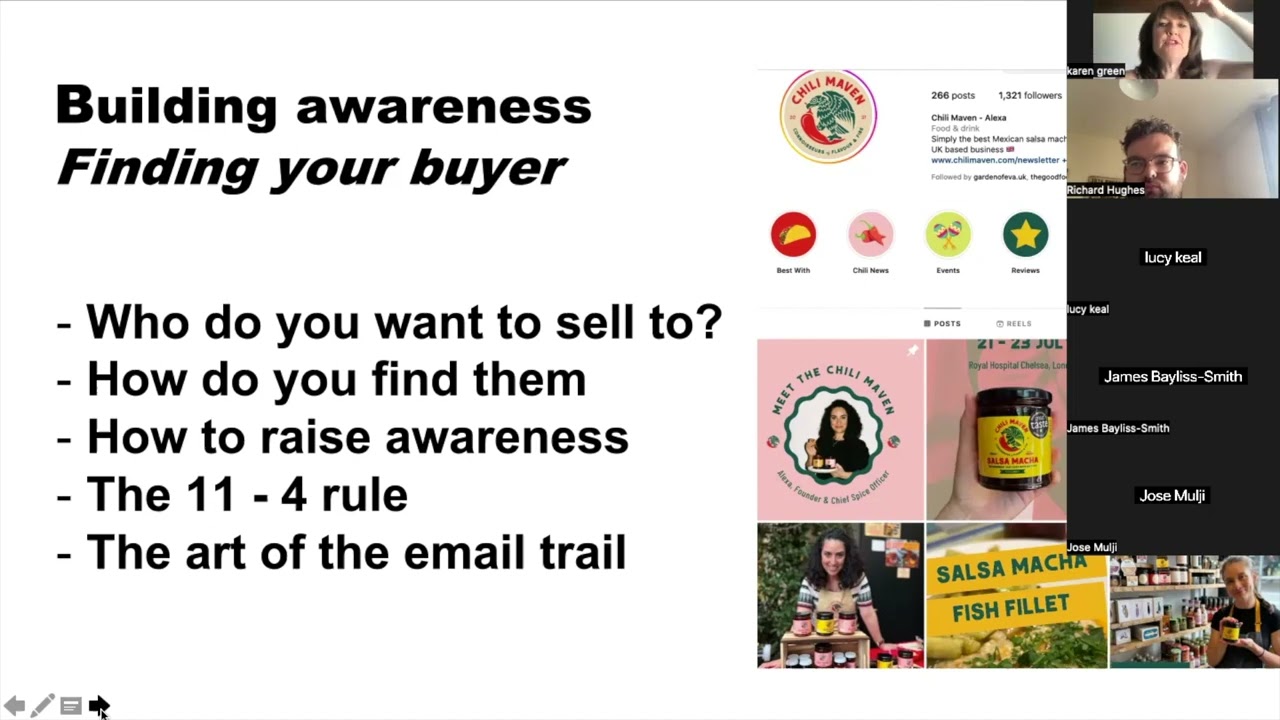
Working with supermarkets, tips, trade secrets, and what you might miss. This is really targeted at all of you, whether you've got a listing, whether you're thinking about getting a listing, or whether you want to expand your business. I think it's relevant to all of you. I know a lot of you on the call, but anybody who doesn't know who I am, Karen Green, obviously. I started life as a buyer with Tesco's. and Boots. I then moved across the table to be commercial director, well, actually a national account manager to start with, and then commercial director, most latterly for a sushi company. Now I work with food and drink companies, helping them increase sales. I've written 2 books, Recipe for Success: The Ingredients of a Profitable Food Business and Virology. And I speak at various events. I'm also currently the UN International Trade Centre's UK sales advisor, which does take up quite a big chunk of my current availability. And I will be at Speciality Fine Food in a few weeks' time, 6 weeks, I'm told. So if you want to come and say hello, I will be on stand 1340, but obviously I will send out more information about that as we get closer to it. But That's my next trip. And again, for those of you unaware, I actually live in France. I don't live in the UK, but I am in the UK quite a bit. Okay, so what are we gonna do today? As I mentioned, I have a— I've got 2 books, but my book that I launched this year called Buyrology has a fairly simple process of selling, which counterintuitively I actually call the buyer process. And it's the 5 Steps to Retailer Growth, and that's for your brands. And that's what I want to take you through today in terms of working with supermarkets. I think supermarkets is a little, maybe might be a bit misleading. So it's UK retail. So that might be supermarkets, it might be even relevant to independents, but maybe slightly less so. It can be the big grocers, but it could be somebody like John Lewis or Whole Foods or Selfridges, all of these are relevant, the principles are relevant. And obviously, if you want the book, there's the QR code. But let's just think about, well, what is the buyer process? And when you're selling, you wanna think about, well, how is the buyer buying? And that's the whole point of the book. That's the whole point of the structure of what I, how I work. So the most important thing to me, if you're looking for new, and, you know, there's 4 of you you haven't got retailers at the moment is building awareness. And I'm going to talk about that in some detail in terms of how do you build awareness. And it's important to keep going. So even if you've got a listing, keeping that awareness, keeping top of mind with buyers is really important. Then we'll talk about unique value proposition. So that's the U in BUYER. And each of those words is absolutely critical in terms of making sure it's unique and it's unique and tailored to the retailer that you're selling to and the buyer. The value that you're creating and the proposition and how that proposition is actually supported. The why is obviously for yes, we want to get to yes, we want to get those listings and we also want to develop that business as well. So I'm going to talk a bit about within the yes of what do you do once you've got the listings, is there an opportunity to get more out of it whether it's distribution, new SKUs, that's etc. The E is probably the most critical part, which is execute well. I heard the phrase launch and love a few weeks ago, and I just, it's my favorite phrase for executing well. And I think it's really important, and I want to talk about that again in detail because if one of the things we're really guilty of is putting all the effort into generating the new business and not necessarily looking after the existing clients, or customers or supermarkets. And it's the same, I think, across the board. We tend to think about, well, what's next rather than actually growing the business. And your, I was gonna say, the lowest cost opportunities are the customers you've already got, whether that's direct to customer or listings. So execute well and then review and repeat. And again, if you've got listings, this is really critical. And even if you haven't got listings, getting existing customers to review is really beneficial. So we'll talk about that. So that's the kind of structure of what I want to take you through. There's a really great article, and I will send it out with the notes actually from this. So I will share the slides, and it was in The Grocer about a month ago on how to get new product development listed actually in supermarkets. So I've shamelessly cut and and pasted some of the quotes, but if you go to the article, it is actually really interesting and there's a lot more in it. But the one, the first one that I really liked is from Ben, who he is now at Viper. So Viper is, it's quite a good research tool if you want to get some information about what people think about your brand fairly easily, and it then gives you some statistics and some numbers to use in building your presentations. And so what he was saying is this is about getting the buyer's attention. Consider multiple touchpoints, have creative methods. So, you know, you can do the emails, you can do the calls, but it is like advertising. And, you know, people say, and I use the 11/4 rule, which I'll talk about in more detail in a minute, but someone has to see you 11 times from 4 different locations or before they actually do anything and before they engage. And I think that's critical. And in fact, let's— we'll dig into thinking about that now. So the first thing you want to be thinking about is who do you want to sell to? Because one of the important things is from, as I'm sure you're all aware, from a marketing point of view, You cannot sell to somebody until you know who they are. And I think the, the more work you do on that buyer avatar is really important, whether that's the consumer, but more importantly, what we're doing today is the trade. So who do you— who are the key buyers? Now, I've had a couple of people, um, I've been working with recently who, who are waiting for the buyer of their choice to come back to them. And I've kind of said to them, look, you really do need to have a plan A and a plan B, because whilst we do want to have a really good target and a strong strategy, the strategy is only as good as its delivery. And if your strategy is, say, to be, I don't know, listed in Tesco, let's go straight to the top in terms of number of outlets. and they don't answer, or they're not gonna do a product review for maybe a year, then you either sit there and wait until they do the product review, or you actually do other things. And for me and most of the clients I work with, we want to generate some decent sales. So I think you do need to think about your plan A, plan B, and plan C. But the first part of it is, who do you wanna sell to? Who's, who's on that list? And then how are you gonna find the human if the human is findable? So I, I sort of say that because again, I'm, I'm doing a lot of work for the UN at the moment, and we are, we've got a number of different chocolate brands and a chili company as well. And it's kind of like sometimes it's easy to find the buyer and sometimes it isn't. But I think if, if you have that hierarchy of saying, right, well, these are the retailers I'd like, this is my sort of plan A, these are my plan B, these are my plan C. If I can, if you can find the names of them, great, because it will make that awareness raising a lot easier. But if you can't, then just bear in mind the retailers that you're looking for and really start to think about, well, how can I target people who work for those retailers? And then it's a question of, we, I mentioned the 11 to 4 rule. So what are gonna be your 4 sources of information? Where's the buyer going to see you? So let me, let me give you an example. I've actually put Chilli Maven here. So Alexa is a client of mine. She's, she and I have been working together for quite a while. She makes salsa matcha and she is out there. She's not currently in any major retailers, but as we will discover, she, she will be shortly. So basically she's got Instagram, she goes to a lot of festivals, she's got a mailing list, and she does do some collaborations. She's also in a wholesaler. So there are 4 or 5 different places where she could be seen. She's, she's very proactive in, in working with people like the Hot Sauce Society and building up that awareness. She's also lucky because she's in a marketplace that's really of interest. Pardon me, Kantar came out and said that Swicy, which is sweet spicy, not that she's particularly sweet actually, was, was gonna be a thing. Chili matcha, salsa matcha is gonna be a thing. So she's in that, in the right place at the right time. So right product. But because she's been working so hard in raising the profile of salsa matcha, so she is Mexican, she, she could make other Mexican products, but she's quite focused. She's actually been proactively approached by 2 buyers. So this is when building awareness and fairly close together, actually. So this is where building awareness really is quite interesting. I'll be honest, I've probably come across it 5 times since I've been doing this, and this has happened twice in the space of a couple of months. So we're obviously starting to do something right. And You kind of, and I just wanted, I wanted to mention it because I think sometimes, and I'm the same, you know, I post on LinkedIn fairly regularly. I send out my mailings, I do webinars. And sometimes you do think, is this actually doing anything? Is it actually worth it? And then something will happen and someone will say, oh, I saw you on LinkedIn or da da da da da. And you go, yeah, it is. Yeah, it is. It's working. And it's really good when you can see examples like Chilly Maven of how it really works. That is obviously, as I say, the rare, the rare example. The majority of time you are going to be out there, you're going to be promoting, you're gonna be building awareness, and then at some point you are going to have to take the plunge and say, right, well, actually, I'm going to send out emails. How many of you on here actually had any— well, either went to Bread and Jam And secondly, did anybody get any pitches? Because I think that's quite interesting. No, Richard, you're shaking your head. Because we are now 2 weeks on, I think. Fiona's saying, yes, I got to pitch. They got one with Cresco. And I suppose my next question is, have they come back to you and have they followed up? Because certainly the clients that I've got who had pitches, I've— we had 3 and not one of them has come back to us. Oh, we've got lots of pitches coming through. This is good. Excellent, Hayley. Well done. You actually went out and were proactive. That's really good. WHSmith pitch, no response. GoPuff have been very responsive. Okay, good. So, so there's a mix there. And I think— You're waiting to hear back from a buyer next week. Yeah, I mean, that is part of the problem with Bread and Jam. It was in the, in the holiday season. So And Rebecca, you're saying one hasn't contacted back. Yeah. So it is, it is a mixture. And I think what's, what's interesting about that is if some, if you're getting that reaction, if you're not getting anything, it's what do you do next? And I've just been working with somebody. Yes, was it yesterday, day before yesterday? And we've been writing a series of emails. So Obviously we're not gonna send them, we're not gonna automate it, we're not gonna put it into anything like HubSpot and just make, because we want to be a little bit more in control of it. But basically, if you have done a pitch or even if you haven't done a pitch, what are you going to say? So say for example, and you know, let me use my real example at the moment where I'm talking to chocolate wholesalers. I want to get into CLF. I've written CLF an email. What am I gonna do next? He's not replied. what's the next one? And what I'm doing is I'm scoping out, you don't have to go too far, but at least to say, well, what am I gonna do? So if nobody, if they don't reply, so we're 2 weeks after bread and jam, what are you going to send to them next? And my belief is that there should always be something interesting and new that's relevant to them that's going to support your products. So for example, good timing, good example is Great Taste Awards. If you won a Great Taste Award this week, there's something that's a great, that's a gift. Go and talk to, tell them about that. Say, oh, haven't heard from you, got the Great Taste Award. And then depending what the action was from your meeting, you could say, you know, did you get my samples? Shall we fix a meeting? Et cetera. So even though you're, you're, you're doing what I call a light chase, you can still, you still need to put that call to action in. So that's the first one. Then a week later, follow up with something else a week later, and I would probably do 3 to 4. And then if I still haven't heard anything, I would probably do what I call the breakup email. And those of you who've worked with me or, or been to some of my things before will know I'm quite fond of the breakup email. Um, and it depends on, on the situation, it depends on the interest, but I would say something like, oh, I haven't heard from you, um, I assume you're not interested. It's fairly, fairly brief. And actually, um, if you Google breakup email and HubSpot, they have some really good suggestions on how to write a breakup email. And the point of it is to say, well, actually, I'm gonna get back in touch with you, but I'm gonna leave it. So your breakup, you could say, you know, I'll get back in touch in 3 months, because what it does is it actually gives you the opportunity to go back because you've actually created that for yourself. But it also means that the— that you'll Not hassling that person. And what often happens in, probably in my experience, about 50% of the time, you'll get a reply. And it may well be good. I'm glad, you know, I'm, I'm not ready to talk to you now anyway, or something like that. But you, that's a good way of stopping them ghosting, because ghosting they will, and it's, and it can be quite frustrating. Okay, so That is the first layer. So we're building awareness and the next piece really, this is a really good point and I think we forget the fact that the buyer has in a lot of cases to sell the product internally. So a lot of retailers say, oh yes, our buyers are all, you know, empowered and they can do it and, you know, they make their own decisions, but In a lot of cases, they— that might not be the case. They may well be doing a major review of which you could be one of many products. It might be a one-off, and they just— they need the information that they love you, but they need to go to their boss or go to the, the whatever the review panel process is, the internal stakeholders. And so what Isabella is saying is absolutely right. You need to give the buyer both for their own peace of mind but also for internal some robust data. And if, you know, there's 4 of you here who haven't sold in retail before, don't worry about that. There is— we can always create robust data in various forms. And if you're still at that early stage, it's probably worth thinking about What can we do? So that's a piece of work that I do with clients is actually sit there and say, right, okay, so if you want to be in Tesco, so let's keep using the Tesco analogy because it's kind of in most cases a long way down the line. What are the building blocks that you would need to get that Tesco listing if that's your ultimate goal? So the building blocks would be you need to be able to demonstrate that you could I don't know, do in food to go, you could do a rate of sale of 50 a week. So how could you prove that? And so you then take a step back and you say, well, actually, I probably need to be in some other retailers so I can show that. So then you get some independents and you actually work with them and you look at how you can increase your rates of sale with those stores. Or if you're already in Whole Foods or Planet Organic, use that data to extrapolate and so on and so forth. So in Chilli Maven's case, we have been asked, what is your rate of sale? And in fact, we've— I've got another client we've had the same question from for as well. So we've had to sit there and go, okay, well, we're in a few independents, let's have a look at the data and have a think about it. And I think we've probably under-egged it actually rather than over, which is not a bad thing. So What I want you to think about is what makes you unique, and that's probably relatively easy. But then why is that relevant to this buyer that you're talking to at the moment? Because, you know, you might be talking to Tesco's one day, you might be talking to Selfridges another, and you've got to tailor that information. And we talked about The value. What value are you bringing to the party? So again, this, this doesn't necessarily have to be sales or profits. It could be footfall. You know, if you've got— I've worked with a couple of clients who've got massive direct-to-consumer exposure. So you, if you've got that, great. If you've got huge amounts of Instagram followers, that's another opportunity. Are you bringing something that's completely different to the category which is going to overhaul their category? Is it something where they are weak in this category and you know that you could strengthen it because you're in another retailer and it's working really well? There's all sorts of different permutations and it's worth thinking those through and saying, well, actually, which one is going to be relevant to each buyer? Because it will vary. And then how do you support that. So I've put Amelia here. It actually came from when I did the joint— I did a joint presentation with Kieran from North Star, and she's worked with them buying data. You know, this is slightly further ahead. So they're obviously listed in a number of different retailers, and they wanted to grow their business, and they were buying the data. The investment in something like North Star, you're probably looking at about £500 a month. So it's a It, for some of you, that's gonna be too much. For some of you, that's not bad when you consider that a full gamut of Kantar data would probably be about, oh God, 60-odd thousand. So it's the North Star stuff's fairly accessible, but it depends what level you're at in terms of sales and how valuable you think it's going to be. You know, it's In the smaller retailers, I don't think it's that critical. With the larger ones, you know, if you walked into Selfridges, it probably wouldn't be that— it definitely wouldn't be that important to them. If you walk into Tesco's and you're proposing, you know, you want a number of chunk of stores, it probably would be worth having a look at, because at that point you're going to want to be at that level anyway in terms of funding for other things. And then the last thing I sort of snuck in here because I wasn't quite sure where else to put it is about exclusivity. We are with a couple of my clients at the moment facing exclusivity requests, and it's quite difficult to navigate through them. So for example, Sainsbury's Future Brands team ask for a year's exclusivity. Selfridges like to be first to market, but they're not bothered, you know, if it's just for a week or so. And it's one of the questions I get asked a lot actually with clients. Oh, they've come back and they want some exclusivity. So think about what permutations you can offer and actually try and preempt it. So examples, you could obviously have complete exclusivity of the brands. That's really hard to do and expensive unless, say for example, they're looking for 3 to 6 months and you, and it's with I don't know, exclusivity in grocery, and you haven't got anybody else you're talking to, it's not going to cost you anything to give them 6 months exclusivity or 3 to 6 months exclusivity because you're pretty unlikely to get another retailer listing in that timescale. The big guys, you know, the Cadburys and the Mondelez of these— of this world tend to think about— they'll develop a specific SKU, so it might be a specific flavor, a specific size, a multi-pack, an outer case. Think about something that's going to make it interesting because all of these retailers need you to come to help them create a destination shop, and that's why they're looking for exclusivity. But what you don't want to do obviously is cut off your opportunities, because ultimately what you'll find is if you do have your Plan A, Plan B, and Plan C, and you do all your building awareness, and you do your outreach, this, it's, it's really bizarre. The seeds don't grow and then suddenly they all come up at once, which is a lovely thing to have, but it can also be quite a challenge. So you need to be preempting that. And again, exclusivity, if they're interested, can be a really good one to get, get a product over the line. So Leo, buying director at Picado, his kind of one of his key pieces of advice is have a plan for the long term. And this is, I wasn't quite sure where to put this quote because it actually sort of comes all the way through, but, you know, getting the listing isn't the end of the journey. It was what I was saying before about launch and love and The reason I put it here rather than later on in the process is to say, and this is the work you need to do now, go and have a look and see what other brands are doing. How do they activate with the retailer? What's, what's gonna work for your brands? And I was talking to a marketing agent yesterday because I was kind of like, what else is there? Because so many people just go, well, we do digital, so we're on Insta or we're on TikTok and Yeah, that seems to be about it. But there is a lot more opportunity, both from a consumer point of view, but also from a trade point of view. So really think about it. The easy wins are go into the store. Do they promote? Are they doing, you know, but multi-buys are not acceptable if you're not HFS compliant and you are a product that falls into one of those categories. You're not going to be doing multi-buys. You're not going to be doing meal plans. So go and see what opportunities there are. How can you promote your brand in the store? Can you do sampling? Is it going to be really, really expensive to do it in the store? Could you do it near the store? What's going to work for you? And it really does depend, but you need to be doing it before, before you present. You need to have this in the back of your mind, not least because you need to think about the cost involved and how much money you're going to be investing. So once you've kind of got your unique proposition, you're in front of the buyer, you're basically doing the deal and you want to get to yes. The things that make a negotiation strong are basically creating the desire in them so that they can't walk away, that they can't say no, which obviously, you know, they could say no. That's not the But you need that strong point of difference, and it needs to be tailored. And I've just picked out this one that we did. It's probably about a year ago, but with Holland and Barrett worked really well. We, we looked at what we could do for them, and we mocked some stuff up in terms of, you know, digital support, festivals, magazines. Opportunities to promote, and we put together a budget so that we could go to them and we'll say, right, this is what we're going to do. Great commercials, you know, the price is important. Margins do seem to be creeping up, and costs seem to be creeping up, which I can only assume that margins for brands are coming down unless you're Unilever or Mondelez, because they do seem to be making more money. So for the smaller challenger brands, like I think most of you are, it is a bit of a difficulty. But I'm just gonna have a quick look because I can see Fiona, when you say sampling in the store can be very expensive, does the retailer charge you for doing sampling? Yes, they do. And it can be really expensive because basically the bigger retailers, you know, you're the the major big 5, 6, however many you want, they use their own people. So you're going to be paying however much a day, £350 a day, £500 a day. Plus, in a lot of cases, you have to— the stock, you can't send them the stock. They take the stock from the store shelf, and that's charged at retail rather than at cost or even at your cost. So It can work out to be very, very expensive. So that's a challenge. Are you legally allowed to sample outside the store? It depends where you're doing it, to be honest. And there's agencies that will help you get the permission if you need it. Obviously, if you stood outside a Tesco on Tesco's land, I think they might be a little bit upset about it. But there are ways of doing it. And I would, I would speak to a specialist in outdoor marketing if it's something you want to do, because I think it's quite interesting. Richard's asking, what margins are we looking at? Ah, Jonathan's saying it's only 100, was only 150 in Waitrose. That's good. That's probably worth doing. And you do, I think, I'm a great lover of spreadsheets, and I think you have to do a P&L for the bigger supermarket.
Karen?
Yeah?
Sorry, that was £150 per store per day. So that was just like, oh my God. So that was that. That really is expensive per store per day.
Yeah. Yeah, because they're— well, I actually think £150 a day is not bad. Because if you think about, I mean, I suppose it depends how long that person's sampling for, but if they were sampling for 8 hours, Yeah. you're paying them £20 an hour, then £160 is not bad. And if Waitrose want to take a piece of that pie as well, I think that's not bad. But, you know, depending on your products, how many, what do you make? Or what?
That was a chocolate spread.
A chocolate spread. Okay. So maybe, you know, best case scenario, it would be 50, say a fiver. That was probably less than that, but say it was a fiver for easy maths. So you'd have to sell at least 30 to think about breaking even. But then obviously you've got the cost of the product on top of that. So yeah, you're gonna have to sell a lot to cover it. So you've then got to say, well, what's the lifetime value of that customer? Are they gonna keep buying it? And do the maths. And then on the flip side of that, there is kind of, and this is a little bit uncomfortable, it's a total package. So generally, I think you need to be working on at least a 10% trade marketing budget for the retailer. And then you start to work out, well, what am I going to spend that on. And I'm not saying you just spend it for no reason, but it's worth having a look and trialling it. But it's like Holland and Barrett's asks for in-store positioning, in-store training, in the Healthy magazine are phenomenally expensive. And I think generally the rule of thumb is in the first year Holland and Barrett will not make money, but in the second it will. Richard was asking about what margins are we looking at. I've been working, well, I've been doing this for 7, 8 years working with smaller challenger brands and I've tended to work on a 40% level, but I've noticed this year that 50% is creeping into conversations. Now part of that is I've been doing quite a bit of work with wholesaler-led businesses, so where supplying somebody like Whole Foods who won't take a product directly. So you've got to work through a wholesaler. So you're looking at 50-55% margin combo. Holland and Barrett don't really like to get out of bed for less than 50%. WHSmith are explicitly asking for 50 or 55%. I can't remember which deal I did last year. It's chunky margins. Now, with somebody like WHSmith, if you've done any traveling, and I do obviously travel quite a bit back and forth to the UK, and I use Kind Bar as an example because I actually quite like Kind Bars, and Kind Bars retail, or were the last time I was in WHSmith, although it was Amsterdam, I think, £4.99. €4.99 or £3? No, it was, it was €4.99 for a Kind Bar. And you're kind of looking at it going, you have got to be kidding. That was euros, not pounds, but even so, it's a, it's a chunk of cash. So although that 50% sounds quite painful, the retailers are, are prepared to maximize the money that they're making. So, and, and so it's not as scary maybe as could be. It depends on the products, actually.
Yeah, just quickly to build on that, is that ex VAT or including VAT?
They work on ex VAT. Yeah, so, yeah, it's a chunk of cash.
Yeah, I mean, we work with Wilko, which— yes, so they actually were pushing for 60% VAT. for quite a long time on the majority of items.
What do you make, Richard?
So we are the leading supplier of homebrew beer kits in the UK.
Right.
So it's a bit different to some of the stuff that you've been talking about, but I wanted to come along to kind of listen to what you had to say about approaching different things. But yes, we have that market kind of sewn up in the UK and also internationally.
Brilliant. What's your exposure to Ilco?
Uh, £100 grand. We managed it pretty well, um, but our actual exposure with like branded products that we have inside our business is about half a million.
Right, but so because it looks like they're gonna go today?
Yes, luckily we're a larger business, so the company I work for is Muntons, uh, and we're a manufacturer of malt, um, so 50% of our business, yeah, we put the, uh, the molten Malteser, if you like, as well.
You're over in Ipswich way, aren't you?
Yes, Stoke Market.
Yeah, anyway, I'll not digress. Sorry, how I know that. Um, yes, okay, so yes, it's— and you're absolutely right, Richard. I, um, I'm working with a number of different products at the moment which are higher margin, uh, retail margins. So supplements, for example, they will be looking for 60, 70%. So, um, yeah.
Ironically, I used to be in the manufacture of vitamins and supplements as well.
Oh, did you? Ah, well, we'll have to talk about that sometime. That's what I used to buy at Boots. Um, what do I mean by the retailer maximizing their— I don't know. James, James just asked me that. Don't write it. What do you want? I don't understand what you're saying.
Sorry. You know, it's just, you said, um, they take a big chunk of your— like, they take a big margin, but they also maximize Maximize their, and I can't. I didn't understand what you were saying, and I think what you meant to say was that they take a big margin, but they also make a big order. So it's kind of worth your while. Is that what you meant?
Really? I was saying they maximize the amount of money they get out of you.
So right. So yeah, they just screw you basically.
That's very bitter and twisted. Yes. I mean, I think what you what you have to yeah. They if we if we take the emotion out of that sentence, and what we say is. The buyer's job is to make money, and your job is to make money. Um, and you know, if we take out the why we do business and all of the rest of it and the purpose, etc., at the end of the day, they're there to make money. You're there to make money. And so basically how they work is they have what I call the money tree. So there is the money tree. So the first level of the money tree is we buy it from you and we sell it for more. There's the first bit of money. Now, what other things can you give us? And so over the years, there have been huge numbers of different ways of shaking the money tree. Something I'm expecting to come much stronger over the next year will be settlement terms. So when I was a buyer at Boots, which was a long time ago, the mortgage rate that I was paying, I think, was 13%, and interest rates were a lot higher. And so settlement terms were really interesting. And one of the things I used to do was I would say, right, I want 40% margin, but I want 2.5% settlement terms or what have you, which basically means if we pay you within 90 days, we will take another 2.5% off. Sorry, most of you will know that, but I just thought I'd explain it. So this is what you need to be thinking in terms of what else is in the list. So the nice things are things like trading terms because— sorry, marketing, trade marketing, because that will hopefully give you a sales uplift. But other things like, for example, settlement terms, you know, you want to be paid. And I would expect us to see longer settlement terms. And then if you're in a situation like Richard with Wilco and Keita 8 were with Planet Organic, and I spoke to somebody else the other day who, who has also lost about £30,000 from, from Planet Organic going bust. The longer the settlement terms, the more your exposure. So you've really got to be careful and think about, um, yes, these people, people you want to play with, but actually do your due diligence. I'm not saying Tesco's will go under, but Wilko's is a pretty big name, and there's been some other big retailers, obviously Planet Organic's the main one in the smaller food space. So I guess all of those points are how to get the yes. But actually, the other thing I'm going to say is, don't forget, you can say no. And walking away does take some balls, but I actually think in some cases it's worth doing. You know, so many people I have spoken to over the last three, four, five years have gone. Well, I really want to be in Holland and Barrett. It's going to be a really good exposure for me. I don't think it's really going to make any money because da ba da ba da ba. But and whilst I think it's going to be, it would be really hard for most people to make money in the first year because of the amount of of investment you have to. put in, if it's not making money in the second year, it's not something you want to do. Because I go back to my original point, we're here to make money. Well, I don't know, I'm making an assumption, but I'm assuming most of you are here to make money as opposed to just do something nice for Holland and Barrett or the retailers. So yeah, so those are the things I would think about. And if you've got any questions or you're coming into a negotiation, give me a shout. Very happy to sort of run my eye over it and have a think about how we can get, get you to a better place. Because it's the most critical part. Because the other thing, again, people say to me is, well, it'll be okay because I'll negotiate, you know, when we come around in a year's time, we'll negotiate the price down. You will never negotiate the price down. I don't think. I've not come across it. Happy, happy to be corrected if any of you have ever managed to do that. But it's not—
Karen, well, yeah, on learning, I've— so I'm working with a brand at the moment and they, they, there was kind of, they made it, in my opinion, they made a sort of error last year in terms of chasing a distribution opportunity, but at the expense of taking a softer approach on a cost price recovery. And the reality is they're never gonna get that trading margin back that they've sacrificed.
Yeah.
And whereas the distribution, you know, so the trading opportunity is going to be in reality a kind of short-term win from their perspective. But they've just, you know, their overall trading margin has been completely eroded. And I think that's to your point of sort of walking away. It's also in that trading plan, you know, they'll want the same and more the following year. So you've got to be prepared for not overcommitting on that first sort of that first sort of approach because, you know, you've got to be expected to match that and then invest more the following year. So that's, there's sort of other elements to be aware of.
It's very true. And I mean, WHSmith is a good example of that. So they look for £20,000-£30,000 upfront investment in marketing. And I've had a couple of people who've just come, who are coming to the end of the year and say to me, oh, Um, we're going to do this this year and propose. And I said, well, you be careful because I think they're going to ask for the same or more. And I think in some cases that's fine because if, say for example, carry on my Tesco analogy, you've been in Tesco's and before you didn't have these 1,000 stores and now you've had 1,000 stores, your cost of goods in theory will go down. However, do not think that the Tesco buyer is not aware of this and rubbing their hands in glee with an eye on actually going, well, actually you've been in it for a year, we've given you this distribution, it's time you gave us as a price decrease. So I think you're absolutely right, you have got to bear that in mind. But in these early stages where maybe you've only got a couple of retailers and you're desperate for that growth, it's very tempting to say, yeah, all right, I'll do it. But it's not good. Okay, so let's just whiz through this. So I mentioned launch and love. So once we've got to yes, what are we going to do? And I think the biggest thing that I find with people who get their big first big retailer listing is the expectation that these guys know what they're doing. They do, but not on a granular level, and certainly not for you because actually you're so tiny. And I was talking to a buyer, an ex Sainsbury's buyer the other day, actually, who's just literally just left. And it was absolutely fascinating because what she was telling me was exactly what I thought, which is good. Where, you know, basically they're not going to look at— you're too small, you're still too small. So you need to be the one that's looking at the sales. You need to be the one that's talking to the sales team. You need to be the one that's actually in the store having a look at what they're doing, because believe it or not, they may not put it on the shelf. They may not actually reorder. They may— their system may not actually recognize that you aren't there. So the first 14 days are absolutely the most critical. And I can't stress that enough. You know, if you get a listing, the first 2 weeks— Hang on. I told you there'd be a postman involved. Bonjour, Tony. Okay, je dois signer ou non? Non, parfait, merci. Okay, je suis en rendez-vous. Sorry. Right, first 14 days. Yes, cancel everything if you get a listing. Do everything you can to get those sales in the first 14 days. The reason for that is their systems are automated. And if they see good orders coming through, they will keep ordering. If they don't see good orders coming through, it's very, very hard to get it back on track. So make sure the shelves are full. Depending, obviously, if you're in 1,000 stores, you're not going to be able to go around those 1,000 stores. It's worth paying somebody to do it. Get a merchandiser to go around And look at the stores, and you will find people like Coca-Cola, Pepsi, Cadbury's. They all have merchandising teams who literally just go around and make sure the product's there. Make sure the shelves are full. Make sure you, if you can get hold, most of the retailers provide you with data. Make sure you're monitoring that data. You're looking at the rates of sale. You're, if you've got short-life product. That you're monitoring waste. And also, if you are doing some form of marketing activation, be aware that if it launches on what is often a Wednesday, I wouldn't start marketing until the Monday. So you're still within your 14 days. But, you know, I have been in so many times and the product's not put out yet because I haven't done the build, especially if it's a rebuild. The stores may not build on the day you think they're gonna build, but you do need to make sure that that product is flying off the shelf. So make sure you time your marketing, make sure that there is some in-store launch support. If it's a smaller retailer, can you go and do sampling? You know, can you get your team, can you get a team to go into each store? Say you're launching into Whole Foods, what can you do in terms of Windows, price promote, launch promotions, etc., etc., to get it going, get people to trial, get people to, to, to behind it, go and talk to the store staff, get them behind it, you know, pay for some Hollander Barrett training if you've got a nice big budget, and then maintain the momentum. So you need to keep it going. So do not launch and abandon. You need to launch and love. And that sometimes can be hard. I've been in a situation where actually I was managing Sainsbury's and my company launched into Waitrose. I had no end of trouble with Sainsbury's. They were— they just threw all their toys around. So just be aware of that just in case you are launching 2 quite close together. It does need some careful management. And the marketing needs some careful management as well. So be very, you need to be very specific on that. But that's, you know, so it's a nice problem to have if you've got 2 major grocers fighting over you, but it's quite key. And then I love this phrase from Adrian, when it launches onto our shelves, it's already old. I think, I don't think all retailers are like that. Otherwise, obviously, we wouldn't have any products and we wouldn't have Marmite, who's that obviously been there forever, but newness is important. Fiona's asking, what's the best day of the week to announce your launch? Oh goodness me, it depends. It really depends what the product is. So it depends if— it depends when they're going to launch. So some launch on a Monday, some launch on a Wednesday. So it's good to have obviously your first piece of social media to support. But if you say, for example, I don't know, you make sandwiches, which is something I've done a lot of work with, Monday is the biggest selling day. So you're going to do all your buzz on a Monday. If you're making, if you're doing something for the weekend, like I'm working with someone on hangover patches at the moment, maybe you would start promoting on a Friday. So think about your products and where you think the majority of the buzz needs to be. What are the changes for online retail? I think online retail is just the same as mainstream retail. I just, it's probably a little bit more tailored. So you really need to get into the granularity of who is their customer. And therefore, when are they going to want to buy your products? Jonathan's saying about head office sampling. Yes, that's a good interesting one. I have forgotten about that. I have done them. I have dressed up as a fish in Asda in my life, unfortunately. So yes, it is a really good way of doing it. It doesn't cost very much. And as you rightly say, well, I think sometimes we forget that buyers and people who work at retailers are actually humans who go and buy stuff. And it is a really good way of profile raising. So nice, nice one. So final stage, the R, review, review, recommendation, rebuy, all form the R for me. And I've chosen Man Alive because I happen to be an investor in their business. But They're obviously peanut butter, just in case it's not obvious, and they have just launched cocoa-dusted peanuts. So the reason for mentioning this is again hierarchy. So we, you know, we're talking about Plan A, Plan B, Plan C. So when you're in, you've got your listing, what we want to do is sell more stuff. So first off, to sell more stuff, it has to be there. So you make sure your supply chain is really good, you make sure it's on the shelf, you make sure they don't have any apps. You either, you or you get a gopher, and most of the big companies who are managing a couple of accounts will have a gopher who literally spends their time looking at this information. So making sure that those, you're getting the best out of the listings you've got. Then you think about, well, actually the rates of sale are amazing, you really should be extending into more stores. So that's the next thing that you start to push for. And then you say, well, actually, you've only got 3 of our SKUs, maybe you should have 4 or 5. And then, which is where Manalive Peanuts comes in, you start the innovation. So you start, and again, probably at the stage at which you're presenting your first range, you also probably have a slide on, if that's successful, we've also got this. So, you know, 6 months in, a year in, whenever, and it depends, you know, how often they do reviews, etc. You might say, well, actually, we're doing really well, we want to extend this, or we're doing really well, we think this would complement it, build the brand. Can you introduce me to the peanut buyer or whoever Man Alive actually ended up speaking to? And then obviously you've got to take advantage of that growth. And as I say, the retailers will be taking advantage, going, that's good, more volume, less margin for you, more margin for us, less cost for you. So So be aware that's coming and plan for it and plan for how you can continue to invest in that retailer. And then dealing with the challenges. If you are, if you've got yourself into Tesco's and you're doing well, you're gonna have to deal with someone like you who's gonna come along and try and challenge your brand. So be aware that that's coming because competition is going to get tougher and you know, you need to be on the front foot at all times. And actually, Man Alive have just launched organic as well in the last week or two, so put that one in as well. And then the final thing is something we don't tend to think about with retailers anymore, but people do buy from people. And if you can build the relationship bonds, that's really, really critical. And it's not just about emotional person to person, because as you will probably be well aware, if you've been doing this for a while, the buyers move quite quickly and Ocado are particularly naughty at this. So you might just get somewhere and you may not even get launched and then they go, oh, buyer's changing and you go, oh God, start again. So think about how you can make relationships that aren't just dependent on the buyer. So with store managers, with supply chain, with the developers, with the category managers, depending on the structure of their businesses. Make sure that you, you are keeping that relationship going and also you don't neglect it. So for example, if you know there's no review until next August, do speak to the buyer in the next 12 months. Don't just go, well, it's not even worth me doing it. Continue, go back to that first principle we were talking about, about email trails and how do you keep the buyer up to date with what you're doing on your brand. successes, excitement, etc., so that they keep going, oh yeah, yeah, that's okay. So when they do come to review, they don't think, oh God, I haven't even heard from that person, he's not doing particularly well, etc., etc. Manage it well. Okay, so any questions? Just coming to the end of the hour. Let me just— please do link in with me. I have managed to get through a whole hour without mentioning LinkedIn, I think. I might have mentioned it actually at the beginning with building awareness, but please do link in with me if you're not already. I do have quite a lot of connections, and it's always very useful to widen your network. So do, do that.
More from karen


Why Selfridges Said Yes | Megan Tan on Supermarket Listings & Retail Strategy