AI Developer Day | Fireside Chat with Konstantine Buhler from Sequoia Capital
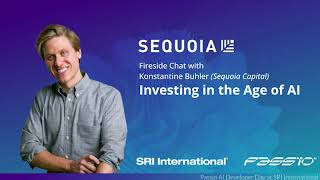
Sequoia Capital partner Konstantine Buhler compares the current AI wave to the personal-computer revolution, driven by LLMs and diffusion models. He explains how Sequoia hunts for outlier founders building 10-20 year companies, citing seed investments in Nvidia and Series A in Google as proof. The real opportunity lies in application-layer startups, not just infrastructure players like OpenAI and Anthropic.
Chapters
Thank you. Hello everyone. So good to see Dimitri. Thanks for having. Wonderful to see.
Seeing you. Thank you for agreeing to join us. I think it's a, it's a treat for everybody here and I'm. I've been waiting to ask you this series of questions about what in the world. The world. So the part of the discussion that we've had here was centered around the world has changed. The world has changed. It's been massive. It's been the world before ChatGPT and after ChatGPT, before diffusion and after.
Yes.
And what we want to cover here is in this world, what companies make sense to be building and funding. Your job has become significantly more difficult, but also significantly more exciting. So tell us how you are seeing this world today. Maybe different than the way you saw it before. And yeah, let's build on this topic.
Wonderful to see Dimitri. And first, if you have no prior, if you condition on just the random distribution of names in the world, it is incredibly unlikely to have two Constantines on stage. But if you condition it on it being a Dimitri, inviting people, actually pretty high probability. So glad to have a group that likes stats out here, so. And get stats jokes. So pleasure to meet you all. Thank you for having me and great to be here at sri. So I actually live right around the corner and have driven by this place thousand times probably and have heard about SRI over the years. Went to Stanford three times, so. So I'm a cardinal, I'm a loyalist. If it works, stick with it. And have heard just great things about SRI but have never been inside the building. So this is a pleasure to be here for all the researchers and alum. Great stuff, thanks for having me. So what's going on right now in AI and why this is different? Exciting. I am a computer scientist, engineer by training. AI engineer by training. That's what I studied at school, in particular nlp. But I also really like history because I think we learn a lot from history and I think what we're experiencing right now in the AI revolution is most akin to the personal computer revolution. You see, you hear some people talk about it as the Internet, you hear some people talk about it as the mobile phone, et cetera. I think that the closest historical parallel is the personal computer revolution. And the reason why I point that out is because of the impact that the personal computer revolution has made, similarly to the impact of the AI revolution. So imagine right before the personal computer revolution, you're a typist and you're typing on your. On your machine and every time you Make a mistake, you take the paper out, tear it up, you throw it out. Start from the top, blank sheet of paper. Then a personal computer is introduced to your workflow. And yes, it requires retraining, yes, it requires a new paradigm, but then it makes your work so much faster, so much easier, puts a lot of protection around your experience as well, and automates a lot of the workflow, including, by the way, printing 100 copies as opposed to Xeroxing 100 copies. That is very similar to the type of experience that we are undergoing right now in artificial intelligence. That type of faster, cheaper, safer, more accelerated experience. And as you mentioned a moment ago, ChatGPT diffusion, et cetera, the reason why that moment matters is because it is a step function in AI, just like the graphical user interface was a step function in the personal computer. So I've been studying AI for 13 years. That was what I studied in school. I'm sure a lot of you have as well. I bet those who were in school in the 90s studied, if you were stats, you did neural nets at some point. Probably those in the 80s and 70s and 60s. Frankly, I've seen some really old neural net books. And the reality is, the difference between the principles then and now is that we've broken through on compute and data to have a massive scale, enable a new user interface so that you don't have to understand AI engineering to use AI. You don't have to be an AI engineer anymore. You just have to understand language. And that was just like with the personal computer, when all of a sudden you had the point and click on the graphical user interface. Before, when you were using dos, only people who could use Terminal could use computers. And Terminal's rough from the start, and that's a small population. I like Terminal, but that's because I'm an engineer. The average human does not like Terminal. And I won't even get into the VIM debates or anything like that, but the average person does not want that. Whereas as soon as you introduce the gui, anybody could use the personal computer, and as soon as you introduce the LLM, anyone can use AI. That's why this moment in history matters.
Thank you. Yeah, no outstanding analogy. Let me actually build on a somewhat different analogy. I'm very curious. When I think about building companies and investing in companies, one of the things that come to mind for me is the way the speed with which the AI is changing the landscape of software development. So you mentioned the GUI moment. A different analogy that I've got is years ago I read the records while the singularity is near. And the way Ray defines singularity is the time where change starts happening so fast as we are no longer able to predict what will happen, like the next moment. And it's not. We're not there yet, but it starts feeling to me that this is the time where we are clearly approaching those innovation cycles in AI, Even at Pasia, we've moved through different paradigms of AI engineering multiple times just over the past several months. How do you make a decision about what company is worth building and what companies are worth investing in in the world where you can hardly predict what will happen next month, let alone 10 years from now? What historically used to be the time horizon of investments, spot on.
Well, the first thing is, and this has always been a piece to me of the singularity thesis, but the ability to predict what happens in the next moment has always been impossible for humanity. Like life is. Life is stochastic, okay? And that's the beauty and chaos of. Of it. And AI is really a computational innovation, I view. I try to take a very long time span of discretion, as I mentioned, engineer, but love history. And I view it as the direct intellectual descendant of the calculator. And why do I see it that way in the computer? The personal computer is right in that heritage, right in that lineage. Why do I view it that way? Because it is all about computational prediction of some likelihood that some event will occur in the future. It is all about predicting the future to some degree, including what the next word is going to be in an LLM. And that has always been considered intelligence. If you think about Pascal in the 1600s, Pascal describes a future machine that has. Intelligence uses this concept because it can add, subtract, multiply, and divide. What is that machine called? It's a calculator. And so none of us would look at a calculator today and say, that's called intelligence. So as I think about artificial intelligence, I think we're just. We're not unique to every other human in the history of the world. We are the same humans that were walking the earth 100 years ago, 400 years ago, with Pascal, and we're experiencing the same kind of thing. He's thinking, wow, oh, my gosh, if we had a calculator, we would have intelligence, okay? Whereas as soon as it happens, humans get used to it. We're homeostatic. Something occurs just like when you're in a car and you accelerate, all of a sudden you're homeostatic. We're all moving around the earth some Physicists will tell me the exact speed at which we're moving around right now. We adjust very quickly and so every AI innovation will be adjusted to very quickly. Another analogy to this is Maps, Google Maps. We all in this room probably know Dijkstra's algorithm and shortest path type algorithms, and that was pretty powerful at some point in time. And you could consider that intelligence to some degree. I would, I give that credit to that type of prediction intelligence. And the idea of knowing exactly how quickly to get to this location from any other location is a pretty brilliant, intelligent innovation. And yet now we all use GPS like it's nothing, like it's just a rote machine. That, that was, that was intelligence at some point. So the number one thing about artificial one, one thing about artificial intelligence is that unfortunately, because we use the word intelligence, it is forever doomed to never fully arrive my eyes. As soon as it gets there, we're going to be on to the next.
Thing, on to the next. Onward to the next things.
Exactly.
And now it's getting faster and faster. So you started, one of the interesting things you did in your career is starting Forbes AI50 list. Yes. From the time when you guys started up until now, how many companies have actually rotated? And from when you started until today, how many of those companies are still on the list? And how many of those companies do you think will be on the list a year from now? Basically, what is the speed of rotation on that list?
Yes, wonderful question as well. So the list that Dimitri is referring to is five, six years ago, I was working in venture and had a focus in artificial intelligence because that's what I'd studied. And I thought that it was an important long term trend. And this paradox was right in front of me. This paradox I just described, that artificial intelligence is forever that carrot when you're on a treadmill, right? You grasp it and then it's gone. You grasp it and it's gone. And that always was something that I wrestled with the term artificial intelligence. Because by the way, even a lot of great computer vision companies, now founders will come to me and we say, oh, we're not really AI, we're computer vision. Okay, well five years ago that was all of AI, right? And by the way, five years from now it will be different and progress differently. But a lot of my classmates, my Stanford classmates from undergrad and grad school would come to me and say, okay Konstantin, you've got the engineering and the business backgrounds. And engineering classmates would say, hey, what are actual AI businesses? And the business classmates would Say what businesses actually have AI. And they were trying to get into the field, but they didn't have any sort of strong guidance to this is a real business and this is real AI. And if you want to have a career in a field, first of all, you want it to be real technology because this room especially is all technologists. But secondly, you want to be in a real business because if you're not in a true company, if you're not in a true business that can grow, you're selling yourself short to every engineer in this room. If you are not in a company that can grow and thrive, you can't reach your full potential if it's just, if it's stagnant. So the whole idea behind this list was, can we curate 50 companies? This was six years ago. We came up with it five years ago that we put the first lift and we partnered with Forbes, that now leads the list with us. And we said, can we put 50 companies that are real businesses and that have real AI? And so we did an algorithm to calculate real businesses, which was based on quantitative metrics like revenue, revenue growth, the type of revenue, the type of customers, et cetera. Quantitative metrics that curate the top 100 and then 100 companies and then a qualitative AI expert panel, AI engineers to take that hundred and make it 50. And so you know it's a real business and then you know it has real AI in it. Was the purpose of the list. And is every company there always going to be exceptional? No, but the, the goal was to say, hey, if you're right out of school or you're interested in working in a great AI company, this is somewhere to start, find what resonates with you. And now it's five years on, we just published the most recent one. We had over 800 companies apply to this one. And it's a really involved process to apply. We've got an amazing list of companies this year. I don't know the specifics on your question of how many persisted through the years, but there are some that have persisted for many years. And it's a list that we're proud of because we put a lot of work into making sure that it is high quality businesses, real AI, diverse teams that have strong values. And we're excited about that list.
Awesome. Yeah, thanks for elaborating on this. One of the interesting things about both our online attendees and the people in the audience is a lot of us are working on startups and building the AI companies and startups. What do you See, at Sequoia, you guys are privileged to see hundreds of different startups, especially right now, in your role in AI space. What separates those who get Sequoia support and funding from those who don't? And when you are thinking, especially on the practical level over the past several months, how this has changed with the rapid transition, are you guys seeing a lot more companies trying to build superficial solutions on top of the GUI as you described, or is there more? Are you seeing a lot more on the research front where people are trying to build, for example, unification between reinforcement learning and joint embeddings? Did this landscape change for you guys or not? Or is this about the same as it used to be?
So, yes, we are seeing a lot of AI companies, no surprise, hundreds in fact, including probably hundreds that my team and I have met over the past several months even. But for us, for me and for Sequoia, that hasn't changed the way we look at it, because we have a very long term horizon. As I mentioned, for me, AI has been the cornerstone of my career for 13 years, since I was introduced to the concept of a neural network at Stanford years ago. And for Sequoia, it has been a cornerstone for us for 30 years. We're not showing up to a party and acting differently. It has been a cornerstone for 30 years and that includes arguably the single most important hardware company in all of artificial intelligence, Nvidia, where we led the first round as a founder investment with Jensen Huang. So Nvidia, the $700 billion GPU company that powers much of AI in the world today, was a Sequoia company at the seed. And it's a great example of what we're looking for, which is this brilliant long term vision and also exceptional engineers, because Jensen was an engineer at another Sequoia company who was called out by the CEO of that company as being the best engineer in the entire organization to our founder. And that's what led to the investment and the partnership and kicked off what has been a 30 year relationship and 30 years of history with AI at Sequoia. And then in 1999, 24 years ago, we partnered with arguably, if not the most important at maturity AI company in the world, Google, at the Series A, where Google has an incredible amount not just of AI powering their ad systems, but I view PageRank as an intelligent algorithm because it took something that humans would be doing and it made it in a very elegant automated way, as when I first learned the PageRank algorithm, it seemed very elegant representation of ranking the world in an Intelligent way. So that was another example of Sequoia 20 years ago. So we're not showing up now. We have always been excited about artificial intelligence and I've been excited about it for 13 years. As we evaluate companies, we're thinking about people and companies that also have that long term horizon. So is this a founder and an idea that can compound for one or two decades, not one or two years. We're not a venture fund that's interested in quickly selling companies. Acquisitions flips, we understand that and we respect amazing founders also do that. But we're built, we feel like we have an important responsibility in the world that we're built to help just that very rare founder who's trying to do something almost irrational in terms of its scope. And we understand that that's, that's definitely not for everyone. And it's also not a judgment on different types of companies and approaches. It is just our duty in the world. That is what it's our job to do. So and so one of the things I'll say that I'm really motivated about right now, Dmitri, is I feel because of the AI background, because of the opportunity at Sequoia, I feel a responsibility to work really hard to try to find the person who is going to build the next personal computer. I say that in parallel to the personal computer analogy. You know, in 1972 we partnered with Steve Jobs when it was Jobs in Wozniak in a garage. And I feel that responsibility in Sequoia, feels that responsibility to find that next Steve Jobs and Wozniak in this moment of massive revolution. And so if there's hundreds of companies and each one's doing their own little thing, that's not what we're focused on. We're trying to find that one, that one special outlier founder in a big broad space that can compound forever and build that next Apple.
So that's actually an interesting point and I tried to ask about this in my first question, but let me try to reverse my question and double down on that. When you, when Sequoia funded, for example, Google or Apple or Nvidia, Jensen Wong was able to draw a picture of Nvidia 20, 30 years into the future. And this is where Nvidia is today. Similar situation with definitely with Apple and Google. But the future that they were able to envision and then create took decades to create. And it was clear that yes, if those founders deliver on that vision, the world will be different. Right now, and I may be wrong about it, feels like it becomes more and more difficult to predict what will the future be 10, 20 years from now. It becomes more difficult to predict what the future will be a year from now. The pace of change is changing, is accelerating. Or maybe it feels like this from the AI insider perspective. Do you feel that US, Sequoia and the team that you are leading is still able to make those predictions that are decadal in nature? Or is it becoming more difficult for you guys?
So a couple things this audience laughed at a joke about Bayesian priors. So it will get what I'm about to say, which is the world is stochastic. I think about a lot of this as distributions, like statistical distributions of what could happen. And in all the cases you described, it was a distribution of potential outcomes. Like, it's not like each any of those founders knew exactly what the world would become. So number one is founders that have grit, founders that are able to bob and weave and adjust and react to the times. Because if there's one thing that's certain, it is, is change. Okay, so that's no doubt. Every founder gotta walk away with that. And then number two, for us, for the way that our model works and for what we're trying to do, which is challenging, we at Sequoia are trying to help the daring build legendary companies. From idea to IPO and beyond. Let me unpack that. So the daring, we're talking about outliers, something maybe a little screw loose. It's neither just a different type of approach and person. Someone's trying to do something daring, legendary company, something that puts a dent in the universe and from the very beginning to IPO and beyond, that is our mission. And as part of that, especially the daring and the legendary, we're picking things that are on the edges of this distribution. If it's a Gaussian curve, we're looking at extreme outliers. And I'll quote one of my partners who's a mutual friend, Sean McGuire and a wonderful friend to me and you. He said this recently and I thought it was a wise comment, which is don't judge me by how bad my ideas are. Judge me by how good my ideas are. And in our world. And he said, in a world in which there's power law, a constantly changing power law, that's what you should be judging on. He was saying that for the venture and the technology industry and really this constantly changing power law in which a very small extreme doesn't matter if the idea is so bad that it's on this side of that curve and doesn't work out. And yes, that's very difficult, but if there's one or two that really do work out, that changes the world. And that's what we as a firm are built for. Another side note on this is it also is what has propelled our AI community. It is people thinking on those extremes of the curves. By the way, the extreme not smart and the extreme brilliant before it happens sometimes looks similar, including by the way, massively scaling LLMs. That was not clearly the extreme brilliance six years ago. I know that for sure. And if there's an AI research out there that claims otherwise, I'm curious to see the data to support that. Because a lot of the smartest AI researchers six, seven years ago were saying, hey, that's not an elegant. We all hear this in math, we all hear this in computer science. That's not the elegant approach to it. Like, let's find more elegant algorithms. And so I commend the people who said, hey, we're going to just crazy scale the data and the compute, which seemed kind of wild five, six years ago until it works. And then it worked and we all benefit from that.
This is definitely one of the key observations that we, that we are seeing is it caught everybody by surprise. What caught me by surprise is I wouldn't use the word. Well, maybe, maybe I would buy your way into the LLMs. Because this is actually one of my next questions is yes, it took boldness to actually foresee that you can actually throw that infinite amount of data onto the problem and that resulted in the emergent behaviors of ChatGPTs. But it also took OpenAI because billions and billions of dollars before they were able to actually do that, to do this execution. First, they were bold enough to do it. Second, they were able to secure their resources to do this. Do you see that in the world of AI evolving right now, it is a necessity to have that infinite basically war chest of capital, or do you see new algorithmic ways evolving where you actually do not need billions of dollars in compute? And how are you guys looking at this? Because that the from the startup perspective becomes very, very skewed if you are able to secure tens of billions of dollars for compute versus you don't.
So I'll answer present and then future in the two parts of the question. In terms of the present.
Our current.
State of artificial intelligence is a triumph of free markets and diverse thinking. Let me unpack that for you for a moment. Free markets in a command and control economy. I think it would be very, very unlikely that people with a Totally different idea like that. The team at OpenAI and several other teams had to get massive resources and go do these crazy, at the time experiments that worked out incredibly well. So it is first a triumph of A, the free markets, in which people can make their own risks, bet on something that's crazy and different, and B, diverse thinking, which is something that we need to foster as a culture, society at large. Because again, it is these extremes in the power law world that we exist in that drive the innovation. So these people thought differently. And because they thought differently, they had a breakthrough that, yes, was incredibly costly. And by the way, a lot of people were criticizing it at that time and throughout, and even now they're getting criticism. That's the price for doing something special. If you ever, if you do something special, you will be criticized. Always ask Galileo. In his case it was pretty bad. And then going forward, not as bad.
As Giordano Bruno, right?
Touche, touche. So in that case, going forward, what does that mean? You said, hey, are there room for algorithmic innovations or do you have to raise billion dollars to go do these things? You've mentioned it. The world going forward is unpredictable by its very definition. So I view my role and Sequoia's role in that future as helping enable that diverse response, that intellectual curiosity, in order to try many approaches to the future. And by the way, if we found an approach with a new architecture that was incredibly efficient on a small amount of data and incredibly capital efficient and highly customizable and reduce hallucinations, phenomenal, and someone in this room might have that. That is the beauty. And by the way, you can go run and do that, because you don't. You're not beholden to some system in which you have to do exactly what you're told. In this one area, if we had a system that said now everyone has to just do this transformer architecture and massive LLMs, that would. That kind of innovation wouldn't occur. But we have a system in which you can try those different things. And I think we're going to be surprised. All I know is we're going to be surprised.
Yeah, I don't know what it will.
Be, but I know we will be.
Surprised, especially with the current rate of change. Yeah, I'm surprised now every day with what I'm saying. Even with what we are building at Pasio, our team surprises me every day with the results that we could not have predicted. But I know we're short on time. I'm dying to ask you hundreds of questions, but let Me end on one question and then maybe, if you don't mind, we'll ask one question from the audience for you. It will be a treat for everybody.
As long as you're nice. Absolutely.
From my side, you guys are at Sequoia looking at the most bold companies, digital companies, and you are forced to think about the future five years from now, ten years from now, because that. The returns that you. The integral of returns that, that you're optimizing for. I would be very curious to hear your. You paint a picture for us of the world in the year 2030.
Yes.
From the following. On the following topics. Renewable.
My phone would know that I'm speaking and not go off.
Renewable energy. Where are we in the sustainability space? Where are we in security space? Yep. Where are we in space exploration? You guys are big investors in SpaceX. And the last one is augmented reality and Metaverse, which used to be. That's probably the most interesting thing for me to hear your perspective because it's been a buzzword. It's not been a buzzword. Where will we be in the metaverse in 2030?
So on all of these, it depends. Okay. And I'm going to, I'm going to answer this question with a story. And the story is when I was a student at Stanford, I was doing, I was doing some systems class. I think it was CS107, which is like the A systems class. And I forget my professor's name. She was. Her name slips my mind. But she was speaking about systems engineering and she was talking about Moore's Law. It was an introduction to Moore's Law and how it works. And she shows Moore's Law and she says, this is. Everyone knows what Moore's Law is, you know, transistors on a chip, et cetera, over some period of time, doubling, etc. And she says, this is Moore's Law. It's been in action for decades. And then she said, Moore's Law is not a law. Moore's Law is not a law. Like there are laws of physics. It doesn't just happen. Moore's Law is tens of thousands of brilliant electrical engineers toiling away for 10, 15 hours a day for years to make something like this happen. That is the closest thing we have to this magic called Moore's Law. It is not something that happens. And so the future does not happen to you or me or any of us. Doesn't just happen. That was an empowering moment for me as a student because I realized that Moore's Law, which enabled this incredible explosion in computation wasn't something we just sat by on, it was something we all decided was going to be the future. This industry, all of these brilliant electrical engineers who went to get trained and worked incredibly hard and were institutions like this storied institution right here in order to make advancements in materials and science. And so which future you describe, be it climate tech, be it artificial intelligence, be it augmented reality, is completely path dependent on individuals in this room and outside of this room of where you're going to dedicate and spend your lives. Okay. So it is dependent on where are you going to get that personality. Sometimes it's a personality who gets, galvanizes a group and brings them together and inspires them in a direction like you did in some of the personal computer revolution or the mobile revolution. Where are you going to get those, those personalities that break through a technology just a little bit and then attract the talent to keep going down that vein and find something really brilliant. And so it is completely dependent on you, founders, individuals, engineers, scientists, to say, what is that future that I want and want to see and can I make a breakthrough? Because when you make a breakthrough, it snowballs. More people come to it and then it continues to roll and that compounding effect is massive. So that is what we'll decide what 2030 looks like.
You all completely agree. And this is, this would be actually, since I promised the question we'll need to corner, but this is actually a phenomenal stopping point for my part of the, of the presentation. I believe that we've got right now the tools with AI to create the future we want. And we are trying to empower developers with the tools we are building at Pasio. But also companies all across the valley right now are opening the doors for innovation and solving the challenges that, that we've not seen being able to solve before. So I'm really excited. The way you phrased it is let's go build the future, let's go create the future we want and make the world a better place together. So let's do the one quick question and then.
Sounds good to me.
We'll wrap it up. Thank you. Yeah, just you mentioned outlier startups. Yes, for three or four examples. That's a good question to wrap it up.
Yes.
It gives you a good, a good opening to highlight some of the magic you guys are working on.
Absolutely. So, so companies that to, to work. What is the context? Companies to work out or. Yeah, yes is the answer. And let me give, let me, let me give, I'm gonna give a Few quick examples, including some in our portfolio and then one not in our portfolio explicitly. But I think it's an amazing one just to keep that balance in perspective. So broadly speaking, what's happening right now in AI is there's a lot going on in the infrastructure layer in order to enable the application layer. It's kind of like building a city where you have a lot, you lay down the pipes and you the roads and then before you know it, you can build the building the applications. And so every major technology trend usually starts with a lot of infrastructure. That's why you saw Cisco being such a giant company and laying down the groundwork of the Internet, for example. So you have a lot going on in infrastructure and obviously you've got the OpenAI's of the world in the infrastructure layer doing amazing work, Anthropics of the world in the infrastructure layer doing amazing work. I also think that what Hugging Face is doing is really exciting. That's a Sequoia company that allows open source, kind of like a GitHub, for all the AI models out there. That's pretty powerful and pretty amazing. And when you can power all of those brains and connect those brains and those models, some magical things can happen. That's some items in the infrastructure layer. Something connecting the infrastructure layer and the application layer that I love and a company out of Stanford, since we're at sri, is Kumo AI, which is Yuri Leskovich, Hema Raghavan and Vanya Jasakovsky's company. And basically what they have said is databases forever have had data of the past. They store what has happened in the past. What if you could make a database that queried the future? What if the database, just like you could search what happened in the past, predict exactly what would happen in the future. Let's say a normal customer table that this customer spent this much in this time in the past. Okay, what if you had another column right there that said and this is how much they're going to spend tomorrow, what could you do with that? And it was to a high level of prediction. And so they have taken frankly world leaders in graph neural networks, which I actually think is one of the key potential new architectural innovations. Like what could be a challenger to the transformer one is graph neural networks. And they have taken graph neural networks and access a database and been able to make predictions that are striking, really amazing at the large enterprise layer. So from infrastructure all the way up to applications, they plug this in and they have automated a lot of the decisions, predictions that a large enterprise can make. It's another company to watch and look out and be aware of. And then I'm going to call out two application layer companies. One in the square portfolio is called Harvey, which is a legal tech company that does automation of a lot of legal processes of an entry level lawyer who does a lot of writing. You think about the LLM as being able to create autoregressive tax based on context. It does that very well. That's an exciting area in which you can bring innovation and efficiency to the to the legal tech field. And then the last one is not in the Sequoia portfolio, but one that's near and dear to my heart and that I had the opportunity to work with from day day zero. In fact the negative 100. I almost started a company with this founder when we were in school which is VIZ AI, which is using AI to detect major medical issues. First of which was the large vessel occlusion, a type of stroke in the brain which it's a stroke that was very important to me because it affected my grandfather who's I'm named after and I care very much about and it has saved so many lives because in brain science time is brain every minute of not responding to a stroke is a long 1.6 million brain cells and they are able to take what was this huge range of time to responding to a stroke, 30 minutes, 60 minutes, an hour, sometimes four hours and bring it down to a couple minutes, just instant because the AI identifies where the large vessel occlusion might be, tells you exactly where it is, and they are in hundreds if not thousands of hospitals saving a lot of lives. That's a pretty amazing, exciting path. And now they're introducing many different AIs for medical they really broke through enabling healthcare AI. So those are some companies that I'm really excited about that I think have a lot of potential. And I'll pose it to you all because I know this is the last question, but I'll pose it to you all where I ask if you see companies in the AI space that have that outlier potential that can change the world, please feel free to share them with me and Sequoia. My email is Constantine with a K and an E at the end constantinecoia cap.com and our entire motivation mission is to help those outlier founders and companies reach their full potential. So I'd be very grateful by that. That is my mission, especially in the AI space and if you have the opportunity to do that, I'd be very grateful.
Awesome. Well thank you so much. It's been a treat and a huge pleasure. I'm grateful that you found the time and pleasure. As always, look forward to many, many, many future conversations.
Thank you very much. Thank you.
Thank you.
Thanks, everyone. Awesome.
More from Konstantine
OpenAI Sora 2 Team: How Generative Video Will Unlock Creativity and World Models
The $10 Trillion AI Revolution: Why It’s Bigger Than the Industrial Revolution
Sequoia’s Konstantine Buhler “How we're teaching computers how to use computers.”
Sequoia's GPs - The AI opportunity is massive, but only for those moving fast enough to seize it