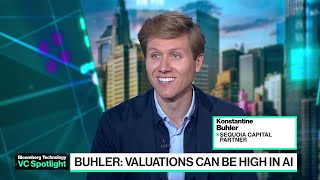
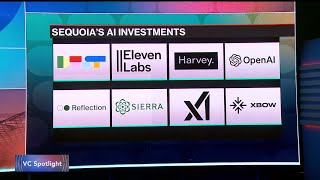
A Sequoia partner discusses the firm's AI investing surge: 20 deals in 2023, about 60% of early-stage investments. They praise OpenAI's developer-focused strategy, comparing it to Stripe and MongoDB, and say GPT models will benefit the entire ecosystem rather than cannibalize it.
Chapters
What have you been writing checks for?
Absolutely. Ed, Caroline, thanks so much for having me back on. It's wonderful to be here. So last time we caught up, you asked the question, how Sequoia going to lean into this moment of investing. Because Sequoia has been in the AI space for decades now, but there's this amazing inflection in the generative AI revolution and I'm very excited to share that. We've leaned in by backing excellent founders that are solving real customer problems. So this year alone, we've made 20 investments in the AI space. That's about 60% of our early stage Net new investment.
Real quick, how does that differ from what you did last year? For example? How is that a ramp up in activity in investing in AI?
It's even more than last year. We've always had a focus on AI, back to 1993 with Nvidia, which is one of these absolute cornerstones of the entire AI field. We've always had an eye on AI, but there's been this exciting inflection point with generative AI that's allowed us to lean into even more companies in 2023. And this, this has allowed us to actually see users leaning into these products and using them actively. So now we're seeing lawyers leveraging AI and our product Harvey in order to generate contracts. We see teams using dust in order to make personal assistants that automate mundane tasks. And we see developers using hugging face to implement open source into hundreds, thousands of projects. Overall, it feels like AI has landed and we've moved out of hype and into reality.
Was any of the valuations of which you were writing the checks feeling a little hypey?
No doubt valuations can be very high in the AI space. We've tried to stick with fundamentals and one of the things that we found really helpful is a lot of AI builders, especially the ones we work with, appreciate the fact that building an AI company is building a company. So they look to Sequoia and they look at the track record and they realize a Sequoia backed company is four times more likely to go from seed to Series A than if it weren't backed by Sequoia. It's twice as likely to go from A to Series B. Why do I say this? The point is that an AI company is a company. And so the fundamentals of company building that we've learned over the past many decades with AI companies and Internet companies and cloud companies and mobile companies are translating very well. And that's led to a lot of our Founders realizing the Sequoia advantage and valuations that are much more reasonable within the ones that.
There's an interesting triangle here. We started the week with OpenAI's developers conference. You, Sequoia were an earlier investor in OpenAI and a big part of their pitch was kind of creator economy. In other words, they're going to start offering stuff that will help others build an AI company. Is that your assessment as well?
Yes. So we've been investors in OpenAI for a while. We invested back in 2021 before this amazing movement really started to inflect. And what they've done exceptionally well is lean into the developer, per your point ad so they understand that the creator has that power and yes, they can actually augment it with this type of staff that you're describing, but they still want to take that and put the power in the hands of the creator, which is another decades long trend. So we've always known the developer, the creator has been key. This hearkens back to Stripe, which is the developer tools company for payment a decade ago. MongoDB right here in New York. Developer tools company for databases or even Unity, the developer tools companies for game creation. One of the things that OpenAI has nailed is focusing on the developer, focusing on the creator and helping that creator, including with these assistants and services.
I'm interested. You mentioned us, for example, a way in which we can all suddenly be augmented basically with our own very helpful chat bot. But how did GPT that OpenAI is going to be suddenly making more abundant, not just eat into that moat. How do you decide which one to back?
Yes, so GPT are going to be, I think, a wonderful addition to the ecosystem. And as, as I see it, as we see it, the. The world is not going to be a zero sum game in AI. All boats are rising because of this amazing wave. You can do so much more with so much less.
But not all value is going to accrue to set to some of the ones that you've backed. I mean not, not all of these ones are going to survive the competition.
Coming from the juggernauts, no doubt. And what we've learned time and again at Sequoia and these technology innovations is that it's survival of the most nimble.
The big concern of OpenAI is that they can stomach the mega compute cost, the talent cost.
Yes.
So they end up being the strongest and only game in town. Is that a fair argument?
I don't think it's going to play out that way. And first of all, we love Open air. We want them to succeed and continue to perform. They've actually contributed a lot to the ecosystem. But we're in the middle of a decades long AI revolution. This is a point in time. Let's think back to the three things that make up AI. It's algorithms, of course, written by people, it's compute and it's data. In the early 2000, we saw the first sparks and that was in the form of predictive AI that powers everything from your Facebook newsfeed to your Netflix recommendations. Then more compute, more data. We had the perceptive AI revolution. That's everything from computer vision to self driving cars, which are now commercially available on the streets of San Francisco. And amazing. This wave, the generative AI wave, is just more data, better algorithms, more compute. And we're going to continue to go from here. It's going to be video, it's going to be multimodal, which they're investing into as well, and it's going to be AI controlling complex systems. Just another point in time. And all our job is to focus on the underdog so that they can actually come in and usher in the next wave of AI in what's going to be many more decades of innovation.