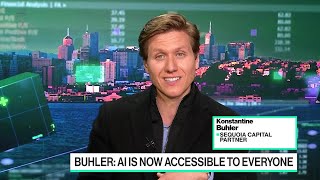
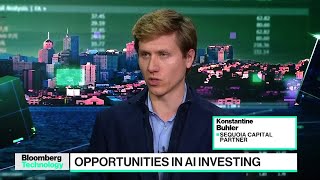
Sequoia partner Konstantine Buhler compares today's AI boom to the 1980s PC revolution, with ChatGPT playing the role of the graphical interface that made computers accessible to everyone. He warns that humans using AI will replace those who don't, and urges people to start using it now rather than wait for regulation or perfect safety.
Chapters
The history of AI is very closely tied with DeepMind. They've kind of brought Google and DeepMind together. You heard Demis there. Can I just get your reaction to the landscape and that in particular?
Absolutely. First, thanks for having us. It's a pleasure to be here always. So we are in the middle of an incredible revolution in AI. It is probably most similar to the personal computer revolution of 40 years ago. And Demos alludes to this briefly in his comment when he says we're in the middle of something very big here. Why do I say personal computer revolution? Because of the impact it's having. Imagine right before the personal computer revolution, you were a typist and every time you made a mistake or you had to make a change, you throw away the paper.
Right. You'd have to put in the clink of the typewriter.
Exactly, exactly. Throw away the paper. You have to put a new one in. You have to start all over again. And then the personal computer comes around and everything is faster, it's easier, it's way more streamlined. But there are some changes, there's some retraining that needs to be done. You have to learn this new technology. Same kind of thing is happening here in AI. So there's this massive potential. We're right in the middle of it. It's been the cornerstone of my career for 13 years. Security Sequoia. It's been a cornerstone for us for 30 years. And it is just the early innings of what's going to be brings us.
To the here and now, though. So you are principally a seed stage and series A investor.
Yes.
You know, there are many that echo your sentiments. How do you actually invest? Yes, in that moment.
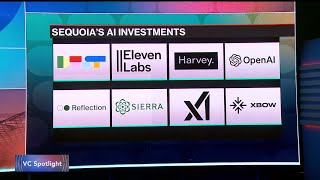
So the, the first thing is founder driven. Okay. Founders are always the lifeblood of the venture capital industry, the technology industry at large, and definitely the industry. So think back to when Sequoia started its venture in AI, which was 1992, when we backed at the Series A, the first investment in arguably, if not the most important AI hardware company in the world. In video. That was a founder driven investment. It was a founder driven investment because Jensen Huang was an exceptional engineer from a previous Sequoia company. So founder driven as always with Sequoia. And then in 1999, arguably the most important at maturity AI company, Google, was also Sequoia investment. And that brings us all the way to today, which is a lot of great AI companies that are coming up, hundreds at this point that we're meeting. We're excited to get to know and finding the most brilliant founders for what they're building in the future is what Sequoia is all about.
In a Caroline's Constantine's point, we see that activity on the show every single day, the hundreds of new companies that he's talking about. That energy, it came from Open Air in November of last year and then Microsoft's investment at the beginning of the.
Year and of course backs Open AI. But I'm interested to dig in hugging face and then others in your portfolio. Constantine. It feels as though the rest of the VC community is rushing. It feels that regulators are having to be forced to rush. It feels as though this has taken us all by complete surprise. But you've been studying at Stanford. I as you say, it's been a cornerstone for 13 years. Why have we suddenly been sort of had the rug pulled a bit?
Okay, so you're exactly right, Caroline. This is actually decades in the making and for us it's Sequoia. For, for me, for our team, there's, there's, this is something that we've been training for and excited for for decades. But there is a big exciting change and it is exactly what you described, which is this new user interface. When I talk about the user interface I'm hearkening back to the personal computer when you had the graphical user interface come out. And that was the advent of the first Microsoft Windows, that was the advent of a lot of the first Apple computers. And the point of the first graphical user interface in the personal computer revolution is that anyone could just use their mouse and click as opposed to the old terminal based Ms. Dos that only engineers could use. Similarly, the lens that Open AI and others have introduced make it so that anyone can use AI. You don't have to be an AI engineer. That's why we're in an incredibly important moment because all of a sudden AI is accessible to everyone.
That's what's the data which it runs on is still in many ways not perfect. Biases within how are you thinking about the startups you invest in and the overall regulatory environment that's going to have to play catch up in some way.
Yes, no doubt it's the data. And you're referring to hallucination is the term that's often used. This is absolutely top of mind for the enterprises that we're talking to and there's some several ways that are currently being addressed from an engineering and a company building perspective to improve that. And in terms of policy there's a couple of responses. One is to step back and say hey, too powerful, too dangerous, not me Another is to just say, hey, let it run. And the third way, which is what we take at Sequoia, what I believe is the right approach, is to say, hey, this is incredibly powerful. Let's be involved. Let's take actions to help form it safely. Let's. Let's be a part of this evolution of this technology so that it can be a powerful force of good for humanity.
You're sounding positive, you're sounding optimistic. In fact, we went to our own viewers, we did a Twitter poll, as we tend to do every single day, consisting. Just take a look at the results, because we asked them whether they're pessimists or optimists around AI. Great for humanity. Actually, Ed, only 22% said yes.
Yeah, yeah.
And look, they're too early to tell. We hear it so often. So, Constantine, you've been in this field for a long time. Broadly, society is catching up, is Caroline's point. There's a parallel I want to draw with crypto, because you've been an active investor in the crypto industry. I think the latest was EDX markets.
Right.
That is a froth and bubble burst cycle. Why. Why will we not see the same thing play out here in AI?
Yes. So first, I am a believer in crypto as well, but that is a separate trend for, you know, for further discussion, because there's a lot of depth there too, on AI. This too early to tell point is a critical point. And I encourage your audience to use AI and to actually start making it a part of their lives. You know, there's this. There's this kind of trite quote which is, AI is not going to take your job. A human using AI will. And I think that is a lot of. There's a lot of truth to that. The action that should be taken is to start harnessing the power of AI. If you're not using AI tools, try them out, see how they can make you better internally. At Sequoia, we talk a lot about augmented intelligence as opposed to artificial intelligence.