How to facilitate "The Weekly"

Chris Lambert, founder of Life Remodeled, walks through how to run "The Weekly," a structured meeting format for nonprofit leadership teams. It covers segments designed to boost accountability and decision-making, with input from multiple practitioners on what actually works.
I'm Chris Lambert, Founder and CEO of Life Remodeled and author of Next Level Nonprofit. In this video, you're going to learn how to run the most engaging weekly non profit leadership team meetings you've ever experienced. We call this meeting the weekly a 90 minute meeting with your nonprofit's executive leadership team ELT that must take place on the same day and same time every single day, single week. Always start on time, always end on time. Every leader must be fully present without distractions. No emailing, no texting, no doing other stuff. The weekly is where you and your executive leadership team will share what's happening.
Monitor progress, hold one another accountable, grow.
In transparency, strengthen team unity, discover the.
Most pressing opportunities and create next steps together.
Rumble Determine what information needs to be shared with others.
This may sound like a tall order to accomplish in only 90 minutes, however, our life remodeled ELT can tell you from years of experience we make it happen every single week. Most importantly, your team will get to a place where you will make wiser decisions more quickly than you currently do and in such a way that team members will be truly united. Now we're going to unpack and explain each of these sections.
Highs and Lows these are one sentence headlines about each noteworthy positive or negative event or activity that happened within the past week. These are both personal and professional. This brief portion of the weekly accomplishes much in regards to knowledge sharing and trust building. The purpose of personal highs and lows is to foster relational connectivity with all the leaders in the room. An example of a personal high is Our family went to see Hamilton last week and we were all blown away. An example of a personal low could be this past weekend. We had to lay our dog to rest. Sharing personal highs and lows will come natural to some team members who enjoy opening up. However, other team members may prefer to remain silent at first. The best way to encourage others to share openly is to take the first step and share openly yourself. Over time you'll create an environment where all team members can feel safe and to be their authentic and transparent selves. The purpose of professional highs and lows is to share important bits of information so everyone will be in the know. Professional highs and lows could be about things that are happening internally within your organization, or they could be about a donor, a client, partner, etc. A professional high about one of your donors could be Sandra Jones just became a first time donor with a $10,000 initial gift. A professional loan for one of your donors could be John Smith was just recently diagnosed with cancer. We're going to meet tomorrow at 9am to share thoughts and prayers for him. Lastly, it is essential that no discussion happens during this time or in any other section of this meeting until we get to the Opportunities Next Steps portion of the weekly the individuals that list their highs and lows simply states them and then the next person shares. This is fairly rapid fire. Never more than three sentences per item and every high and low should be typed and input into your template prior to the meeting so that everyone can see it on the screen.
Focus Time as we transition from celebrating highs and lamenting lows, Focus Time centers our team in preparation for what comes next.
In the meeting.
Someone may lead the team in a meditation, motivational reading, prayer, or time of silence. This could be as simple as saying a prayer, playing a pre recorded meditation using a popular app, or even reading a poem. We we found that because we allow a wide variety of expressions during this time, all team members are willing to lead this activity. Experiencing different styles and perspectives on Focus Time helps keep our team inspired Scoreboard.
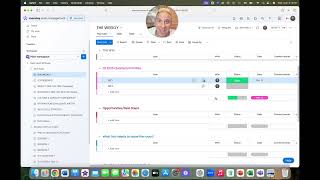
Review your scoreboard is a list of the 4 to 12 most important metrics that can be measured numerically every week. Each Accountable Team member reads their numbers and states on track or off track. Remember, there is zero discussion during this segment. However, once all numbers have been reported, the facilitator will ask if there are any items that needs to be dropped down to opportunities, Next steps, or discussion. If yes, drop it down without discussion until the proper time. Here's an example from Life Remodel if you need help developing your scoreboard, our book, Next Level Nonprofit provides a step by step process.
The W3s, what, who and when. Every time an ELT member makes a commitment during a weekly meeting, it's recorded. These commitments are generally due within the next seven to 14 days, so each meeting includes a review and verification of the previous week's commitments. We call it the W3s because each commitment must concisely state what must be done, the Accountable Team member who and the due date when. If the commitment is off track, the Accountable Team member will update the date the task will be completed. If any discussion is needed, drop this item down to Opportunities and Next Steps. Quarterly Priorities. Each Accountable Team member reads their quarterly Priorities, other known as Key and states on track, off track, or done. If any discussion is needed, drop this item down to Opportunities and Next Steps. Here is an example of Life Remodel's QPS from a previous quarter. If you need help developing your quarterly priorities, our book, Next Level Nonprofit will.
Show you how Opportunities, Next Steps this section is the heart of your meeting and you're going to spend 60 of your 90 minutes right here. What are Opportunities? Opportunities are the problems, challenges, or issues your organization is experiencing currently. However, we use the word opportunities to label them because that's what they truly are when we see them from a growth mindset Whenever we want to start discussing the next opportunity, we begin by narrowing down the core nuance. Often the way the statement is communicated at first is not actually the root opportunity that needs to be discussed. Therefore, drill down to the single focus at the core and determine what you're actually hoping to accomplish before beginning the discussion. This will significantly narrow your focus. If your team members trust one another and if you enter into this Discussion bravely, this 60 minute portion will be filled with healthy amounts of conflict, vulnerability and what Brene Brown calls rumbling. Well, if your team needs more help with rumbling, well, check out chapter 10 of next level Level Nonprofit when we're Ready to Develop Next Steps it's important for our team to understand we aren't seeking to cure cancer in one swoop during our discussion, but we are seeking to solve that which is getting in the way of our eventual discovery of the cure. Sometimes there's just one next step for an opportunity, and other times there are multiple steps. Each next step must be assigned to one appropriate, accountable team member. And add this to your W3s right then and there. Remember the principle of being 80% confident. One of our guiding principles is to make decisions when we have at least 80% confidence the next step is the right one. I'm not saying you need 80% of the team members to say they agree. I'm saying that each of your team members is at least 80% confident in the decision. When team members don't want to make decisions because they lack 100% confidence, this often comes from a mindset of fear or perfectionist, both of which can be cancerous to innovation. Therefore, we are very intentional to drive discussions towards next steps and decisions. Keep in mind, Next Level Nonprofit is latent with radical accountability for every action that team members take, so we are able to rapidly reevaluate change on the fly and recalibrate decisions as needed. So how do you decide what opportunities to discuss each week? We encourage all ELT members to add opportunities to the list before the upcoming weekly and come prepared to clearly articulate each one. We can also add opportunities to the list at any time during the weekly. However, the first thing we do when we get to this section of the meeting is ask the team what are the three most important opportunities we will discuss first. Sometimes team members want to pick the quickest and easiest items. Therefore, it's important for the facilitator to to guide the team to prioritize the most important and most time sensitive opportunities. Once you get through the first three, choose the next three. You might be wondering, how many opportunities will we solve each week? In part, that will depend on how complex each subject is. However, it depends far more on how skilled your team becomes at identifying the real heart of the opportunity and how well you can learn to move the discussion to the point of making decisions on next step steps Life remodel typically solves 5 to 8 opportunities per weekly.
Wrap up the final 5 minutes during the last 5 minutes of the weekly, you'll cover the following bases Recap W3s Simply read off what commitments were made and by whom. Make sure no commitments made during the meeting have been accidentally left off the W3s list. What info needs to leave the room? Is there anything we discussed or decided today that needs to be shared with others inside or outside of the organization? If so, what and with whom and who will be accountable for the sharing in each of these cases. How do we do as a team today? Use a grade range of A through F including pluses and minuses. To rate how you did as a team, you simply ask each individual to assign their grade letter for the team today. To be clear, you are not rating the facilitator's individual performance. You are rating how the entire team did as it relates to being prepared, fully engaged, vulnerable, and action oriented. At minimum, you want the team to score a B. A grade of A does not mean the meeting was as thrilling as a trip to Disney World, but it does mean this is exactly how we all needed to engage today. Anytime a team member assigns a grade below an A, the facilitator asks that person, from your perspective, what could have been done differently today for our team to reach at least an A? This person then provides a one to two sentence response. She may say, today I just wasn't fully present and I'm a team member that needed to better engage. I know what I need to do and I'm on it. Or she might say something like this while looking directly into the eyes of her two team members. I really wanted to hear more from you today, Stacey and Darryl. I could be wrong. I felt like you had more to say. I don't want our team to miss out on your geniuses.
That's it. Now you know what it takes to run the most engaging weekly nonprofit leadership team meetings you've ever experienced. Here's to nonprofits going to the next level, and the next level after that.
More from Chris








Next Level Nonprofit with Chris Lambert - Podcast Ep 97 #nonprofitplan #fundraisinggoal