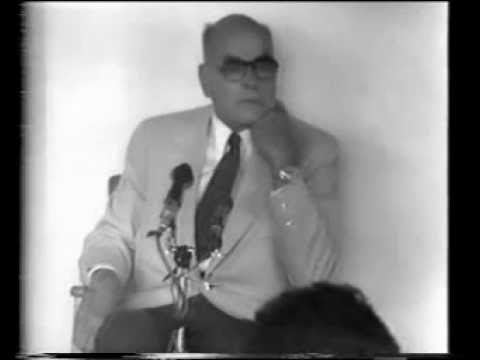
Wilfred Bion argues that calling patients "terminal" misses the point. Instead of fixating on death, he says analysts should focus on what patients still have to offer. He compares rigid adult minds to the flexible thinking of infants, suggesting that even at life's end, people retain capacity to contribute something to the world.
Chapters
You know, you get ridiculous things said like, ah, will you come and look after these people in this particular ward, shall we say, of the hospital? They are terminal cancer patients. Terminal cancer. You only got to think about it a bit, you realize what a ridiculous phrase it is. How do they know it's terminal? Terminal of what? What is the endpoint of? And in any case. What we are concerned with— we're not really concerned with arranging the funeral arrangements or something of that nature. What we're really concerned with is living people. And if there's a job to be done for making the life of people in a particular ward bearable for such length of time as they've got to live, then there's something to be done. That's got nothing to do with terminal cancer or terminal anything. It's got to do with making such life as is still to come, which is still left over, whatever's still in the bank, so to speak, tolerable and available, and finding some method by which the patient can be given a chance of getting onto that wavelength where you bother with what can be done and don't bother overmuch with what you can't do. I sometimes think, you know, that there's almost an occupational neurosis Of analysts, because so much time is spent in finding out the various mistakes which are made, our faults, sins, crimes, and so forth, that one forgets that it's a very unimportant part of the whole story. Because one wants to know, no doubt, What one is bad at, it's quite useful to know that, but the really important thing to know is what part of it are we any good at. So even if you've got somebody who is supposed to be in their terminal stages, the really important thing is what are they still good for? What would you do with the geriatric patients? It's almost as silly at the other end of the scale. Of course, it's no good, they'll say, to analyse a child. Of 2 or 3 or 5. I've even heard fantastic statements talked about not being able to do anything when the fibers aren't myelinated. Well, the trouble with the myelinated fibers is That the persons who have got them are so often so rigid, so obstructive, that you can't get another idea through their mire. On the other hand, if you've got a reasonably intelligent baby and Quite early in the proceedings, you put it in a potty, its non-myelinated bottom seems to know what to do, and it will then proceed to perform very adequately without any fuss or bother. Now, why that is, I don't know, but I think that the— I think that the— It's a reflex. The infant must have a personality, and so must the old person, however ill they may be, however convinced that they are that they've reached their terminal position. If they had, there's no problem. There is a problem though, In that little tiny gap of whatever it is— day, weeks, months— between that point and the point at which one no longer exists. So I think once again one has to get back to this curious business of Considering that not only has one anatomy and a physiology, but also a mind, canst thou not minister to a mind diseased? Remember the question which Directed towards Lady Macbeth sleepwalking. The answer presumably would have to be something like, well, not at the moment, but in 400 years come along again and I'll tell you what we can do. Similarly today, come along again in 400 years and we'll give an idea. But in the meantime, each one of us individually lives this very short period, this ephemeral existence, possibly in which one could use this hypothetical mind that I'm talking about, to contribute something to the general fund.