Angela Maiers On Why WE Matter (Peernovation Season 1, Episode 2)
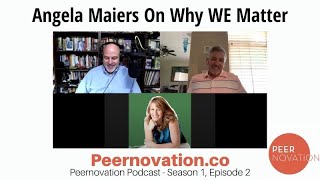
Angela Maiers, founder of Choose to Matter, argues that the need to matter is hardwired into human DNA like food and water. She says less than 1% of people actively contribute while the rest stay silent from feeling inadequate. Small, consistent actions in your community can shift that, she says, like instruments in a jazz ensemble.
Chapters
Welcome to Peer Innovation, the podcast with Leo Battari and me, Randy Cantrell. Building on our previous shows, The Year of the Peer and What Anyone Can Do, we turn our attention to helping business leaders build high-performing teams. We'll talk with a diverse group of thought leaders who will share stories and insights that will help you and your teams achieve new heights. If you believe there is strength in numbers and that meeting the challenges of the future can only be achieved if we do it together, then join us for the conversation. Today's guest is Angela Meyers. Angela is the founder of Choose to Matter, a global movement that challenges and inspires students to work collaboratively to develop innovative solutions to social problems. Angela has authored 6 books including Classroom Habitudes and The Passion Driven Classroom, which introduced the concept of Genius Hour in education. We welcome Angela to the show. Welcome back to another episode of Peer Novation. 3-time, am I right, Leo? A 3-time guest. Yeah, we started—
4? Is this 4?
No, it's 3.
Just 3.
Yeah, we've had—
I feel so honored.
Yeah, well, you're— somebody has to have the honor, so we decided to make it you. Her name is Angela Myers. That is her her beautiful face, a photograph that Leo and I just— I don't know what we bring to the show, but I'll turn it over to you, Leo.
Well, you know, as I said, this is Angela's third time on the show. To save a little bandwidth here today, as we were kind of experimenting, Angela is going photo here today. But I can't tell you how excited we are to have you here. You know, One of the things that, of course, the focus of this show has really been talking about teams and how we learn better when we learn together, about how, you know, it's very difficult for one person really, you know, to be able to do what a team of people is really capable of. But a lot of that starts with recognizing that the power of we begins with me, or it begins with you, it begins with all of us. And You know, we thought very early on it is so fundamental to have your work and your ideas around this topic set things, set the stage for everything we're going to be talking about for the year when it comes to teams. Last week we had Craig Weber, whose work on conversational capacity I think is wonderful. But before we can—
I like that term. That should be a quotient, our conversational capacity. Like, that is something we should measure.
Oh yeah, and oh, it's great stuff. You know, he's got two books on the subject, and you know, obviously people communicating effectively and productively with one another is real important, but at the same time, I think even more fundamental to that is to reflect and have a sense of who we are in ourselves and what we bring to the table. Own that in a way that our culture doesn't always, you know, give us permission to do sometimes. So if you could, for those, because it is a newly rebranded show now, who may not be as familiar with you and your work, I'd love for you to just, you know, riff on that a little bit and get us started.
Absolutely. So I— there's just so much to say. My brain is so full. My heart is so full right now. Just a little bit of my background. I actually created a new word to describe who I am and what I do. And I, I use the word humanologist because I have been studying human behavior from the perspective of many sciences. So my background is neuroscience, but this is social science, social psychology, neurobiology, anthropology, sociology. If we study human behavior at that level, We have to understand that at the core of being human is to matter, period. To matter. And that the conditions of being human that allow us to feel like we matter, to be seen, to be heard, to be valued, to understand and recognize and own our essentialness, are not luxuries. They are not niceties. They are DNA-level drivers that are as important to our health and well-being as food, water, shelter, and air. And so I know there's a lot going on that polarizes us, these ideologies about how we should act and not act, but this today is not about ideology. Today is about biology, and understanding that however we must act moving forward, we will not be able to do it in our full capacity if these human needs and conditions are not addressed. And so that is the starting place. That's been the starting place of my work for the last 35 years.
You know, I think what is so fundamental, you know, We've talked a lot on the show about how sometimes it can be very difficult if you ask someone, what do they want?
Right.
And they have a very difficult time articulating that, right? Laura Goodrich has talked about this for a long time where they'll tell you what they don't want.
Yes.
That's OK. But to actually try to say, here's what I want, or here's what I want to do, here's what I want to achieve, here's how I want to make a difference in the world. I think it was Robert Fritz whose research talks about the fact that we don't always feel either capable or deserving, right? And it's one of those two things, and sometimes both, that serve as drivers for us not helping us own how much we matter.
That's right.
And the difference we make when we're in any meeting or in any room or anything like that. And, you know, I'd like to Do you have any thoughts for our audience in terms of if you don't— if you have trouble taking ownership of that, right? What are some of the things, steps that people can take or a mindset maybe shift that they can have about this that can help them get to a place where they feel comfortable saying, I matter?
Absolutely. Even if they don't use those exact words, and I'm conscious of that. I'm a word person, so I'm comfortable exploring the depths of our language. But I think the deepest understanding is that worthiness is something— is not something you have to earn. We come into the world believing in our potential. I always say, like, what's the most exciting and energizing thing about being around 5-year-olds is that they own their genius. They will let you know that you are in their presence. If you don't notice them, that will last about 3 seconds, and you will notice them. But if you dig into that deeper, the driver for that is not ego. They're not trying to show off. They're trying to show you that they have something that they fundamentally believe someone else in the room or the world needs. And that's a really important perspective. You were created for significance. And hiding that and holding that in, even though we have couched it in and under the context of humility, like we can't toot our own horn, we can't brag, we can't— well, don't do it from the context of that. Do it from the context of service. You have something that someone else in your life and in the world needs. And holding it in is the most selfish act that we can bestow on one another. And once you recognize that, that you are exactly what someone in the world needs right now, you might not have met yet, but like a 4-year-old or a 5-year-old, letting people know that you're an artist, that you're a dancer, that you're a singer, that you're really good at X, Y, and Z, is an act of generosity and an act of humility. Because just in case you need to know what a dinosaur X is different from dinosaur Y, there's people around you that can fulfill that. And holding that in and hiding that, it's biologically, physiologically impossible at our youngest age. But then we enter the standard of the world where we have been told and we've started to believe that worthiness is something that we earn, that we're not enough, that when you do this and if you do this and only if you achieve this, then you're worthy. You matter is a finite statement. You matter, period. There's no ifs, there's no ands, there's no whens, there's no just. You have value now, period.
You know what's interesting about that is you make me think that they're not trying to show off, they're just trying to show up.
Exactly, exactly.
So if we all just showed up, you know, I mean, we talk a lot about whether it's peer groups or teams or whatever. If you were part of a jazz ensemble and, and you played trumpet, you played bass, you played whatever, you pull those instruments away And it matters, right? Because now you've absolutely changed the sound. So every one of those musicians recognizes how much they matter to that ensemble. I think we don't always take that same ownership when we show up to a meeting and realize that I'm at this meeting for a reason. Because I'm not— because I'm smarter than anyone else, know anything, but I look at the world through a unique lens that tends to deliver a contribution to the whole.
That's right.
And And, you know, people have said too that, you know, people are so worried about being kind of that definition of confidence or arrogance, right? You can be confident and say, I'm good at something. That's different from saying I'm better than everybody else.
Absolutely.
Absolutely. And that's fine. I may have shared the first time I was probably— God, I bet I was 8 or 9 years old. And there was a guy in my neighborhood who was a minor league baseball pitcher. Pitcher, big guy, you know, big kid, you know, basically. And he was playing catch with me out on the street. And so he said, what position do you play? I said, a pitcher. And he said, are you good? And he was actually a pitcher in minor league baseball. And I'm kind of kicking the ground, so I'm all right, you know, kind of thing. And he caught the ball and he stopped and he looked at me and he said, don't ever be afraid to say that you're good at something. That's right. He said, are you good at it? And I said, Yeah, I'm good. I am good at it.
That's right.
Good for you.
That's right.
Never have anyone— and I thought, what a powerful lesson.
That's right.
You know, from this 18 or 19-year-old kid at the time who just had the presence of mind to give me the gift.
That's right.
Of sharing that, because I think it was the first time probably in my life at that time that I was like, it's okay to say that, yeah, I'm, I'm good at this. And it made— and it changed everything. I mean, it was just an extraordinary moment.
Yeah. So think about one of the ways to reframe the conversation for people that are uncomfortable about talking about what they're good at or talking about what their genius is. Talk then about your essentialness. So one of the questions I asked in an event on Friday talking about the same thing is, what do people count on you for? So I learned this like I guess by my DNA of growing up in a town of 641 people in the middle of a cornfield in Iowa, you did not underestimate anyone in the community. You never, ever, ever looked at anybody as nonessential. And no one was just a farmer or just a housewife or just the— because the mayor was a farmer and a housewife and on the QuikTrip because you had to get in. And so very quickly, and I guess unconditionally, you found your place. Everything was volunteer in a small town. There's a volunteer fire department, there's a volunteer mayor, there's a volunteer— so whatever you were good at, you had a responsibility to show up and do that consistently and unapologetically because you knew that someone else was counting on you. So if you think about it like that, that's how a 3-year-old thinks. They literally can't imagine somebody going to bed confused about a tyrannosaurus or a stegosaurus because they know that they can fix that. They know that they can be of service. And that is the deepest level of mattering and the deepest driver of human behavior, to know that you are counted on and needed by someone else. And it can be just one person. It makes you show up.
When does that change, Angela, for kids? Roughly at what age and what are the factors that drain that from us? Excuse me.
So I wish I could say that doesn't change until 8th or 9th grade, which I start, but my research is showing it changes as early as 8 years old. 8 years old, we start hesitating, holding back, and doubting our enoughness. And it is a combination of unintentional factors. This is not a statement about anyone intentionally doing that, but education has a huge part of it because what we focus on expands. And what we focus on in education is not the development of the individual and the nourishment of the genius in our presence. What we focus on is performance according to someone else's standard. There is not just an unwritten when you do this and if you do this and at the point when this is accomplished, check, check, check, then you will be good enough and worthy enough. We have an entire education system built on that and an entire prison system built on those who didn't fulfill the checkmarks. So that plays a part. Parents play into that because they are products of that institution. And so the idea that we're not enough, because even when we get those checkmarks, we still struggle with enoughness. So we have not built in practices in our daily life, rituals and routines that enhance the discipline of worthiness. You don't just stumble upon significance. You have to work at it, just like you have to pay attention to what you eat and how many hours you sleep and how you take care of yourself, because if any of those essential needs aren't addressed, You don't enter the world your full self, period.
You know, this brings back another— this childhood story is less, less positive than the first one. So I remember being that kid and I don't remember what grade it was. I'm pretty sure it was elementary school though. It was. In fact, now I remember. So I was about 11 and it was a, class where they were talking about life on other planets. And they basically said, yeah, life is impossible on other planets because there's not enough oxygen for people to breathe. Of course, I raised my hand and I said, well, I don't know, what if there's some little kid out there that can breathe nitrogen or something like that? Like, is that like impossible? And the teacher and everyone looked at me like I was the biggest idiot in the world. And the teacher was all in on this too, giving me a bad time about this. And I thought, and it was kind of crushing at the moment because I'm like, I didn't think that was that stupid question. And yet, you know, but then it was It was a long time before I kind of stuck my neck out again, you know, to ask what I thought was the perfectly legit kind of thing. But it, it, those things can kind of screw you up for a while for sure.
They can haunt you for the rest of your life because clearly didn't forget it. Yeah, absolutely. So I think what you're illustrating is the difference between success and significance. When you truly understand that you are good at something, that you bring to the world a unique talent, a unique perspective, a unique way of looking at something or solving a problem. Or one of the kids said, genius is someone's ability to get the world unstuck. And I'm like, that's so true, that is. So however you get another person unstuck, that's a genius. Then you know that you're fulfilling that in what you're doing and you'll work on that. When you're in that space of living a significant life, there's no jealousy. There's no competition except with yourself. How can I be better at delivering that value to the world? Success, especially success based on someone else's definition, if I do this, when I do this, only if I had this. This is why we see over and over and over stories of people that have what would seem like the greatest success ever, whether it is a movie star or it is, you know, everybody from Whitney Houston and Michael Jackson to Robin Williams, like ungodly amounts of genius and talent, money that we can't even comprehend. And they still don't feel like they matter enough. I think Oprah said that she's interviewed over 5,000 people, and there wasn't a single person, no matter how big they were, from presidential candidates to movie stars, that after the interview reached over and whispered to her, "Was I okay? Was that okay?" Because we still question that we have value. No matter what we did, even on our worst days, we have value.
So this is kind of an interesting time to pivot, I think, a little bit too, because— so you talked about, here you are, you're part of this town of 641 people. Yeah. Of course, I think about— I believe that the population in this country alone has tripled since 1950.
Yeah.
We have what we perceive to be big problems, big challenges, let's say, lots of people, over 7 billion people on the planet. So now, as people just look at the math on it, and they might think that I matter less than ever before, right? And in the face of all of what we're dealing with, particularly in the United States right now, um, and how we can make a difference in how we see one another, um, I'd love for us to talk about the fact that maybe we're not powerless at all, you know, ourselves, our peers, our friends, and that one person at a time, you know, but I'd love for you to touch on that because I think we're obviously going through just a horrible period right now. I mean, pandemic notwithstanding, but look at, you know, the— just horrible, you know.
So there's so, so many things in what you said that are so profound and urgent to speak about. One of the contexts that's important to understand is that we have been brainwashed, I believe, into believing and thinking that complex problems require complex and unbelievably expensive solutions. And it doesn't matter how many examples, from Gandhi to Martin Luther King, that show us that we can literally move mountains in the simplest ways. That is one of the things that I fight all of the time. How can something as simple as telling somebody they matter make a difference? So I find myself in the position to remind people that if we take the mindset that this is too big for us, that it's gonna require too much, it is an internal excuse to not show up, to not be brave enough, to even try. And so what we have, and are you familiar with the concept of one-percenters? When they looked at, as the web was evolving, Tim Berners-Lee and his team looked at the patterns of contributions on the web, of original content, of the things that people retweet and talk about. And of those 6 trillion people on the planet, less than 1% of them are contributing. When we all have been given this beautiful privilege and right to share our voices, to share our perspectives, to share our talent, and we have become silent, not because somebody outright said, "Don't say that," but we become silent because we are trapped in our belief that we're not enough. That the problem is too big, that the situation is too complex, that we can't do anything, so we do nothing. And that breeds one thing: hopelessness. And hopelessness is dangerous because it breeds agony, and it is apathy that— and the contagion that it brings upon it puts us in a position that is really, really disturbing, and we have to change that. So one, I mean, what do you think about that? Do you agree? Do you disagree, Randy? What are you guys thinking?
Oh, I agree. My question would be for those people that may be more reticent or—
Yep.
You know, we've got these labels, right? We love labels. You know, introverts and extroverts. And all the other stuff. But for those people that might be— I mean, as you were talking, I was thinking about those of us that kind of fancy ourselves being kind of natural encouragers.
Yep.
Easy for me to do, right? Easy for me. I mean, I've done it today, and Leo will tell you this is largely what I do, you know, sit here and just listen. That's comfortable for me, right? And I don't have a— I don't have a problem with that. And I'm, I'm a guy who's rather more comfortable shining a light on you, shining a light on Leo. That's just, that's my natural wiring. That's just how I roll. Um, and so it makes me wonder, if you aren't upfront, if you're not one of the 1 percenters, yep, boy, boy, you can— it's a pretty powerful group. It's obviously the majority, a pretty powerful group that can, that can really shove more people to make that 1% grow, which is really the— I think that's largely a lot of your work. It's grow where you're planted and be what you got to be. Don't be what somebody else thinks you need to be. But to the theme kind of of our show, who you surround yourself with matters. I mean, speak to that. Speak to the impact that the people that can powerfully impact your life. You talked about parents and education and stuff that can kind of wring it out of us as little kids, but what about, what about the other group, the group that can propel us forward when we're in self-doubt and we're insecure?
So think about, it goes back to again, contribution. So go back to the small town, this unwritten rule to be an actual resident, a member of the community, Contribution is non-negotiable. If you pull back, and I mean, contribution can be physical, it can be emotional, it can be soulful, it can be spiritual. Contribution is walking down the street and saying hello to somebody. Contribution is moving your neighbor's garbage because they were gone for the day and they needed to get their garbage cans out. Contribution doesn't mean you have to build the town hall center or that you have to be the mayor. It means that you show up and you do what you need to do in service of, of the we. And every individual member, if one member isn't contributing, the entire room, the entire community suffers. So it's, it's like not even plausible to think that you're going to be a non-contributing member. Because we call non-contributing members to a neighborhood, to any space that we're in, visitors. They're visitors. So we can be visitors on this planet, or we can be residents where we thrive only when we have community. That has been proven since the beginning of time. That's how we're wired biologically. We're not meant to be alone. But part of the entry into being in a Community that has the chance to uplift you, to inspire you, to push you, to drive and make everyone's life better is the commitment of contribution, whatever you choose that to be. And so if you can help people understand that it isn't the size of contribution, it is the consistency of your contribution so people know what they can count on from you that matters. So to experience this, I had about 2,000 people on, in a, I had a conversation on Friday. I hate calling it webinar because it's not a webinar. I hate webinars. But they were coming from the place like, the problem is too big, this is too grand, what can I do, this little person? And so I asked them to close their eyes, and for 30 seconds, I actually timed it, I shared these messages with them. You are enough. I couldn't have done that without you. Thank you so much for being my smile today. You were so patient with me, and I appreciate it. I can't imagine this neighborhood, this place, my life without you in it. I appreciate you. You matter. So what did that take? 15 seconds? Then I asked everyone in the forum without thinking to write down how they feel right now, 2 words that describe how they feel right now after 15 seconds of interaction, of my contribution. So I'll ask you guys, how do you feel right now hearing those words?
Grateful.
Grateful.
That's the word I wrote down, gratitude, while you were talking.
Grateful. So I took all those words and put them in a word cloud. I feel hopeful. I feel energized. I feel empowered. I feel grateful. I feel I feel beautiful. I feel seen. I feel— I'm getting goosebumps just saying and putting all those right there. So if we looked at that from this non-contextual perspective, if people entered the world every day in the midst of the most insurmountable context, like the one we're facing right now, but they entered the world the world feeling that way, how different would the world be?
And how quickly would it change?
How long did that take?
No, it's— yeah, right. How quickly would it change?
Biology, not ideology. This is biology, not ideology. Well, with that, I answered your question.
I think you did. I think you did great. But, but I'll tell you this, and actually, when it comes to You know, things like that. I know you've got, um, an event tomorrow, um, that very fortunately with the timing of what we're doing today, we have the opportunity to have you talk about that. We'll provide some links in the show notes for folks who want to participate, want to learn more from you and your movement and what this is all about and how it can make a difference in the world. I'd love for you to share what that's all about. And it's Thursday, correct?
Yes, it's Thursday. You just about gave me a heart attack. It's Thursday. I think one of— I asked my community a question a few days ago. What do you need most right now? And that was actually before the latest, the latest things happened in this surreal, almost unrecognizable world. Like, I wanna know what people need right now. How are they and what do they need? And 2,700 people responded. And when I did the same, I love word clouds, but when I put their word clouds in, the two top responses were hope and empathy. And that hit me. They didn't, hopelessness is so, dangerous. And what drives our ability to get through this together, not only to survive it but to thrive and become better because of this, is hope isn't the absence of nothing bad happening. Hope requires struggle. Hope is not an emotion. It is a way of being and becoming. And And we find hope when we recognize how extraordinarily resilient and empathetic and human we can become in the worst of situations. And we have that moment right now. Hope requires action. And so I am creating a conversation that ends with a call to action on Thursday. Especially to educators, because we talk about essential workers and we talk about first responders. We have a whole nation of extraordinary genius human beings right now on the front line healing our bodies from this virus. But there is an invisible force waiting to be activated that's— that has been called upon to be healers of our souls. And that is what education truly is. Education at its core is the profession of hope, and we are dispensers of it. So I'm calling on my community to do exactly that, to flood this narrative that's happening right now, this narrative that is hateful and divisive and almost unrecognizably inhuman with messages that remind us of our humanity, that fulfill these conditions of what it means to be human, so we can become human again. And to not underestimate the contagious nature of hope. As much as we talk about contagion, apathy and hopelessness and anger and fear are contagious, and the antidote to that is hope. So it is a call to action to help understand how our individual small actions, when put together and activated together, can become a massive force force that the world needs right now.
And it really, yeah, reminds me whether it was, well, all three, all three said this, Bill Clinton, George W. Bush, and Barack Obama. They complete 8 years of the presidency.
Yeah.
They get beat up every day they were there.
Yes.
Right. And what is the first thing these guys talk about? You know, in the weeks leaving office, they basically said that they left the presidency more optimistic and more hopeful than when they started, which is really staggering, which is one of those things that has always given me real hope that from that perspective, from that view and that vantage point, they saw love and humanity and good in people that so overwhelmed all of the negative and all of the things that, you know, we deal with in this world. And I think it's a great reminder, I think, for all of us that as we go through, whether it's this pandemic or social injustice or, you know, all of the major challenges we have, that every one of us can just do a little something. And, you know, and that we should really remain hopeful.
One of my favorite quotes from Brené Brown is hope is brokenhearted on its way to becoming wholehearted. And that's where we need to go. That's the path we need to take. And to recognize this isn't some rose-colored pipe dream, that hope is a function of struggle. And it gives rise to our extraordinariness. And we have the capability to overcome this. And I'm not dismissing what the depth and gravity to what everyone is feeling right now. But what is the alternative? Are we going to give in and say we can't do anything and be hopeless? I almost canceled the event on Thursday and then thought about those words. Hope is brokenhearted on its way to becoming hopeless. Wholehearted. And I, I am full force in because I was scared, like, I don't want to cause any more discourse, I don't want to hurt somebody. But I think if you bring your whole heart and you bring it to the situation, there's nothing more beautiful that you can do. And if we come together with the promise that our contribution will leave a single person better off than we found them, then there's no way that can be wrong.
Angela, this event open to everybody?
Every— yep, anybody. It's free.
And for the podcast listeners, give us, give us the details. We're recording today on Tuesday, the 2nd of June, so this event will be Thursday, June 4th. So give us the details real quick.
So it's at 12 PM. I will send you the link to it. And it's 3 hours because we, when we started—
That's Mountain Time.
Mountain Time. No, actually, sorry, Eastern Time.
So it's 10 PM Eastern.
Sorry, Mountain Time. And I didn't want, I didn't want this to be a webinar. I wanted this to be a chance for people to see what hope looks like in action. And so I've brought in leaders of multiple communities that have faced really devastating circumstances. So one of the communities that will be represented lost 25 young lives in a span of 8 months, with the youngest taking their life at 5 years old. And it was deemed a year and a half ago a contagion by the Center for Disease Control. And when the leaders came together, this was hospitals, this was first responders, this was parents, this was school leaders to look at— this is a middle America community in the middle of Ohio. It, it couldn't be more like beaver cleaver. And yet here is this pandemic that came out of nowhere, seemingly came out of nowhere, that did not discriminate any zip code or any neighborhood. It took lives from every place and everywhere and shook the very core of not just that county but the state. And when they surveyed kids afterwards thinking, Why this rash of suicides? It must be a bullying problem. It must be mental health. It must be all this. And the responses came back that the essential need of mattering was not being met. Kids did not feel seen. They did not feel heard. They did not feel like there was one person that would care in the world that they didn't show up.
So this will be noon on Thursday.
Yep. 3 hours, multiple, multiple speakers, speakers, 12 speakers, and a panel of kids, um, that, that I have so much faith in as ambassadors of hope for the world.
And to hear them, we've got to be optimistic in our kids. Right. So, well, we appreciate you being on. We've, we've appreciated you being on the previous 2 shows. You appeared on Year of the Peer. She appeared on What Anyone Can Do, and now she has appeared on Peer Novation.
I'm just with you. You can't get rid of me. I'm like a virus.
Yeah, you've hit the trifecta. So we greatly appreciate it. Her name is Angela Meyers. His name is Leo Buttari. The website is peerinnovation.co. You can find out all about Leo's work and how you might work with him, and we'll put links to all of Angela's stuff and how you might solicit her to help you as well. Thanks, everybody.
Thank you so much, you guys. Bless you.
And thank you so much.
Yeah, absolutely.
Thank you for joining us. To subscribe to the podcast and learn more about how you can engage peer innovation for your organization, contact us on the website at peerinnovation.co. Till next Until next week, remember, the power of we begins with you.










