Leo & Randy On CEOWorld Compendiums (a celebration of Leo's 50th article for CEOWorld)
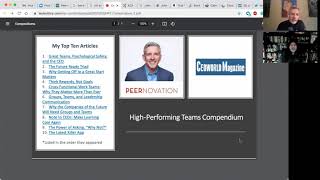
Leo Bottari marks his 50th article for CEO World with five downloadable compendiums covering high-performing teams, peer advisory groups, leadership, and accountability. Each compendium gathers ten of his favorite pieces on topics like psychological safety, the Future Ready Triad, and cross-functional teamwork.
Chapters
Welcome to Peer Innovation, the podcast with Leo Bottari and me, Randy Cantrell. Building on our previous shows, The Year of the Peer and What Anyone Can Do, we turn our attention to helping business leaders build high-performing teams. We'll talk with a diverse group of thought leaders who will share stories and insights that will help you and your teams achieve new heights. If you believe there is strength in numbers and that meeting the challenges of the future can only be achieved if we do it together, then join us for the conversation. Welcome back to another episode of PeerNovation, the podcast. The website is peerinnovation.co. My name is Randy Cantrell, coming to you from Dallas, Fort Worth, Texas. We got through the winter storm, but another cold front came through, so donning the headgear. He is in a much warmer clime. He is Leo Battari, and we're going to talk about— well, it's a milestone, 50 articles, CEO World, and we want to give some love to CEO World too. So Welcome.
Good to see you. Yeah, it's actually, um, I— this was the week, uh, where I actually, you know, kind of got back on the road in earnest. Now I'm not going to have to travel again for a while, but it was so interesting. I go to Arizona basically Monday night and Tuesday, and then I went to Georgia Wednesday and Thursday. So you plan a little time zone thing, but it's so funny, airports and just the whole routine and everything that I could do in my sleep or blindfolded. I'm walking around these airports like, all right, where do go down. I mean, it's crazy. And I was asking, um, one of the guys in the group that I was, um, speaking to on, um, on Tuesday, and I was explaining this. He says, oh, I feel exactly the same way. And it's funny, so at least, you know, this is— see, this is why we talk among our peers, right? To realize that we're not alone and how we feel, what we're going through in these situations right now. But it was, uh, it was good. I actually liked being there in front of people live and in person as opposed to Zoom. Now, again, I enjoyed Zoom. I've been grateful for it. I think there are some advantages to it. I think I've learned a lot from it, but I also, you know, appreciate what I was able to do and enjoyed the time I got to spend with actually two Vistage groups. One was, like I said, Arizona, the other Georgia, both pretty new. And so it's fun just kind of getting them off and rolling and really enjoyed the time. But yeah, yesterday was when the first of the 5 compendiums, as I'll call them, were released. The first one's on high-performing teams. And there'll be one a week that will come out. Pretty much I'll put them out every Thursday. Peer advisory groups will be next week. Pandemic. Will be week 3. Week 4 will be leadership, and week 5 accountability. And in some respects, it was a little bit stolen, if you will, from what I've always enjoyed that Harvard Business Review does with the 10 articles that you may get on different subjects, and they'll clump them together. Now typically, of course, when they do it, there's all different authors and everything. And I realize these are all my articles. However, I think for anyone who kind of happens to like the work, and also for me, on a selfish front, it makes it easier to kind of cluster them and find them and share them with people and all that as well. So I'd like to think there's a win-win there. When you look at being able to, like if someone said, hey, what has Leo written about peer advisory groups or high-performing teams? Well, you could go and do a search for it, or here are at least my favorite of the 10 articles on that subject. Of the 50 articles, I didn't use every single one when it comes to the compendiums, not because— but I just figured I want to just pick my personal favorites, at least against each of the categories. And some, of course, span multiple categories. There's no question. So there'll be a few articles where they may appear in leadership and may also appear in peer advisory groups or something ends up with accountability and another category. So, uh, but I, I had a fun time putting them together for sure. And I can even actually show you what it looks like, you know, for those of us— those of you who are, uh, you know, only listening, you won't get to see this. But if you check out our YouTube channel, we always have video as well. And I can share screen here and we can have a look at what these look like. And they're really just super simple. There's actually a link to CEO World Magazine if you're interested in them. There's a link to Peer Innovation and the work there. But then the top 10 articles, and the top 10 articles for high-performing teams, and these are listed in the order that they appeared, so earlier to later. So the idea isn't that these are in rank order, you know, in any way other than that. The first one is about great team psychological safety and the CEO. It basically talks about how obviously in Project Aristotle with Google, this whole idea of psychological safety and what, what it meant to high-performing teams, uh, was really obviously a huge finding. And I just wanted to also offer that in all of the work that I've done with workshops and when we studied them, psychological safety also plays that same critical role for high-performing peer groups as well. And was just talking about kind of walking through the same conclusion, coming to the same conclusion, but walking through a different door and just talking about that. Next, we talk about the Future Ready Triad, and that's really nothing more than just a conversation about a leadership model that really recognizes that whether it's a group or a team, that the leader, the group or team, and the individual member all share responsibility for the result. And when we were talking about forging ahead, you know, into the future and trying to pivot and try to figure out how we handle what's next, we all share in that responsibility. And the more we think of it that way, the more likely we are to achieve, you know, really great results. I think what getting off to a great start— why getting off to a great start matters is a bit self-explanatory. Think rewards, not goals is probably one of my favorite pieces. That's what we talk about all the time with— when you think about great teams in business, or I think particularly in sports is an easy way to illustrate it, that those teams tend to not regard winning the championship as the goal. They regard the goal as getting better every day. And this is where we kind of invoke that learning-achieving cycle that we talk about all the time and what that means for growth. Because if you are committed to that, just getting a little better, you know, than you were yesterday and seeing yourself being a little better tomorrow, you're always going to put yourself in a position. You may not win the championship, but you're always going to be part of the conversation. Cross-functional work teams is another that really mattered a lot to me because for years I've seen cross-functional work teams kind of fulfill what Harvard Business School says about them, which is basically— or Harvard Business Review says about them, which is that Oftentimes, these cross-functional teams are dysfunctional teams. And they're dysfunctional largely because, first of all, no one knows each other's job. They become people who, when they get together, they're like the ambassador and king or queen of their department, that they're basically there to fight for their people and their budget and everything. What they really need to be there to do is simply look at the business through the lens and help the organization make good decisions. And that may mean sometimes that marketing takes a hit one year, and then maybe somebody else takes a hit the next, or, or there are certain investments that are made that are always right for the business. But when you get a cross-functional work team that's really healthy, and there's that level of trust that everyone is making recommendations that are really good for the business and not just in their self-interest, it makes a huge difference. And so I'm really happy with the message of that piece. And when you really get right down to it, if cross-functional work teams took on a lot of the values and behaviors and practices of peer advisory groups, they would function a heck of a lot better. And so that's really what that's all about. Groups, teams, and leadership communication, right? We know how important leadership communication is. We've talked about clarity. And what that means and how it's the leader who's responsible for the effective delivery of the message as intended. Why the companies of the future will need groups and teams. I think this is really crucial. I do believe this. I think this is where we're going to be headed because we have no mechanism to take anything we've learned and put it into practice, number 1. We don't have the ability to, I think, help our individual contributors be really solid team contributors, and it makes it more difficult to gain strategies around alignment on strategic initiatives, particularly from a cross-functional standpoint, when you don't have— when you have these separate teams and everyone is siloed as they are. Number 8 is— these 3 are more recent. Note to CEOs: make learning cool again. Right? Let's kind of, you know, inject some fun and inject some, you know, interest in learning and what that can mean. And I think it kind of feeds into this idea of thinking rewards, not goals. How do we get better? And how do we really work on that? The power of asking why not, of course, goes back to my Boston Red Sox, back when they were winning the— look at winning the World Series and this idea of a team that was down 3-0. It's never happened at any point in Major League Baseball where someone came back from a 3-0 lead to win a series. And so to come back against all teams, against the New York Yankees when they won the World Series for the first time in 86 years in '04 was pretty remarkable. But it was a team that wasn't down 3-0 and just said, all right, well, I guess we've got to hang it up. You think about all the work that goes in, right? That's when you start having to get inside the heads of players who've been since spring training, have been going through that 162-game season, all the playoffs. Nobody's interested in just saying, well, I guess we just give it up and wait till next year. So the idea that they were able to find a way, carried on their backs by— or Big Poppy, you know, David Ortiz carried the team on his back for several of those games. But, you know, that's what that's all about. And, and great fun. And, and this idea of Simon Sinek's and asking why and having purpose, but also giving your team the confidence that they can actually, um, realize that, right, and achieve their goals, achieve that purpose, um, you know, is really important. And last but not least is this idea of the killer app and what we talk about here. This basically also could have been called Inside the Five Factors because If you look at the 5 factors, they are right people, psychological safety, productivity, accountability, and leadership. The inside 3 there are psychological safety, productivity, and accountability. So they have a special relationship with one another that was worth crawling inside that I think lies beyond the overall reinforcing loop. And there's a lot of feedback loops in there with regard to psychological safety, productivity, and accountability. And I think the more that we understand those, the better. One of them, for example, is people are not inclined to want to access or leverage an environment of psychological safety unless they feel there's going to be some good, positive, tangible outcome from it. So if you don't believe there's any efficacy, you don't believe that any kind of productivity, if you will, is possible, then they're not likely to share. And when people are not likely to share and be open with one another, they're never going to be comfortable accepting personal responsibility for really bringing their A-game and expecting the same of others. So that psychological safety piece, really going back to the very first article and what Google's findings were on that, you realize how pivotal it is to so many different things. So anyway, that's kind of just a quick little overview of that. But I do think if people are interested—
for our video audience, this is a PDF that he is sharing on the screen. Question: are you going to make this PDF available to the audience so that they can click on these links?
The PDF— so if you go to, um, so first of all, if you go to the media page, um, at the website, uh, it's right there, it's right on top. Um, it's also I have also used this. I actually had a bit of a fumble with this yesterday. In fact, I was going into the workshop and the links weren't working in the way I had set it up initially. I'm like, great. So I had some kind of clumsy workaround that actually had you flipping through, you know, 83 pages of the— all of these articles, as opposed to just clicking directly to the site. So on the plane, on the way home last night, I fixed this so that the PDF You know, and you just get to it through a link. So if you go to the post on LinkedIn, Twitter, or on Facebook, the link is there that will take you, uh, to this document. And of course, it's available on the media page at either peerinnovation.co or leobattari.com.
But, um, show notes, and this is episode 13, season 2021 for our listeners. So if you go to the show notes find that episode. And, uh, we'll probably call this— what are we going to call this, Leo? So on compendiums. There you go. Yeah, so we'll put links so that you can, you can get this. Anyway, it's not a cool PDF.
Yeah, not a word to use every day, but it is— it provides a, you know, a compilation of these articles. I think that, uh, that works. Um, I didn't know if there was any of of those for you that, that you found like, okay, of the 10 that are there, there was, there was one or two that, um, kind of hit you at all?
You know, I was more closely kind of fixated on these categories that, that you put these in. I mean, my curiosity, you as an author of those categories Does one of those jump out for you more than anything?
Well, first of all, you know, this looks like this was a grand plan, right? Like back when I first started writing these pieces to see— oh, well, first of all, when I wrote the first or second or third, I had no idea that I was going to keep going. It wasn't until a couple months ago that I'm like, you know what, I'm knocking on the door of like 50 articles here. Maybe I should think about what I can do. And then I also found it increasingly difficult for myself when someone would bring up something and I'm saying, you know, I've got a piece on that that really goes in depth or more in depth on it, and I want to send it to them, and now I got to go find it, you know, which wasn't always, you know, convenient or easy to do. So this really— yeah, there's, there's a bit of a selfish motive here on one hand as far as doing it, but I also feel like It does bring the work together, and the categories came from the articles, not the other way around. So I, I didn't— again, I didn't start this, you know, a number of years ago and say, all right, I'm going to look at these 5 categories and I'm going to start just filling these buckets, you know. That was not the case. I just looked at them. And by the way, all 50 articles are not included in these 5 10-article compendiums. There are some articles that crossover into two, maybe even three categories. And there are some articles— isn't that I don't like them, it's just that I found it difficult to leave certain pieces out that I thought were more valuable.
So we'll go back to the— because I'm, I'm curious now about the, you know, so you start and you write a couple of articles And I know that the audience— okay, let's just share humanity here. You know, it's not all just some big grand master plan. And I know the gurus on the planet would have you believe that you're missing out because you're just not planning every step of the way. And it's fascinating to me, all of the people that we talk to, all of the interviews, I can't think of a single instance of anybody who would even dare claim that that was the lay of the land for their life. So using your writing articles for CEO World, I don't know, peel back the curtain. So you say yes, you're writing these articles, and what are you thinking? I mean, other than the added visibility to you as an author and a speaker and a coach, consultant, whatever, you know what I mean? What are you thinking? Back 50 articles ago or 47.
So, so I'm thinking, well, first of all, I mean, those 50 articles for CEO World may be one of— when you, you could take a look at articles I've done for other publications or the hundreds and hundreds, it, those are probably 50 out of 500 to 600 to 700 posts. I mean, easy. I mean, if not more than that. Um, not all about peer stuff. I did a lot of stuff a number of years ago on client service and wrote tons of articles around that. I mean, hundreds. So it's really, again, just looking at wanting to share the content, number one. Writing articles like this keeps me sharp on things because oftentimes it isn't like, oh, I have this grand idea and I'm going to put it on paper. It's that I want to learn more about this. So I'm going to spend some time really exploring this and see how what I'm thinking about can connect with an audience and how it fits into a body of knowledge that's already out there. I've had people sometimes say to me, because I'll reference certain people a lot or whatever, first of all, they deserve credit. Secondly, I don't mind showing people that I actually read. I don't just write things. And I think it gives it some credibility. This isn't just some idea that, oh yeah, you know, I did, you know, X number of workshops or talks or whatever, and this is the only evidence that I have that what we're talking about here works. You know, that there are other people before me and, or who are currently writing about this stuff and talking about it, where I think people can start to assemble that. And I think there's some value in that when we start, you know, when we look at, um, the article about why and why not. It takes something that is very well known from Simon Sinek and adds just a little piece to it. Now people can look at it from the perspective of, wow, finding our why is great, but now I want to be able to realize that why. And what will that require in terms of having our team have the confidence that we can actually do that? So asking yourselves the question, maybe why not us? Why can't we be the first to do this? Why can't we be the ones that get to the top of that mountain or wherever, whatever goal or whatever purpose it is you're trying to realize. So that's really kind of where it comes from for me, I think. And then over time, sometimes when you get enough of this stuff together and I'm thinking, well, maybe there's a book here, right? Um, you know, the 3 books, again, trilogy, right? Grand plan? Absolutely not. You know, the first book, The Power Appears, was an accident in many respects. It was me being at Vistage. It led a brand refresh of the company. I'm asking all these CEOs how they learn and grow. Excuse me. And they're telling me things like, I read books, I hire coaches, consultants, I go to events and conferences, I go to executive development programs at Harvard and Stanford. Nobody in an unassisted way was mentioning peer groups. And I'm like, you got to be kidding me. Like, I look at how unbelievably effective these groups are, and an infinitesimal number of CEOs and business leaders actually participate in these groups. And largely because they don't know about them, they don't understand about them, and it's not really in their wheelhouse of what they think about when it comes to learning and growing and bringing new thinking into their companies. So the first book was really about, and I've said many times where I said to the board at Vistage, we're trying to sell a Mercedes to someone who doesn't even know what a car is. And it's not just us, it's everybody else out there in the same space. So, and I'm certainly not the only one to have, to have written about it. You know, Keith Farazzi's written about these groups, Bill George has written about these groups, Rick Franzi. You know, there's a host of people that, um, but I also think adding to that body of work, um, is helpful in, in just raising the level of consciousness about what these groups are about. Then of course, you know, you got me into the podcasting world, and at the time I didn't know what that was going to be like, which is why we set up the Year of the Peer, right? We had an exit strategy built right into it, which was a lot of fun. But think about the amazing 50 people that we interviewed that year. I mean, it was extraordinary. We had a really great group, and it was fun to ask all of them, hey, did you get to be successful and where you are today all by yourself? And they'd laugh, right? I mean, they're looking at either— they're like, not a chance. The countless people helped them. And I think their only, you know, concern sometimes is they know they can never repay the people that helped them get to where they are. But it was really nice to see that their generosity of spirit is fueled by the fact that they want to pay it forward and they want to help others. And for many of them, even just getting on our podcast and being willing to talk to us was kind of a way of doing that for our listeners. And so, but yeah, and that really kind of, you know, you know, inspires an idea of the fact that— and these people would also say, kind of similar to what Joe Henderson talked about, Being successful isn't about leaping tall buildings in a single bound and being superhuman. These are just normal people. However, not that they're not talented, but what really makes them successful is that they do those things that anyone can do that most of us never will. And it seemed to me that for many of them, because they surrounded themselves with really great people, because they enlisted their help and they engaged them in a kind of public declaration of, here's what I want out of life. They did those things that anyone can do far more often than if left to their own devices. So there's your second book. And then, so now you see the power of the group, you see the power of the individual. Concurrent with this, I'm running about 150 or so workshops. I think yesterday was my 184th. And, um, and now all of a sudden you start— it becomes abundantly clear that all of this stuff is super relevant to high-performing teams. Everything that groups do so well, we can bring it into the— the context is a bit different, no question about it, but the fundamentals of it are rock solid. And to be able to bring that into high-performing teams and recognize the power that we have as individuals and how much we matter, right? And then we enlist the support of others. This is why having groups and teams operating side by side in companies can be so powerful and beneficial, because the team the group— excuse me, the team, the individual member, and the leader of that team, again, all share that equal responsibility for the outcome. It could be anything from our profitability to how much fun we have. And so, you know, again, no grand plan here. And who knows, you know, what's next? I don't have a clue. But I do think of it like those kids with the marshmallow challenge, you know, when they have the 20 sticks of pasta and they're trying to build the the tallest structure with the string and tape, and they've got to put the marshmallow, it has to sit on top. Well, the planners lose this game all the time because they spend so much time planning, then they build it, they put the marshmallow on top, the thing crashes. The kids, by the way, are going through this very iterative process. I don't care who's in charge, I don't care whatever, they're just building it. It's probably fallen down 6 times already, but then they get it right. And now there's a standing, everyone else's is nowhere. And it just shows you that, I think, and think about this world, it's changing so fast, right? So I think our ability to not just set up a big plan, which as we know, kind of borrowing the military, you know, no plan survives contact with the enemy, right? That we constantly have to pivot and adjust. And yeah, so that's what we're doing. We're pivoting and adjusting every day.
Yeah, and the great thing about this— I was describing— somebody asked me about this podcast some time ago, and I described it as a grand— and I said, now admittedly, I'm putting the term grand on it. You know, it's a grand collaboration. You know, this is just a grand collaboration with or without guests. It's just a grand collaboration. Grand in that that's the aspiration, at least for me, in trying to produce content that the audience can, can do something with. CEO World, I would encourage also, and I'd be interested in your take, I mean, some shout out to CEO World, but for those of you in the audience that aren't CEOs, certainly do not be put off by the fact that content is found at CEO World. There is a ton of really great stuff over there, not only by Leo, but by others in spaces that are very interesting. And I can assure you in the audience, if leadership matters to you, if high performance matters to you, you will find transferable information at CEO World.
CEO World's great. I don't care if you're a CEO, you're an aspiring leader, whatever it happens to be. They cover a range of topics, and it's really terrific. Fantastic to work with. And, you know, our good friend Larry Robertson just started writing for CEO World, and, you know, and, and he writes for, you know, all kinds of different publications. And Larry's work is incredible. And so when you look at who's, who's writing, what they're writing about, um, and it's— and they got just a ton of content, and it's changing every day. I mean, they really are bringing a lot, uh, to the table and getting a lot of good people from around the world. you know, participating in it. So I would highly recommend it. I mean, it's a, it's been a lot of fun, uh, doing the work and being a part of it. And they're, again, terrific to work with. And whenever you've got people that you enjoy working with, you know, I probably, there's no question I could spread things out a lot more in terms of where a lot of these articles appear. And at the same time, I feel like I've found a little bit of a home. At CEO World and really enjoy it and enjoy the, you know, the people, enjoy the company that I am part of with regard to the other people who write there. And, uh, yeah, it's a lot of fun.
The good thing— I mean, there are many good things, but one of the good things about our topic and the reason that keeps my passion really high on it is It's what the web calls evergreen kind of content. You know, we're people, we're humans, and frankly, not much has ever changed. You know, we are— we hope to bring some insight and some learning so that we can work better together and collaborate together. And in a world that seems to lack understanding and any patience for even trying to understand, you know, I know sometimes I don't know about you, but you feel like you're just kind of shouting into the void at times. And then somebody steps forward or somebody raises their hand or somebody emails or somebody contacts you and lets you know, hey, here's what we're doing over here. So I know part of what we want to do moving forward in our interviews is just shine a light on, on the people and the stories to let people know there can be a better way to do things. If you're stuck in tyranny, there is a better path forward.
Yeah, I want to just make a final thought too on this because I've noticed recently the audiobook sales for PIRNovation have been really good, and it's a lot of fun. What I love about the audiobook— no typos in an audiobook. Beautiful, right? You know, think about it, right? Because I'll tell you what, for anyone who's done this— and by the way, I was I was told a friend of mine actually has one of the early copies of The Great Gatsby, which apparently had a bunch of typos in it. But now it's worth a lot of money. So hang on to your copies of Peer Innovation because, you know, it was obviously edited, proofread and all that. But still, you can have as many people look at it as you can possibly imagine. There's a little something here and there and it just drives you crazy because you do everything you can and you wonder how you could have read over the same thing 12 times and missed it. And then recognized that other people did the same thing. However, audiobook, no problem, you know, no, no typos in the audiobook, no missing words, no little punctuation issues, anything like that. It's all good. And I had a ton of fun doing it. I, um, you know, as I mentioned, I didn't read the first two books, and I would definitely recommend that, particularly if you're a non-fiction writer and you're sharing your stories and your ideas and concepts. I think listeners want to hear from it. And if you can deliver that content with a shred of emotion, then you should be okay. And typically, if it's your own work, you'll be able to do that. So, but yeah, I'm glad you did that. I enjoyed that quite a bit. But yeah, grab an audiobook, you know, especially if typos bug you. Like I said, and I don't mean to suggest the book is pretty—
No, the book is not filled with typos.
No, not at all. I'm just kidding.
Um, but yeah, in fact, I had a, you know, I had one of the early galleries and it wasn't, it, it wasn't, it wasn't filled with, with typos, even, even, even in the early stages.
No, no, no, no, no. I mean, it is literally like just a couple of things.
And, and I'm actually going to, um, yeah, they bug you more than they bug anybody.
Yeah, no, quite. Yeah, I'm gonna have them, you know, adjusted, which I can do, and I'm gonna do that. But, um, yeah, no, tiny stuff. And yeah, uh, but But yeah, it was fun.
Anyway, these PDFs, we'll put links to these PDFs, and those of you that don't currently consume Leo's content at CO World, we certainly encourage you to do that, and everybody else's. And to give people some sense of this, these are not, these are not articles that are going to take you 20 minutes to read. These are, I mean, what's the word count on these, Leo?
850 to 1,000 words.
So these are short, brief, but but impactful, hopefully impactful things that you can take and implement. A big part of what we want to do here at Peer Innovation, the podcast, is not just to give you some things to think about and ruminate on, but things that you'll actually use, things that you can do something with. I'm going to give you that.
I think they're short enough to absorb but long enough to keep you out of trouble. And I mean that from this too. I mean, you know how I feel about like these tips articles, the things, you know, how here's, here's how you you know, 5 ways to do this, 3 ways to do that, but they don't give you any context. They don't. So the first time you try it, if you deal with any adversity at all, you're going to bail on it. Because you're really— it's not part of— it just sounded like a good idea. It's kind of what you did, but it really isn't who you are. And you have, you have to kind of live that and have it be part of you if you're going to do something and actually stick to it. So what I try to do with these articles, and what I like about what CEO World does is they want that length to be— you're not going to find typically, I don't think, that I've seen 400 or 500-word articles that just touch on a topic. That 800 to 1,000 words at least allows you to dive in deeply to something more finite and gives you a level of understanding about it. And I don't say that just for me, but for the other writers there as well. And that's why I think the articles are valuable. And they're a notch up, I think.
Yeah, I agree. We appreciate you listening, clicking play. You can subscribe to the podcast and find all the links over at peerinnovation.co. If it's easier to remember, just remember his name, Leo Bottari. That's L-E-O-B-O-T-T-A-R-Y dot com. We appreciate everybody. See you next time.
You bet.
Thank you for joining us. To subscribe to the podcast and learn more about how you can engage peer innovation for your organization, contact us on the website at peerinnovation.co. Until next week, remember, the power of we begins with you.










