AI Conversation Technology featuring ChatGPT
Con Sotidis and Debbie walk through ChatGPT and image-generation tools like DALL·E and Midjourney, showing how they save 35-55% of time on customer support, writing, and design. They cover practical wins like generating a year of social posts in minutes, plus real risks: bias, hallucinations, and privacy concerns that need human oversight.
Chapters
Hello, hello, hello. Welcome everyone to today's webinar. We are actually now live. We're live on various sources. We're on Facebook, we're on LinkedIn, and we're also on YouTube. Good morning wherever you are in the world, whether you're in Australia or anywhere else in the world watching this, or afternoon or evening. Good morning.
Good morning, Con. How are you?
It's good afternoon. You're right, it probably is good afternoon, but anyway, we're still sort of moving across that afternoon period. Great to have you again, Debbie. How you been?
Oh, look, Con, I have been busy exploring all sorts of things in ChatGPT and the AI world. So I'm really looking forward to today's chat.
That's great. That's really good. Yeah, I heard you had a really good session last night with your friends at Monash.
Yes. So we had an amazing session last night. We had over 600 people register for the alumni event. And we had I don't know how many exactly were online. I was too busy presenting, but there was between 200 and 300 people live on the Zoom call, and we were inundated with questions at the end. So it was a really successful session, and hopefully a lot of people have walked away with some really cool tips to use in ChatGPT now.
And we had a really good session last week. We did it at our local learning center here in Melbourne, Victoria. And we had a number of staff and board members, and they, they really enjoyed, uh, seeing what, you know, platforms like ChatGPT can do for them going forward. And we're now looking to get that rolled out further to the community. So it's going to be really exciting times ahead. So looking forward to doing some work and helping the community come to grips with this technology, but more importantly, getting some value for it as well. Okay, so for anyone that doesn't know us, let me just do a bit of an introduction just to make sure we get everything out of the way. For me. That's me, Con Sotidis, Social Selling Warrior. Social selling comes from the word that LinkedIn uses in relation to that sort of concept of using LinkedIn as a platform to create more opportunities. I've been doing LinkedIn for quite a few years now, and now along with Deb and other people, moving into the AI space a lot more because I see this as a great opportunity to educate, to inform, and update people about a great platform So if you want to contact with me, that's me there, LinkedIn, easy to find, just my name. And also the website, please be gentle, it's still always getting updated and reviewed. But at least it's up there with— there's a domain name, there's a presence, and we've got some content. And we'll further enhance that. Now, Debbie, tell us about yourself.
Oh, I am very busy in this AI world at the moment. So, you know, I am playing in it, exploring it, and teaching at the moment. And I have come from a learning and development background, focusing on leadership a lot of the time, but also change management and HR within that space. And we have also stepped into this AI world with an absolute passion and just a curious nature and always constantly learning and wanting to share those learnings with others. So this is where, you know, you and I have come together and we've had some fantastic training workshops webinars and virtual sessions. So looking to continue the journey.
Magic. That's great. Okay, that's the end of Melly's. Guys, if you're watching this live, please put your comments in there. We'd love to see your comments. Any questions you have, we'll have some time at the end for some questions. Any questions, thoughts, observations, whatever you want to put on the table, we're happy to entertain. We'll have some time at the end of today's session. So what I've done is I've prepared a bit of a presentation that Iv and I will sort of speak to. And we should highlight a few of the opportunities that exist within this, um, new environment of AI, and also why you, if you're in business, if you're a professional, whatever industry you're in, why you should start looking at AI and ChatGPT and start, um, using this technology to your benefit. Okay, let's get into it. We'll add that to the stream. There we are. We should have that. I'll just take, uh, that off, and we can take that off. And good. And There we are. Magic. Can we all say that? Maybe.
Can you say that? Absolutely.
Yep. All right, so, uh, AI conversation technology is sort of the theme, but really, at the end of the day, um, what ChatGPT and Gemini AI mean for your business is the most important part. For your business, whether you're an employee, whether you're a business owner, or you're an entrepreneur just starting out, this is an opportunity for you to come to grips with the technology and a platform that's really gonna change your way and a lot of ways of why you do things. So let's get into this now and we'll just move along. So what is ChatGPT? Well, it's one of the fastest growing applications in history. I'm hearing a lot of sort of stats being thrown at me, you know, a couple of million people in the first couple of weeks signed up for ChatGPT. It can be used to augment and even automate existing work processes in IT, marketing, across all industries. It's, uh, it started off— well, I come to it, uh, I came into it about October, I think, last year. Maybe, Deb, you were the same around then?
Yeah.
Is that when you first came across it? Yeah. And just about it and seeing it, and then, you know, joined up and started using it. I was just blown away. So, Deb, what was your experience? Do you remember your first time you came across ChatGPT as a platform?
Yeah, I'm not sure how exactly I found it, but I found it, you know, just through people's emails or comments on LinkedIn, etc. And I thought, oh, what is this stuff? And jumped in and was— it took me a little while actually to get in because my VPN prevented me from getting in. I had to work around that. So I had to be very determined to get in and I was. And I was so grateful that I had that determination because when I got in there, it absolutely changed my world. So, you know, I don't know about you, Con, but In the past, I've been given projects to do. And, you know, sometimes you sit there and you go, right, how am I actually just going to start this first piece of information? Or what is that project plan in its entirety going to look like? Because I don't know all of the pieces yet, you know. And I started playing around with things like that. And, you know, it's an amazing thing because it can clear your writer's block.
Absolutely.
And to add to that, I must say, I introduced my dad who is in his late 70s, and I introduced it to my dad a couple of weeks ago. And he was, you know, a bit nervous, a bit tentative. He actually sat in on my webinar last night as well. And he spoke to me this morning. He goes, right, you know that book I've been writing for 25 years, thinking of writing for 25 years? I've actually jumped in this morning and I have got, I've got some layout, I've got some structure, I've got the skeleton. It's going.
That's great.
And I thought, oh my God, this is amazing. So it just cleared 25 years of writer's block.
Yeah, and my example is a very similar one. I've got a reasonably big family being of Greek background, so we've got a lot of birthdays and, you know, sort of major milestones coming up. So I've been thinking, you know, I always struggle with writing that message on the card. You know, I want to make it personal, but I'm always struggling to write the The right words, make sure they're the right. So what I'm doing now is I'm using ChatGPT to give me a bit of a start and then personalizing it with my little, uh, little thing at the end. But it gives you a bit of a start to write that, you know, that greeting to that sort of a family member that, that's going to make it a bit more effective and make it a bit more personal. But then I add my own little personal, um, greeting to it as well. So that's the moral of the story, I suppose, here. What we want to talk today is— we will talk about this— is Do not, and I know Deb agrees, do not just accept anything this platform gives you. Look at it, verify it, validate it, add your own brand, your tone, your voice, but it's going to give you a great head start. With that in mind, let's keep going and let's see where else we go. So we're going to start thinking soon. I think this is going to become important in the years to come. We're going to be talking about eras, just like our friend Taylor Swift, her eras. We talk about the before generative AI, we're going to be talking about the post, the new exciting era of GA, the generative AI. So years to come, we'll be saying, you know what, in BG we used to do it this way, in GA we're doing it this way. So it's going to become part of our natural language vernacular, I think. Deb, what do you think? It's going to become something that we're going to become used to, I think, in years to come.
Absolutely. And, you know, I sort of look at things that have happened, particularly over the last 100 years, you know, and I was saying earlier, Con, with electricity, you know, If we go back 100, 120 years ago, electricity was this new concept and people were scared and fearful of it. And we don't talk about it as before electricity, post-electricity, but it's that type of concept again. And we discussed stepping stones. Electricity was a stepping stone to get to where we are now. Without electricity, we wouldn't have all of the technology that we can work with. This is another stepping stone, and who knows where it's going to head. You know, when they introduced electricity, they didn't think of computers, technology, AI, any of those things. This is simply the next stepping stone, and it's a pretty big stepping stone, I think.
I think it's gonna be a watershed moment in history. It will be.
Yeah, absolutely.
So the perceptions of AI in the business world, I mean, In general, we're hearing a lot of good feedback from the business world. And in some recent surveys there by Deloitte, 79% of companies are using AI. And we're also seeing that organizations now even boosting their capacity, their IT capacity to take advantage of AI. And we're looking at, you know, 23% increase in the next 12 months based on that Deloitte sort of survey. So business is embracing it. We are hearing now major organizations around the world are starting to invest in this very heavily. Deb, did you have some other stats that you come across, some other sort of studies?
Yeah, well, I specifically talked to some— 3 studies last night when I was doing the Monash webinar. And, you know, the 3 studies, 3 separate types of businesses. One was customer support area, one was a developer productivity area, and one was just getting business people to write their normal reports, right? And they did pretty much all of the studies did half using AI, half not using AI. And what is recognized across all 3 studies is that not only is there a huge reduction in time, so anywhere between 35% and 55% reduction in time, there is an increased productivity as well. So not only are you reducing the time, you're also elevating your productivity. So from a business perspective, that's a win-win. scenario. The other thing that was recognized in more so 2 of the 3, but the 3rd one did recognize it a little bit, is the fact that those that were utilizing the AI actually improved their performance and there was a removal of the inequality that currently exists between low performers and high performers or less experienced and more experienced. So there was this this social improvement within the workplace, cultural improvement, right? And it brought people to a higher productivity much, much faster, 2 months as against 8 months to bring them to a high productivity level. So the reports are new. They are, you know, obviously they've only been done in the last 12 months with ChatGPT being released last October. But this sort of study is going to show, and the longevity will come into it. as people go back and say, okay, well, what's happening with those people now? And has that productivity still increased? Has it been sustained? Or is it starting to level out? So I think there's a lot of good stuff to come, but it's all up, up, up for businesses in this space.
And I like that last point you make because I saw something the other day that said it's going to democratize content creation. And that's a very interesting concept. It's going to make it sort of a more equal playing field with the haves and have-nots because it's a free resource. It's there. We know there's a version 4 which is available to sort of Plus subscribers, but even the 3.5 version is very, very effective and very useful for what you want to achieve. Yeah, what you want to achieve. So that's interesting. Thanks for that. Thanks for sharing those studies there, Debbie. So let's keep going. Businesses face a labyrinth of problems. That they do, and they do that on a regular basis. But when it comes to generative AI, businesses can overcome some of these issues. For example, another state that I come across was Forester, where including, you know, things like generating coherent stuff and trying to recreate biases and all that, ChatGPT can do that. So there is some issues and concerns about ChatGPT and what it can do. I hear a lot of times people say, I don't trust it. Oh, it's creating some stuff which is not true, which is not right, it's not correct. Yes, it's still learning, and you need to train it. And the one thing about ChatGPT is once you get in and start using it, the more you train it and tell it about yourself, your business, your website, the more it will remember about you. And when it comes back to doing more output for you, it will keep that in its memory. So it's continuing to learn, which brings the other facet into it, which is about what do you want to put out there. Remember, what you're putting out in ChatGPT is not private. So be mindful of using client names or client businesses or even using some private information because it's out there in the big wide world. So yes, it can create some biases. Yes, it might be not as accurate. But having said that, with a bit of careful prompting and a bit of careful sort of scripting, you can achieve the outcomes you desire in relation to getting some output you're going to be able to use. Deb, you want to add to that?
I just think it's important to have that human oversight, right? To remember that this is not an entity, it is a tool, it is a resource. No different to going to, you know, going— you remember those things called libraries that we used to have to go to in the old days?
Yes.
And look up the encyclopedia? It is no different to that. It is a resource, right? And we just need to keep that at the forefront of our minds and go, it is us who are actually— if we're going to copy and paste anything out of it, which we can do, No problems, but you need to put that human oversight across it. And that will mean fixing any of those errors that potentially are there. If you use ChatGPT-4 and do it as a temperature 1.0, it will go crazy, right? But if you keep it nice and sedate and calm and you prime it up effectively, it will give you— it will deliver the right information in the right way for you. But you've got to have always, 100% of the time, human oversight.
Just want to touch on that, Deb, just for our people who might not be across that sort of temperature thing. Can you just explain that temperature thing a little bit more, please?
So if you put a prompt in and then put at the end of it temp and the digits are between 0.0 and 1.0, the closer you are to 0.0 with your temperature, the more focused, very specific to the exact topic, exactly what you've asked it for, it will come out. If you go closer to the other end, that 1.0, it will get very creative, innovative, a little bit random. It can go a little bit crazy. It might start to make some things up. So it's just about really testing the waters and framing it up. And you might find that you really are comfortable with the temperature at a 0.4 or a 0.5 or something. You don't need to go to that, you know, far end of it.
You might be comfortable— And therein lies the whole sort of premise of what we're doing today is keep playing with it, keep trying it, keep using it, keep experimenting with it. Because like Deb just said there, even with the temperature stuff, you can get some different sort of creative outputs. And just a matter of you trying and looking what the extreme creativity might be, and then saying, okay, well, I want to go a bit more closer to what I really want to get and make the temperature a bit lower. So very, very good point. Thanks for that, Deb. That was really good to enlighten our audience on that. So let's keep going. Now we've got one or two questions coming in. We'll do those at the end, and we'll definitely cover those. So I've got them, I can see them coming through. So keep Keep putting those questions in the comments and we'll be able to answer those at the end. So the next question is, what's to be done? Well, and this is the aim of today's exercise and what Deb and I are trying to do is trying to educate, trying to give people that opportunity to learn, trying to give the people the opportunity to come to grips with this platform. Now you can go on various sites and we've all seen them where people just feed you top 100 marketing ChatGPT prompts or top 100 social media prompts, whatever the case may be. I am a fan of Stephen Covey, and Stephen Covey talks about the fish, which is give a man a fish for one day and you feed him for a day, teach him how to fish, you feed him for life. And that's what Deb and I have in mind. We want to teach people, we want to educate people, we want to give them the skills, the capability, the confidence to get onto this platform and to start using it effectively. Deb, over to you.
Yeah, I think that's such an important thing to really start to understand how to do this effectively for yourself. Because as you say, you can jump on and get 1,000 prompts. I saw 1,000 prompts the other day and I went, that's great. And I had a look at them and I went, none of them actually relate to me and what I want to get out of the system. So that's fantastic. Thanks for sharing. Brilliant. But it doesn't actually help me. What the? You know, so I think if you are open-minded and you're willing to learn how to frame up your prompts effectively and actually, you know, get to the specifics that you want to get to, you'll have a much more, not only enjoyable experience, but you'll be able to optimize the experience effectively. For your needs, right? Whether they be business needs or personal needs, it doesn't really matter. You can frame it up to whatever you need specifically.
Yeah. So if everyone's watching this, whether it be live or recorded, it really is up to you to come to grips with this. I have a bit of an image that I use in the sessions we do is don't keep your head in the sand. Take it out of the sand and explore it. Have a look at it. And that's the aim of what Debbie and I are trying to do is trying to educate people and given that skill set to be able to use the prompts and use them very effectively. In fact, I saw an ad the other day, Netflix in the USA is looking for a new prompt engineer for their studios. Companies are now investing heavily in this field. Like Deb and I always say, I'll hand over to Deb, AI won't take over your job, but—
People who understand and can use AI will take over.
Correct. Remember that as we go forward. Let's keep going. What a great, what a great duo we are, Deb. Uh, we should be in comedy. Okay, let's look at some use cases. And this is just giving you a sample of what, you know, where you can use it. So for example, it is becoming much more effective in creating images. Now there is things like DALL-E, which is an OpenAI tool. There's Midjourney, which sadly has stopped all its free plans, but there's a subscription plan. There's things like one I use and Deb uses a lot, which is a D-ID, which is an avatar sort of creation. But when it comes to image creation, the sky's the limit. Some of these tools— another one I found, which I'll put in the link later on, it's called playground.ai, which is free.
Stable Diffusion is another one, Con.
Stable— so what's the Stable—
Stable Diffusion.
Stable Diffusion. Yeah, right. We'll put those links in later on too, Deb, um, for people. But this is where Image creation now is going to become so, so powerful that you won't have to invest in that sort of stock photo anymore because you'll be able to create images that you need for your purposes and be able— and they're getting better. Yes, there is still some little tweaking to be done, but they're getting a lot better, and you'll be able to use them on your socials, on your websites, on your brochures, on whatever you need. So image creation is an area where AI is really going to change The whole landscape. Deb, did you have anything else to say on image creation?
I was just going to say the other tool that is much newer, but Adobe Firefly is absolutely spectacular. It's currently in beta stage and is, I still, I believe, I haven't checked it this week to be honest, still free to play with it in beta. But if you're an Adobe user, then I would highly recommend jumping into Firefly because it's a fantastic tool. Tool. And I think it's actually— Midjourney is great, but there's no free version of that anymore. And I think Firefly might surpass. The other thing to mention is that companies like Shutterstock and iStock and all of those companies that have been selling the images, the photos and things, they are actually investing in AI as well. So what you might see happening in those sites is that they are now starting to introduce AI tools to then create within their websites also. So they're on board with the journey.
I'm just getting some of those links here, Deb. So just give me a second. So that's— I will put that in there too.
Yep.
Here it is there. So I've got Stable Diffusion. Is that the one, Deb? Stable Diffusion. And also, yep, Adobe Firefly. Really good pickup. I've been using that quite a bit. It's still in beta version, like you said. But he's simple, awesome. And the other one I've used is one called— I'll just put this one in there as well. Just give me a second, guys. Playground.ai. I've really enjoyed this one the last couple of weeks. I've been playing with it quite a bit and I really enjoyed it quite a bit. So hopefully there's some resources there for people to tap into. Now let's move along. Sorry, dude.
I was going to say, Con, so you just said, you know, I've been playing with it quite a bit. I think it's— you have to actually maybe dedicate a little bit of time. It might be, you know, an hour at the end of the week or the start of the week just to play with the amount of tools that are coming out and explore what is available and what you can, you know, have a play with for free, etc. Um, I only go in and play for stuff for free unless I'm absolutely dedicated to it, and then I'll invest. Um, but you do need to set aside some time, otherwise it will escape you. And there's about 2,500 to 3,000 tools being released every single week, which is just phenomenal. So if you're not in there playing and exploring, you'll, you'll be left behind.
Yep. Okay, I can't see any links. I'm posting them, so maybe they're not coming through. Uh, look, I'm surprised because, uh, oh, here we are. I should do this, shouldn't I? There you go. Uh, yeah, but I thought they'd go into the comments. Maybe I'll put them in the— look, guys, I'll put these links in later on in the, um, the event as well. So don't stress if you're not getting them now. But there, there's that one there, and there's stable-diffusion-web.com, and there is Playground. But look, don't stress if you go back to the replay later on. I'll make sure when we finish this stream, I'll put all these, uh, links in there for you to have a look at them as well. So my apologies, and So hopefully Adam and the Olympian user there can— hopefully Adam, you can now see them, or have seen them, but I'll put them again also in the comment section of the events later on when you go back. All right, let's go back to the presentation. We've also got now there the marketing. This is an area that I play a lot with, where it is really impacting the marketing space quite a bit and be able to create on-brand content and also help with creating some, whether it be social media posts, website copy, and so forth. For example, the example we've used before is where we come across a subject matter that we don't know much about, but we've been asked to write something about it, whether it be a course or whether it be a post or whether it be a blog. What ChatGPT has been able to give me is the opportunity to break that sort of mental block give me a start and be able to give me a head start in relation to some of the content. It could be some technical content as well, and then I'll go away and tweak that and massage that and adjust that for the brand and the voice that I want to apply to it. So marketing is another area. Content creation is a big area where platforms like ChatGPT will be changing the landscape. Debbie, do you want to say anything on that one?
Look, I think this is a big player at the moment, particularly. And from my perspective, we've actually used ChatGPT to create us a marketing calendar for the entire year. It did it in about, I reckon it took less than 3 minutes. So we've got a calendar for the entire year. And within that calendar, because we framed up the prompt effectively, we asked it to create us all of the content for LinkedIn, Facebook, Instagram, what those posts should read, what the headlines were, what the hashtags are. Everything all came out within a 3-minute space. So we've now taken that away, we've copied it and put it into our Excel spreadsheet, and now we're working through it and giving it that human oversight. But I think from a marketing— I'm not a marketer, right? I teach people. I'm an L&D person. But, and I get lost in the marketing world, but for me, it's just, it's a godsend. It really is, you know, it's a tool that I can use effectively.
So there's 2 areas where, you know, we believe the platform is going to have a big, big impact. And there's some of the areas that we focus on in relation to our training that Deb and I do. So when you come along, we'll, we'll show you some areas of content creation, sorry, and also some image creation tools that we use and how we apply them in actual real cases and scenarios. All right, so let's keep moving along. And I understand that I didn't comment yet, Adam, and I will get them in the comments soon. So, so keep in mind that AI is just another step in the evolution of modern computing. Yeah, the things I hear, Debbie, is like, oh, it's cheating. Yeah, or it's, uh, it's not doing the right thing. Well, you know what, the way I address that is we Google things anyway, when no one's ever talked about cheating there. We actually Google, we get results, we actually go into those results, and we have actually sometimes look at those results and get some content from there. So, and I think the analogy you use is the old encyclopedia where you'd go down to the encyclopedia, to the library and, and look at the encyclopedia. So yeah, the way I see it is that it's not cheating. It's about supporting you in your outcome that you want to achieve. So it's just another step in our evolution of where we're going with relation to IT and technology. And sort of content creation and marketing and graphic design and so forth. Did you have anything to add to that?
Look, I think 100% con with what you've said, but I think where people see it as cheating and look, some people have gone in ChatGPT, do this for me, copy paste, send it out there. That is cheating, right? If you haven't got that human oversight over it, if you haven't given it your voice, your tone, if you haven't added to it or subtracted from it and really framed it up effectively to be more of your style, then yes, absolutely, it's cheating, right? Exactly. But if you continue to offer that human oversight, and that's the terminology that I'm going to use moving forward, I came up with it for last night's webinar, but human oversight is the quintessential point here. Right? Get curious with it, learn from it, use it as a resource and a tool for knowledge acquisition, for knowledge collection, for knowledge resource, but you need to still work with the material that comes in. It is no different, as you said, going to the encyclopedia or going to Google or even going to that dreaded academia website called Wikipedia. You know, it's a resource and you need to treat it as a resource tool. Right, it's not, you know, it's not—
Exactly right. It's a resource, and that human oversight concept is so powerful. And that's the most important thing we need people to take away from today's session. We're not saying it's going to be the best thing since sliced bread, but I'll tell you what, it's very close to it. When you add something, when you add some human oversight to it, you will, you'll find it gets very, very close to it. So You know, that's the important part of today's session. So keep going along. There we go. So I'm just gonna get the— not working.
Technology con.
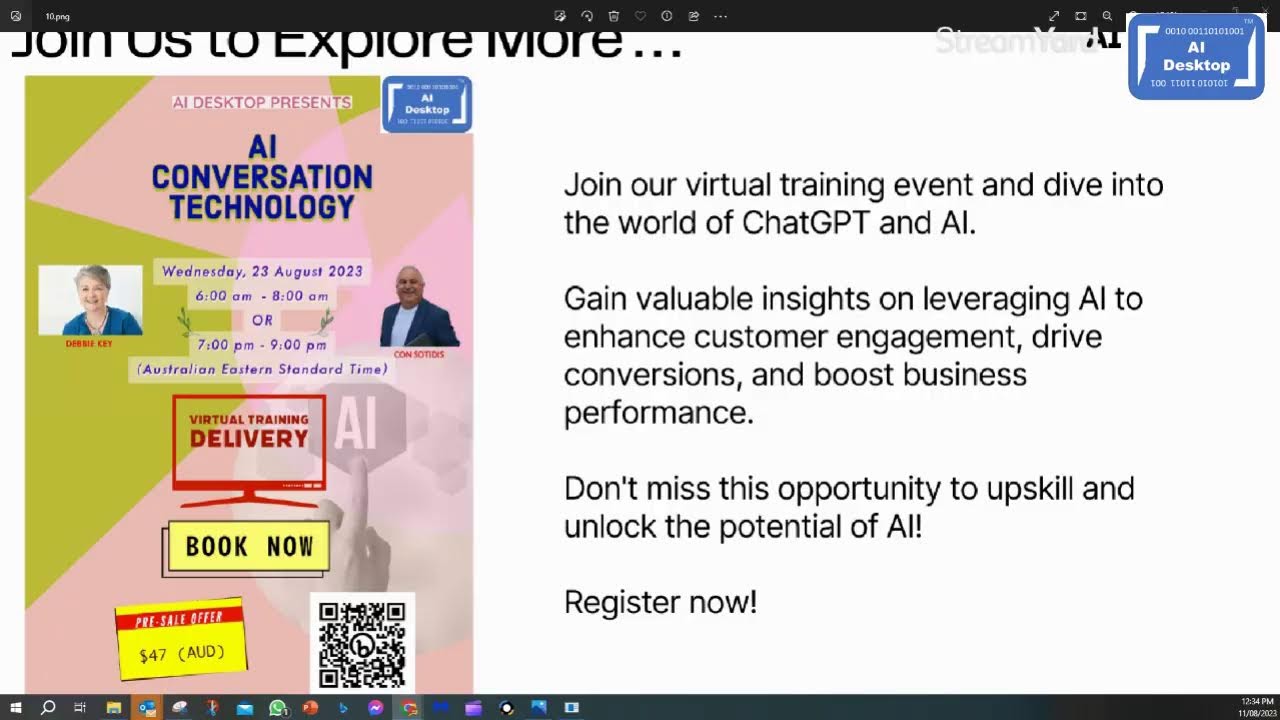
It's not going. Let me go forward. What's that? Let's see. Let's just make it small. Let's see. We're there. Is that there? That's it. Yep. Let's make it bigger. Strange. There we go. That's why. Now, so what, uh, Deb wanted to do— this is the only part, guys, that we just want to talk to you about what we're doing going forward. You've heard a bit about today about what we do. You've heard a bit about some of the use cases. You've heard a bit about where AI is going and sort of how it can impact your world. What I'm going to do is I want to give you an opportunity to come on this journey with us. Uh, we want to provide you that capability. That skill set that you will require to be able to come to grips with ChatGPT and AI in general. So you get some valuable insights on leveraging AI. We'll have conversations, we'll have discussions. We've got a workbook that goes along with this. We have some examples that we show you where they're being used in real-life business situations. And we, we're offering this to you at a very, very good rate. And you can see there It is $47, the best dollars ever going to spend for 2 hours with Devin Khan in an interactive session going through ChatGPT and how you can use it for your business. So we'll open it up to a conversation. We want you to come along with some of your challenges. We want you to come along with some of your, your topics, what you want to do, what you want to cover, what is something you want to achieve by something like a ChatGPT And we'll be attending to those live in the sessions. We've got them happening on the 23rd of August. And because we realize there's a variety of different personalities, some people are early risers, some people are late workers. And time zones. And time zones, yes. And hopefully people around the world are watching this. So Deb and I are going to get up early, and after we milk the cows, we're going to go in there and start the conversation technology.
At 6 o'clock, and then we're gonna have the hair and makeup done at 6 AM, Con, but we'll see what we can do.
Yeah, I know, I know, I know. That's the eyes. Anyway, a bit of Baraka will help us, and then we'll get up, uh, then we're gonna go for a little bit of a nap and then get up at 7 PM and do the evening session. Both sessions are live, they're not recorded, so you will get live sessions. They're not those pre-recorded sessions where you sit there listening to someone, you ask questions, you get questions answered later on. They're both going live. They'll both be live. We'll be sitting there talking, discussing, interacting with you all in relation to the type of challenges and questions you have. And you'll get a workbook, you'll get some resources that will come along with that, and you'll be able to then go away and start using it ASAP within your own business environment. So there it is there. That should be the, uh, let me just put that in, uh, yep, that's there. You should be able to scan that QR code, should take you straight to those sessions. Deb, you looking forward to this one?
Absolutely, Con. I think it's, it's going to be a really— it's going to be a long day, but it's going to be a fantastic fun day. And, you know, for both of us, I think we really enjoy actually helping people to resolve their particular challenges and issues that they're having with the tool or with various tools that we may talk about. We don't promise that we're going to talk about every tool, but if you've got a tool that you want to talk to us about, we are confident that we have at least seen it and we know how to play with it. So, you know, bring your questions. If you want to prime us before the session, feel free to, you know, shoot us out some questions before the session and we can make sure that we can absolutely answer those questions with authority. But it's going to be a fun day. And I think if I think back to the testimonials we've had from our previous sessions, people have walked away and told us that the session was mind-blowing, that they came to the session thinking that they understood the tools but have walked away with such an elevated application of the tool now that they wouldn't have missed it for the world. So we're very confident and positive that you'll walk away with pragmatic tools that you can apply immediately, and you will get more than your value for money in return.
Yeah, I recall one of these feedback sessions. I had a call, one of the people that came to our session, we did it, I remember we did it in sort of the afternoon. That night, I got a call about 11 PM from one of the individuals that participated. He said, what have you done to me? So what do you mean? He goes, I've been up all night, he goes, and it's getting close to midnight. I just still just grappling with this stuff you showed me today. This, this is mind-boggling. I said, well, there you are. He goes, but yeah, he actually thanked me. He said, where you been all this time? I've been looking for someone like this to help me in my business. So this guy was a small business owner. So you will get value. And trust me, those sort of, um, moments that I experienced with that individual, you will also experience as part of this session. We believe it's priced very, very modestly for 2 hours of our time, and you'll get a workbook and resources. We're hopefully— it's, uh, we've priced it at a level we, we want people to be able to access it and be able to participate in it. So we're not looking to sort of overcharge too much here. We're just looking to give you resources and our expertise, you know, in this space to help you come to grips with, uh, ChatGPT and AI. So on that note, did you want to, as we close up and see if there's any questions?
Um, yeah, let's explore questions, Con.
Yeah, let's call for questions. The only question I had there from a user who's just left are the references for those 3 studies. So we can get those references, Deb.
Okay, absolutely.
Yeah, we can put them in the comments later on, those, uh, 3 studies, and I'll put the one that I referred to as well. That'd be great. Um, if anyone's got any other questions, you look at the comments here. So Adam, I appreciate your comments in relation to the, the links. For some reason I'm not able to post links. I don't know what's happening with my StreamYard, but I'll, um, I'll put those links in later on after the event in the comments. So please go back and have a look at that. And they'll be in there, those links to those particular tools that we mentioned. Anyone else? If you've got any questions, please place them in. We've got a couple of minutes left.
We've answered all the questions, Con, obviously.
Yeah, we have. So there's Adam. Thanks, Adam, for your support. Thanks. Thanks.
See, we answer all the questions. People walk away with everything answered.
Most important thing is we would like to, uh, we'd like to see people come to our sessions and come to, come to grips with this technology, because that's the aim of the game, is to come to grips with this technology and come to our sessions and get— meet other people and find what other people are doing with it, but also listen and see what, what we've been doing with it and how it can help you as well. Any last words, Deb? Just, uh—
I think, you know, if, if, if you're questioning whether you should come along and, you know, pay $47 for 2 hours, I think you're not actually ready to get on board, right? And if you're not ready to get on board, you're going to be, you know, you're going to be without this wonderful knowledge and experience. And I think, you know, I know that early adopters are the people who, you know, push this We're not in early adoption anymore. The million users that jumped on ChatGPT in the first 5 days, they're the early adopters. We are now mid-range of the bell curve, and it's about everybody starting to really get to grips with this. So don't leave it any longer.
That's right. Good point. It's time. On that note, I'd like to wish you all a great Friday wherever you are in the world. Enjoy your weekend, and we look forward to seeing you on that particular webinar. And we do also have a LinkedIn group. It's called AI Desktop. So join that group. We— I try to share resources and commentary around what's happening in the AI space. So if you go to LinkedIn and search for groups, search for— you see the top corner there, AI Desktop. Search for AI Desktop in the LinkedIn groups. And you'll be able to join our LinkedIn group where we try to share resources and some articles that are floating around, around ChatGPT and AI in general. Thank you very much. Thank you, Deb.
Thanks, Con.
Have a great one. Yep, we'll see you all soon.