NDIS - Connected Care Conversations
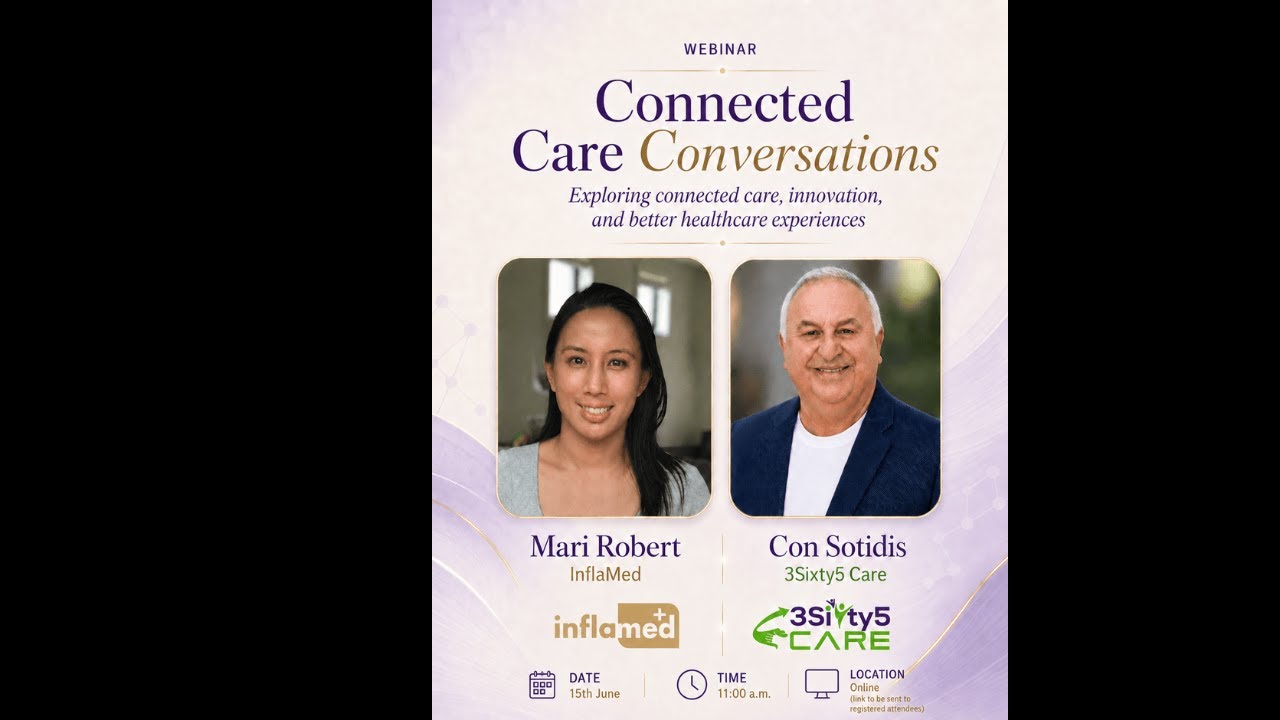
Alan from Continua Healthcare demonstrated a connected-care platform for NDIS clinicians that aggregates patient data, wearables, and notes in one place. It cuts administrative work by automating reports and syncing with practice-management tools, and includes security features like ISO 27001 certification and granular patient consent controls.
Chapters
Hello everyone, just trying to get things set up. We've had a real, uh, spanner in the works this morning, change of plans. Oh, Alan's mic. Alan, I thought I gave up. We've got the camera. You're right to go on. Can you hear me? Nope, you can't hear me. Can anyone else hear me?
You want to put a comment in the comments if anyone else can hear me? Hey, Con, how are you?
Can you hear me, Alan?
Yep, I hear you.
Okay, all right, great. Yeah, like I said, I was just about to cancel it, then I saw you pop up, so well done.
Oh, sorry, it was just waiting. I was waiting at the, uh, I guess the front door of the thing, but you had a special invite.
You had a special invite. I said you've got a special invite.
That's okay.
Oh, okay, not too worried. Um, okay guys, welcome to the, um, yeah, sorry, we've just been put off altogether. Sorry about this. Um, give me a second to get my, uh, numbers together. Okay, welcome to today's session, 365 Care, in collaboration with Inflamed. Um, I met, uh, I mean, Inflamed, I met Maui and Alan about a month ago at a networking event, and I was very impressed with, uh, what they were developing and what they were creating, and I thought It'd be great to get more exposure and get some more traction on this product they're creating. And what better way to do that by doing a bit of a live demo? So what I liked about what they were doing, I'll just quickly talk to you about, if I'm going to continue, I had all these set up, so let me see if I can do it again. Just take it over there and let's see what happens here. Okay, good. Okey-dokey, where are we? Continue on another time. It must be this one here. It's amazing how long— yeah, okay, I'll stop sharing that. Not going too well here, I see. But anyway, we'll have to stop that one and, uh, yeah.
Well, I've got a, I've got a presentation myself that I'll give.
Yeah, take it over, man. And we'll go from there. Yeah.
All right. So let me just grab the screen.
Yeah.
So are you able to see my screen?
Yes.
Yeah, so I'll just kind of go back up to the start. So, Inflamed really started with Mari, and she's sorry she actually woke up with more problems that she's had to deal with today, as patient zero. So, a lot of what she was dealing with was having a way for her to understand what was wrong with her and waiting almost over a year to see a clinician. She wanted a way to be able to understand what was happening for her between appointments. A lot of that was built from her experience along that path. How can she grab all that information to be able to understand for her? But it was about going along that journey and then finding that connecting with the clinicians and the providers was where she was actually able to start transferring that information and working together with them to connect Not just the patient data, but the, the in-session data and that data over time, all that information over time to help identify patterns and really get down to the root cause for better decisions. So we're all about clinical intelligence. So clinical intelligence for us really means taking less time trying to deal with all the different systems Worrying about what's happening from that pre-visit. So clinicians not knowing what's happening between the 30 days that they saw you last, or knowing, trying to know what's coming in, having all these different systems that you're having to deal with, your notes. Somebody sends you information by WhatsApp about this, scheduling the appointment, running the appointment. Doing all the potentially scribing, fixing what the scribe says, then taking that and making it into a note, and then being able to pass that on to the patient when they're leaving the appointment. So what do they need to know going away? What are the things that you would like them to do and check on them for? Or even better yet, if this is— a chronic issue and you're dealing with a care team, how to pass on that information from you to the next person so that it doesn't get lost and it doesn't get dropped. So it's all about taking all that information because there's a large disparate problem between it. So there's a big pressure around seeing what's happening. Dealing with what's happening and knowing that something's going to get better. There's a large growing demand around the allied health, around burnout that you're dealing with 800 hours. We've seen from a solo operator they can deal with 800 hours of administrative reports for NDIS each year that we've, we've come across. From the weekly reports to a monthly, to a quarterly, to a biannually, to an annual. It was kind of a never-ending process with them. And then what, what we really came back and tried to figure out, okay, how do we help not just the clinician but the patient? And that's where we sit. Simplicity-wise, it's all in one. So we really have tried to connect all those things that the clinician deals with, whether it's telehealth programs that they're dealing with, patient engagement, the actual running of the appointment itself, to the scheduling, to the seeing that patient, to the discharging of them, and the reporting of all that thing, all that Information burden, administrative burden that you've had to deal with. So we take that and we provide something that we've heard back that this is a great thing that we can show what's happened over time. We can help with taking all that information of what's happened versus where you want to go. So what is your plan that you're looking for? And tie that together to see how an outcome has been generated and what's personal for that person. We allow you to manage it, to see it, to sign it off, and save time with that. And from all of that, getting something that's simple to use, that's new and improved, it really— we found that we could get benefits not just in the outcomes, not just in the efficiency, but also in helping solo operators run their clinic at a better cost. Paying for all these systems comes out to more than it would be for ours alone. So I've kind of talked about all those things, we sit in the middle of connecting all those problems and getting something great out of them. What are you going to see today in a quick 10-15 minutes? 3 key moments that we're going to go through that's going to help reconstruct and make the case for where we sit and where we're trying to benefit everybody else. We're going to look at what happens between visits or prior to visits from the patient's perspective. So how can they simply see what's going on with themselves, help you get that information, or be able to— if you're set up from that current problem that they're having— be able to set an appointment with you and see you right today? To being What is that intelligence that we keep talking about, right? How can we see the change in that patient from what we're calling a live profile? What are the difference that we're seeing? What are the patterns that we're recognizing? And how can we help make your life easier so you're not paying 20 questions or spending 30 minutes of a 45-minute consult asking questions to try and get your bearings? And then after that consult, it's really about how do we take all that information and make your life easier. So whether or not it's from the documentation perspective, but it's also being able to set it up that is personalized for the care— that care plans that you have. So being able to take that care plan, take all that information, and be able to have a visible, intelligent report out of you. So if there are kind of no questions from that, I'm gonna just go back really quick and check the main information. So I'm checking the main thing. All right, I don't see any chat or questions coming through.
Nope, no questions.
I'm just gonna go.
No questions this time. You're good. Let's get going.
Okay. All right, we'll keep going then. All right, so what are we going to see from my perspective? I'm going to show you the patient and I'm going to show you where the clinician lives. So for now, I'm going to focus on the patient itself, and this is me having logged into the patient app which they can download by scanning a QR code. You can invite them through an email, but I'm a patient that's logged in saying I've got a problem, I want to track it. So I can track that through my own survey by entering information that would be connected to the, the data schema that I could see in a hospital in my health record. All this information goes across. I'm having a problem with my mouth, sore throat, feels bad today. I'm going to take a photo about that when I turn around. And all of that photo, that information can actually go into my record and be saved. I can book an appointment. From that, excuse me, I can book an appointment if needed. I can enter information, or I can be connected to my watch and wearable or any other medtech device that would help them get that information. So we do capture data around you. From the weather, from your location, from anything else to help us get insights on what's going on with you so that we grab all that information. But I've taken all this stuff and I really want to see my doctor. He's given me homework to follow. I've filled out information from the last time, but I want to book something with them. I can just easily go in if you've given me your appointment. I need to test out my new speech. And that can be booked right now at the scene within the hour, given you are available. So from the patient's perspective, they have the capability To go ahead, grab all the information that they need, get it ready for you to come in, and now walk in in the next 10 to 15 minutes. So what I've done now is logged into the clinician portal. So you're coming in to start your day. You have an appointment coming up. You want to look and see who it is, or given that it's a patient, we'll go ahead and look at Mari. I get kind of a quick view about what's going on with her, but we talked about that clinical intelligence. So what is this? What's been going on with Mari that she wants to come in and talk with me about, or that I've given her information to see? I can see, given the program that I've had her follow, that she is following her, you know, talking capabilities with her child a certain amount of time on that activity. She has filled out her questionnaires that I've got her around your patient-reported measures, DAS-21, her mental health. So I can see that her mental health is progressing. It's coming along well from a moderate to now a good session. But what's happening in the next, or what might need attention that's flagged for, or what's coming up in this visit that I want to really get more information around, or that it would come about? So I'm able to flag that. If she has sent in any information, I can actually follow that, see the details of it, and I can actually see the pictures that she's uploaded as of yesterday around what was happening with her that I can actually track that progress. We get an analysis around that progress so that I can say, ah, okay, She's coming in for certain problems. Here's what's worsened in her condition. I really need to talk to her about that. So I run the appointment with her. I can run it telehealth-wise through the platform itself. I can attach certain case notes based upon the appointments of the last few times that I've saw her. But what I can do that helps you out from that third perspective is I can generate specific reports for her, and those reports are built in a standard that you would care about. So given that I want all of this information that she's filled out, all of her past progress reports, any guidance programs that she's followed, the notes or trends I can pick the particular period of time that I care about this report being. So if I was generating a report for NDIS on her quarterly report, I would only choose the last quarter. Or if I'm out there dealing with a TAC form of somebody's OT progress, I would just have to go find the standard TAC form. Or I could create my own form that matters for me. And here's where it helps me out from that perspective, is that if I actually go to her functional capacity from an OT perspective and I view that report that's generated for me, it's filled in all this information. Around her. It's told me, given the plan that I have for her, how she's fit within that plan, what her scoring is, and it's built so I could build a section that cares about these. I can build her daily section and it report from there. We've had it build those reports, which you'll see in a lot of places that they can build reports. But we've also added to the side of that any observations where it's seen conflict. So Mari is not supposed to be eating sugar within the last 6 weeks because that's shown a bad outcome for her. And she's told me she's not done it. However, in the visit, she's told me she's not done it. However, in some of her daily logs or her mental health, she might have mentioned doing something. We just help with conflict resolution and call it out when it exists. So we create a set of logs for the decisions that the AI has done for you, for you to be able to verify that that's happened. And anytime that it comes back and you have to deal with a legal standpoint, you can have something to log what decisions were made and why. So we've seen that the patient can track everything, can get in contact with you, can give you that information. You can run the appointment, you can do the administrator on the appointment, and then when it comes to these reports, you can actually pass them on to a care team or a particular clinician. So you have the ability to communicate Your other doctors, you have ability to communicate with the care team themselves. And if you choose to, we have the functionality that communicates between you and the patient, but certain people don't want that, so we allow them to turn that on and off. But overall, if you come to a care team that has had information passed from one group to the other, you can share these different reports and that can transfer to the next point in the chain of care. So all of that can be coordinated from a singular to a whole core care team that can discuss the patient and how that patient is being progressed through their journey. along the way, this data is allowed to translate with them. The key points that you do need to know is that we are cyber secure from a 27001 standpoint. All that data and processing is handled within Australia, from Australia privacy principles. And we give ownership and authority to the patient themselves. So they have their information. They can consent from a granular level of what information is shared to who and over what system. So take for instance, we've had scenarios where there was domestic violence, but they're being passed on to a nutritionist. The patient itself is able to block out all of their mental reports along the domestic violence and only share the nutritionist portion with the nutritionist. So we try and be not just legally there, but aware from all standards that we need to meet to ensure that we are trusted and you stay trusted as a provider yourself. So hopefully that's a good overview. of what we've tried to do, not just to help from the patient's perspective, but also from all the providers and the team that can go with it. I will kind of pause at that point and see where we are.
Thank you very much. There's no questions so far, so I don't know if there's anything else you want to show us. Was that all there was Is there anything else you want to cover?
There is a lot to cover. When it comes down to it, I tell people this, that we have a full menu of things that you can do. From the patient side, they can not just record information or hook up to a wearable or worry about where they're going, but they can do learning programs that are sent to them. They can engage the community, they can engage themselves to understand more about them. From the provider side, you can run a clinic, you can see people, you can get all the information that you need. It's just combined all in one. So your telehealth, your scribe—
Do you have any clinicians using it at the moment? Could you give us a bit of an example of any testimonials of anyone who's been using it?
Yeah, so from our perspective, we have it in speechies. We are working with OTs, and we're working in a metabolic clinic where you have anything from your nutritionist, nutritionist team, OTs, and your cardiologists going with clinicians. But I'll say there's, there's 2 things that we've seen. That are different, but the one in terms of speech pathology uses it more from understanding the verbal changes and nonverbal in children. So using video analysis to help them out and understand progression. But, and from the other side, it was the administration. So taking 800+ hours and cutting that down to, you know, Days instead of months. So helping with that efficiency. What we saw of everybody across the range, it was the combination of all that information to help them move as one. So they didn't have to switch between a screen to do telehealth, then look at a scribe, look at the The definition, whatever the scribe's output was, then monitor that, then shove that back into the report. All of that exists in one. The information that they may have had their patient fill out before they came in, so pre-administrative checks, or the data that they wanted to say, fill out, you know, here's a form for your mental progress over the next month. Or your speech progress over the next month. Fill that out there. The patient's able to easily go fill that out. All that information came in, was organized for them, and they didn't have to jump between 7 different pages of trying to figure that out and then take all that information and shove it into something else that really didn't fit. So a lot of this was built to be fit for purpose and make their lives simpler. So from that point on, they've been really happy.
Yeah, when I first saw it, that was what impressed me, was the efficiencies and effectiveness of this sort of product. That's why I wanted to showcase it. So I think in this day and age where margins are tight and people always got to do more with less, I think some of this can help clinicians to be able to become more effective and also have that relationship with their patients.
Yes, for— yeah, like, like it started, it started out with Mari wanting to have a better relationship to get to the root cause. So how could she combine all that information and provide it, walk into an appointment and say, here's everything that you need to know about me and where I've been, what my problems are. That was the starting point.
Mm-hmm.
But it really came down to, that's just the starting point. It's really taking what's happening for the clinicians and the providers and taking all of that information, all the work that they need to do and just fight through all these disparate systems that don't talk to each other so that it's so easy for that final report that I showed. That final report can be, you know, you can build those reports to be how you want. Particularly, and it takes, it takes, you can just do what's today that's happened, right? If you're just worried about today, it can take the telehealth, it can take the screen, it can take any, you know, information that they filled out and do it for you. You don't have to sit there and be stuck worrying about, you know, where last did I see this? Where did I get this? It's all, it's all in one. You don't have to transfer an email over. And then you can give that to the next person in your group.
So it's amazing how our lived experiences sometimes are the instigators of things that we want to create. It was really good that, I suppose, Mari was in that sort of space and along with yourself was able to create something to support not only her but also support others in the community.
Yeah, I mean, that's That's been the biggest drive is to sort of uplift, not just, you know, if it's just one person it helps, to her, it's worth it. But we see it helping everybody that we come in contact with. So we're trying to help as many people as we can. And then it's not— and the great part is, it's something that we can, you can use to track outcomes. So how can this be personalized for you? And how well did this work? It's able to see over time what's mattered for you and what hasn't mattered for you. Each person is different.
Okay, I'll open up for any comments or any thoughts or any questions to anyone. I mean, actually, they can put it in a comment there if they want to put a comment, or if they want to put their hand up or they put their cameras on, I can turn them on and they can come online and ask a question. So while they're doing that, what I'll do then, Alan, is, uh, I know, um, Maree and I talked about a clinicians cohort offer. Are you aware of that?
Sorry, say that again.
As part of the webinar, we were going to present a family clinicians cohort offer. Are you aware of that?
No, I wasn't. But I will say that Our— so our capabilities are on the website, founding clinicians cohort offer.
Okay, here it is. There it is there. So this is what we agreed on. So next 12 months, next 14 days, anyone's online and attended this, and 6 months of professional care for the price of Essentials, and a 60-minute call with Mari, and lock in pricing for 12 months, and also get a direct line into the team. as part of the roadmap. Are you okay to support that?
I am okay to support that. That is something that we are very on board with, bringing in people and working with them to make sure that we make sure that their journey with us is as frictionless as possible. So from that perspective, we do— I would say I can talk about one quick We do allow you to come in and run this as your own, you know, own standalone, run your whole business around this. But we understand that people have existing things such as a Cliniko or a Halaxy that we actually support syncing to. So if you have a Cliniko account, we'll allow you to sync that information. The data flows 2 ways. So if they book through Cliniko or you have the information Flukeneco, all that flows through and we talk and update between them. So we understand that there are frictions, that we want to try and make your life easier. We believe that your life would be easier on our side, but we will help you out on all the pieces that you have there. So that is a great, I would say, uh, way to—
The systems in place, that's really good to hear. Because that way they don't want to let go of something so that way they can integrate or work with other systems. And, you know, you know the IT one better than me. That'd be all yours. Yeah, we want to do is—
Yeah, you have a chance to try. You have a chance to try, see how it works. We believe you would want to come over. But if you choose not to, that's up to you. You don't have to lose the functionality of your current system. We will talk back to it and give it back anything that if you think that this wasn't for you.
So, Alan, how do people take advantage of this? Do you want to put an email in there, or you want to?
Yeah, I will drop a— our website is on— yeah, I will drop it in there.
Yeah, I'll share the screen.
So we are Continua Healthcare.
Is that the website you're after?
The one from continuahelcare.com? Or you can go to the parent company, Inflamed. So we started out as inflamed, but inflamed is a bit hurtful of a A way to look at it. So we are Inflamed in terms of we want to heal the inflammation as much as possible. inflamed.com.au or Continua Healthcare is our, our core place. You hit between there, you can see, you can contact us, you can get a demo from there from a practitioner standpoint.
Yeah.
See everything that we have on Yep.
Okay, good. Hopefully everyone got that. And if not, we can always put those in the, um, in the comments in the LinkedIn post.
I just dropped the website in there.
Magic. Well done, well done. Okay, anyone got any questions before we close off for today? Nope. So I'll just, uh, make sure you all know we've been speaking today with This gentleman here, there he is there. His name is Alan and he's from—
I'm from Continua Healthcare.
Continua Healthcare. Oh, that's right.
Yeah, that's the one.
Have I got the right one there that's scrolling through? That's good.
That is correct.
Yes. Good. Okay, so take away anything, it's Alan been speaking from continuahealthcare.com. Get in touch with them. I really was impressed with this product. I think clinicians, it's going to make a big difference. And I really think it's going to be something that people should be aware of. I think for patients, it's gonna make a big difference. And Murray is an example of that. And hopefully, guys, you get some traction here. Hopefully more and more people hear about this and more and more people jump on board and take up the offer especially.
Yeah, we appreciate all that you've done and all that you've helped us understand more about the insights into the actual Allied Health So I appreciate everything you're doing, Con.
No worries, you take it easy. And I'll just finish off. Guys, that's, that's today's session done. The NDIS Care Conversations. Hopefully we'll do another one with another presenter in the coming months. We'll see how we go. I'm always about showcasing new people, new opportunities, new technology, whatever the case may be, being a technology myself. So hopefully you enjoyed that. We'll try to do another one when we find another particular product or individual that's got something to showcase that we believe is relevant to the whole industry. Till next time, thank you for joining us. Have a great rest of your week, and we'll see you all soon. Thank you.
More from Con






How AI is Transforming LinkedIn Posts (Writing Perfect LinkedIn Posts with AI)