Anastasiya Baydachenko Speaks About Leading as a CEO and Mother from Kyiv, Ukraine
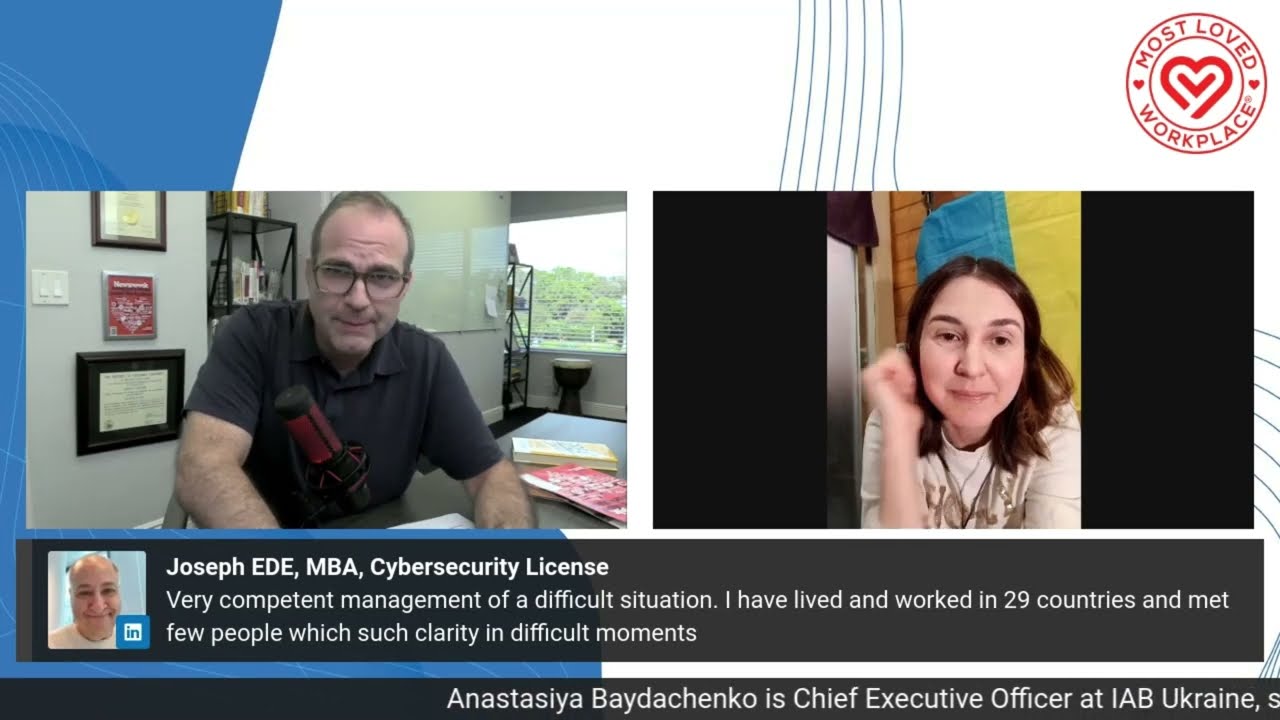
Anastasiya Baydachenko, CEO of IAB Ukraine, leads a five-woman team from Kyiv under Russian invasion. She kept the organization running by moving to instant messaging and remote banking, while her team launched a campaign on YouTube targeting Russian soldiers' families. She stayed in the city to protect its cultural heritage and infrastructure.
Chapters
and going to share with you the current situation, what's happening in Kyiv, as well as leading her teams as a CEO under this time of threat of being invaded and attacked. And it's just, it's just incredible to me. Anastasia, welcome to my show. Welcome.
Hi everyone, I'm Anastasia from Ukraine. I'm working in Interactive Advertising Bureau Ukraine. We are a small team of 5 people, all, all are women. And actually, I can share my experience about how to manage this team because we have not only difficult circumstances, we have actually open war state. And we now, our team should keep their working mode in extremely difficult situation. So first of all, I can say now that a pandemic and COVID-19, they were a good training. So we change all our processes from offline or mix offline plus online to online and digital only, and it actually was good preparation because 7 days ago Russia started a war with Ukraine and we should operate as non-government organization, as industry organization that should unite interactive digital industry of Ukraine in a very difficult situation. From my team, I stay in Kyiv, which is relatively, for today, a relatively safe place, but our project managers go to other parts of Ukraine. And actually, today I understand that one of our project managers tried to change her location for more safe. And we are all in different places with not always stable internet connection, which is key, key factor for our sustainable work. And we, from the beginning of war, we also understand that our typical procedures, our typical meetings, statuses, committees, everything will change. So we should start our work in more flexible way because every minute we can hear sirens informing about air attacks. So we should go to the shelter or something, some safe place in a flat or in a house. And it is complicating factors, of course. So what we do as organization? First of all, we move all communications from email to messages. In normal life, it's a good way to lose some important information, but in time we live and operate, it's a good idea because have all answers and ask all questions quickly. That is why for the previous week we move everything to the Messenger and make a lot of working groups also in Messenger. Of course, there is some paperwork that couldn't be missed because of legislation procedures, because of accounting needs. And for today, this paper part of our work is actually one of the most problematic because we are separated locally by locations when we have access to internet, but we are not always have access to printer, to paper, and so on. So we need to change all paper procedures we have in more digitalized way. Also, such situation and open war and some certain difficulties of normal city functioning Of course, that we should manage all bank questions also online because a lot of bank offices are closed and all these paper things, banking accounting things, I think will be postponed till the situation will be more understandable and clear and banks will open again. So also in war state, every leader should pay more attention to the psychological atmosphere and psychological state of team because we are girl team and we are emotional. We are, of course, afraid of situation and We need, first of all, to be in connection and speak with each other. Today we are writing in Messenger and understand that we need to have at least one today call with all team in order to keep ourselves connected and give each other emotional support, which is very important. In our difficult situation. So what is more important about team leading under stress and under actually crucial and problematic life situation is to be a good role model for them, for your team, For me, it is very important to keep— to be a role model and to keep good mood in order to support my team and help them to keep their psychological state in— it is difficult to say in normal under this circumstances, but I think kind of quasi-normal because I think it's difficult to say that in the 21st century we can name war as a normal state. But it's crucial task for any leader to support emotionally, support as as a mentor, as a role model, all team, and give them a sense of safeness, a sense of, if possible, predictability, understanding that what the team could do in every moment in order to make situation better and what is dangerous and what is possible to do, and so on. Also, we face the situation when we couldn't going on with our typical routines with all these committees, with something that was scheduled, and we understand what we do a month, for the month, or even 2 months before had. For today, we lost this schedulability and ability to plan. So for long perspective, but we— not we as organization, but we as a Ukrainian industry, digital industry, interactive industry, started a lot of initiatives That first of all, we are focused on giving full information to some audiences in Russian Federation because as we know, Russian is strictly controlled by government and there is almost zero free or independent media. And we understand, and a lot of us has relatives in Russia, understand that Russian doesn't see the situation and the war between Ukraine and Russia from all sides. That is why we, as a team of volunteers, make advertising campaigns using YouTube, using Google tools, using social media in order to inform Russian Federation people, Russian soldiers' moms, our European partners and colleagues, also Belarusian audience about situation in Ukraine. So we have a lot of different messages. We showed real Russian army losses. We show real situation. We show all this bombing prohibited missiles, ruins, all that can, could make situation understandable more fully. And also we have special messages for Russian soldiers' mom in order to motivate them to call to their sons and ask where they are. Uh, and, uh, it, it is not typical. This project, uh, is, is, um, not, uh, linear. It's, um, it's a great project, at least 4 subprojects. And, uh, we, uh, do it not only as IB, also a lot of organizations and agencies and advertising market representatives launches a similar campaign but with different advertising messages. But this campaign, as it was quickly planned, quickly delivered, also became a part of our routine for this wartime. As a project, it greatly reflects the situation. Months ago, we can plan for the March, for the April, for the May. We understand what we will do as a team, but 24th of February start with bombing Kyiv and other big cities. We change our attitude to project, and a project for the communication with Russian audiences, a good reflection of our current state. I couldn't say that it is ineffective, because different situation and different circumstances need different approaches. So it's a good example of crisis project. Also, there is big teams, not only our, our IB girls take part, but we integrated a lot of creative, strategic, and media team to find good solution and to to execute this campaign. And if we could predict this kind of project and this kind of people management, project management planning 2 months ago, it was— it couldn't be realistic. But when we are in such situation in war state, we act, we should act in another way. Less plan, more action. Actually, we can less time for every decision, and it's easier to find answer quickly. Also, it's a greater possibility to make more mistake, but actually time is a crucial parameter. And as we act now as a team, we act as a kind of crisis team, and I think we will be successful in such a project.
Wow, I mean, this is just outstanding. You're getting so many comments saying that you're just incredible, your competence and your in your management and leadership during this unbelievably tense and stressful situation is just out of the stratosphere. Tell us what— tell us really what it is that we need to know, what we can do, what the U.S. can do to help you and leaders in the Ukraine at this moment, where some of the newest figures that just came in, 752 civilian casualties from the UN Human Rights Monitoring Mission, and over 2,000 have been killed in the Ukraine. Just extraordinary numbers. What can we do? What can we do for you, for CEOs, for leadership in the Ukraine?
Uh, okay, uh, the main thing I might like to speak about is that, um, we are a small and very brave country. Uh, the current situation faces us, uh, in war with a huge aggressive neighbor. It's a great problem. When we years ago refused our nuclear weapon, it was Budapest Memorandum that guarantee safety of Ukraine. And as we can see this year, no external guarantees for the national security doesn't work. It's a bitter lesson, I can say. But what I found and found actually great, it is a desire of our partners, European, US, UK, to help us. I speak a lot with IB Europe and I have not only deep concerns and kind words. I have actual— I receive actual action plan, uh, and, uh, I hope, uh, great support and help. Um, there is, um, actual, uh, actually two main ways, uh, to help Ukraine to survive and, uh, fight this war, because it's a war for our, uh, independence, uh, and We don't want back. I'm 40 years old and I was born in Soviet Union. I went to school in Soviet Union and I don't want back. And almost all people in Ukraine don't want back. We want to see our country independent. Yes, we are in war with aggressive and huge neighbor. We need help. Our National Bank of Ukraine launches two special accounts dedicated first for the support of Armed Forces of Ukraine and second, which is more important for other countries, for humanitarian support. We need any donation because no normal country budget war. Actually, Ukraine didn't budget a war in annual budget for the year 2022, and war cost us a lot. It costs for our people not only their lost flats, not that they became refugees, but also it cost their lives. Russians went their war, I think I can name it in medieval way, use a lot of prohibited and illegal weapon. Our second largest city Kharkiv bombed by vacuum bombs, a lot of cassette bombs, a lot of prohibited instruments. Russian go to Chernobyl and They keep all Chernobyl teams and it's a great danger because they could put Chernobyl again and it will be a great catastrophe, ecological catastrophe, not only for Ukraine and Europe, it's worldwide catastrophe because we know what is Chernobyl. In this situation, as I say, we need any kind of support. A lot of our partners bring us already modern weapon, humanitarian help for our people. And if any foreigner have a desire to help Ukraine to fight and win this war, battle, actually battle for independence and for European future. It's a good way to donate to the special accounts of National Bank of Ukraine for Armed Forces or to the humanitarian needs. Also, you can support any initiative, local initiative you think will be useful. For example, NGOs actually without any donations could stop their activities because when we have war states, priorities changes. So people invest in things they need and support of NGOs or some funds are actually it's a low priority because, um, the main question is to support people with, uh, water, with food, uh, with, uh, a kind of accommodation, uh, and, um, it also could, um, bring us a few steps, uh, ago, uh, because, uh, we are, uh, highly developed as, um, institutional society, and we have a lot of NGOs, and I can sadly predict that this war situation caused that a lot of them should stop their activity because of lack of financing.
Yeah, a lot of people are saying that, you know, the plan that Putin has is stuck, you know, and it's going to stop. People and leaders like you, Anastasia, who are there in Ukraine, in Kyiv. You stayed. There was, you know, I think it was 40,000 fled, you know, across the board. Tell me about you, your choice to stay in Kyiv and what that means to you.
Yes, it will be very difficult for me to bring you any rational reason why, but I have feelings that I should stay. Kyiv— I was born in Kyiv. Kyiv is my city, my home city. All my children were born here, and I have a strong feeling that I should stay. I check a kind of how I should— how I could make my stay in Kyiv more safe. Of course, I'm a normal mom, but I decided to stay. And it's not only a unique decision. A lot of my colleagues stay in Kyiv or bring their families to Western Ukraine or Eastern Europe and then go back to Kyiv. Because we need a lot of volunteers. Of course, men could be mobilized, or we have territory military unit, like, not military, like territory civil organization for local protect, and they are a kind of police, but they are not military. And we need also a lot of volunteers to make infrastructure. Kyiv is a large city with population more than, I think now, 3 or 3 million, more than 3 million people, and its infrastructure needs support. There is a lot of old people in Kyiv that people couldn't move and they need water, food, they need medicines and so on. That is why Kyiv now is not empty city. A lot of people stay here. It is also important. It's a capital, it's important city for our government, for our president. A lot of resources, not only internal but external from our partners, bring to Kyiv in order to support city and keep it with Ukraine. Also, Kyiv is a very old city and full of historical monuments, and this also should be protected. Because I think if people just— population just leave Kyiv, all these historical monuments will be a subject of destruction. So when we stay, when the activists, when the volunteers and part of population stay in Kyiv, it means that we have chance to save Kyiv in that form and type as we used Kyiv see and we love it. So it's not only my decision, it's decision of a lot of people to stay, support city infrastructure, protect Kyiv and support and protect all valuable and historical heritage we have in Kyiv.
That's extraordinary that you've stayed, and that we've, uh, the, the newest numbers we just found is 1 million people have fled Ukraine since the Russian invasion. And, uh, what you're saying now is, is quite, is so admirable, which is that you have an extraordinary history, you have monuments, you have a strong family structure, that you're saying, I'm here, this is my country, this is my home, I'm staying. Uh, and so I— the question now, I think a lot of people will want to know, I certainly do want to know, it's 7 PM there in Ukraine, in Kyiv, right now. How are things? How— what is happening now? Uh, the current state, current state, um, the previous night was, uh, not easy.
We have a lot of air attacks. It's a kind of fugitive bombs, missiles, and Russian troops stay not very close to Kyiv, and it help save us from be a subject of usage of some very aggressive in city wolf weapon, but Aviation and air attacks are frequent. As for me, I have feeling that it was almost every 20 minutes this night. So we have sirens and a special and very unpleasant signal which inform population that air attack is possible. Sometimes we have message air attack, sometimes we have message rocket attack, which sounds more— worse, actually. And we are recommended to go to the shelter. As for me, I sleep in shelter already. And this night I have feeling that it was every 20 minutes. And it was very massive since previous evening. It was very massive air attack for the almost all territory of Ukraine. And, uh, but our— I don't know how to say it in English correctly. I tried to, to translate by myself, but I'm not sure about all those military terms. We have, uh, uh, anti-air— oh, how to say it? Uh, it's a No, no, it's a special missiles on Earth that could hit the flying missiles or flying bomb and destroy it in the air. I don't know how to say it in English correctly. In Ukraine, it's protipovitryna obrona. It means that Ukrainian soldiers, heat from Earth, uh, to the flying bomb and destroy it in the air. Uh, and, uh, actually, we are— our, our, our soldiers, our army, good in it. And, uh, also we have good, uh, great— not good, great, actually great and the bravest team of, uh, our, uh, our, uh, soldiers, uh, that who would do their best to protect us. But as for typical civil population, actually, situation in Kyiv seems dangerous. Kyiv, as far as I remember, I'm 40 years old, was very atmosphere, very kind, very nice place with World War never stay nearby. That is why it looks like surrealism. It's something unbelievable. But there is not the worst situation in Ukraine. There are much, much worse things in Kharkiv. It's a great city. With population more than 1 million people, which is situated to the northeast from Kyiv. And very bad situation in Mariupol. It's southern Ukraine. Kherson, it's also southern Ukraine because this city is almost sieged by Russian troops. And there is no water and electricity in Mariupol for 2 days. And our authority asked for the green corridor in order to save civil people. And Russian doesn't allow to save people, civil people, not military, civil people who sit in their half-destroyed houses for 2 days without water, without electricity, without a mobile connection. I wait for the response of my friend Tanya. She is in Mariupol with her child and I have no response for today, no response. I just suppose that there is no electricity in just show mobile phone off. It's my hope. But actually, it is almost terroristic action of Russians because green corridors, it's a normal human way of dealing such situation. We ask Red Cross to help because it's almost humanitarian catastrophe. In Mariupol, in Kherson, and maybe not in such a degree but also very, very significant in Kharkiv. But Russia doesn't allow to use forces of Red Cross for this situation, and we also ask— I'm sorry— the United Nations to, uh, use, uh, their influences. Because third, fourth day without water, uh, it's, uh, it's actually, it's, uh, it's a tragedy, uh, and, uh, we speak, uh, about the situation with all our politicians which are very active. We speak as an industrial organization, but, uh, the situation is stable. Russia doesn't allow a green corridor to save, uh, civilians from Mariupol.
With the new satellite, the internet system, has that been of use to you? Have, have you been able to access that? Is there a way that we can help you with that access in terms of communication to people, or some way to connect families or connect others through social media from you to others in the Ukraine?
Actually, it's a good situation with mobile connection. It's stable even in the territories of occupation or of these territories with active war action. But when you have no electricity, your mobile phone will die in in 2 days even you use it in very economy mode. So, uh, mobile without electricity, um, is a just a piece of metal and glass. Uh, also, uh, we have not bad mobile internet, um, penetration. Uh, it means that, uh, if your mobile phone, uh, is is on and you have enough battery, you can connect not only by mobile phone, but mobile connection, but also for mobile internet and use any messengers and use any social network to be connected with your relatives, your team, and so on. But we just could imagine apocalypses when electricity will be shut down or electricity infrastructure will be destroyed and it will take some days to recover. It means that all this day it will be no actual connection with people who are not close, but it will be almost impossible for me from Kyiv to connect with Tanya in Mariupol and understand how is she. And actually, I don't know what will be the solution because electricity is like first need to support all modern infrastructure. When we lost electricity ability to keep our batteries on, we lost any connection. That is problem. But what is, what is good, even in Kharkiv, who— Kharkiv is partly destroyed by massive air attacks, uh, it is possible to call, uh, by mobile. And, uh, also my, my friend, uh, Sasha Kolb, he also messaged, um, in Facebook, uh, current situation, uh, in Kharkiv. And a lot of people make videos, uh, of, um, uh, usage of illegal weapon. And, uh, they're able to load all these videos, uh, to the Facebook, to the Instagram, uh, and make them available for the wide audiences. So we are not a wild country and everything is okay with mobile connection, with mobile internet, but I'm very afraid of any problems with electricity support. It will be a crucial factor for normal communication between all Ukrainians. And with their relatives who are abroad or with refugees who are leaving, left or are leaving Ukraine these days.
And they're still leaving in droves. 1 million people are still leaving Ukraine, and it's CEOs who are staying. And you have most of your team in Ukraine, yes? Your team is there in Ukraine, is that— yeah, and an entire association that you lead too. Are you— you mentioned your friend. Is there a way that you're able to commune with them, or are you— you're in your— in a bunker right now physically. You're not able to get out of that bunker with, with your family, really. Is that— that's right. Is that right?
I'm in Kyiv, and we have such a special, uh, uh, hours. It calls commandant hours. It means that we couldn't leave our apartments from 8:00 PM till 7:00 AM. The only way we can leave is when we see, when we hear sirens about air attack, we have ability to go to the metro station. For example, because metro station is a kind of shelter. But no other exceptions. So from 8 PM to 7 AM, we should stay in shelter or in our flats in Kyiv. In different cities, there is different hours. For example, in Kharkiv, it's more strict. So you almost all time should be located in your shelter or flat. But when morning come, 7:00 AM, you can go to the supermarket, to go to the pharmacy, to go with your dog, for example, and try to do all the things which you do in normal life— buy food, go with your dog, buy medicine if you need. And so on. But when you see— when you, sorry, not see, hear siren informing about air attack, you should go to the nearest shelter. In my district, it means first of all metro station because there is two metro station nearby and in 3 minutes you can run to any of them. And stay there until the siren will stop. Then you can go out and finish all you want to do. Also, you need to be with your passport, with your paper passport, because we have electronic— all of us have electronic passports, but in such war period, we need to have with us a passport every time. And there is a lot of police, a lot of military, our territory, local administration, and they have opportunity to check every time your personality, check your documents. It's normal because there is a lot of diversants and they are— I can name them. Terrorists because they, they put signs for aviation. Uh, they, uh, actually, uh, it was, uh, absolutely dreadful situation yesterday. Uh, uh, they used, uh, uh, they used rocket, um, to destroy our, um, uh, TV tower, TV translation tower, uh, as a part of city infrastructure. But as more worse, they, uh, destroyed part of Holocaust monument, uh, Babiyar, uh, which is worldwide Holocaust monument, which is worldwide tragedy place, uh, and they destroyed, uh, this monument, uh, because they wanted, uh, to hit, um, television translation tower. And it was actually for me dreadful situation because Russians who invade, they told us Nazis. And it is, it is actually dreadful situation because they, not, not us, they destroyed Holocaust Memorial. For me, it's such a difficult and impossible situation that it is difficult to speak about. It's just impossible to destroy such a sacred place, such a place of all human tragedy, to just to— in plan to destroy TV— TV translation power. Which is more important? A TV translation tower is actually not very important for city infrastructure because in Ukraine there is high internet penetration and only small, small villages and towns use this signal. Others use internet, connected TV, OTT, and other services and we use other type of translation to watch TV, not this TV translation towers which was actual 20 years ago. That shows that our enemies are not only low educated and wild, but also that they for the very idiotic target could do awful and dreadful things. That is why we should stay in team, as a team of volunteers in Kyiv in order to protect our monuments, such as Babiy Yar and Holocaust Memorial, such as Saint Sophia Cathedral, such as a lot of, a lot of things. And it's not a joke because in Chernihiv, It's also city which is subject of air attack. Russians destroyed part of cathedral which is before Mongol period. It's a very early cathedral. There is only a few all over the world such monuments of— sorry— of culture. That is why every monument should be under protection and control of volunteers because I have no names another than barbarians. If these people could destroy Babi Yar Memorial, if they could destroy 20th century— I'm sorry, 12th century cathedral, it means that there is such values understandable for all people means nothing for them, and it's actually dreadful.
This is, uh, it's so terrible. So it is so dreadful what is happening now, and especially what you're mentioning about targeting monuments, targeting institutions alongside your telecommunications and the endgame that is near. I really appreciate you talking with us today. I know this must be a stressful time, and I don't want to keep you longer. I certainly would love to hear more if you'd wish to share more about the situation, or perhaps, you know, something that as of late that you've been doing now, really, you know, that maybe in the past, you know, 6 hours or so that you've noticed? Has there been any changes? There been any discussions? There been any movement that you've heard of, uh, that, uh, shows some hope or, uh, some more or more of the same? Uh, what have you noticed? What have you observed that perhaps gives some sort of, uh, uh, sort of, uh, thought or forethought for what could be coming in a, in a positive way or potentially other ways? Tell us, Mo. How you're seeing that?
Of course, we are all Ukrainians, we are hope for the best. There is no back steps for us. We only should go forward. Forward, it means to protect our independence. There is no another way. That is why we trust in our armed forces. They're the bravest men in the world. They'll do impossible things. And in 8 days, they stopped one of the largest armies in the world. I hope we have, I think, positive trend because a lot of of Russian soldiers, especially on tanks, people who are very young, they just raise their hands up, give their weapons, and our volunteers call their moms, and there are a lot of videos. Our government allows moms to go to Ukraine and give their children and go back to Russia. So we are very modern in this way. We keep all the human rights, Geneva Convention. So if we have this Russian soldiers. They receive medical support, they receive food, water, and it is possible their relatives to come to Ukraine and keep them to Russia. And I hope, because a lot of signs and a lot of positive videos shows us that trends became positive. We have a lot of even funny. What is more strange in such situation, we have funny stories when old women just with their hands keep the soldiers and do it without any weapon. Or we have, uh, roms who stole tanks And we have a lot of— we are very optimistic, with good sense of humor nation. And even in this dreadful situation of war, we have a lot of situation to have a kind of fun, I can say, or a very something to smile at. And as I see, we have every day in the morning a kind daily statistics for the military issues— tanks, planes, aircraft, people. So, and the statistics show also positive trend, and I hope that in the nearest 5-7 days we will help Kharkiv. And I'm very hopeful that Red Cross and United Nations help us with Green Corridor in order to help civil population of Mariupol and Kherson, which need this support now the most. So I think that I have, and I and Ukrainians have no right to have any other options and any other hope than to trust in our armed force, to trust in help as a second priority of our partners, who also— thank them very much— help us with weapon, help us with humanitarian issues, help us with financing. But I hope it will be better. Such kind of war are a technically impossible to be long in 21st century because it's not 50 or 70 years ago. We have other infrastructure, we have other population, and Ukraine is quite large country in terms of square of Ukraine. And I think that all this military action should be shortened. That is why I believe to have positive changes in the nearest 3, 5, 7 days, especially for such cities as Mariupol, Kherson, and Kharkiv. And we still keep our capital Kyiv, and we do our best to safe and protect our independence and protect our Ukraine.
Hi everybody on LinkedIn, I'm Louis Carter, CEO of Best Practice Institute, and it's an honor to have Anastasia Badachenko, who is the Ukrainian, Ukrainian CEO, uh, and she is live from Kyiv. May I ask, this is a question, how do you do this with your children? How are they doing? How with your family, how do you help them to work through this, uh, incredible, uh, say, a stressful event that's just catastrophic, stressful event? How do you do that as a, as a mother?
Oh, it's a difficult question. I think with team management is much easier, but first of all, we need to understand that Every war is such as such situation will absolutely bring post-traumatic syndrome. It could be strong or weak, but actually every war situation causes post-traumatic syndrome. It means that sometimes after everything finished, you— we need— all of us need therapy in order to to recover, and it's compulsory, as I understand. But what could we do now? First of all, it is very difficult for kids to change their, their accommodation, their friends, lost their schools, and it's very psychologically difficult. From this point, I think that for my children, it's a kind of a little bit not so difficult because we stay in our home. But a lot of Ukrainian children, they sleep 7, 8 nights in shelters, in metro, and it's actually very, very difficult situation. And all of them will need a kind of psychological therapy. I suppose that our Ministry of Education will organize such a therapy in schools. And also, we need a lot of instructors for that because I'm not sure that in Ukraine we have even enough specialists to work with post-traumatic syndromes with all school children, for example, because it's a huge number of people to do. But therapy is a must. Also, there are a lot of kind of guides how to help kids in stress situations. First of all, we need to speak to understand their feelings, to speak about their feelings, to give them emotional support, to give them physical support, to give them tithes, and so on. I couldn't say that I every time remember to do all these things, but I try. It's a difficult time, and it's difficult not only for kids but also for adults. Also, we spent a lot of time after all finished in order to bring ourselves to normal life. But we shouldn't make no mistake, war is always trauma, and we should understand that in every case Uh, in every child who, uh, live at least a few days in war state, we have a child with post-traumatic syndromes, and, uh, this, this should be cured with the specialist, with the therapy, and so on.
Well, I mean, that, that, that's great insights. I mean, the, the, the impact on your country, on your people, is just out of— it's unconscionable. And I do hope, and I call on all of my communities, uh, all of the people who are watching this and elsewhere, to the Red Cross. We can ask the United Nations for help. Uh, we can also give to legitimate causes that I've given here, uh, globalgiving.org, which is an actual Ukrainian crisis relief fund. You can give to that. They've, they've been You can see it here on the screen, globalgiving.org. It's projects Ukraine Crisis Relief Fund. That's a legitimate source, and so is the Red Cross source here, which is redcross.org, and you go to the— just Google or just look up Ukraine Red Cross delivers aid to families, and so important, and others I know will want to know how to help. In other ways and to get to help you, really. And you've outlined quite a lot today. You're extraordinary in your emotional regulation and your leadership and competence. I'm just amazed by you, and I'm— and I really appreciate you today coming on, joining us, and sharing this experience and awful situation that's happening now in your country, Ukraine.
Thank you.
More from Louis



How to Get Found in ChatGPT, Perplexity, Gemini, Claude & Grok | Visipage AI Visibility Audit

Your Competitors Just Got Certified. Now What? | Most Loved Workplace® Demo & Hiring Advantage



Visual Thinkers: The Hidden Genius Behind Skilled Trades & Innovation! #shorts

Car Mechanics: The Secret to Engaging Autistic Adults Over Video Games! #shorts


