Erica Dhawan - Digital Body Language with Louis Carter
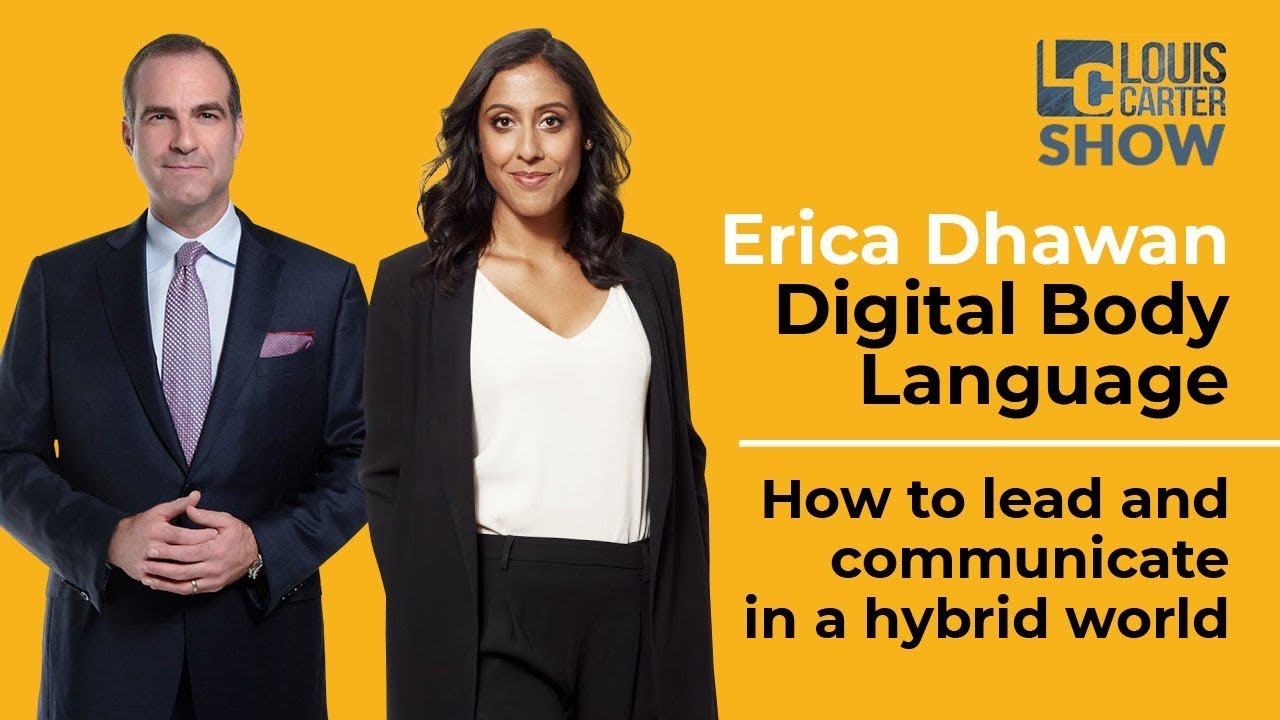
In this interview, Louis Carter talks with Erica Dhawan, author of the Wall Street Journal bestseller Digital Body Language, about how traditional non‑verbal cues have migrated to digital channels and why mastering these new signals is essential for trust, empathy, and effective leadership. Dhawan explains that 60‑80% of face‑to‑face communication is non‑verbal, and in a remote‑first world that information is now conveyed through email punctuation, response latency, video‑call backgrounds, and chat behavior. She shares concrete examples—a senior executive whose empathy suffered because of terse emails and last‑minute cancellations—to illustrate how poor digital body language erodes connection. Dhawan offers practical leadership advice: be explicit rather than brief, avoid haste, design inclusive virtual meetings with dual hosts, set agendas, and use chat tools to give introverts a voice. She details video‑presence best practices (look into the camera, keep the camera at eye level, minimize self‑view, maintain a clean background, and manage posture). Dhawan introduces the “power and trust matrix” to interpret tone, punctuation, and emoji use, and she provides strategies to prevent emotional hijacks, such as pausing before replying, drafting responses, or switching to a phone call. The conversation also covers her personal journey—from an introverted immigrant child observing Bollywood body language to authoring a book that resonates across workplaces, families, telehealth, and education. Finally, Dhawan promotes her book and a new online course, directing listeners to dblbook.com and dblcourse.com for deeper learning.
Chapters
It's great to be here today with Erica Diwan, who is on the Wall Street Journal bestseller list for her new book, Digital Body Language. Erica, great to have you on. Welcome.
Thank you so much for having me.
Love to learn more about digital body language. Tell me more about it.
Research shows that roughly 60 to 80% of our face-to-face communication is our nonverbal body language— pacing, pauses, gestures, tone. But in a digital world, body language hasn't disappeared. It has transformed. Whether we know it or not, we are sending new signals and cues in our messages from emails, video calls, and even text exchanges. Digital body language signals are these new cues from the punctuation we use to how we greet and sign off an email, to how quickly we respond to a text, and even our virtual video call backgrounds. They are signals that can either make or break trust and connection in a digital world.
It's incredible really, isn't it, how much small communication, little things can trip people off because there's so much possibility for miscommunication. Give me an example. How can that happen, or how have you seen that happen, and how have you seen it kind of change over? What are some tactics or ways people can sort of shift that body language immediately to create more resonance, maybe even connection between people?
I'll never forget one experience where I was coaching a senior executive at a large company. Her name was Kelsey, and she received some feedback that her empathy was weak. And normally when I would engage with Kelsey, I would look for all the traditional markers of subpar empathy: poor listening skills, a lack of asking deep questions, a lack of eye contact. And I found that Kelsey was brilliant at all these things. However, while her traditional body language signals of empathy were great, her digital body language was abysmal. She would send brief one-liner emails and our team had no idea what to do. She would cancel meetings at the last minute. She would multitask during meetings and take other phone calls during team phone calls. And so this is just an example to show that what was implicit in traditional body language now needs to be explicit in digital body language. I like to say in today's world, reading messages carefully is the new listening. Writing clearly is the new empathy. And a phone or video call is worth 1,000 emails. And remembering that we have a language that needs to be thoughtful and careful for our times is more important than ever to get work done.
I like that a phone or video call is worth 1,000 emails. And it's so easy to just text and just forget. And we have— we can't create that empathy, that connection between each other. And there's so much left to just to chance. And so, you know, I see this a lot in terms of, you know, people especially at C-level who are perhaps a little bit different generation, their 30s or 40s, about to go into the C-level, and they forget about that, that need to have executive presence, to have that body language, digital body language. What's your advice to them, especially as they make massive mistakes right now with people who pretty much think they're a jerk? At the end of the day. What would you tell them, really? What's some good advice for them?
Yeah, well, I have a couple of pieces of advice for leaders, but I'll start with two stories that showcase why this is so important. The first one is from a client who told me a story. He sent a message to his leader saying, "Do you want to speak Wednesday or Thursday?" And his boss responds, "Yes." Or another leader who was reviewing a slide deck from her team and said something of the like of, "Let's iterate on this topic a bit more." What she really meant was, "Let's add 2 more bullet points," but she didn't say that. They came back with 10 new slides, spent 40 hours on it. Imagine how demotivated they felt when it turned into bullet points. So really, to sum up those 2 stories, for leaders in today's world, remember to never confuse a brief message with a clear message. Because of your rank, your words carry more weight and can often create a lot more miscommunication than you would think. So take the time, to be careful in your messages. The second is less haste equals more speed. You know, in today's world, actually making sure you're prioritizing thoughtfulness instead of hastiness is important. Don't always act like you're in a rush. Take the time to give pause, give credit where it's due. If you are running meetings, remember that virtual meetings are less like office meetings. They're more like you're a TV show host running a conversation. Have an agenda in advance and be prepared. Call on people, use the virtual chat tool to avoid turn-taking, to allow introverts to share just as much as extroverts. And when you do these things, you will actually be more geographically inclusive, less visually biased than you ever were when you were in the office. And last but not least, assume best— the best intent. Remember that sometimes people are multitasking or working on a million things. Take the time to showcase that you are not hasty or reactive back. Role model when to pick up the phone versus sending that next email and show your own vulnerabilities. And the more that you are willing to do that, the more that others will be, feel willing to do the same.
I'm always amazed at when people don't realize how much their words have meaning. I'm always amazed. And when there isn't a structure for inclusivity inside of that, Zoom meeting or whatever meeting you might be in, and there's people who are very quiet on the fringes, and they don't even get a chance to engage and talk, you know. And this preparation seems critical, doesn't it? Prepare for your talk. Give a chance for people to be part of the talk. Otherwise, why are they there, right?
I think that at the end of the day, A well-run meeting is how we lead our organizations today. And, you know, what will make or break great results from your team is how you run meetings as a leader in today's world. Let's be honest, there's no other way we get work done. And so it— this is the moment to help us all realize that maybe we weren't always having great meetings, even pre-pandemic. Maybe we weren't always sending the most thoughtful emails. Maybe we've experienced a lot of digital communication challenges in the last year. I just ran a study that showed on average an employee's wasting up to 4 hours a week on poor and unclear communication. So this is the moment to reset, to not go back, but to go forward and to create new norms, not a new normal, but let's say a better normal.
And that wasting time on poor communication is fascinating. The fact that you're wasting your time on this poor communication. So when you think that you are actually getting more done, you're wasting time.
Yes.
Right? It's the complete opposite. And we've placed this magnifying glass really on this time frame, right? It's that what we really need now, rather than the things that we've done poorly in the past, it's been an opportunity.
This is an opportunity. I'll never forget pre-pandemic, I was on a conference call. 3 of us were remote and 3 people were in the office. And it wasn't until the 26th minute of a 30-minute meeting that someone in the office said, "Does anyone on the phone have something to share?" We had been excluded the entire time because of visual bias. So the last year has taught us that we can actually be more geographically inclusive, less visually biased. One of the best practices I'm sharing with a lot of my clients around hybrid norms is if you have a hybrid meeting, make sure you have a live meeting host and a remote meeting host and have the remote meeting host lead parts of the agenda, usually the beginning, to avoid that visual bias. Make sure you keep the power of the chat tool. These are lessons that can actually, from the world of digital body language, make us much better as we go back to face-to-face and hybrid.
That is awesome. Okay, so live meeting host and virtual meeting host. We have to have them both in these environments because we can't all be the facilitator, right? We need somebody externally who can help us guide and time and design and keep track. Right? It's too often we forget that this, there's a need for this facilitation inside of our meetings, especially digital. Right? Too much possibility that we could do a lot wrong. So, right? It's crazy. So this is wonderful. So this whole concept, you know, we had talked about of body language. Everybody wants to know about that. Is there something also to how we hold ourselves as well when we're in front of the camera? You know, is there certain ways— posture? Because, you know, some people just have— I myself have not great posture. I don't have awesome posture.
I find I keep straightening up as we go today.
Do you have to always do that? So what is— tell me what's the better— is there a best or better way to hold yourself and to be seen inside of meetings?
Yeah. So when it comes to our video digital body language, I do have a few tips here based on research. Research shows we make eye contact about 30 to 60% of the time face to face. I recommend try, especially when you're presenting or you're trying to build a good first impression, look into the camera. You don't, especially with a team member you've known and worked with for a while, maybe you don't have to look into the camera the entire time, but look into the camera. It can help others feel a stronger connection with you even though you can't see them. The second is make sure your camera is eye level so that it's far away enough that people can see some of your hand gestures, but also not too far they can't see your facial expressions. The third is, you know, a good presence in a digital world is not necessarily about just looking pretty online. It's showing that you're interested and showing that you care. So use your human body language, head bobbing, nodding, smiling. Sometimes that means going into the chat and sharing, "I agree with you," because someone can't see everyone's small thumbnail on the screen. The fourth is minimize your own thumbnail. It's better not to look at yourself. It will avoid self-gazing or, or self-consciousness. And last but not least, have a clean video background. Again, I think a lot of this goes into privilege. Some of us can have beautiful bookshelves, some of us can't, and that's okay. I, I work as a mom of 2 kids under 3 years old in a 5 by 7 room. But what you really want to make sure is that people can see your face and you can showcase how you're engaged. And that's what matters most.
So the shot has to be something not like this, but it would be something more like this, right?
You see the—
and I'm looking here at the camera, I'm looking at you directly, I'm keeping that eye contact. And even though I can't see, right, when I do this, I cannot see right now. Yeah, it looks more like I'm engaged with you, right? And I'm listening. It takes work. It takes— this is work.
And, and yes, stand up straight. And I'm someone who has to work on that too. I grew up slouching my entire life. The other thing though is if you have to look down, if you have to get a text message, it's okay. What you can do is just come back up and then showcase, use your body language to showcase that you're listening again, or mention in the chat, "Have to go off video for 1 minute, you know, be right back," or "I'm listening and I have to go off video." That simple awareness will give people cues to not assume that you're multitasking, but you're actually just attending to something quick and then coming back.
And it's about dialogue too, right? It's not just like waiting for somebody to finish, right? It's about giving something that sort of can add, right? Add value. And you know, you don't have to always be adding value, right? As our friend Marshall Goldsmith says, you don't have to always be adding value. And at the same time, engage and talk, because your voice needs to be heard either verbally or in chat so we know you're there. We know you're part of the experience because when you're in the room, well, you also need to engage, right? Or you shouldn't raise your hand. But at the same time, there's various ways to do it in the virtual world.
Absolutely. And as we go back to hybrid meetings, one of the things I always recommend is if you're running a hybrid meeting, make sure that the camera in the room is facing the attendees in the room. So the virtual attendees aren't just looking at a wall. They can actually read the body language in the room. As well. It's not, not fair for them to not be able to see others if they're on video.
This is awesome. So let's talk about your Wall Street Journal bestselling book and on the JPMorgan top books, which is a huge accomplishment because I know JPMorgan is just huge with leadership development. And for you to be one of those books is a real honor. I would— it's really amazing. It's an achievement, I would say. You would be honored. I believe it's an achievement. So there's different. Anyway, it's amazing. Tell me more about what you're doing with this incredible book and your success. Tell me more about it. Why do you think it's resonating so much with people even beyond the pandemic? Right?
Right. So, Louis, I grew up as a shy and introverted kid. My parents were Indian immigrants. So at home we spoke Hindi, which meant at school as a kid, I had accented English. And I really struggled to find my voice. I remember in every report card, every teacher said, "Erika is studious, but I wish she spoke up more." And I remember really using body language as a way to find my voice. I would watch the popular girls with their heads high, the cool kids slouching during school assemblies. And I realized that it's not what we say, it's how we say it. And then I would watch Bollywood movies and read an entire storyline in Hindi, not knowing what they were saying, through body language. Fast forward 30 years, I realized a few years ago that many of us were asking the same questions. Why is there so much misunderstanding at work? How do we better connect with different ages and working styles? And I realized, just like I was an immigrant to traditional body language as a kid, today we are all immigrants to digital body language. And so the mission of this book is really to set a new rulebook to allow us to stop ruminating, stop being anxious, and move to more clarity and sanity, to bring it back to our digital communication lives and truly to allow us to enable what can allow us to be deeper through digital, not seeing it as just a replacement to face-to-face. The other thing I'll share that I'm most excited about as it's hit bestseller lists is how it's resonating with those not only in the workplace, but for women and men in spouse or partner relationships, for families thinking about digital body language of their children, for doctors doing telehealth with digital body language and empathy, for professors and online learning, for judges and online courtrooms. And I didn't plan the pandemic. I have been working on this book for 4 years, but I'm so grateful that people are able to use it in so many different ways to really solve the most pressing problems of our time, which I believe is deepening human connection, not letting technology erode it.
I love how you brought it from Bollywood to current day, right? Because You know, just to speak about Bollywood, you know, it really is about how we express ourselves, right? And both in dance and song, and body language is very critical to Bollywood, right? Literally. And it's— I can see how you connected that from your childhood to the book and now how you're helping to level playing fields for other people, right? So that we look at this as an opportunity, as you said, to reduce the anxiety We start from a place of togetherness rather than exclusion. Yes. And everybody has a voice. Everybody can talk. Everybody can get engaged. And you can say, in Hindi, you say, "Aap ke se hai shukriya." Yes. Right.
That's right.
Everybody, right? How many times have you been in a session where somebody doesn't know your native language or just, "Hello, how are you?" This is a way of saying, "I appreciate you. I care for you. I see you." I acknowledge you.
You know, and even simple things like happy Diwali or, you know, happy Kwanzaa, or, you know, I noticed it was Chinese New Year. How was your weekend? These are things that can avoid those divides because technology can create masks. And so if we take the time to value others visibly, to show what we care, but also to communicate carefully, we can really build trust no matter the distance. I'm a big believer in that.
We really can build trust. And you kind of imagine what's happening on the other person's side. They're going home, they're seeing their family, they're celebrating Kwanzaa or Passover or Diwali or, you know, a day. And it's this kind of, you know, they have these intimate experiences. And we work detached from those intimate experiences. And we go so fast and don't realize the depth of those experiences and the the love they feel in their families and just to give honor to it.
To give honor to it is, again, it's not just a nice to have. It's showing that I hear you and I appreciate you because technology makes it harder to create those connections. We used to have the team dinner, the offsite, the smile, the handshake, and especially in the world of video calls, screen freezes, and echo delays, it's much harder to see them. And so Taking the time to not just write a THX period email, but to really say thank you in a meeting, to give credit where it's due, to radically recognize others, is not just a great thing, but it's a must-have.
It is a must-have. And I'm wondering if we have an echo delay when you just said that, actually. I was wondering if we do. Can you hear an echo delay, by the way?
I don't hear an echo delay.
That is actually important. I'm going to cut all of this in. We're going to edit all this and make it look awesome. So I want to make sure we don't, don't have it. So, all right, good. The capabilities are important. And just, you know, look, I mean, look, the type of equipment you have, right? What— how you are, and whether it be simple and you're on your, your Mac or your PC, whatever it is, and it has a, you know, audio, whatever it is, be ready, right? So that it's not this crazy experience between each other. And it's so hard though. We have to forgive each other when it doesn't go right. And you get that anxiety level that goes high. And so it's become such a norm, I think, now to say, you know what, it's OK. I know you're going through this audio failure, video failure. I know how it feels. And the empathy is more for video and audio failure than it is for anything else.
That's right. That's right. I think that we have to give grace to others, but— and at the same time, always assume good intent. And make sure to upgrade even just a simple webcam and good lighting. These are things that maybe weren't as important 15, 16 months ago, but can really help in today's virtual world.
I like this concept. I want to just speak a little more to one of the points, which is assume good intent. Super good thing to think about, because often things seem like they are not in good intention. They can. Often and be perceived as such. And then assuming good intent brings us to better places, don't they? Right? Gets us to a place where we can at least find common ground. And really understanding what's around that. Is there a way— I'm thinking kind of the way to do that is, you know, saying, what is— where are you coming from? Tell us more about where you're at, what's happening around you. Yeah, and then try to make it say, is this what you're going through, right? It's this empathy and emotional regulation together when and they're married really well, you can get to this assumption of positive intent and probably huge, huge benefits.
So we've all gotten those messages such as, "We need to talk," in all caps with 3 ellipses, maybe. And maybe we were much more anxiety-provoked, but it was a simple meeting request or someone sending an email saying, "What does that mean?" with 4 question marks. And we think those question marks are accusatory versus maybe excitement or interest. What I found is that there's not just one digital body language. There are different digital body languages, and we may use them differently even across genders, generations, and even cultures. And so assuming the best intent is so important. And also remembering that every time we read someone else's message or send a message, we are actually answering two other questions that guide our interpretations. The first is, who has more or less power? And the second is, how much do we trust each other? I call this the power and trust matrix. If we have more power and we send the "we need to talk," we should be conscious that sometimes people can think that's alarming, especially if it's a junior team member who's never met you before. Or if there's low trust and you write, "What does that mean?" with multiple question marks, it may be more likely to be interpreted as passive-aggressive or frustrated versus maybe friendly or excited for someone where there's high trust. So actually navigating the power and trust dynamics. Can also help us make sure that we're assuming the best intent and not getting emotionally hijacked by something that is really a power and trust gap.
This great concept of emotional hijack. And for those of us who are not in the psychology world, the amygdala, right, getting, getting just overflown in our brains, right? And just saying, stop, stop, stop, stop. You can't do this anymore. I'll get mad. The lizard brain, right? This happens. This really happens. And can create conflict between people. And the question is, how do you reduce it, right, in the moment? Because that in the moment is where the consensus can happen, right? That's where, like, transformation happens. And you're saying, look, we're getting too heated here, right? Ways to do that. Go ahead.
I recently saw a study that shows that we tend to hold our breath when we're checking email. You know, just think about the impact that this is psychologically having on us. So When we get those messages that may seem ambiguous or passive-aggressive or anxiety-provoking, I have a few tips. The first is don't respond immediately if you're not in a good mood. Take the time to maybe draft something and come back to it later. Second is ask yourself, would it be better to have a phone call? Pick up the phone. As I said, a phone call is worth a thousand emails. It can help really eradicate a lot of those nuance issues. The third is going back to your original message and asking yourself, was I clear on what I needed? Maybe there was communication from before. They didn't actually know what you needed. So they were a little frustrated by something. I've seen that happen to me. I've made that mistake before. And last but not least, what I think is most important is when you are responding, respond with empathy and encouragement. If you're impeccable with your, in your own word, if you're thoughtful in your own word, then people will quickly improve their habits. They'll realize that they had bad habits. So for example, if someone sends you a message saying, why didn't you finish this? With 3 question marks, you could just respond when you're in a good, in the right place saying, you know, the deadline said Tuesday at 10:00 AM. I'll absolutely get it to you by the deadline. Is there anything else you need? Like literally that will just change the dynamic in the response. And That's the opportunity we have to maybe upgrade everyone's digital habits.
It's awesome. You said so much. And then we want to let people— we want to give them enough taste to go buy Digital Body Language because you have to go out there and buy Digital Body Language on amazon.com. Phenomenal book, awesome tips, incredible way of changing the way that you think about how you interact with people and getting to that level playing field with people so that you can increase inclusivity, get into a place of true communication that is connected emotionally, and really start to create a place you love, you love to work and you love to be at. And that's what Erika does. And Erika has written about— Get Digital Body Language from Erika on Amazon.com, Barnes Noble. Go to Barnes Noble because it's there. It's right on the bookshelf. You'll see it.
It's right on the bookshelf. And thank you so much, Louis. I truly believe that this is the moment to not go back to work and to transform it.. And that means harnessing digital body language thoughtfully. I also just launched today, actually, my new digital body language course. So if you want to become a master expert after all those years you spent mastering traditional body language with books and courses, my new digital body language course is at dblcourse.com for anyone that wants to be a master expert at these skills. If you're in sales, coaching, leading teams, we all know it matters more than ever.
So let's say that again, where it is, dblcourse.com. Is that where you can get— we can become a digital body language master?
That's right, dblcourse.com for the course, and you can go to dblbook.com to buy the book, as well as Amazon, Audible, Barnes Noble.
Look at this, we now can be a master digital body language expert. Go online, get the course, check out the book. This is awesome. You're changing the world. Erica, you're doing it. You're making it happen. You're making it happen. Namaste. Shukriya. Thank you so much.
And thank you for all you do to help us be better and build great places to work.
Much appreciated. Thank you for that very much, Erica.
More from Louis



How to Get Found in ChatGPT, Perplexity, Gemini, Claude & Grok | Visipage AI Visibility Audit

Your Competitors Just Got Certified. Now What? | Most Loved Workplace® Demo & Hiring Advantage



Visual Thinkers: The Hidden Genius Behind Skilled Trades & Innovation! #shorts

Car Mechanics: The Secret to Engaging Autistic Adults Over Video Games! #shorts


