Interview with Maria Barabash, President at Actions First Foundation in Kyiv, Ukraine
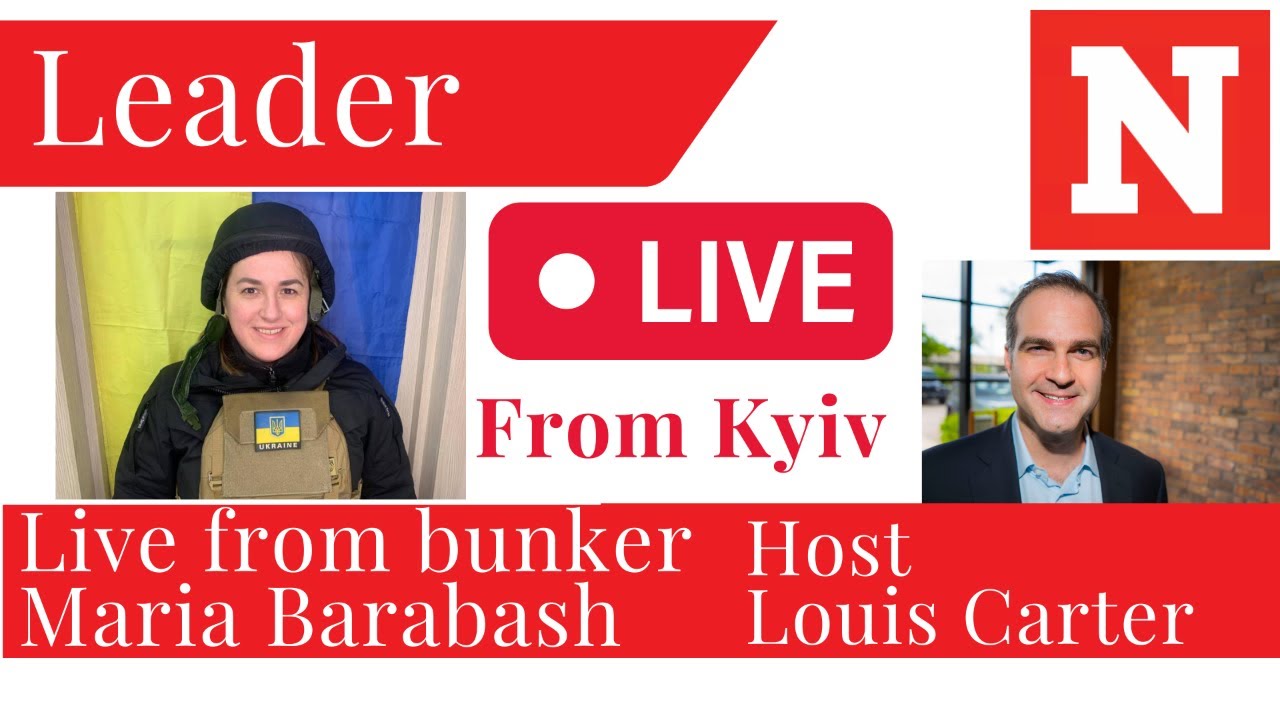
In this live interview on The Leader Show, host Louis Carter speaks with Maria Barabash, a volunteer soldier and president of the Actions First Foundation, who is broadcasting from an undisclosed bunker in Kyiv. Maria recounts a recent Russian missile strike that hit a residential area in Kyiv, killing a Radio Liberty journalist and causing civilian panic. She describes the chaotic aftermath, the response of emergency services, and the resolve of civilians who refuse to evacuate, choosing instead to stay and defend their homes. Maria characterizes Russian President Vladimir Putin as a terrorist leader whose indiscriminate bombing is intended to intimidate, and she condemns the United Nations Secretary‑General’s meeting with President Zelensky as legitimising aggression. She outlines Ukraine’s three‑line defence system – the regular armed forces, the territorial defence, and a volunteer/International Legion – providing rough figures for each tier and noting the participation of foreign volunteers. The conversation moves to international military assistance, highlighting Israel’s promised Iron Dome, the U.S. Lend‑Lease Act, and ongoing deliveries of modern weaponry, which she says are strengthening Ukraine while sanctions cripple Russia’s production. Maria explains the Actions First Foundation’s “one vest saves a life” campaign, detailing fundraising for locally‑produced body armour and medical kits, and shares anecdotes of soldiers lacking protection on the front lines. She also describes her pre‑war role as CEO of a major Ukrainian think‑tank, her current confidential work supporting Zelensky’s office, and the broader humanitarian and communication tasks of her foundation. Looking ahead, she discusses plans for post‑war reconstruction, economic reforms aimed at attracting foreign investment, and Ukraine’s aspirations to join the EU and NATO. The interview concludes with a discussion of war‑crimes accountability, the work of the International Criminal Court, the possibility of a special Ukrainian tribunal, and the role of Belarus as a Russian proxy. Throughout, Maria emphasizes Ukrainian resilience, the moral boost from international solidarity, and a steadfast belief that Ukraine will ultimately prevail.
Chapters
Hi everybody, welcome to today's show. We are live in Kyiv, Ukraine in a— uh, Maria will explain where she's at. She is live in Kyiv, Ukraine in an undisclosed bunker. She's a soldier, volunteer soldier, uh, for the Ukrainian Army as well as the president of the Actions First Foundation. She's going to be speaking with us today about this incident yesterday that happened when Antonio Guterres, Secretary General of the United Nations, visited President Zelensky in, uh, in Kyiv and, uh, bombed Kyiv and other regions of the Ukraine as a result of that meeting. And firstly, welcome, Maria, on the show, The Leader Show. Thank you so much for joining us during this incredibly difficult.
Thank you. Hi, hi, Louis. Thank you for inviting.
Thank you, Maria. I'd love to hear more about how people, your fellow soldiers in Ukraine, uh, are, what they're thinking and feeling at this moment.
Actually, so the situation is very critical these days in Kyiv, so unfortunately I cannot disclose my location, but I'm in Kyiv and I was on the place of the two Russian missiles that hit Kyiv yesterday. It was all like in the evening. I was on my way home and we saw the big like foil and a lot of cars were driving on that place and we saw these two, um, like, places where the two missiles hit it. And at this moment, we know that one person died, unfortunately. She was a journalist from Radio Liberty, from Radio Soboda. And unfortunately, she was found dead this morning. And I was very worried, and why I drove there, like, immediately, because our— my relatives were— very close relatives were living in on that street what the— where the— these two missiles, uh, targeted. And they, they are living 200 meters from the place where the— these two missiles hit it. Thanks God, all are alive. We will rebuild the apartment. So there was small destruction, but we will— like, it's, it's nothing. The, the, the main idea is, and the, the, the most important thing is that they're alive. And, uh, I was on the place, so there was a lot of firemen, policemen, military men, and for sure there was a great work of our emergency workers that helped to release people and to help those who were injured.
This is just incredible what's happening right now. You've, you've seen your family, you've seen people die in the front lines now. And what— tell us about what happened when you went to those front lines. What did you see?
Oh, so it was like chaos. A lot of people were screaming, and, uh, the milit— like, all the soldiers, they were trying to put back all the civilians, because there was like hundreds, several hundreds of civilians that were on the street at like after the, the missile hit it. So what they told me is that, that the missiles were targeted to the military factory for the third time already for the last two months. So they didn't get to the factory, but they hit it as a residential house where the there was like, uh, busy with, uh, preparing their dinners. Some of, some of them, for thanks God, some of them were in shelters because at that moment there was an air siren. So, and there was a critical alert to go to the shelter immediately, but unfortunately, uh, some people, they didn't, uh react on that alert and they stayed at home and didn't go to shelter. And that's why we have one person died. So if, um, the journalist, she went to the shelter, she would live today. But unfortunately, the results as we see. So for sure it's, uh, like awful And unbelievable things I saw, like for the first time, the, the missiles, two big missiles. It was cruise missiles from the, uh, as, as not as discussed, and from the Black Sea, from the military, uh, of cruise, uh, liner. So, uh the, the, the, the— they targeted the factory, but they, uh, hit the residential house. So there was a big panic for sure. There are a lot of people, uh, but for this moment, this street is, uh, is like trying to get rid of the all the rubbish that there was. There was a lot of, uh, like destructions from the buildings on the streets. So the emergency services are cleaning this up.
This is just unconscionable what happened. And you, you're there in the front lines, you're there with your fellow soldiers right now in an undisclosed location. What are people thinking? What is happening in just with your— in terms of their, their own, uh, sense of well-being, their own feelings themselves? How are they feeling as a result of these bombings? Is there anger? Is there fear, frustration? What is their current sort of culture right now, the feeling?
As for, for example, for this, like, this example of the missiles that hit for the third time the same area, For sure, a lot of people already evacuated from this area, but what I talked to some relatives and some people that I know from that region, and they told me, no, we will not go away. So we will stay till the end. It's our home. Why should we go somewhere where it's not our home? So we will defend it till the end. For example, I talked to a hairdresser that was like, like I was her client for many years, and she just told me that I will stay. I will— I'm— I was shocked. She told me that she was walking in the streets, in the same street, 5 minutes before the missile hit it. So she, she's in shock, but Today I got a message from her as her client that I will continue to my work and I will get, uh, like, I will give the 100% discount for any soldiers that I can help, and like some significant discount for any person who will come to her, uh, the, the, like, uh, in the coming months. So you imagine the person who, uh, just got her second birthday just 5 minutes walk after the missile hit it. So for sure I would not talk to her if 5 minutes later she was walking on the street to her house. But the, the mood is as, as, as I told, so almost everybody are staying, uh, in the, their homes. They're not coming out of the city. They're not like transferring to another location, uh, you know, like in some other cities. I saw a news yesterday that there was a missile attack and somebody, uh, people in the yard, they were playing tennis. So they were Ukrainians. We're, we're like, we're used to everything. So we have 300 years of war with Russia, so we're used to that already. So we are prepared.
It speaks volumes about Ukrainian citizens and this, this senseless, unjust, unfair war that's happening right now. People are continuing in their lives, and there's a situation where a leader of— is making decisions based upon feelings and showing sort of a bullying response, that he can bomb Ukraine and Kiev even if the UN Secretary General is there. Is that how you're also seeing it, perceiving it, as this bully leader Putin and the Russian Federation who bombs with abandon? And it's just a— it's just extraordinary for the world to see this. And without any— really, he does it with impunity. He— there's no care for, for his actions. How do you and your, your fellow soldiers— what do you— how do you respond to that?
Louis, I totally agree with you. So he is not a leader. He is the head of the terrorist organization of the Russian army. It's not the decision actually by the Russian pop, like population. The— it's, it's a decision of one person. So the first person, the person number one in the world, uh, the Secretary General of United Nations is in 2 kilometers meeting, uh, uh, president number one in the world, President Zelensky. And you hit— you, you are given an order, a task for your terrorist organization to hit the military factory and the missile got in the residential house. So it's any— any— it's not about humanity, it's not about justice, it's not about any like, uh, consciousness. So it's, it's about like the— he is out of his mind. So, uh, and, uh, I think like my personal opinion that he has very limited time, uh, to live and he wanted— he wants to be in the history. But who wants to be in the history like Hitler? Your generations, your, your, your nation will be, and already is, uh, like, uh, evil number one in the world. So you are like nobody. Uh, I talked— I, I, I saw some interviews of Russian citizens, so They're ashamed that they're Russians. So what you did for your nation, you disgraced it. So, and all our soldiers, they are also talking about that. So it's unbelievable. And also, like our president told, it's unbelievable why the Secretary General went firstly to Moscow and then went to Kiev. It's totally unacceptable. We need to change the Secretary General of UN like ASAP. So, because, uh, Nobody talks firstly to terrorists, and anybody actually in civilized world talks to terrorists, uh, but he talks to terrorists. So it's unbelievable. And we Ukrainians that are fighting and defending our own territory, we see that and like, we, we're in shock.
Shock is definitely the feeling that is common to so many Ukrainians and soldiers today. The, the part about this that is, is, uh, coming up more and more is that Ukraine is seemingly looking like the new Israel of the, of Europe, where you have to be the soldiers, the force against others who really are forcing you to not be a nation, to not be united in a terrorist fashion. And how do you feel, and you believe, this is going to be— it's going to play out for the rest of the, say, 10 years, 15 years? How do you see Ukraine building and strengthening in that kind of resolve? With that kind of result?
Yeah, for sure. It's a long way for recovery, but for sure we will succeed and it will take time. And actually, we are very thankful to Israel. Like several hours ago, Israel confirmed that they will give an Iron Dome system to Ukraine. They have the best anti-air missile system in the world. So Azerbaijan has this system, and Israel, you know about this, a whole world knows about this Iron Shield, like Iron Dome. So they are ready to give this kind of systems to Ukraine. And also, like yesterday, the Lend-Lease Act was voted in the House of Representatives, and on the April 6th, it was voted in Senate. So, and Uh, we are waiting for the signing of this act by the president of U.S., so we are very thankful also to you. So this kind of steps like Lend-Lease, Iron Domes, the, uh, modern heavy weapons that is coming and coming every day to Ukraine, uh, this will help to protect our country. This is— will help to defend our country. And as you know, Russia doesn't get this modern equipment, heavy weapons. They are blocked with any parts for their— for producing more new weapons in their country. So because of sanctions, so it's working for sure. It, it will take some time. They still have a lot of weapons and, uh, they still have some stock— in stock some parts. To repair the, uh, like to fix, uh, the, the weapons. But I see that in several, like 5, 10 years, Ukraine for sure, the Ukraine's, uh, recovery will, uh, like stay on shoulders of international help for sure, uh, because like, uh, international financial organizations, uh, International Monetary Fund. So they're helping us every month, and their help is increasing and increasing. So the last bill that was asked by the US president was $33 billion for the direct help, military and humanitarian, like, and many, many other countries are helping us to, uh, recover, to be more— like, to have more strength to defeat the enemy and the occupation. And for sure, our army is getting more and more motivated every day. This is what I see among the soldiers. And the international help, for sure, as it was in Israel after, like, as, and as it is in Israel. So they have like wars for, for tens of, uh, years, and, uh, they are like number one, one of the best countries for IT specialists. So, uh, and other technology, high-tech technology. So Ukraine will also find his, uh, the, our way, uh, and, uh But for sure, we will stay and we will defend our sovereignty. This is our, like, the number one task.
You had mentioned that your army is getting more and more motivated every day. Would you say that, you know, really Putin's actions, his bullying, as you said, terrorist actions, are in fact strengthening you, strengthening your resolve, and your army will only get stronger as he bullies more? And he terrorizes more.
Yes, yes. Every minute that Ukraine— Ukrainian army is fighting, the— and he— that our army is getting stronger and the Russian army is getting weaker every minute. So it takes time, but the, the situation is like that. The U.S. will not— would not support any land lease for a country who will not win. U.S. never supports losers. U.S. every time supports the winners. So, uh, as for like Second World War, uh, because of the land lease agreement and act, Anti-Hitler Act, actually the coalition Anti-Hitler coalition won the, the war, the Second World War. But now we have the Third World War, but it's now limited only on at the Ukrainian territory, and hopefully it will not go further. But as we know in our history that every, every, every actually war that we have, they have a circumstance, like circumstances and the results, and it will be like felt in every country of the world because Ukraine can feed 400 million of people. And as for this moment, as we cannot farm on our land, we cannot grow the agriculture products. For sure, a lot of people that were, uh, like, they were, uh, had hunger, and they will for sure feel it in very negative ways. So, uh, and you know, in U.S. you have the same, like, gas prices. You feel that. So I think every country We worldwide feeling that already.
Just extraordinary. You had mentioned World War III. You know, there, there are multiple— there are many different countries involved in this awful, uh, in a unfair and unjust war against Ukraine. Uh, you know what, you know, there's many different definitions of, of World War III, um, one of which is other, other, uh other armies coming and other countries actually coming into Ukraine to help. I know there's been over 20,000 foreign volunteers, and I believe you have in your volunteer efforts over 150,000 Ukrainian citizens. Is that true? Tell us more about your, your third line of defense, maybe the other two lines of defense, so we can better understand the full situation of your army.
Yeah, sure. So we have like three lines of defense. First is armed forces of Ukraine, so it's air, navy, and all other types of the, uh, our like secret special operations, uh, forces. The second line is a territorial defense, uh, so like first line there is like, um, more than like 200,000 people. Like, second line is 150,000 people, and third one is like, uh, I, I think like already, um, 80,000 people that are like on the third line. So I'm in the third line. It's a volunteers defense, as, as we called and we have International Legion also as volunteers that came here, uh, like from U.S., from Britain, from Canada, Japan, Sweden, Norway, Germany, Israel. So all over the world. Georgia. So they are very motivated, uh, for sure. It's— they understand that this is a big risk. A lot of International Legion members are already, uh, not with us, but they're with us, like, in our memory. So as we are, uh, call them like heroes, they do not die, they stay with us for, for eternity, for the whole life, as soon as we, we remember them. Uh, so, uh, at our defense forces, uh, for example, like some of our groups are in different locations, like in Kyiv region, like Makariv, Ivankiv, Bucha, Irpin. So different cities that we're helping to clean the territory because like today, uh, there was found some Russian soldiers that they were hiding for more than 1 month on the Kyiv region territory. And he, that soldier, was hiding 4 items of military weapons, so, and including a tank. So it's still not safe to, to come back to Kyiv region, and for sure for eastern part of Ukraine and south part of Ukraine. So we are helping like Mariupol, for example. We've found and donated the bulletproof vests to Mariupol Azov Defenders that are trying to release the civilians and injured soldiers of Azov Mariupol battalion and helping with what they need, because like without West you cannot defend anything. So, uh, we are working on the like cleaning the territory, working on the front line, or the groups of us that are the most prepared. They have— who has— who have the combat experience in other locations of war locations, or we help with humanitarian help, with fundraising for necessary goods that are needed for the Armed Forces or for the territorial defense.
You had mentioned that it's still not safe to come back to Kyiv. A lot of people have been coming back to Kyiv from various countries that they have left to go to, would you warn others to delay their travel back to Kyiv due to the situation now?
Yeah, in my opinion, it's not worth that. Like, unless till the, like, 10th, 12th, like, until the middle of May, if there will be more information, because, like, there will be 9th of May the Day of Victory, which is very much celebrated in Russia. It's like a celebration even more than a, than a New Year, than Easter, on any, or any other, um, like, uh, celebration day throughout the year. So that's why we expect very a lot of provocation and attacks for that date, like when we are coming more closer to, to that day. So my opinion, not— it's not worse. Better to stay in a safe, more safer location and come back after.
You know, I admire how you're staying and how others have stayed in their country, uh, regardless of the situation. And I also admire those who have been able to, uh, go to other countries who are, who are supporting them. There is military experts, or there are military experts who have told me that, and I've, and other economists, um, that we've discussed about how Putin and Russian Federation wants immigration to happen to other countries, not just to, uh, support other economies and, and put pressure on those nations but also so that he can have more ability to enter into your location. So he's looking to create fear. How does that motivate your fellow soldiers in protecting not only you, you protecting Zelensky and the presidential cabinet, but also just all Ukrainian citizens?
Yeah, for sure, it's motivating a lot, and the, the main idea is that we are on our land and we are on our country territory. So we are not— we didn't attack anybody. So, uh, it's Russia and Belarus who attacked us. So, uh, for sure we will win. And the soldiers, they see a lot of international support that is coming. It's also very critical crucial for them. And they see like a lot of weapons. For example, Poland today, uh, sends— sending us 200 tanks to Ukraine. So, and others, other countries are getting more and more support for Ukraine. This is a great motivation for sure. The best motivation for sure is our president, because we see, we hear him every day, and he is number one motivator for us. So he stayed in Kiev, he stayed in his office, and he will never leave till the end of the war, till the— our victory, till the Ukraine's victory. I wish every nation will have such leader, and who is, uh, whose leadership for sure is very um, driven by emotions, with emotions, with a big love to Ukraine, of many generations of his family that are from Ukraine. And, uh, his whole life, uh, went in Ukraine. So I very understand him because we have a birthday with him in the same day. And the, the character I know such people, we are very emotional, but our emotions sometimes helps even more because it's motivating, it's driving us. For sure, he has a perfect team of his advisors and the— our armed forces. Mr. Zaluzhny, the commander-in-chief of our armed forces, is a brilliant military expert, and a lot of books will be written about his strategy and his action for the last 2 months. But for sure, these are like the main motivators that I see and hear from the soldiers.
You know, that's extraordinary. You're talking about President Zelensky. I know you have a role in President Zelensky's office. Tell us more about your role, if we can understand more about that, and what that's meant for you. In, in, in this effort as a volunteer in the Ukraine, uh, army?
Yeah, for before the war, for 2 years, I, I was a CEO of the one of the biggest, uh, think tanks in Ukraine on, uh, developing reforms, uh, strategy in Ukraine. So I was helping president, uh, to, uh, implement, uh, to plan the reforms, uh, in the country together with Mikhail Saakashvili, the president, the third president of Georgia, who is— will— I wish he will be with me in the territorial defense also. He will help, he would help a lot, but unfortunately he is in prison with like an unprecedented, like, uh, unlawful reasons, uh, by the decision of Putin, also by the decision of Russian— pro-Russian government in Georgia. But hopefully and soon he will be back to Ukraine as a Ukrainian citizen. So now I'm a volunteer in the Presidential Defense Forces. We're helping, uh, with a lot of tasks. Unfortunately, 99% of them are confidential, but that the, uh, like what I can tell, we're helping with humanitarian help to volunteers, uh, fundraising for the, um, armored kits, like for the medical equipment, medical kits, uh, like the, for sure, uh, like the weapons that are needed for, for, for the volunteers activity, uh, helping with a lot of communication tasks with the international community also. Uh, that's why I'm very thankful for your invitation, because it's also very important to have this information outside that there are a lot of volunteers as myself that are dedicated, and we do not get any salaries. We just have the motivation from our president to help our country. And this is like what we are doing, like we are like fundraising for this kind of vests. This is our like main campaign. As you told, like thank you for, for your idea, is like donate one vest and save one life. I very like, like that idea. And this is what we, what we are doing. Like, unfortunately, the situation is not safe here, so every day we understand that every day here can be our last day. But we are convinced that every minute that we volunteer will help, uh, Ukrainian soldier, a Ukrainian military man, or Ukrainian doctor with protected armored vests or some other equipment that we are fundraising and delivering to the front line.
Let's talk about that, Maria. You had mentioned before about your, uh, your foundation, Actions First Foundation, which is really awesome. What you've done. And this whole concept of donating one vest and saving one life— we, everyone around the world can help this. We can all help you in this situation. Tell us about what it's like to get that vest for you, what it's like, how it's helped save lives, and how you've seen lives lost as a result of not having a vest.
Yeah, so like, as an initiative for Actions First Foundation, we have started the campaigns for fundraising, the vests that are made in Ukraine and are made by the very professional, like, Finnish armored steel that are quite light, like, not heavy, but still protective. And I saw a lot of soldiers on the front line in Kyiv region mainly that didn't have West. Like, when we— I was driving, uh, somewhere on the Kyiv region, like to Bucha, to Irpin, I just stopped, um, by the, like, checkpoints and saw soldiers that didn't get anywhere. So it's like it was bombing there. You saw the pictures of Bucha, Irpin. It was awful. And I, like, thought If those people there, even civilians, had enough vests, would they be killed right now, or they will live and have a lot of generation after them? So, uh, it's very easy. So like, one vest can save life because it saves the most critical of organs of the human body. So it actually helps a lot because most of the people that— among the volunteers, they're dying also not only from the bullets but from the parts of the weapons that's boomed and hit by these parts. And the vests and the helmets, they're for sure, they're helping with that a lot. So Oh, my, my dream is to have like every volunteer will have a vest and like every, even Ukrainian will have a vest because like we have, uh, 38 million of people for sure, like 5 million already left Ukraine, uh, 13 million are now in the locations that are very unsafe. So 13 million, for sure all our like soldiers that are fighting with on the first line, for sure they have the vests, but, uh, all the second and the third line, unfortunately not, they didn't have that because we were not ready. This second and third line, they started to be prepared like only at the end of last year, so only for several months. So for sure it takes time to get all this west. And we have like— you can go to— anybody can go to my LinkedIn page and see all the updates, all photos that we are taking with the soldiers, volunteers, and, uh, uh, we— whom we're helping.
It's exactly what is happening, and you've been on the front lines doing that. You know, often people, uh, think that just, you know, it's, it's men who are volunteering, right? It's not true. There are women and men and people who are like you, who are brave, courageous, amazing entrepreneurial thinkers, innovative thinkers, um, like you, who are on the front lines and helping your fellow soldiers. Just amazing. What is it that you would say to really everyone around the world at this point in terms of what we can do, in terms of, you know, sending— actually sending you to help with vests, of course, but also in understanding better really what's happening in Ukraine? What is it that at this moment you're saying that you really are going to do next? What is your next? Is it really safety? Is it safety procedures, protocol, scenario planning that must occur more? Is it planning for the next action? How are you responding now to this? And that would really know that others know that there is safety still in Kyiv and that there's possibilities that we know that we'll get through this.
Yeah, for sure. Like, the first thing is safety. So to protect our people, to protect soldiers, volunteers, civilians. This is like the, like the civilians who are helping, who are not like, who are working, uh, who are paying salaries. So to protect all the people who are, who stayed inside of Ukraine. And this is like the first number, first priority, because we need to, to stay and we need to be alive, not just to have our country operational. The economy should work because, uh, no, no, no, no matter what. So we, we need the economy that, that should pay taxes and should give the jobs and salaries to the, uh, Ukrainians. So this— the safety for sure. But as, uh, my, my opinion is that in, like, in coming weeks or months, there will be more news, very good news, uh, for Ukraine and for the world, uh, that our army for sure will, uh, release and, uh, will de-occupy all the territories that are occupied right now of Ukraine. So for sure, the, the mood, the motivation that I see from the soldiers, from the Armed Forces volunteers and everybody— so, uh, like 80% of all Ukrainians believe that we will win, uh, for sure. And every day this this belief is getting up and up. So for sure, the next and big task for us after the victory, there will be a big, big job for the whole world to rebuild the, uh, destroyed infrastructure, destroyed residential houses, destroyed factories, companies, production facilities, so many like roads, bridges. So there will be a work for all world, and this for sure we Ukraine cannot do without the international help. That's why our president is now already— we have actually a fund for the national recovery And I think in the coming weeks there will be more promotion of that fund. The strategy of the recovery is now preparing in Ukraine by our Ministry of Economy, Yulia Sviridenko, brilliant economist, so, and other economists. But we also invite international expert specialist. For sure, our idea is to, to have a most regulation-free country, to have— to do not have any pressure on business, to lower taxes, to have some investment incentives for investors, to have more benefits for investors like free land or some tax vacation and some other benefits. For sure Ukraine will be like number one location for, I think, like 10-15 years after our victory and after we will rebuild all the infrastructure. And hopefully we'll join European Union in 2024 or even earlier, join NATO. And, uh, firstly join NATO, so this is our aim and to have a secure and safe place to live for any person in the world, but for sure firstly for 65 million of Ukrainians that are worldwide and living all over the world.
You know, this is just in, a U.S. Marine, uh, former Marine was killed fighting in Ukraine, uh, that just came in the last 30 minutes. The effects of this war is just extraordinary. You know, the Russian forces are concentrating on Ukraine's eastern Donbas region, but they're getting resistance in Donbas, aren't they? So that's— but they're continuing and they're fighting, aren't they? What's happening in Donbas region right now, you know, as people are continuing to get bombed and shelled and attacked? What are you seeing in the Donbas region?
Yeah, for sure. There, there are like the biggest fight in the last, I don't know, many, many years, many dozens of years, I would say. Uh, right now it's happening on Donbas region. So all our like best forces are there. Also the Russian forces, they, uh, like took back all the forces from Kyiv region. Chernihiv region from the north part of Ukraine, and they transferred all these, uh, battalions, brigades to the eastern part of Ukraine. So Russian dream is to have the Donbas region occupied, but they will not get that. They do not have any resources They do not have any motivated soldiers. Every day we got the telephone records of the, of their telephone calls between their relatives, between each other. We got this from Secret Service and it's online. You can listen to their calls and what everything they're talking about is Uh, it's insane. We lost most of our soldiers, they're killed, and others would like to go back and just resign as soldiers and go back to their homes to, uh, go with and stay with their families. So I'm very sorry for the U.S. Marine veterans, so 22 to 20 22 years old. He have— has like all the life, uh, before him. So, and but unfortunately it was his decision to go and to die as a hero. For sure, U.S. and Ukraine and all the world will remember him as a hero. So it's like yesterday also two Marines from Britain died also, and A lot of people are dying, but more, more are dying from on the occupant side. So unfortunately, Putin is sending more and more Russian citizens just to go to, like, to die. It's like he doesn't like, doesn't love his citizen. He just love to see how they're dying. And this is what we see. And for sure, on Donbas, Ukraine will win. And we have very, very, uh, modern heavy weapons that is coming from U.S., from United Kingdom, from Poland, uh, with NATO equipment which doesn't have Russia. So for sure, we are much stronger, like, every hour.
We look at some of these statistics now. Almost 5.4 million refugees have left Ukraine, while an estimated 7.7 million people had been displaced within the country. That was by the 21st of April, just last week. And you mentioned the amount of Ukrainians who have died since the beginning of this war. It's innumerable.— how many have been— how many children, men, women, and children have died. The crimes are extraordinary— sexual crimes, murder crimes, you know, these war crimes that have occurred since the beginning of the war are unconscionable and inexcusable in every possible way, shape, and form. I wonder— my question for you is, What do you see as happening with the International Criminal Court, uh, for bringing Putin and other Russian soldiers to justice for, uh, the sexual— sex crimes, other types of murder, uh, and unjust, uh, actions that they have done? Do you see International Criminal Court as really the best action for these horrible, horrific actions.
The idea is like not like the instrument but the result. If all the criminals that did that unhuman actions will be— will have their punishment, and like the punishment that will be, like, in parallel with that what they did, uh, it will be a good decision. International Criminal Court experts, they were in Ukraine, and there I think they, they travel to Ukraine every, every week, or even they stay here. So they have a very big group here working, and a lot of videos and photos that they got from the soldiers, volunteers, civilians, and media. They are collecting it, and I think they're very motivated to make a very fast decision. For sure, it can be any other, um, court, but the main thing is the result of this court proceeding. So those criminals, those terrorists, barbarians. I even cannot find words. It's not human, it's something not human, a creature. So I actually, I, I cannot even find a word for, for the, for such, uh, like, uh, I don't know how, how even how to, how to mention them. I saw men and women lying on the streets murdered in Bucha, for example. So in Irpin, I would never like thought that I will see this like in several kilometers from, from my city. So I hope that this decision will be fast because the, you know, like the, uh, and like Hitler court with all those criminals took, took a while. So it took a lot of years to have that decision, but I hopefully it will not be years, it will be months. And, uh, for soon we will have, uh, like, uh, the most, uh, strongest, uh, punishment, uh, for those people who murdered children. What what a child can do for you. So what— why, why you— you— they, they actually, uh, with, uh, aim to, to, uh, kill the child, uh, did that. So it's actually— it's unthinkable. It's not possible to, to, to, uh, understand. And for sure we will not forget and not forgive for, for all the generations. I think there will be a very big memorial in Ukraine and in many other countries to remember. I like, for example, Holocaust. So we have a true genocide here in Ukraine, genocide of Ukrainians by Russians and Belarusians. I also want to mention that Belarus is the same aggressor as Russia. All the— most of the missiles, a lot of missiles that hit Ukraine were, uh, started and that they were targeted from the Belarusian territory. So the Belarusian president, like some kind of president, he's not elected like truly elected democracy president, uh, Mr. Lukashenko is the same terrorist as Putin. I, I cannot see any difference between them.
You had mentioned Belarus and Russia being, uh, together in aggressors against Ukraine. You're seeing this more and more as it becoming public, publicly known. Do you see more and more people understand that that is a— there's, there are those two territories, two countries that are, that are fighting against you now?
Yeah, so because sometimes, like, in the first months, the, the everybody was talking only about Russia, but no, it's one country. Like, not everybody understand this. It's one country. It's just a region. Uh, Belarus is just a region of Russia. It's fully dependent financially, energy, uh like production, uh, agriculture. They're fully dependent on Russia. They can't— it's not a sovereign country, unfortunately. Uh, Belarusian people, they are very big friends to Ukrainians. We speak almost the same language. So, uh, we are— for— we even didn't have any, like, uh, protected, uh, like territory between our countries. It, it was all like, uh, in my office we have a Belarusian citizen and unfortunately he left Belarus after Lukashenko last election. So unfortunately there is no freedom, there is no democracy, is totalitarian territory, but But I hope that Belarusian people, as Ukrainians, will free their country very, very, very soon. And I hope Georgian people will also free their country from Russian occupation. So, um, it's getting more and more information about, like, Belarusian also involvement in this war. It's, it's one country, so we even didn't divide it into two countries.
You know, uh, Maria, this is— this is— you've been very, uh, generous with your time. I do want to go back to just one thing, uh, if you would, if you would. Um, you know, the International Criminal Court is beginning its work, and, um, you know, Ukraine is naming Russians, uh, for war crimes. Um, the question I really do have is, if we look back back to Nuremberg and other trials, uh, with— of war crimes. Um, we see that some of those trials did not bring people to justice. In the event that— in the event that they do not— International Criminal Court is unable to bring, uh, the, uh, the, uh, Russian aggressors or Russian, uh, soldiers and Putin to justice, do you see, uh, Ukraine creating its own court and bringing through whatever means those Russian soldiers and Putin himself to Ukraine to be tried?
For sure that there is such idea, and already President Zelensky mentioned this idea to have a trial in Bucha and to have the best judges from Ukraine and from abroad, uh, to have all these criminals, uh, taken to, to, to justice. So, uh, for sure it will be a great idea, and— but the main is the result. So, uh, the result of this court, it can be anywhere in the world. The first thing is like the speed of this court and the decision, the speed of the decision of this court. So for sure, to, to create a new court, it's— it takes time. And, uh, it could be also, uh, like, uh, we have a very strict system of our court system which is written in our constitution, so we cannot change the constitution institution when there is a wartime. So, uh, that's why it can be some kind of special court, or like, uh, for, for special timing. But, uh, for sure, I think that all the international community will support that. So, uh, to, to, after the, the, our Ukrainian victory, to take all these soldiers that they will be alive, uh, who are— will be alive till that moment to any Ukrainian city, or Kiev, or Bucha, or anywhere. I think Bucha will be the best, uh, example because it's like the number one, like, massacre city with all the other cities that we saw all over the world. It's impossible to understand the motivation of a person who is doing, who was doing that. So for sure there is a good future for such initiative.
Absolutely. And know that, and you do know, the world is with you. And to the aggressors, the terrorists, as you say, from Russia, we're coming to get you.
Yeah, for sure. We will find everybody.
This will not go unsaid. It will not go untold. This will be in history as one of the most awful, horrific incidents and unjust and unfair wars in our world history.
Yeah, for sure. So, and the justice will come to a final end, and Ukraine will win and will defend the whole democracy world and Europe, Americas from these barbarian terrorists and not humans that should be stopped.
Bullies won't win when we— when the world, all of us, stands up to them. They will go down, and he will go down in history. We're all going to do this together. I call to all strategists, everyone around the world, not just to help, give their thinking, their strategy, their help in any way to stop this awful terrorism that is happening against Ukraine today.
Yeah, thank you very much, and thank you for highlighting and promoting this and for your support. It's very needed. And thank you very much, Maria.
Wonderful to have you on today. Thank you for spending time with us, and God bless. All my best wishes.
Thank you. God bless you. Slava Ukraini!
More from Louis



How to Get Found in ChatGPT, Perplexity, Gemini, Claude & Grok | Visipage AI Visibility Audit

Your Competitors Just Got Certified. Now What? | Most Loved Workplace® Demo & Hiring Advantage



Visual Thinkers: The Hidden Genius Behind Skilled Trades & Innovation! #shorts

Car Mechanics: The Secret to Engaging Autistic Adults Over Video Games! #shorts


