LIVE Updates From Kyiv with CEO Anastasiya Baydachenko: Living and Leading During War
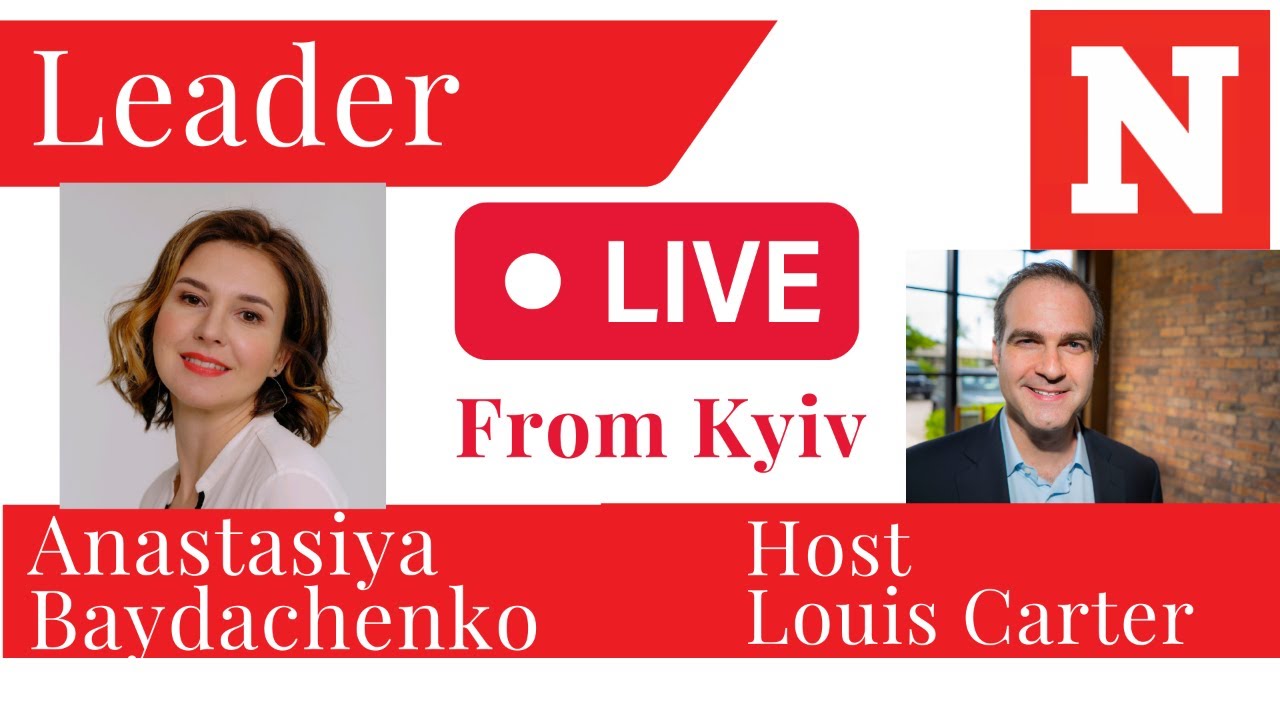
Anastasiya Baydachenko, CEO of a Kyiv-based company, describes the war from a bunker: over 7 million Ukrainians displaced, Mariupol's humanitarian collapse, and Ukraine's economy projected to shrink 35 percent. She explains how companies are rewriting half their annual plans to survive the chaos, and why negotiations with Russia feel impossible right now.
Chapters
Hi everybody, we're here today in Kyiv with Anastasia Barachynko again. So Anastasia Barachynko is in Kyiv, Ukraine in an undisclosed bunker. Anastasia, welcome to the show again.
Thank you, Louis. All my greetings from my heart from Kyiv to everyone, and I hope I could share new information and hot news from Ukraine today.
Yeah, we do get news up to the minute as much as we can. We don't get as much as we could from you, who are really there on the ground in Kyiv, and to learn more from you. Tell us more about what you were just mentioning about the Russian aggression now at the moment and what's happening at the moment that you're seeing directly now in Ukraine, in Kyiv.
Okay, it was about 15 minutes ago, it was reported in City on Telegram channels that there is two explosions in Kyiv, but still there is no official confirmation. I live in the city center and I haven't heard any explosions. So we are just waiting for official confirmation. Today, Odesa is under air attack. It's the main news and main tragedy of today. Rocket attack city infrastructure in Odesa and a religious cult building. Lately, officials from Odesa report that a rocket destroyed roof of the church, but unfortunately they have not reported of what exact, what exact confession. We just know that it is just religion cult building. We know that 13-year-old teenager, uh, unfortunately was killed during this air attack, and also one teenager, 17 years old, was wounded. Um, Odesa is now an object of air attack. As we know, Russians are memorable date lovers, and today is May 2nd. It is also memorable day for Odesa because in 2014 When Russia started its aggression against Ukraine, Odessa was also under attack, and it was a kind of terrorist act from some diversants bought by Russians, and a lot of people died in a fire. That, that is why our security, National Security Service, they expected some provocation and some, some attack on exactly, uh, in Odessa. So, uh, I hope that there will be no more victims of this attack found, and I hope Odessa will have a kind of, uh, good night's sleep because, um, Odessa now is a center of attention, um, Because we have close to the Ukrainian borders Republic of Moldova and also unrecognized Republic of Transnistria. It's Pridnestrovie, as we call it in Ukrainian. And in this unrecognized republic, which was part of Moldova previously, there is also a lot of Russian agents and Russian soldiers. And we understand that it could be also additional provocation in order to attack, uh, Odessa and Odessa region also from this unrecognized republic, uh, Transnistria. Also, uh, the Russians tried 3 times to destroy a bridge, uh, which is very impossible transport area. And I think that the first or maybe 2 weeks of May will be very hot and dangerous in Odessa and Odessa region. And it is possible that we will have a new hot, hot, hot spot in European map, not only in Ukraine but in Moldova and unrecognized Republic of Transnistria also.
So there's a lot happening right now in Kyiv as well as in Odessa, which is becoming a hotspot. Just going over to Mariupol, there are also quite a lot happening there as well with people who are being evacuated and also fleeing because of Russian attacks. Could you tell us more about what you've heard and with your friends, people on the ground in Mariupol as well?
Fortunately, my close friend Tanya, she escaped from Mariupol and with her child, 12 years old. And she is— she was an evidence of all things done with Mariupol. Now city is completely destroyed. There is no electricity, there is, bad supply of water. Uh, the only, uh, spot on the Mariupol map is the plant Azovstal. Uh, and, uh, today, uh, our, uh, responsible services, uh, negotiated, uh, evacuation and green corridor because, uh, uh, in Azovstal there is not only, uh, Battalion Azov, uh, which is warriors, but also a lot of civilian people, women with kids. And there is humanitarian catastrophe. They have no water and no food. That is why our officials like Irina Vereshchuk try a lot of days, day by day, to negotiate green corridor in order to evacuate women with children, women with children from Azovstal. And they started— they have to start evacuation yesterday, but it was postponed till today morning. And as far as I know, the first, uh, the first civilian from Mariupol already, uh, uh, went to the safe spot, but not all a column because there are a lot of people, and first of them are already in safety place and receive medicine, receive food, receive water, and also, which is important, psychological support. But not all this column of evacuated people reaches the destination point in the Zaporizhzhia region, and it also could— delivery of the rest of people also could be postponed for some hours, as our officials reported, which was for me a kind of discovery that people, people from Azovstal, from Mariupol, civil people, they do not have information, they do not have internet, and live in a kind of information blockade. Most of them think that Kyiv is already occupied by Russians. That is why it is extremely important to keep deliver information and deliver news even to the occupied territory. Because what is Russian strategy? When they occupied territories, they blocked Ukrainian TV channels, they control using their internet providers, they try to control the internet. That is why people on the occupied territories could not have the full information and could not rely on news they received. An example of people who escaped from Mariupol shows us the importance of current and truthful news delivery. Uh, so, uh, I hope that, uh, the rest of the civilians from Mariupol, uh, will be, uh, in the safe place as soon as possible and receive all, um, all support and water, food, uh, and psychological support and clothes if they need. Uh, there are a lot of kids, there are a lot of wounded people also, and I hope they will be in the safest place in the nearest future.
Well, this is just extraordinary, Anastasia. Last time we had talked was just last week before the attacks, and we were discussing moving on and rebuilding Ukraine and what we can look at in terms of new policies and procedures. What has been the shift for you personally from the time last week just to the bombing, with, uh, the UN Secretary General coming in, and then this. How are things different now? People are going back, I would assume, uh, who have come, come, come by, who have formerly been refugees. Over 5.4 million refugees had left Ukraine. Estimated 7.7 million have been displaced by April 21st. Some of them have been coming home. Are they going back? To their, to their, uh, to other countries again?
Uh, as far as I know, um, there are, uh, some, uh, people, about 1 million, uh, that, uh, came back to Ukraine, mostly from Kyiv region, uh, because now it's a relatively safe place. But we have a kind of second wave of refugees from Eastern and southern Ukraine because our government and local, local authorities, they ask women, elderly people, children to evacuate. There is a lot of evacuation trains. Authorities organize everything and try to evacuate the most vulnerable and the most sensitive part of population, women, kids, elderly, handicaps, and other people which could not feel safe and protect themselves. That is why the previous weekend, this week, we, we will have a second wave of evacuation from eastern and southern Ukraine because Lugansk, Donetsk region, Kherson region, this this week also, maybe part of Mykolaiv region. There are a lot of civilians that they could prefer evacuate now because they understand experience, tragic experience of Kyiv region and small villages and cities nearby Kyiv. That is why I understand this second way. But also we could understand that people from Kyiv region come back and try to restore their, their houses also. As for me, now it is very difficult to make any forecasts because any equilibrium is very unstable and highly dependent on war situation on the south and east of Ukraine. But I could also understand people who are who want to come back, who want to live in their houses and not to be refugees in Europe, for example. Uh, that is why I, I can, uh, understand it like a kind of, uh, um, difficult— first of all, difficult situation, uh, but it's a kind of new reality for Ukraine, uh, and, uh We should understand that we will act and live maybe in the nearest future and maybe in the nearest next years in terms of instability and in terms of risks, uncertainty, chaos. But from the other hand, it makes us stronger because actually all modern world is unstable. So we— it could— this situation could fail us, but also we could see it as challenge that do us stronger, more adaptive. And also we now, we know a lot of things how to react and how to act. And I think we as strong agriculture, agriculture country, which provide a lot of countries with grain, for example, with sunflower. Our agriculture— our agriculturists, they started their own seedings and all this agriculture spring procedures in order to deliver food, to deliver agriculture products to to Ukraine, first of all, and to other countries that are dependent on Ukrainian agriculture products. As for me, it's a sign of, uh, of strong, uh, of strength. And, um, I believe that, uh, yes, uh, there will be risks. Uh, we have a dangerous neighbor. We help— we will help all these risks every time and every day, but we could learn how to do, how to live with it, and how to do with it.
You know, and that's what you, uh, you are, Anastasia, as a leader, as a CEO, as a mom. Uh, you're, you're brave and you're courageous staying in Kyiv, uh, knowing the risks, yet knowing that that is, uh, a place that you can stay strong and you can also help your company, your, your country, and to, to rebuild. Um, I'd like to go into that a little bit. Um, just in general, you know, whether it's religion or spirituality or whatever it is that guides us during these times, you know, you just look at Pope Francis condemning this in the macabre regression of humanity, and we think about just in general what you've done to stay for your children and how you've helped them through this and giving you a deeper understanding of what to do really when we get through the crisis. Could you bring us through that a little bit where, you know, what you see us doing, what you see Ukraine doing during the— when you do rebuild? Because we talked, yes, before about rebuilding, and there was in fact a bombing after. Yet, I know that you have the strength to think about the future and to plan and to strategize. I know that about you, Anastasia. Tell me about you and your planning for what that future may look like.
Oh, planning is quite difficult management function now, but we try. And the key medicine for planning in this time, in chaotic time, in time of crisis, is adaptive planning. So we have— maybe we have a kind of draft for middle-term plans, but we understand that all this plan could be a subject of adoption and could change. Normally we We adopt and somehow change about 30% of our annual plans in normal life, no war. But I think this year maybe half of our plans will be changed and somehow adapted under the current circumstances. And also we understand that every day we could receive any other challenge to react as a market, as an industry, as an IAB Ukraine. And that is why we should first of all change our way of thinking from fixed to adaptive. It's the main strategy appeal. And without adaptation and without flexible thinking, I think it will be extremely extremely difficult or even impossible to act in Ukraine. And I could say in a modern world, because yes, we have maybe more difficult situation, but all modern world is unpredictable, full of challenges, full of unpredictable situation like COVID pandemic, and so on. So first of all, we should move from fixed to flexible and adaptive way of thinking and understand that there is changing and adopting goals. It's not bad planning, it's just another way of planning. And I'm absolutely sure that we couldn't refuse this the function of planning, because management, people management, company management is completely impossible without planning. But definitely, modern planning, our time planning is something different comparing to 20, 30, or even 15 years ago, just because our world and innovation become, uh, receive more higher speeds and everything changes more quickly. That is why.
Yeah, this— I love what you said, from fixed to adaptive mindset, you know. And there's, there's growth and there's adaptive, and it's exactly what you're saying, is the flexibility is important for what you're going through now. And that's what I've really seen as a, as a line, a thread that goes through, um, the leadership that you've shown, and others as well, is this flexibility, this growth mindset, that you're able to see what's possible because you're being thrown these incredibly conflict, unconscionable actions each day. And there's fears on all sides that could, it could be construed as fears. I don't see you as thinking of them as fears. You think, I see you as thinking of them as being adaptive and flexible. And I see that's really incredible to see that regulation. I'll give you one new thing. You know, Hungary comes out and they said they would veto EU sanctions on Russian energy, you know, while of course Germany, a little bit more, you know, on the side of Ukraine, they say sanctions won't be lifted until Russia withdraws. So, you know, the question is, you know, has there been some kind of world response where people are now taking sides and Ukraine is kind of needing to keep a little more insular. Are you seeing more of that where you're having a— there's a lot who are on your side, yet there are others like Hungary who are vetoing sanctions themselves? So what are your thoughts on that?
Yeah, I read about this. You know, it's a kind of economic It's like, uh, Hungary and some other countries, not only one Hungary, they are highly dependent on Russian resources— gas, oil, I'm not sure, maybe electricity also. That is why Hungary supports Russia almost in every way, and they put veto. But as far as I understand, other 25 countries of European Union, they could also support this, the sanctions, even taking into account Hungary veto. They— I'm not sure if they create a new procedure, but I read that it is possible to, uh, to launch this 6th wave of sanctions against Russia, just with 25 votes from 26 to 27. So I hope it will help us because despite that previous 5 waves of sanctions, as it was forecasted, Russia will lost just 8% of GDP. For example, Ukraine, as our Minister of Economics estimates, will lost 35% of our GDP this year just because of war action and critical infrastructure destruction. So I hope that this 25 countries support new wave of sanctions. And this wave of sanctions will not be the last because 8%, it's not, it's not great price. I think we need more sanctions and we hope for default because all these economical troubles in Russia for us understand that they have less money for rockets for military ammunition, for new soldiers to attack us. That is why I greet every sanction, and I hope that European Union will adapt their procedures in order to launch these sanctions and new more sanctions despite any veto of Hungary or any other countries.
Absolutely, Anastasia. And we also see that Germany's sanctions won't be lifted until Russia withdraws, and many other countries are continuing sanctions and sending more firepower, artillery, and many other types of reparations. What's important now is also, you and I talked about that reparations and also about sort of, you know, what happens in International Criminal Court after all this has been done and what you've seen really as a result of all of this. Tell us really some of the things that you've seen and heard, not only in your company but also sort of beyond in your circles in Kyiv, of the things that sort of, you know, that have been done in terms of war crimes. So, you know, Ukraine recently named 10 Russians of war crimes just in Bucha. However, there's very— Mariupol, there's, uh, many— there's 3, 4 different fronts that are being, uh, attacked at this moment. So that's just one region, you know. What, what else have you heard in terms of the— these war crimes that are happening at the— this very moment?
Um, as far as I, uh, hear and read from local Telegram channels, uh, the catastrophic situation we have in Mariupol, where almost 20,000, 20,000 of people were killed. Comparing to Nazi occupation in 1940s, which was during the Second World War, there, there was killed almost 10,000. It means, uh, 2 months of Russian occupation and Russian attacks took from us twice more people than it was during the Second World War in Mariupol. It's dreadful statistics for me. And also Russians teach a good lesson in Kyiv region because in Kyiv region they were completely inaccurate and they lost a lot of, uh, materials, provements, and everything was well recorded because not only our criminals, our criminal experts were here, but also, uh, as far as I know, French and criminal experts from UK. It means that everything done or will be done in the highest level. But what, what Russians does do in Mariupol, they used, uh, they tried to hide their exact death rate and the exact number of people killed and murdered and tortured. So they They just put their bodies into fire. They use mobile— I hope crematory, do you have such a word in English where the dead bodies put to fire? It's like crematories. Yes, yes, they, they use mobile crematories in order to hide the exact number of civil people die. And using crematories, uh, it's Actually a big problem because it makes very difficult, um, bring them to justice because, uh, nobody, uh, no, no evidence. And, uh, it's a great, it's a great problem, uh, but, uh, we have a lot of photos from drone and we could understand where there is places of tombs, and we could understand even the moves of these mobile crematories. But actually, the absence of bodies makes a great problem to bring them to justice for this crime, for killing 20,000 people, civil people of Mariupol. And unfortunately, we have not yet any statistics for, uh, children killed in Mariupol, uh, because we have, um, now statistics that more than 20, uh, kids, um, in all Ukraine were killed during the war. But at least because we, we speak— we tell here at least because we, we have no understanding what is in Mariupol. We just could estimate that if there is 20,000 of civil population, at least, at least 30% of them are children, unfortunately. And also Russians, uh, transport, uh, civil people, uh, from Mariupol and other regions to Russia, and they They destroyed their Ukrainian passports and give them Russian passports instead. It also give us additional problem to identify people, to understand the exact number of transported to move to Russia and exact number of people died and killed in Mariupol. And I hope one day we could estimate all these tragic statistics And, um, all responsible, mostly it is a military management and, uh, country management, Russian country management, they will be persecuted and, uh, will be bring to justice to the tribunal, uh, international tribunal, I hope. And, uh, uh, I think, uh, they will be in jail. Um, I think this kind of articles for, for this military, uh, crimes. But, uh, also some, some small villages in the Perizhzhia region, they are under attack now. And, um, we have, uh, we have post, we have information that there is a similar situation that was nearby Kyiv in cities like Bucha, like Irpin. But, uh, Still, we have no official confirmation from our officials, from ombudsman, or from Cabinet of Ministers. But as far as we understand them, the style of action of Russian army, I think it is of a high probability that all this information is truth, unfortunately.
Mm, you know, we were talking about the International Criminal Court the other day and the fact that if they are tried in the International Criminal Court, there's a possibility it won't be a fair trial. And, uh, it will— in fact, we talked, we discussed Nuremberg and the discussion about Nuremberg and how, uh, some Nazis were not brought to justice. Um, and we were all then, uh, discussed, well, what would happen and would it be possible for Russian criminals of war to be tried in Ukraine? And what do you think would happen in that event?
I think it is possible, and also I think there is two— maybe if there is— in general, there is three scenarios. First of all, it's International Tribunal, and in case it will be unfair or unsuccessful. Also, it is possible to bring them to justice in Ukraine. And also, there is a third way, which was used by Israeli, when it was a kind of unofficial state service that find out and— Nazis criminals. And kill them. I'm not sure that it is a very legal or even legal way to do justice, but, um, we as a country and our people were wounded so much and were killed and tortured. That is why there is a lot of hate in our hearts. And I could not, um, I, I could not, I could understand if there is some, uh, someone, uh, there will be a kind of such a secret service, uh, with the task, with the goals, uh, to bring, uh, to bring, uh, we call them racists, uh, as, um, like, uh, like Nazis and Russians. So we call them racists, uh, to call this racist criminals to justice, prosecute them. In the best cases, case, they will be not killed but bring to the justice to Ukraine. It will be legal and it will be a kind of normal situation for modern society. But unfortunately, there is a lot of hate in Ukrainian hearts because We, uh, we have a lot of tragedies, uh, we, uh, have a lot of, uh, tortures, we have a lot of sexual, uh, sexual crimes, we have a lot of murders of civil peoples, and all these things unfortunately, uh, just feed the, the hate. They—
that's right. I mean, the— just to hear and to know the amount of sex crimes and murders that have occurred is extraordinary. And the, you know, the feeling of Ukrainians about what has happened, I can imagine, would be just unbelievable if somebody did, in fact, or they were tried in Ukraine. You know, the antisemitic statements made by Russian Foreign Minister Sergey Lavrov you know, they were condemned by Israel. And what was interesting about these statements was that they were completely untrue. And so the— we're working with right now is truth. We're on the ground, we have actual statistics, real numbers. These are not— this isn't fake news, this is real news that is happening on the ground. And you look at Russia's news, however, the subjectivity of it is extraordinary. It's completely subjective, the thinking. Uh, and so what, what are your thoughts on the subjectivity and things that, that when they're sort of talking about things that aren't— that have no truth or to them in terms of the perception of somebody being anti-Semitic? I mean, there, there's no higher order thinking in that way, is there? And, you know, the way you're speaking about growth mindset and, uh, fixed mindset, it's not something that really would be even known in that location. What is that like to, to live with such an illogical, um, irrational neighbor? That was subjective, but I say it anyway. I mean, how can, how could, how could that possibly— is that what's driving the, the Ukrainian citizens because of the irrationality? The, the fact that it, it, I've heard, seems like terrorism.
Uh, yeah, actually it's, it's terrorism. Uh, for me, uh, what is the current situation in Russia, uh, is like a Black Mirror series. It's parallel reality, absolutely parallel. They take, uh, something which is white and just report it using TV channels that it is black. And, uh, there is very old PR technology, uh, but Uh, it is completely out of date, and, uh, if they, they will keep using it, they will be North Korea. Uh, there is no way. Uh, it's, uh, keep their people, uh, without any critical thinking. And, uh, yes, these people are object of easy management. It is very easy to manage these people, to make, to create for them external enemy, and to use them as the leader or president wanted. But actually it's a very dangerous game in modern world because all the, all the last appearances, for example, of President of Russia, uh, have a lot of signs of, uh, computing. And it's like they, um, shooting it using the green screen. And there were a lot of mistakes, for example. And, uh, it looks for me like they are live in a kind of virtual reality. Showing, um, something which is not truth, uh, naming white, black, and so on. And, um, as our, as our President Zelensky said, uh, light, uh, light overcome, uh, the darkness. Uh, there is, there is a rule. Maybe it takes, uh, a lot of days or even years, but, uh, when we live, uh, in virtual games, when we every time, uh, day by day speak, uh, not truth, uh, speak, uh, something wrong, uh, one day, uh, this structure will be, will be destroyed, uh, from inside, uh, it, it's like axiom, there is no another way, one day this system will be destroyed from, uh, inside. And, uh, for me it is very difficult to hear any news from Russia just because of They are illogical, they are wrong, they are not truth, not truthful. And it was a very, very strange statement of Lavrov yesterday, maybe this morning, about our president, and it shows actually a real antisemit attitudes in Russian government and in Russian elite. And it, it is very, uh, seems very dangerous for me because, um, as far as I reported during our first interview in March, they destroyed, they destroyed with, uh, with rocket, um, Babyn Yar It's a Holocaust memorial in Kyiv, which is a sacred place for not only for Jewish people but also for, for Ukrainian. For example, my grand— uh, great-grandpa also was killed in Babi Yar because he was a kind of partisan in Kyiv occupied by Nazis. And, uh, it's a, it's a sacred place for a lot of people because, uh, there were killed a huge number of civilians. And it is, um, it is impossible for me to even to think that someone could destroy such places. But, uh, as we hear from Lavrov, uh, it's just, uh It's just their policy. It's something in their head, completely abnormal, completely illogical, completely out of date in terms of modern world.
I think that's more than reasonable to assume the out of date. It's incredible to hear these statements being made and the duality that we're talking about, the black Black and white. It's, it's dualistic. And the, the interesting part of this is if you looked at all that has happened, uh, Russia just today stole $7 million worth of farm vehicles, and Ukrainians, uh, Ukraine soldiers pushed them out, uh, from those farm vehicles. You've lost more than 35% of your GDP as a result. Um, this isn't a result of sanctions. This is a result of stealing, killing, and murdering. Bottom line, you know, and there it's indisputable that this has happened. We have the stats, we have the figures, we have more than 20,000 dead, we have, we have 30, 35 or so wounded, we have children who have been murdered, we have men who have gone to war, we have a volunteer group, we have front forces. This is truly that you have been attacked and harmed by a secondary force. This is just outrageous, outrageous. And more people need to see this even now. We can't forget, cannot forget. So this is what I wanted to also explain here too, is that what's coming up in May, the day when Russians felt were victorious in World War II— what are you expecting to happen in the next couple days now from Russians? Is there a brace for more for more attacks in Kyiv? What is the overall thinking for you and your company and also your colleagues?
First of all, we expect attacks on Kherson region, Zaporizhzhia region, and part of Donetsk region. It's very hard battles with very low success from Russians because we are strong and we are good in defense. And which is more important, we already have received some of new weapon from United States, from United Kingdom, and some of European countries. It makes us not only stronger in defense but also give us opportunity to attack distantly. Not from short distance, but distantly, which is of course save our people, our soldiers. And I think it will help us to change dynamic of battle to more positive and more dynamic to Ukraine. But I understand that they will still attack, air attack Odessa, and they definitely have troubles in unrecognized Republic of Transnistria, Pridnestrovie, and possibly Moldova. It's not very thoughtful from their side because it's like another second front, and it is understandable that there is not much resources. But it is of a high probability that we'll have another, another front in Pridnestrovie and Moldova. Also, all cities, all city, city, all region capitals like Mykolaiv, Kherson, Zaporizhzhia, it's southern Ukraine, they could be subject of air attacking and aerial alerts. But as far as I understand, they tried to attack Dnipro and Kryvyi Rih, which is a birth city of our president. It's also a kind of symbolic— Russians prefers— prefer. But it, it is very difficult for them. So they, in my understanding, concentrate all their efforts on Zaporizhzhia region, Kherson region, and Donetsk region, using air attack to Odessa also.
So there is more to come. And if you— and one last thing, to look back at the beginning of the war, February 28th, when we, when we were looking at Zelensky, Putin wanting to come together, Zelensky wanting to come together with Putin and discuss the terms. And the— it could have been easily done where Actually, I should really ask you this. Would it have been possible to create some sort of more peaceful understanding and creation of an alliance between Russia and Ukraine where it wasn't— there was not war? In fact, there was an understanding where you could be partners in some way. Was that ever possible? At any point in time.
Uh, yes, in modern world it is more profitable to be a partner. It is more profitable to make negotiation, not make war. But, uh, you see, we are in different paradigms, paradigmas. For example, it's like we play chess like intellectuals, and they play box because they're strong. And it is impossible for, uh, when we are playing chess to win someone who play box. It's almost impossible. That is why any negotiation and any kind of partnership, first of all, any negotiations are possible when we and Russia, Ukraine and Russia, will be in the same paradigm. And it first of all means that should be, that must be completely different government and president that they have now. So it should be completely different leader in order we start to think that negotiations, uh, will be effective. Now it is impossible because we are playing chess and they're playing box. No, no, no effective negotiations.
Well, it's, uh, it is unfortunate that it has— this has happened. Not just unfortunate, it's unconscionable, as we've been talking about it before. And I thank you so much for being our correspondent there in Kyiv. You've had some absolutely unbelievable— I know that unfortunate is not really the word, right? Eugenie said it, said that it is laughable, it's ridiculous what has happened here. And the fact that Russian public— Federation has really turned into this, as you had mentioned, as you had said, more like the North Korean government. Where it's a much different PR effort that is being created. And it's just unbelievable. I really thank you so much, Anastasia, for coming here today, for being with us. And I do welcome anybody to comment on this at any time or to ask questions. I believe we can— we're being we're being, uh, simulcast throughout 4 different platforms. So if you do have a comment, please do add that. Let us know where you're even calling in from. You can put that right down here. And we do see, Lucrezia, several people on from throughout the world right now. And I wish you peace today and for the many days ahead, and to keep that incredible spirit and courage and bravery that you have, Anastasia, and hope to also have you on again as our correspondent for live breaking news. Thank you, Anastasia, for joining us.
Thank you.
More from Louis



How to Get Found in ChatGPT, Perplexity, Gemini, Claude & Grok | Visipage AI Visibility Audit

Your Competitors Just Got Certified. Now What? | Most Loved Workplace® Demo & Hiring Advantage



Visual Thinkers: The Hidden Genius Behind Skilled Trades & Innovation! #shorts

Car Mechanics: The Secret to Engaging Autistic Adults Over Video Games! #shorts


