LivePerson CEO Rob Locascio on Leaders Live with host Louis Carter on Newsweek
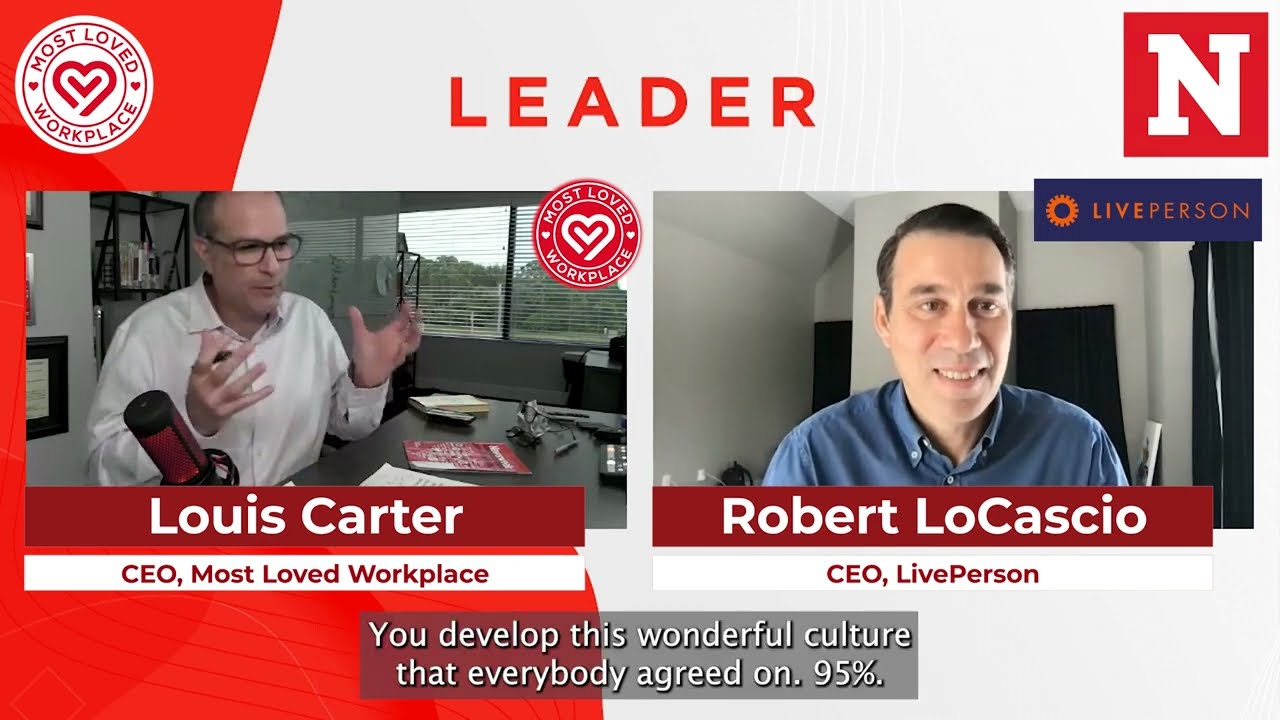
In this interview, Louis Carter talks with Rob Locascio, the founding and long‑standing CEO of LivePerson, about how the company created and sustains a "Most Loved" workplace. Locascio describes the origins of LivePerson’s core values—owner, help others, meaningful connections—developed through a company‑wide voting process and an off‑site in Israel, and how those values shape the physical workspace (open, wall‑less, circle‑based meetings) and daily rituals. He cites Zappos and Tony Hsieh as a benchmark that set a high cultural bar. The conversation moves to the challenges of scaling that culture as the firm grew from 400 to 1,500 employees, especially with remote onboarding, cultural‑fit hiring, and the difficulty of assessing fit in senior hires. Locascio explains the EqualAI initiative to combat unconscious bias in AI and the broader organization, and he shares his recent focus on building an internal “farm team” to develop leaders from within rather than hiring externally. Throughout, he emphasizes servant leadership, stewardship of the company as a living body, the importance of authenticity, psychological safety, and the need to scale the "beauty" of AI rather than its destructive potential. He also reflects on personal mistakes, the pain of mis‑aligned hires, and the philosophy that leaders must give before they get, leaving the company better than they found it.
Chapters
Great to be here today with Rob Locascio. It's awesome. He's the CEO of LifePerson. He's also the longest-standing founding CEO going on his 27th year. Welcome, Rob.
Hey, Louis, thank you. Thanks for having me.
It's great to have you here. I have some questions, so many questions and so much learning from you. You've been through the entire gamut for 20 years of being a longest-standing founding CEO, and there's a lot to learn from you about how you created great cultures, how you've created a most loved workplace. And that's really my first question for you. You know, you've created and currently lead a culture that employees love. And, you know, here's the first question: How did you do it?
It's interesting. I mean, first of all, culture and is an ongoing work in progress, I can tell you. And even on my board, I have Fred Mosler, who was running Zappos with Tony Hsieh, and Jill Layfield, who was over at the CEO of Backcountry. And they were culture-focused CEOs. I brought 'em on my board. And another gentleman, Peter Block, wrote about community. So we really believe in it. And 11 years ago, we actually, there were about 400 of us at the time. There's 1,500 now. But we decided to put our values in place, like our core values. And we actually spent like, I think, 6 or 8 months. We invited the whole company in to give ideas, and then we, we collected them as a small group. And then we actually took off for— the entire company shut down for 3, 3 days. We went to Israel because we had an Israeli— this operation over there. And we all worked through it. And then we voted whether we would have the values put in place. And we said if the vote doesn't get 98% of the people, we wouldn't put the values in place and we'd continue forward, because you have to live them. We talked about what it's like to be living them. And we— so we developed— it was be an owner and help others and create meaningful connections. And these were the three that we had, and we put them in place. And then we started to, like, we changed even how our physical workspace— we broke all the walls down of there's no cubicles, no offices for connection. We ran our, we ran our events and our meetings around connection before content. We put people in circles instead of everyone in like a line looking at the back of each other's heads. Everything we did, we started to build around connection and community and our values, and we trained in on them and stuff like that. So that's how it got started. And I guess that really put in a framework so that as we've evolved the values We are, we're able to kind of snap them into something that already exists. But I think the biggest part about what makes us unique is we're kind of one part connection and people want to feel like they're connected to each other and it's just natural to help each other, help others. And then we're like one part entrepreneurial and the idea that, you know, Be an owner. And, you know, and we have one called Dream Big. Now we've added another one, Dream Big. And so we have this interesting combination of people who come here who do well, are very connected people, but they're also very entrepreneurial people. And that's kind of, I think, what makes our culture unique.
What's really cool about that is I see so many Most Loved workplaces that combine what they provide to their customers with what they live inside of their company. And that's exactly what LivePerson does. We, you know, you provide this community, you provide a learning community. They are entrepreneurial. Your customers are very much like the people who are inside your company.
Yes. And the meaningful connections at the time, although we just revamped the values again, interesting enough, but the meaningful connections was what our software does. It's what we believe in. So we create that as like the golden thread. And I think when you think about culture, if you can get the golden thread between your customers, your products, and you, it kind of makes it easy. Like, we know why we're all here. So I think, you know, this is what's given us, I think, the, you know, the type of company that we can be most loved workplace. But like I said, I definitely wake up in the morning and I talk to like, like I said, Fred was at Zappos, which I started this journey because I was watching a TV program, CBS Morning, and, and at that time, 11 years ago, Tony Hsieh was being profiled, and Zappos was the number one company to work for. It won, uh, the, you know, I went and I flew out to Vegas and met with Tony and spent a day with him and walked around Zappos' headquarters, and I was like, oh my God, we are just so far from this. Like people are living and they were delivering happiness was their, was, is their value. And they talked all the stories about delivering happiness to customers and the things they did. And I said, my God, we're just not even like this. But it set me on the path, like the high bar. Tony set me on the high bar of this is what a real company with real— and, and every day I wake up and think, man, we are so far from that bar. We are so far from that bar.
So that, that's a great segue, um, into the next kind of question or area is what things could you do better to get to that bar that you're setting for yourself?
I think, I think that the, the greatest challenge is that we're in a growth business and it's so dynamic. Like, we, we We kind of moved from chat 7 years ago, and I invented that technology to messaging and AI, and we put all this effort into the product, and there's a focus there. So it's like focus. I just think it's what makes it challenging is you've got a business you're running, and then you've got this culture that's driving it, and you gotta take care and feeding to all of it. You know what I'm saying? Culture in itself needs care and feeding. And the greatest challenge I see that we have even today is like we've added a lot of new people. And training them and getting them to understand. And now they're remote. What, what I— what the, the greatest challenge for all of us is that we normally onboard people into physical offices, and there's a lot of information that's transferred without speaking. Like, you see the office, you see how we act, you see how meetings would take place, and people pick that up. They don't even— you don't even need to write down like, here it is and this is what you do. They're like, oh, I'm in a meeting and this is kind of different. Oh, is this the way we run meetings? And they start to take mental notes. Oh, our offices, we don't have offices, we're in open spaces, like, but it's different. We don't have that today. So you're telling people about the culture, you're trying to onboard them. And I think this is a challenge. And we're also interviewing people to be hired that we think are cultural fits, but you can't tell. Like sometimes you're on a thing and they look like a culture, they feel like a cultural fit, they sound like a cultural fit. And then they onboard and then they're not. They don't have that way. So I'm really— I'm focused right now on— I kind of really did another look at what makes a live person a live person. And I've now— I wanted to develop like a competency, competency grid on this for culture. And then we'll work with our employees on it because it's different than when they were onboarded into offices. The stuff we're doing, we create an organization called Equal AI. And we because we are one of the leading AI companies for conversational AI. And we started to realize that, and we've read all the horror stories about unconscious bias that gets put into machine learning and algorithms that are, you know, put in front of people. And so, you know, I started to think through what do we want to do about that as a company? And then we formed this organization, one of the founding members of this organization called EqualAI. And we're training large companies and mid-sized companies, really a lot of large companies about, about it. And we have a whole program that these companies can take and put their people through and get certified that they're looking at the things on an engineering, on a culture, you know, to really root out unconscious bias. Marian Vogel, who runs the organization, she under Obama administration was tasked with this in the federal law enforcement agency. So she built the whole curriculum around unconscious bias in federal law enforcement because they saw it there. So I think, you know, what is unconscious bias? Pretty straightforward. Like, brains take a lot of energy. I think they take 25% of your body's energy is consumed by your brain working during the day. It's a fair amount. And what's happening is your brain naturally doesn't want to use its brain. Like, your brain just wants to say, like, I'm going to preserve energy. So what it uses, it uses bias. It basically unconsciously tries to make decisions about people, especially based on stuff that we don't even understand, like stuff that went back to the, you know, prehistoric days where we were on Earth and we were part of communities, small communities, tribes. And, you know, I— back then, somebody came into your group and they looked differently, they would maybe kill you. So automatically, we got, okay, that person is different than me, they're probably going to harm me. And that stayed in our brain— color, sounds, looks and feel, obviously, race— all that stayed inside of us. And we don't even know it's there. That's the unconscious part. But we all know it's there. If you really step back and you're walking down the street and someone is walking and you're just the two of you, think about all the times you make decisions on them without even knowing who they are. I, I'm scared. I'm not. I've got to be cautious. I'm not. Why is that? So this is not our fault. It's how I look at it. We weren't raised like this. We were programmed like this. And so this shows up in technology, you know, and we want to make sure that at least people would be aware of that and, and be able to not bring that to AI.
You know, we— I think of Singularity and how we can get to that point where we're releasing ourselves from those initial assumptions. And, um, that this is the such an important step in doing so, so that we, we— it really averts disasters, it averts wars, it averts, you know, conflict that may harm a other people, ourselves and others. And what a great step in learning, Singularity Learning. It's really wonderful.
Yeah, I mean, it's, it's this, we talk about metaverse now and all this stuff, and you think how technology will play a greater role. It plays a greater role every day in our lives. But as we start to live more, we're living here in, in a metaverse. I mean, people laugh, but this we're living— this is some sort of altered reality. This is not reality. It's an altered reality that's, that's here, but we're living in it. And this is also could do things for bias and unconscious bias. So once we start moving more and more of our lives into digital lives, transforming the digital lives, all of that will just be moved into another world. And that scales, unfortunately, that you can scale that. And that creates harm at scale. And that's what algorithms do. You can The beauty of AI is we can scale. Like in our business, we scale customer contact conversations. So a bot can handle millions of conversations simultaneously. A human can't do that. So the destructive force or the beauty can be scaled. And we just want to make sure we're scaling, you know, the beauty of it, not the destructive nature of it.
The 80/20 has to go in the, in the, in the beauty way rather than the— it's excellent. Well, the other thing is, too, you know, this is, this is something that, you know, some CEOs like to answer, some don't, you know, to admit where, you know, where we've gone wrong, we could do better. Right. Let me just ask it straight out, right, like this. I know people like to hear about— they've had mistakes they've made before. And let's just ask it like that. What's the biggest mistake you made in this and how did you correct it?
It's, it's, oh, the biggest mistakes you can make as a leader is hiring the wrong people. And I've even done that recently. You know, knowing that everyone is a good person, like the majority of people are good people. Every now and then you come across someone who's a bad apple, and they just have some personality disorders. But the majority of people we run into are good people, and you bring them in. And so they don't have— they're not here to harm. But what happens is that they're not a cultural fit. You find most people have the skill, and they come in with skill. And but ultimately, they can't apply it to the company. And what they come in with is usually a framework. And this is the difference between managers and leaders. Managers are people who manage systems that exist. And they— it's kind of like homeostasis. Leaders are brought in to do not incremental, but exponential changes. And so if you want to exponentially change a business, and then you got to come in and understand first, like, what is this place about? Instead of what I find, some people come in and they just try to impose their structure in that they learned. And then they get a lot of feedback that this doesn't work. And then they give up, or they're like, you know, I don't understand, or this place isn't as good as where I was. This is what I see. But this— but their— the impact they have on the org in a short period of time, especially if they span a lot of control, is massive. They are impacting people's lives who do the work, who have been here, who maybe are not perfect, And I think the worst mistakes I've made is hiring people into senior lead— I just recently done this, you know, hired some people into senior leadership because we're growing, we're half a billion in revenue, growing in, you know, high 20%. Like, I need more people. So you go usually to hire people who come in from big companies and you want them to scale. And what you see in the end is culturally they just don't fit. And, and what you find is a lot of people don't want to take the time from from other— from especially bigger companies to really learn the culture. They come in with, hey, where I was was great. We should just make that culture here. We've been around 27 years, for better or for worse, we got here. And we got here under some great ways and some ways that were hard, but you got to respect the culture. And that's the biggest mistake I've made as a leader. If I could dial back the people I've hired— luckily, I don't— haven't hired a lot of those. But you get one or two in at a time. And it's just painful. It's a painful experience.
There's so many ways, of course, to know if it's the right person. You could use tools, use instruments, use models, and, you know, sometimes they work, sometimes they don't, right? And, and, you know, the— so the, the question is, you know, if, you know, if you could just sort of wave a magic wand and say, you know, I really would like this to happen, right? Instead, so that we don't get those, as we call them, bad apples who harm your culture. And they can They destroy, erode a culture, you know. So how do we help the people who really want to work at LivePerson, right, to know, is this the right place for me?
Well, this is—
this—
so my lesson learned recently, and this is a recent lesson learned, like within a few weeks, is that at our scale, at 1,500 people, I don't think we need to hire a lot of people in those leadership roles from outside. I think this is our— this is the mistake, is that we need to have a stronger farm team to make the managers the next set of leaders. Because we can— when you have people come in in lower-level jobs, mid-level jobs, their destructive force is minimal, right? It could be, yes, they could harm a customer. They can— maybe they're in a group where everyone pissed off about them, but they'll go out fast. And it's no harm, no foul. Matter of fact, you don't even hear about them. Like, they come and they go. They're part of the attrition numbers, some of them. And, you know, non-regrettable, right? And that's the best way to do it. And then, then we have to have strong ways, which I don't— which, once again, this is a focal point of mine now, is to build a better way to get the team, to farm the team, because I want the next set of leaders not to come from the outside anymore. I tried some stuff recently. It just doesn't work. So I want the next set of leaders to come from inside. That's my lesson learned. And now there are, you know, I've done this for 20-something years, so the times where I need to hire people off the street because we're growing at a pace, we don't have enough people to farm the team, you know, you don't, you don't have enough people. You got 10 people, you got 20 people, you got 100. I went through from me on a couch to 1,500 people, so I've seen everything. But at our scale we can build farm teams, like really strong, strong ways to find the next set of leaders. And that, that's my goal right now is find the next set of leaders.
So, so really grow from within, have succession plans to the top, and then, uh, grow in more of the entry to mid so that you can grow them up.
And that, that's it. And so that, that it's, it's, it's, it's going to take work. We got to build the programs to do it. You know, we, we're moving. The thing is, like I said, we move very fast, because we got, we got a lot of growth. So you tend to like, you're cutting corners on stuff like that. You may just say it's easy to hire someone externally, who's got all the things, who has all the, you know, all the, the resume, you know, not only do they have skill, but they build big orgs. What you realize culturally, that the part is culture. And what I, what I've realized lately through one or two examples, recently experienced is that the culture here is very strong. Like, when a leader comes in and they're not a cultural fit, the red flags go up. Now we're all— I find the company, because about— we're about connection, people are very patient. They're like, let me connect with this person, let me feel them out, they're individual, I want to— but within about 3 months, it's like the red flags just go up. Like, this person doesn't do this, they're that, they're— and then what the— now on your 5th month, what I see is the good people are like, I may not want to work here. This is what they realize. Well, they'll come and say, look, I can't do my job. And this— and I love this place. I've had a conversation like this. She's like, people cry. I love this place. And I helped build it. And but this, these, this person is not aligned to our culture. And it makes me think, what type of company are we now? You know, that, that's that. And that as a CEO, you're like, God, we spent so much time building culture. And now a person who's really a great cultural fit, who's shown they can deliver, is feeling like maybe this is not the right place for them. That's, that's, that's a painful moment. That's a moment of learning.
And that's— they call them growing pains, different types of ways of identifying that feeling that people have, especially when they have such love. And they, and they have this realization that things have changed. And we have those in relationships. Oh, things have changed. You've changed. We've grown or whatever it may be. And what I, what I'm hearing you say is, you know, being the longest-standing founding CEO, you want to capture and enliven what really helps you succeed. You want to enable it consistently like you did with Peter Block, with creating a community back in the beginning. And you went offsite, you went to Israel, you developed this wonderful culture that everybody agreed on. 95%, it's about doing that again, right, in a different way. And the two things you said were wonderful— do this and do that. Isn't that cool? Because the do this and do that are the things that we know as a person feed our souls, feed the love for our company.
Yeah, yeah. And that, that's the thing, like, people— why are people here? You know, like, you can work anywhere, right? Why are people here? And they're here because they feel like this is a place that they can grow. They feel like this is a— I don't like to use the word family, but it has a familiar, a familiar thing. It's a thing that I feel like I can be me. And I've always wanted to be me. And most people work in companies, they can't be them. And that's what happens. They get— then they start building these weird personalities to get through the jiu-jitsu of a company, you know. And then I don't— and then working, I got to think that I'm going to fake it. And they fake it to make it. When people come here and they fake it to make it, it's hard. Like, I've seen it, and it's like I pick it up. You're like, God, you're faking it to make it. And so even times where it's interesting, well, when we did physical, I would always do— I do, um, meetings with all the new recruits who have been hired, and I'll do a meeting, talk about the culture and, and the company and the history. I can see in a room— I remember we put 15 or 20 people there— I could see in the room, I go around the room, ask people stuff,. And I would see immediately, this person shouldn't be in the company. And I started to make notes. I told the trainer, the person who's doing the onboard, I, I'm making a note, I don't think this person should be in the company, follow them and see if I'm right. And inevitably, I was right. I had a guy once who was— we were all about connection. So we sit in a circle. And he put a briefcase next to him, like his laptop, so that no one was next to him. Like, it was like, Louis, we're all next to each other, the one chair next to him. And his chair was off the circle. It wasn't even in the circle. And I went around, everyone explained, and I was talking to him. I could see, just, I'm like, what is this guy doing here? How do you even get in this company? I found out what company he came from, which is a bad culture company. I knew this company had very bad culture. I said, how the hell did he get in here? Because he has a skill.
Yeah, it's the skill, not the will or the fit, right? You can have the skill, not the will and the fit, and it won't work. And what I'm hearing about the Do This Do That, I'll see, I'm going to test myself assumption is that the do this and do that are really be yourself, be authentic, have psychological safety that you're not going to be harmed for being who you are. You're going to be celebrated for being yourself. And if you're something else and you're trying to put an air on or be someone that you're not, it's just not going to work, right?
But it even happens to me. Like, I'll, I'll— and recently, it's good, good thing to have a talk about culture because recently I've had this example. I've seen, once again, good these are good people. I'm not making judgment on their character. They're not stealing, cheating, and lying. You know what I'm saying? These are good people. But it even makes me feel uncomfortable. Imagine I'm in meetings with somebody and I'm like, I'm uncomfortable, but I'm dealing with it because as a human, as a human, even though I know deep down, this doesn't feel right. I've been in this company long enough to know this doesn't feel right. Like, I'm the CEO, I'm the founder. But I'm— but then I put up with it. You just put up with it. And you're like, this person, they just, they say things the wrong way. They talk, and I'll give feedback. I will give feedback and say, look, that's not the way we do things. And, and it goes on. And then I'm in meetings, and I'm like, I feel bad. I'll walk out of a meeting, I'm like, I don't feel inspired. I don't feel like, I feel like I'm scared. Like, is this person really going to do good for the company? And, and so I think about, but I'll put up with it. You— we always do it. Everyone always says we never fire people quick enough, we never exit them quick enough. So we go on, maybe they're going to change, maybe I don't understand something, I don't understand, maybe they— because they had this great, you know, success, maybe I don't understand something. And this is the CEO— I, you know, I have a podcast called Over the Wall and we talk about the psychology of being an entrepreneur, being a leader. And it's like, then you get it, your brain starts working in these periods. The bottom line is this: I'd rather just like go at it and maybe we don't make it, but at least we don't make it with a team of people that want to make it. You understand? Like, I always felt like we're going to give it our best, but at least I know when I go to work, I know I'm working with people that care, have a heart for the business, and culturally I don't have to think through the jiu-jitsu. And so then I think their impact below— like, that was the impact on me, now the impact below. I don't see half of that. They're doing this stuff. They're doing their thing. Once again, these are good people, but there's something they're doing that's not right for us.
You know, and it's a challenge, isn't it? You know, being at, you know, literally the top and saying you have all this noise, right? A lot of noise that happens. And you have a singular focus of succeeding and achieving, right? And yet, you know, as we grow, as I'll say, in our age, in our title, whatever we might be doing for our own factors of success, you know, a lot happens beneath us and below us and around us and above us, right? And it's often hard to say, well, who else can take that? Who can I trust with it, right? And to, so that I no longer have to sort of be in constant care of, of, of sort of, you said familial, so I'll describe it, of the, of children, like, and that's in that sense. And so it's no longer familial, it's organizational, it's given away, right? And you can then focus on the love that you have for culture, customer connection. So that, that just enlivens you. Every day, so that you don't— you no longer have to be concerned or challenged with all the noise.
Right. And I think the biggest part is being— this term is used a lot, but like the servant leader. And so like, even myself, I serve the company, even though I'm the founder, and I put a lot of my blood, sweat, and tears in this company. I serve this company, not myself. And it turns out the company is aligned to me, like other people that are here that are culturally aligned. The company gives me things. So it is selfish. Like, I do get things out of it. You know, it's not material things I'm talking about. It's that I get a feedback loop during the day that I'm growing. But I'm a servant to the company. I've said this from day one, even when I was one person on a couch, I serve the company, the company, which means corpus, by the way, you know, company comes from the Latin root corpus. Which means body. And so we are, we are a steward. We are stewards of the body of the whole, and the company itself has its own energy. This is what I've seen. I'm just, because I've been doing it for so long, the company itself has its own destiny. I've known this, and I'm just here to help it get there. And that's all I'm here. I'm not the— I can't do it on my own. It's not all about me. It's not my idea. The company itself just got put into the world, it got birthed. And, and it's, it's growing, and it's trying to be something. And then it's asking for a community of people to come together to help it get to its goal. And when you think like that, you're a servant leader, I serve on behalf, and I've had like these, these leaders, they come in and they, you feel like you're serving them. They feel like they're doing you a favor. Like they're doing the company, a favor showing up. It's not true. It's really, it's if you give, you get. Give and ye shall receive. You've got to give to get. And so there's, as a leader, you always have to think, is this thing above us? Once you get into you, it's about me and what I can get out of this thing, not what I can give first, then we got a problem.
And I believe that's how true growth occurs, Rob. I really do. And, you know, and I've seen other companies that are smaller and not growing that have this philosophy that no one will ever love the company as much as I do, other people will never work as hard as I do. And I've heard a lot of founders who say that. I think you have too, right? You— and they, they give— they say, well, everyone, they Go have fun, everybody. It's playground time. And I can name some people. I won't. I think you know who I'm talking about. So, you know, I won't call him out on this. I think, by the way, that is a very destructive way of leading a company.
I do.
I believe that when we say, have fun, here's my yard and pool, I want you to have a big house party when I go away and destroy the place, you're not gonna grow to 1,500, to 1 billion, to 3 billion. It's just not gonna happen. People have to believe that they're part of something greater and give of themselves enough that they serve the customer in a deep way and the company in a deep way. Have to, must.
That's right. And so I remember, I, um, and I wish I remember who it was, about 7 or 8 years ago, I was at a conference and there was a retiring CEO there. And I don't remember who it is. I really, I told the story a couple of, and he ran one of the biggest companies in the country. It was like one of the biggest companies. And he was there for 12, 13 years. And under him, the company did really amazing things. And I remember at this conference, he announced he's retiring. Okay, he was like in his 60s, he was like 65 or something. And he said, and so somebody asked him, what are you going to do next? Nor, and yeah, and then so that was one question. The other one was like, what are you most proud of? And so the most proud of conversation was like, he goes, I was raised by my family, by my mom, he said specifically, is that when you go into a person's home, like you're there as a guest, that the room should be cleaner and nicer than when you leave. And I'm very proud to say, when I took over CEO, this company had been around like 50, 60 years. It's in a better place. I'm very proud of that. The second thing he said is that I— they asked him, what are you going to do next? He said, well, normally guys like me, they get— they go into professorships, they go venture capital. He goes, I'm going back to undergrad. I'm going to undergrad because I need to learn so much. And people are like blown away, you know, like, because he goes, I'm gonna go back to undergrad. And so it really— I so admired this person because I believe in these two things. You always can be learning no matter where you are. And you should always leave the house better. And, and, you know, whether that's touching customers, that's your own teams, that's companies. Even if you're here for, for a couple months, make the home better. If you're here for many, make the home better. And some people, they just don't have it in them, you know, for whatever reason. They, they— once again, it comes about, they want their home better. You're here to make my home better. Why don't you come over my home? And it's like, no, you're here to make our homes better here, this home. So, so I think these two things go back to the servant leader I think this is really what the servant leader is.
And it's what your culture— and why it is your culture has become a most loved workplace. That's exactly why. Because we're leaving our home, we're leaving LimePerson a better place that is more loving, and that people who love it continue to love it and grow it to a place that you want it to grow as well, making it a better place. And you're continuously learning. And developing. You've said it all, Rob. You just gave some— those are great, great ideologies. And I love that, come in my home, you leave it better. Leave it better. So, and we have today. We have today.
Thank you.
Yeah, Rob, it's great meeting you, Rob.
Same here.
Great hearing from you and your philosophies, your incredible success. And it's clear that through your philosophies and through your learning and willingness to continually grow and grow your company, that you're a Most Loved Workplace.
Thanks. It's been, first of all, an honor to, you know, you, it's nice to get recognized, to be honest. Like, I don't live for awards, but it's nice for us as a whole to see that someone puts a stamp on us and says, we recognize. Because when you're inside of it, you're working hard all day. It's hard running businesses, especially in this environment. To just get like a 2-second break and have someone put a who you respect, you know, to put a stamp on it and say like, we recognize that you guys are one of the most loved workplaces. It just makes you think like, okay, we're doing something here that, you know, just is right. You know, that will work and that people want to be a part of. And that's, I'm really proud of it. And I'm proud of everyone in the company because once again, it's, we're part of the whole and everyone here works hard at trying to make this place a place of loving, caring, and connection.
Outstanding. Outstanding. This is great stuff. Thank you so much for joining us today.
Thanks, Louis Carter. Thank you very much.
More from Louis



How to Get Found in ChatGPT, Perplexity, Gemini, Claude & Grok | Visipage AI Visibility Audit

Your Competitors Just Got Certified. Now What? | Most Loved Workplace® Demo & Hiring Advantage



Visual Thinkers: The Hidden Genius Behind Skilled Trades & Innovation! #shorts

Car Mechanics: The Secret to Engaging Autistic Adults Over Video Games! #shorts


