Logitech CEO Bracken Darrell's Secrets to Becoming a Billion $ Business
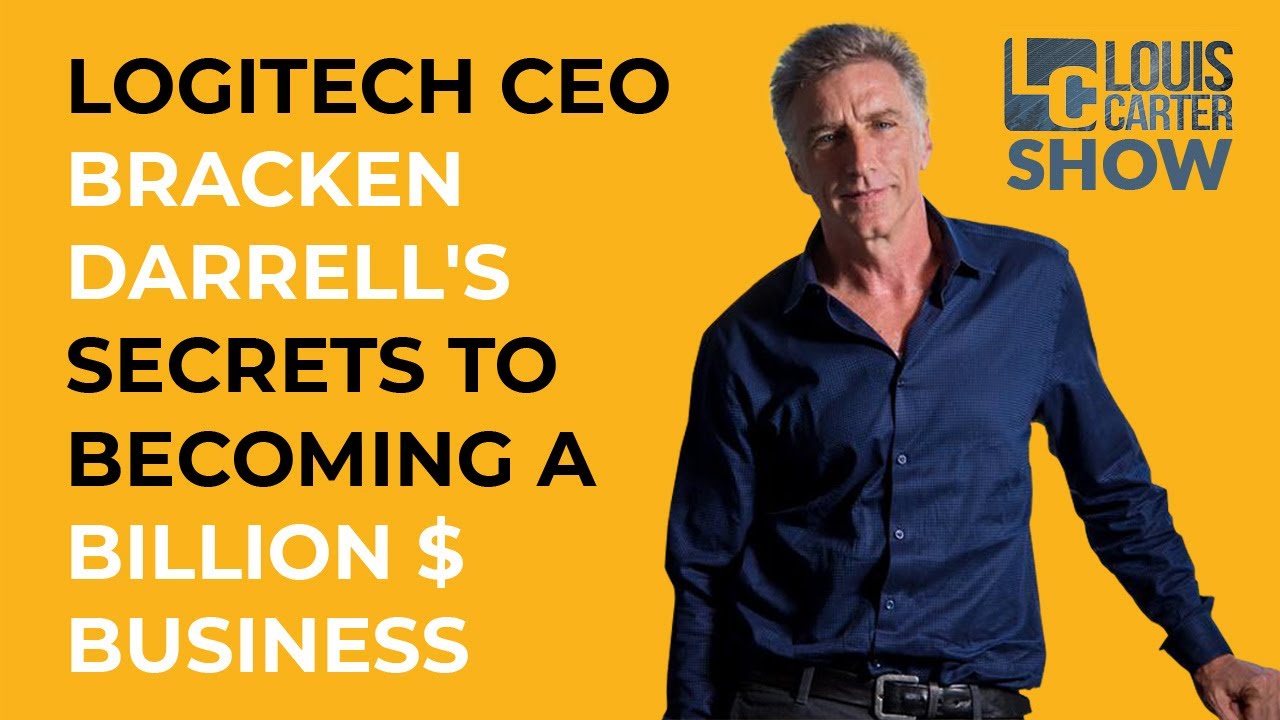
Logitech CEO Bracken Darrell credits the company's billion-dollar growth to four market trends: audio-to-video calling, esports, remote work, and creator content. He built an ownership culture where employees make decisions, maintains 23 direct reports, and regularly asks new hires for candid feedback to stay sharp.
Chapters
Hey everybody, it's good to have Bracken Darrell on today. This is amazing to have Bracken on with us. He is so humble yet so successful in his, his life as well as in his work as a leader and CEO in so many different companies and engineering companies ranging from Braun now to Logitech, which he brought up into the billion-dollar level in sales in September and record-breaking sales. And there's a reason for it. There's so many reasons for why Bracken has done this that you'll— we're going to learn today. Bracken, it's so great to have you with us here today. Thank you.
It's great to finally have my personal publicist. I've been looking for you all night.
Hey, you know, I put on my publicist jacket today. So, you know, so Bracken, thanks for joining us. I'd like to— I'd love to sort of start with you as a person. Because that's a good place to start with any CEO and to get that humanity. You grew up in Kentucky in a fairly small town. Now it's 53,000. I'm not sure, you know, it's exactly the same then. It's exactly the same then. So, you know, tell us about, you know, growing up in that environment, right? I did too. I grew up in a small town. What kind of values does that give to you and how does that really impact the way that you lead at Logitech or as a CEO in general?
I was probably more shaped by my— but not necessarily because I was in a small town, but just because of the nature of the family I grew up in and the orientation I grew up in, that probably shaped me even more. I mean, I grew up in a family that sort of was deeply into education. You know, my mom was a first grade teacher for 35 years. She used to say it took me 35 years to get out of first grade. And then my dad was a college professor. My grandfather was a college president of a very small junior college. My grandmother was a college professor. My Brother later has ended up being college president. He stopped now, but he did that for 5 years, did an amazing job. My sister works in the city schools of— anyway, the bottom line is we've just got lots of interest in education. And, uh, and so that, that had a huge impact on my, uh, kind of strong desire to just keep learning. I would say that's the biggest thing. And then the other one was, I, you know, we grew up with very little money, and I wasn't like a Horatio Alger story or anything, but, you know, single mother and you know, we just didn't have any money. And I think we didn't all grow up like hungry for money. I don't think any of us did, but we did grow up feeling the need to really work at it, really have to work to get what we wanted. Nothing came for free, you know. And we don't get me wrong. I mean, in this world where there's a lot of discussion around advantages, I mean, I have more white privilege than, you know, than any white person I know well, but I also had enough struggle that I felt like I really learned to overcome things. And that's become kind of a big part of me is this drive to get through stuff.
And that's the culture of Logitech I see is that as well, where you have this, you have a global culture, right? There's Silicon Valley, there's Asia, there's Switzerland, and you've lived in there for a long time. And there's a oneness to it all though. You know, it transcends just nationality. It's more of what you're describing, right? Never taking, uh, where we're at for granted, right? You've sold 3 million mice, but doesn't matter another day, today or tomorrow. What matters is what you're going to do today. So what defines us yesterday is not what we do today.
That's right. Yeah, we're, we're an interesting company because we really do— I guess two things. One is, by definition, you can't be the mouse company and be too cocky, you know. I mean, mice just aren't cocky, you know. And, and, and, and it's literally true, and, you know, the way you think of a mouse, it's also really true about our business. And we're the We're the peripheral of somebody else in almost everything we do. So that automatically comes with humility. The other thing that makes us more humble than most companies maybe is, you know, one is we're Swiss, and Swiss are sort of— they live in this— the Swiss grew up in this world where they feel like we're really small in the middle of this massive world. We've got to be— we've got to be premium, we've got to be good, we've got to be on time, we've got to, you know. And then the last one is, you know, we're in the— we're mostly in the hardware business here, where our sales happened yesterday and they're over and they don't come back. I mean, we have to start over again every single day. We sold 170 million things to people last year. And when we start the next day, we have a zero. We don't have software as a service or a recurring revenue stream or subscriptions. We start over every single day. So it makes you need, you've gotta perform. You gotta always be performing.
Now you went remote on May 13th. Of this year for your workforce.
March, a big deal.
March. So what I'm wondering is when you went remote, did that culture still remain? And if it may have swayed, how did you enable it to come back? Like, what did you do? What did you put in place? Because you actually had record growth even after that. So what did you do? What was your message?
Well, I mean, first, we— the most important thing we did was have momentum because we've been, you know, we've been doing the same— we've been running this play now for, for, uh, 8 and a half years. When I started, the company was worth $1 billion. Today it's worth $13 billion. So we've kind of done— we've doubled in value every 2 and a half to 3 years. So we had a lot of momentum coming into this, and we positioned ourselves in, in the, uh, right, right in front of 4 huge kind of trade winds of the future. You know, one of them is the, the conversion of everybody from audio to video calling. Another one was the, the rise of esports as the biggest collection of spectator and participant sports in the world. Third one was that people are going to work from everywhere. And the last one was the idea that, you know, content's going to, going to come not from Disney and Netflix and Amazon for the most part, it's going to come from you, you know, and me, you know, people creating content. So those are, those are the business trends we had, and though those trade winds that are driving us into the future, we are really well-positioned going into this period. So momentum really helps in culture too, because it gives you a sense of identity. And so when the whole COVID-19 pandemic really took root and we were all staying at home, there was 60 days where everybody outside of our company and inside our company were panicked. We were saying, holy cow, is our business going to fall through the floor? And the good news is that we pretty quickly could see we didn't think it was going to. So in terms of culturally, it has been different, but we were a very video-oriented culture to start with because of the nature of our business, very global. So by definition, more calling. And we were in the video business. We used to take a week of the year and say, this is work from home week. We tried to get other companies to do it. And so we were already kind of there. And then the last thing I'd say is, All that being said, it's so radically different from what it was before that we've certainly lost things in our culture that we'll have to try to get back. And we'll have to evolve because it's different. And, um, and so we're not stopping. I, I have calls with almost all, but as many of our new employees I can. Every week I have a new hire call where I talk about strategy and culture. And, you know, that's my little tiny attempt to try to stay connected to the new people who are coming in. They're the ones I fear for the most because they're They don't get to rub elbows with people in offices. They don't get to kind of walk through and get a feel for what it's like. They have to get it through virtually. And so I try to do my part, but I think our whole team is very aware of it. So I don't know if we're doing it, to be honest with you, Louis, really bring our culture forward, but we're bringing something forward, and I hope it can be aspirational for people who work here.
I like how you said that because we've been researching and looking at different methods by which we take CEOs who have been extraordinarily valuable with people, right, who represent the culture, brand the culture, which you've done really well, who have that mix of capability, humility, and also who have that kind of thinking where you really do want to get in front of all 6,100 employees. You want them to know who you are, right? And give them that sense of who you are too, so that they know, feel okay about contributing.
Well, and it's actually, it's much more both ways than that for me. I want them to, I want to get in front of them, but even more in front, I want them to get in front of me. I expect the new employees have something that I've lost. I lost a long time ago. I can't get back, which is the newcomer's advantage. And so they have the objective eyes of a newcomer. So I ask every new employee to write a note sometime in the first 30, 60, 90 days and just say, hey, what's the one thing or 10 things you would either change, add, stop, whatever. Can be the color of the carpeting in our Newark office to, you know, we ought to be in healthcare, you know. And I— it's so wonderful to get these notes. I get them every day, you know. I got one yesterday because they really are things that I would not have thought about, or if I ever— if they ever would have crossed my mind, they're gone now because now I could walk into that office, I don't even know what color carpet is. I'm so used to it. It's just part of the— so, so I do that and then I, I You know, look, at the end of the day, I learn so much every day from the people in our company, and up and down, all around. I try to have calls with people who report to people who report to me, or deeper than that. And, you know, it's a very, very much two-way street.
That's what I was thinking. You get these ideas, right, from people there, and that's what's the hallmark of an innovative company and of a great engineering company, really. And I know that when you first, you know, sort of walked into Logitech, it reminded you of places like Braun, you know. And you brought that, I'm sure, with it when you get those ideas from people and engineers that can be like gold. Some of them are, they're like different gifts. I give you a gift of advice, you could take it or leave it, right? Do a cost-benefit analysis on it, or it could be gold to you. So, you know, you want to hear from these brilliant people. That's the idea. Sense I got from you is that it's—
Absolutely. Absolutely. You know, it's funny. I mean, I think when I came in, we had a 4-year period that was pretty tough before I got here, but I don't think we ever lost the spark, the idea orientation of the company at the lowest level. And when I first came in, you know, people weren't bringing them up forward very much anymore because they got— the business got in trouble. And when the business gets in trouble, the top people kind of circle the wagons and say, we're going to focus here. And somebody will say, well, what about here? And they'll say, we're gonna focus here. And so they're not listening. And part of that's by design. But if it doesn't work, then all of a sudden you've got a culture where the top people are listening and the rest of the people aren't telling, not talking about what's wrong. So I really got, I really just begged people to start to speak up. And I got in this habit, which I still have today, which is every time I met people, I'd say, tell me what's not working in the company. Tell me what's not working around you. You know what, just tell me, 'cause I won't, you're the only place I'll find it out. And it really helps. It helps me. And I think, look, at the end of the day, I think this is a company of 6,000 people and every one of them has an incredibly important role to play. And if we do this right, we'll get better and better and better at helping people feel like they can come into Logitech and unleash what they're capable of and what they're passionate about. You know, I used to, my entire career until I got to Logitech, I thought, like this. You get— you hire a person, they come into the company, they do a job, and they do it well, and the company performs. I've changed my view of that now. I think now you, you try to get somebody to come work with you. It's an all-volunteer army. They come in and they bring what they love into the company, and if you're lucky, you've, you've got alignment between what the company needs and what they want to do, what they love. And when that happens, that is magic. And I think it more and more now, you know, I've got, I'm personally hiring people working for me who are coming not with, not to come help you with Logitech, they're coming to help to realize their dream. And they see Logitech as a vehicle to do it. And it's phenomenal. When those two things are aligned, it is amazing. And I'm seeing it.
It sounds like it gives you excitement too. There's a reciprocal nature, a systemic nature of that saying, I feel great when you feel great. Let's do this together as a collaborative co-creation that occurs. Now I can get involved in it, and you're looking at the details. Not all CEOs do that. They say, let's look at the details, right? Let— I want to own this just as much as you do. You want to own this as much as I want to. So you all become owners in these concepts and create together.
Well, you absolutely need, need owners. You need a, you need a company full of owners. But let me, let me talk about the details for a minute. I have a strong view view of that from a CEO's perspective. If there are CEOs out there listening, so here's my view of this. I think the bigger the organization that you're in charge of, um, the fewer decisions you're involved with, right? I mean, by definition it has to be that way as a CEO, or you could say as a general manager would be the same thing. The bigger the group, the less you're involved in. So at my level, in a company my size, of our size, Logistix size, the vast majority of the decisions are made by somebody besides me. I mean, By far, I mean 1,000 to 1. So the 0.1% of decisions that I get involved with are generally, um, the, the, their, their judgment calls, or they're based on my experience, or they're based on intuition, or they're based on the fact that I sit and look across everything instead of just a few parts of the company. So by definition, um, they're, they're intuition-driven or judgment-driven, and You know, and that means— and I'm the only one who can make some of those decisions. The reason I'm telling you that is because I think, you know, as you, as you look at a company like ours, you discover that, you know, actually a CEO is of very minor importance compared to any two employees in the company, because anybody can make decisions. Anybody in our company can make decisions, and there— and if you're close enough to make it, you should make it. So everybody has a role. My role is just like everybody else in the company. I just have a different set of decisions to make or a different set of things to do that only my role can do. Or if I weren't here, that work would be distributed to other people. They would do it. But so it's a, it's a fascinating job, this CEO job. And it, and I'm having so much fun doing it, but I never fool myself to think that I'm so important. You know, I mean, every single person in this company is just as important as me. They just have different decisions to make and job and work to do.
One of the things that struck me when you said that was it's not about the role, right? It's not about the person, it's about the role, right? It's about being the CEO. And everybody can make a decision. It doesn't— you don't have to be a CEO to make a decision. We all should have that ownership. Duncan Niederauer, CEO of New York Stock Exchange, said to me once— I was with him at New York Stock Exchange— he said to me, it doesn't matter. My name doesn't matter. What matters is that I am the acting CEO. So don't think of me as Duncan, think of me as the CEO of New York Stock Exchange. For when I leave, we'll think about what I've left and what I've done and what the New York Stock Exchange has done as a result of me being here. And it was about Euronext and New York Stock Exchange combining during his time. But they're not gonna remember Duncan, they're gonna remember the administration. So it was interesting that I heard you say that because it was what everybody did, not just what he did.
Right.
I hear that everywhere. What interested me too was you have fired yourself before without any sacred cows after. Could you tell people about that a little bit? CEOs will want to know more about this. What, what was your thinking about behind that? Was it to clear the slate and sort of tabula rasa? What, what helped, what enabled you or made you think that that was important for you to do in your company?
The short answer is yes, it was about clearing the slate. So what happened was I've been here 5 years, the company increased in value I don't know, by then maybe 8-fold or something, a lot. And, uh, and we were so different 5 years in from what we were when I started, you know, really dramatically different. And I was in bed one night, and I think it was in December, and I was thinking about the future, you know. I was thinking, hey, you know, 5 years from now, this company is going to be more different from what it's like now than what it's like now compared to when I started. So it's going to be— it's accelerating in change, not slowing down. So then I thought, God, you know, in that context, I was probably the right person for the— or one of the right people for the job for the last 5 years. But how can I be the right person for the next 5 years? It's that different. So then I thought, well, you know what, I should figure out what the right person would look like. So I wrote down, you know, on this piece of paper what I thought the, uh, the next CEO should be good at. And then I— and then I thought, okay, now how do I look? And so I looked at— I kind of measured myself up based on my LinkedIn profile or based on what I could I thought, you know, I'd— if we were interviewing for a new CEO for the next 5 years, I'd be in the hunt, you know, because I, I have a lot of experience doing the things that are important here. I'm pretty good at change management. I'm— I could do a lot of what's needed here. I'm really— I'm good at product stuff. But I have one disadvantage which almost disqualifies me, maybe it does, which is I have ownership for so much that I'll be hesitant to change things, you know. And so, so I thought— so I— when I got to that point in my thinking, I thought, you know, I can't be the next I can't be the CEO for the next 5 years. I've got to go because I cannot be objective. So I decided to fire myself, but I learned, you know, over the last, you know, the 5 or 10 years before that, that I should sleep on decisions because I often change my mind. So I kind of fire myself. I'll tell my chairman tomorrow and we'll have a long transition approach and all that stuff. So I went to bed that night feeling a little disappointed that I was going to leave, but not devastated because I knew it was the right thing to do. Woke up the next morning, had a completely different view, which, you know, happens to me 51% of the time when I sleep on a big decision. I realized, no, of course I can do this. I just have to have no sacred cows. So I signed myself a new mental contract, which is I'm the new CEO and I have no sacred cows about what that prior person did. And I shared that with my CFO. He's the only person I shared it with. I shared it with him. I said, you need to fire yourself and we're the new people. And now we're no sacred cows. We're going after it. So I felt like a newcomer again. And it was so exciting and fun for me.
It still is.
I still, now I'm trying to compress that newcomer mentality, that no sacred cows mentality to do it more often. And I'm getting there.
This was 5 years ago. I think the methods you use to continually improve, right? You look at what your goals are every year and you attain them and you grade yourself, right? And say, what could I do better? You're always thinking that, what could I do better? When you fired yourself 5 years ago, were there goals that you had that you realigned and said, this is where I need to go now. And then you achieved it, obviously, you know, look at this year. So, you know, and then because I— let me— I'll throw one more thing in. You know, you're great at change management. And how did that help you to get to where you are now? Right? Your knowledge of change management, was there things you put in place to enable that 5-year ascendance to this billion-plus Intense.
The most, by far the most important thing I've done in this job is get people who are great. I have an absolute all-star team, you know, and I, and it's, it's always changing a little bit here and there, but, and, uh, and I keep adding people, you know. I've got— this will drive some people who are listening to this crazy, but, um, or watching this— I've got 23 direct reports or something like that. And, and there's a reason why I can have 23 direct reports. It's because I've got 23 great people. If I had, uh, you know, 6 great people and 6 average people for their jobs, and so I need to really do the Gusso, then, then I couldn't have more than 12 direct reports. But when you have 2— when you have 23 direct reports, you're— the pressure's on. You have to have great people. And so I do. And so you asked me about change management. You know, I think change management is vital. You know, I think, you know, Kotter's book on change management, to me, like the Bible, but there's so many good things to read. And I would absolutely, if I were going to a situation, any situation, I'd probably take a good look at that book again. But I'll tell you, the number one thing is who's on the field. And if you don't get the right people on the field, and that doesn't mean you can afford to go fire everybody and replace them all. You can't. So you have to do a combination of inspiring coaching, bringing new people. It's a whole mix and it never stops, you know, and it's so fun. It's really hand-to-hand sports and it's fun.
I like how you brought in, you know, sort of basketball. You're an avid basketball player and you feel like that's your team, right? That's your basketball team. They all have to be good at their roles and their jobs and be great at it. And, you know, what When you're a coach and sometimes you go on the court too, what is it, how is it that you keep them aligned? How do you keep them aligned when you have 23? That's a lot of people. So if you had a day or two, it would take 2, 3 days for them just to report out on all of their goals, right? Even if you give them an hour each. So, you know, that's a good 3-day session. So do you have a way to sort of, what is your way of, of keeping things in line.
Yeah, I'm going to tell you a secret, so don't tell anybody. I don't actually keep them aligned. Um, I'm— they're pretty much, uh, they keep themselves aligned among each other. If somebody comes to me and says, you know, so-and-so's not doing this, blah blah blah, and I said, well, so what did they say when you told them that? If there's a silence, you know, then I don't need to say anything else because they know that they should have gone and talked to them. Directly. There's no reason to bring me this thing until you, you have talked about it, tried to figure it out. And if you can't, then that's why I'm here, you know. I have a role to play if I have to break ties with people who report to me. But, but if you haven't, then, then do that. It's kind of basic. I mean, you know, it's like basic human interaction. So I don't have to keep them too much aligned. What I have to do, the thing that's really important that I do, is I have to poke and push and prod and dream and, uh, and, and try to inspire a little bit on the things that I believe that other people can't see, or they're caught up in something that, that, that, that, uh, obscures their view of the future. I have the— I don't have a perfect crystal ball. I have a blurry view of where I think can happen. I have a unique chair where I can see things, um, that are, that are collage of everything we're doing and things on the inside, things on the outside. That gives me a perspective, and I have a lot of conviction around some of it, and some— and, and half— and I'm half-heartedly convicted on other things. But what I have is that, that central place. And so I can say, gosh, I really think this is going to happen, and then I've got to figure out how to get people in, into that spot. Like, I've got an issue right now. I'll give you an example. I've got an issue right now that I'm very excited about, but I'm pretty sure that most of the people might come— in fact, I know the the leaders throughout my company don't, don't know this is coming. And I may be wrong, but I'm, I'm about 80% sure I'm right. So now I'm going one-on-one, and we'll talk about one-on-one in a minute. I'm going one-on-one with all the leaders that are engaged here, not to have a group discussion about it, but to engage them in the discussion, say, I think this is going to happen, what do you think? And then they say, well, no, I think you're wrong, Bracken. I said, well, here's why I think I'm right. And they say Well, maybe you're partly right, but you're not totally right. Well, no, I'm totally right. Okay, I'm not totally right. I'm mostly right. And so by the time we're finished, I've learned, I'm smarter, they've already come forward. And then I do that, I've done that over and over again on this particular topic. I've done it with 7 different people and everybody's, it's like we're all moving together towards this new place. Now you could say that's a team of 7 people. I will tell you it's not, nor is my team of 23, a team of 23 people, nor is a team on a basketball court of 5 a 5-person team. It's, it's a, it's, it's all multiples of the only team that matters, which is a 2-person team. So every team is just multiples of 2. And so every interaction you have, whether you're talking to one person, you're talking to 1,000, is, or 5, is really an interaction with one person. And when you start to realize that— I'll give you an example. I'm sorry, Louis, I'm going on and on on this, but I'll give an example. If I— if you, you and I right now are the only ones here, nobody's watching us, it's just us. So it's just two of us. So we have a two-person team. And if we're a high-performing team, which so far I think we could be, Louis, if we keep this up, you know, we'll be amazing. Now add one more person, they come out of the screen. Are we a two-person— are we a three-person team? Are we three two-person teams? I will tell you, I think we're three two-person teams because now it's me and you you and her, her and me. And so if I'm talking to you and you and I interacting, somebody's a bystander. Now the reason why that matters is because, well, let's say you're on a basketball court, because I do love basketball. Steph Curry's bringing the ball on the court, Paul Durant's on one side, Iguodala. I'm an old Warriors fan from back. And so it's a, it's a fast break. There are two people filling the lane, there's one person, Steph Curry, bringing the ball up the court. Is that a three-person team, or is that 3 teams of 2. Steph Curry knows what Iguodala is going to do next because a great team, they almost can anticipate each other. Iguodala knows what Steph's going to do next. Iguodala also was watching Durant. He's thinking what he might do next. Durant's watching Steph and saying, am I going to get the ball or not? And if I do, should I tip it to Iguodala? It's a series of 2s. And the reason why I think it's so important is because you— because, because of team size. It— once you realize that, or you, you agree with that, you then say, well, why is it that small teams are so much better than big teams? Why is the big teams get bureaucratic and slow? Because you know how hard it is to manage, uh, you know, if you go from a team of 2 to a team of 5. But, you know, my dining room table, my kitchen table growing up, that was the best performing team I was on for most of my life. You know, it's my sister, my brothers, my mom, and we were doing homework together and everything's just 4. If you added 6 more people at that table, man, it would be a mess because you have 160 teams. At 12, if you have a 16-person table, you have 120 teams with them. So the bottom line is, uh, the argument I'm making is I believe that you should think of your life as everything in your life is about twos and every team.
I can see this completely, uh, because we can only know our own behavior and perhaps anticipate others, right? Because we have a series of understandings of that other person's behavior, and perhaps some of it informs what they may do. And I think about George Bush and how he was in the same fraternity as some of the people in Russia who he worked with when he was president, senior, and he knew what they would do in anticipation. When you're in a fraternity with someone or in a basketball team, you're going to know what that person is going to do, and they know when they're going to bluff or when they're going to do something. Something different or crazy or silly. So it is about this one-on-one. It's about that connection. It's a connection web. And the way that you, you make it exponential and you multiply it, it's brilliant because you're talking about series of webs with each other and the, in the connectedness and understanding of that behavior, your own and others, so you can create good decisions. Brilliant.
I never heard it before like that because I think you could pick out, pick out great pairs in history, you know, Steve Jobs and Wozniak, who, and, uh, that was a great pair, but you can have more than, more than a few pairs in your life that really at the same time, you know, you have Steve Jobs and Laurene Jobs, Steve Jobs and Tim Cook, Steve Jobs had Jonathan Ive, Jonathan Ive had probably Dan Riccio had Jonathan Ive, you know, you might not know Dan, but he was the head of hardware at Apple. You had all these pairs that are all working really well as individual teams, and then they're overlapping with others. So in your life, I guarantee you've got, you know, whatever it is between 3 and 6 pairs in your life that are operating at super high performance right now for you.
You think about the balances too, because there's function and dysfunction, enable, disable. Like you need a pair to enable you, you know, it's, or even like polarity, you know, you, you need different poles to it. And you know, even, your company, it has 3 poles, right? You have the Asia, Switzerland, US pole, and so it's kind of tripolar in a sense, and has to balance each other. So you have these one-on-one relationships between cultures and between itself. So it's really 2, 4, 6, right, relationships that are creating one.
Well, I'm glad you brought up, because I think this, the differences, the things that pull you apart are the things that make you better. And this is one of the reasons why diversity inclusion is so critical. It's not only morally right and ethically right, it's right from a performance standpoint, it's right from a personal growth standpoint. You know, there's, you know, I have so many people now that are, I'm growing so fast because of the people that I've associated myself with, or I've brought in the company. Who are of different— they're, you know, Jason Baines is Black and I'm white. Erica Glenn is a woman, I'm a man. You know, Quinn Lu is from China, I'm from the US. You know, all those differences are the things that are making— I'm selfishly exploding with enthusiasm for diversity because I'm growing so much, but I'm also so excited about it from a standpoint of Logitech and the whole world. And as we go more and more, you know, there's so much discussion about diversity inclusion. I think there's a there's a perspective that there's this pie and we divide it up a certain way. And as more people get in the game, they're going to divide the pie. There's not enough discussion around that. As we unlock the power of diversity, the pie is going to grow very fast, much faster. I see it personally.
I do too. And coming from your perspective of your geographic perspective, and the way you've enabled relationships and have different relationships globally and how you can connect that to market, right? Because it's really about market when it comes down to it and how we accept, how we appreciate, how we love our customers, know where they're going. Like you said, one-on-one, know where they want to go. We can anticipate needs, anticipate the needs of our employees as well and do it in an innovative way, right? That is diversity. It's an inclusion. It's let's include all aspects. Let's not exclude people who perhaps have awesome ideas, are just different for whatever reason. Doesn't matter what the reasons are behind differences. What matters is the inclusion of ideas and market and people.
Absolutely. And the terrible thing is that we've, in different parts of the world, in this country, in this company, we've had systemic racism. Let's not mince words. Systemic racism. It doesn't mean that the company's— we've got a bunch of racist people running around the company. It's our company, the way we've developed the systems that were developed grew out of a place that automatically biases against a huge chunk of, of the, the world. This super powerful, effective, creative, effective group that we've got to find our way to break down that, those systems and get back in the game. And we're starting to do that now, and we're nowhere near done within Logitech, and we're certainly nowhere near done than the world at large. But as we do that, we're going to see another— more and more spurts of powerful effectiveness and growth, not only for the underrepresented groups, but in general. And so it's an amazing time to be alive. And I think any leader out there, if you haven't kind of started to feel the power and the need for diversity inclusion inside you— and it's not easy for some. You will. It's coming. And as you start to do it, if you start to play offense on it, you'll be amazed at what comes out of it.
Bracken, it's awesome talking with you today. You can feel the vision and excitement behind the future that you see as well, right? You see this and you're taking hold of it. And that's what CEOs need to do these days. We're given an opportunity to open up. We're opening up, and, uh, so many of us have closed down for so much time. When you open your mind, you can see these variables before you and systems open where behaviors go down before, now they can go up, just like done so well with your market.
You're so right. You know, I think it's, uh, it's one of those— it's an interesting time because I think in the beginning of the pandemic, um, Philippe DePalin, who works for me, had this great analogy because he— I was saying, gosh, this is This is such an incredible moment to get ready for the next act, you know. And he said— and so I was telling him and some others in the leadership team that— and he came back and said, I've got an analogy for you. He said, you know, when race car drivers are coming down the track, as they go into the turn, they brake right before the turn, but then they stop braking as they go into the turn. They accelerate, and they accelerate right out of the turn. As they slow down a little bit, they accelerate. Now, I don't know if that's true or not. That's what Philippe told me. But I love the idea that as you're in this turn, you're accelerating. And that's what we're trying to do now. So you said opening up. We've tried to open up as we've gone into the pandemic. Look at everything, really open it. And now we're hitting the accelerator. And as we come out of this pandemic, we're going to be flying.
Absolutely. You got the skids to get there too, the traction, that ability to lean in to that turn. And have more momentum. Awesome. I see so, so many great things for you and Logitech and the next and everything else in between, right? We always have the future. It's always going to get better later too. So, uh, like they say, you know, I won't always be here, right? Uh, one day, one day I'll fire myself.
Life extension, you can always be here.
Cryogenic. We'll start with the healthcare portion. That's the— that's what one of the Notes will be. Thanks for joining us, Bracken.
Well, thank you so much, Louis Carter. It was really fun.
More from Louis



How to Get Found in ChatGPT, Perplexity, Gemini, Claude & Grok | Visipage AI Visibility Audit

Your Competitors Just Got Certified. Now What? | Most Loved Workplace® Demo & Hiring Advantage



Visual Thinkers: The Hidden Genius Behind Skilled Trades & Innovation! #shorts

Car Mechanics: The Secret to Engaging Autistic Adults Over Video Games! #shorts


