Louis Carter Show with Bev Kaye
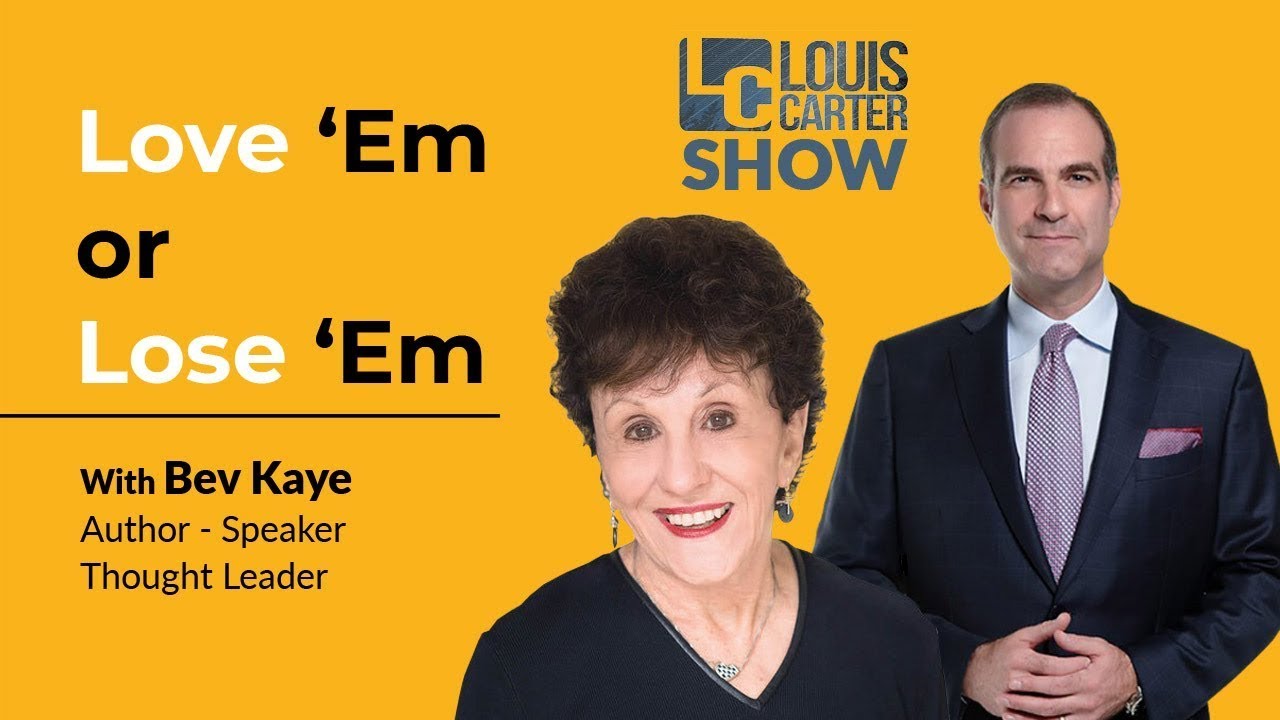
In this interview, Louis Carter talks with organizational development expert Bev Kay about her seminal book Love ‘Em or Lose ‘Em (6th edition). The conversation explores why the word “love” is central to employee engagement and how managers can foster emotional connectedness. Kay explains the book’s unique alphabetic framework – 26 practical actions (e.g., Ask, Buck, Career, Jerk, Question) – each offering concrete, low‑effort tactics for busy managers. They discuss the shift from traditional “manager vs. leader” thinking to a blended approach, the importance of asking employees why they stay, recognizing and verbalizing concerns, and mobilizing support. The dialogue also touches on generational sensitivities, inclusion and belonging, and the need for managers to adapt to remote work realities. Kay emphasizes actionable steps such as the “recognize‑verbalize‑mobilize” routine and encourages listeners to pick one chapter and try a single practice. The interview ends with contact information and a call to read the book for deeper guidance.
Chapters
So we're on here today with the amazing, the incredible, the awesome Bev Kay, who's a legend in the, in the field of career development and organization development. And you'll see on the upper left-hand corner, uh, do what you love, right? Love what you do, right? And, uh, her newest book, Love 'Em or Lose 'Em, right? Uh, in the 6th edition now. So we're gonna be talking about that book today and Bev's work and really just learning it and just get, getting a real understanding of this newest edition, what's new and, and how it connects to— Bev was talking about, she actually has my book there, which is awesome. In great company. And there's a lot of connection between what Bev does in Love in the Workplace with emotional connectedness, really, in our new Must Love Workplace list and closing that gap, really. Bev will talk to you a little bit about that, from perhaps not having that much high employee or emotional sentiment for your company, and then having a lot of them. Bev Kay, welcome to our show today!
Thank you, thank you. You know, you and I have the word love in common. I even wore my love shirt.
Um, you have the hearts, right?
The hearts, yes.
There's a theme emerging.
And you know, I, in, in doing the 6th edition, I have fallen in love again with the word love. And when I wrote the first edition in 1999, uh, there was a lot of concern about putting the word love in the title. In fact, our publisher said, "Are you sure that's the word you want to use?" You know, "Would a manly man pick a book off the shelf with love in the title?" And we said, there's no other word we can use because no other word means connectedness, means pay attention, means notice, means smile, means say hello, means etc. And so we stuck with love, and now I think it's more accepted than ever.
It's incredible, Beverly, how the word love, what it conjures up in one's mind, because there's all kinds of love, right? So, and we're talking about this kind of connected love, the love that you feel when you're around people that you feel high sentiment for and you want to work for it. It makes you perform even more. Tell us how you help enable that kind of love in the workplace.
So I go around kissing everybody. No, no, I, um, You know, here's how it all started. In 1999-ish was when McKinsey published their The War for Talent. And in that book, they said people don't leave organizations, they do leave managers. And everybody seemed to pick that up. And Sharon, my co-author, and I felt, well, Everybody, it's right, they do leave managers. But nobody was telling the manager how. Like, how do you then be the kind of manager that nobody wants to leave? And so, we did our research. Gosh, we did a survey of at least 20,000, and that's gone on and on. And, um, we did a lot of interviews, and we took exit interviews, and we read what they said, and we followed the exit interview person to where they went in the next company. And we said, we have your exit interview, why did you really leave? And out came all the reasons why they left. And that's how we began to really build the book. And we wanted a book that a busy manager could go to and get an idea. So, after many tries, we organized the book according to the alphabet. And we sat in a hotel room with the alphabet hanging on the wall around us.. And we said, what from all our data could be the A? And what from all our data could be the B? And we had trouble with the X and the Z, but we got it. And we built the book around the alphabet, giving managers really not only 26 ways to show they love their people, But within each chapter, a myriad of practical things that a busy manager could actually do. So that was our goal, and we are sticking to it.
So the things that a busy manager can do, let's go, let's go there. The myriad of things, because these are things that anybody could do right now, right? We, at any moment. So Talk about some of these things. What are some of the things that a busy manager can do to evoke that feeling of love really in the workplace?
Well, so the A, the A in the book is for ask. You know, ask your people why they stay. Ask your people what you can do to keep them. Do you know when most managers utter the words, what can I do to keep you? It's when your employee comes in and says, I'm leaving. Well, that's too late. But the statement, you know, you've been doing great work, you know, I want to keep you on my team, you're important to me. And, and I want to know what keeps you, what keeps you in this job? What keeps you in this company? And when we delved, the reason managers were afraid to ask it, because they said, well, what if they answer with something I can't give? Like, what if they answer with, well, you know, what would really keep me is more money? Then I'm stuck, and I'm sorry I ever asked the question in the first place. And we say, "No, you're not stuck. Your next question is the truth." In fact, truth is a chapter in the book. Truth: "I can't deliver on that now. But I really want to find something within my power. So tell me what else matters." And I say to managers around the world, if you ask the "what matters" question, 3 times, I promise you, you will get something that's within your control. And the B in the book is for Buck. It stops with you. Not on everything, but on many, many, many things that your employees want. So that's just a quick example of showing love.
It's funny. I mean, a lot of that is dialogue, right? It's asking the right questions.
It is.
Because we wait until it's too late. We do these yearly reviews rather than checking in constantly. We don't— and we leave people alone and we say, this is what needs to be done. And we become this manager rather than leader. And a leader has far different competencies than what a manager typically has. Right?
Right.
And, you know, the leader listens, the leader questions, the leader coaches, has executive presence, emotional intelligence. They do all of these things. That managers typically don't do.
Well, I, I don't know if I agree with you. I know the literature says that leaders lead and managers manage. I don't know any leader who doesn't have to manage part of the time, and I don't know any manager who doesn't have to lead part of the time. So, from just for me, the words are schmurgled. I can't pull them apart. So, the book, you know, and Sharon and I argued over, do we use the word manager in the book or the word leader? And in the introduction, we say, for us, the words are Too connected, because leaders have to do these things, and managers have to do these things, and human beings have to do these things for each other. You know, it's interesting, um, and we should talk about this sometime off camera. I have been looking at the 26, uh, chapters and applying them to my own life. Like, do I ask? Do I ask my husband? Do I ask my daughter? Do I ask my friends? And on B for Buck, sometimes I take on too much, as my team here would, would tell you. So I say it's all my responsibility. Then that's not the right way to do it either.
Right. So I think that is a, it's a good question. Do you take it all on yourself or do you delegate, delegate effectively and then follow up with accountability? Right. So there are, those are management and leadership skills. They are, they live together. And oftentimes I think leaders, right, as we call them, get a bad rap if they don't have enough emotional intelligence or they're not Right? They're not connected enough. They don't listen. And people cry. And they're like, oh, why did you hurt my feelings? And that's really not what this is about at all. This is about being honest with who we are. Right? Love is acceptance.
Right. And in your book, you say emotional connectedness among employees can create a workplace where people are so deeply engaged and aligned. They'll do whatever it takes. So your words.
Absolutely. And they do whatever it takes because they're appreciated and respected for who they are. And the newer generations— I know it's not usually cool to talk about generations. I'll do it anyway. I think it's about really entry-level, right? You know, it's people coming into the workplace in the beginning, first 10 years. As I see it, there's a certain sensitivity level. Right? And so that, you know, different generations are used to engaging and being with each other in a way that's very open and honest, and many times, right? And then newer generations come in, and it's a little bit more challenging to connect the two, right? So how— so the question is for you is like, what kind of advice do you have for managers or leaders who are kind of coming up against that new generation who may have some sensitivity, yet they're being told as a leader or manager you must have this empathy and emotional regulation and be a little bit robotic in your understanding of those people. How do they become connected?
Right. You know, maybe the question to whatever generation is, how do you like to be managed? How can I best give you direction in a way that connects with you? You know, maybe we're not asking the basic questions. And, you know, in the book, the Q chapter is question. And in that chapter, we said, question, reconsider the rules for the sake of talent. And in the old days, the theory was what you do for one, you do for all. Now we believe that there's a quadrillion different ones, and everybody wants to be done to or done for in a way they want. And so the manager has to ask, you know, I, I I want to be the best manager I can. You know, like, what turns you off when you've been managed by others? So you could put it on the other.
It's true. This question, the Q, as you say, you know, there's— I always say to leaders, it's important to do a cost-benefit of what somebody really wants from you versus what you can really give to them. Right. So they might say, well, actually, it is going to cost me a lot to be like that. Because I, you know, or they might say, well, I've never been like that before. So it's going to take me a long time to get there. And so there's a sort of continuum of willingness, right, to change, to become, to do the Q, to get to the Q, right? And as you said, with your husband asking those questions, how likely is it that any— both of you will actually change after the Q.
Yeah, well, I am working on my husband, who is a, uh, rocket scientist. I've been working on his listening skills for 47 years, and I'm gonna get there.
Exactly. Like, are we really going to get there after a while? I think the key is that you, you entertain the questions. That you started with the cue and that, you know, you have enough respect to ask the cue or give space for it. That's one of the things is giving equal airtime is a form of respect, right? A form of love. Whether you do it or not. Right, right. So another— so the questions themselves, you'd mentioned the different, uh, 26, correct? The different 20, the 20. So what are your favorites? Tell us your, like, your favorite 3 or 4, which ones you just really most passionate about.
Yep. The C is for career. And you know that the other whole part of my life's work is around career development. So I, we filtered through the book, my ideas about career, And I think if I had to point to one letter of the alphabet, it might be the C for career. Because the data has been saying for years that if people don't see a career path, a career opportunity— the word path is wrong because it implies up. I mean, if people don't see that they're growing, if people don't see they're learning, they are gonna look elsewhere, like, period. And the other favorite chapter is the J for Jerk, and the subtitle is Don't Be One. And we had to put the jerk chapter in Even though, again, our publisher said, "It's so such a positive book. Why do you need a negative chapter?" And it was because people used that word, you know, in our interviews. They said, "I left because my boss was a jerk." And like good researchers, we said, "Well, can you tell us what the word jerk means to you?" And they gave us 55 jerkitudinal characteristics, which we wrote into the book. And in the workshops we do, we will often say to a group of managers, even senior managers, have you ever worked for a jerk first? And which of these things did that boss do? And the key question is, how did that affect you? And then we get that myriad of wonderful answers telling us, well, I pulled back on my ideas, well, I shut down at meetings, well, I, etc. And then we can gently move into the question, so How much of a jerk are you some of the time? Because everybody is.
I love that because you're, you're asking one to examine themselves and do some self-awareness as well as just blaming the other. Because, right, a culture emerges in blame when you say, oh, that person's a jerk, and often you see it in yourself, right, right, right? And you, you unearth that. You've found out that Sometimes the things that we see in our boss is sometimes what we see in ourselves. And maybe we're all not as much jerks as we think we are, right?
Or everybody's a jerk some of the time. And maybe when we catch ourselves being a jerk, we have to say, excuse me, that was one of my jerk behaviors, wasn't it?
And apologize, right?
Apologize, right?
I'm sorry, I was a jerk. And because it's so important, and, you know, today we have a litigious society, right? So if we sometimes admitting that we're a jerk can get us into trouble, so we have to be in a safe space to be able to say we're a jerk or not a jerk. Maybe we don't, though. Maybe it could be different. So, you know, there's all these questions and differences these days and with the remote workforce. What did you find in the 6th edition about some potential differences with today? How would you say it's shifted or changed for managers at all? Yeah.
Well, we had, we had a big goal in mind because our publisher said, look, diversity inclusion is gigantic. I want you to show us how every single chapter how engagement is also inclusion. In other words, if you engage, you include. And we're not diversity inclusion specialists, but when we got into it, we found the word belonging was an easier word to wrap our heads around. And, and what we found that was Interesting is we interviewed diversity thought leaders. And we said, look at these 26, pick 5 that most support belonging and inclusion, thinking we'd have this big aha and we'd get 5. Nobody agreed with anybody else's 5, which taught us that they all apply and that if you engage you do include. And if you include, you engage. So, I don't know theoretically if that's correct, but I do know it gave us the aha to write the book that way.
And it speaks so much to the current state of diversity inclusion, which is we all speak different languages, even if we're speaking the same language.
Right.
And our fluencies are different, right? We do, when we create our same, the same kind of change fluency, we can start talking the the same language again. And when we used to do research, right, I know back in the '90s and early 2000s, language was the same. Yeah, it was— it wasn't hard to do what we call in PhD work, Dr. Wood, thematic analysis. It's like these fancy words. But now the, the very, um, uh, the very, uh, act of dialogue and interviewing We see there's diversity in that too.
Right?
Right. And that's a huge learning that you had. And so in your training and development, do you— is that part of what you do is kind of opening up and hearing all of these myriad of ways of thinking? And is that part of it?
Yes. And our, you know, as I said, I'm not a diversity thought leader at all. But I'm into practical ideas that a manager can do without so much layers around it. So that's what we stuck to.
That's awesome. And that's what I love about the whole practice of opening up in dialogue in groups, right? You work in group, people working in groups, working together. To come to conclusions on what we hold to be self-evident, to be our truths. What truths have you found in your work that you could say to managers, these are some universal truths with career? You said about succession planning, people need to know that they're going to succeed in their careers. They need to know that they're going to have a path. Otherwise, they'll leave. They need to know they're developing, right? Otherwise, they're going to leave. They need to know that you won't be a jerk. Otherwise, they're going to leave. These are really self-evident. Are there others that maybe there's like blinders that they can't see, you know, certain things they can't see? Because every day we go about our days and we think that we're doing the right things. What things may they be thinking perhaps they have to do that, you know, that we need to tell them about, right?
You know, I think it's a job of Do you notice me? Do you notice that I'm in work today and I look upset, or on the Zoom call you can see that it's not a good day? Do you notice and do you say something? And in somewhere in Love 'Em, we say to notice, there's 3 steps. First, you recognize. Gee, Beverly came in this morning with a big frown. Do you recognize? Then if you want to do one better, you recognize and you verbalize. Hey, Bev, what happened on the way into work? Or, or what happened yesterday that I can see in your face? You know, it's not a good day. So recognize, verbalize. The third step is mobilize, you know, so what can I do? Do you need an hour or two? Do you need the morning? Because I can see that your, your mind is elsewhere. And I'm just making that up, but it's recognize. If you just do that, good. But if you add verbalize, even better. And if you add mobilize, even better. So now people listening have something they can do.
I love it because it's actionable and, and that they— someone can actually do that every single day and change and shift the entire landscape of their management style, their leadership style. It just changes things. These are real things that people need to do every day. How many, how many times just people walk in, you could just tell, right? And they don't, right? You can tell in a genuine how are you. Do you know the genuine how are yous versus the how are you? How are you? There's genuine how are you. And I got this weekend, I got a real how are you from our friend Edie Greenblatt. You know Edie?
Yeah.
And Edie gave me a genuine how are you. So two things came to my mind when I got it, got the how are you, was do you know something I don't know? And am I okay? So really, you know, because I don't get genuine how are yous a lot, right? I don't think any of us really do, right?
Right. And sometimes adding one word like, how are you really? Like that word added will make someone say, well, actually not so good, or actually great.
And it, it is, it really, it qualifies it, you know. And when it, when it, you have to get to that point where it doesn't need the really, right? They believe you so much that it doesn't need the really, right? So we've been here with Bev Cade, Love 'Em or Lose 'Em, the, in the 6th edition. You have to go out and get this book. This is, this is a seminal book in career development and the work she does to develop managers and leaders in organizations is phenomenal. And employees to help them through the ranks. Just think about all that you can do to enable a culture where everybody loves being in your workplace. It's far different, right? It's different than how we imagine it before. Because before it's— think about the trust that's eroded in American organizations and organizations throughout the world, really. We no longer trust. We don't have as much respect. And you see this in a new HBR article. There's lowest levels of trust than ever before. Another article shows the lowest levels of trust for HR. OK? So, yep, lowest levels of trust. All Fortune 500s. I will send you the link. It's unbelievable how much, how much we've reduced. So how do we build that back up? Read Love 'Em or Lose 'Em in 6th Edition because it gives you these kinds of tactics and tools and tips and Bev's model for doing this in 26 steps and areas that she's going to work on with her rocket scientist husband as well. And that's really great stuff. And Bev, it's great to have you on today. Tell us one thing, any, anything else that I've missed here that you'd like to share with us today?
Um, get the book and pick one chapter that just jumps out at you and say to yourself, I'm gonna do one thing in that one chapter and see how it goes.
And let us know, right? Let us know what it is, how it goes.
See you, Bev Kay at bevkay.com.
Bev Kay at bevkay.com. So you go to bevkay.com as well, www.bevkay.com, and also email bevkay@bevkay.com.
Right.
There we go. We've done it all. Said it all. Thanks for joining us, babe.
Thank you. Take care.
More from Louis



How to Get Found in ChatGPT, Perplexity, Gemini, Claude & Grok | Visipage AI Visibility Audit

Your Competitors Just Got Certified. Now What? | Most Loved Workplace® Demo & Hiring Advantage



Visual Thinkers: The Hidden Genius Behind Skilled Trades & Innovation! #shorts

Car Mechanics: The Secret to Engaging Autistic Adults Over Video Games! #shorts


