Mohegan’s Culture Advantage: Ray Pineault on Employee-First Leadership
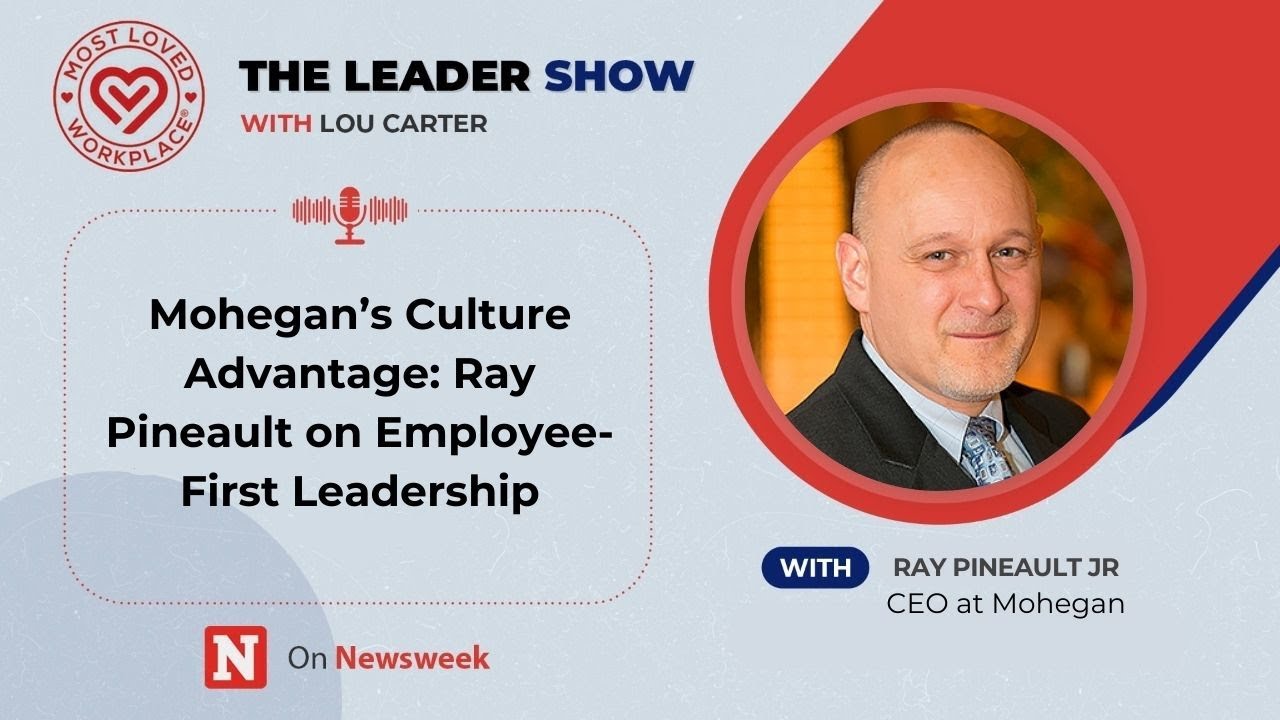
Ray Pineault, CEO of Mohegan Sun, built the casino's culture on "Spirit of Akwae," a 400-year-old Indigenous leadership philosophy centered on cooperation and mutual respect. The company generates over 100 employee ideas yearly and maintains 76% guest satisfaction through open-door policies, behavioral hiring, and frontline empowerment.
Chapters
Welcome to The Leader's Show. I'm Louis Carter, and today we're diving into a powerful leadership insight that's fueling Mohegan's global success in gaming, entertainment, and hospitality. Most companies focus on engagement, but the real driver of profitability, execution speed, and customer loyalty is emotional connectedness. Research by Best Practice Institute and Most Loved Workplace found that employees in high trust emotionally connected workplaces are up to 4 times more likely to perform at higher levels and stay with their company 3 to 4 times longer than those in less emotionally connected environments. Mohegan has turned this into a winning strategy. At the helm is Ray Pinault, CEO of Mohegan, who has led the company's expansion into Las Vegas, South Korea, and Canada. Scaling a culture of trust, respect, and high performance. Today, Ray will share how Mohegan's Spirit of Akwae, its centuries-old leadership philosophy, drives revenue growth, innovation, and a thriving workplace. Care about each other and we care about the customer. And that is the one legacy. That's the name of the game. And by the way, it's, it's not up here. It's here. Yeah. It's in the heart. Yeah. It's great to have Ray Pinella on with us today, CEO of Mohegan. We're talking about a really great concept here today. And that is of high-trust environments, right? Environments that are not built on competition or hierarchy. Environments that are built on Indigenous leadership principles, Akwaein, Native American principles of trust, of respect, of reciprocity. And you think, well, that stuff won't work in a business environment, right? Most people say that. Well, it actually does. That's the counterintuitive insight here is that it actually creates a better experience for the customers, a better experience for guests, a better experience for everyone who is achieving, and a culture at scale. Because Ray's done some incredible stuff here. He has scaled this culture globally, multibillion-dollar ventures. He has just done a phenomenal job and kept the experience exceptional. And I want to talk more about that today. How do you keep that experience exceptional with the culture? Ray, welcome to The Leader's Show. Let's dive into this. Awesome topic so more people can learn from you.
Well, Lou, thanks for having me on. You know, it's great to be back with you. Uh, it's an honor to be, to be recognized, uh, you know, and of course we really appreciate it, but it wouldn't be possible without our team, right? It's all about the team. Um, you mentioned, you know, right off the bat, our spirit of Akwae. Our spirit of Akwae is built on the foundation of cooperation, mutual respect, building relationships and cooperation. Um, and you know, it's It's easy, I think, for companies to say, you know, what their culture is, but you got to believe it and you got to hold people accountable to it and you have to demonstrate it and you have to demonstrate it on a regular ongoing basis. And I know in your intro, you know, you're talking a lot about building that loyalty and that trust. And that is not something that just happens overnight. And it's unfortunately something that you can lose overnight. Right. So if you're not believing in yourself, if you're not following it, if you're not holding people accountable to it, then people aren't going to believe it either.
So I speak about it all the time.
All the time. I adhere to it all the time, and I hold my leaders accountable to it as well, as that's the leadership style that we want. And that builds those relationships. We want our leaders to know our team members. We want our team members to trust in their leaders, trust that they can have their back, trust that they can go to them with questions, trust that they can go with them with suggestions for improvement. And, you know, it's an everyday job. It's not something that, you know, you just pick up one day and say, hey, we're going to do this and talk about it for a little bit. It's something you have to actually live every day.
Yeah, let's, let's get into that, because a lot of people are going to be asking and wanting to know, how do you keep and hold people accountable for it, right? And, you know, how do you do that, right, every day, so that they can feel comfortable coming to others, they can feel like they can create that high-trust environment, that they create a great guest experience, right? So what, what are your tricks and tips for holding people accountable. And then I'd love to see how you do that on a global scale, because you're going beyond just a culture. You're going into other global cultures. It's a whole different ballgame. So first, how do you hold them accountable? And then how do we scale it culturally?
Well, you know, let's start with having that, that open environment. Every one of our leaders is expected to have an open-door policy, including myself. And I have people that will walk into my office just randomly and ask me questions and sit down. And I've developed those relationships over the 20-plus years that I've been here and they know me and they know, listen, I'm here to hear what's going on in your life, what I can do to help make it better, what makes our experience better. And if it's an issue with a team member internally, let's hear about it. Let's hear what's going on. Let's understand what the issues are. Let's resolve it together and let's work cooperatively. So it starts with leadership and leadership being able— being open-minded to hearing from their team members. And if this is an issue going on, we have to address it. This isn't something where, oh, you know, I like Joe or Sally or No, you know, we all are held to the same standards, to the same account, and we're held all to the same, same methods of leadership and building that trust and relationships with our teams.
Absolutely. You know, when you have that kind of trust, we're talking about a 400-year-old legacy of leadership wisdom, right? And it's worked for 400 years. So it's got to work now. How do you make it happen when you have a— I mean, you have a very, very powerful tribal culture. It's very powerful. It's very, you know, it's, it's steadied in a lot of wisdom. And how do you continue that connection to that, that tribal culture, right? Even throughout the enormous ventures that you've done throughout the globe, you know, how do you replicate it? What are the ways you do it?
Well, you know, I think it starts with when we went to, went into these enterprises is hiring the leaders that are going to believe in the culture that we believe in, and they're going to carry it forward. So, you know, it goes back to the simple concept of the service profit chain, right? And it starts with hiring the right people. You hire the right people and those people are going to deliver your culture. They're going to deliver your culture. They're going to deliver great guest service and they're going to build loyal guests. And then there's, you know, accountability and spot checks, right? I visit the properties. I go talk to the leaders, but I don't just talk to the leaders. When I go to the properties, I talk to, you know, frontline team members. I may go talk to a chef or I may go talk to a security officer. How's your job going? What things are challenging you? What things could we improve upon? You know, what are your comments about the business? How can we get better? You know, all of our properties, you know, have programs where, you know, we call them tangible improvements. You know, give us ideas on how we can improve the business, how we can get better as an organization, how we can better provide a better team, better team member experience. How can we provide a better guest experience? And we want our team members to be a part of that. Particularly on the front line, Lou, they see what's happening every day, right? Much more than I can ever see what's happening every day on the front line with our guests. And, you know, we rely upon a service industry and disposable income. They know what's happening every day. If something's broken, if something's not working well, if something's hindering their jobs, they're going to know. And let's figure out— now, there's certain times regulatory requirements will prevent us from making changes. And you need to be honest with team members and say, you know, these are the regulatory requirements we have to follow. But oftentimes it's, hey, you got a great idea. Let's talk about how we improve that process.
Yeah. In that continuous improvement, I think you said it right. It's inspect what you expect, right? And doing those spot checks, ensuring that, you know, things are as you expect. You know, it's not necessarily that you're surprising them. It's that you're enabling them to be continuously improving, right? I'm here. I want to make sure it's the same. It's up to our standards. And you're watching, but in a respectful way. As you said, not— it's not necessarily a regulatory requirement, right? It's again, it's more than that. It's about who you are, continuously improving, continuously getting better and making those tangible improvements on a continuous basis.
Every day, every department has a goal of having at least 5 items that they're looking at as potential. And, you know, some won't come to fruition, right? Because you investigate it and say, oh, this isn't really going to help us, this isn't going to change the process. But oftentimes, you know, last year in our flagship property in Connecticut alone, they implemented over 125 tangible improvements over the year in various departments, some small, some large. And all of those are intended to have an impact on efficiencies, on guest experience, on team member experience, on the overall culture. So we're listening to our team members, we're listening to their feedback, and we're taking action on it and holding people accountable to make sure we live by it.
And that's the thing, taking that action, you know, Daily. And that is part of Spirit of Kauai, isn't it? Right, the reciprocity aspect. Yep. And let's talk about your global expansion, because there's a lot of global companies as well out there. How— tell, tell us about that. I'm sure there's a lot of regulatory, a lot of negotiations, and, you know, understanding those different cultures. How did you— what was the way in which that you see some, you know, not some tricks and tips for doing that to others who are expanding globally? What would you say to them?
You know, I think, you know, one of the important things is to, um, you don't, uh, you don't, um, what's the right word, you stick by your culture, right? Regardless. But, but when you're going international, you have to be respectful of other, other countries' cultures. It's not going to be like yours. They're going to have a tremendous amount of differences, you know. I'll give you a great example is when you go into the Asia-Pacific Rim, it's very, very hierarchical. We don't run our organization like that. You know, obviously, we have titles and we have leaders and we have bosses and, you know, people who are making decisions at a certain level each and every day. But we want our team members to be empowered. And that's a foreign concept or abnormal concept in many Asia-Pacific Rim countries. And you have to be cognizant of that and respectful of their culture.. But I don't think that bringing things like cooperation, mutual respect, those aren't things that are foreign to anybody. It's, you know, how anybody would want to be treated. So bringing that to them and letting people know in different countries that this is how we expect people to be treated, this is how we expect our team members to be treated, this is how we expect you to treat our guests. And if you want to be in this organization, these are the cultural standards you should live by. So I don't think it's, you know, rocket science. It's reinforcing. It's living. I think one of the important is living by it, right? I truly believe it. I act that way. Like, if I ever got out of line from our Spirit of Akwe, which I don't believe I ever have, I'd want people to hold me accountable and say, "Ray, that just wasn't in alignment with our culture." I'd want them to call me out.
Yeah. And the culture is earned because people genuinely, they're engaging in this awesome customer experience, engaging in mutual respect. And it is universal, isn't it? Right. There's a word for mutual respect in nearly every language, right? Ikigai in Japanese. You have sangho, which is mutual reciprocal, or jeonjeong in Korean, right? These are, these are words that exist that they can, they say it and they're like, yes, I get it. Right.
So you can understand it right in any culture that you're in. These are words that exist in any language that you speak. And then it's just demonstrating to them how we, how we demonstrate that to our team members, to our guests. To our partners, right? We have many partners, and we've had many partners since we began this organization that have been with us the entire time. And the reason that we stay with them and they stay with us is not about price and, you know, trying to get the lowest value for anything. It's about the partnership that's existed over those years and how we've mutually worked together for the benefit of all.
You know, that's really— let's talk guest satisfaction now. There's other hospitals, hospitality companies who are most loved workplaces, and you have one of the lower, lowest rates of turnover, right? And so you have to look at what accounts for that, right? And, you know, you mentioned something about hiring, right? Hiring the right people, and then ensuring that they are linked to that employee experience and also linked to your trust principles. So, you know, what is kind of behind that, right? That kind of, you know, sort of ditching that hierarchy, but still having it inside of you know, inside of your global regions and acknowledging it and embracing their cultural values, you know, as a really as reciprocity for that new leadership currency. Like, where do you see that showing up? Like if you were to go globally and in Korea or other, Canada and other countries and in U.S., do you see it happening the same? Does it seem to be different? Tell me more about that as well.
You know, I think You know, listen, it starts with the leadership, right? So, you know, behavioral interviewing and making sure that your leadership is in alignment with what your culture is and what your values are. Because, you know, I will tell you that if your leadership doesn't believe it, if your leadership doesn't live it, if your leadership doesn't, doesn't exemplify it and if your leadership doesn't express it on a regular basis, nobody else is going to believe it. Right? It's just words. So it starts there. But it's also finding the right people. Not everybody is built to be in the customer service industry, and that's what we're in, right? We're in the guest service industry, and that's what we do. And I think, you know, when we go through our behavioral interviews, is being honest with our prospective team members that we're in the business of guest satisfaction. And if that's not what you're interested in, this shouldn't be the business for you. We should be honest with them, and they should be honest with themselves. You're going to be interacting with thousands of guests on a weekly basis, and our goal is to bring them back as often as we can and enjoy our product as much as they can. And to do so, we need to provide them that superior guest service each and every time they come. And listen, we all fail. We all fall down sometimes. But do we recover from it? Right. Do we offer an opportunity to recover that guest, to recover that team member, say, hey, we made a mistake and here's how we can recover from it and, and how we can make it right and make it better.
Yeah, that recovery. And I've seen other hospitality companies have a recovery fund, right? Yeah. They can provide $10,000 to $20,000, you know, remuneration or extra special hospitality to them. Ritz-Carlton has something like that. Yeah, too. And, you know, that sounds like you're also in that, that way. And, and the, the— I'm not sure if you have the $10,000 fund to do. It's kind of an interesting thing though, to use a monetary value for reciprocity.
Yep.
You know, the, the other thing too was you said about hiring, right? Hiring people who are ready for conflict too, because you're going to have conflict in hospitality.
Oh yeah.
So they have to be ready for that and they have to be willing to do that, right?
Conflict resolution is a part of everyday life, right? Not, you know, everybody has a bad day, everybody has a bad moment, everybody has, you know, something that didn't go their way. And listen, we get complaints. Anybody that's in the customer service business that serves millions of people a year, you're going to get complaints. But how do you recover from those? How do you make it right for the guests? How do you You know, our goal is for A guests. You know, we do a lot of guest service surveys and, you know, we are very fortunate that, you know, in excess of 76% of the time we get A scores. But what we focus on, the 24%. What did we do wrong? How can we make it better? How can we make it right for this guest? How can we bring them back? And listen, as you said, conflicts happen. But how do you de-escalate the conflict and make it better for the guest? Okay, they're having a bad time. You know, it could be as Simple as, you know, you're at a concert and, and the guests around me are too loud or disruptive. Okay, let me move you to another section where, you know, it's probably not as disruptive for you. There's little things and we need to empower our team members and we do to do it on the spot because the guest doesn't want to go home angry. We want them to leave happy after they've had that, that moment.
And I always say those are experiences that you have that are not bad. People say genuinely, oh, we're doing bad, we've done something wrong. Those are actually good.
Yes.
There are opportunities to improve. So, you know, when a team gets down, and I've seen this on my team too, "Oh, we did something wrong." No, this is excellent. You get to work with the customer to make it right. That's right.
It's an opportunity to reengage that guest and build that loyalty, right? You know, there's nothing wrong to admit you made a mistake or there was an error or something went wrong. But what's wrong is not saying, "We can correct it for you and help you out and make it better." right? Um, and, and that guest recovery, I believe, truly creates that loyalty. And as you know, if you follow the service profit chain, once you have that loyalty, um, people drive farther, spend more money, and spend more time with brands they're loyal to. Um, and that leads to bottom line profits, right? That's a simple service profit chain. I think it works exceptionally well. And, um, I'm very fortunate to work with a team that is very loyal to Mohegan, very loyal to our brand. And, and, and I have a, uh, a cadre of leaders that understand and know they need to live the culture and demonstrate it and hold people accountable to make sure they are as well.
It's good. Living it and being that change in the moment is really what it's all about. Well, this is extraordinary because you just have it right. The service-profit chain, you really have it right. Right? Some people don't fully get that. They don't— leaders of hospitality in industry, gaming industry, they don't fully understand it's not just about the financial element. You have to get the behavioral element right. Oh, absolutely right. It's still a variable, and if they— you don't get that right, you have a lot of problems. A lot.
You know, I think it's demonstrated in our business, though, to be honest with you. You know, in Connecticut and Niagara and, and, and, uh, Pennsylvania, and all— we're leaders in the market and, and in our regions. And why is that? Well, it's not because we're closest to most of the guests, because I can tell you that's clearly not true in most of the circumstances. It's because we build that loyalty and people get that special feeling and want to come back and they don't feel it other places. And, and yes, they can go to places that may be closer or more convenient, but if it's not as much fun, then they don't bother.
And I've been to Mohegan. I lived near there. I know what you're saying. I know what it's like. This is a special experience to go there. It's inclusive of all these things. Your entertainment. There's— there is gambling, right? And there's entertainment and there's just this genuine excitement that's around you. And fun, right? It's just, there's this palpable culture of fun and people who will help you in your journey of having fun.
You know, we're a resort that's built on delivering entertainment to guests each and every time. It's got to be entertaining. And, you know, could be gambling, it could be dining, it could be a show, it could be the spa. Each and every moment is an opportunity to impress that guest, to make that impression moment, to build that loyalty. And we focus on each moment is important. Because anyone that could go wrong, now you have to do the recovery, which is fine because that happens. But let's make sure we do that right.
I think you said that— yeah, it was right what you said there. In the time I went, it was fun. For others, it could be relaxation. Yeah, right. For others, it could be getting away. It could be detaching from their reality. There's all these different experiences that you're shepherding for people, right? And that, that takes—
it's got to be a personalized, individualized experience for each guest. And there's some, you know, reading the guests, you know, understanding what is the guest looking for, what is the guest's expectations. So there's some of that, you know, kind of foreshadowing and trying to delve into what they're looking for. And we look for our team members to do that with guests, you know, be inquisitive, ask them, you know, what is it you're looking for? How can I help you? You know, there's nothing wrong with that. Guests love to be asked questions and they'll tell you what they want.
This reminds me of the cruise ship industry, right, where you have a dedicated agent who helps you with your individual experience for that entire time, right? You also, you're using this because your employees have to know, right, who is that person, why are they going through this experience even, right? Because you could, you have people who come and go. They're triggered sometimes by things, right? There's psychological triggers. And if you don't fully understand the, the complexity of a human being, right? Yeah. And the complexity of their visit it becomes more like just a job every day, right? It's, oh, I'm just checking someone in. Oh, I'm just, I'm just making sure the tables are properly, you know, set. Right. It's more than that. It's a deeper experience than just that.
It's much more than that. If it's just a job and you're just showing up and you're just punching a clock and you're just filling out a form, that is not going to demonstrate the, the, the guest care that we expect of our team members. Top to bottom. So it needs to be much more than that. It needs to be about the guest experience. It needs to be delivering. We call it every guest, every time, right? Every time you interact with a guest, every time that you have that interaction, how do you make it a memorable moment for the guest so that they leave remembering, hey, I met Ray and what a great job he did for me, how much he helped me out, or how he explained something to me. I remember Ray. I want to go back and see Ray because that was, that was really fun.
Absolutely. Yeah. And we remember experiences. And these are the most loved experiences that we have, right, in life. And some people, you know, invest. Some people, of course, you should invest, but some people look at vacations and experiences and family and having those, and that memory becomes a kind of psychic wealth for people.
You know, and isn't that the most important thing about how we spend our money is experiences? You know, and I've often told my children this, and and whoever I've spoken to, right? You can buy things and that's great. And your material things will probably last for joy for a day or two, but then after 2 or 3 days it's old, right? It's no longer new. But when you go on, you know, one of the things, you know, personally that was great for me and my daughter graduated from college a year ago and I took the whole family on a vacation and they're all in their 20s now and it's hard to do. And it's such, the kids still talk about it to this day 'cause we had so much fun. And that's the same thing we need to deliver here at our property. Experiences. It's things that people want to remember because that's what they remember in their mind. And if it's a great experience, they want to relive it.
And you can't trade those memories. You keep them with you, all the great times, and you hearken back to them and you, to the memory and the time of the, what's spoken or what was done at that time. There's real, real value in that.
And longevity.
Longevity. Exactly. Yes. Even after one is gone, right? Remember when we did that? When Dad, when Mom, when whomever.
That's right.
It's awesome stuff. I, you know, this is, it's great to talk with you, Ray. It's great to connect back to you and being a Most Loved Workplace. And congratulations again this year. You guys always do so well. And it shows why you do so well, because you connect to that human experience, both on employee level and on your guest level. And it shows through talking with you today and throughout your data as well, your reports.
Well, thank you, Lou. I really appreciate it, and we're going to continue moving forward and continue focusing on our team member and our guests.
Awesome. Ray Panal, CEO of Mohegan Sun, doing an awesome job in their spirit of akwae, really connecting into what all guests really want, which is a memorable experience they could take with them forever. Ray, thanks for joining us.
More from Louis



How to Get Found in ChatGPT, Perplexity, Gemini, Claude & Grok | Visipage AI Visibility Audit

Your Competitors Just Got Certified. Now What? | Most Loved Workplace® Demo & Hiring Advantage



Visual Thinkers: The Hidden Genius Behind Skilled Trades & Innovation! #shorts

Car Mechanics: The Secret to Engaging Autistic Adults Over Video Games! #shorts


