The Competitive Edge of a Most Loved Workplace®: CEO James Avery on Kevel’s People-First Culture
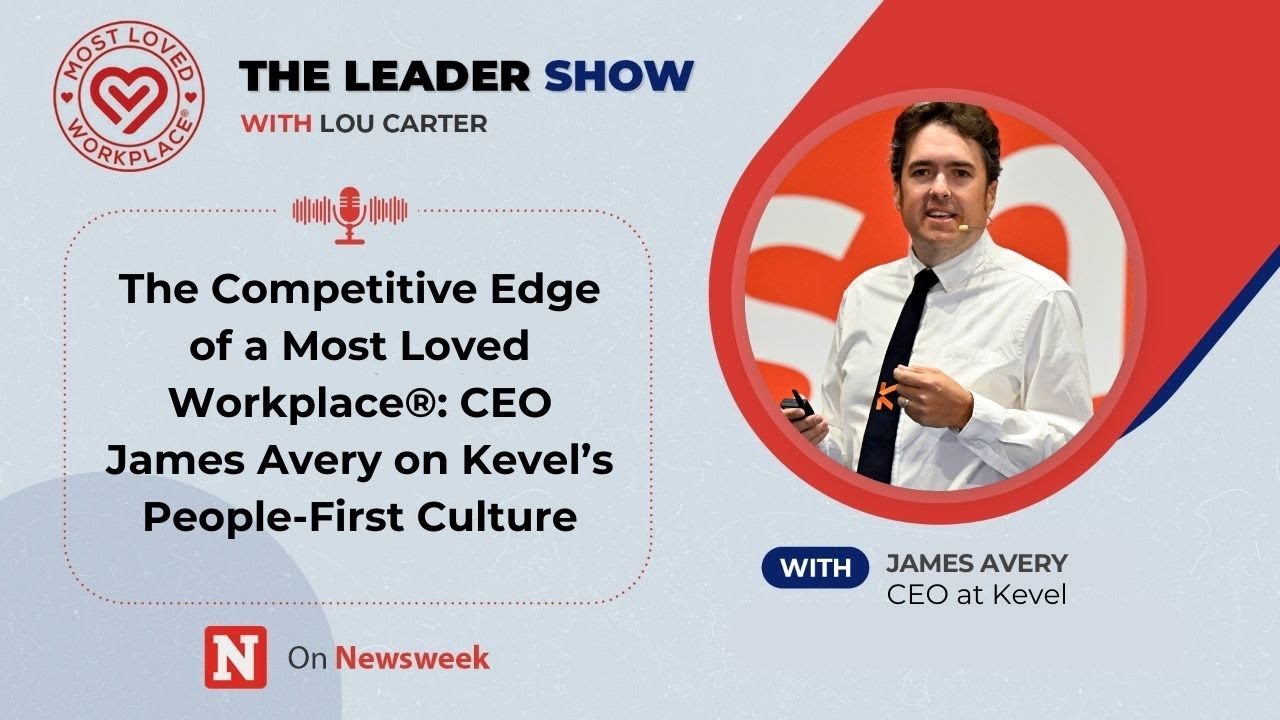
In this episode of The Leader’s Show, host Louis Carter interviews James Avery, founder and CEO of Kevel, a privacy‑first, API‑driven ad‑tech company that powers retail media networks for brands like Home Depot. Avery explains how Kevel’s technology lets customers bring their own first‑party data and machine‑learning models into the ad‑decision engine, ensuring highly relevant, non‑intrusive ads while keeping data private. The conversation then shifts to Kevel’s people‑first culture, which mirrors the product philosophy: transparency, trust, and autonomy for both customers and employees. Avery describes the company’s “constitution” and employee Bill of Rights—guaranteed paid insurance, unlimited PTO, remote‑first hiring, and a core value that every employee is treated as an adult. Autonomy is framed not as a free‑for‑all but as ownership of business objectives, with collaborative decision‑making, regular financial all‑hands, and clear visibility into profit, run‑rate, and key metrics. The interview highlights how culture is earned through performance, how remote‑first hiring expands talent pools, and how financial education and unlimited vacation reinforce a thriving, most‑loved workplace that drives product excellence and business growth.
Chapters
Founder and CEO of Kevl, one of the world's top most loved workplaces. Kevl isn't just another ad tech company. They're revolutionizing the industry with privacy-first, API-driven ad solutions that put control back in the hands of brands. But here's the counterintuitive twist. The real reason Kevl is winning? It's because they treat their employees the same way they treat their customers— with transparency, trust, and autonomy. So how does Kevill's radical approach to workplace culture fuel product excellence and business success? And why should every company, no matter the industry, pay attention? Stay with us because this conversation is about to shift the way you think about leadership, innovation, and long-term growth.
Care about each other and we care about the customer.
And that is the one legacy.
That's the name of the game. And by the way, it's, it's not up here.
It's here.
It's in the heart.
Welcome to The Leader's Show. It's great to have James Avery on with us today. I'm psyched about this discussion because it's really showing how a company takes an outstanding technology that they have that treats their customers with respect and autonomy and living those values inside of the company. And the real winning approach that they have is treating customers and employees with respect and autonomy. Autonomy and trust and having these great values that enable an ecosystem really of, you know, for an organization that is successful. And today you can learn the same kinds of things from James because he's extremely successful in this way. It's great to have you today, James, on the Leader Show. Welcome.
Yeah, absolutely. Thanks for having me on. This is very exciting. Uh, when you have that demo reel in the beginning, uh, all the different companies that have been on here, it's a, it's a good, uh, good group of companies to be included with.
You're in great company, no doubt. Lots of people, and it's great to learn from you today. And I want to go into so much— your company constitution and core values, right? And learn more about your privacy-first ad solutions. Let's start with that first. What is Kämpf? Let's start there.
Yeah, absolutely. So yeah, fundamentally what we do is that we really enable retailers to build world-class retail media networks. Uh, and so I saw kind of in the, in that intro reel, right, Home Depot is, you know, one of the, one of the companies highlighted. Uh, Home Depot is a customer that we've worked with to really help them build out their retail media network, uh, which essentially means, you know, running really well-targeted, relevant ads on Home Depot, right? So when you're going to Home Depot and you're looking for a new lawnmower, you know, how is John Deere able to show you the right ad so that you realize that this is the one, the lawnmower that you want, right? Or this new model that you didn't know about, or this really kind of educational, useful advertising. And that's always been kind of the core at what we do, which is how do we help, you know, brands and retailers really deliver ads that are relevant and really work for the user. So you said earlier how we kind of, you know, have this trust and transparency with customers and employees. You can also add our, you know, our customers' users into that as well, right? Like you as the consumer going to Home Depot, how are we making you have a better experience even though you're looking at ads, which isn't something everybody always loves.
Let's talk about that first. You allow your, your customers to bring their own machine learning models, which, you know, it's sort of what— and I want to make the connection to employees too, because employees bring their own machine learning models. Yeah, right. And knowing how they want to be treated, very similar in that way, right? So let's first talk about customer, then we'll talk about employee. How do you enable that for your customer bringing their own machine learning model in, bringing their own ecosystem in. Tell me more about that. And then thus the ads, of course, are specific to their ideal customer profile, right? So tell me more about that awesome technology, then let's dive into the culture.
Yeah, absolutely. So essentially we really, you know, we look at a lot of our competitors, look at a lot of people in the space. You think of Google, people like that. Who they really take the approach of that we, we own this data, we build our models, we, we kind of will tell you what the right thing to do is, right? And I think we, we kind of trust our customers to say, you know, they know their customers better than we do. They know their customers better than Google does, right? Like, you know, you go shop at this store, you shop online, you shop in store, you've probably been doing it for 10 years, 20 years a lot of times. So we know that Home Depot really has a good understanding of how their customers shop, what they're doing, uh, and how, you know, have that data. And so what we do is we say, okay, well, instead of us trying to say we know best and we know what your customer wants, we're going to let you bring your own model, bring your own data and input that into our system so that when we're making a decision around what ad to show, it's not just based on what we know, it's based on this, this customer's kind of first-party data that they have. And so I think it's pretty innovative where we say, hey, hey, customer, like we're basically, we know that you're smart and we know that you have a way of doing this and we know that you know a lot about your customers. So we're going to let you bring that into the decision to help make these ads really relevant and good for users.
And it's not like you're stealing anything, right? It's like you're saying, I'll help you if you help me. And that kind of approach, it's very transparent in that way, isn't it? Right. Yeah, yeah, yeah.
And totally. And essentially, we, you know, we really don't have our own data, right? We're only working on behalf of the customer. So I think it's something else that's unique for us in this space is that Home Depot can trust any of this data because we're not sharing that with their competitors or sharing that with anybody, right? Like, that is still their data. We just happen to be using that to inform the decisions. And so I think it's kind of this, you know, it's perfect.
Right? And that's really the transparent culture element, right, that we're talking about. Employees bringing their whole selves to work, right? And what does that really mean? You're bringing your best part. You know your algorithm to get the best done.
Yeah, 100%.
Like, go ahead. Yeah, yeah.
I'd never really drawn that connection, like, but I think you're right. Like, in the same way that we think about, you know, really trusting our customers and the data they have and the know-how they have, I think that does apply a lot to thinking about an employee. And hey, you know that you, you tend to work better if you start at 10 o'clock and you come back on at 8 o'clock at night to get 2 hours of things done. Like, great, work that way, right? Like, we trust you to do that, right? Or, or, you know, you prefer to work away where you're doing less meetings and you're doing more brainstorming time, or you need to be working with 3 other people versus working just on your own. And, you know, kind of letting the— letting— you're right, like, letting people have their own instruction manual. Of how they work and letting them bring that to work.
And it's that knowledge because sometimes people need to build up that knowledge. They may not know in a new ecosystem when they bring their machine learning model in their minds, right? Which can be really automated, as you said, instruction manual. When they bring it to work, they say, well, how does it work in this environment? Right. And how can I get the resources, the thinking, the people around me who also understand they can bring their own operating systems their own machine learning models. And that's what you've really done with your company constitution and core values, right?
Yeah, absolutely.
Tell me more about that, because that gives people the, the platform to bring their own machine learning models in. Tell me more.
Yeah, absolutely. So I mean, it's really interesting, like, the kind of story of these things. Uh, so originally when I, when I first started the company, which is 14 years ago now, uh, one of the things I thought about was, you know, thinking about the formation of America, right? And this idea that like, you know, we, you know, laid down this Constitution and this Bill of Rights, uh, and really said like, these things are going to stay stable, right? Lots of other stuff is going to change, right? You know, the US went from 13 colonies to 50 states and, and all these things, right? And I knew that like starting, starting the company, you know, yeah, we were 5 people in a little coworking space, like, you know, that now it's 140 people, like a lot has changed. But I wanted to think about what are the core things that we don't want to change, that we want to stay the same. And so when we really think about the employee bill of rights was certain things where we said, look, we're not going to force people to be in the office every day. Right? Like that was always a key thing. Like I think it was like, you know, early on it was really important for me because I would pick my kids up at the bus stop at 4 o'clock. And so I'd leave the office at 3:30 and I was like, it was really important to me that I'm there when the kids get off the bus. Right? Because you only get one chance at that. And then of course I'd go work later because I'd be behind on email or other tasks and things like that. But it was, it was kind of saying, hey, like, we need to have this way that we can, we can work this way. Uh, things like insurance, right? They were like, look, we're always going to provide 100% paid insurance for our employees, right? I was like, that's just— I feel like that's a right. That's something we should always do. We're not going to make you pay for that, right? Will the benefits change? Will the plan change? Like, all these other things will change, you know, but like, there's, there's some key tenets that we want— I wanted to lay down really early on.
Uh, and you know what's cool about that? It's that you're creating structure for people to earn the culture. I've had so many people tell me that, is that a culture is earned. It, it's not given to you. You have to earn your way to perform it, right?
Yeah.
And so it's a— people misunderstand that. They think, oh, I go in and I'll be treated wonderfully and I'll be completely respected and loved and you know, and everything will be great. No, you earn it. Cultures become most loved because they're profitable as well, they're successful, and they're performance-driven. Yeah, right. You can't be most loved unless you have profit. Yeah, yeah. There's a misunderstanding that I just walk in and I'm taken care of. Uh-uh. You walk in, you take care of each other and yourself the company, you will be taken care of when you have great CEOs, founders like James, who cares about people and puts them first.
Yeah, and that's— and one of our, you know, we have, we have our core values, and our values really— we also, we, we extracted those values. So it was actually a couple years in, we said, okay, we really like how we're working together. We're like 12 people, and we're like, let's write down like why we like working together, like what are those key things. And so one of the key ones is that we're all adults. And I think it's the one that everybody comes back to all the time as, as really recognizing and understanding and loving. And we talk about, you know, some concrete examples of like, look, if you need to go to the doctor, just go to the doctor. Like we're all adults here. Like you're de— you shouldn't have to ask somebody's permission to go to the doctor. Right? Like we're not in school asking to go to the, get a bathroom pass.
Right?
Uh, and then I think another big one is, is really understanding when you have a value like that. How do you protect it? And so what we would see is we would, you know, sometimes you'd hire somebody, maybe they're young, they're right out of college and they start, you know, making poor decisions, right? I'll leave it at that, right? Whether that's, you know, whatever that is, right? They're making poor decisions at work. And the instinct people have is like, okay, we need to make some rules around this, right? We need to make a rule that says you can't do this, right? You can't throw a party in the office after hours. And I'm like, you don't need a rule for that, right? Like all what you need is to say, to sit down with this person and say, We're all adults here and we expect you to be an adult. And if you can't be, like, you don't work here anymore. We're not gonna write— we're not gonna make a school system of rules and put them on the chalkboard for you to help you learn how to do this, right? Like, we're not in the, in the world of training adults. We're in the world of working together as a company.
And if you have to ask to break the rules and say, I expect that to happen, that's a red flag.
Yeah, yeah.
I— what do you mean I can't have office parties? That other company does it. They're most— they love— oh, they tell me I can do anything. No. Are you part of this value? Do you align with our values, right? That's the A in SPARK for Most Loved Workplaces. Do you align with the values of the founder and CEO, with the founder of the 12 people that you were just talking about, right? And that's what emerges of a love culture, is the— is people who agree that this is how we can be successful.
Yeah, and I think— and you do— I think, uh, I think it's a lot of people, I think, pay less attention to this in the interview process than they should. Like, we think a lot about when we're interviewing people, you know, will they fit in culturally, right? Like, do they— do they— are they an adult? Are they— do they default to open, right? Do they— do they want to be open with other people? Uh, you know, are they embracing diversity? All these important values to us. Uh, but I think when people are interviewing at the company, the really good people, those are the questions they're asking. Right? The people that you're worried about are the ones who are just like, oh, how much does this pay? Like, how often do I have to do travel? You know, it's like, those are, those are questions that need to be answered. But if you're really trying to figure out if you're going to be successful in a job, you need to be figuring out, am I going to work well with these people? Like, how, how transactional are they versus, you know, emotional? Or how, you know, all these sort of questions that people should be asking.
Huge red flag when they ask, what's my travel first question. Yeah, yeah, yeah, right, no doubt about that. You are a fully remote-first company.
We are, yes.
It enables you to hire top global talent without those geographical constraints. Tell me how that works, how you've been successful with that strategy.
Yeah, so it actually— we started out, uh, we were all in the same room. So started out, we're all in the same room Uh, then really before COVID so probably 2017, maybe we started to hire a little bit remote just because we realized that, you know, we started to have people come to us that say, hey, I know this really, really great engineer, but he happens to live in Virginia. And I'm like, well, am I really gonna say I'm not gonna hire this great engineer because he lives a 4-hour drive from our office? And so we said, okay, let's hire him. He's worked remote before, he'll know how to do this. And he actually helped us— got him, Craig— he helped us build all the tools we needed to be a good remote company, right? Like getting on Zoom really early and good audio and learning using Slack more effectively, things like that. But then I think when COVID hit, we just started hiring, we just went full remote. And so now what we've done is kind of we're full remote, but I'd like to say that we have, we have kind of centers. And so, you know, we have a couple of international groups. So we have a group in Porto, Portugal, and a group in Copenhagen in Denmark, where we have offices and people there will go into the office and work out of the office. They're not required to, but I think a lot of people love, love some in-person interaction and love to be around other people. We have the same in Charlottesville, Virginia. We have a small office because we have a group of kind of engineers and engineering managers there that will go into that office and they enjoy that interaction. And we still have an office here in Durham, you know, sitting next to me where, you know, every once in a while people go in. But it's fully optional, right? And so I think that's the key thing is remote first, but also giving that option to people that do want some in-person collaboration, that want to spend some time together.
That's awesome. And about autonomy, you know, employees are given full ownership of their work. It really reduces that kind of bureaucracy and increasing engagement. Tell me how that works, about full ownership of people's work.
Yeah, I mean, I think that the key thing there, right, and I think a lot of people get this confused because I think sometimes people think of full autonomy and they think of, uh, somebody like Steam where it's like at Steam apparently you can just do whatever you want. Like you can just one day you can come into the office and say, you know what, I decided I want to, I want to start an ice cream food truck and I'm going to run that outside the office. And they're like, great, do that.
Right.
Um, that's not what autonomy is. Right. We still, we still have company goals. We still have company objectives. We have things that we need to accomplish. I think what autonomy means is that you're not given a fine-grained list of tasks to go check off and do, right? You're given more of a business objective. You're given a thing of, say, hey, we want to sign this customer, or we've already signed this customer, we need to make them successful. Like, go work with that customer and help them be successful. And yeah, that might mean writing some code over here and launching this feature, That might mean flying to their town and sitting with them in a boardroom for 3 days and working with them. That might mean, you know, weekly conference calls for 6 months, whatever that is. Like, it's your job now to try to make this customer successful or successfully launch this product or reduce the cost of one of our systems, right? I think it's kind of giving people a business objective and letting them and their team kind of work out like, how do we accomplish this? Right? And I think, I think that's what people want, right? I think a totally blank slate of like, do whatever you want. Nobody wants that either, right? They want to know what's the most valuable thing for me to do? Like, what are you trying to do? Okay, you want the cost of this reduced by at least 10%? All right, I'm on it. Let me go see how I do that and maybe I can get 15% and I'll feel really good. And so I think that's what we think of when I think of autonomy.
And doing that with strategic speed, right? It's so important. And autonomy is great, People say, what about inspecting what you expect? Tell me more about that. How you, after doing that, becoming autonomous, coming up with a solution, how do you inspect what you expect?
Yeah, I mean, I think, I think a big part of that is a lot of, especially in our engineering culture, you know, we have a lot of it where, you know, there's just a lot of collaboration. And when you look at our CTO and our director of research, they spend a lot of times with teams, sitting down with them and saying, okay, like, how, how are you thinking about solving this problem? Okay, well, like, we want to make sure that this is scalable. We want to make sure that this is cost efficient. You know, explain that to us. Oh, let's, let's dig more into here. Let's talk about that. Let's brainstorm on that. Right? And so I think it's different from saying in some orgs where they might be coming up with a design and just pushing it down and saying, hey guys, go implement this.
Right?
It's, it's a lot more about collaboration. And it's not about, you know, here's a business objective, like, go away and come back in 6 months. Right? Like, that, that doesn't work either. Right? It is, It is really that collaboration and saying, okay, let's, let's work together on this. You know, on the sales side, right? It's like, hey, we want to sign this deal. But, you know, I'm, I'm talking to reps, our COO is talking to reps, our VP of sales is talking to reps. Like, you know, you get the big deal and it's a very collaborative approach across the whole company. But still, those reps have a lot of autonomy and like, hey, what approach should we take? I'm bringing this plan to the leadership to say this is what we should do here. Let's talk through this, right?
So everybody's excited about it and everybody sees the success together.
Yeah, exactly. And there's no, there's no big surprises up or down, right? Like, you know, you're not, you're not spending 6 months working on something and then everybody's saying, nah, we don't like that, let's, let's go away, right? Like, let's do something different, you know?
And that kind of thing fuels smarter decisions, right? Because they have full visibility into financials and strategy. Wow, you don't hear that too often, you know, just like your clients have full control over their ad platforms. So tell me more about this, how, how people respond, what they— how it helps, challenges. Tell me more.
Yeah, you know, it's funny, maybe I've been doing this too long. It's always shocking to me when I talk to somebody and they say, oh, we don't, we don't know, you know, how much money we make as a company, or, or what our profit is or, or not is, or And I'm like, how do you work at a company and not have that idea? Right? I mean, obviously if it's a public company, everybody knows, but I think there's lots of private companies where people are like, well, I'm not sure if we're doing, you know, $20 million a year or $50 million a year. And I'm not sure if we're losing $5 million a year or making $10 million a year. And I'm like, how do you make business decisions without having that context? And so we, you know, every all hands, uh, or once I'm like, uh, we do all hands twice a month, but one of them we do the financial update from the previous month and we share, hey, here's where we are on run rate. Here's where we are on profit, here's where we are on, you know, kind of every other major objective, right? Whether it's leads for marketing or the sales number for the quarter or the engineering projects and where they are and really sharing that with the whole company, it keeps everybody on the same page of why are we making decisions? Why are we doing what we're doing? So yeah, it's like, you know, some people think, you know, are shocked that we do that. I'm kind of shocked that people don't do it. Like, I don't know how you work in a company and not have an idea of like kind of where things stand.
Are there certain things you share, like, uh, profit, balance sheet, profit and loss? Like, do you— how do you share it? Is it— because some people don't understand financials as well.
Yeah, we definitely don't. We don't just drop like a— like, if you drop a P&L and balance sheet and they're like— like, 80% of people aren't going to see that. Like, we, we basically show it as, you know, more of like— really, honestly, it's a lot of the same stuff that we send to our, our board of directors like every month, right? Is to say, okay, here's, here's our run rate for the month, right? And here's where it is over, like, compared to the last, you know, 12 months, right? And so showing growth rate and showing that, that over time. Uh, and so we really try to simplify it. Um, I will say though, if you, I think if you ask a lot of people at the company, like, they've all learned a lot of new financial terms they didn't know before. Uh, our CFO, Chessy, is very good at explaining and going through, okay, here's what net dollar retention is, right? And, you know, I think if you're an engineer at a normal company, you probably never have to understand what net dollar retention is. Or what EBITDA is, or, or how EBITDA works. I don't think they could all tell you how EBITDA works, and they necessarily— but they have an idea of what it means. And so I think that, that, you know, if we're, if we're a little bit of this, we're doing some financial education in the world. Like, that's, that's only a plus.
Absolutely. For people who want to run their own business, want to sell it one day, they can understand how important EBITDA is and the health of the company, uh, cash flow and metrics. It So important. And people probably less so wonder about vacation time. Have all the vacation time you want. Look at our EBITDA. Yeah.
Well, and it's funny, like you mentioned vacation time, because we've always been— we're one of the early companies that said, you know, it's unlimited PTO. And when you look at it, some people are like, well, I don't understand, like, why wouldn't you just take all the time off? And I was like, well, that's a quick way to tell us that you're not an adult. And that you're not serious about getting work done, right? And, but I think, I think with unlimited PTO, the risk is people will take, don't take enough time. And so I think it's always something where I've tried to lead by example and I'm very public where I'm like, I'm going to the beach for 2 weeks with my family this summer. Like, here it is. Everybody can see that I'm doing that. You need to do that too, because we, none of us can work, you know, 40 hours, 50 hours a week for a year and not have that break where you go and and just unwind and read a book and get in the waves.
Well, who doesn't like to do that, right? You really can prove that most loved workplace and an industry-leading product do go hand in hand, and you've shown it time and again today in teaching everyone out there what you can really do to not just create a most loved workplace but a healthy thriving culture financially, performance-wise, and employees who truly love to work for your company. So James, thanks for being with us today. It's a pleasure for you to be on our show here, Leadership Show. Thank you.
Absolutely. Thank you for having me. This has been great.
More from Louis



How to Get Found in ChatGPT, Perplexity, Gemini, Claude & Grok | Visipage AI Visibility Audit

Your Competitors Just Got Certified. Now What? | Most Loved Workplace® Demo & Hiring Advantage



Visual Thinkers: The Hidden Genius Behind Skilled Trades & Innovation! #shorts

Car Mechanics: The Secret to Engaging Autistic Adults Over Video Games! #shorts


