The Louis Carter Show, with special guest Dr. Darren Good
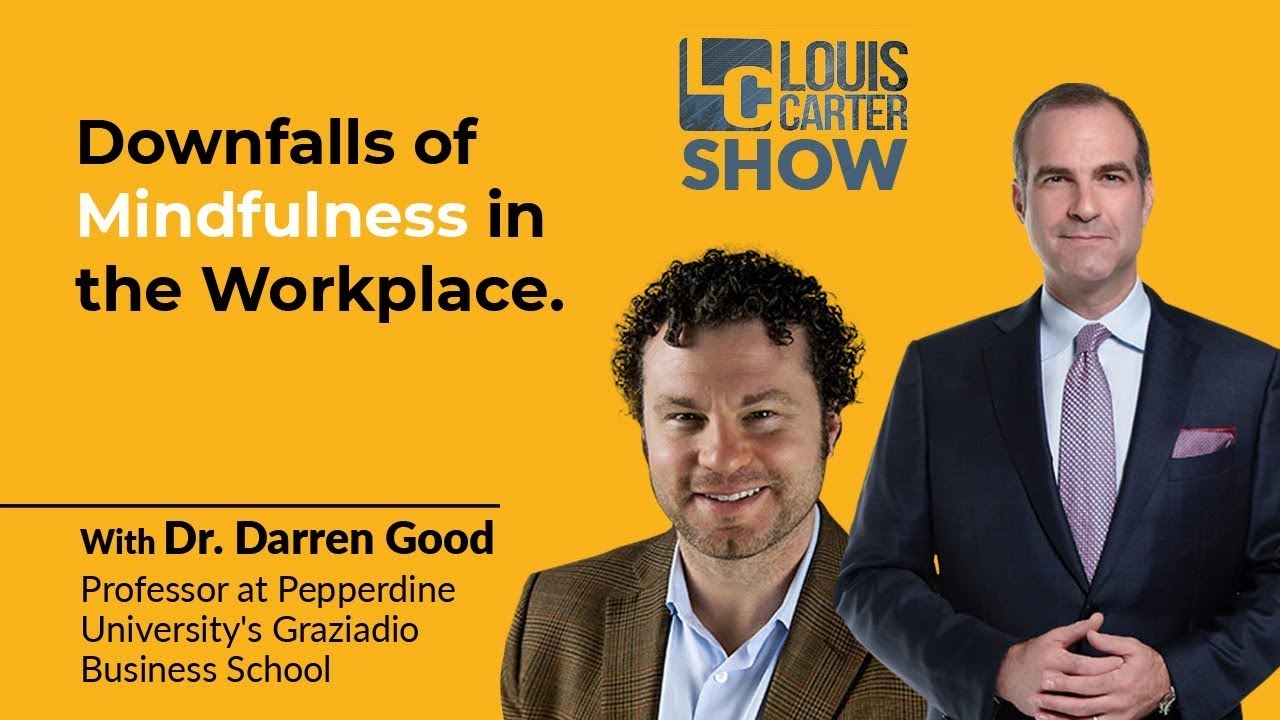
Dr. Darren Good, assistant professor at Pepperdine, found that mindfulness can backfire at work. When employees fake their emotions, heightened mindfulness makes them more aware of the gap between what they feel and what they show, draining energy and hurting performance. The effect is worst during layoffs, difficult conversations, and remote work.
Chapters
Hey everybody, welcome to the Louis Carter Show. Dr. Ted Good, Dr. Good is here with us today. Let's talk about that. Let's go back and do that. Dr. Good is here with us today. He's the assistant professor of applied behavioral science at Pepperdine University, and I will talk with him and learn more about the downfalls of mindfulness in the workplace. Dr. Good published an article in the Journal of Applied Psychology with his research team on the downfalls of mindfulness in the workplace. This is cool. Usually we find out all the things that are wonderful and amazing about mindfulness. Dr. Good found something different. Through a series of experiments that Good and his research team performed, they surprisingly found that being mindful at work may pose hidden and largely unexplored challenges, specifically that mindfulness is not always particularly helpful in the workplace, specifically where employees are engaged in what's called surface acting. And we'll talk a little about more about about that today, where employees hide their true feelings or pretend they have emotions that they don't really have. Um, uh, yeah, mindfulness, it leads to increasingly taxed employees, diminished tax and citizen performance, which is some big OB terms, and increased counterproductive performance. So it's really a pleasure to have Dr. Good with us today. Hello, Dr. Good, welcome to our show. How are you today?
Good afternoon. I'm doing well, Louis. Thanks for having me.
Thanks for coming on. It's great to have you. And I was really interested in this today because of the whole concept of counterproductive performance with mindfulness, as if we're being someone that we really are not, right? And we're pretending. We're putting on these sort of different— these blinders and not being honest. And tell me more about what you learned and, you know, how you came to this conclusion.
Yeah, well, I mean, what we learned is that, you know, when you think about— when you think about work, you think about what it usually takes to survive and thrive at work, and it's— you have to be fast and quick and evaluative and judgmental, and you're constantly planning for the future. And it does sort of stretch our imagination to imagine how mindfulness is entirely good all the time, which is what the evidence so far has found across, you know, thousands and thousands of empirical studies. We see this sort of universal positive kind of claim that mindfulness does everything well, improves everything, including your performance, your relationships, your well-being, and so on. And if you think about what mindfulness provides you with, you know, maybe some of these, maybe some of the qualities of mind that emerge when you're mindful are not always that helpful. You know, is being really present and being really aware of what you're experiencing while you're experiencing always good at work when in fact at work you have to do things that you don't always want to do? You know, that's what work, some of what work is about. I mean, we want to, of course we want our work to be amazing. We want to be, to have passion and engagement, and there's great things that happen at work, but work also can suck sometimes. And one of the ways that it can be challenging for a lot of people is when you have to be inauthentic in order to do what the organization wants you to do. So if you have, let's say, a customer or a client, or even internally, you know, a colleague that you're frustrated with, Oftentimes the organization expects you to put on a display, at least on the outside, of a smile, a friendly hello, to look happy. And this is called surface acting, I think, as you just mentioned in your intro, when you have an outside display that's inconsistent with your internal feeling. And maybe being more aware of that internal feeling actually has a cost. And that's kind of what led to our investigation here.
That awareness of the fact that we can be a service actor, right? And we're trying to be this emotionally intelligent, amazing human being to everybody, right? And we have to put on those airs. It's important, though, I would assume, the emotional regulation and the empathy, of course. However, it needs to come from a place of genuine acting rather than, as you call it, surface acting.
Yeah, there's, there's two different ways that people deal with emotional labor at work. There's what we call surface acting, which is what— it was the more common approach, where you basically are, you know, giving a smile to a customer even though you're totally frustrated with that customer in the moment. And then there's deeper acting, which is where you are able to reframe what's going on and actually embody the emotion that the organization expects of you. So this would be like, for instance, you know, let's say you're a nurse at a hospital and you have, you know, really angry and frustrated family members. And, you know, you're frustrated with them, but maybe you could step back and say, okay, they're frustrated, they're angry, they're being even hostile toward me. However, I can understand that below that is fear and sadness. And maybe I can come to a place of being really empathetic with where they're at and actually embody those genuine emotions. I mean, that's the ideal. It doesn't always happen though at work. And we end up oftentimes surface acting. And that's where I think there's really deep costs, you know, to people's ability to— it depletes your energy sources when you're when you're putting on the surface acting because it's work. You're having to do something that you don't wanna do, and that requires extra energy and resources, which then of course impacts your performance in the long run.
So I'm curious, what motivated you to come up with this hypothesis? Was there something that sort of where you had an epiphany or something that came up for you where you experienced this?
Well, I mean, I experience it all the time. I mean, I don't know about you, but I'm not so authentic all the time at work. I would love to be, but there's oftentimes where I'm, you know, or I have to— you put on a bit of a show and it hurts. If you're aware of it, if you're— when you're aware that you're being inauthentic, I think it has an extra special sort of punch, you know, that you can feel. But for me, I mean, I'm passionate about mindfulness. I'm passionate about mindfulness in the workplace. I think overall, even though we have these findings that are sort of counterintuitive to some, I still believe mindfulness is a very helpful tool and technology to serve people at work. But I am skeptical still that it's easy to integrate. And when I think about work, it's almost opposite to everything we think of when we think about being mindful. So the idea of how to integrate mindfulness into work is a passion of mine and my research team, my colleague Chris Liddy, who is the other lead author on this paper. So that's always driving us. What are the conditions under which mindfulness may not be as helpful at work? So that's sort of the driving passion. And the more we can understand those conditions, the more we can be really grounded and passionate enthusiasts about it. 'Cause I don't think just having this panacea, like, oh, this is just great for everything, is realistic. And I actually don't think even helps the movement or the field that much. The more we can begin to find all these boundary conditions, the more we can help both scholars and practitioners deliver something that's realistic and helpful to people in organizations.
I like what you said about boundary conditions. I'll bet you found some of them, right? You mentioned a nurse and how they could be stressed. They could have a lot of things that are happening in people's lives with the pandemic. What are some of the boundary conditions that kind of throw it over the balance where it becomes over or underproduction, underproductive eventually?
Well, and I mean, I want to be careful not to go too far. I mean, all we found was is that when surface acting is high, people who are more mindful get more depleted and their performance is lower at work. So that's what we found in this particular instance. But then the next question becomes, what are some potential other places where being more aware of your experience could be potentially a problem at work? So what are the other unpleasant experiences people are having And where am I being more aware, more engaged, more intentional actually cause problems? So we're thinking maybe about other necessary evils at work, as they're called, when you have to deliver tough feedback to somebody or you have to do layoffs. I mean, is that an area where you want to be extra specially aware and more mindful when you're going through and laying somebody off? Maybe, maybe not. I mean, these are areas for people to do future work to figure out. There's a host of unpleasant things happening at work all the time. And I think it opens up new conversation about what to do about it.
Darren, what it reminds me of is kind of going back to Ken Blanchard's situational leadership is that perhaps there's situational mindfulness. Cool, love it. Right? There's different places or times to be mindful and different ways to be mindful too. Maybe it's a grid. It's, you know, when you have to be a little more direct or you have to be a little more indirect, right? Side by side. There might be different situations, like you said. And it's an interesting— that's— I like— it's interesting how you pose that.
And I like how you're posing it, actually. I think that's really— that's fascinating because it would give so much more nuance to somebody who's coming into an organization and trying to help people. You know, I think if you're— if you have that level of nuance, then you could really deliver a program that's beyond just saying, okay, let's just all meditate and then life will be better, which may be true, but maybe not, right? Not at work, at least.
And that's the thing. I mean, it's specific for each person. And there's this great guy, you probably know David Kanter, remember the David Kanter Family Systems Therapy Institute? He did some really cool stuff around every single organization has different needs. And you have to, you know, a college dorm needs to have different types of interventions than say, you know, a an elementary school or a jury, right, or a really random IT environment, right? So everybody needs different things, and you're going to have different emotions that come up. So the only way we really can connect with other people is sometimes not just to match those emotions, but be with them as a person just in general and not have this kind of almost robotic AI approach, really. Right, to mindfulness.
It's, yeah, it's fascinating. It's almost a bit paradoxical. I mean, that's where mindfulness is helpful, I think, is, you know, to get out of the robotic responses, the automatic responses, to undo your autopilot so you can be with people in the moment and really connect with them. I think that's, you know, so you're not just sort of caught in your self-concept and dragged from this sort of being in the past to being in the future constantly. You're actually able to be with people. I think that's one of the real gifts and powers of being mindful. And perhaps being mindful at work, but needs to be integrated with all the other expectations that happen at work, which is really about getting a lot done. And there you see sort of this— it's almost antithetical in some ways, right? Work is about future about achieving future goals. And mindfulness is about not having goals and being in the moment. And so I think that's really where it opens up a lot of potential interesting dialogue and challenges for integration.
What I see too, Darren, is that it's opened up the rise of lazy leadership. So we have this kind of excuse. I'm mindful. I need to be mindful of others. I have to be respectful of their territories, yet I have I have a job to do, and for some reason I'm waiting and I'm slow rolling projects because I have to respect everyone, right? And what should take an hour takes 2 months because there's so many people in your way and all you want to do is be kind and mindful of their emotions. It's unproductive.
I mean, it can be unproductive. If you are truly holding up projects you know, constantly. You know, I think we have to be careful about what mindfulness means, right? You know, when you're mindful, you're— we use the term mindful all the time, right? To be conscious of other people's needs is not necessarily to be mindful. That's to be sort of aware of them, considerate of them, and sort of use mindfulness as a sort of a lay term in that way, as opposed to the state of being mindful, which is where you are truly being sort of present-oriented with your attention and awareness and nonjudgmental and non-evaluative. So it's a hard thing to think about how that integrates on a daily basis, minute to minute in the workplace.
It's that non-evaluation, that ability to say, okay, I see this out in front of me, right? And it exists out in front of me. And I have to evaluate what's happening while still being empathetic, right? And being mindful is something different. Tell me more about the difference, which you found that can be antithetical or can harm. Would you define the harming?
Yeah, so, you know, when you're mindful, you're seeing things as they are, for what they are, sort of objectively as possible. It's almost like, you know, when you think about the ladder of inference, I don't know how, you know, I'm sure you're familiar with that, you know, the idea that you have sort of data in its objective form at the ground level, but yet we quickly move up the ladder as we apply our beliefs, our evaluations, and our judgments upon that data, thus selecting certain things we want to see and then adding all kinds of meaning-making on top of it. Mindfulness would be, to the best of your abilities, kind of remaining at that sort of ground floor just with the data, not evaluating it, experiencing it for what it is as it's happening. And so if you're at work and you're faking something, right, you're being inauthentic because you think you have to, and you're experiencing that, that moment of inauthenticity as it's happening, some people may say from a mindfulness perspective that you're just watching yourself being, you know, being inauthentic, and it's— and you're seeing at a distance and you're not really evaluating, that's okay. I think that maybe as you're being willful about that, I think that's really— can really kind of drain your resources and be very uncomfortable for you. So the more mindful you are, the more you're into that raw experience and sensitive to it happening in the moment, as opposed to just being more conceptual about it and kind of abstract about it at a distance, I think that's where it can really be potentially harmful. And so I'm trying to think about what— where are other areas at work where people are willfully doing things that they don't want to do? And so I think those are really interesting conditions to explore.
That's a cool way of looking at willfully doing things that they don't want to do. And, you know, that, that could be in a way sort of behaving in a certain way that they're expected to behave, right? And therefore, if, and if they don't, they don't fit the culture. That could be counterproductive.
Totally. Totally. Whereas like, you know, mindfulness has been seen to be very helpful for buffering against a lot of unpleasant things. Like for instance, if you have an abusive supervisor and you're mindful, maybe that will be something that helps you deflect against or push back against some of the pain that comes with that. But that's different than I think willfully doing something.. And I think that that's sort of a working hypothesis as to why maybe we found what we found in terms of these outcomes.
What if there's a situation where sort of you're stuck, you have no control, or with a relationship or a contract, let's just say, for instance, and there's something you just can't control. I always think about sort of prophecies of these are things you can control and not control and have the wisdom to know the difference. You've heard that, of course. So what if there's things you just can't control? And it does require a change in kind of your behavior, um, in, in perhaps behavior you're not just uncomfortable with, perhaps you don't choose to act it. So it becomes, uh, an unwilling actor relationship. How do you— how does one sort of, uh, change in that circumstance?
Or yeah, and what would be a good example of that? Do you have Do you have something in mind that—
I do. So let's say, for instance, you're stuck in a relationship with a client or a vendor or someone you just contracted with. It's someone you've got to work with.
Yeah, you're locked in.
You're locked in. You're totally locked in. And perhaps there's some assumptions and judgments you've jumped up to that ladder of inference and said, that's it. I know this is awful. Is there some ways— I would think there's a— my assumption is that you'll have to use some behaviors you're a little more uncomfortable with to walk down that ladder again, right? And to get down to the bottom together rather than just one at the top, one at the bottom. Judgment, judgment, and then getting down and undoing the perception. So, like, what happens when someone's stuck? You know, and perhaps they have to get out of their comfort zone and, you know, sort of, as you said before, use that unwilling kind of actor approach. I think you defined it— what was your term again?
It was, uh, willful.
Yeah, willful acting. Yeah. So yeah, what is that like? Like, uh, how would one exercise a different way of being and how to get down that ladder when they're kind of, you know, where they may have to be a little bit, you know, of a surface actor.
Yeah, so I think that's really interesting because this is where I think the deep acting hopefully comes in, where you can really step back and spend some time considering reframing what's going on. Why is this person acting— why is this person the way they are, you know? Why do they come across the way they are? Is there a way to think about their situation and why they may have arrived at behaving the way they do? What's below or what's beneath the surface for them that you can imagine that may allow you to have a little bit more empathy for for how they are? And can you find a more acceptable reframed understanding that leads to an emotion that is both consistent with what the organization wants and something that feels a little more authentic to you? I mean, that would be, in my mind, the ideal. Doing that is a bit more difficult. And yeah, and mindfulness— what's interesting about mindfulness is there's research that says that the more mindful you are, the less you do surface acts. Right? So it does lead to more authenticity in how you behave. It's just that when you have to surface act, that's when it becomes sort of a harmful, harmful quality.
And there's that whole statement, fake it until you make it. And what we're saying here is don't surface act until you make it properly act, right?
So, yeah, or don't be mindful while you're faking it.
Don't be mindful while you're faking it. That's interesting. Okay.
So that's, that's the piece is like, if you know you're going to be inauthentic and you have to be, and there's nothing you can do about it, this is, that would not be the time to go do a 5-minute meditation before you go into that conversation.
Yep. You go in with full emotion, your full self and who you are at that moment and engage in it so that you come to that conclusion together rather than through an inauthentic self.
Yeah, because that's where, that's where you're going to feel the, the pain, right? So normally when people surface act, they do it automatically most of the time. They go through the motions, and which makes sense, right? If I'm doing something that's, that's uncomfortable or not nice or unpleasant, why wouldn't I do it going, you know, in a robotic way, right? You know, the famous, the famous like Van Manen ethnography from like the early '90s of the Disneyland ride operators. You know, there's— they— I guess his final claim was that they're just as robotic as the rides because they're just constantly smiling all the time. And so if you have to go through an unpleasant thing, you— why would you— why would you check in with it and be more aware to it? So I think, I think that's really fascinating because even things that seem very, um, on the surface unhelpful, like being very automatic in certain situations, they must serve us in some way or else we wouldn't do them. And so, yeah.
Yeah, I, you know, once worked with Richard Olivier, Laurence Olivier's son, and in London. And one of the things he talked about was like living the character, being the character, and not like, not being kind of an interpretation of the character. So you fully immerse yourself. Like, it's an immersion acting. And what he really meant, though, is you're feeling it in a way that connects to things that you've actually done. So it's not empathy. It's real sympathy, right? It's like things you really— happen in your life. You connect it to the darkest place, you know, that you're with. And it kind of— it gives you a sense of calm just knowing that you could be like that, or that is you. And that becomes you.
Yeah, so real, real deep character acting, like the Daniel Day-Lewis style, right, where you're all in.
Yeah, he was Abe Lincoln, right, for— yeah, the whole time, before and after. This is the deepest form of empathy.
And yeah, it's empathy. I was— I reflected on that because, you know, I was living near Richmond at the time where— that's where they filmed the movie Lincoln. And there was all this local media. First of all, they're excited to have a Spielberg movie on, you know, close by. But there's all this local media of him walking around the town as Abraham Lincoln, going to dinner and stuff. Like, he was just— he was out and about in the streets being Abe, which is just amazing to me. But again, that is, that is the way to learn the character.
Certainly it is. And everyone who came in, in his path, like, literally was talking to Abraham Lincoln. And, you know, that's what, you know, we We mistake that, right? In the workplace, we want to be this perfect artificially intelligent person that we've learned from this competency model, but we're not being our own sense of selves or our own Abe Lincolns, right? I mean, if you're really going to be that competency model, you might as well get there, right? Really get there, right?
Yeah, all in. All in.
Yeah, be all in. All in. That's awesome stuff. But this is cool, man. This is really cool. So you've got your own research team over there at Pepperdine over in LA. What else are you working on? So is your book coming out now? Or is it— you're in HBR. I saw that in HBR. And I saw it in the journal, which is a great HBR journal, by the way, article. I'll put it in the notes here. Tell me more. Do you have a book coming up? Go ahead.
I don't have a book coming out. I wish I did. It's just that I'm lost in this younger, mid-career academic world where the currency is— about journal articles. But yes, I mean, writing a book would be fantastic once I, you know, land a bunch of these articles with data that I've sitting in backlogs that needs to be attended to. Yes, but I'd love to write a book. Yeah, that's maybe next along the list somewhere.
It's awesome because that one phrase, surface acting, and what actors do to really get into the role, good, great actors. We're talking about, you know, the Hallmark actors. Nothing against you, Hallmark actors, you're great. Yeah, we love watching you. We're talking about Cameron, Candace Cameron, you're great. But we're talking about Daniel Day-Lewis. We're talking, right, about, about really the people who live those roles, the icons, the icons of the field. Yes, the icons, you know, uh, Orange Fishburne, you know, you know, Liam Neeson, you know, these are people who who, like, when they go in and they— they're talk— not pretend, they're acting like they're, they're protecting their wife or their child in the movie. They really are doing it.
Yeah.
And when they have a specific set of skills to go get that person, or I'm gonna go get you, I will win, they really mean it, right?
Yeah.
And they do it as if they were actually in it.
Yeah, I, I assume, I assume that's— I mean, I'm not an actor, but I assume that's what I would do if I were one, as I would try to imagine put myself in that situation and embody all those emotions that would come along with protecting family. And it would be really hard to imagine that without having a family, you know. So it would have to be real for you at some level.
And whatever that may feel like, right? It could be father, mother, protector, guardian, whatever it is in your—
in your world, whatever your version of that is for you. You need to step into that, I would imagine, to arrive at a place where you can, you can embody it to a place where it's believable to you. So it becomes real for other people watching you.
And become more productive in the meantime. Right. Yeah.
There's, and by the way, there's still work involved with that deep acting. It's not like it's not costly. It's still, there's still labor involved. It's just not as, not as depleting as not nearly as depleting as the surface acting. That people tend to do more often?
Deep acting, because it almost is the place of mindfulness, isn't it? Deep acting. Because it's like, OK, now I feel like I'm in my skin. It's cool where I'm at. I don't have to be someone I'm not, right? And it's also connecting to that larger purpose and vision and then sort of following it through. And we need that more today, don't we? I mean, we don't feel as connected to ourselves and others for so many reasons.
For so many reasons. And maybe this type of research for those who are doing mindfulness practice in organizations, of which this is off the charts, is growing exponentially by the minute, it seems. Maybe this is an opportunity to engage in a kind of dialogue around this, where as you're presenting to your clientele or to stakeholders in the organization, where are the places that you tend to surface act? And how can we have that conversation about where mindfulness may be a problem there and how to think more about how to engage in deep acting as a way to resolve some of those issues that we have? So I'm hoping that it leads to those types of dialogues.
Two great dialogues right there. I mean, the perfect workshop. Where do I— this is where I surface act, right? And this is the way I can deep act. And then doing it and saying, this is it. This is how we do it. Not just role-play. Let's follow up, see how you do it. And then make it part of a checklist. Did I deep act? This is the level of deep acting I did today. Did I not surface act today? 1 to 10. Making it part of our daily habits, our daily activities.
Yeah. And when you did surface act, what happened? Why did you go there? What was going on for you at the moment? I think these are really important dialogues. And by the way, in the Zoom environment, I think it's really rough because if you are surface acting, I'm watching myself, like right now, if I'm surface acting, I'm watching myself surface act as I'm watching my face right now. That's gotta be really rough because seeing your reflection of that has to be even more depleting, I would imagine.
And more people are just looking at themselves rather than the screen. Right? They're not looking at the camera or they're not doing this. There's two cameras, right? I'm looking at you. I change my perspective. I'm looking at you. I change my perspective. We have this 180 view of just ourselves, right? And not anybody else, right? It's just— why are we looking at—
it's nuts. It's nuts.
It's nuts. And so we have to— the surface acting is great online. I can see that you're saying it. Having a workshop online, having to say, what are we doing online to surface act? How do we know when others are surface acting? What does it look like to us? Because we're seeing people do it and we're not looking at each other anymore. We're just looking at ourselves, you know, and it's gotta be painful.
It's gotta be. I imagine it's even more painful. I have no data on that, but I imagine it's even more, more painful. But then again, you know, these Zoom calls, they do, they do offer up opportunities because you know you're coming, you know you're about to go into one, you can think about it ahead of time, and then you can have your own checklist about what are the odds that I'm going to be surf stacking with this group, with these people, or this person, and what can I do to maybe deepen and see if I can be in more of a deep backing place. And if I can't, well then, you know, What am I gonna do about it, right? So, you know, and by the way, from a mindfulness perspective, what we're seeing here is, you know, maybe this is not the time. If I, if I know I have stand no chance of being able to be authentic for whatever reason, because of the history you have with this person, maybe it's okay to not be as engaged for— in terms of your mindfulness. Maybe it's not the time to engage with the mindfulness practice, for instance, beforehand. So I think the timing is important.
And I think in that case, this is interesting. I want to just keep the, keep it going because it's so interesting. Um, the, in that case, you know, sort of, uh, uh, detaching and then seeing who's in front of you, sort of like a, kind of like a chessboard. So you might have others who are in front of you who are having more of those deep relationships, and you may be connected or feel more connected to those people who are in front of you, right? People who work for you., right? And you could, you could deep act with them and enable them to be with that person, right, in deep acting, and thus eventually have that kind of deeper active role connect together because there's so much organization structure today that is in our way to get to those people, to the CEO, right, to the C-level, to the VP suites. We have these people in front of us and we also have it up all the way down. So traditional hierarchies make it even harder for us to be able to get to deep acting.
In terms of just making good contact with people. So even just putting acting aside, right, just in terms of just being able to make— have the time and to actually make good contact with people, I think is challenging. No doubt about it.
And be ourselves. Like when somebody either A, goes into the CEO's office, right, and anybody, Or B, the CEO has to work with somebody perhaps that is inside of the organization, and they may not have that connection as we're talking about. So we have to think of different ways to deepen that connection and to make it more of a deep acting situation or cool out and not say anything.
Yeah, there's all kinds of safety issues, psychological safety issues when you engage with certain people in the organization, depending on the culture of the organization and the norms that you have. I mean, this is why you have the CEO disease, right? This is why people tend to not give the real— give the information that's most needed to the people at the top when you have opportunities to do so, because of fear and insecurity.
Yeah, absolutely. Well, we've been fearless and secure here today, and it's been great talking with you and learning from you and your great research. Can't wait for your book to come out after all the scholarly research comes out and to share it with our community and beyond. You've been great today, Darren. It's been a pleasure to meet you and to talk with you and learn about these amazing concepts. And I'm sure you're going to be able to talk to Liam Neeson soon. He's going to come to us after this, right? To come to you.
Yeah. And I'm sure I will be surface acting when that happens.
So exactly, so be it. Yeah, can't you?
Such is life. Such is life.
Life is good, right? Gary, great seeing you.
Appreciate it, Louis. Take care.
Bye-bye.
More from Louis



How to Get Found in ChatGPT, Perplexity, Gemini, Claude & Grok | Visipage AI Visibility Audit

Your Competitors Just Got Certified. Now What? | Most Loved Workplace® Demo & Hiring Advantage



Visual Thinkers: The Hidden Genius Behind Skilled Trades & Innovation! #shorts

Car Mechanics: The Secret to Engaging Autistic Adults Over Video Games! #shorts


