Transforming Tech Leadership: Emil Eifrem's Vision for Neo4j
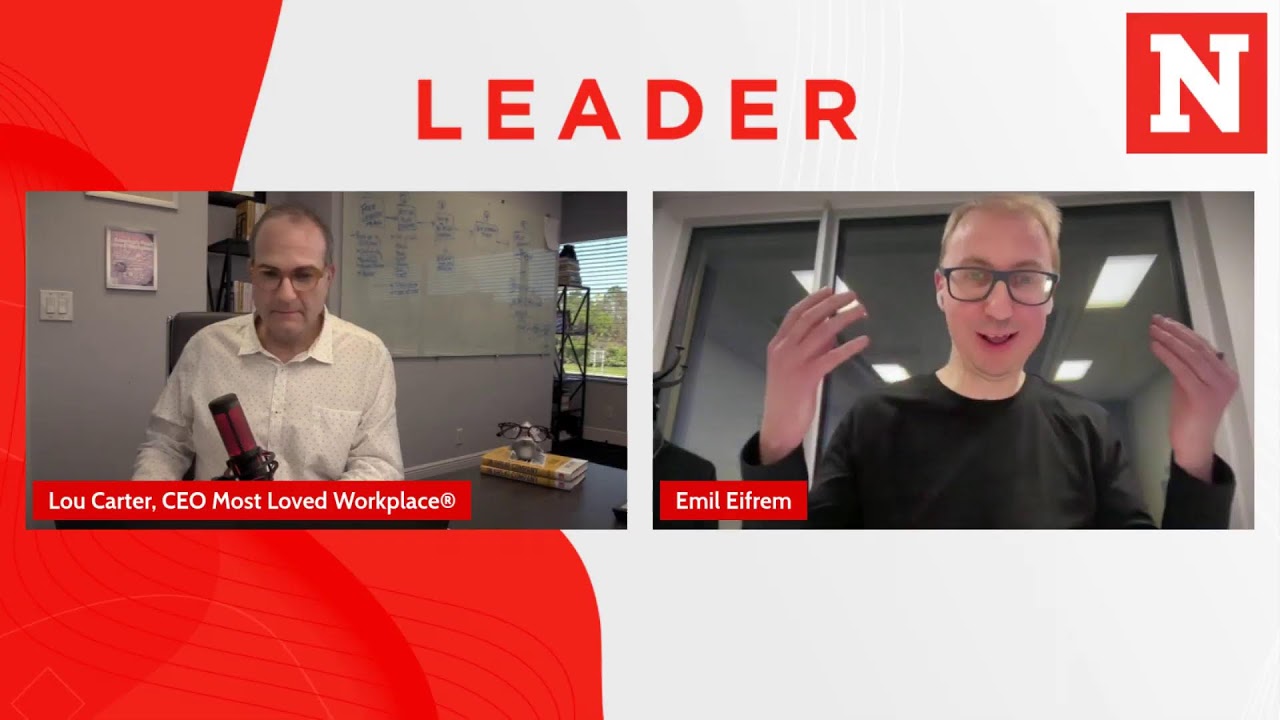
Emil Eifrem, CEO of Neo4j, explains how graph databases model interconnected data like the human brain, and why the company open-sourced its platform to build a massive developer ecosystem. NASA used Neo4j to accelerate a Mars mission by two years, and every major North American bank relies on it for decision-making.
Chapters
Coming up right now on the Leader's Show, I'll be talking with Emil Efrim. Emil Efrim is CEO and founder of Neo4j. Neo4j is ranked number 44 on 2023 Global Top 100 Most Loved Workplaces and number 37 in 2023 UK's Top 100 Most Loved Workplaces. Before founding Neo4j, he was the CTO of Wind AB, where he headed the development of highly complex information architectures for enterprise content management systems. Committed to sustainable open source, he guides Neo4j along a balanced path between free availability and commercial reliability. Emile is a frequent conference speaker and author of NoSQL Databases. I'll be talking with Emile about the great culture he's created at Neo4j and all the success he's had with becoming a most loved workplace. I'm your host, Louis Carter, founder of Most Loved Workplace. The Leader Show brings together executives and leading thinkers to bring into focus our collective purpose and passion for what we do and where we do it. The search for occupational fulfillment, happiness, pride, and passion starts here. Emil Ephraim, it's so great to have you on today. We have Emil Ephraim. He brought this company to $2 billion, and it is just amazing. We were talking about before his story of how he got the domain at first. $2,000 was too much for him at that time, but now it's $2 billion. We went from kind of a, it's an incredible exponential change. We're gonna learn about how he built the culture, how he has scaled the culture, how he enabled the success, the stories of getting a company to $2 billion in the software development space and being so successful at that. Emil, we've got a lot to learn today. Let's get started. Great to have you on the Leader Show.
Great to be here. Thanks, Lou.
Let's get started. Tell us, okay, Neo4j, how did you come up with the name?
It's frequently one of the first questions that people ask me. Maybe before we get to the name, what do we even do? At the highest level, we're a database company, but we've invented a new type of database that's inspired by the human brain. So like the human brain, I think everyone who's listening knows that the human brain is neurons connected to other neurons through synapses. It builds up a network. Turns out that a lot of knowledge and a lot of understanding is figuring out how things are connected. So we've invented this new type of database called graph database, uh, that is great at turning data into knowledge. So that's the core of what we do. And when we invented that thing, I guess circling back to your question about the name, right, we always thought of this as a new model for data, a new way of thinking of data. And of course, neo in Latin means new. And so we figured Neo would be a great name for it. Project Neo, we called it internally at first. And when we decided to spin it out, you know, it's almost 15 years ago now, into a separate company, we wanted to get neo.com. And, you know, sadly neo.com, as you alluded to, was outrageously expensive because it was all of $2,000, right? You know, which was $1,900 more bucks than we had. Um, and so in the end, you know, we grew up in the, in the Java community. And so Java is the programming language, and at the time it was common to call projects 4j, uh, you know, blah blah blah 4j. And Neo4j, we didn't love it, you know, but the domain was $9, so we could afford that. So therefore we got the domain, and here we are, you know, 700, 800 people 15 years later, $2 billion valuation, and we're called Neo4j.
And it started with your idea and work in Open Graph Database, right? This is incredible. Graph— so tell me, this is— everyone says it's easy to have an idea, it's a lot harder to put it into action, right? And your idea was brilliant. So let's talk about the idea first, then how do you make— place it into action with brilliant people.
Yeah, so the initial observation was very, very simple, which is we live in this increasingly connected world, right? We thought so 10, 15 years ago, and boy, like, just think about where we are today. Here we sit, you know, across many geographies listening in over LinkedIn, Twitter, on Newsweek, whatever. Or like listening to this, having this conversation. But even back in those days, the world was becoming more and more connected. And if you work in data, then when you think about what data actually is, it's a term that many people throw around. Hey, I'll get the data. But what actually is data? Well, data is a digital representation of the physical world. It's a way of describing the world so we can shove it into the computers and then operate on it, compute on it. That's what data actually is. So then it follows that if the world is becoming more and more connected, then data is becoming more connected, right? So that's the realization that we had. And it turns out that connected data was just really bad fit to shove into the old types of databases, the tabular databases, the ones that work like Excel. Now that database is really powerful. It built companies like Oracle, huge part of Microsoft, and so on and so forth. It's definitely powerful technology. It was just not good for connected data. That was the original OG idea, if you will, 10, 15 years ago.
It's crazy. The Open Graph idea 10, 15 years ago and you create these new neural pathways for people because data in and of itself is unpredictable, it's chaotic. And we all seek order. We seek order. And all that you've written about, right, with open source enables huge communities of people who are really great at developing to provide more to the concept itself. And that's really— must be part of the success you build is enabling those communities to thrive and grow.
That's a huge part of it. And I guess that's a good a good segue into the second part of your question, which is, all right, so there's the idea, but honestly, ideas are a dime a dozen. I bet there's been hundreds or thousands of people who've had like, wait, shouldn't we model data as a network instead? Maybe that's smarter, right? Like, so how do you actually execute on it, right? And a big part of that for us was being open source. And so if you're in technology, everyone will know what open source is. But if you're outside of technology, What does that even mean? What it is is that you take your entire product or a version of your product and you give it away for free. And not only do you give it away for free, you open it up so the source code is available. So this is like you open the hood into the engine of the car and you give people the ability to rewire the car and do whatever they want with it. In fact, not just the ability, you encourage them to do that. And what this leads to is this massive ecosystem of developers that adopt your software They adopt it and then they adapt it to other technologies. They integrate it with their favorite frameworks. And not just that, they look inside of your product and say, you know what, I don't like this, I want to fix this, or this thing over here. How about can't you do this in some other way? So it enabled this co-innovation with your community that has been a huge part of our success today.
I love it to have such talent and a large community be able to iterate on your concept is so much more exponentially powerful. And we've seen that in different open source— in crypto, right, in blockchain, we see it just open source communities working heavily on improving the infrastructure, improving the nodes, right? And then also with open source of great software products, right? So GitHub is a great place, right? I'm sure you're a big GitHub fan for all of that to happen with a great community. And so tell me, Mila, what I want to know, because this is— there's a lot— there's a great talent allegory to this talent management allegory. Can you— if you're speaking right now to talent managers, HR managers, and you said to them, look, here's what I did with open source, here's what you can do to create something that is more like open source, tell them how you did it to get excited about it. How do you get them excited or do they organically become excited? How does that happen?
Yeah, first of all, you kind of have to have the core product that is exciting and interesting to people, right? Like that the core idea as expressed in software is something that people care about, right? And I guess the HR analogy there would be, is the company that you work for like even interesting? The problems that it solves, do they matter to people? Right. So I think that's the kind of the, the, the foundation to even be able to, to, to have the conversation. Right. Then on top of that, I think at least what's worked really well for us is that not only did we invent this new type of database, but we also coined a category name for it. So this is one of the hardest things to do, but ultimately the most rewarding things to do, I think, in marketing or in go-to-market, which is category creation. My analogy for this is Levi Strauss. What is it, 200, 300, you know, you know, year-old company or something like this, right? They invented this new type of product, right? But they didn't just call it blue, you know, uh, pants or something like that, right? They said, no, no, we're not just pants, we're a type of pants, we're going to call them jeans. And that created this entire subsegment, this subcategory inside of their thing, right? And it allowed them to build something bigger than just their specific products, right? We've done the same thing where we put the word graph and database together for the first, first time. And we said, you know what, what's really valuable, dear developer out there, what's really important is that you use relationships in data because you're going to be able to build better applications. You're going to be able to get better insights, turn your data into information, into knowledge. If you use relationships in data, that's what matters. Then of course we love it if you use our product. We're not against that. In fact, we're in favor of that. But if you use a competing product, that's also fine. A rising tide lifts all boats. So that's another key ingredient of getting this out and really creating a revolution out there around it.
I love that. It's just so extraordinary about revolution. You're building this community, and I want to go to that actually about the better insight. Do you have a favorite success case of some developers who brought this to a rising tide and really brought everybody to a better place?
I have so many favorite stories like that, and it's a little bit like choosing your favorite child. Like, I have 3 daughters, all of them are equally my favorite, right? Same with this one, right? I'll do a quick one. NASA. Is on the record saying that thanks to Neo4j, humanity is going to get to Mars 2 years earlier. We accelerated Project Orion. This is the descendant, if you will, of Apollo, the Apollo mission, the mission to the moon. Project Orion, mission to Mars. We accelerated that by 2 years. As an old space geek like myself, that was just really freaking cool. But there's also 20 independent projects that right now use Neo4j to look for the cure for cancer. I mean, not to be too much of a Debbie Downer on the call here, but I think every single person listening has someone who's either one step or two steps away of being impacted by cancer. I'll personalize it for for a moment. I, you know, I live in Malmö, Sweden right now. We just talked about that, you know, at the top, top of the call. Um, as a teenager, I lived in, in Seattle, went to high school in Seattle, stayed with, uh, an adopted American family I'm very, very close with. I call them my American mom and dad. Had two brothers, um, very close, you know, was the best man at my little brother's wedding. My older brother died from cancer when he was 24. Right. If there's— at the end of the day, if I've accomplished nothing professionally except I've increased the probability of humanity finding the cure for cancer by anything, that is going to be just sufficient.
It's an amazing story for life to come full circle, full circle, and for your purpose and passion to come to play. And I'm sorry for your loss. It's an extraordinarily difficult loss. And one that you have helped the world in, which must feel so fulfilling to you.
So yeah, and it's ultimately what motivates me. You know, at the end of the day, we, you know, when you're a 700-800 person startup growing fast, it's this vertical learning curve of being a founder CEO, which is really rewarding. It's also really tough, right? And, you know, sometimes I'm I have dark times like everyone else and I go to myself and it's like, man, is it worth it? So much hard work and so much pressure and that kind of stuff. And that is what I always go back to, the transformative change, the amazing things that our customers do with our technology. And they're very, very explicit about it. They couldn't do it without us. There's a real probability that we're going to find the cure for 1, 2, 3, 4 types of cancer, thanks to Neo4j. And the Mission to Mars story was supporting investigative journalism in support of democracy worldwide. There's stuff like that that ultimately goes to what motivates me at the core.
Let me ask you something, Emil, because making it to Mars and curing cancer are pretty lofty goals. They're enormous, and it's incredible that you you can place your, your dent in. It's not just a dent, it's a large dent in the universe with those, those two things. And I'm wondering, how did that come about, right, in your community with your employees? Like, how did they even think of it? Did you stimulate their thinking in this area? Did they come to you?
Yeah, this is one of the amazing things about building infrastructure, right? So Satya Nadella, you know, CEO of Microsoft, an extraordinary CEO of Microsoft, He used to have this saying, I don't know if it's true for him and Microsoft anymore, but at least 5-ish years ago, as they were competing neck to neck with Meta, which I'm sure was called Facebook back then, and Google and so on and so forth for hiring candidates. And people asked him, it's like, so how do you compete? And he said, it's very easy, right? I ask candidates, right? In particular, he was talking about engineers. Hey, do you want to be cool? If you want to be cool, go work at this other big tech company. If you want to help others be cool, you should come work at Microsoft. It's exactly the same thing here at Neo4j. We build this foundational layer that in and of itself doesn't do anything. We don't solve end problems. It's our users who do that. We've built this amazing hammer or engine or tool, whatever analogy you want to do. The extraordinary thing when you do horizontal things is that you cannot foresee. You allow 1,000 flowers to blossom. It's impossible to foresee all the amazing things people can do with it. When we invented this thing, we thought it was going to be widely adopted. Never in my life could I have imagined that humanity was going to get to Mars 2 years earlier thanks to it. So it's, it's one of the extraordinary benefits of horizontal technology, um, coupled with that community co-innovation and open source that we talked about at the top of the call.
This— then the Mars, right? I want to talk about the Mars because you're helping Elon, you're helping the universe, you're helping us to all— I say Elon, I'm at the university. Pilon might be a bad word in Sweden, I'm not sure. I'm wondering, to do such a thing, how does that work within your ecosystem in Neo4j? Do you help developers to actually integrate that into NASA? Is that part of your service you're offering?
That's the two legs of our organization. One leg is where we started, where we said there's an open source edition that we give away for free. It has a spiritual sibling in the cloud where there's a free tier of our cloud service where we manage the database for you, but we give it away for free. There we have people, they're called developer relations people who are core developers, fantastic at working with data, working with Neo4j, who go out and help people in the community. They help people, But even more importantly, help people help themselves. It's the teaching a man how to fish type thing. We have these community forums where you can go, you can ask questions, and other people in the community answer those questions for you. That's what's happening on the open source side. On the commercial side, what we haven't mentioned here is that every single one of the 20 biggest banks in North America, every single one, top 20, are now users of Neo4j. 8 of the 10 biggest retailers in the world. Every single time you book a flight, 99% of all air tickets, the price has been calculated thanks to Neo4j. Every single time you stayed at the Marriott, the room price or Ritz-Carlton, any one of the Marriott properties, the room prices have been calculated with Neo4j. You for sure, if you're listening to this call, for sure you've used Neo4j, maybe today, at least this week. It's just behind the scenes, right? For that commercial motion, then we have forward-deployed customer engineers who go out there, sit down, work with our customers, understand the business problem, translate it to data, and help them get started. How to model, you know, these are the, the NASAs of the world, but also the big banks of the world, the big telcos, the big retailers.
And you're, and you're working with CTOs there and their tech teams to implement into their database architecture and infrastructure to make better decisions for their customers.
That's spot on. Exactly right.
It's extraordinary. And to have that community aspect of it as well just makes everything exponentially understood by the world and get to Mars sooner and cure cancer.
That's exactly right.
Which is not a bad secondary consequence of such work. So there was a time when you had rapid growth and it's happening now too. You're growing. Tell me more about what— how you scaled your culture. How you built your culture, because typically when you have rapid growth, you have microcultures. They need to become the same, right? Or that you want to make sure that that beginning foundational wonderful magic juice, right, can be extended. Tell me how you did that. How did that happen for you?
Yeah, it's, it's a question that has different answers for the different stages of a company size, right? Like the way you, you operate at size 20 versus size 200, 500, it's just very, very different. And then if you're distributed, we were born as a global company. The technology was invented in Sweden, but we rapidly got an office in London. We're headquartered in Silicon Valley. We have tons of people across Asia. So it's a very kind of global phenomenon. When you can't meet them at the proverbial water cooler, it's a different thing. So the tactics, they differ, but what's always the same is you have to focus on it. You have to focus on it. You have to invest in it. You have to care about it. In the early days, it was primarily through role modeling. So in other words, I behaved the way that I wanted us as an organization to behave. Right. That was the primary one. The secondary one, and I'm not— one is not more important than the other, both are equally important, is hiring. Right. Where you're very, very explicit about how we hire and we have the no a-hole rule type thing. I've always kind of intrinsically looked for or intuitively looked for people who are what I used to call realistic optimists. So these are people who are generally glass half full view of the world without being off in la-la land. You need to be able to confront the brutal realities of where you are, especially in the early days of a startup. You're a 20-person startup, your default mode is to die. Your default mode is to be bankrupt., right? So you have to be able to confront that. There's a concept called Stockdale's paradox, which is an amazing articulation of exactly this, like that being able to combine long-term faith in a fantastic outcome with the ability to see very— have a very clear-eyed view of your current reality, right? So that hiring criteria, hiring bar, hiring filter has— those have, have remained the same, but then the tactics has shifted, you know, as the organization has grown in size.
I mean, accountants hate the Stockdale Paradox.
Do they really?
Now, without it, we wouldn't grow.
Yeah, that's right.
There'd be no growth because we just see the, the red and we'd see the money going out Right. And we wouldn't realize that when we pay the money, it's an investment toward growth. And they're really an investment in people toward growth. And right. And everyone wants to make the bottom line look perfect. I see accountants. I don't know what your accounting team is like, but ours gets excited when it's specific. We made the numbers perfect. Congratulations. Well, let's try. Let's think more like Stockdale Paradox. How do you create that? So you get people who all do that, including your finance team.
Yeah, yeah. I mean, that's spot on. You have to invest in the future. Like, and that's— that I think as, um, it's funny, right? Like, as you know, as you grow up as a CEO, you initially maybe you talk more to people kind of in your own universe in technology, right? But you know, as the company is becoming bigger, you end up selling maybe to bigger customers. You talk to CEOs from other industries. The technology sector has many pros and many cons. One of the things that is very built into people in technology is we have a non-zero-sum game view of the world. There are so many times where we actually win together. And I was just talking to a geopolitical strategist at an event a couple of weeks ago. Geopolitics is ultimately the battle over resources and power and influence. That is a zero-sum game. And I think that mentality of, hey, we can all grow together, and yeah, of course we compete as well. It's not all— I'm back to my la-la land. It's not all that, but we can certainly grow together. And I think that wires people to also think around the value of investing in the future.
And the value of investing in people that are great at doing specialty, right? Like creating this category of graph databases. If you want to do great in graph database, right, go to Neo4j, period. And there's others in there that do database, other in there do IT, others that contribute on a geopolitical sphere. Yet you want the great graph database and you want to improve the infrastructure, get them more sooner cure cancer, use Graph, right?
Yes, that's, that's spot on. And I want to touch on one thing that you said, said in there, which is like one of the key things that I've always both hired for and tried to be very explicit in my leadership style around is enabling what I believe is maybe the strongest force in the universe, which is intrinsic motivation. Intrinsic motivation. People who truly genuinely care about doing something no matter if you pay them or not. Now, you should also pay them well when you have the means to pay them well. You should also do that and just take that off the table. And that's a checkbox. You have to do that. But what truly matters is people who are deeply passionate about solving the problem, who would try to solve the problem even if you didn't dangle some extrinsic motivation in front of them. And my belief around intrinsic motivation comes back to exactly what you said there. At least one of the components. You talked about mastery. You talked about how for graph databases, we are the masters of that domain. We're the leader in the category. We invented it. We defined it. We have the best product. We also have the best people at that. I think in order to unlock intrinsic motivation, you have to give people mastery, autonomy, and purpose. Mastery, autonomy, and purpose. Mastery is the ability to become really great at what you do. Right, which is, you know, enable that, train people. But primarily it's about finding other people who are world-class, because world-class people want to work with world-class people, right? Autonomy is leadership, it's management. Don't micromanage. Set goals, measure people to achieving that goal. Don't micromanage the how. That's the autonomy piece, right? Purpose— we've touched on that a couple of times here. Hey, our mission is help the world to make sense of data. If we can cure some cancer and get humanity to Mars along the way,. I think that's a reasonably good purpose. The purpose— I'm sorry, the goal with those 3 things, mastery, autonomy, purpose, is to unlock intrinsic motivation. And that is a really powerful thing I've found over the years.
It's extraordinary, Emil. I am so grateful to have met you today and to connect on the extraordinary things that you're doing. Emil isn't just a great guy. Besides being a great guy, an amazing person, And curing cancer and getting us closer to Mars, he doesn't have much going for him. Emil Efron, what an extraordinary talk. It was one of my favorites. You mentioned about favorites. This was one of my favorites.
Awesome. Thanks. Pleasure to be here.
It was great having you here today. And please look up Neo4j. This is really extraordinary. Open Graph, we're using it every day. We don't even know it. Um, they're, they're, they're, they are getting us closer to doing things on a geopolitical sphere, uh, on to improve the Earth, improve us all. This is, this is, these are people you want to look up, you want to check out, and to check out what Emil is doing as well, being the most loved workplace in the UK and, and you in global. This is an incredible person, up to $2 billion. Emil, someone you want to understand more about, not just in the show but otherwise. Man, I've enjoyed this, and I hope everybody I hope everybody in the Newsweek audience has learned a lot and also throughout our Most Loved Workplaces. Emil, great having you here today on the Newsweek show.
Been a complete pleasure. Thanks, Lou.
More from Louis



How to Get Found in ChatGPT, Perplexity, Gemini, Claude & Grok | Visipage AI Visibility Audit

Your Competitors Just Got Certified. Now What? | Most Loved Workplace® Demo & Hiring Advantage



Visual Thinkers: The Hidden Genius Behind Skilled Trades & Innovation! #shorts

Car Mechanics: The Secret to Engaging Autistic Adults Over Video Games! #shorts


