What Can We Learn from Leaders Who End Conflict?
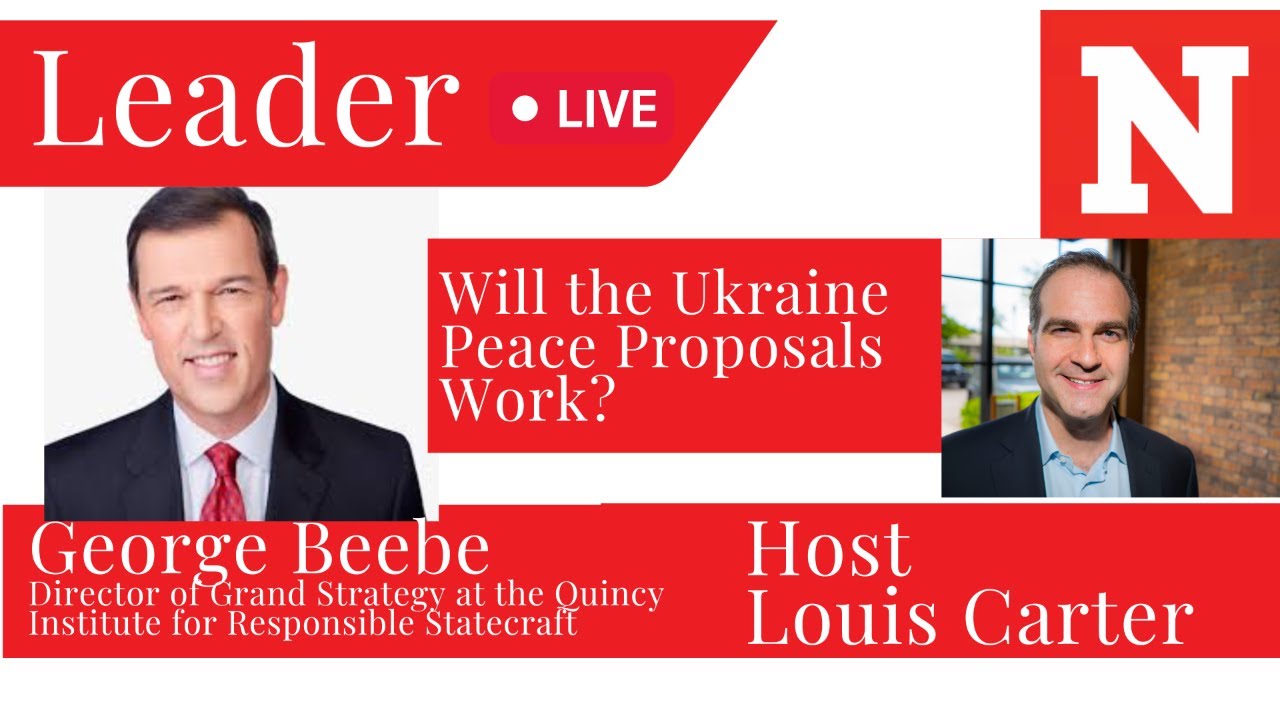
George Beebe argues that military aid alone won't end the Ukraine war and that shifting narratives away from good-versus-evil framing is essential for diplomacy. He points to Northern Ireland and the Cuban Missile Crisis as models, saying the U.S. is the only actor with leverage over both sides to broker a settlement.
Chapters
Hi everybody, welcome back to The Leader's Show. I'm Louis Carter. It is great to have you all here today with us. I'm excited about today because we're talking about leadership helping conflict come to an end and how leadership can sometimes either cause more conflict or create less conflict depending upon the decisions we make and how we enter into arrangements and how we also are able, or leaders are able to reduce the conflict in many ways, and we're going to speak today specifically with George Bibi from the Quincy Institute for Responsible Statecraft about some of the decisions that we're seeing to get to an end of the conflict in Ukraine and some of the seemingly different approaches that, that may help or may not help the the end of the war. Specifically, my question first is going to be, well, George, within Congress and Senate in the US right now, you know, how do you see the provision of military support to Ukraine helping to end the conflict itself? What is that doing? What kind of message is it sending?
Well, it's a complicated situation because on the one hand, the, the West and obviously the Ukrainians cannot afford for the Ukrainians to lose this war in the sense that if, if the West does not continue to provide this military support to the Ukrainians, Ukraine can't continue to function. Its economy is completely dependent on support from the West. Its military is completely dependent on support from the West, and that's not just weapons that we provide, but also training and help with maintenance, and, and perhaps most importantly, the intelligence support that we're providing to the Ukrainians. So all of that is necessary to continue, otherwise the Russians, uh, won't have any incentive to come to the negotiating table and end the war. But the problem is, by itself, it's not sufficient to bring the war to an end. It's sufficient to prevent an outcome that we want to avoid, uh, but it doesn't by itself bring the Russians to the negotiating table. Uh, what the Russians have done is essentially continue to escalate this war to make sure that Russia can't lose. Um, and I think the Russians have a great capacity to continue doing that for quite some time to come. Right now, the Russian strategy appears to be to turn this into a war of attrition in the hope that they can wear down Ukraine's reserves over time, eat into Ukraine's manpower, exhaust its munitions and weapons, and perhaps most importantly, exhaust the West's political will to continue supporting Ukraine. In the hope that over time, you know, we'll lose our interest or our capacity to continue fighting, and, and Russia will be in a position to achieve much of what it has hoped to achieve, although not all of it, since the beginning of this war. Now, in turn, what I think the West is trying to do is to turn this into a war of maneuver, to allow the Ukrainians to use speed and provision in real-time intelligence to identify and exploit weaknesses on the Russian side that can lead to a breakthrough in Russia's lines and, uh, hopefully to the collapse of, of Russia's lines generally, and to force the Russians to sue for peace. The danger that we're facing in this kind of approach, however, is that it could lead into an escalatory spiral that brings, uh, the United States and NATO into a direct military confrontation with Russia, uh, the world's largest nuclear power, uh, and that kind of scenario is fraught with dangers of nuclear use. And right now I'm not sure that the West has really figured out, uh, how to balance all of these, uh, various interests that are in tension with one another. We don't want Ukraine to lose, but in order to prevent that, we seemingly have to escalate the war. But we don't want this escalation to go too far. How do we manage that? And right now, I don't think we've, uh, been able to square these circles. So it's a, it's a formidable problem.
And I always think back to peace talks in, you know, Northern Ireland. There was peace talks, and there, there was, uh, shuttling diplomacy in the Cuban Missile Crisis. We had different situations that perhaps were different, of course, in scope and, and size, uh, and, and possibilities of nuclear disaster, of course. But at the end of the day, aren't there similarities between conflicts that could be applied here in terms of lessons?
Well, every conflict is unique, no question, but that said, every conflict has some things that it shares in common with others. So, very infrequently do wars end in unconditional victory of one side over the other. That was how World War II ended, of course, in the unconditional surrender of both Nazi Germany and Imperial Japan, and in the military occupation of those states by the victors. Extremely unlikely that that's going to happen this time for a very simple reason. Russia has, you know, the world's most formidable nuclear arsenal, and if push comes to shove, I think the Russians may feel compelled to use it to avoid exactly that unconditional defeat scenario that occurred in World War II. So I think either this war is going to grind on in some sort of inconclusive stalemate for a long time to come, or there's going to have to be some sort of agreement that both sides buy into that produces peace, or at least a durable, long-term armistice that can allow Ukraine to begin reconstructing itself and allow Europe to begin putting the pieces back together in the aftermath of this. There really is not an alternative that that is at all appealing to that kind of diplomatic settlement. The problem right now is that nobody believes that a diplomatic settlement is possible or is willing to do the work necessary to make that kind of diplomacy possible.
You mentioned about willingness. Is the willingness a condition of an algorithm that's askew. I think of economics. If we're working on an equation of unconditional defeat, it's far different than if we're working on an equation where there is some give and take in proposals. Is that why people are unwilling? Because they're working on the wrong problem?
Well, I think that is part of it, yes. One of the difficulties we're facing here is that to generate the resolve necessary to fight back against the Russian invasion, we've portrayed this war in very black and white terms, very, very good versus evil terms, and we've used analogies such as Nazi Germany in World War II, the need to defeat that kind of evil in order to render it incapable of doing any further injustice or committing further atrocities in the future. That kind of narrative for this war makes it very difficult to pivot and suddenly say, yes, and we have to compromise with these evildoers. So we're going to need to find a way to transition from narratives that help to galvanize resolve and resistance to the Russian invasion into a paradigm that says we've already achieved a lot. Ukraine has prevented Russia from seizing the capital, Kyiv, from conquering and occupying the vast bulk of Ukraine, and now is the time to consolidate those achievements rather than push towards something that is probably unattainable and certainly quite dangerous, which is to eject Russian forces from all pre-2014 Ukrainian territory, including Crimea. So that's going to require a lot of work to prepare the publics in Ukraine, in Europe, and in the United States for that kind of shift in our objectives.
And it's understandable. We all know that Ukraine really didn't do anything to participate in this war itself, right? So we're kind of at this situation where they are able to stay their course they have the support of, of all nations around them, and they can declare victory in, in some sense because they're able to keep their, their territories intact and begin the consolidation of achievements. And, and that, that means building back up their infrastructure. How would that process begin? Because as I see it now with their 10-point proposal and Russia calling it an illusion, uh, which is obviously not a positive way of, of saying yes to any of those points, um, how would they just in essence create history and saying we declare our achievements, let's consolidate them and move toward this next plan regardless of any back and forth that may occur? Is that a possibility for how we might move forward?
It's possible but very, very difficult to do. One of the things that Ukraine is going to have to do is to build support internally among various Ukrainian constituencies for a diplomatic process that will inevitably require some compromises. As this war has gone on, as Russian atrocities have come to light, as Ukraine has demonstrated an ability to roll back Russian gains, at least to some extent, sentiment in Ukraine has tilted heavily toward the belief that not only can Ukraine win this war altogether, but it must. And that any compromise with the Russians is in fact a betrayal of Ukraine's national interests. That's probably not a situation that the current Ukrainian government can overcome without outside help. The United States is going to have to, I think, work behind the scenes with Ukraine, with the Ukrainian government, in helping Ukrainians to adjust to some painful realities about what really is achievable and what the limits of U.S. support are really going to be. And to some degree, we're going to have to play the bad guy eventually. Now is not the time to play the bad guy publicly in Ukraine. And the reason why I say that is if it looks as if the United States is leaning on Ukraine in some way, trying to twist its arm, that actually disincentivizes Russia from offering compromises or entering into a serious negotiating process. They would be content under those circumstances to let us negotiate with ourselves rather than to, to budge from their positions. So it's important that we are not premature in playing this role. But eventually, there will come a time, I think, when the United States is going to have to put some public pressure on Zelensky in order to help him, because he's going to need someone he can blame some of these things on politically so that he can point to his hardliners and say, look, you know, I'm sympathetic to your positions, but I have no choice on this. Our primary benefactor, without whom we can't continue to run our economy or prosecute this war, is putting pressure on me to do these things, and we're going to have to make a nod to that unfortunate reality. So that's got to happen, I think, somewhere down the road.
Tell me about the painful realities, because we talked about the who, the kind of the the, uh, the sinister person or entity that he'll be, uh, placing this blame on. What are the realities that he'll need to present to Ukraine that are painful?
Well, um, I think one of the things that will become obvious is that there's going to have to be a compromise between, uh, the United States and NATO on the one hand and Russia on the other. About Ukraine's geopolitical orientation. This war was not simply a land grab on Russia's part. It was not simply a drive to recreate the Soviet or Russian empires. This was also, from Russia's perspective, an effort to prevent the United States and NATO from turning Ukraine into a military ally, which the Russians feared would become a launch pad for use against Russia itself, in an effort to, at a minimum, weaken Russia, but perhaps even to foment regime change in Moscow and to, to actually break up the Russian Federation. And so if there's going to be an agreement in this war, part of this is going to have to be a compromise on that big strategic issue that the Russians can live with and that we can live with. And the Ukrainians, I think, need to be prepared for what that will mean. I think the second thing here is the reality that Ukraine's not going to be able to reconstruct itself for as long as this war is unsettled. And what I mean by that is the Russians, I think, clearly cannot seize and govern the vast bulk of Ukraine. But I think what they can do is leave Ukraine in such a state of insecurity, under the constant threat of new rounds of missile attacks and artillery bombardment that devastates Ukraine's physical infrastructure and in so doing injects great reluctance on the part of investors to putting lots and lots of money into reconstructing Ukraine physically and economically because they would fear that whatever they reconstructed this week might be destroyed next week. And you can't really address that problem unless the Russians agree to a settled end to this war. Otherwise, their guarantee, at least as they see it, that Ukraine won't become a Western military ally is to wreck it, to leave it in such a state of destruction that it is in no condition to join anyone or rebuild itself. Now, I think that would be a tragedy for everyone involved, first and foremost for the Ukrainians. But the alternative to that is engaging in some kind of diplomatic process that will bring a compromise, one that the West can live with, one that the Ukrainians can live with, and one that the Russians buy into. And that's, that's going to be a difficult a good thing for everybody involved, and the publics in all of these countries have to be prepared for that, and right now they're not.
Who are the best players right now out there to enable this diplomacy to happen? Who, who are the people behind this that can make it happen in your opinion? There's both the villains and those who create consensus. Is that— does it require a leadership change to get there in and of itself, or Do they exist now?
Well, I don't know whether it will require a leadership change. That's a key uncertainty in all of this. There's no question that the longer the war goes on, the more radicalized all of the players become. Ukraine was probably in a better condition to reach a compromise with the Russians much earlier in this war than it is right now. And I think that also goes true for the Russians. I think over time, um, the more, uh, they have lost, uh, men and munitions, um, the more this has radicalized the Russian public, not, uh, in the direction of peace, but in the direction of insisting that Russia must win. And that certainly makes, uh, compromise over this war more difficult over time. And I think the United States, as it has invested more and more military weaponry, more and more dollars into this, and more and more political capital, is also increasingly in what you might call a sunk cost problem. It becomes harder for us, having invested all of this in this war, to say, and now we need to find a compromise way of getting out of this. So the longer this war goes on, I think the more difficult it is going to be to make this pivot. So I think we need to start doing it now. Now, who does that? I think the United States actually has to be the driver in all of this for several reasons. You know, one is we have the most credibility, uh, and the most leverage over the Ukrainian side here. And the Ukrainians aren't going to accept, uh, anybody as a security guarantor if the United States is not involved. They recognize that their military security is heavily dependent on the United States. And if we're not intimately involved in finding a way out of this diplomatically, we're not going to get the Ukrainians to buy into this, uh, clearly. Uh, also, the Russians don't actually believe that their negotiating, uh, interlocutor in this is in Kyiv. They believe that what they're really fighting against here is, is not the Ukrainian military, but the United States and NATO that is playing out a proxy war on the battlefields of Ukraine. So the Russians aren't going to strike some sort of separate deal with the Ukrainians. From their point of view, they don't think that would end the broader conflict that's been going on between Russia and the West. So they will insist that the United States be deeply involved in this. Otherwise, you know, you're not going to get a deal. So, um, I think the United States is in a position where only it has the, the combination of carrots and sticks that are going to be required to bring this war toward a compromise. Right now we've been using the sticks, but we have not paired that with the kinds of carrots that also need to be used in this situation in order to incentivize all the sides to come to a compromise, and I think we need to be thinking hard about how we do that.
George, you've served as CIA chief for for the Russian Federation, correct? Back in— when was that? Tell us more about that, your service. I want to get that right. What was your— I never say it right, so go ahead.
So I was at CIA beginning in the Soviet period during Mikhail Gorbachev's tenure as General Secretary of the Soviet Communist Party, and eventually I became head of Russian analysis after the Soviet Union broke up, Russia became an independent state, and I did that for several years in the early to mid-2000s.
So you have a unique perspective on this, and just recently Ambassador Lynn Tracy was— she became Ambassador of the US to the Russian Federation, sworn in January 9th, 2023, so just this year. You know, what will change? With that, that you see, or what, what advice do you have for Lynn Tracy and her work, especially from your, your, your vantage point and with your expertise?
Well, I think Ambassador Tracy has an enormously difficult problem that was not of her making, but she's going to have to contend with nonetheless, in that the two embassies, Russia's embassy here in Washington and, uh, the U.S. Embassy in Moscow, uh, are not really, um, talking very extensively, uh, to key parts of, uh, the, uh, the governments to whom, uh, they're representing U.S. interests, uh, and this has been a problem that has been worsening ever since the outbreak of war in Ukraine back in 2014. It was exacerbated quite significantly by the Russiagate scandal, and we've— both sides have engaged in tit-for-tat actions against the other side's diplomatic representatives, to the point where both the US Embassy in Moscow and the Russian Embassy here in Washington are really operating on skeleton staffs, and it has become very difficult for either ambassadors to get meetings with key parts of, of the governments that they're empowered to talk to, and that's going to have to change And it's not going to be an easy thing to address. So long as Ambassador Antonov here in Washington is struggling to get significant meetings here in Washington, Ambassador Tracy in Moscow is going to struggle to get significant meetings in Moscow. And so this is something that we're going to have to gradually work our way out of, and it's going to require some small compromises. Um, but I think that's, you know, not only a necessary thing, but it's part of, uh, what has to be, I think, uh, a concerted effort to start to rebuild a little bit of trust in the US-Russian bilateral relationship. Right now, trust is near zero on both sides. But I think you need to send signals to the other side that at least we believe we're going to have to talk with each other.
And those signals are truly meetings that are allowed, and perhaps there's something around— and this is just thinking a lot— rules of the road of these meetings themselves and seeing who it is that can meet. If we were to look at the who behind— and Ambassador Tracy, ambassador also to the United States from the Russian Federation in Moscow. Are there, are there shuttle diplomats or people that we can put in front? And that, that was the original thought process I had in the beginning, which is Cuban Missile Crisis and other equations that didn't equal these kinds of unconditional surrender. Uh, we're at that point now where we can enable that kind of shuttle diplomacy between both ambassadors. And if that's the case, can this really occur without political attribution?
Well, I think you've raised an excellent question, and I don't have a simple answer to it. One of the reasons why the Cuban Missile Crisis was successfully resolved was that the compromise that was key to defusing that crisis was largely forged in private, in a back channel between Bobby Kennedy, the, the brother of President John Kennedy and then Attorney General, and Anatoly Dobrynin, who was at that time the Soviet Ambassador here in Washington. And Kennedy and Dobrynin met secretly many, many times in order to talk through the dangers of the situation and possible ways forward. And the advantage of doing this secretly, in private, was that you are enabled to float some things which, if it were done publicly, you know, in the glare of the television cameras and in media headlines, would be very, very difficult for either side to do politically. And I think in this particular case, we don't have a back channel, at least not that I'm aware of, and I'm not sure that there's a lot of willingness on either the US or Russian part to engage in one right now, in part because there's, you know, such an absence of trust in the relationship, such a belief on both sides' parts that the other side cannot be trusted, that it will abuse these sorts of things and use them as advantages to try to bring about a defeat of the other side and the victory of your own side. So, uh, in order to, to create a situation where we can have that sort of, uh, private, uh, negotiating between the sides, we're going to have to do a few things to build trust, some small steps, some signals that we can send that can build a little bit of confidence on the other side. That we're actually serious about trying to find a way forward right now. The Russians aren't sending those signals. I would say that the United States has been reluctant to expend much political capital in trying to bring about a diplomatic process, worried that the Russians aren't, you know, willing or ready to engage in it. And that would be a, you know, a lost expenditure of political capital, you know, a risk that I'm not sure the Biden White House is ready to undertake without some assurance that it might pay off right now.
Brilliant. That was a brilliant analysis. We have to get up our zero trust situation through signals, uh, before even back channeling, because whatever we create in those back channels will go to ears and eyes and hearts that are at zero trust, thus not getting anywhere. And so the establishment of those, those, uh, signals is number one, just to show openness. And it seems that right now, as you said, the Biden White House is not in a position, or does not have any plans to do as such. Thus, leadership is still an issue with— is the current leadership equipped and ready to increase the trust, thus enabling back channels to even occur?
Right, I think that's exactly the question, and it's not an easy question to answer.
It's not. George Vitti, thank you so much for joining us today from the Quincy Institute for Responsible Statecraft., and you're always an extraordinary guest with an incredible mind for this amazingly complex situation. George, thanks for joining us again today.
Thank you.
More from Louis



How to Get Found in ChatGPT, Perplexity, Gemini, Claude & Grok | Visipage AI Visibility Audit

Your Competitors Just Got Certified. Now What? | Most Loved Workplace® Demo & Hiring Advantage



Visual Thinkers: The Hidden Genius Behind Skilled Trades & Innovation! #shorts

Car Mechanics: The Secret to Engaging Autistic Adults Over Video Games! #shorts


