Windstream CEO Tony Thomas on The Math of a Highly Engaged Workforce
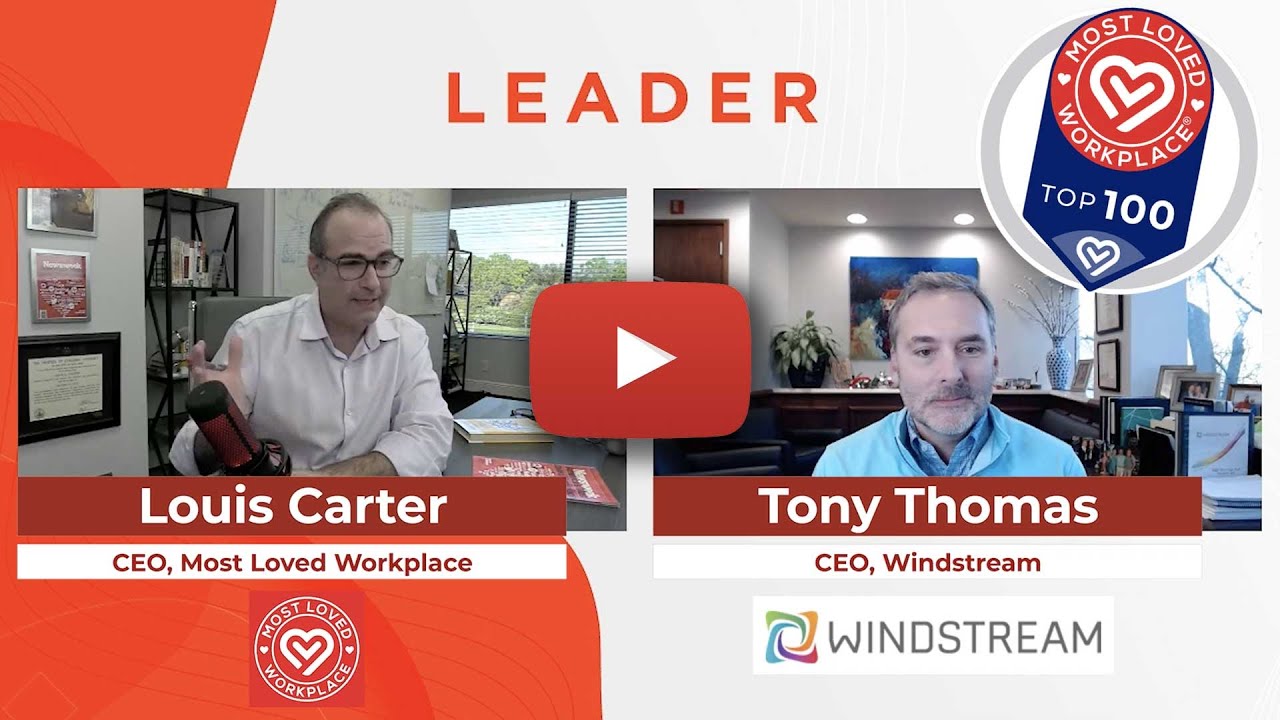
Tony Thomas, CEO of Windstream, explains how a $5 billion fiber upgrade and a decentralized team structure drive employee engagement. The company uses a "Connect the Dots" video series to align 11,000 employees with long-term goals, and Thomas identifies three quantitative drivers of engagement: pride in products, mission alignment, and the ability to be authentic at work.
Chapters
To have Tony Thomas here with us today, CEO of Windstream. Tony, welcome.
Thank you, Louis. It's good to be here.
Well, congratulations on becoming a Most Loved Workplace and making it to the Top 100 list in Newsweek.
It's quite the honor. It's one we're excited to have and share with our employees.
Outstanding. Outstanding. I know that, you know, the mission really says a lot: connect people and empower business. It's never been more important for you, especially during the time for this, especially during the pandemic. Tell me more about that mission and vision, how it connects to really being loved by employees.
Yeah, the core of the mission and vision, this connecting people and also enabling a world of infinite possibilities. And frankly, businesses need to connect. People need to be able to connect to not only work, but school, you know, entertainment options, and just that ability to be a company with a purpose-driven culture where folks understand when they come into work that what they do really does matter in people's lives. It matters in businesses where we provide critical infrastructure. We support children's hospitals. There can be nothing more important than that, probably, in terms of connectivity. And that, I think that energizes people. They see the purpose of what we do and they rally to that for the sake of our customers and Windstream.
That's extraordinary. I mean, the fact that you have that mission vision pervasive throughout the company, how does it sort of manifest for you and your leadership itself? How do you get that, that kind of thinking and knowing being out to the enterprise? You know, you had this major upgrade to your network, over $5 billion in investments over 5 years. Moving to cutting-edge cloud-based enterprises. It's an exciting time. How does that kind of connect for you and get that feeling out there?
Well, I think it connects. One, employees want to see actions aligned to words. Yeah, so we can have the best mission, the best vision, the best, you know, what we believe are the right qualities, values inside the company, but do we act on it? You know, do we reflect it in the way we treat each other just day to day, you know, in countless hundreds and thousands of interactions, but also in terms of, you know, do we stand behind it in terms of the investments we make in terms of connectivity to people, in resources inside the company, and the way we go about, you know, getting things done.
You say connectivity to people, your investments, and also what you do right by the community. You know, what I'm really amazed at here is how much you put in these investments, right? That's not a small number, $5 billion. And so what does it look like for you in terms of these cutting-edge technologies? What do they look like? I'm sure people are excited to get behind them.
Yeah, you know, for residential broadband customers, what we bring is world-class connectivity over fiber. Fiber is just an amazing technology providing, you know, basically multiple gigabits of speed into a home. So basically something that was like unimaginable just a few years ago, now customers connected in a way that frankly enables technology like this to work seamlessly from really anywhere in the world. It's just remarkable that that's what that investment really enables for our residential customers, but we also have business customers and they use a technology that enables them to connect across multiple locations and see all the applications going over their network, you know, how they can run their businesses better. You know, ultimately those are the types of solutions we call that solution SD-WAN, it's software-defined wide area networking. We're the nation's leader in that technology. And it just anchors businesses' connectivity. And anymore, so much the connectivity is important in a business because you have to go back and forth from the cloud. 'Cause so many of the great applications, probably like one we're using today, it's not on a piece of hardware in Louis's office, it sits someplace in the cloud.
You know, and it's rapid what you're talking about too. It happens quickly, working happens quickly. And not only in the technology itself, also in the collaboration that ensues at Windstream. How do you make that happen in your team? What's happening in terms of the complexity, the agility, the rapidity? How does that happen for you?
Yeah, we have embraced the small teams mindset. We believe in agile as a way of doing work. Small teams, organized, 10 or less people solving a problem. The agile approach for us has allowed innovation, creativity, also kind of independence. The CEO is not getting involved in making decisions that go into the next product release. Occasionally, I'll weigh in on the big product portfolio, where we want to go in the future. When it comes to just cranking out new capabilities and features, those are small teams that are executing that. Then we bring it all together in terms of a team of teams philosophy, where we have loosely coupled but tightly aligned teams back to that mission and vision, they know what they're going after, and we empower them. We decentralize the decision-making and put it in their hands, and they're the ones who ensure that this is what our customers want, and they get that feedback and react to it.
You know, this team, the team of teams mindset is so critical. In everything you do and has really become the crux of creating respect within teams and then driving it within the company, really through face-to-face collaboration, right? Have you seen that happen in real time? What does it look like when team of teams get together? And what's a great example of you seeing it happen palpably?
Really say, "Wow!" Yeah, I can tell you where I see it's happened is it's probably not in the areas— you might see, oh, you see it in terms of recognition. Where I see it most, where I'm most excited about it, is actually in the disagreements, where when you actually have trust on a team and you can have really aggressive debates, because that's when you're really debating, like, is this really what we should be putting into our solution next? Is this really what our customers are going to love? And the fact that employees have enough trust in each other to have that kind of aggressive debate and discussion about what's best, that's when you know like the magic is happening. You just kind of step back and you're just like, wow, you know, this is how and why we are winning in the marketplace. You know, 'cause that's when I know we're gonna get the best attributes of our products out there because these teams know what our customers want. And frankly, they're debating it aggressively.
And that's what it is, you know, knowing what the customer wants, executing on it rapidly, you know, making it happen. Incredible can happen when teams get together and do that. And one of the biggest factors that we found in our research is safety. Do I feel safe enough saying that we made a mistake? Do I feel safe enough saying we need to get better at this? And there was research that showed that all of disasters could have been diverted by being, feeling safe saying what could go wrong or what we could do better.
Oh, I agree 100%. And, you know, and I'm a fan of some of that literature as well. And I believe some refer to that as psychological safety. It's that willingness to be vulnerable, to actually express a concern, to speak up. Because as you allude to, we know the worst thing that can happen inside a company is when employees don't feel empowered to speak their voice, to be authentic to themselves. And if we have any goal here, it is to make sure employees can be themselves and feel empowered to speak up because we know that is absolutely the recipe for the number one ingredient in high team effectiveness is, do I feel safe speaking up with my team? And we have to get that right. If we don't get that right, we don't win. And so that's absolutely one of the paramount things we focus on as a company.
That kind of environment, like you said, it makes a difference at work. People feel safe to speak up. You know, you also have a lot of feedback or information, advice coming back to you from all the diverse groups inside of of your company, so you're listening constantly, much like your product's listening constantly. It's, you connect that thing in terms of the feedback direct to you.
No, absolutely. We have a lot, we have an internal collaboration tool where we, you know, we share the strategy and the vision and the priorities we have for a year, and it's interactive. Employees can weigh in there. We do town halls, lots of vehicles for folks to know what's happening inside the company and make sure they understand how they connect back to our strategic priorities and the mission and vision that we have inside the company. But it's an active dialogue and debate and lots of different kind of listening posts, if you will, in terms of what we need to do to execute what we have, but also be mindful where we need to make adjustments.
You know, a lot of times employees, organizations, when they get large, it's hard to connect the dots. They don't quite see where things connect together. They're not able to see a larger systems picture, big picture thinking. And we get so kind of myopic in our mindset. Now, what I've heard you've done is strategic communications and Connect the Dots video series. So what this is called is particularly a clear overarching long-term goals for the company and annual priorities. So people see the whole big picture like you do.
Yeah, absolutely. You know, it does me no good to be the only person who understands the overall picture. We're trying to push that into all 11,000 employees so they can understand how what they do connects back to those strategic priorities. And we literally, through this video series, we go out and we talk to the product leaders, we talk to the folks on the front line, you get their questions, you know, and have our product or IT leaders, you know, answer those. So everyone understands the priorities and frankly, how, what they can do to advance those, because really that's what we got to do. We got to make sure that people, that people see the actions they're taking today. Oh yeah, that's translating to one of our goals in this new year.
It's incredible. You know, you could definitely tell what drives Tony. You know, people, you know, driving this team of teams and, you know, connecting dots and enabling your entire enterprise. You love that. You love when people feel safe to innovate, to think out of the box, to get it done. That's just, that's an awesome trait and behavior competency as a CEO.
Well, I would— you know, one of the things, uh, someone told me a long time ago that stuck with me: all a business really is at the end of the day is a collection of people. And, you know, your competitive differentiation comes from a highly engaged team, you know. And that's why we win in the marketplace today. And that— and, you know, that's ultimately what you have to be focused on if you want to be successful.
That collection of people, it's funny you said that, that on the Most Loved Workplace Index, we call it the connection web. And showing how people are connected and collect together to create, you know, to create and solve problems. And the connection and collection of people is what creates that sort of bond of trust and getting it done. That's exactly what you're talking about right now.
It is indeed.
Spot on, spot on stuff. Well, this is good. The last question I always have for CEOs, especially with tech companies, which I love, is, you know, what's next? What should people be looking out for? What should they be excited about with your company? What should we tell the Ethosphere of the world about Windstream and its network?
I tell you what we're really excited about is the ability of data to really help drive better customer experiences and to help our customers have better experiences themselves. So we're, we're able to take big data and turn it in what we call big insights. So we can actually tell a business, hey, you know, this is a suboptimal setup you have here in your network, and here's the change you should make, because we know that results in less issues because we have terabits upon terabits of data that we put through machine learning algorithms that tells us the best configuration is this. And then we boil that down and we do the same thing for residential customers. We tell them, hey, the best opportunity for you to have a better Wi-Fi, in-home Wi-Fi experience, is to move that Wi-Fi device, you know, 20 feet over. So just turning it into ultimately something very practical that drives better customer experiences. But really the ability of big data, you know, turned into big insights through machine learning is That's real. That is happening. It's exciting. And it's one of the areas we're investing tens of millions of dollars to derive differentiation.
With big data and terabytes of information, they say we have enormous amounts of terabytes of information in ourselves, in our own minds, right? And how do we transfer those terabytes to others while sort of maintaining our own vision and business purpose? And you're doing that. You're investing in big data and enabling what can happen in the future with products. And we don't want to get too close to singularity theory. However, you're getting close. You are. Investing in doing that. Singularity is both a learning concept and a technology concept, and we have to invest, all of us, you as CEO of one of the major telecommunications and technology companies in the world, and all the others in that whole concept of big data and improving emerging technologies.
Oh, you know, absolutely. Yeah, one of the interesting data points is, I like the math, so occasionally, a lot of machine learning is math, but when you look at the math of what drives a highly engaged engaged workforce. You know, the number one determinant— and we do what's called inferential, you know, inference correlation. So we don't actually— so it's basically we take other data points and infer what we know employees drive high engagement. Am I proud of the products and services we sell is the number one. It's interesting, is the number one determinant of employee engagement. You know, the second one is mission and vision. You know, for us, based off, you know, when streaming, the third is Hey, can I bring my authentic self to work? Does my company— is it diverse and inclusive in its mindset? For our employees, those are the top 3, which I think is just fascinating, the role that— people want to be proud of the work they do. They want to know that it's done for a purpose. And at Windstream, we can fulfill that for employees. And it's a complete collective effort. But when I look at the singularity, how you bring it all back together, we talk about big data and product. You know, it does matter because we know employees want to be able to say, hey, this is what my company does and I'm proud of that. And that ability to convey that and make that emotional connection that, hey, I work here and I love it, it's just frankly the incalculable benefit you get from that. It's just amazing.
Emotional connectedness. That's exactly what it's about is how do you create that, that, that, uh, bond between individuals and bond to product and consumers. And you're completing the system circle. And it just, it creates incredible behavior over time for your company. I love that. Proud of Praxis Services, mission, vision, and bringing your authentic self to work. Tony, it was great talking with you. We're gonna have just, just wonderful seeing and hearing that you are leading in this way. Not everybody leads this way, right? You are in it, you are being it, and you really live Most Loved Workplace. You are Most Loved Workplace, Tony.
And the word there is we are. You know, CEOs get a lot of credit. That's often, frankly, too much credit and too much blame. But hey, there's things we need to do as CEOs. But when we succeed, it's because we have 11,000 folks rallying to that mission and vision that we've all worked together on.
I like that 11,000 folks. You have to weigh the calculus of the equation, right? When you put it on one, the pros and the cons go.
Exactly. When you get 11,000 highly engaged, aligned people, wow, watch out.
Then life is good. Tony, you're great. Thank you so much for joining us today.
No, Louis, I appreciate the time. Thank you.
More from Louis



How to Get Found in ChatGPT, Perplexity, Gemini, Claude & Grok | Visipage AI Visibility Audit

Your Competitors Just Got Certified. Now What? | Most Loved Workplace® Demo & Hiring Advantage



Visual Thinkers: The Hidden Genius Behind Skilled Trades & Innovation! #shorts

Car Mechanics: The Secret to Engaging Autistic Adults Over Video Games! #shorts


