The new food guidelines are great… if you want to feel average.
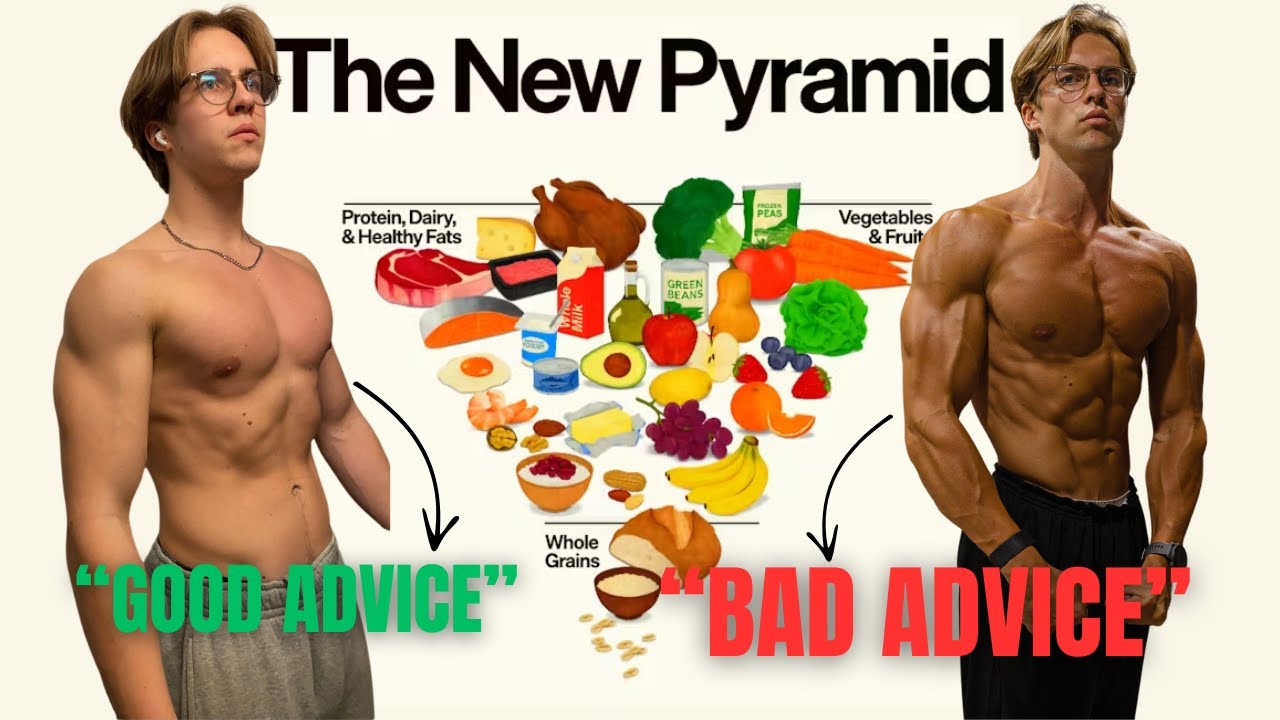
In this video, Lucas Wilhelm Hedenbäck critiques the newly released food guidelines and pyramid, arguing that while they improve on previous versions by emphasizing whole foods, reducing added sugar, and encouraging dietary diversity, they remain a generic, calorie‑driven model designed for population‑level disease prevention rather than for high‑stress, high‑performance individuals. He explains that the guidelines ignore critical biological factors such as nutrient density, mineral availability, circadian rhythm, seasonal variation, and especially the state of the nervous system during eating. Hedenbäck illustrates how sympathetic (stress) states impair digestion and absorption, leading to inflammation, hormonal imbalance, and suboptimal results even when the diet looks perfect on paper. He advocates a context‑dependent approach: prioritize food quality, use protein as the foundation, fats for hormonal health, and carbs as a tool to buffer stress and support performance, while aligning eating patterns with circadian and seasonal cues. The video includes multiple client case studies (e.g., Cooper, Landon, Thomas) showing dramatic transformations when his framework is applied, underscoring that nutrition must be integrated with stress management, sleep, and lifestyle optimization. Finally, he invites viewers to follow his Instagram, view proof of his clients’ results, and apply for personalized coaching.
Chapters
Okay, so the new food guidelines are here, the new food pyramid, and they're great if you want to feel average. So in this video, I'm going to break down exactly what I think about the new guidelines, where I think they go wrong, what I agree with, what I don't agree with, and also exactly what I would add to make these guidelines complete. Because it's not like they're terrible, don't get me wrong, it's improvement from the last ones, but it's still very generic and very incomplete. So this would probably be you if you're an average person that listens to these guidelines and follows them to a T. Sure, you might get some results, you might look good, you might build some muscles, But this is really what we want to settle for when you can take another approach, add some things, keep another a few other things in mind, and look like this. No. So this is very similar to what I usually like, what I would have considered a good approach in my in my initial years when I started out my journey. But there's a lot of things missing that will take this person to here, and that's what we are also gonna break down. So first of all, what is it trying to do, this new pyramid? Well, the new pyramid is not designed to help you feel amazing. It's designed to reduce population-level disease, prevent deficiencies, and be safe for millions of people, which means it has to be conservative, generic, calorie-driven, and risk-averse. And that's fine as a public policy. But it's a terrible model for entrepreneurs, high-stress professionals, men with heavy cognitive loads, and people who want vitality, not just your normal average labs. What does it get right then? Well, there's a few things and improvements from the last one, as I told. First of all, it emphasizes on whole foods, which is good. Less ultra-processed food, more fruits, vegetables, basic staples. Right? Any move away from hyperprocessed food is a step in the right direction, right? Reducing added sugar— clear win for metabolic health. Blood sugar stability matters, but the sugar itself is not the enemy. It's your body's ability to metabolize and utilize the sugar. So it's a metabolic issue, not sugar itself. So I, I don't like the fact that it's, you know, super, super demonized. I don't agree with that either, but It's encouraging dietary diversity. Variety improves micronutrient exposure better than rig single diet dogma. So if someone moves from fast food to this model, don't get me wrong, they'd feel amazing, no questions asked. That's also what it's kind of trying to do, you know. It's being pushed to this person that, that, uh, the thing is like a lot of things would make this person feel, feel very good. Where does the pyramid start to break down then, and what does it get wrong? Well, here the first big problem is calories over biology. So the foundational assumption is still this: if calories and macros are controlled, health will follow. But biology doesn't work like accounting. Your body doesn't respond to calorie targets, macro ratios, food labels. It responds to nutrient density, mineral availability, energy safety, circadian rhythm, and nervous system load. 2 diets can look identical on paper and produce completely different outcomes in real life. And that's where the model breaks. It doesn't consider real life. The new model still assumes a person who, you know, sleeps well most nights, isn't chronically stressed, has low cognitive load, isn't running a business, isn't glued to screens all day, and isn't relying on caffeine to function. And that's not you. And when someone like you follows the— follow this Guidelines. Something strange happens. You're doing everything right, but you feel flat, inflamed, foggy, low libido, low drive, and dependent on stimulants. You start thinking maybe I'm just not disciplined enough. You are. It's just that the model just isn't built for your life. It takes zero discussion of digestion, absorption into Consideration, because food on paper will not equal food absorbed. Your gut health will determine energy, mood, immune function, hormonal signaling. You don't become healthy by what you eat; you become healthy by what you absorb. I had a very fun conversation with my clients about this the other day, where it's like if we take two examples, we have one example where you eat. Keep in mind, let's say we're trying to put on size, put on muscles. You're eating 3,000 calories. I'm saying calories is completely irrelevant, or it's still a bit relevant. 3,000 calories of the best of the best food: grass-fed beef, raw honey, fruits, veggies, complex carbs, all the good stuff, right? Oysters, liver, all the things. But you are eating whilst you're stressed. In a sympathetic nervous system state, and then you have me, or you have another alternative where you eat half of that food, 1,500, 1,600 calories. You're eating in a parasympathetic state. You're chill. You can actually absorb the food you're eating. I'd pick that option every single time of the week. Every single time. This is also where we completely debunk the whole calories in versus calories out because it doesn't. Care about the outcome or what's happening inside your body when you're actually eating that. Calories is a metric of heat, it's not a metric of health. That's something we have to understand because once again, you, you don't digest in a sympathetic state. You only digest food in a parasympathetic state. So if eating whilst you're stressed, moving, or multitasking like a lot of, you know, high-stress people do, you're absorbing like a broken funnel. And what happens when you eat stressed is first of all, you know, blood drives or goes away from the gut and goes to your muscles and brain. Stomach acid and enzyme production drops, bloating, gas, incomplete breakdown of food, which leads to toxicity, dysbiosis, and a leaky gut. Even if you're eating the best of the best food, it can be very, very unhealthy for you. Also leads to chronic inflammation over time. That's going to decrease your testosterone and increase cortisol. So you can Train all you want, eat like a king, and still feel like garbage. Because if your nervous system is locked in fight or flight whilst you eat, no amount of clean eating will ever save you. Biology and rhythm— what the pyramid completely ignores: circadian rhythm, seasonal eating, light exposure, stress load, nervous system state. You can eat perfect on paper and still be biologically misaligned. Some examples of that is eating high carb late at night under artificial light, Under eating while overtraining, chronic caffeine use making fatigue, ignoring sleep quality. If I nutrition requires so much context. If I try to I mentioned this example so many times. If I blindly listen to Paul Saladino's nutrition philosophy, a lot of beef, a lot of meat, and a lot of fruit works fantastic for him. He's in the tropics. He has a Shit ton of sun. Me right now in Sweden, snow, cold weather, barely any sun. If I follow exactly like what he's doing, I'm going to feel like shit because right now my body is not optimized to actually digest and absorb carbs as my preferred energy source, right? We're more fat adapted in the winter. So there's so much context that matters and therefore there's no such thing as a one-size-fits-all approach to nutrition. Everything goes in seasons, right? Ah, but that's bullshit, Lucas. No, three winters ago I tried to do the Paul Saladino approach—a lot of fruit, a lot of a lot of meat. I felt terrible, terrible. And two two years ago, I stumbled across seasonal eating. I understood that you know nutrition is not a one size fits all. It requires Context, and it requires information of where you're at and your environment. And ever since then, my energy levels has been insanely good throughout the whole winter as well. I used to, you know, search for the you know you want to escape the winter because it's terrible. Everyone is depressed, this and that. Yeah, because they're completely misaligning their biology. So if you align everything perfectly, you're gonna feel amazing. You're not gonna have hormonal problems. You're not gonna get sick in the winter as anyone everyone else. That stems from misaligned biology. It also pushes loads of veggies. The new guidelines still push very high vegetable intake. Again, sounds good in theory, but in practice for already stressed individuals, this often leads to feeling full but underfueled, digestive stress and bloating, low calorie density, poor mineral balance, and increased cortisol. You're eating healthy, but your body is still signaling scarcity, and a body that feels unsafe will not burn fat efficiently. Build muscle, support libido, regulate mood, help with mental clarity, anything, right? It's going to be the last things that it wants to prioritize. The only thing it wants to prioritize is, is that stress, being in a constant active state, which is going to be terrible for you. And this is why people feel worse even if they do everything right. They follow the guidelines, they track intake, they eat clean, they control their calories, still end up flat, low motivation, brain fog, poor recovery, dependent on caffeine. And they assume that the answer is more discipline, more restriction, more control. That's backwards. The issue isn't effort; it's that the model never asks how stressed your system already is, and where you live, and where you're at right now. The pyramid doesn't factor in chronic sympathetic activation, cognitive and emotional stress, poor sleep and light exposure, travel and irregular schedules. Nervous system exhaustion. You can't layer a healthy diet on top of a dysregulated system and expect optimal outcomes. Health is context-dependent. The guidelines don't handle context. So what would I personally change then? Well, we don't need to replace it; we transcend it. It's still a very good base, don't get me wrong. But my principles will always stay the same, and these are. A few of them. Quality over quantity always. What you absorb matters. What you eat matters, but also what you eat have been eating matters. There's so many things that that is important around this. You know, once again, this is why I said on paper two diet or two days of eat can look completely the same. One might be the shittiest quality ground beef and the worst quality whatever. And then you have another example with the best of the best quality blah blah blah blah all these things. You get what I mean? It's going to complete, or it's going to create two complete different outcomes. So quality is the most important thing. Quality over quantity. How much you absorb matters more than how much you eat as well. We want to see protein as the foundation, which we kind of, which I agree with on the new guidelines. Fats for hormones, but then we want to use carbs. Carbs is a tool. We want to use them for performance purposes around training. We want to use them as a shield for stress. This is one of the things that endurance sports gets wrong, or it gets right. It's one of the only things that I agree with long-distance stuff. They eat a shit ton of carbs to prevent the cortisol and the stress load on the body around. We have to understand that carbs is going to be your best bet. To deal with high stress, and your body doesn't understand where the stress comes from. It all hits the same nervous system, right? So you can be stressed from training, you can be stressed from work, you can be stressed from whatever it might be. Stress is a one. It's still a. It's the same thing on your body. It doesn't care where it comes from. Seasonal variance. Digestion first. So I don't follow a pyramid. I follow feedback from my biology, and I follow feedback from my body. If you want a more in-depth guide, you can check out my nutrition philosophy guide where I go a bit into detail about everything. But that's the things. It's not a crazy pyramid; it's just principles and a framework that never will fail you. The summary here: all the new food pyramid is better than before. Once again, don't get me wrong, but it's still incomplete. If you're living a demanding life, you don't need to. You don't need the safe for the average person. You need a framework that respects stress, biology, recovery, and reality. And until nutrition models are built around that, people will keep doing everything right and wondering why they still feel wrong. And this was the case for a lot of my clients. We can take a couple examples. Let's take Cooper here as an example, a business owner. Cooper was eating clean, training hard. Still feeling or looking bloated, inflamed, bad skin, very, very stressed. 90 days later, shredded, looking a million bucks, feeling better, energy levels better, everything better, right? Same thing with Landon. Landon, when he came to me, was already eating clean and had been training for a long time. You can just see that this physique screams low testosterone and high estrogen. Right, bloated, inflamed, water retention, stressed. 120 days later, shredded. Screams high testosterone. You can just see the smile on his face, looking 100 times better. You can't even compare. Obviously, we— the blood works before and after on this as well. Landon had problems with high cholesterol and all these things despite eating very, very good, eating very, very clean. You know, here eating those so-called high cholesterol food whilst his blood blood works profile you know improved as well testosterone I don't know doubled something ridiculous right? This also just goes to show you can eat as clean as you want, but if you prioritize the wrong thing doesn't matter. Same thing with you well business owner from Sweden. Training, eating clean. Wrong framework. Right framework. 3 months later. Same thing with Thomas. Had been training his whole life. 90 days later, boom. And Mert and Nick. Tonda, business owner from the Czech Republic. Same thing here. Training, stressed, a lot of work running his podcast business. 120 days later, boom. Ata, Malek, Edward. You get the point. It's the same thing here. Rasmus, Leo, doctor from Brazil. Same thing here. Javier, Bash as well, business owner from Australia, right? The thing is, like, you'll probably look at most of this and think it looks absolutely insane, absolutely crazy. And yes, it is. And why I'm able to get so insane results with all my clients, obviously these are just a few, is because we actually I understand that training and nutrition is not the only thing that is going to get you to your goals. Most coaches will give you a training plan and nutrition plan and, you know, think that's it. It doesn't matter if I give you the perfect nutrition plan and the perfect training plan. If you're not absorbing any of the food, if your stress levels aren't under control, if you're not sleeping good, if you're not optimizing all these other areas of your life, that won't produce any result results at all. But if we focus on the right inputs, if we understand that that's just a part of the equation and all these other things— lifestyle, stress, hormones, biology— all these things matters, and we focus on that, align our biology, fixes our metabolism, all these things, boom. That's why all these people get so insane results. So everyone needs to shift their focus. It's not just training and eating good. It's aligning your biology. It's fixing all the right inputs. It's doing the right things and then staying consistent with them. That's what's going to create the crazy, crazy results. And if you're not convinced on working with me by seeing this, I'm going to want you to go to my Instagram. I have one, two, and then I have another one that is called proof, proof, even more proof, more proof. 300 testimonials. I can't even fit them all on the screen here that you can scroll through and look at on Instagram just from the last year of people just like you, business owners, busy guys that gets insane results because we focus on the right thing. And if you're interested in coaching by me and from me, I'll leave a link in the first or I'll leave a link in the description where you can apply. You can book in a call, a consultation call. You'll be speaking with either me or One of my one of on my team will we map out your full situation, understand your bottlenecks, see where you want to head, your goals, and try to bridge that gap and see if the coaching is something for you. So if you're interested in that, check out the first link in the description. If you have any questions, let me know in the comments. Reach out on IG. Go check these out if you're not convinced yet. I'll guarantee you you'll be. Because it's literally insane what happens when when we focus on the right things. That's what produces these crazy results. It's not just a training plan and nutrition plan that gets Landon from here to here. It's fixing his biology. It's the same thing with you, and it's the same thing with Thomas. It's the same thing with all of these guys. So shift your focus, get results, and that's my take on the new food pyramid. If you follow this. You'll look probably something like this. If you listen to me and take all the other things in consideration, you're gonna end up like this. I know which one I pick or prefer. Hope you enjoyed. Thanks for watching. I'll see you guys in the next one.







