Why You’re Not Getting Results, And How To Fix It:
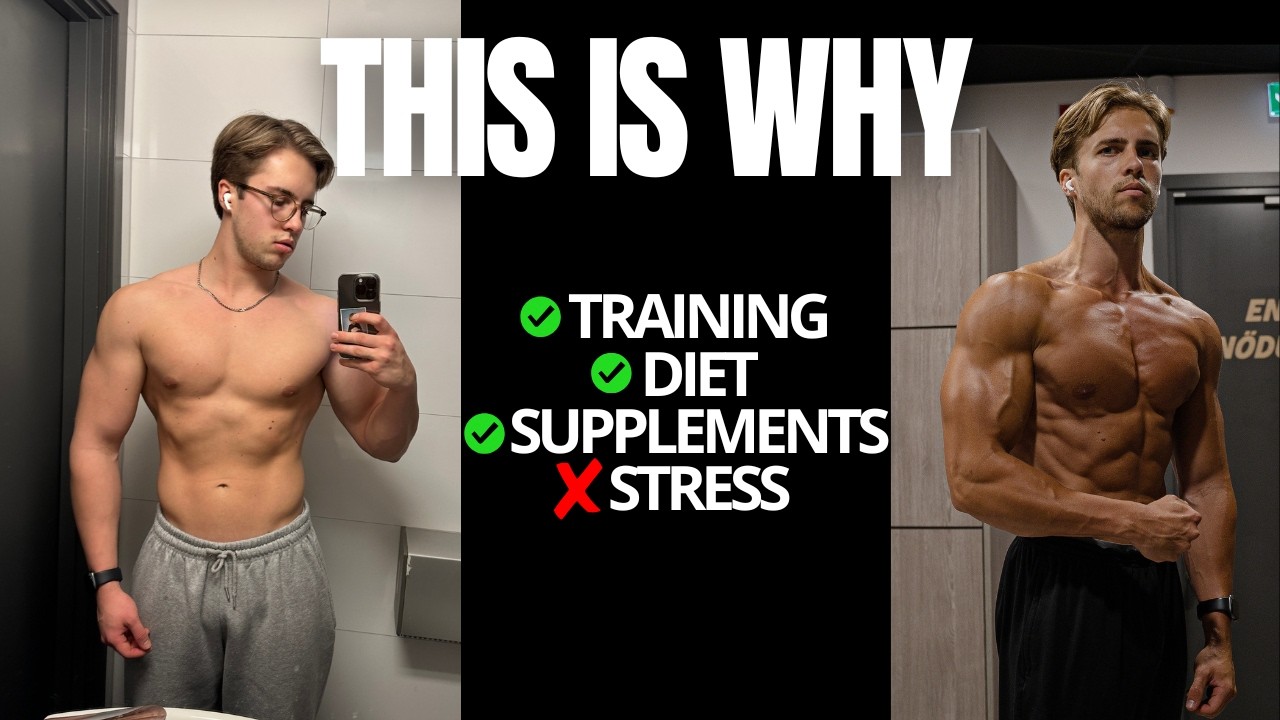
Lucas Wilhelm Hedenbäck argues that unmanaged stress sabotages results even when training and nutrition are dialed in. He shares client cases where stress reduction alone improved body composition and energy, and introduces a stress-management framework with breathwork, grounding, and sleep hygiene. Stress and nervous-system regulation make up 80% of the equation, he says, while training and nutrition are only 20%.
Chapters
If you feel like you're doing everything right, you're training hard, you're eating clean, you're consistent, you're showing up, you're putting in the work, but you're not seeing the results that you feel like you should and that you feel like you deserve from the effort that you're putting in, this video is exactly for you. I'm going to explain exactly why this is, because I see this all the time and this is what I experienced myself as well. If we just look here back at how where I was at Just 2 and a half, 3 years ago, I was on paper doing everything right. I was following the perfect workout plan. I was listening to all these roided-up bodybuilders online. I was taking every single advice and studying everything to a T, you know, the literally the perfect laid out to a T workout program, the perfect macro ratio and macro, macro split according to all these people that I was listening to. Yet I had brain fog, I had massive energy crashes, I was dependent on caffeine and energy drinks to get through the day, I had sky-high cortisol, and I was generally very, very fatigued. And it came to a point where I started questioning myself, you know, because on paper, well, I'm doing everything right. Is this the roof? Is this how I should be feeling by doing everything right? And I started to question that because I was thinking to myself First, I was thinking I just have to push more. I just have to bring more effort. I just have to do more, and then eventually I'll get to my to my dream dream physique. That was my initial thought. But then I started realizing by doing more and by doing everything even more perfect that that was not the solution. It just made things worse. So I completely shifted my focus from okay. I don't even care how I look. I don't care. I just want to feel good. I want to have high energy. I want to have high libido. I want to feel good in my day-to-day life, and I don't want to have brain fog, and I don't. Want to be limited in my day-to-day life by, by how I'm feeling. So when that shift happened, I stopped trying to focus on just the looks and having everything perfect and just like, okay, the only thing that I care about now is how I feel. And that led to me not being as perfect with the workouts and with the macros and with everything as these people that I was listening to was, was preaching. I started cutting out all the bullshit the protein powders, everything, and just ate clean. And I thought that this would come with a, with a cost of, you know, sacrificing the physique that I had been working towards. But in reality, it was the complete opposite. When I made this shift, the physique that I had always wanted naturally just came as a byproduct by me focusing on being truly healthy from the inside. And not even putting the work towards, not even putting like effort towards getting there. It just came. It came naturally because I was doing the right thing. And this is where I started understanding that, okay, throughout these, my initial 3 years of my health journey, I was doing everything wrong. I thought that effort was the only thing that mattered when in reality I was working my corporate job at a bank. I was trying to start my business. I had all these stressors in my life that was holding me back, and then I added more stress on top of that by going to the gym and you know eating low calories here. I was I was trying to shred fat, but I couldn't get fat on my of my body. I was eating probably a thousand eight hundred calories or something at this point, trying to get shredded. Nothing was happening happening, and I thought more cardio, less food was the solution. Now I don't even track. I don't do anything. I'm probably eating eating closer to three thousand calories a day. But I'm managing my stress, and this comes in to the one bottleneck that you're facing right now if you're watching this video. In my opinion, that is most likely stress. If we compress everything to the core, you might have gut issues, you might have some other issue, you might have sleep issues, you might have some issue. Everything starts with stress, and in this video I'm going to break down exactly how you can fix that and the framework that you should be applying in order to Fix your stress throughout your day, and and how you should think about it, and how you can go about managing your stress, which is the most important thing. It's management because stress will always be there. It's not like we should or or can eliminate all stresses from your life. You most likely have a hectic job. You maybe have a business to run. You have family, whatever. Stress will always be there. But how can we manage it better? That is the question that we should be asking ourselves. So. Once again, I see this all the time. I have clients that coming that are coming to me, guys that are they're disciplined, they're showing up, they're following the plan, but they still look exactly like I was looking: fluffy, not as lean as they should, not fully dialed, and they don't have the best energy levels. And they always think same as I thought: Should I train more? Should I eat less? What am I doing wrong? But the truth is that you can have the perfect training and the perfect nutrition plan. But if your stress isn't managed, you will never get the full return from it. Never. Stress is your number one bottleneck. It was for me. So therefore, it's of your number— it's probably one of your highest priority to try to fix it as well. Also, before we dive any further, if you're new to the channel, first of all, welcome. My name is Lucas. I'm just a regular guy from Stockholm, Sweden. Over the last 5 to 6 years, I've dedicated all my time and energy to try to solve this complex thing called health. And all I do on this channel is break down my lessons and learnings to actionable implementation so you can walk away, put it to practice, and fix your own issues. So let's dive into it. The first thing we have to understand here is that when it comes to stress and when it comes to your mindset generally in life, You probably frame this diff like wrong because this is how you need to think about it. Training and nutrition are not infinitely scalable. You can only train so much and eat so well, but there's a limit. Training and nutrition, if I think about health, is 20% of the equation, right? The other 80% comes from all these other variables around managing your stress, fixing your nervous system, fixing your hormones, fixing your sleep. Fixing your habits, all these things—that's where the magic happens. So training and nutrition is not very scalable. There's a limit. Stress management infinitely scalable, and for most people is the most most underdeveloped area as well. It's probably the one area that you don't even think about yourself right now. That's where you're going wrong when stress is not managed and when it is too high. The problem, or the first problem that happened, there's a bunch of problems that happens, but the main thing is that your body shifts into survival mode, right? And when that happens, the first thing that starts to break down is your nervous system. You're stuck in fight or flight, which means that you have poor recovery, constant activation, and no real resets throughout the day. A body that is stuck in fight or flight and a nervous system that is stuck in activation mode. Will never prioritize recovering from, from the training. So you're training, but you're not being able to recover from it. How are you going to build any muscle? Right. It's not going to be able to prioritize digestion and absorbing the food that you're eating, which means that how are you going to be able to recover and feel good and be energized if you can't even utilize the fuel that you're putting in your system? Right. And it leads to a bunch of like negative spiraled things. By having a constant activated nervous system, it completely drains your stress budget as well, and you never get the resets, which is one of the core things when it comes to stress management. Digestion also gets affected when you're stressed. Digestion completely shuts down, even if you're eating perfectly. Nutrients aren't absorbed, gut gets irritated, and bloating increases. This is why I spend a lot of money on food. You probably do also. But if you if you're watching this, right, you're you're putting all this money towards food because that's one of the biggest return on investment you can. You can get you direct return on investment in yourself, right? You should be spending a lot of money on the best quality food that you can you can get 100%. But if you're stressed whilst you're eating this best of the best food, it doesn't matter how good quality you get. Grass-fed, grass-finished beef can still cause gut dysbiosis, leaky gut, problems with your gut, SIBO, SIFO, all these problems. Can still happen from the best of the best food. And that states one thing: it's not just about what you eat, it's about what you absorb. That is the most important thing. And managing your stress is one of the key things that will fix that. I have so many, so many examples of clients where we do everything right from an input perspective— fat loss stagnation, right? And then we sit down, which is one thing that I'm going to show you later in this video as well. Okay, if we go to a regular trainer or a regular fitness coach, how they would look at this situation, they would do like this. Okay, we're training, we're eating this amount of calories, we're not losing weight. What should we do? Eat less, train more, more stress, more stress. What do you think is going to happen then? Well, if you had— if you were tired and had brain fog before, imagine how much more brain fog and how more tired you're going to be after that. There is no one looks at the whole piece of the puzzle, the whole puzzle. You have to—you can't just look at one thing. Same like this happens all the times. I had another client yesterday. Feels like he's stagnation. Okay, then we sit down, go through the whole situation. Most stressful time of his year or of his life. He newborn and a puppy at the same time, not sleeping anything. And he was like, "Oh, Lucas, should I eat less?" No. If something you should eat more here, right? You need to give your body even more. Like power to to actually recover right now because you're in a like shittier setup in your life. So we always have to understand that like you can't just look from a surface level perspective. Oh, I'm stagnant with my weight loss. Well, I have to eat less and move more. More stress, more stress. Once again, that's probably that's gonna do more damage. It's not probably it's gonna do more damage than good for you. Hormones. Chronic stress leads to elevated cortisol. Poor testosterone output and blood sugar instability, which directly affects your physique as well. You can just see if we go back to to this, you can just see that this screams high cortisol, low testosterone. This, I don't know about you, but I think this screams sky-high testosterone and low cortisol. So there's a like this is an accumulative issue of all the things that I did wrong, right? And this is an accumulative issue or. Consequence and all the other things that, that I did right, right? It's more important for your physique. If we have 2 examples, one Lucas, which is basically exactly how it was for me, that doesn't train as good and doesn't eat as perfect macros and calories, but his hormone— his hormones goes up because he manages his stress levels, his sleep gets better, his nervous system and stress gets better, but he works out like shit. And then we have the other Lucas that is like fucked from hormones, nervous system, stress perspective, but But he works out perfect and eats perfect. I'd want to pick the imperfect Lucas that manages his stress every single day of the week, and that person will get ten times better results, even if the inputs aren't as good on paper. Right? Always because it becomes a flywheel. When hormones get better, physics gets better. When stress gets better, inflammation comes down. Stress comes down. Physics gets better. Right? So we have to stop focus on the just the surface level solutions. Same thing here. If you had a If you go to a personal trainer and he and you say that you're you're stuck and and this and that, they are eat less and train more, right? That they're not taking anything into account, right? And you have to look at the full picture. Last thing that happens obviously is inflammation. You hold on more water, more inflammation, more softness, even if your body fat isn't that high. Like I'd argue that my body fat here is is not crazy high. It's just that I'm pluffy, I'm inflamed, and I'm stressed. Like crazy. That's what I look— why I look terrible. This is how I look when, when body fat is, you know, roughly the same, I'd argue. Better stress management, less inflamed, not holding on to any water. I'm actually heavier on the right here, which is also crazy. I think this is like 77 kg or something, and this is 81, so it's 4 kg plus, which is just ridiculous when you think about it. But that is how it is. So the problem here is that you think that you're doing everything right, but your body don't respond. So most people's solutions, once again, more effort. And that's exactly what I did wrong in the beginning as well. That's where everything just gets more and more messed up. You feel like you're not getting results, or most people do this and they train more, they eat less, and they push harder, which adds Even more stress. This is where it becomes a shit show. Now you're going in the complete opposite direction. You're not getting closer to your goals; you're getting as far away from them as you can. You're constantly walking further away from it. So people always think, you know, what is the real fix? Well, it's not more effort; it's better regulation. You need to build a body that can handle stress, recover from stress, and then return to baseline. This is what I call managing your stress chart. And instead of me showing you a presentation here, I'm gonna give you a real-life example of this. So I have one of my clients, Varun. He's doing everything right. I'm gonna show you a behind the scenes of how a coaching call can look. He's doing everything right. He's training. He's showing up and training consistently. He's eating perfect. Let's say he's eating 90% good. There's we can scale it up to 100%, but he's running a business. He's super super stressed, and he's not getting the results that he should if you just look at the inputs, right? Training and nutrition—he's dialed. If you ask another if some another personal trainer would look at these inputs, or if you would look at his food and his and his training, you would say, "Oh, this guy is dialed." Right? But when we look deeper, the situation with Varun was never a training problem. It was never a nutrition problem. It was 100% a stress problem. So in this clip that I'm about to roll, I'm going to show you exactly what he's doing wrong and kind of how we're fixing that going forward and applying what I'm calling my stress chart analogy and philosophy. So that we will fix this, because now he's, he's been starting to implement all these things and we're already seeing serious results just from doing that. So without further ado, let's roll that. Maybe.
That's not bad, it's not bad.
Still a bit, a bit cold, but we had something like over the last weekend we had really, really nice, uh, weather, like a couple days in a row, so it was really nice.
Nice. Yeah. All right, so let me, let me give you the update. So implemented the new routine, which, which again, I think has kind of helped with some sort of extended fast. So eat dinner at 7, 7-ish, let's say. Morning, get up, have the Superhuman coffee, butter, raw honey, just pure black coffee. And I was surprised, but that actually sustains me through 11, 12 AM. Like, I'm not really hungry. I'm just able to work and function. So then I have my power bowl, go do the workout at, you know, let's say noon.
Yeah.
Sometimes I have midday calls, so then I'll, I'll just kind of keep going. I'll do the workout at, let's say, 4 PM. And so I'll have my power bowl around 11, my eggs, parm, sourdough, uh, at like 1, 2, somewhere in there, workout at 4. So that's kind of my other secondary routine depending on how calls are during the day, and that's worked really well. I feel great. Dinner, you know, just rice and beef and all that. All the same diet we've talked about. Nothing's really changed there. Workouts feel good. Pushing on the weight. I think I fucked up something in my back with leg press. Like I went a little too far deep, and then so my lower back is kind of like. Nothing's like really wrong, but I definitely like, I, something's a little, I might take a couple days off from, from leg press. So yeah, yeah. Uh, probably the question for you on that is, um, in your video for leg press, it seems like you're getting your knees all the way like this. These are my legs, like you're kind of going like almost like all the way here. I think I, I might have done that, but maybe my back was at a weird angle. How do you think about it?
I mean, you should, you should only challenge your own range of motion. So maybe you're not as flexible in your, in your your hips and hamstrings to the point where you can get that deep, right?
Yeah, very good point.
And then just like don't push it, push it until you like, until the form breaks, because that's usually, it should, it's probably your heels, hamstrings, and hips that are a bit stiffer, which doesn't allow you to go as deep, then don't go as deep, right?
Yeah, okay. Do you, I assume you get a good leg stretch before you do leg day?
I mean, not really. I walk maybe on the StairMaster for 5 minutes and like same as with upper body, just do some light movements, swing around the legs a bit, and yeah, I get them a bit warm. Yeah, but like nothing crazy.
Okay, all right, so very good point on that is don't, you know, don't try and do what you're not. I'm very not flexible in my legs. It's a little— yeah. challenge. Uh, like I used to run track and cross country in high school and, and would have to stretch for like 30 minutes before a race as other people would do 5 minutes and then that's it.
Yeah.
So to each his own, I suppose. So anyways, the workouts feel pretty good as I look at, uh, the chat, right? So like just looking at some of these wins, um, Charles, Charles had a really good photo he just posted. Pretty shredded, looking pretty big in the shoulder area. You know, as I think about kind of like, like Frank is sort of like level 1 to 10, Frank seems like he's level 10, like he's pretty close to Lucas. Charles is like a couple levels above where I am, where he's gotten strength, he looks pretty shredded, but he wants to get more shredded. Anything different would you say kind of what I'm saying versus maybe what he's doing that I could think about?
Stress management.
You think so?
100%.
Elaborate more, go further.
You should, you should look in, we went in depth on this on Monday. I want you to look at that, look at that call as well.
Okay.
Training and nutrition is not very scalable. You can only do so much, right?
Yeah.
You can only train so, so good. You can only eat so good. There's a very hard cap. Lifestyle stress management, obviously we've talked about this. That is the most scalable part of someone's health, 100%. So for Charles as a primary example there, and we've been like, he's been putting on a shit ton of size. Obviously we're gonna start shredding a bit more now to get rid of some of that fat, but I think he's gonna look very, very, Very, very good. But one of the things that he's been religious with, like last couple or this month, which he didn't, or no, this year, which he didn't, was let's say November and December, or December when he started, is all the small things. Making sure that he goes outside and eats his food in the sun, making sure he's getting the grounding and making sure like All these things and being religious with it. One, one on I remember one call when when when he said like, ah, but I I have to just eat between the very quickly between the appointments or when someone is coming in and blah blah blah. And I was like, do you or can you take five ten minutes that you then add on until? you know, 5 to 10 extra minutes towards leaving work later. And I was like, yeah, no, that's pretty true. I can definitely squeeze in that, like that rest, you know, in between and like those resets, right? So there isn't really an excuse because at the end of the day, when we zoom out as well and when we are dialed with all these things, that is also gonna mean that your general performance is so much better from a mental clarity perspective and just output perspective in general. So it's like, You know how investments work. You're putting something in and you're expecting a return. In this case, we're investing into habits and tweaks in our day, which it costs time, but what do we get back? Better mental clarity, better results, sharper, feeling better, better health, infinite scalable, right? It's worth it every single time of the week.
Very good point. Yeah, I guess you're absolutely right. 'Cause as I think about the last, I mean, this, if I, I'm glad that, I'm glad that I forced myself to do this whenever we started in December, but Q1 was like level 10 stressful of what I've ever experienced of trying to build a company. So therefore, like, if you look at like me, which is like, okay, like you're in shape, but versus Charles, like, it's like, yeah. Even though we started at the same time. Um, so I feel like the last probably like 4 weeks is when I really was like, shit, like this time has gone by and I haven't really accomplished that much in terms of— not nothing from your side, you've delivered 10 out of 10, but from really from my side. And I'm like, what do I need to do here? And so then we dialed in, we fixed the diet and, you know, changed some of the meals up, timing of eating, the coffee. Power bowl instead of like the extra bread, made it a point to sleep like at minimum 7 hours. Like maybe one night I was up late working, but other than that, like 7, 8 hours for sure every single night, like this week and last week. And then the final, even like this morning, I was like, I was like, nah, I gotta get out and walk. Right? So every morning I've made it a point, even if it's 10 minutes right before a call.
Yeah.
Get out, fresh air, sunshine, and you feel so much better. So, um, that's a little thing. I think you're saying go even deeper on the small things that will help you manage the stress you're, you're experiencing. So, yeah.
Same thing there. Same thing there, everyone. We can make all the small little tweaks nutrition-wise and make that perfect. And you, yeah, maybe let's say we're at 90% now. Yeah, we can scale it up to 100%, right? But how much is that actually gonna How much is that gonna bring back? How much return are we gonna get from that compared to, let's say we have the stress side of things where we're maybe at 10, 20% right now and we can scale that up to 80, 90. Of course we're gonna get an insane return from focusing on that instead.
Yeah.
So we can tweak that, but if the thing that is gonna give us the most leverage isn't in place, gonna give us that much. You know, if we take the example of having quote-unquote worse training and worse diet but better management of like lifestyle and habits, I would take that every, every time of the week.
Oh, it's a very good point now that you say it that way. It's almost like what you've said before, which is you're better off having 3 eggs and 1 meal of rice and beef that only gets you 90 grams of protein than like 200 grams of protein from shitty processed powder. Yeah. David Bars.
Exactly.
Yeah. Okay, cool. Um, fine. So let me go back through your weekly call from Monday. And then also I know there's a stress management module, so I'll revisit that and see what else I can implement this week specifically in these small habits.
To simplify it here, I'll show you the— let me show you this. Let's see, where do we have this? So this is what I'm covering this in depth in that one, but just so we can kind of get a visual, because the only thing that I want you to think about when we think about this is the analogy of a chart. So if we, once again, I mentioned this, but if we just accumulate stress without any resets, it's gonna be a chart that goes straight up, right? And you can also think of this as like a car fuel analogy where when you cruise at a semi-good pace, you know, that fuel will last you pretty long. Right? But then when you push the paddle in the bottom, you know, and you keep it there, what happens with the fuel? Well, you've fucking drained the shit out of it very quick.
Right.
So your stress works the same. When your chart is peaking, like, you're just draining it. You see?
Yeah.
So whenever we, like, it goes up, We always need to manually bring it back down. That's how you want to think of it. So this is like the person doing it wrong, and then you have these charts. Obviously, this is a heartbeat chart and whatever, but just to get it like to get get the point. Like this is what you're trying to accomplish. So after a a up pattern, we want a like a man a down pattern, right? So so stress compensate, stress compensate, stress compensate.
Great point. Very good point. Yeah, yesterday was one of those like up days. I did nothing to reset it. So that's an amazing point.
Yeah. And the thing you're trying to accomplish here is obviously like stress doesn't have to be here. We want to stress, we want to recover. That's how we adapt.
Okay.
And when you think about building your resilience towards stress, like we have to take, You have to take the baby steps in the beginning, but this is— your vagus nerve acts as a muscle as well. The more you train it, the stronger it gets. So it will get to a point where you can handle stress so much better from like a baseline perspective if you train it, but it's not gonna get to there from one day. It's the same thing, you're not gonna go into the gym and do one bicep curl and then you're gonna have a massive bicep, right? That's not how it works. You have to train it, you have to show up, and you have to do the right things, and that's how you build the capacity. So by being cautious about this, like if we zoom out 2 years from now when you've built the resilience, your body from a day-to-day perspective is going to be able to handle that stress load so like so much better and you're gonna like be less affected from the high stress. You see what I mean?
Yeah, yes. Exactly. Just like at the point you're at now, lifting however much on bench press or leg press or whatever is nothing to you, whereas somebody starting out doing one rep of your normal might be like insanely hard.
Yeah, correct. So that's exactly how it works as well. That's why when you like— let's take in my case, I think I'm at a point where I'm very, very resilient towards, towards stress right now. Of course, you can always improve and you can always be better, But think about the Ironman training as an example there as well, which is also a good analogy to think about. Like that is a massive stress hit that you're gonna put your body under. You know, you build up the resilience over time. You build up your body's ability to handle this stress for months and months and months and months and months to the point where, okay, now I can handle it, right?
Right.
And then you could argue if that's a good or a bad thing and whatnot, but like Forget about that. If we just think about the like the from it from a resilience and how we how we should think about and go about it, it's just like progressive overload. Train train the nervous system in your body to handle it better, so that in return your everyday life and and the high stress load that you you know you're most likely going to have in in one two years from now as well. It's gonna affect your health less. Or less from a negative perspective or negative side of things because you're more resilient.
It's very true. I mean, if you look at your average person, a doctor, lawyer, pick some high-intensity job, right? How they look at 55 versus somebody who's, I don't know, let's just say an entrepreneur who's figured out how to manage his life and he runs a big company but he has more flexibility and more time and figures out, here are my 3 or 4 anchors and things throughout the day that those guys always look great, right? Pretty, pretty healthy, pretty fit. Uh, so it, it matters. I mean, with how you age and how you take care of yourself, 100%.
And in those cases, that's probably been things that they haven't even been kind of aware of, but it's just been things that they have kind of been forcing themselves to To do, right? They've been forcing their— or not subconsciously kind of, yeah, forcing themselves to be able to handle the stress better, right? So 100%. That's like the most leveraged play for us in general because once again, like nutrition is there, training is there, What's left of the scalable pillars. Yeah, you could argue we can try to get an extra hour of sleep as well, which is going to be something that is going to come with a lot of upside in my opinion as well. But, just in general, it's stress, it's recovery.
Okay. I got to tell you, I really never expected to go this deep on life with you. Work-life, these things. I was like, oh, okay, we're gonna work on diet, we're gonna work on fitness, maybe he'll have some tips on sleep or whatever, nutrition supplements. But I almost value the life advice and these things that are long-term. How do you build success equally as much, perhaps if not even a notch more, because perhaps you've been through this entrepreneur journey for the last 3 years. I'm starting.
100%. And it's also, it's once again, like, yeah, we can, we can dial in the training to a T. But it's not very scalable, right? That's not where the magic happens. So like the magic happens elsewhere. Of course we're gonna look for what's gonna yield us the most.
Always. Yeah. Okay, got it. So I think I have my instructions for this coming week. Everything else feels pretty tight. Noted on the sleep point. And I think this was the first week of trying to implement the new routine, which was, I'd say, 80% successful, maybe 70% on some days. But I'll get that dialed in tighter next week.
Yeah, listen to that because obviously I'm running through it like quickly now, but a lot more in-depth about kind of the stress chart and how we want to view that. So still like biggest focus point for us, 100%.
Yeah. All right, man. I appreciate it as always. I really value these calls. Like, thank you. Of course, I think it's nice as well.
It's, yeah, no, but like literally also just like what I, which if I come or compress what I do with a lot of people, it's more so like mindset reframes that get someone to where they want rather than, you know, the perfect like the perfect training and these things, like just shifting kind of the, the beliefs is really what matters at the end of the day as well, right?
Yeah.
Um, so yeah, no, it's good.
Yeah, you're, um, I mean, like I told you way back when, the thing that really was like, this is, this is the guy I want to work with, was your video about identity. And that's what you're saying right now.
100%. And that's like, that is more important than arguably everything else.
Yeah. All right. Well, I appreciate the time. Have a good weekend. Spend some time on the farm.
You too, mate. Yeah, of course. And enjoy your Friday. Enjoy your weekend. And Take a look at that. Let me know, like, send me after you've watched or listened, I want you to send me the main takeaways as well. Like, if you can just summarize those so I can leave you some notes if I think that was good or bad or whatever, and if I wanna add something. So do that after you've watched that call also.
Okay, will do. When's your dog coming, by the way?
Twelfth May. Okay, it's close. Yeah, it's getting closer. Excited. Nice. Yeah, it's gonna be nice. Awesome.
All right, man. See you later. Ciao. All right.
So that was a little behind the scene of how to manage your stress chart and the analogy that you should be applying yourself. So I'm gonna repeat this once again. This is one of the reasons why I take all the approach that I'm taking with all my clients. We're not just focusing. On the training and nutrition because once again it's 20% of the equation. We focus on everything because everything counts. If you train correct and you eat correct, yes, you will get some results, but it's not very scalable. Once again, all the other things are what's very, very scalable. And we can take some examples here as well. If you look at Joel, just to give you some examples, Joel is a business owner from Sweden. When he came to me running his startup tech, stressed through the roof, he was training, he was eating good, and he didn't—he felt like he was doing everything right but didn't get the rewards. So what did we do? Well, we put a lot of effort naturally towards the stress, fixing the stress because that's the biggest bottleneck right here. And boom! What happens three months later? Looking like an absolute stud. Fat stop, fat loss actually started working. Hormones actually started getting better. Training actually started giving us a return from the time we were putting in. You know, imagine going up and training and putting all your investing your time into this. You're not getting any any return on it. I don't know about you, but I that that wouldn't be a good thing if I'm putting if I'm investing my time into something, I'm expecting a return, right? And that's exactly what Uwell was expecting and understood that he was doing wrong as well. Same thing here with Tonda. Business owner from the Czech Republic, running a business and also being a sales manager at a big company. Stress, stress, stress, stress, stress. Training wasn't working. Boom! Biggest focus point for us. Four months later, in Yul's case, this is actually ninety days for Tonda here. Four months later, boom! Same thing with Lan then—a business owner from the U.S. Deprioritizing sleep, stress, running his business, having multiple employees to manage. Shit show from a stress perspective. Training for ten plus years without seeing proper results. Four months later, dialing all these things in, prioritizing sleep, prioritizing stress, prioritizing prioritizing managing his stress and doing all the right inputs. Results speaks for themselves. Edvard, Oliver, Leo, same thing here. Blake, same thing here. This is a good visual example as well. Luca, forty days between this. Bloated, inflamed, holding on to water retention. Everything gone by dialing in the stress and dialing in all the inputs. Boom. Same weight, completely different body composition by fixing hormones, fixing stress, and fixing everything around. Same thing with my good friend Ludwig. Ludwig working at a, um, or working in the finance scene. High stress, sure. Good size, good muscles, inflamed. Bloated, holding on to water, puffy, dialing everything in. I don't think I have to yeah tell or speak anything else about it. You understand the point. We focus on all these things because in in most of these people's situation as well, just fixing the training and nutrition was not is not the thing that gets them to gets them these results. It's by actually focusing and looking at the whole picture, and this is. Where I think everyone goes wrong in this industry and in this space. I don't see anyone doing— taking the approach that I'm taking where we look at the whole picture. I have multiple clients that come in, they've had— they've been going to naturopaths, functional medicine doctors. Maybe they have some stress problems, they have some gut problems, they've been diagnosed with IBS or whatever issue it might be, hypothyroid, or you have Candida, and then you're trying to— you have a bacterial overgrowth of this specific bacteria, and then you try to compensate that because they prescribed you another bacteria that you have to eat now to fix And it's like you can't micromanage a whole ecosystem. Your gut, if we take that as an example, is a whole ecosystem. You can't you can't micromanage one bacteria when there's millions of bacteria existing. That's not how it works. We have to look at the full picture. We have to dial in all variables around in order to get healthy and get the results and get maximum. Out of the effort that we're putting in towards our health and towards our training. So if this resonates with you, or if this sounds like you, and maybe you're dealing with stress, you can't seem to figure out—you know—you're putting in the effort, you're you're putting in all the work, you know, you're running a business, you have a high stress job, feels like you're doing everything on paper. Maybe you've had a personal trainer that just tells you to train harder and or eat less, but nothing happens. Well. Check the first link in the description. See if it's to have a free assessment call with me or my right-hand man Anton. We'll map out your your full situation. We'll explain exactly how it looks to work with me one to one. That's the superhuman protocol. It's my coaching program. It's where we do twice a month one to ones. You have a full built-out roadmap for everything and anything you can think about health-wise. We fix whatever issue you have, whether that be sleep, whether that be stress, whether that be gut issues. We take a look at the full picture and actually map out everything and understand what are the triggers. How do we fix this? So whether you have sleep issues, gut issues, stress issues, we fix whatever whatever issue it is you have so that you can finally start to see some results from the work that you're putting in training-wise. So hope this video helped. The main takeaway I want you to have here—not so practical, but practical practicality—I have a bunch of other. Videos on exactly what to do regarding fixing stress and everything on my channel, but more so the framework and the analogy, because that is the most important thing, like awareness. And think about the stress chart and think about these things. And then you can go look at the other videos with the application or with the actual like tools, how I like to view it, doing breathwork, doing grounding, making sure you're getting your sunlight, making sure you have all these good habits in place, making sure you get some resets in throughout the day. That's the practicality about this, but this is more to to highlight the importance of the framework and the stress chart for you. So hope you enjoyed. Let me know if you have any questions. Put them down below, and thanks for watching. How I'll see you in the next one. And this is exactly how to fix your stress and the framework that you should be applying to finally start to see some nice results from the work that you're putting in that you're worthy of from all your all your hard work. So once again, Supreme Protocol, if you want to take away all the decision fatigue from your end, if you just want to have someone tell you this is what to do to fix your shit, that's for you. If you just want a training and nutrition plan, it's not for you, right? This is not your average training and nutrition and fitness program. No, this is a full-blown health and performance and optimization protocol where we focus on absolutely everything— hormones, mitochondria, nervous system, sleep, stress, everything that affects your health. We dial in. So, or and whatever issue issue it is you have, we dial in. So if that's if that's you, you know what to do. Thanks for watching. See you in the next one. Peace out.







