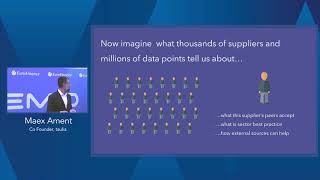
Maex Ament, co-founder of Taulia, argues that AI and big data can transform treasury and working-capital decisions the same way they power autonomous vehicles and Netflix recommendations. He shows how pattern recognition can optimize supplier financing, payment scheduling, and cash flow.
Chapters
This is about applying intelligence to treasury and one particular, one special part of treasury, the working capital area, the area of payment terms, payments, the area of— I put in a couple of buzzwords that we heard here on the floor, obviously supply chain finance and stuff like that. So that's what I want to talk about and how AI, artificial intelligence, data can help here to make the right decisions. Quick about me, my name is Maex, Maex Ament. I happen to be the co-founder of Taulia. In terms of background, I spent some time in my previous startup that got acquired by ReadSoft in AP automation, e-invoicing payments. And I started my career with my beautiful German accent at SAP where I was responsible for the payment program, which comes quite handy if you talk about supplier financing and paying suppliers to know how SAP systems pay actually suppliers. Let's start with more generic high level on artificial intelligence. We initially had a little question mark here whether AI is the next game changer. I removed that question mark because it is, and we can talk in detail more. I have just a few examples to set the stage on AI data and where AI is at work today, and then I want to make the case how this translates to what we actually care about or what we care about on this conference. Because I think we care very much about a few of those things in general. Driverless cars. So obviously data today is an artificial intelligence, and the data that those cars collect is used to enable autonomous driving, to make it possible that cars can drive without a driver. Not only can drive, but drive in a much safer way. So I don't think it's a bold prediction, actually it's pretty much common knowledge. That in a few years when cars really start driving on their own, insurance policy will be more expensive, but not for self-driving cars, but for us that want to still drive on our own. Yes, sounds weird and scary, but it will happen. One thing that annoys me a little bit and makes me sad is that Tesla is leading the charge here. As a German, I want to see obviously Mercedes and Volkswagen. Good news though is I spent the last 12 years in Silicon Valley. So that makes me then happy again and proud of Silicon Valley. It's a little bit like in soccer. My wife is Spanish, I'm German, and yeah, one of the two teams always wins, right, in the championship. So similar here with Tesla, I guess, or with cars. More serious topic, obviously, in healthcare, in tumor diagnosis, where we see here actually IBM Watson at work, where IBM Watson this pattern recognition to diagnose tumors, cell mutations earlier. Earlier, better, more precise than humans. So that is already happening today measurably, where artificial intelligence does a better job than humans. It's great, so it will save lives, literally save lives. Awesome. Now back to the opposite of not so serious stuff, but still important for all of us. Netflix or any movie/TV show streaming site that you want to pick. What happens at Netflix when you go to Netflix and you watch something? In 70% of the cases, 70%, it's not actually you that decides what you want to watch. It's Netflix recommending you what other people saw. And that's not a bad thing because it totally hits your taste and recommends it. An example that we don't have here is like similar one at Amazon. In 35-ish percent of all cases, At Amazon, when you shop, when you buy something, it's not necessarily because you want to buy that, but because Amazon tells you that others bought that and you might like that. So that's where we see artificial intelligence at work. Big data, like billions of data points used to match you against your peers and make recommendations, really precise recommendations that actually work. So how the heck does all that— what does that have to do with treasury? So yeah, that's what I want to do in the next like 3-4 minutes to make the point here. What does that have to do with Treasury? It's not a big deal to know what a single supplier