Christopher Danielson: What Math Do Kids Need?
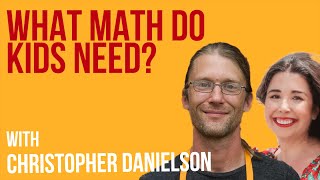
Transcript of a podcast episode (Teach Your Kids) hosted by Manisha Snoyer interviewing Christopher Danielson about math education. They discuss what mathematics is, using ‘Is it or not? Vehicles’ as a playful example to show mathematical thinking; the purpose and practical value of learning math; Common Core and curriculum/publishing issues; informal family math experiences (Math on a Stick); recommendations for parents on early math play and resources (e.g., Desmos, Bridges); and Christopher’s reflections on work and motivation. Tone is conversational and parent-focused with practical examples for families.
Chapters
Hello everyone. Welcome to Teach your kids. We are a podcast and an online homeschooling community. I'm Manisha, a Pre K through 12th grade teacher of 20 years and host of Teacher Kids where we talk about whole child development, homeschooling and the future of education. Today we are talking about math. I am so very pleased to have Christopher Danielson with us. He is the founder of Talking Math with your kids. Christopher is an author, educator and dad. He has over two decades of experience teaching math in public schools and at the college level and has a PhD in in Mathematics education. He's the author of Common Core Math for Parents for Dummies which we are going to dive into. Which One Doesn't Belong, How Many. And he founded Math on a Stick. He founded a large scale family math play space at the Minnesota State Fair and he works on public math which is a nonprofit that supports informal math experiences for families in public spaces. He has a really cool TED talk about the number one and many other fantastic talks about math and really great math lessons. So I think that we should just dive in with the burning question, what is math?
Oh, wow. Yeah. So I think thank you for getting.
Real quick to the heart of the matter.
Yeah, I think probably the best way for us to have this conversation in a useful way is if you do a little math for me that doesn't look like math and then we can talk about why I think that it is math.
I would love to. I'm prepared. I'm excited. I am not self conscious. So let's go for it.
So this is a book that I've been pitching and have not yet found somebody who wants to publish, but it is a ton of fun. So the book is called Is it or not Vehicles. So because this is about vehicles, we could also play Is it or not with lots of other. With lots of other objects. But we're going to do with vehicles. And in particular this is delightful for me because it's going to bring some mathematical thinking out of objects that are we wouldn't think of as mathematical. So we're going to do, we're going to do the logical study of vehicles and along the way we'll have to have to turn vehicles into logical objects. So the first, the first question in the book, it's all yes or no, but then there'll be some things we'll want to discuss. First image in this prototype book, which is available on the Talking Math with your kids website, people can download this and have a good time with it is a dump truck and so I ask you, Manisha, is a dump truck a vehicle?
A dump truck is a vehicle, almost.
Like an iconic vehicle. Right. Like, if you were to see a.
Book titled Vehicle, kid is going to get super excited about that dump truck.
Yeah. And if you were like to do a concept book about vehicles, you wouldn't be surprised. Surprised to see a dump truck on the COVID right?
Not at all. You would be surprised if there wasn't a dump truck in that book.
Excellent. What about a salad? Is a salad a vehicle?
A salad? You know, I have this kind of brain that starts to extrapolate very quickly, which is why I have difficulty on standardized tests. So I think one could make the argument that salad was a vehicle for your nutrition.
Oh, so it's the. It's the means to get the nutrition into your body, is that right?
Yes. But I would say if I was to taking an SAT test, I would say no.
Yeah. And if you were, again, if you had the concept book about vehicles, you saw it in the library, you would. It would be unlikely to have a salad on the COVID Right. So stupid.
Perfect.
Tricycle. A child's tricycle. Is that a view?
Absolutely, yes.
Interesting. So this is a place where people start to disagree sometimes. So I'm going to ask you to flex your mind a little bit. Imagine that somebody said no. And it's. Believe me, I've had thousands of vehicle conversations over the years. What does somebody who says no? A tricycle isn't vehicle. How might they be thinking about vehicles differently from you?
I think they would say it's not powered by an engine and so it's not a vehicle or it doesn't have like a meaningful from here to there point. But I think part of me as an educator, I just really believe in children's empowerment. So it's almost emotional for me already moving forward.
We've got now a skateboard.
Skateboard. Yes.
Is a skateboard vehicle.
Definitely.
Definitely. The interesting people for me are the. All people are interesting. All math minds are interesting. The actually interesting ones are sometimes you run across somebody who says opposites for tricycles and skateboards. So somebody who says yes to tricycle but no to skateboard. And often that's somebody who says, well, at least the tricycle still has, like some mechanics involved. The skateboard, you're just pushing off against the ground like there's no machinery involved.
I guess the thing is, I lived in New York City for 15 years, so I've seen how fast people can go on a skateboard and where they can get to, like, I see these super moms next to their kids on skateboards, like, just zooming past you to.
School, you know, what about a path? Just a path along the edge of a meadow. Is that a vehicle?
I'd say no.
Okay.
That would be a hard pass.
A hard pass. How about an elevator? It's an elevator. A vehicle for you? Yes, for sure. A lot of people, A lot of no's out there because a lot of people think, like a vehicle has to have, like, should have wheels, you know, that you can see and there might be wheels somewhere inside there. Or like, it only takes you up and down in the same location. It doesn't take you horizontally across the planet. And a vehicle should do that. So we're not all. We don't all agree on that.
Everyone has different frameworks.
Oh, exactly.
Oh, yes. Is a horse a horse? Yeah, maybe.
All right.
Not a wild horse.
Oh, all right. Does it matter whether the horse has a saddle?
Not if you can ride bareback for me, perhaps. Yes.
So. So a horse might be a vehicle for one person, but not be a vehicle for another person to the same person. Right. That, that you could imagine a horse being a vehicle for yourself. Very familiar with riding horses.
I might need a. Another person to also guide the horse. I need some accessories.
Broken down bus with no wheels in a junkyard.
Is that not a vehicle?
Not a vehicle. A lot of times we have to clarify the question. Isn't, has it ever been a vehicle, but is it now in this moment of vehicle, you say no. Tell me.
You know what? I think if you had put that image first, I would have said it was a vehicle. But now that I've been exposed to all these things that can move and get people from place to place, my definition has evolved throughout this conversation.
Nice. So there are people who have, like, with the horse, they'll have a no living things clause. Like, vehicle is a machine. It's made by human beings. Horse is a living thing, can't be a vehicle. And other people will also have. And sometimes they'll be crossed over here. But some people will have once a vehicle, always a vehicle policy. And then it's really interesting to think about, like, okay, so we take that bus from the junkyard and we run it through the metal shredder, and then we melt all that metal down and turn it into a sculpture. I don't know, of a salad. Like, still a vehicle. And if not, at what point did it stop being a vehicle? There's like some really essentialism there.
Yeah.
So Boat on a river, floating downstream. Is it a vehicle?
Yes.
Okay. If you get out of the boat, you've got your life preserver on, you're floating downstream. So life preserver, a vehicle?
No. No, I don't think so.
So for me, this all started right, with the question what is mathematics?
Right.
Yeah. Now we know, for me that conversation is math. Mathematics is the logical study of logical things. And if we had talked about, if I had asked you up front for a definition of a vehicle, it's unlikely that your definition would have been. It's a thing that takes you from place to place, might or might not have wheels, is not edible. Like, you wouldn't have had all of the, all of the constraints that the examples seem to bring up. But by the time we get far enough along, if we were to write a definition now, we'd have a whole bunch of things that we would want to include into that definition in order to be able to do that sorting more carefully. And I think a lot of times in. So that, for me, that's a process of turning whatever the object we're studying is your vehicles from a sort of experiential object into a logical object. Right. We're coming closer and closer to what where the separation line is between vehicles and non vehicles. And the beautiful thing about vehicles is it absolutely does not matter. We have no stakes. You have no stakes in whether you convince me. I have no stakes in whether I convince you. It's super easy for me to just step back and if, if you were saying yes to everything being a vehicle, I'm more than happy to present some, some counter arguments. And if you say no to everything being a vehicle, I'm more than happy to present the counter arguments. Like, it doesn't bother me. There's no stakes. But when we get to mathematical objects, there can be some stakes. Right on the. If I'm the parent and I am going to have, I'm helping my, my elementary kid out with some, with some elementary geometry. And there's something about trapezoid, right? Big word, maybe a little bit scary. And maybe I half remember that. Like my teacher had a big thing about whether a trapezoid had exactly two sets or exactly two parallel sides or at least two parallel sides. And I can't remember. And now I start to get, I start to get nervous. And so part of that is because I don't, I don't know, like, I feel like there's an outside authority that's going to make that decision and there are consequences for me like in terms of saving face, like looking intelligent in front of my child or in front of the teacher. My schooling gets brought back. And so it's really hard to have the conversation about how do mathematicians take experiential objects and turn them into logical objects in order to study them logically. But with vehicles, there's no stakes. Nobody cares, right? We can have a fun conversation. We can laugh if you have this conversation. I have it all the time at, at Math on a Stick, which is, you mentioned the beginning, large scale, playful math event, 12 days at the Minnesota State Fair every year. And so a lot of times I'll, I'll have conversations with parents while their kids are playing in order to, you know, just like both buy the kid a little bit more time to play, but also to do a little parent education. Right. So we'll talk about the vehicles book is one of the things I'll pull out. And you can see we're standing next to each other, we're looking at these things. Their kids are putting some tiling turtles together. And you can see for every person there's a moment somewhere along the way where they have to shift and think. You can see that we've engaged a different part of their mind. So dump truck, easy. Yeah, of course. Salad easy. No, of course not. Airplane pretty easy. Yes. We get to tricycle. And now the person's like, because I've never had to do the thing that I'm being asked to do, which is logically study this object that I haven't, that I only have experience with. I have to make a yes, no kind of logical determination. So I think, is it or not? Vehicles is a, is mathematical conversation because we are doing a logical study. We're looking at the consequences of the logical definition that we've made. We're realizing that it's not good enough and we're making it better. Whether that's explicitly or sort of implicitly through our, through our conversation and with new examples.
I think it's just such a beautiful example of how you can use math in everyday life in terms of even when you're seeing something on social media instead of just, you know, getting, having a strong reaction to taking a step back and asking questions and logically figuring out if this is true for you or not or why. And that process can be really fun. So math is really fun. I mean, that was really fun. I feel in my body, I feel more energetic, more excited. So I want to ask you something that many 12 and 13 year olds are asking their parents right now, and you alluded to the fact that math can be very traumatic in schools. There's a lot of memorization, there's a lot of feelings of like, yes or no, rather than fun problem solving. So what do you say to a child who asks you, let's say a 14 year old who says, what's the point of learning math? Which I think is a fair question.
Yeah, absolutely. I was just listening to your podcast relatively recently. Right. And you raised this question.
Yes, I asked this question a lot and I'm still asking it because I still need to know.
Yeah. So for me, I think I would add, I would reframe the question a little bit because I think there are just a lot of assumptions behind what's the point of learning math? Because if, if what I'm asking if what I'm going to defend is you going on a trajectory that goes through algebra 2 and includes rational functions, and its point is to prepare you for calculus so that you can get into, you know, whatever, whatever college it is that you and your family feel is prestigious. Like, that's not something I'm ready to defend at all.
Well, I guess in that case, the point is getting into that college.
Right. And so you, you got to decide whether that, whether that's your point. But for me, but, but I don't, I don't think that's a good enough point. Like, we put so many kids through lots of experiences that are premised on, on some of the things that, that not every kid has as their goal. So I would say that there is a reasonable set of important mathematical both skills and ways of thinking that we need in order to be able to be like literate citizens who can both communicate and make decisions.
You are the illustrious author of Common Core Math for Dummies. Most parents don't know second grade math, which is why they need your book. So you help them teach it. What is your honest take on the pros and cons of the Common Core curriculum? How bad is it? No, so this, this, I mean, how, what do you.
Yeah, this outlines like, those assumptions. Right? I said there are a lot of assumptions behind what's the point of learning math. So math as a field or math as a set of standards? Right, and so you're, you're narrowing us into. To a set of standards. Here. Here's my main, two big main messages on. On Common Core. That book, by the way, was a lifetime ago. 10 years ago. I think I wrote that. I can tell you the story. It's a fun story, but two Main messages. One is that prior to Common Core, in the no Child Left behind era, right, there was accountability for states to demonstrate growth. So all 50 states were writing their own standards. And the way that curriculum is marketed in this country, it's not ideal, but it's the way that the world works at present is that large textbook companies dominate the market. And what they want to do, they. They are interested in efficiency, right? I don't want to have to produce 50 different textbooks. And so what I do is I produce. I'm a large textbook company. I produce a textbook that can be adopted in the state of Minnesota. So maybe it includes, as an example, operations on positive and negative numbers, adding and subtracting, multiplying, dividing positive and negative numbers. Maybe Minnesota standards ask for that in seventh grade, But Texas has their own set of standards and they require adding and subtracting positive and negative numbers in sixth grade. So what do I do as a large textbook publisher? I can either produce separate editions, which is a lot of money and effort, or I can just make sure that everything that everybody asks for is in every year, which in the. In your recent podcast, I was listening to one of the things you mentioned is that the textbooks are heavy, right? That they're giving. Kids have to put that huge textbook into their backpack and tote it back, back and forth. And part of that is because we hadn't agreed as a country on. We were. We had agreed through no Child Left behind that there was to be accountability, right? And testing and 8th grade standard, 8th grade, 4th or 8th grade testing annually. But we hadn't agreed on what the things were that we needed to learn, combined with a textbook publishing system that is national in scale, but needed to be able to be adopted in a variety of states. So one of the important things of Common Core, one of the important missions, whether ticket hasn't ultimately been successful, in part for a variety of reasons, but one of the main missions, and it's gotten us a little ways, was to reduce the number of sets of state standards so that if there is one set of standards and each state adopts that set of standards, then you can produce a Common Core edition that can be. That can be used in a large number of states. So one is just sort of a standardization. By the way, one of the big misconceptions about Common Core was that it was a federal program. Absolutely not the case. I live in a state, Minnesota, that never adopted Common Core in mathematics. So it was definitely a thing that states were opting to, into, or out of. And there are a number of states that did each of those. So that's, that's. The big message was that it was. We were hopeful that it would provide some coherence across states through. Through the curriculum publication industry. The second big message around Common Core is that it. One of the goals was and remains to help educators to make more central the ideas that kids already have about mathematics and to try to push the field in the direction of understanding that kids and math are not blank slates, that kids have ideas, and that part of teaching math is developing those ideas in meaningful and important directions. And that less emphasized, is turning kids into computers. Right. I mean, computers do things, some things very, very well. And a lot of the traditions in mathematics teaching and learning date back to times when computers didn't exist to do those things very, very well. And so if. If most computations that most adults do on a daily basis are done by a machine, that's got to have some. Some consequences for what we teach kids, right?
Absolutely. So I wonder, as a parent, I mean, if you're. I think it's a really difficult concept for parents to get their mind around sometimes, that their child doesn't have to learn everything that's being taught in school, that it's okay to depart from that standardized curriculum. So I'm wondering, you know, if. If a parent comes to me, for example, and says, I just want to feel confident that my child is learning the math skills that they need to know for the future, and they had absol freedom to teach math the way they wanted to, what would you advise to that parent in either, you know, a curriculum to follow or what. What skills would you focus on?
I think modeling, being a critical consumer is really important. I gotta be honest. I have no homeschooling experience. Right. I'm a. I'm a classroom teacher. I'm used to having 35 kids, whether they're college students or in professional development work, large group of teachers. I'm used to doing the intimate work with my own kids and not worried about standards and curriculum. Right. Just having conversations about the math that we see in the world. But I know that that's not what homeschooling is. Right. Homeschooling isn't just improvised conversations about, well, it can be.
And I guess that's part of my question is that, you know, I mean, there are families who just say, you know what? I don't need a formal math curriculum at all. I'm just going to learn math out in the world as it comes to us. I mean, is that enough or do you think some kind of structure and standards are necessary to really prepare for children for the world?
I think that probably it is a very rare parent who is well prepared to support their kids in developing all of the essential like computational skills. Like I'm, I'm here to say that yes, being able to multiply a couple of multi digit numbers is going to be important. Being able to think about why dividing fractions works, like what's going on when we're dividing fractions. Having your mind stretched in those particular ways, I think is important stuff. And I think it's pretty rare parent who is prepared to have those experiences with kids to offer those kinds of experiences. Kids without some kind of external guidance, just as I would have been, I think pretty ill equipped to like do teach my kids to read from scratch. I think there are particular kinds of knowledge that are represented in resources that are developed as, as professionals, as teachers. I think those, those are all, I think that's, that's really useful stuff. And the person who does have those skills already probably isn't really asking me for advice.
So maybe, I don't know. I mean, I think, well, there's, first of all, there's a lot of fear, right? I mean, even if a family kind of feels like, yeah, my child does seem to be learning math and seems capable, but I'm just afraid that they're missing out. There's that kind of intense FOMO around the standardized curriculum. But I would say also in some ways literacy is easier to teach because when a child knows how to read, it's very obvious. You either know how to read a book or you don't know how to read a book. I mean, math is a little bit more complex. I mean, you can see if a child can pay for something at the store, but there's just a lot more to it. And you know, if, if they're going to, you know, be able to do a software engineering career or be financially literate, I mean, it's just, it's hard. I think it's a little bit harder to measure math proficiency than reading proficiency.
Yeah, I don't know enough about reading proficiency to be able to make that compare like, you know, to be able to say one way or the other whether that's a, that's a fair comparison.
Well, you can tell if a kid can read a sentence.
Yes. Right.
I mean it's not hard to, but.
Likewise, you can tell whether a kid can add two numbers. Right. That you offer up to them. And there are lots of situations in the world that you could. That. That would. Where that would become useful. Right. Estimating what our total is going to be at the grocery store. Yeah. Number sets is something. One of the. Just a really fun example that is leaping to mind of not. Not quite answering your question, but is in sort of the same ballpark. Is in my family, we play a game. It's a stupid, silly little game in which if we're ever at a restaurant, Bill comes, you know, it's face down the table or it's in fancy place. It's in one of those little books. Question is, what's the total? And whoever guesses closest to the total feels very, very smart for having grabbing guests closest to the total. We played, I don't know, 10 years maybe. My kids were terrible at it, absolutely terrible. My spouse terrible at it when we first got started. And now everybody is quite good. And it's really fun because it's not. They aren't like running the numbers on, you know. Well, it was this plus this plus that. It's more like what kind of environments are we in? I saw like I had a menu in front of me, so I have a sense of like what the thing I might have ordered might have cost. You know, maybe I'll multiply that by four. Like there's not the. Like the deep accounting. It really is an estimation game and my kids are quite excellent. I still usually win, but. But it used to be like just be off by a lot who's the one?
And I used to always win is a little more paying attention when everyone's ordering well.
So that. Well, yes. Also it's the person who is paying who has the experience. Right. That there are with. Before we played this game, the reason my kids were terrible is they had absolutely no experience with it. It was not a question they had considered what's the total going to be. But now they've had a lot of experience. And I know that finances are something that can be a little bit like math. Like math is often a topic that parents will shy away from. One of some of the really interesting research around math anxiety and how it gets communicated to kids both in classrooms and outside of classrooms suggests that in math anxious households parents, when there's almost no math talk. So anytime numbers, shapes, patterns comes up, parents tend to change the topic. Finances are a lot like that too. I remember being a kid and like asking, wondering how much did my parents make every year? I still have no idea how much my parents made every year when I was a kid, like absolutely no Clue. Except for being able to estimate, you know, what a person who did the job my dad did probably makes now and what that would have looked like in 1980. But it's never a conversation that we had. So of course, I had no, no idea. It's the same with, with kind of everything in the world, right? So it is. It's the per. The person paying the bill is the person who has experience, who knows, when I'm at a fancy place, it's going to cost us 100 bucks. And when I'm, you know, at a, at a Perkins, it's going to be closer to 40. But wait a minute. Haven't been in Perkins for a while and there's been a lot of inflation recently, so it's probably going to be more than I expect it to be. And we give kids that kind of experience just with a simple, silly little game that we play.
I love that. And one thing that strikes me, returning to this question of what is math is, it starts with noting, noting when math is coming up in your life and drawing attention to that and then turning it into a fun game as opposed to turning into, like, pressure around learning or showing what you know. And that's the go to, you know, the restaurant. I mean, I think, like even. And. And that math is also puzzles. It's the wordle. It's, you know, talking about a video that you've seen and ask who funded this video? What's their agenda? What do you agree with or not agree with? It's that logic piece. So it kind of starts by acknowledging, oh, my goodness, there's so much math in my everyday life and how capable is my child of solving these math problems that get me through life? It's a really fantastic way to think about it. So I'm actually not that familiar with desmos, although I've heard amazing things about it from the homeschooling community that this is a math program they really love. I'm curious about math curricula that you recommend to parents and if you could tell me a little bit about Desmos and, and how it works and what it's doing differently, that would be super fun fact.
I'm actually, actually left desmos two weeks ago and I'm starting a new job that I'll tell you more about later. Yeah, so I was a middle school teacher starting in 1994, came to Minnesota for a job that I got in the St. Paul Public Schools, taught seventh and eighth grade, and left that classroom in the year 2000 to go to Michigan State to work on my, on my PhD and the reason for me that Michigan State was appealing is that it was the place where curriculum called the Connected Mathematics Project. Connected Mathematics had been written and they had some National Science foundation funding for making a second edition. So I was a graduate student while we were writing what we called at the time CMP2. And so got a chance as a, as a classroom teacher to teach some interesting new curriculum from the mid-90s and then did a lot of professional development work with teachers around kids, problem solving and thinking in the context of this problem based curriculum. And then had an opportunity to go to Michigan State and work with people who were writing the materials. So that is the experience that I drew on. One of the questions that they were working on was what would it look like to develop a lesson that we could deliver as electronically to teachers that uses the graphing calculator and some associated technologies sort of as the core. A lot of what we were seeing at the time was Khan Academy and similar kinds of things where the paradigm in answer in devices that were going into classrooms, whether it's iPads or Chromebooks or laptops, was putting kids one to one with a device and offering short tutorials and multiple choices or numeric input questions and moving kids, advancing kids through a curriculum that way. So it's very much like you would see classrooms full of kids that had everybody on their own laptop with their headphones on. And it looked to a lot of us, it looked like a very isolating experience. And one of the great hopes I think, of public education is having kids who interact with and learn from each other and about each other. Right. And so we wanted to ask and start to play around with what would it look like to use the devices that are in classrooms and the networks that they're hooked up to, to use those in fundamentally different ways. Are there ways that we could use them to connect kids to each other, to connect their ideas to each other, rather than to separate them out into, into their individual little buckets without very much human interaction. Old school folks who grew up in the 80s and 90s may remember something called Geometer Sketchpad. This is now the desmos has an equivalent to that in their geometry tool. And then the other portion, the larger 2/3 of the company became Desmos Classroom and was acquired by a textbook publisher called Amplify. Most recently I was working on the geometry curriculum, high school geometry. And so as, as desmostudio was building out the geometry tool, we were always in touch with, with our former colleagues asking about you know, and both asking about what capabilities they were working on, but also directing the needs for curriculum. You know, if we're going to. If you're developing a tool that's not going into a curriculum, you might go in one direction if it is something that is, you know, you need kids to have a particular kind of experience might introduce different kinds of capabilities.
I just think there are so many parents who are craving math games and exercises they can do with their young children because I think parents want to get their kids excited about math and it can be challenging sometimes. So it seems like there is a really great purpose there.
Yeah. So this means I have three weeks between having left one job and starting the next job. Some lovely downtime. And so that's always. Anytime I have some downtime is always a fun, creative space for me. So the parents you have just described will be very excited. I have done a little bit of crowdsourcing and then curating of the crowdsourcing in answer to the question, what should I give a kid of various ages as a mathy gift in this gift giving season for so many folks? And so I'm in the middle of curating that super fun lot of. I encourage people who are submitting to think broadly both about math and also about gifts. And so curating that and doing some writing about the things and making sure all the links work and everything has been a ton of fun. And that'll be coming out. I assume this. It will already be out when this podcast airs, but goal is to have it out the morning of Black Friday.
Yes. I mean, I think a lot of parents will be really interested in that. And I think, I mean, we might have already touched on this question, so I don't want to rehash it, but I do have a lot of really caring parents who care very, very deeply about their very young child, ages 3 or sometimes 2, in developing math skills. And my essential attitude towards this is don't even worry about it till they're seven. But I cannot, you know, change a person's mind. And so I wonder, you know, I mean, you are kind of a specialist in that area. I mean, one dad was telling me, like, I just can't get them excited about learning math. I'm so frustrated. And he's a brilliant, you know, software engineer. He loves math so much. So how. What advice would you give to these families who want to get their young children excited about math? I mean, I try to tell them about, you know, child development and abstract thinking, but.
Yeah, well, I'm actually Gonna. I am. This, this is a question I live for, and I'm going to disagree with you. I think, I think, I think wait until 7 is the. Is the wrong answer. But I also don't think that worksheets and skills assessments are the right answer. And so the thing that we, I think a thing that we know kids don't get enough of in, in our culture is open opportunities to play with math ideas and a wide variety of examples of math ideas and of mathematical objects that are worthy of discussion. So I'm going to show you an object that I'm super fond of. And it is, it's a shapes puzzle that I developed. Hexagons, says across the top, and then there are three by three array of colorful hexagons. And, you know, they come with hexagons that you can, you can put into the little frame. And there's some fun relationships built in among them. And we have some of these as well as some very similar spirited other kinds of shapes puzzles. One that's titled ellipses and one that's titled conic sections. But they're built for. I mean, you can see the size of these things, right? They're big and chunky and brightly colored. Like, these are made for very young children, right? Toddlers. And so we have a bunch of them out at Math on a Stick. And parents don't have to know that there's an agenda here, right? It's a thing that kids, young children will pull up to Math on a Stick, hop out of their strollers, and they'll see these colorful things. Like, they know these are built for them. And so kids playing with hexagons. And often you will hear a parent remark, wait a minute, are these all hexagons? They don't look like hexagons. And pretty soon, like the parents and the child will be counting the sides, right? So we have in mind, and like almost every time that a child has heard, if they've heard the word hexagon at all by the time they're two years old, the only thing they have ever seen when they've heard that has been this guy right here, right? Your regular hexagon. All the same. All sides are the same length, all angles are the same measure. It's highly symmetric. It's a lovely shape. But we do that so much to kids, like, show them only the most iconic example of a thing and not at all any kind of variation. And so just like simple things like using the word hexagon, drawing a bunch of Drawing a bunch of hexagons. Triangles are the, are the other thing. Almost anytime a kid sees a triangle, it's, it's equilateral, right? Has all sides the same length and it's sitting on its base. And so you'll talk to a 4 year old kid and it's not at all uncommon or kid in kindergarten. It's not all uncommon to hear a kid ask a child what's a triangle? And they'll say it's a shape that has three sides, which is a reasonable definition going back to vehicles. But then you show them like a tall, skinny, pointy triangle that's balanced on its point and ask if that's a triangle. And they'll say no, because it doesn't look like one. Triangles don't look like that. And so you can have this logical. It has three sides but not actually apply that because you're so. Our brains get so focused on the, on what things look like. And because they've never seen, they know they're not wrong. All the triangles they've ever seen have three sides. But none of the triangles that they've seen and heard people call triangles are in different orientations or have different side lengths. Tall, super skinny ones or super wide ones. Like they just never see that. So they don't have any idea that that's what triangles are. So I would say that the idea what, what we want to do with young children is play with these ideas. Whether that's by drawing, whether that's by finding good resources that let us play with those ideas. Finding online resources, like there's a lot of stuff out there, most of it like, but using a good filter and most of the stuff that you'll see. I have an ongoing thread in, on Twitter in which every time I see like a, a photograph of a, of a, of like a politician or something started with a Boris Johnson. When he was Prime Minister of Britain. There was a, he was in a classroom making some pronouncement about education and I could see a shapes poster in the background. I'm like, I bet, I bet it's going to be an equilateral triangle on its base. So I zoom in on it. Sure enough, right behind Boris Johnson is that equilateral triangle. So yeah, having that like as a filter for the resources that you select. We understand as a society that kids can, kids can process deep narratives, right? They have really rich children's books with really rich ideas and interesting characters even for young children, and we don't do that for them. In math, we offer them a shapes book and it says triangle on one page, square, rectangle. Never talk about relationships or giving up kids opportunities to play with them.
I used to translate the plays of a French playwright who used to write, who he still writes very scary plays for kids. Children love to be afraid. We really don't give them credit for their, their incredible capacity. Yeah, I'm curious about, you know, you've worked for Desmos. I mean you've been in the tech world of math and you build these wonderful physical games and I think some parents would love to see math apps that were as addictive as video games. And I think that adaptive learning technology has a long way to go. So I'm curious to hear your thoughts about adaptive math games that are online and you know, should we be striving for these really addictive mathy video games? What are your thoughts?
I don't mind it. I think about like what's the most interesting work for me to be doing. And so for me, like there's, there's, for me it's always diversity. So I've been working in the tech world, right, where day in, day out we're producing things that sometimes paper lessons. But largely two thirds of the work of our curriculum is digital materials. And I need balance, right? So I want to also make some things that I could put physically into kids hands. When I wrote the Dummies book, one of the most bizarre professional things I have done in my life. It's a machine and so it got written in 12. They're like the way this works is got 12. We assign you an editor, you've got 12 weeks, quarter of the book is due every three weeks. And so like you'd write, I'd write the, you know, biggest term paper apart from my dissertation, like the biggest term paper of my life. Quarter of a book, turn that in and now boom, it's time to start the next quarter. Very bizarre experience, but it was very word heavy, right? And so the next spring I put together which one doesn't belong. Almost like every page in the book says which one doesn't belong. And there are four images, right? So very image heavy for me. I always find that there's, that there's that balance and I think that's important in all aspects. So if you've got kids, if you've got kids who are, who are super into into video games and apps and media, I think there are, there are some great opportunities to introduce some more mathematical play into that, that diet. But I'm also If you have kids who are more into to having their hands on things or to drawing on physical paper, again, I would go for whatever the kid's already into. Like, are there ways to get more mathematics in there rather than trying to send a kid who wants to work on paper over to an app or try to always draw the kid on the apps off of it. I think some balance is important, but I also think being able to capitalize on what kids are interested in is important. But your question is about apps. There are, I don't know, just anything that asks kids to be creative and playful with shape, space, numbers, patterns. Minecraft and Legos are amazing for spatial visualization. So if kids are intrigued in that way, just know that they are going to be developing whether it's the physical or the, or the digital Minecraft. Like that is super helpful for, for kids in their, their mathematical development. There is. I haven't looked in a while because my kids are older now. My, my son is a sophomore in college, my daughter is a junior in high school. So I haven't looked at like at the, the app side of things too much. But there was a guy who's doing great work and I'm sure his apps are still up. Karsten something Math doodles. There's like a series of them and that was fun because they had, they were beautifully, they're beautifully designed and they both had the. You could either do it under time pressure or not under time pressure. So there were some fun, puzzly aspects. If you're a kid who wants like that challenge, I'm going to do it faster than I did before. It's there for you, but it also valued like the kid who just wants to be able to sit back think. My daughter and I are now we play wordle. You mentioned wordle and just like with the receipt game, like she was pretty terrible at it for a while, but now she's pretty good. And we. One of the things I love about wordle is like you don't have to have any kind of time pressure, but you could put that on yourself, right? You could say, I'm going to get it done in two minutes and set your own timer or whatever. And so it's a thing that we don't do at the same times. We don't compete that way, but we do. You know, she'll text me at the end of her day. Did you do the wordle today? What'd you get? How many, how many, how many words? How many words did you need to get? We'll compare strategies. And so those kinds of conversations, like things that will support those kinds of conversations, I think is the direction I would want to point folks to.
Fantastic. I mean, I just, I love the. How you put the emphasis on problem solving and demonstrate how actually your children is learn. Your children are learning math when they're playing Minecraft in the terms of the spatial and the visualization. And it's just really important for parents to keep that in mind that, that natural play is really fundamental to their foundation for math. It's not all about mastery based learning of everything going in a specific sequence. According to the school standards. For parents who are really interested in kind of building just like really diving into the skills that children need for math, is there a framework that's been proposed that you think is better than Common Core? Or does such a thing exists? Or would you have any books you'd recommend for parents thinking about what kind of skills they might want to support their children in developing?
Yeah, I mean, so I wrote the Common Core Math for Parents for Dummies because at the time that Common Core was coming out, there were, there was so much conversation, so much of it uninformed. Like there are, there are valid critiques to be had of, of the standards, but they're not, they're not the biggest broad strokes. You know, kids are being taught nonsense. Nobody cares about, about multiplication and division. Like the kinds of missed, kinds of large critiques that we were seeing were not based in what the actual standards were. And so we weren't able to have a conversation about how might we actually improve these standards. Instead, it was all a lot of debunking. And so like I still say like the. I wrote that book for a reason. Right. And that's the reason. So I would say dig into Common Core Math for Parents for Dummies. Pretty sure it's still available online. It's a thing that's often in libraries. Go grab it. Anybody who picked it up in good faith with the kinds of questions that you're posing, what skills are important? How do they build on each other? Could get, could, could walk away from.
Having read that could understand why this framework, the positives of the framework. I love that it's so important and I think Common Core really is bashed too hard. There's a lot of goodness in it and it can be helpful for understanding what kind of skills your kids can learn. If you're homeschooling.
I would look at Bridges curriculum. There are a couple other large scale curriculum projects out there that I think have done responsible work. But I think your basic, like, hold Prentice hall, those kinds of things.
I love that. And I think it's just an important distinction that it's Common Core. Of course, like any. It's hard to create a set of standards for all students, but there is a lot of goodness in the standards. It's the way that they've been implemented and perhaps also some of the standardized testing. And that has. That is part of the problem as well.
Yeah. Testing is not. Common Core was a response to testing. Common Core did not create the testing. Right. No child left behind first. 50 different states doing 50 different things. Common Core was an attempt to make. To make things more coherent. So if I move from Texas to California, I'm still studying the same stuff anyway.
Sorry. Right. Which is a problem in and of itself and why community driven education is so powerful. But that's a whole other topic. And I just want to say I think that these resources you have developed are so wonderful. I know that there's a lot of parents in our community who are craving more resources for early childhood education, and this seems really to fit the bill. So I think they're going to be really excited about that. And I mean, thank you. Because I've had a lot of complex questions about this and it's been really hard to find the information that I need about Common Core, about the point of learning math, about how to be sure that your child is learning what they need to learn about early childhood math. And so it's been really rich for me to listen to you and I, I really thank you. So, Christopher, I like to finish up every interview by asking my guest, what is something interesting you're learning now? And a great answer would have nothing to do with math or math education or anything we've talked about, because it's just about being passionate about learning.
I'm learning a lot about myself. The. For me, the. When I was working at Desmos, we were a startup. We had about 60 people. And when we were purchased by Amplify, much larger organization and our, you know, slide, we use slack, we had 60 people in our Desmo Slack. And then there were 3,000 people in the Amplify Slack.
Extraordinary.
Yeah. And so one thing, like, I'm learning a lot about my own, like what motivates me and how I get through the world. Understanding how I have had the feeling over the last year and a half. I haven't articulated this to anybody in quite these words before, so these are new thoughts coming out. But I would say it's not a coincidence. Sorry, it's going to go on for a minute. It's not a coincidence that one of my first books was titled which One Doesn't Belong? I often in school felt like, like a lot of times I, I wasn't. I was that square peg trying to go into a round hole. Like I, I had ways of adapting to it and I see this a lot in my own children as well. But that idea of being able to figure out where is it that I'm going to be able to thrive and understanding what sorts of conditions make that important. And so I remember in school feeling like it wasn't a place where I thrived. It wasn't a place I really thrived in mathematics or really anything except writing. I was on the student newspaper and there was a great deal of autonomy and interesting results. Right. We published a paper every week. It wasn't very long. It was the front and back of like 11 by 17 sheet. But that was motivating for me, right. Knowing that I had a voice and some autonomy and interesting colleagues, other students who were doing the same kind of writing and creating conversations. And that's a lot harder. My experience in the short time that I've been at a much larger corporation is that this is a lot harder to do in a large American corporation. To feel like the things that I'm doing have an impact that on the things that other people are doing. To feel like I'm learning from the people that I'm working with on a regular basis and have a certain amount of autonomy in how my efforts contribute to the larger whole. And so I'm excited for my new gig where we are very small. I'll be the first full time employee. There's an executive director, but it's a family foundation and she's in that family so she doesn't draw a salary. She has some, they have some interns and some a couple part time folks. But it'll definitely be a place where I'll have some autonomy, some amazing collaboration and opportunities to interact in exciting ways. So what am I learning? I'm learning about myself, what motivates me, how I can can function in the world of work, which is something that we would love for all of our children, would we not?
I love that. And you're using mathematical skills to come to the understanding, the metaphor of the peg in the hole. I just, I feel, you know, I'm in the same pathway in some ways and trying to understand and where I find my power and my purpose. So it's just wonderful to hear that from you. Well, Christopher, this has been so enlightening, and I just thank you so much for being here with us today and sharing all your wisdom. And I can't wait to see what unfolds in this new initiative. And we'll be sure to include all the links to your website and the beautiful math games and products you've built so that parents can enjoy them.
Well, if you or your listeners ever find yourself in Minnesota in the 12 days leading up to Labor Day, Minnesota State Fair, one of their slogans is 12 days of fun ending Labor Day, which starts on a Thursday, runs through two weekends, ends on Monday, Labor Day weekend. Ever find yourself there? Come, come out and say hi. We run on volunteer time, hundreds of volunteers staffing hundreds of volunteer slots over the course of 12 days. We're open for 11 hours a day. Come out, say hi, play some math with us, and we can have an extended or as long a conversation as we need about what Matt, math is, whether airplanes or vehicles or.
I love that. I'm totally in. It sounds great.
Outstanding.
All right. Thanks so much, Christopher. You enjoy your day, all right?
You bet. You, too.
More from Manisha

Contributing to Florida Prepaid Plans (2026–2027) | Step-by-Step Guide for FES-UA Families

Contribuyendo a los Planes Florida Prepago (2026–2027) | Guía Paso a Paso para Familias FES-UA



Finding Providers & Services in the Marketplace (Families) | Step Up For Students (2026–2027)

Encontrando Proveedores & Servicios en el Mercado (Familias) | Step Up For Students (2026–2027)




