Climate Education and Hope is a Verb with Elizabeth Bagley
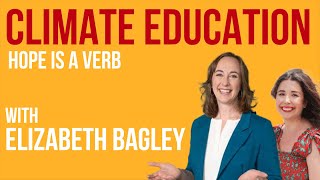
A recorded interview (Teach Your Kids podcast / YouTube) in which host Manisha Snoyer speaks with Dr. Elizabeth Bagley (Managing Director, Project Drawdown) about climate education, homeschooling, and practical climate solutions. Bagley emphasizes teaching solutions (not only problems), cultivating hope-as-action, and implementing a ‘‘tapestry’’ of many interacting solutions rather than one silver bullet. She highlights Project Drawdown resources (the 2017 Drawdown book, a 2021 Climate Solutions 101 video series, a catalog of 93 solutions, place-based roadmaps, Stories/Neighborhood program, job-function action guides, and webinars at drawdown.org). Practical advice for parents and educators includes centering solutions in curricula, focusing on local civic action (e.g., city composting programs, sustainability commissions), supporting youth participation in networks (Fridays for Future, Climate Generation, Wild Center youth summits), using hands-on and project-based learning, and leveraging educational games and challenges (video games, Playing for the Planet, Daybreak board game, EcoChallenge, ChangeX). Bagley also describes local wins (creating a sustainability commission and hiring a full-time sustainability coordinator that unlocked federal funding) and encourages listening, empathy, and collective action to address climate anxiety and grief.
Chapters
Welcome to Teach youh Kids. I'm Manisha, a Pre K through 12th grade teacher for over 20 years and a tech entrepreneur. On Teach youh Kids, we talk about whole child development, homeschooling, the future of education, and most importantly, how to optimize your child's education by tailoring it to their individual needs socially, emotionally and academically. One big concern driving many families to homeschool is that their kids are not learning the topics they need to be learning in school. And one of those hot topics is climate change. Today we're talking about climate education and how you as a homeschooling family can educate your children and yourself on climate change and climate solutions. Hopefully you'll take away from this conversation some strategic actions you can take to alleviate some of the anxiety you might feel about what the future will look like for your kids. I'm so honored to be joined by Dr. Elizabeth Bagley. Welcome, Elizabeth.
Hey, Manisha. It's such a pleasure being here. Thank you for having me.
Of course. Elizabeth Bagley is the managing director of one of my favorite environmental organizations, Project Drawdown. It's the world's leading resource for climate solutions. Even as an environmental studies minor, I found all the info about climate change really confusing and conflicting. And I love Project Drawdown because of its evidence based, clear, scientific, strategic approach to solving climate change. Project Drawdown's mission is to help the world stop climate change as quickly, safely and equitably as possible. So, Dr. Bagley, Elizabeth holds joint PhDs in environmental science and Environment and Resources and Educational Psychology. She's an experienced environmental educator, interdisciplinary environmental scientist, and a learning scientist. A few highlights, she's created sustainability courses that have reached tens of thousands of learners, worked as a naturalist in Glacier national park, created professional development courses for teachers, and I think a lot of you are going to appreciate this. She's designed the science content for video games at LeapFrog. We are very big on educational video games here. So, Dr. Bagli, could you tell us a little bit about especially Drawdown Learn and your work in K through 12th grade schools?
Absolutely. Well, and I'm glad to hear that educational video games are a shining star in your world. I mean, just.
We were gonna talk about that.
Okay, we'll talk about that at Project Drawdown. One of the. One of the things that we realize that, Manisha, you touched on is that so much of what we learn about in school, so much about the conversation in the wider world around climate change is focused on problems which often can lead to doom and despair and a Lot of apathy and people not stepping up and taking action and making their communities better. At Project Drawdown, we really focus on the science behind the solutions, where we're cultivating hope, we're cultivating a sense of possibility and opportunity. Right. We are living at an incredible time on this planet where we are the, you know, we're part of the generation that gets to reinvent these systems and stop climate change. And so in order to do that, we need to know about the solutions. So hypothetic drawdown. In 2021 we released a video series called the Climate Solutions 101, which was all about six unit video series. And I can send the links later if you want to share that with the listeners.
We will definitely include that in the show notes.
Oh great. And we really unpack the science behind the solutions. What can sometimes happen in the world is that we hear about a shiny object, we hear about a potential climate solution and folks get really excited about it, but the science might not pan out. And what we've done at Project Drawdown is really think about, well, what's going on in the atmosphere, what are the main sources of the heat trapping, greenhouse gas pollution that's causing climate change? Right. Where are they coming from? Where are those gases coming from? And once we know that, right. We can then layer on what the solutions are. So when we know what the sources are, we can connect the solutions and we can make sure that the solutions are actually addressing, stopping those sources, supporting sinks. Those are things like land, ocean and engineered sinks. And we can make sure that we're supporting society in that space.
Fantastic. And I am really curious about your research process because it feels like, at least from what I've observed, people tend to get really attached to single solutions. So they're doing research and they find this thing that could work and then that becomes their star that their whole organization is focused around. How do you kind of keep yourself in check as an organization?
In 2017, Project Drawdown released the book Drawdown. And that book opened up a whole new world of climate solutions for folks, showing first of all that there are climate solutions and, and that they work. And to your point, some of the initial, and still continue to this day, interest in the book was in the rankings of solutions, which ones have the greatest potential to reduce or avoid heat trapping greenhouse gas pollution. But it was also in solutions that people really gravitated towards. And while I think, you know, feel free to gravitate toward whatever solution works, what we know to be true is that we really need A tapestry of solutions, right? We need all of the solutions. We've identified 93 solutions. We need all of them implemented as quickly, safely, and equitably as possible. And so our next iteration of our research, our evolution of the research, is really focused on what we're calling, drawn on roadmaps, for example, that looks at what are all of the solutions that make sense in a particular geography, let's say, just for the sake of argument, Southeast Asia, related to food, agriculture, and land use. We're looking at a geographic timescale, we're looking at geography, we're looking at a timescale which things should be prioritized. Who are the actors who are best positioned to implement those solutions? What kinds of accelerators need to happen in order to get those solutions into place? So while it's not. While I'll never discourage people from being excited about a particular solution, I think it's helpful to sometimes go to a little higher level and say, well, how does that solution stitch together in this larger tapestry of solutions that we need to implement in our communities, in our regions and globally in order to stop climate change?
Fantastic. I just love it so much. And I'm curious to know. I mean, it seems like unfortunately, a lot of the work has been done around proving that climate change is real. After originally everyone said, okay, we have this problem, and then it became politicized, and now I think people are coming around again. But what if. What. How do you, you know, try to convince people who are resistant to the idea of climate change that it's real, who have levers in the policy world? Or is that even something you're attempting to do? How do you open the conversation in a new way?
I think there's a few angles I'll come at that question with, because one is some work that Dr. Katherine Hayhoe has done. I would highly recommend folks check out her YouTube series called Global Weirding. That would be a great resource for homeschooling and also just for how to understand climate science in a really digestible way. Catherine is a climate scientist. She's also the chief climate scientist at the Nature Conservancy. One of the things that she talks about is the importance of just talking about climate change and when we talk about it, aligning on values, because so often we all ultimately want the same thing, right? We want to have healthy, clean air to breathe, clean water to drink. We want our children to have, you know, have access to nature and to be able to thrive on this planet. And if we start with values and aligning there, we can often have much more productive conversations. Now when we think about the percentage of the US population in particular that denies climate change happening. The George Mason University and the Yale center for Climate Communication has been doing a really interesting study called the Six Americas. And they've been looking at what they call Six Americas over the past decade. And that goes from at one end of the spectrum, people who are very alarmed about climate change, and the other end of the spectrum, people who are denying climate change. And we've seen a fascinating shift even just in the last year, but across the last decade where we see the percentage of US folks in the alarm category increasing and in the denial category decreasing. So when we think about where do we want to put our energy right, we actually, we all have limited time, limited energy with how we spend our days. We've decided not to focus on the denialists, right, but rather to focus on the people who are alarmed and concerned, aged and really want to do something right. That's where we're hoping to get to a tipping point for people taking action to stop climate change.
I love that that's such an important area of focus. And I guess in my, maybe we could make it even more specific. So I, I can think of, you know, people, two groups of people in my life. One is a group of people, I will have to say, like in my meditation group, who talk about climate change in the most depressing, defeatist way you could ever imagine. And even just bringing in the idea that there be solutions to climate change, personal action and also technology to them is like, that's almost controversial. Like, it's almost like they kind of want to wade in the reality of the apocalypse. And if you're, and if you're not agreeing that there's an apocalypse, you're in just total denial. And I have a lot of difficulty with that group. And the other kind of group is, I'll talk to my friends about it and they'll say it's so great that you care so much. Like, and that's just kind of the end of the conversation. Like you're such a good person to care about climate change. I'm like, well, you have a 2 year old. Don't you want to, you know, make sure that they grow up in a healthy world? And it's just you're such a good person. So how would you, you know, if you were in my position and you wanted to kind of galvanize either one of those groups, is it, is it a lost cause? Should I be focusing elsewhere? What what advice would you have for me?
Well, first of all, I will deeply empathize with you because, wow, is there a spectrum of ways that people process emotions? There's a lot of fear associated with climate change and that's very warranted. I'm not the best person to talk about climate grief. I would recommend Britt Ray's work, Jen Dredd. She writes really brilliantly about that work. But I will say, just as a human who has emotions and works in climate change and in my fun life, who also works on climate change, as a member of the sustainability commission in my town, I actually go back to the values piece. So, okay. For your friends who are just kind of patting you on the head and saying you care so much.
The cheerleaders.
So one thing, and I'm, I'm hesitating a bit because I don't want to come across as, you know, you need to change their mind necessarily. But I really encourage us to always try to find that common ground where we can move things a little further in a direction towards solutions. Right. So, for example, this is not a climate solution, but let me just give a community level example. Let's say that the city council, where let's. Assuming that your friends live in the same town. Right. Let's say that there's something on the agenda that relates to, that relates to climate change.
Composting in the city, for example. Getting composting.
Thank you. As I was struggling with.
I just talked to your colleague Dan Jasper, so I'm ready.
Thank you, Dan, for tossing me a softball from this podcast. So could you invite some friends to come and say, hey. So they're like, manisha, thank you. I'm so glad you care about this. Then you're like, actually, I'd love for you, I'd love to invite you to come to a city council meeting. Let me make it super comfortable for you. Here's what you can expect. And it's important for our voices to be heard. And this is a venue for us to do that. So getting people into the public process. Right. So just offering an invitation with your meditation friends. You know, I have, I have definitely encountered a number of people who are very much in a. They're in a tough spot. And I don't know that I'm the best person to get them out of the tough spot by directly addressing their concerns. Because if I go point by point through their view of what living in the apocalypse is, facts are not going to change their minds.
Right.
It's not going to change their hearts. I think I tend to try to listen and I try to live my values and live in a space of hope and possibility as a role model. So I am happy to listen, happy to sit with someone and really empathize and happy to show up and do the hard work and show that hope is a verb, right? Hope is not a noun. It's not something that we just, it's not a thing. It's an actual acting on the climate solutions that we know work in the world today.
That's such a beautiful sentiment, Elizabeth. And you know, I can feel myself in the presence of these two people as we're talking and thinking about the mom with the two year old and saying, hey, you know, do you want to come to this town hall with me? And afterwards you can come over for vegan charcuterie and wine, you know, and, and I think that, you know, maybe she'll be interested and piqued and then, you know, for a friend who's wallowing, just like really trying to be present for them and, you know, accepting their grief, but also reflecting that that's not how I feel, you know, and I just, you know, I can really imagine how difficult it is to have that feeling. And, and you can even invite them to participate in an action that feels effective and, you know, and say, like, you know, I know that you don't think new technology is the solution, but I'm really excited about this and I'm glad that something's being done. I love that so much. So.
Oh, sorry, one more thing to that, because I love what, what I heard you saying also that I, that I didn't really hammer home is climate change is a global problem and it can feel so overwhelming and so hard to figure out what levers we can and should pull and whether or not they even matter. And for some folks, that brings them into a state of utter despair and despondence. Right. And I think one of the antidotes to that is a local action. And when I talk about local action, I talk about figuring out what is in the locus of our control. Where are things that we can make better? How can we be more resilient in our own communities? How can we help adapt to and mitigate the climate change that's already happening in our lives so that we do feel like we have control over something and so that we are taking steps towards the future that we want instead of just being a victim of the impacts of climate change.
I love that and I feel almost that that involves both courage and humility in that you are recognizing that me in my small town showing up to this town meeting, there's going to be someone else in another small town like me who's also going to show up for their town meeting today and kind of having trust and faith in humanity and kind of ease in yourself, that it's enough to take that smaller step in your own town, even though it's.
A global problem to know that. I think back to when my boys were young and on a particularly hard day, I could wake up and imagine the parents around the world who had kids born on exactly the same day who were probably up against some of the same challenges that I was up against and feel strength and support from those disparate folks all across the world. I love that it's not that we are acting singularly, but that there are so many people around the world who are doing incredible things every day. And I think, Manisha, that's a story that's not told around climate change. However, I will encourage folks to check out drawdown.org and specifically our Stories program. We just launched today a series of stories about community members in New York, New Jersey and Connecticut showing up in their jobs and their roles and implementing climate solutions. None of those folks are climate scientists. I don't even think any are scientists. But showing how every one of us has a role to play in creating the future that we want. And so our Drawdowns neighborhood program has done a really good job of bringing more people into the conversation about the great work that's happening all around the world.
I have to say that just from the beginning of our conversation to now, I feel lighter in my body. I mean, being with you, it's really like being in the presence of light. And even when we were about to talk, I started just to feel kind of the weight of climate change and how overwhelming it feels. And, you know, on one side, am I doing enough, on the other side, can I. Is there really any point in doing anything? I mean, Elizabeth's taking care of it. And now just talking to you, I feel, you know, there's this kind of integrity you feel when you understand science or you understand something that that's happening, it impacts you emotionally, and then you take the right course of action. I feel like when you do that, you're. You're just more whole as a human being.
That was beautiful, Manisha. And I really appreciated the humility. I'll add vulnerability. Right. This is a space where we can. It's okay to have different feelings every day, right? The National Climate the fifth national climate assessment came out yesterday and that's full of a roller coaster of emotions for those who want to check that out. Right. And recognizing that it's important and okay to feel the feelings and to find our way through that space to what we're uniquely positioned to do and who we can do that with. Really encouraging people not to be alone. There's a great two great resources I'll share. One is a website called EcoChallenge.org and the EcoChallenge folks do number of digital challenges. So that's something. You could even try that with your meditation group if you wanted to.
Maybe my homeschooling family, that might be a better. I need to give myself a win.
Right?
No, I love my meditation friends who don't want to give their own impression.
No, I love them too. I think that having a challenge where you can see, see, first of all, they've done a lot of research around what are some of the most impactful individual level and community level actions that we can all take. And they make it fun. So that's@ecochallenge.org and then another group that's doing great work is called Change X. So Change the letter x.org and they take community level action. So they take great ideas in communities. So if we go back to something like composting, they actually have a five point blueprint for how to create a community fridge in your community so that food doesn't get wasted. And so they have how much time might it take, how much money might it cost? What does it look like over time so that you know what you're committing to? And I love visiting those pages because it gives me hope and it gives me a sense of camaraderie and with other folks who are already stepping in and doing incredible work in this space.
That'S just so wonderful. So, you know, when I think about climate education, when I first learned about climate change, I was 16. It was many decades ago and I felt paralyzed and also that I basically had to just drop everything and focus on this so we didn't all die in 10 years. And so that kind of urgency still with me. But one, you know, one thing that I have thought about a lot over the years is just how important it is to get climate education in schools. And you know, I've spent a lot of the last seven years in the homeschooling space and vetting different curricula and there's just still so many curricula out there that teach neutral science, which is basically like climate change. Might be true, it might not be true. There's changes in the weather when actually the science behind climate change is very direct. Direct and simple and very confirmed in the scientific community. So that is frustrating. I'm sorry to take it in a negative direction after you brought so much hope in, but, you know, I guess. And then the other thing I've seen is, you know, in New Jersey, parents are overly, overwhelmingly in favor of climate education in the classroom, and yet they have not been able to get in the classroom, even though parents are really pushing for it. So I'm wondering, I mean, obviously it's politicized and that's part of it, but maybe do you think that it's important that we're teaching our children about climate and if so, why?
Short answer is yes, and a much longer answer, which is probably why you had me on in the first place.
Parents are thinking that they want to teach it. Should they? Why would one teacher teach that to one's child?
Yeah, well, so I think another challenge is any climate curricula that shows up in kind of K12 in the K12 space generally doesn't include solutions and generally doesn't include the youth being part of creating or implementing those solutions.
Right. So it's very defeatist.
Absolutely. So that would be one of my calls to action, actually, for your community too.
I love that.
Yeah. Find ways to really integrate and center solutions and opportunities for creation and implementation of solutions in the curriculum. I think that's something that is, is not, is not widely done yet in terms of. So here, here's another thing that I think is really important, which is that we absolutely need a scientifically literate citizenry. Right. And I think we've slipped a lot over the last couple of decades in that space. And so that's one thing that frightens me, where there's not the trust in science and the scientific process that there once was. I also know that most of our science learning across our lifetime happens in out of school time. When I think of, for example, a place I used to work, the California Academy of Sciences in San Francisco's Golden Gate park, there are so many incredible opportunities in the informal science space to learn about climate change and climate solutions and to take action that aren't within the confines of a traditional school, that me a lot of hope also when I'm on a board of a science center here in my town and I continue to have conversations about how can we invite people to talk about climate change in this trusted space. We know that museums at zoos and Aquariums are deeply trusted spaces in the US Much more than the media, for example. And so maybe while it's important to teach about climate solutions in particular in schools, I think we can also look to other spaces to help support that learning and that engagement around that topic.
For sure. I mean, I also think about internships as a really great way to learn about these issues and solutions as well. So are there, I mean, you kind of alluded to the idea that maybe new curriculum needs to be created for kids. Are there any existing resources that you might recommend for families who want to start teaching their children about climate and solutions?
I guess, depending on the age group.
Right.
There's different, there's a lot of different content and I can send you some resources afterwards. Noaa, the. Yeah, the National Oceanographic and Atmospheric association has a website of that that's really a, a convener of great climate science content. So I was a high school science teacher. I should disclose that I taught in.
So many accomplishments in your resume and it was just too long for me.
To list them all.
But I mean, your teaching experience is pretty extensive.
Yeah, I taught in high school, I taught graduate school.
And you've taught teachers as well.
I taught teachers, Yep, you got it. And when I taught high school.
And.
This is probably, this is something your audience knows very, very well, the more real world project based I could get, the better because ultimately we're training young people to be able to meaningfully contribute in society and reach their highest potential. And to do that, let's give them opportunities to try on different roles in a space that's safe and supportive and relatively low risk. That's why I designed video games.
Right?
I designed video games about climate change so people could mess with a whole bunch of different variables and not ruin things in the real world. But to start to understand trade offs and start to say, okay, if I do this, then here are some of the consequences of those actions. Right? And really being able to explore that possibility. Space, I will say.
Okay, I'm sorry, we have to stop though, because we have to talk about this. These video games that you designed about climate change, start at the very beginning and just I want to hear every single thing about them. And especially like how video games can encourage systems thinking about complex environmental topics.
Well, now I need to just send you my dissertation because I haven't thought about that in a long time, but I could geek out about this for a long time.
Okay, so the video games, how did it start? Where are they? How can we play them?
So none of Them. So full disclosure, they are not on a shelf anywhere to buy. This was all part of my graduate work at the University of Wisconsin, Madison. So when I left teaching, I taught for a couple of years in Louisiana, went to graduate school, had no idea that educational psychology was even a thing. I was studying conservation biology and sustainable development and ended up being interviewed by a graduate student who was designing a video game about being a journalist, a science journalist in particular. And she was doing that because that particular lab, it's David Williamson Schaeffer's lab at Madison, was focused on something called an epistemic frame, which is the skills, knowledge, values and epistemology of a particular way of thinking and being. I was really intrigued. I was like, whoa, how interesting to train middle schoolers to be science journalists. And through doing that, you know, tick off all of the, the English and science standards that the students and teachers are held accountable for. Well, I ended up meeting David Williamson, Williamson, Billingson, Schaefer, and started talking about my interests in climate change. And we decided to build a game. And so that game was like SimCity but with a conscience. So you couldn't have Godzilla come and destroy the whole city. Instead of. Instead, what you did was you worked as an urban planner and you use the urban planning approach to solving problems to design your city in a way that supported stakeholders interests. That was environmentally sound and that. So it was socially, environmentally and economically sound are kind of the three main things that people were working towards. And from there I went to work for. I went to work at the Walt Disney Company for a while and then to leapfrog, where I designed educational entertainment for kids. Now those games were much simpler because I was designing games for three to nine year olds instead of middle and high school students. But, you know, still trying to think about how can these digital devices help us better understand systems and the inputs and the outputs and what our rules are in creating systems and making sure that systems are optimized on whatever variables we're looking to optimize them on.
How extraordinary. And kids are so creative. I bet they could come up with some really great climate solutions that maybe even Project Drawdown hasn't thought of before. Is there anyone else? Yeah, like building these kind of, you know, video games for kids to solve complex environmental problems or. Is anyone picking up the work you started?
Yeah, so my work is not that useful now, but there is a whole group of folks who are part of. It's called Playing for the Planet, and that comes out of the UN Environment Program. And so I would highly Recommend checking out Sam Barrett's work there. Playing for the planet from unep. I would also, though, for those of you who don't love video games and want your kids off screens, Matt Leacock is a game designer out of the Bay Area. He is the designer of the board game Pandemic. Yeah, so he's so great. And he collaborated with Matteo Menopace to design a collaborative game about solving climate change. And that I just got it this week. It is in the physical world right now. It's called Daybreak. So I think that website is Daybreak the game. And that game. I had the privilege two years ago of doing some play testing for the game as it was being designed. And y', all, it is just so thoughtfully designed and really well thought through about what are some of the challenges we're facing and what are some of the solutions that we can put into place and how should we do that as a society? So highly recommend Daybreak from Matt and Matteo.
Just in terms of educational resources which we were talking about. I also think that that book, Drawdown and your website is an incredible resource. I mean, when I was looking for information about climate change as an adult and solutions, that's the book that really helped me. I mean, I spent about two years, like listening to podcasts, reading books, trying to study my environmental footprint, and I was really kind of blocked in my efforts. And then a friend of mine who works in the energy sector said, well, she'd actually brought me Drawdown as a birthday present. I had a party and it was really special gift. And that's how I started to decide. That's how I decided that I wanted to focus my impact on girls education and equity, access to education.
I have another book for you. You ready? So one of the original authors of the Drawdown book, her name is Dr. Catherine Wilkinson, she co edited a book with Dr. Ayanna Elizabeth Johnson called All We Can Save. I was just going to grab it, but then I remembered it. All We Can Save hope. Oh, I won't grab right now, but All We Can Save is an anthology of pieces written by women all around the world about solving the climate crisis. So highly in that book, incredible information and just inspiration as well from women working in all different areas on solving climate change.
Could you share a solution you've helped to implement that you're particularly proud of? A real win?
Ooh, absolutely. So this is not. It's kind of cheating because it's not a solution in our list, but it is working on that pathway. In my town, we moved here in 2020 and there were just some bubblings of interest in getting folks more organized around climate solutions. So I helped write a resolution to start a climate action task force as an arm of the assembly, our city council and we have the task force for a couple of years and then we work to make that a formal commission. So now we have a sustainability commission. We also worked to get a full time sustainability coordinator as a, as a city staffer. We're the only place in our state that has a full time sustainability person. And that to me is a huge long term solution where now she's brought in millions of dollars of funding because there is a lot of funding at the federal level to support infrastructural projects specifically focused on climate change. And so by laying the groundwork, laying that foundation, bringing her in, we now can just soar with our solutions. So that I'm really, really proud of and grateful to, you know, the whole community for supporting that.
That's extraordinary. And then that becomes a playbook for other communities because the funding is there and it's not being used and you can really make a huge impact at a local level. Wow, that's amazing. So Elizabeth, is there anything that I've left out today? Maybe some aspect of your work with Project Drawdown that you'd really like to share with people?
I appreciate you pointing folks towards the website that is definitely the most up to date space for all the work we're doing. Kind of at a high level. We work on advancing science based solutions and strategies. So that's where you can find the latest and the greatest for those solutions that we've been mentioning, as well as the roadmaps and the video series.
Right.
The video series also has downloadable graphics, it has a lot of links to learn more. So they're great educational tools. And really the reason we started those videos was in 2020, when everything shut down with the pandemic and everyone went online, we had faculty members from all over the world saying, oh shoot, I don't know, my students are super depressed. I'm a physics professor so I can talk about the science behind the problems of climate change. I don't know how to talk about the solutions. And we were giving loads of zoom talks to lots of college and high school classrooms. And then we were like, what if we recorded this? And now we've had hundreds of thousands of views of those videos so we'd really encourage folks to look at those. The another area we focus on is really accelerating bold leadership. And that looks like in the corporate space with philanthropists and investors. And so there's all sorts of guides and this might be more applicable towards the grownups and maybe high school students, but we have a number of job function action guides and those are meant to help folks see that every job can be a climate job, right? If you are an accountant, how can you look at your job as a pathway to solving climate change? Because we need everybody, right? And so those I think could be really helpful. And then the last area is really shifting the conversation towards hope and possibility. And that's where we have our drawdown to neighborhood stories that are so inspiring. We have loads of other content that takes our science and applies it to the world, so would really encourage folks to check out that content. We also do a monthly webinar and those are all on our YouTube page, so would encourage folks to check those out too.
I went to the last one, it was wonderful and there was so much room to ask questions. I found it so helpful. So along the theme of hope and possibility, I really want to make sure I get this in. A mother messaged me recently that her 9 year old is really worried about climate change. He's a highly gifted child. And I mean often, I mean we found, we do, we study a lot gifted children, of course, you know, anyone could be this way, but often they have really strong emotional responses when they learn about something difficult in the world. So for, I mean, and I know you're a teacher, so how would you advise, you know, this mom to help navigate her son's concerns about climate change and perhaps, you know, direct them towards, direct him towards action? He can take that if that's the best route. I'd just be curious to hear what advice you would give her.
I think you're absolutely on, on a really powerful path of providing a space for, for the young person to talk, right? For the youth to talk, to talk about climate change and to intently listen and authentically listen and not dismiss concerns and then to connect with possibilities for action in the community and beyond. There are local, there are regional, there are national networks of youth who are doing incredible things related to climate change so that the youth doesn't feel alone, but feels like they can be part of something bigger than themselves. It's something that will make an impact. So I would encourage continuing to listen, continuing to talk, continuing to learn, and then that finding a space for collective action. And I should just be really clear when I say collective action. There's a broad spectrum of what it looks like to take action in the world. Some people show up more like Greta Thunberg, right, with Fridays for the Future. And others show up by, you know, starting a community composting program or doing an eco challenge or looking@changex.org and we need everybody, every flavor of person, every type of lever you can pull. And I just want to invite folks to find out what they're called to do. Right. If you're not, if you don't feel called to go to a protest, that doesn't mean that you don't care about climate change. Right. There's all sorts of ways to care about climate change and take action. And I think I just want to extend that invitation. There's. There's no one right way. There are all of the ways.
I have some unpopular opinions about protests. I think it is important to come together, but I don't know if it's always the most strategic approach. But it's good to have everything in the mix, for sure. But that's neither here nor there. That's wonderful advice. I think that, you know, parents just taking that first step of listening and then taking action together locally or getting a child involved in one of the youth groups. And you mentioned Fridays for the Future. I would love to hear the names of, you know, any of the other groups that you would recommend as well.
There's a great group. You know, you asked before about Curriculum and Climate Generation out of Minnesota. They do great work and they actually are sending a youth delegation to the United Arab Emirates for the conference of parties for COP28 in two weeks. So they do international level negotiation work with youth related to climate, among many other things. So Climate Generation is one group I know well and they do incredible work with youth in the climate space. There's also youth climate summits. Those started out of the Adirondacks, I'm forgetting. I'll follow up with you on the name. But the team at, oh, it's called the Wild Center. The Wild center in upstate New York, they convene youth on climate issues and work towards solutions. So really great collective problem solving space for this, you know, this complex issue for sure.
And I guess I have a question forming in my mind, which maybe you can help me articulate as you answer it. But it seems that you are committed to recognizing that this complex problem has complex solutions. So it's not one solution, it's lots of solutions that are interacting with each other and you're very strategic about implementing them. And sometimes I feel like in this day and age, it's all kind of black and white. And people have difficulty with critical thinking and with nuance in general. Perhaps this is because of social media. I'm not sure. I often feel frustrated. I went to a Montessori school, and even in fourth grade, we started writing research papers where we had to provide citations and check our citations and make sure nothing was plagiarized. And, you know, I mean, even in the homeschooling space, I hear people who are very successful and who I admire say, well, I read a study that homeschoolers do better, and that's the end of the conversation. And maybe that that study was funded by a homeschooling organization. And, you know, there's so much variation within homeschoolers that I just really get frustrated when I hear that. So how can we foster critical thinking and nuanced thinking in our. And our children and our friends, elders.
Across the whole country? I would. Yeah.
And the world, the galaxy.
I wish I had the perfect answer. And I think I have more questions than I have answers. Probably like me, you. But, you know, I do think that teaching about systems is really important. I had a very impactful course in college, my second, my sophomore year, that was an environmental science course. But one of the units was called the Metabolism of the City. And I know, it's so intriguing.
Makes you want to go back to school.
We should just do that class right now. So what we did was we went to the power plant, we went to the landfill, we went to the Humane Society, we went to. Did I say the wastewater treatment plant. We went to the arboretum. We went to all we under. We started to understand the systems that humans have created for us to live the modern lives that we live. Right? And that, to me, oh, it's so good, right? Because that helps us understand all of the pieces that fit together in our lives. Instead of it being just like a binary black or white, it's really this beautiful amalgamation of lots of pieces that have been put together by different people over time. And so solving a problem with one meeting or with a very simple Was. Hopefully, there are simple solutions to some things, but solving problems takes time, and it takes collaboration. And it's rarely the binary approach that we so often see in the world of simplifying. Well, it should be this or that. And it's like, actually, there's quite a bit more in that space. So all that's to say, I do think systems thinking, you know, building those skills, help with critical thinking, help with being an engaged citizen in our communities. And that's the kind of community that I want to live in where people are healthy questioners. And also they're willing to collaborate, willing to recognize that we need all sorts of areas of expertise and all sorts of people to make this world the incredible place it is.
That is just such a wonderful insight, is teaching children about systems and our friends about systems and systemic change. And, you know, I mean, I'm focused on changing our education system. And I often, you know, point out that sometimes people are trying to build the perfect school for all times, but every. There is really no perfect thing. Everything is changing and interrelated. So how can you build a system that can evolve and that can keep children happy and learning? How can you build a world, a system that can be sustainable? Fantastic. Well, Elizabeth, you are just such a joy to be around. I wish I could just kind of carry you in a locket all day long. You're. You're just lovely. And I so appreciate the work that you're doing for me and for all of us and excited to see our community get more involved in it. I wanted to ask you our iconic question. You are a scholar and a teacher and clearly love learning. Is there something interesting that you're learning now that you'd like to share?
Oh, yes. So I live. I live on an island in Alaska, and I didn't disclose that before, and while it's absolutely a lovely place to live, it is nice to be able to get off of it sometimes. So I am learning how to drive a boat in the ocean. That is.
Wow, good one.
It is very cold in the ocean. So you have. So it's. It's actually a really. I love thinking about the. The preparedness. Right. Because you can never be completely prepared. Right. Unfortunately, things happen. Right. And there are things that you can be prepared for. So that's. That's kind of a fun challenge for me to learn how to navigate the waters of southeast Alaska.
Extraordinary. I love it. Well, thank you so much again for coming. And for anybody who wants to continue conversation or, you know, is feeling climate grief or climate anxiety or want some more support on finding resources, we have an online community at teach your kids pod.com we also have virtual clubs that kids can join. Chess Club, Minecraft Club. And also I started a climb action club shortly after talking to Dan. So, I mean, you pointed out that community is so important, so that will be a good group for us to start thinking. Thinking about groups to join and, you know, even get our kids talking about these issues and getting engaged in solutions. So teach your kids pod.com and just thank you so much. Again, Elizabeth, you know, if people are interested in your work, they can go to Project Drawdown. Please make a donation. It's giving season. I mean, this is a place where your money is really going to make an impact on your children, on the future, on clean air, on all our health. So it's a really worthy cause. As I said, I've been following Project Drawdown for years. I am extremely selective about which organizations I choose to support. And I really believe in your evidence based, clear and strategic and optimistic approach. So five stars. And yeah, just have a wonderful day. And thank you for coming.
Thank you so much for having me. This was a pleasure.
More from Manisha

Contributing to Florida Prepaid Plans (2026–2027) | Step-by-Step Guide for FES-UA Families

Contribuyendo a los Planes Florida Prepago (2026–2027) | Guía Paso a Paso para Familias FES-UA



Finding Providers & Services in the Marketplace (Families) | Step Up For Students (2026–2027)

Encontrando Proveedores & Servicios en el Mercado (Familias) | Step Up For Students (2026–2027)




