Dr. Rebecca Winthrop: Expanding Access to Education for All
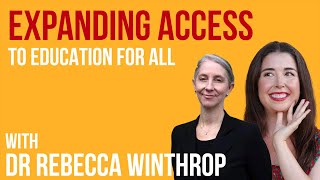
This is a podcast interview (Dec 1, 2023) where Manisha Snoyer interviews Dr. Rebecca Winthrop (Brookings, Center for Universal Education) about expanding access to quality education—with emphasis on girls' education. Winthrop explains how girls' education produces wide social ripples (reduced maternal/infant mortality, lower HIV spread, reduced child marriage, economic gains) and summarizes evidence linking girls' schooling to climate resilience and lower disaster deaths. The conversation also covers definitions of quality education (access, academic rigor, relevance), 21st-century skills, pandemic-era parent–teacher collaboration and homeschooling lessons, and promising adaptive-learning/edtech pilots (Imagine Worldwide / One Billion / Kitkit School solar-powered tablet programs).
Chapters
Welcome to the Teach your Kids podcast. I'm Manisha, a Pre K through 12th grade teacher of 20 years, homeschool coach and tech entrepreneur. On Teacher Kids, we talk about whole child development, homeschooling and the future of education. If you feel like you need more tailored support with your child's education, you can join our online community@teachyourkidspod.com it is such a delightful treat to have Dr. Rebecca Winthrop on the show today. She is the Senior fellow and Director of the center for Universal Education at the Brookings Institution. Rebecca Winthrop has devoted her life to expanding access to quality education for girls globally and also at home in the United States. Today you're going to learn about the impact of girls education and building a better future for us all. The surprising connection between education of girls and slowing climate change, what responding to crises in education can teach us about reinventing education systems, some of the exciting new tools and technologies that are expanding access to education. And we're also going to try to connect the dots between educational access and some of the innovation in the homeschooling community when we talk about Rebecca's research on community powered and parent powered initiatives. And we're also going to do a deep dive into what 21st century skills and quality education means in a rapidly changing world where skills are uncertain. And, and finally, if this is a cause that you and your kids care about, as I do so much, we're gonna talk about what are the most effective actions you can take to expand access to quality education for children around the world. Dr. Winthrop, I am just so happy to have you here today. Thank you so much for spending your precious time with us.
It is a total pleasure, Manisha. Very happy to.
Yes. And I just feel like I need to underline the depth and breadth of experience of our guest because I was just so excited to get you on our. For me, this is like meeting the Dalai Lama, Beyonce, I mean, Rebecca, she's worked at the International Rescue Community, United Nations High Commissioner for Refugees, the Rainforest alliance, and she's been the member of countless boards promoting human rights and education. She has a PhD from Columbia Teachers College and a Master's from the School of Public Policy International Affairs. It's just so incredibly exciting to have you here. So thank you so much again for being here. So, Rebecca, could you share your story with everyone? I mean, you were working with refugees and human rights and you decided to kind of shift your focus to education and girls education in particular. How did this come to be?
Oh my gosh. That is a good Story. Well, it's a good story for me at least. So I really, really, really wanted to be an international human rights lawyer when I was in college. And I thought this was a way to make a big difference. I was really passionate about standing up for people's rights around the world where they are oppressed or where they're exposed to violence, especially civilians, women, children, men too, of course, but that was sort of my passion. That's what I thought I wanted to do. And I was lucky enough to have a professor who had a friend who was running the United Nations High Commissioner for Refugee Regional office in Central America. And I got an internship. I was at the bottom of the totem pole and I went there right after college. It was an eye opening experience. I spent a lot of time assisting on many projects. And one of the projects was really looking supporting legislation to protect women against domestic violence, particularly refugees who had been living, who were living in host countries. So women who perhaps felt vulnerable, they didn't quite have the same rights they were in countries where they weren't citizens. And so it was to work on legislation at a national level to make sure they were protected, particularly against domestic violence. And one of my jobs was to listen to and to collate input from the women themselves. There were focus group discussions and I was very surprised because the women said, look, that's very kind of you. In essence, the summary message was basically, thank you for caring about our rights, but this legislation is going to take a really long time to get enacted. Then of course you have to train the police and that's going to take a long time. And what we really want, if you really care about us, is to help us learn to read. Because then. And the focus groups were particularly with women who were in very, very harsh, difficult relationships with domestic partners, husbands largely, who were very violent and abusive. So it was a very scary situation for them. And they basically said, you know, we appreciate the legal reform. What we need is to learn to read so we can go to the doctor by ourselves without a male escort and we can, you know, go out and make money on our own in the marketplace and get some freedom and change our lives for the better. And that was really the first time I had really, truly been exposed to how small your world is if you don't know how to read and how life changing. Education can be literally life changing. And it had been life changing for me. I grew up in a very small town. Certainly education was a great path way out to a bigger future, but it was, yeah, it was One of those. That was one of the moments. And there were various others, but that was one of the moments that really made me think, wow, I feel like education is maybe at the heart of all social change. And go into the education field.
Yes. I mean, first of all, it's such a testament to you that you really listened to those women and what they had to say. And it strikes me that literacy really is the keystone in someone who has no power and education giving someone the power to completely change their life and how far someone can take that who really needs it and wants it. So perhaps, you know, for me, I've been studying this for many years, and you for many more, but maybe some people who are listening might be interested in why investing in girls education is such a valuable investment for us all. I mean, clearly we can, you know, we can see, I mean, what an amazing gift to give a girl an education.
Education.
I think most people would agree to it, but there are great social benefits as well. Could you walk us through some of those?
Yes, absolutely. Well, first, I want to say that, you know, I, I care about girls and boys education equally. I have two sons, and they always say, what about the boys, Mom? And I say, absolutely. And there are parts of the world, the US being one, where boys are really far behind. But there are other parts of the world, such as sub Saharan Africa, some areas of the Middle East, Central Asia, West Asia, where girls have historically been marginalized for many, many, many decades and are really far farther behind. And in those areas in particular, when you invest in girls education, it's not only, let's do it equally for girls and boys, which is good by itself. You want, you know, your sisters and your brothers to have an equal opportunity if you're thinking about your family. But there's lots of evidence to show that when you educate a girl, you don't just educate an individual whose life trajectory has changed. You have an impact. It's like dropping a little pebble in a pond, and there's incredible ripple effects throughout the whole pond. You have an impact on many, many things. So, for example, and I think you're referencing a big study I did with colleagues called what Works in Girls Education. Why it's the world's Best Investment. And it really is the world's best investment in terms of, you know, per dollar, because of the impact. It has so many impacts on so many other things. So, for example, girls, if you increase the levels of girls education, it helps reduce maternity, maternal mortality. So that's women dying in childbirth, in large part Again, back to that original story. They feel like they have confidence, language, they have better negotiation skills in hospital with doctors, with medical care for what they need. It also reduces infant mortality. How many kids die under the age of five? Again, women have more young mothers have more wherewithal, they're more savvy, they have more livelihood. Girls education has been called a social vaccine for the spread of HIV AIDS because lots of massive studies by the public health community have showed that that is one of the major things that stems the spread of HIV AIDS is having girls have higher levels of education. Again, it's all about sort of allowing girls and young women to have a more empowered place in their communities and society. So they have, you know, they're less likely to get themselves in difficult situations where they could contract HIV AIDS girls and it just goes on. So increased levels of girls education reduces child marriage in a lot of communities because of poverty. Girls are married off by their families at very young ages. So if girls have higher, if they stay in school longer and have higher sort of prospects for how to earn money and the reason they're, they're married early is literally because they get, the families get, get money for it and it, and you know that that's part of their making ends meet and then it just goes on and on. Increased girls education increases sort of lively economics, how their level of jobs and how much money they can bring home. It increases economic development of an entire community. And it's often because women are invest, investing and rooted in a community, starting businesses, employing people, etc, it increases the ability of communities to adapt to climate change. There's this really incredible study that's across 125 countries. I mean it's massive that has shown that if young girls and women were able to receive basically a junior middle school or junior high school level education globally, we would call it lower secondary. The death from climate change disasters would be 60% less. And that's because mothers and young are often the ones helping respond to climate change, make adaptation so their community, their families and communities are safer.
So I would love for you to kind of break it down because it seems there's like an A to B to C step, right, Where a woman learns how to read, for example, and then that reading gives her access to more information about how to take care of her child or her pregnancy or how to, you know, prevent some natural disaster in her area. Would it be then when she learns how to read, the next step is to go to the library or to check the Internet or what are the tools that she's using once that, that she's got that education. And is that also part of the equation?
Yeah, it's a very good question and it's a really insightful question, Manisha, because people are studying that. And I would say that overall there are several sort of mechanisms. One is of course, just basic literacy means you can navigate the world much easier, whether it's jobs, access to jobs, whether it's institutions, voting, healthcare, you name it. Being able to consume your information yourself rather than. It just makes you much more empowered. Another thing is that if you have basic education and you've been in school, you're more likely, and this is the big one, you're more likely to be more empowered, which is the basic, the core, more empowered. You have higher levels of confidence, you have a higher position in society, you have more negotiating power, you're more likely to be employed. You know that that's, you're more likely to be a leader or have leader be listened to. You have more negotiation power even inside the home. So that is probably the, the biggest one.
That's huge. And I feel so grateful that I went to a school that taught me how to write well, I think more than any other skill that has really impacted the trajectory of my life. The ability to communicate and choose words carefully. That's such a powerful point. And so you talked a little bit about, you alluded to this a bit, but I actually discovered your work because as a young child I was terrified about climate change. And you're so positive in your work. And I tend to choose my cause causes because I'm terrified. So I was really scared about it. And I felt like people were kind of flailing their arms around this issue and I really wanted to get the root to the root of the problem. And so I started reading a ton of information and seeing conflicting information. And I mean, I think I learned pretty good critical thinking skills in school, so I wanted to check sources and see if it was evidence based. And eventually that study led me to Project Drawdown where they had built this incredible list of climate solutions. Just a really in depth, incredible study. And I was just so excited to see the quality of their research and the critical thinking that went into that. And so I discovered number six, that the number six way to stop climate change was to educate girls. And I was surprised by that connection, but also excited by that connection because I've been a teacher and I felt like this was an area that I could make an impact. And so I was. And so you were sighted in that study, your paper, and I know that.
You know, work with that group.
Right. So I'm curious to learn a little bit more about that. We've, we've had two people from Project Drawdown on the show talking about climate education, but I really want to go into the girls education aspect about it. I mean, I know there's been research, I think, that shows family planning could reduce like 866 gigabytes of carbon emissions of, like, really huge number. So, so what's the. But it's beyond that. So what's the connection between educating girls and actually slowing climate change for all of us? Because parents care a lot about that.
Yes, there is a couple of connections. So if you really combine. So Project Drawdown is a fantastic initiative, tangible, actionable, global, multiple universities. So I'm so glad I saw that you had people from Project Drawdown on the, on your show, and I'm so glad you did reach out to them. And their focus was really like, what can we do today? We don't, you know, not like, what is, what could we wait to be invented, what technology, but today, what can we do? And if I always say, if you combine, like, I think family planning and education, it's one of the top, you know, empowering women and educating girls is one of the top things for combating climate change. So part of it is the more educated a girl is, for every year of schooling she gets, she will have less sort of a smaller, more sustainable family. And so that's one. And you cited sort of the impact of population growth and in terms of impact on the climate. And there's a whole bunch of studies that people are looking at that around. That's one possible pathway, but there's also the pathway of just for girls and boys, educating them about climate change. And this is globally, across the world, including right here in the US Is really important. There was one study that was done in the US that really showed that if you had a small percentage, it was like 16% of kids, high quality climate change education, so that they really internalized the importance of it and shifted some of their behaviors and patterns, you could really make a dent on the climate crisis. And that was shown for just 16%. And imagine if you had that everywhere. And so part of it is really about thinking about the power of young people's decisions, their trajectories, how they're going to be influencing the world. And then there's a third part which is really thinking about, you know, young people also in climate change education, girls and boys can impact their schools. Like in it to be more sustainable in the US there's 7 billion school meals served every year. Like, imagine if those school meals were, if you had home, you know, school gardens and if you composted and if you did local sustainable agriculture and you know, and you just add, add that on and on. So that, that's another, you know, really powerful pathway.
Also that's such an important point because children are also so immediate in the way they react. Oh, this is a problem in our world. I better do something. And then they just summon up all these creative forces to respond to that problem. Whereas sometimes as adults we get a bit more jaded. So that child energy can be really powerful.
Yeah, I feel like that is really, what you just said is really, really important. And I think about it, for my kids, I'm like, oh my gosh, what, what worlds am I going to leave them? What are they inheriting when, you know, five decades hence are they going to have a planet to live on? So it is scary and it is pressing, but giving kids agency to do something about it and one of the best ways to do it is through their education. Whether you're homeschooling or in a homeschool network network or whether you're, you know, thinking about advocating and supporting climate projects in, in public schools, whatever, wherever kids are. And when kids can act to try to solve a problem, they can see that change is possible. They can learn skills, they can also learn content. They're, they're, you, you know this as a former teacher. They can, they can perfectly well learn, learn about science and math and, and they could throw in some writing and English in there in doing climate projects, but ultimately they can feel like, and they can actually really know quite deeply that change is possible if they act. And that's really what I think we need to instill not just in all our young people, but even adults. Like, we can't, you know, we're going to have to have some come up. We can do attitudes if we're gonna combat this cr.
Absolutely. And if you have a child who's stressed out about climate change, the best thing you can do is take strategic action with them. It's, it's the best mental health.
No, absolutely, absolutely.
I mean, I know that from experience.
Yeah. Learning like kids who learn new, who are deeply engaged in learning, kids who are using agency to change things they care about, you know, that, that isn't often discussed as a major mental health approach, but it is massive. I'm currently writing a book with A co author on Jenny Anderson on this topic around student agency and student engagement.
Oh my goodness, I can't wait to see it. Oh, it's so exciting. And for parents, if you do want your child to get more involved, we actually did start a climate change WhatsApp group as part of our communities to help give people some resources and get positive and active. So, so amazing. And I'm so excited about this. So, so Rebecca, when you talk about one of the things I really enjoy about your research is that you're laser focused on solutions and your laser focus not just on education or school, but on quality education. Because as we know in the United States we have lots of schools, but we don't necessarily have quality education. So when you think about expanding access to quality education, how do you define quality?
It's a great question. And I think of sort of the big needs in education in most countries and I would put the US in there too, in three buckets and they're almost like increasing levels of difficulty. Actually, that's probably not true. Actually, I'm changing my mind as I say that they're all difficult. You need to kind of do them all together. Access, getting kids to access educational offerings, however you do that. So we have plenty of kids in the U.S. for example, who haven't come back after Covid oftentimes I would say young boys in high school who have to often in black and brown communities who have to work to support their families to put food on the table. That is a particular population we should be worried about. So access is really hard, making sure to connect kids to school or whatever types of educational offerings they are in. The second is what I would call academic rigor or what we would often think of as quality learning. And that is really making sure that once kids are, once you do have kids in school or linked up to educational services in whichever way they are really learning, learning, mastering the content, mastering the concepts, developing, growing over time, that it's rigorous and that's really important. And the third bucket is relevance. Are what they are learning related to their lives? Are you talking about things that they understand that they see every day? There's a lot, I think we put a lot less emphasis on relevance and I think it's actually crucial because it does affect their interest, their engagement in the quality instruction and their access. Are they going to keep coming to school?
Yeah, absolutely. And then just in terms of the quality of the, I guess the second piece, which is talking about the skills that they're learning, I mean, I find this One really tricky myself and a lot of the homeschooling parents, parents I work with say, you know, how do I know that my kid is learning the skills that they need for the future? And what I typically tell them is make sure they have literacy and numeracy and then the rest, you know, give them opportunity to explore their interests and trust your own intuition because you know best what your child needs. How do you define 21st century skills in a world that's just evolving so quickly? What, what if, what are the ones that are just really critical and maybe it depends on, you know, where you're talking about as well.
There's so many different definitions and at one point I did a big study and looked at over 300 different frameworks for the skills needed for the skills needed for the future. And they all have different names. So some people talked about 21st century skills, some people talked about the six Cs, which is like critical thinking, creativity, communication, etc. Some people talked about transferable skills, transversal skills, scoff skills, non cognitive skills, right? But really when you laid them all on top of each other, there was about an 80% overlap. Now clearly literacy and numeracy is foundational. It's absolutely a floor that you need to build your education house on. But involved in learning to read and learning math is a lot of what you might call social emotional skills, character skills, whatever is things like attention, things like self regulation, like, you know, deeply embedded in learning literacy and numeracy are social emotional skills or non cognitive skills or character skills. People call them different things, but they're all kind of the same thing. So that's crucial. And then I would say there's also a host of sort of competencies that I think universally are really, really important. And I don't think there's one list that is there forever. But you brought up communication and I think sort of writing, reading, but also speaking. I think more and more this idea of speaking oracy skills, as they often call them in the uk, are really, really important and kids often pick that up from their families or their communities. But really practicing speaking is going to be increasingly important. I definitely think critical thinking and that could be through critical digital media literacy or other things, being able to understand, question assumptions, see when things aren't right, especially in an era of fake news, news is really, really important. And then I certainly think things like creative problem solving, like how do we make sure that kids who are creative problem solvers from the get go, how do you make sure that those natural instincts when they're really young, continue as they're learning more rigor and how the world works. They don't sort of foreclose on sort of narrow definitions of what's possible and how to solve a problem. So those are a couple. I, I have a bunch of favorite ones. I think interdisciplinarity is really important, going to be really important, which is how do you combine, you know, the education world writ large, Higher ed especially, and most secondary school, most high school. Secondary schools is very siloed. You go to chemistry class, you go to physics, you go to English, you go to history. And there's separate when really to solve problems, creative problem solving. We're going to have to pull from all of these insights from all of those. So that idea of interdisciplinary thinking. And then of course there's all the interpersonal skills, making sure you know how to listen, work with, understand other people's perspective, work together. That's the collaborative part of problem solving. And you need a lot of empathy and I think listening, listening to others, not just talking at them. We need to make sure everybody gets that skill to make the whole world a better place, especially our country at the moment, for sure.
I mean, and I guess I kind of wonder if conditions are right. You know, assuming that a child is well fed and nourished and the family has a bandwidth to give them a loving support system, how much of this evolves organically?
A lot of it is through what they, what, what their families and their communities are modeling. So, you know, remember, you are literally your child's first role model and teacher. They're going to emulate how, how you interact with others, how you solve problems inside your house, how you, you deal with, work with your community and neighbors. So I think a lot of times kids can pick it up, but parents are parents and caregivers are always instructing. We instruct from the get go. Please share your toys, say thank you. You need to be grateful someone offered you a meal. That is instruction. And we should probably continue, I think, to call that out in a range of skills. Skills.
Yeah, I guess this kind of brings up a sensitive topic for me, which is how many of in an under resourced community, or you work with refugee communities with, you know, communities that have never had access to education before? I mean, in terms of a family's wealth, are there skills that are less likely to be kind of just naturally passed on this way that need a little help getting in? I mean, certainly other communities have amazing systems that we could learn from as well.
I Mean, interestingly, again, for this book I'm writing on student engagement, student agency, one of the. One of the things that's really important for kids to be engaged and excited about their learning is to feel deeply connected to their. To their. To their parents and caregivers, connected so that they could talk through hard things. And that actually has a huge impact on student engagement.
And.
There was this massive national study and the populations, and they broke it down by race and socioeconomic status. But let's just stick with race. And compared to white communities, compared to African American communities, African American communities scored much higher on building this level of connection because they had a lot more community traditions that sort of were the baseline for developing that close connection. So I actually think that there's a ton of incredible skills and education and resources, and some people talk about it as funds of knowledge, sort of deep expertise and knowledge that isn't recognized. Now, of course, there's other barriers. That means African American students as a whole, not any one individual, any one individual has huge potential to fly if they have the conditions. But there's other barriers. Whether it's, you know, lack of income so they can't get extracurriculars, or kids have to work extra so they.
You.
Know, don't have all the extra time for extra tutoring. You know, there's a whole range of structural barriers that get in the way. But it's. I don't think there is a default or lack of sort of skill development in terms of thinking about 21st century skills. I have often found that the most, and I've worked in many countries around the world, the most creative problem solvers have been refugee communities because they literally had nothing. You should see the amazing things they do with a. Like a car that's broken down. They get it running. I don't know how they do it, you know, and how's it like they will refugee communities because they have to be. And this sort of necessity is the mother of invention. So, you know, I think it's important to keep. Keep that in mind. It isn't always recognized on, like, standardized tests.
Oh, my gosh, so much is not recognized on standardized tests. So I do want to get to the homeschooling, and I think this is a good segue because when we think about education, we often think of a child goes to somewhere away from their home from 9 to 5, and they learn a certain set of skills, and those are the same, and then those are tested and measured and they are supposed to learn. And I mean, you know, we Know that not a lot of learning and growth is happening in our school system, especially in secondary school. But that's another topic. What I'm really curious is about some of the research that you've done on homeschooling, especially during the pandemic. And you know what's worked? You know, I know some initiatives have not worked and some, I think you did a study in Bangladesh in terms of empowering, maybe just even empowering parents, teaching parents to read, or actual homeschooling initiatives. What's some of the research that you've done? What have you found?
So I think we all know the negatives, but in terms of the positives, one of the things that I think has been really helpful when during the pandemic parents were having to step in and partner with teachers to educate their kids at home. This partnership that was built with a lot of parents and teachers and one of the things that I noticed across the world was that schools and teachers who have such a hard job, you know, you've been a teacher for a long time, it's an incredibly hard job. So much on your plates. It's an incredibly crazy operation to think that this, it's like the principal of a school is like a CEO and makes second to only emergency room doctors, makes more decisions on any given day than any professional in the United States. So it's a really difficult job. And I think a lot of teachers found support and allyship with parents when they could connect with them and say, oh gosh, we can do this together. And I think one of the aha moments that a lot of teachers found was that parents that they thought didn't really care about their kids education because they couldn't show up to the back to school nights or the parent teacher conferences. So you know, teachers felt like, well, they're not that interested in their kids schooling, realized oh no, they do care. They just have either four kids at four separate schools or they work nights or they, you know, there's so many, or they don't have transportation money or whatever it is, or they can't leave, they have an elderly relative at home, they're taken care of, whatever it is. I think teachers really sort of at the beginning of the pandemic were like, wow, a lot of parents do care. And then I think parents for their, on their part said wow, teachers, this is really hard. How do they even get my kids to pay attention? This is really hard. So I think there was an opening of mutual respect and we, we see that. And you mentioned Bangladesh. I was thinking of a case in India where the government in one of the states, Himachal Pradesh, decided, well, because of COVID we can't do parent teacher meetings at the school school. So we are going to, instead of bringing parents to the school, the school's going to go to the parents. And they, through any means necessary, through tech, WhatsApp, Facebook, Zoom. Phone calls reached out to the parents of their students and within a couple months the involvement in parent teacher conferences went from 20% of parents to 80%. It was not that those parents didn't care, it's just they couldn't, the method wasn't right for them. So I think that is positive. I worry that we might be losing that as we're sort of going back to normal and I think that would be a lost opportunity, some of that positive collaboration and relationships if we sort of lose that, which I worry we are potentially doing in many places.
So I do want to dig in a little bit deeper to adaptive learning technology. We have a lot of families and tech in our community, some of who've been involved in building ChatGPT. And I've done tons of research on the adaptive learning apps out there and kind of came to a conclusion of well, what if we built some incredibly fun adaptive learning app where kids could learn math and literacy, put it on a, a solar powered tablet that worked offline and just distributed it to kids around the world. And you know, kind of through this process I've discovered one that there's not a lot of great adaptive learning technology that exists. It's very limited in what it can do, which is surprising to me. And secondly, you know, I mean, I guess, you know, when I started looking at your research, I saw that you have found some efforts that have been successful in like South Sudan. And so I was wondering, wondering if you could share a little bit more about this adaptive learning technology and what might be some limitations or what you hope to see built in the future. That's a lot of questions.
Yes, well, I, I love your big vision idea, your moonshot idea. Can't we get some good adaptive, there's tech solutions. Let's get it to kids who don't have access and couldn't that help solve the problem? So a, first of all, I think you're totally right on both counts that one, there isn't a lot of, of actually high quality adaptive learning type technology out there for learning. And B, your moonshot idea is a good one that I am proud to say I was, I've been part of an initiative I was on the founding board of an initiative that's doing that. It's called Imagine Worldwide and it has taken software developed from a group called One Billion that's a nonprofit out of the UK and a for profit company called called Kitkit School. Both of whom won this big global prize called the X Prize on sort of being able to increase literacy and numeracy in out of school populations in Africa. And this organization, It's a nonprofit, 1 billion Imagine Worldwide is taking that software and piloting it and iterating on it and working with all their partners in Malawi and various other countries. Trees and to do what you just said and it's being really successful and it's one of the few edtech solutions that I think has a huge potential for massive leapfrogging. In part because you do not have to be literate or numerate to use this software which is very hard. There's most software you have to have, you kind of have to know some how to read.
You have a starting a foundation, right?
Zero. You can go from zero on up and in some of the class. So I'll give you an example of a. The class I school I visited had. Wait, wait for this. As a, as a former teacher, your jar will drop had 10,000 students in it Primary school in Malawi and it was very orderly. 120 kids, little kids, 7 year olds to a class. The teacher is doing their best but what can you possibly do in terms of, you know, personalized. The teachers were phenomenal, very, you know, charismatic. Get 120 kids engaged and basically with 45 minutes a day and they take, take, you know they rotate the kids through this 45 minutes a day on, on this and the kids identify, they take their. It's solar powered, they're charged at night. They find their little, any old tablet and they choose their photo to figure out pick off where they've left off. Those kids are learning to read at an incredible, incredible rate.
I love that. Wonderful. That's so great. Well if they need any help, I'll give you my number. I think it's so great.
I think they probably do so I love. We can follow up on that after.
We will. And on that note, what are some ways that parents and kids can help? I mean this cause obviously has so much can make such a big impact in making the world a better place. What can an 8 year old do? What can a parent do? A busy parent?
Yeah, busy parent. Well, I think it's a handful of things. The first is really to educate yourself and educate your kids about it. And you have lots of resources, Manisha, that you will share. Some of them I've written and prepared, but there's plenty of other people too. Just being aware.
You have a big reading list for you guys today.
Just being aware is huge because not a lot of people know really about this topic and issue. The second thing is to find a really good organization. And Manisha, I can give you a list like the one I talked about. Imagine worldwide a really good organization, a nonprofit organization that you can engage with and there's plenty out there. There's a group called the World's Largest Lesson in particular that I'm thinking about that does a lot of work with youth around the world. And I'll give you a list and have your, have your young people take part. There's plenty of non profits that have student programs. And the third is get active. There is no reason your young people can't become activists and advocates for this cause. Every year we in our global education community have to advocate for increased US government funding from groups who do international development to go to education. There's lots of competing priorities and it's hard in a time when there's a lot of needs domestically. But I always say education is such a good investment for the US strategic interests.
And we didn't even talk about future engineers and doctors, people working on all these solutions for cancer.
Purely self interested climate change advocating?
Absolutely.
Congress or something? Something. Is it increased education levels, increases trading with U.S. goods. So there's a whole constituency, which I will link you to too, of business leaders who advocate for this. So giving them support is also a great, great way to get engaged.
So we talk a lot on the show about the impact of one on one mastery based learning. And so what do you think about simply volunteering at your local library to teach someone how to read or even online, do you think, think that would make a big impact?
Absolutely. I think there's also a lot of local organizations that help, help young people mentoring. You could be libraries, it could be community outreach, it could be community schools projects, it could be parks and recreation programs. There's a whole, whole bunch of things young people can do for sure.
And I would just, I just want to make sure that we get this in which is that, you know, expanding access to electricity and to the Internet vastly makes it more possible to get some of this learning into people's hands because then you can have teachers who are connecting with parents, as you said, and we can bring more technology, adaptive learning technology to Students, although I love. I'm so happy they're solar powered tablets. I've been actually searching for that and I couldn't find it. So it's good you're here. Um. Oh, my gosh, Rebecca, this has been so great and I have so many more questions, but you have to get back to saving the world. So I just am so grateful and I like to ask every guest one question because I love education and you love education. Is there something fun you're learning right now? Ideally, totally unrelated to anything we've been talking about. It could be.
Oh, my gosh. You should see my reading list. One is called the Five Pathways to Student Engagement. The other is called Visible Learning. The A synthesis of over 2,100 meta analyses of Relating to Achievement. So I'm very excited about those things. Those are like. I'm really, like, glued to them. So what I did just recently read, which was fascinating Study and Personality and Opportunity, the biography of Elon Musk Musk, which was quite interesting. And I. And I learned a lot about artificial intelligence and how our data is being used. If you drive a Tesla.
Oh, my goodness. Well, luckily I don't have a car.
So anyways, that was.
Wow, I love that. I'm going to definitely have to check that out. Is there anything else that people should know before we wrap up today that we didn't get to touch on today?
I mean, I think my last parting thought is that one parent, one child, does make a difference. You can make a difference, and it's really rewarding. And we encourage you to get engaged.
Absolutely, yes. I love that. So we also did not get to leapfrogging, which is a wonderful term you use. And you wrote a book called Leapfrogging Inequality Remaking Education to Help Young People Thrive. So if people are interested in making a big leap forward in education, they should check out that book. Well, I'm just so grateful for all the work you've done. It's been a true honor to host you and I think I can speak for my whole community in saying that we're really excited to support your work and that hope you'll call on us to be your champions. So thank you so much. Wonderful.
I will take you up on that. Thank you so much.
More from Manisha

Contributing to Florida Prepaid Plans (2026–2027) | Step-by-Step Guide for FES-UA Families

Contribuyendo a los Planes Florida Prepago (2026–2027) | Guía Paso a Paso para Familias FES-UA



Finding Providers & Services in the Marketplace (Families) | Step Up For Students (2026–2027)

Encontrando Proveedores & Servicios en el Mercado (Familias) | Step Up For Students (2026–2027)




