Getting into College as a homeschooler with Henry-Hill Gorman (Stanford class of 2024)
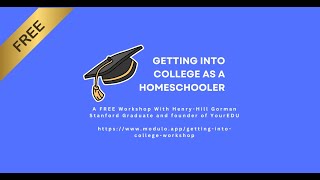
A recorded workshop (YouTube) where Manisha Snoyer interviews Henry‑Hill Gorman (Stanford class of 2024) about how homeschoolers can successfully apply to college. Covers Henry’s personal pathway (unschooling → co‑op → community college/APs → Stanford), practical application advice (crafting a narrative/spike, transcripts, reference points such as community‑college courses/APs/standardized tests, letters of recommendation, gap years, scholarships), and product details about Henry’s startup (YourEdu) and its Common App partnership. Key claims: homeschoolers are routinely admitted (often at an advantage if materials are presented clearly); colleges need a few external reference points (AP/college classes/tests) to evaluate homeschool transcripts; transcripts should be standardized and easy to read; GED is rarely required; YourEdu is piloting a homeschool‑to‑college platform integrated with the Common App and working with ~1,200 colleges (pilot free this year).
Questions this video answers
December 17, 2025.
Stanford class of 2024.
YourEdu (referred to as 'your edu' / 'your School, your Edu').
A partnership with the Common App to create a homeschool‑to‑college application portal/platform.
About 1,200 colleges (stated).
Chapters
I am so thrilled to welcome my newest friend and collaborator, Henry Hill Gorman. We are actually here together in separate rooms at Brooklyn Apple Academy, which is an extraordinary hub for the homeschooling community in Park Slope in Brooklyn. And Henry Hill Gorman, who you probably have already heard of if you signed up for this workshop and is a homeschooler turned recent Stanford University graduate. And he has founded an incredible new company called your School, your Edu, your Edu, which is helping homeschoolers get into the college of their dreams and also just trying to figure out how to support high school students with every aspect of their homeschooling. So we're really, really thrilled to welcome you today. Thank you so, so much for taking the time to be with us, Henry.
Thank you, Manisha. I'm super excited to be here.
Yeah. And I'll also give a shout out to my co founder, Bill Beckler of Modulo and Colin, who is Henry's co founder. And so I just wanted to kick us off today with a question about you, Henry. Tell us your amazing story from homeschool to Stanford University. Were you a baby genius? How did this occur?
Yeah, definitely. Definitely not. And I'll try and I have a tendency to monologue, so cut me off at any point. I'll try and keep this short so we can get to questions. But yeah, I was a lifelong homeschooler. I would say homeschooling for my family in the beginning was far more unschooling. And and so we did kind of non traditional schooling, a lot of stuff outdoors, a lot of kind of classes with my three younger siblings as well. So we were unschoolers up until about sixth grade and then we started going to a homeschool co op. Growing up, I did up until sophomore year of high school, I played a lot of soccer. I was super into that for a while. I thought that's how I was going to try and get into college or try and maybe do that as a career as well. So played a ton of soccer and then halfway through high school I actually quit soccer to start doing comedy. So it actually every weekend would take the like the megabus from Madison, Wisconsin to Chicago for the weekend to take comedy classes and perform academically. Starting in high school, I started to do a mix of homeschool classes in a co op. I took a couple classes at my local university and my local community college as well as a couple AP classes that I studied for on my own. And then yes, so I did that for high school and then I've been at Stanford now. I was there for six years. So I did my undergrad there studying economics philosophy and I wrote a master's thesis, the Ethics in Society program. I actually took a gap year during COVID so in between my sophomore junior year to work. So I worked full time at a private equity firm. Then I came back. I got my master's at Stanford as well in media and business. And while there I taught. I was a TA for several classes on campus too, mostly in political science and communication. And then yeah, Colin and I just founded your udu. So we're focused on helping homeschoolers and kind of everything outside of teaching. What we're focused on right now is high schoolers and especially the transition between high school to college for homeschoolers. So as many of you probably know, we have a partnership with the Common app to create the first ever Homeschool to college specific for homeschool application portal and platform. And then we have a couple other things as well. But super, super excited to be here. That's kind of a general overview and would love to talk more about this homeschool to college and answer questions as well.
Amazing. And you all were so generous in your questions and thoughts in the form. So we're going to try to get in as many questions as possible. We might not get to every single detail of the college application process, but we're going to try to give you a good overview. So I want to kick it off by diving into the big elephant in the room. Do homeschoolers get into college? I mean, we know you did, but do other homeschoolers get into college? And what are any unique advantages to being a homeschooler, if at all?
Yeah, I would say well across the board, yes, homeschoolers get into college all the time. Colleges Some colleges have specific homeschool requirements, but across the board, colleges tend to have a lot of flexibility when taking homeschoolers and actually oftentimes prefer homeschoolers. And homeschoolers are definitely an advantage in the application process. I think that's because honestly, homeschooling tends to look far more like college than a traditional high school would. And so that's a huge advantage. I'd say the other huge advantage for homeschoolers is the opportunity to totally craft your application entirely, entirely tailored to your specific kit. So oftentimes when you're applying to college, half the application is standard forms that your traditional public and private high school provides for every single student that attends there. What's great is as a homeschooler, you're making all of the same materials. It's a ton of work. We'll get into that later. But in that, though, you get to really be able to hone in on your own personal narrative, have a spike, if you will. That's a big thing that we're seeing now in college admissions is as it's becoming more and more competitive, you need certain things to stand out in your application and have some sort of narrative or spike in that application. So there's far more opportunity for homeschoolers to do that. But by and large, though, homeschoolers 100% are getting into college. And with few exceptions, you're not only not at a disadvantage, but you're at an advantage. In that case, I think, Manisha, you're muted right now.
Thank you for letting me know that. So can you maybe highlight, in terms of homeschoolers and their advantages, what are some types of experiences that easier for homeschoolers to have that can really give them an advantage in that application process? Whether it's. A lot of people had questions about extracurriculars versus rigorous academics. What. What would you recommend leaning into?
Yeah, I would try to stay, too. Yeah.
Yeah, go ahead, Henry.
Okay. Sorry, I wasn't sure if someone's asking a question, if anyone has questions, throw them in the chat. I have that open too, and I'm happy to cater my, my answers to that. In terms of, yes, the question was what those advantages look like. I think both academically and extracurricularly, they're both opportunities there. It's a myth within college admissions that you want well rounded students. And that's both in terms often of like, the specific subjects that you're interested in and also your focus area as well, whether that be academic or extracurricular. And so what colleges really want to see is that you're going above and beyond whatever your peers are doing. And so oftentimes, actually it's an advantage to, you know, if you're really into academics, you know, you could go all out in academics and maybe a little less on the extracurriculars and vice versa as well. I know in my case I had good academics. I had kind of the base level that I needed to attend Stanford. So I had several AP scores, a couple classes at my local community college, and a pretty good ACT score. But when I actually looked at the notes from my admissions officers, I did not get in because of academics by any means. And I would argue actually the majority of folks who are getting into Stanford are not getting in because of academics. They're getting in what they're doing outside of their normal classes. If it's an academic orientation, that would be research at, like, a local college or university or publishing papers. Extracurricularly, there's a huge advantage for homeschoolers because. And academically, too, you don't have to spend as much time doing kind of, again, being well rounded, a ton of time in all your different subjects. You can go deep into what you're most interested in. And so extracurriculars, what they really want to see is leadership and achievement. So it is important to have some sort of validation or achievement on that front. And so I know in my case, I was able to, like, I spent a ton of time playing soccer, and that was fine and good, and they liked that. But I captained several soccer teams. They loved the fact that I spent all of this time on my weekends going to Chicago to do comedy as well. And then I had several internships as well, internships during the day. So I was able to get them, actually, because, you know, I was able to have a traditional or a schedule that a traditional high schooler couldn't. And I spent less time. I spent, you know, three or four hours a day on my schoolwork getting all of that done. Could spend far more time on my internships as well. And so I think being able to go above and beyond and do those things because you just have more time and freedom. Flexibility is huge for homeschoolers.
That's such a great, distinct point that it's not just about doing the extracurricular, it's about having that leadership position. So you work at a bookstore, become bookstore manager, or do a sport that you can become captain of the team for, whether that's all, or football. I really love that, you know, and I think there are organizations where there is more leadership structure built within that, if that's what is important to you. So you say, you know, academics aren't that important, but is there a certain baseline in terms of the academics that top colleges would be looking for, even if it's not the edge that gets you in?
Yeah, I would definitely say, and that's one of the disadvantages a little bit for homeschoolers is for top colleges, or by and large, for any college you're applying to. Colleges need to have some sort of way to be able to evaluate a homeschool application and compare it to other applicants. Right. And so what's difficult is with homeschoolers, oftentimes classes are ambiguous, especially the grades associated with them. They talk a lot about, like, mom grades, these former admissions officers I've been working with. And so what homeschoolers need is you need a couple of reference points to be able to give the college. So for example, on my transcript, I probably had about 35 or 40 classes in total during my entire time in high school. And I had three classes, Two from a local college where I got two A's, one from a local community college. And then I had three AP tests. And so I only really had six real grades, if you will, on my application. But because I had those reference points and I scored well enough, they took the rest of my mom grades, my 4.0, and they treated it like any other applicant, you know, because at the end of the day, you're competing against traditionally school, public and private school students. They only have so many spots, you know, kids are getting turned away. And so you need some reference point, even just a couple places. Then obviously standardized tests too. What we've seen is coming out of COVID more and more colleges allow you to be test optional, you know, not necessarily submit an SAT or act. In the case of homeschoolers, though, that's really not the case. Even some schools, it's still required. But in the cases that it's optional, homeschoolers really need those test scores to be able to even be evaluated in the first place. And so that's one unfortunate thing is we've talked to several colleges where if you're a great applicant, you know, but you don't have a couple of reference points academically that they can evaluate, they're not going to be able to even make a decision in the first place.
It almost seems like these community college classes or AP exams or standardized tests are a way for them to verify that the mom and dad grades are actually on par with what a kid might receive.
Absolutely.
Yeah. That's so interesting. And there were some people in the community who were asking about unschooling. Clearly, unschooling is a very broad term. Anything from anti school to a child really directing their own learning to. Sometimes it just means secular homeschooling, to be quite frank with you. And so I'm wondering, let's take for example, a kid who is just a genius in physics and all that they really care about is physics, and they've been taken physics classes at community colleges. And does that child need other subjects or. And what subjects would that be? What. What is the baseline in terms of, like, what subject areas students need to hit in their college application.
Yeah, I mean, I think there's a lot that goes into. Obviously there are also like state requirements and you know, own personal feelings. I'll leave those all out of it. I'd specific. For college applications, the big question becomes twofold. Can would the student actually succeed here? And succeed here in kind of two areas. One actually do well at the college, right. And like whatever their interest or passion is, right. Be able to take advantage of the resources at that school to do really well, whatever that subject area is. So part of the question is going to be if we're only going to admit 10 kids into our physics program, right. Who are going to be the 10 kids who are going to really take advantage of the fact that they're here studying physics. So that's one question. The other question though is like on a more basic level, a lot of colleges still have breadth requirements, right? So even if you're super into physics, they're still going to have you take several classes and different subject areas. They also want to make sure that those students aren't going to fail those classes and potentially jeopardize their ability to graduate in the first place. And so what they're looking for is like still base level confidence in general subject areas in terms of typically it's just math in English. Those are the big areas where they just want to see typically four years of English, four years of math, and those are the two subjects that are also tested in the SAT or the act. So they just want to make sure that basically the bar there is that you're not going to fail one of those classes. So I know in my case I was not STEM oriented. That science, technology, engineering, math, that was not my interest at all in high school. And so really what they were trying to evaluate is is he going to really take advantage of our public policy program and be one of the top students on campus in public policy, and is he not going to fail the required math classes that he has to take, as any student here takes. So that's, I think, kind of how you think about it in terms of unschooling. The one other thing I would say too is unschoolers. Again, it's really important to even just have one or two real grades. The other thing is you have an opportunity in your application. You're going to write a school profile report, course descriptions, detailed transcript. Not to plug our service, but that's a ton of work. It took my family like 50 to 100 hours to do that. We can do that for you guys in like one to two hours and standardized, and we'll work for all the colleges. But that's an opportunity where you provide a lot more detail and context as to what your schooling environment looks like as an unschooler, as a homeschooler. It's equally important in whatever type of homeschooling you're kind of operating under. And so that's an opportunity to really describe what that looks like. And the admissions offices actually spend time really diving into that material as well. So there's that opportunity, too.
So digging more specifically into that whole presentation you give of yourself. Britt had a question, a specific question that the University of California system, does it seem to accept SAT or ACT scores? And is there any way for a homeschooler to still submit that?
Yeah, so some of the forms, some schools have specific, like, boxes you could check off for homeschoolers, some don't. Fans also do. You could apply to the UC system through their portal, but also obviously, the common app as well, which is what our platform is integrated with. What I would say is in the cases where schools physically won't let you submit them, you can do two things that I still think help, and they'll take into account, which is you can include your test scores on your transcript, and you can also email materials to. Typically, there is a specific email for each school where you can email supplemental materials, and you can pass those along as well, and they'll make a note in your application. So I think those are situations where definitely, you know, including those really, really helps. Again, it's something where your standardized test scores or AP scores are not necessarily going to be the thing that gets you into college. Most cases it won't be, but it could be the thing that holds you back from getting into college. That's, I think, a good way to think about this, too. In general, it's just the same thing. Like, detailed course descriptions that you write in your college application aren't necessarily going to get you into college. But if they're not presented in a way that covers all the material needed in the standard and formatted, it could result in you not getting accepted. And so that's the unfortunate thing. And I think the disadvantage to homeschoolers is there's so much more work that you have to do. And what we've seen in talking to some admissions officers, it's like transcripts, like, they've literally said, this transcript, I couldn't read this kid's transcript. And they seemed great, but I couldn't even evaluate them and they were rejected because of that. So that's also part of the thing that we're trying to do with our platform and in general is like, if we can standardize that, we're going to make sure that you're not held back. And I think in a lot of college admissions, you want to think about it twofold. How do you excel, but how do you also make sure that you won't be dinged for anything as well?
So a lot of people have questions about transcripts, and I know this is a service that you're working on, but could you give us a snapshot of what an ideal transcript would look like? Something that's going to be clear, that's going to feel right to those college admissions counselors?
Yeah, I think generally. So I'll talk about two fronts. Like the transcript is a very. The document itself, very simple and straightforward. You just need a course title that is like less than probably at most seven or eight words that just clearly describes what the literal force is. You don't have to get super creative with it. And so having that and then just very basic information, again, it's just like, you know, making sure that they can clearly see which. It sounds silly, but like this is something we've run into, what the student's name is, where they're from, the course that they clearly took, and then the grade associated with that course. And then the other thing too is a GPA that's actually calculated correctly too. Some people don't weight it correctly. A really simple thing to do. Some people talk about units here or there. What I did was I just did for a high school level course, it was half a credit each semester. And when I took a college level course, whether that be AP or at the local community college, that was a full credit every semester. And then a GPA was just based on a single weighting average event. So super, super straightforward on that front. But also too, what I would say is for free. We'll build it for you on our platform. So I wouldn't stress too much about that. And then the one other thing is again, typically what they want to see is four years of English, four years of math, and then typically two years or so of a foreign language as well. But yeah, those are just basic stuff to get out of the way. But other than that, super, super straightforward.
So it seems like a homeschooler who wants to get into a top school as long as they have that math and that ELA and apparently speak a foreign language. Which I wasn't aware of, and have some type of extracurricular where they have really demonstrated leadership and strength that that alone can be enough to get into a top school if it's presented in a strong way.
Yeah, I think you definitely. I think the most important thing across the board between academics and extracurricular is, and this is where there's a huge advantage for homeschoolers, is crafting your narrative. And people talk about narrative and it's often very ambiguous. Really, what narrative just is, is showing what you are best at and what you're. And with homeschoolers, it's typically just what you're most passionate about. And because we don't have the same requirements as traditionally schooled students, you're able to go much deeper in that. And what makes for the most successful applicants is when that narrative that spike, if you will, runs through your academics and your extracurriculars. So I'll just say, in my case, what I did was, was I applied to college as a religious studies major. In part, that's what I thought I was going to study. I really enjoyed it. I was like atheist. And it came from an academic perspective, but I found it fascinating. I spent part of a summer at Harvard Divinity School and I counted that as a class on my transcript. I took a religious studies course at the University of Wisconsin, but I also interned one summer at the Council on American Islamic Relations. And I organized 14 churches across my city of all different denominations for several interfaith kind of activism led efforts there. And so I had a through line both academically and extracurricularly that I also wrote about in some of my application essays as well. And I applied to college as a religious studies major, which at STANFORD they graduate one to two undergrads in religious studies each year. And there are 50 to 60,000 people that apply each a year. I imagine I was maybe one of like at most 30 or 40 that were religious studies. And so again, it's like showing like, I am so into religious studies. This is everything that I do. I'm like going to go all out in it and I'm going to be the best applicant in religious studies that you can have.
That is so, so cool. It's like you're almost building this personal narrative and story around yourself and, and somewhat even applying to a school within a school. I mean, Stanford might get 60,000, but religious studies might get much fewer, and you are the perfect fit for that unique niche. I am curious to dig a little bit more into the schools themselves and I have been noticing that some of the Harvard And Stanford and MIT's are very homeschool friendly and perhaps not as much with some of the what's considered easier to get into school. That, that was an issue for you. But you know, just, you know, not everybody here needs or wants to go to an Ivy League. What, what would you say? Could you highlight some of the schools that you think are particularly homeschooling friendly and others where you might feel like it's still a little bit stigmatized for a homeschooler?
I would say for the most part I don't think there are any schools where it is stigmatized or like a bias on their part of poor homeschoolers that I know of at least. I think there are places where they like homeschoolers and I think a lot of those are the more competitive schools because again, you know, it's really hard. Like Stanford probably has, we accept 1800 or 2000 students. 1800 go in each class year. There are like probably 10,000 students that apply with perfect SAT ACT scores. You know, like the, the bar academically is they could fill many classes over. So you need other things to stand out. I think what you want to think about in terms of colleges when you're applying to and how you want to think about it is what we've seen is how much time is that college actually going to be able to spend on an application. One of the reasons actually that homeschoolers tend to be at an advantage at a Stanford or a Harvard is because they have more well funded admissions offices. And those admissions officers can actually spend more time actually digging into all of your supplemental material, your course descriptions, your Google profile report, spending real time going over your essays. Where some other schools that have a ton of applications, where the admissions office might be less well funded, they're spending less time going through that material. And so in those cases, oftentimes like if you, most states actually if you apply to your state school and you are a state resident and you have a certain ACT score, you're almost automatically accepted. It's like state policy. If you have the ACT score and you have the breadth requirements so they can very easily read your transcript and see four years of math, four years of English, they didn't fail classes, they got all A's or maybe a couple Bs in there, that's what they're looking for there. And so what really matters when you're thinking about applying to college as a whole then is first and foremost base level, regardless of what college you're applying to, making sure that your transcript is really easy to read, your course descriptions are very clear, so nothing is holding you back. What I would actually say too is I did not do as good a job of that when I applied to college. And so I got accepted to Stanford and I got waitlisted at American University. That has, I think, when I applied, because I applied also Binding had like a 70% acceptance rate, you know, and so again, it's. They weren't able to as quickly and easily evaluate my materials. And so I think that's again, like, really thinking about, let's make sure we get the base level. They can clearly meet their criteria because that's all they're looking for. That's the most important thing when you're. When you're looking at those schools that maybe can spend less time on a homeschooler's application.
That is so helpful. And I wanted to ask you a bit about funding and scholarships because obviously colleges can be very expensive. Also, I want to welcome my good friend and collaborator Alicia Wright, who runs Cultural Roots Homeschool Cooperative in Virginia. And her superstar daughters are all off to the best colleges and careers in the country. She has a PhD student in Duke right now, I think, but it's just a wonderful, wonderful organization. So welcome, Alicia. And also, so I wanted to talk if you could go into what you've learned about financing any scholarships in particular homeschoolers might want to be aware of. And in the meanwhile, if anybody has questions they'd like to start putting in the chat, please feel free to do so and we'll try to get to them.
Yeah, yeah, definitely. Yeah. Scholarships are super important. I would not have been able to go to college at all without a ton of ton of scholarships. So I would say they're kind of two main buckets. Most competitive schools don't actually provide any academic scholarships. It's only financial aid. And financial aid across the board is the same for a homeschooler or non homeschooler. So there's less specifics there. So, like at Stanford, I didn't get any academic money. I got a really generous financial aid package that was. Helped me pay for school. And I'd say most of the top schools actually, like, I know in my case it was cheaper for me to go to Stanford than it would have been for me to go to UW Madison. Now, in terms of academic scholarships, when it. They're kind of two buckets. There are ones at the college itself, the university itself, and then they're independent when it comes to the college and university almost exclusively. Those are only determined based on your test scores. So a certain percentage of the top class, whether that be in a specific department or program or across the board, it's based on your GPA and your ACT score. And so that's another thing too. One other reason to even if your test optional, still take these standardized tests is that's going to determine academic aid on that front. And so they need again, they'll put you in that same bucket as all the traditionally schooled public and private school kids if you have at least, typically they say at least three or four real grades on the transcript if they're GPA based. But by and large, typically the majority of scholarships that are academic by school are determined actually just based on your ACT or your SAT score. And so those are super important on that front. And typically there's no extra work there when it comes to independent scholarships from some sort of endowment or external organization that's really on a case by case basis, I would say homeschoolers can get them, but some of them don't accept like I ran into, it's becoming more and more accessible. When I ran into college, like I really wanted the Taco Bell scholarship for a variety of reasons, but I really wanted like, they give you like a little like trophy that comes with it too. And I was obsessed with Taco Bell at the time and they wouldn't accept my transcript even though I said I had college classes. And there's nothing I could do about that even with my ACT score. Some, you know, some of them, that's just unfortunate. Fewer and fewer of those today. What I would say though is many of these scholarships, especially the ones that are more than just a thousand or $2,000, it's a long process sometimes. Like I know the Coca Cola Scholarship, which is the most prestigious one, it can take over a year. And so actually what a lot of students do and I didn't qualify for because I was unaware of is there's the SAT and the act. There's also the PSAT which is typically taken even earlier freshman or sophomore year. And so a lot of these more prestigious longer term scholarships, you take those earlier in the process to even qualify. So that's something to be aware of. And again, they care about transcripts. You need a couple standardized tests. Those are far more though about your community service, your extracurriculars and your essays and so just making sure you meet those kind of those minimum requirements. But that's a process. You Kind of have to start early. I would say that's a long answer. I'll pause myself here. I know that's a long answer to a short question.
It's.
But, yeah, that's kind of some considerations there.
And I think it leads into another question just around preparation for scholarships. If that is a concern for you, is there any way that students can stand out as scholarship applicants? And is that different than students who stand out as college applicants? I mean, in terms of extracurriculars and leadership? Or is it pretty much the same. Same highlights?
Yeah, I would say when it comes to scholarships, they're looking for much more specific things. It tends to be. It's an endowment, and they're trying to serve a certain community or a certain archetype of a student, if you will. And so I think what's really important there is to figure out with that specific scholarship, what is it that they're actually trying to. What community they're trying to serve or what kind of area that they're focused on. So some of them are very focused on science scholarships. Right. So if you did science competitions growing up or you want to use this degree, typically what they want is you're going to use this scholarship dealt, you know, the expectation get this degree right or do this program, then go out in the world and try and solve whatever issue that they're interested in. So really, what it is is figuring out what scholarship is the best fit for you. Typically. They also say you can even see previous scholarship winners. That was something I did that was helpful to see what kind of students were doing what. What they wrote about in their, like, bio for that scholarship to see what they're interested in. But a lot of it is figuring out what they're actually trying to serve and then catering your application around that. So it's far more specific and narrow and focused than just a general college application.
Fantastic. And Alicia also pointed out that there's a special PSAT award for historically underserved communities. And just one thing that you made me think of, Henry, is that one of the big advantages of being a homeschooler for college is simply time. If you want to take a year and study for AP exams or prepare for specific scholarship or apply for scholarships, you have. You have that time. And Britt actually had a question about letters of recommendation. I think she said recommend. I think that's what you meant by recommendations. Brit, how many recommendations would you suggest? It seems most colleges allow for extra. Do you have any other advice around this recommendation letter front?
Yeah, yeah. Definitely one. Actually, very briefly before I cover that, I do want to say one thing that you made me think of as you're talking about the process is these. One disadvantage for homeschoolers is sometimes there's a lot of pressure that rides on these tests. You know, and something that was difficult for me is both dyslexic and have like terrible adhd, is like, you know, doing. I never did super well in my AP exams and it's kind of a year's worth of work that boils down into two hour tests that you take. And so something that I, I really encourage families to do is to, you know, I, especially after having taught at Stanford, like, I don't, I don't think the goal by any means should to be get into a super elite college by any means. So I don't think you necessarily have to like be preparing since you're like six to do that. But I do think starting some of these test scores early, even as throwaway tests, to learn how to take tests is really important. That was the biggest thing I had to learn in high school and was a little stressful is I had to learn how to take a test before I learned the material for the act, right before I could start to tackle that. And so I think that's a really important thing to be cognizant of. And that was something where I actually shifted my focus. Earlier in high school I took AP tests. I ended up taking those college level courses because it turns out for me I did much better if I was also graded on homework assignments every week. And I had a bunch of small tests broken up throughout the semester. So I think that's a really important thing to think about too. And test early is what strategy is best for your students. So that's a brief little aside.
Perfect. And then letters of recommendation.
Yes, letters of rec. So most schools have specific requirements there typically though, and what you can do is, what's really nice is you can gather for every school you can choose what letters of rec you can apply to. So some schools accept the max of two, some of them accept the math. So typically most schools it's no more than four or five. So what I actually did was I, I had like six people write me letters of rec and then I chose different letters of rec based on where I was applying to school. And so typically though, what you want is as a parent, you're already going to write a guidance counselor letter of rec. That almost doesn't count a little bit because it's a part of a standard application for your student. In terms of the actual letters of rec from teachers, typically you want at least two teachers, and if you can have those teachers, not be a parent. And so those actually tend to go a really long way when applying as a homeschooler. Because I know for me, in my case, I had letters of rec from teachers who were taught at local colleges. And so they were able to speak to. They were like, this kid is ready to take on college level coursework. And I think that went a long way in validating my, my application. And then the other thing that you. The most important thing outside of just having those teachers is it doesn't matter as much who's writing the letter of rec. If it's like a soccer coach or your boss at Subway, you know, what matters most is how much do they love your kid and how great of a letter that they're going to write. How well do they know them? So sometimes we see like, oh, this is a teacher that didn't really know your kid, but might be a big name, you know, or something. But they write, you know, a, an average, less enthused letter of rec. That's not going to count for much. But if you have, you know, your boss at subway, there's only three, you know, it's like a 24, 25 year old. They're like, this kid was the best shift leader we ever had and like, you know, made sandwiches better than we've ever had before. That's going to carry far more weight. So really what it comes down to is enthusiasm. And then the final thing I'd say is if you can have a letter of rec that supports your narrative, all the better. So one of my letters of rec came from my organizer for one of the tourists churches I worked at. Another one was from a university professor who I took that religious studies class with. And so again, narrative. There's so many more opportunities for homeschooler to continue to drive home that narrative. And I think leather is a breath of one more opportunity.
Fantastic. And Laurel George pointed out that CUNY's college now has been an amazing resource for her. Homeschooler is free. And they're hoping that, as one of the students, professors will be able to write a letter of recommendation. And I know a lot of homeschoolers take advantage of college and community college classes, and that can be really fantastic. Nicole was wondering about taking a gap year. And if you do take a gap year, what's a good way to focus that gap year to prepare for College admission.
Yeah, I think what a college. I mean, I think I'm hesitant to give, I don't want to give any like the prescriptive answers. So you should do whatever is best for you for your gap year. I would say from a college perspective, there are kind of two areas. One that you want to think about is, is the gap year needed to fill in some gap from the, from the application. So I know some people, their math was really poor, right. And so they're taking a gap year. That's actually the case of my younger brother. His math is an awesome or map, but especially language. So he's taking a gap year to actually go live in a foreign country and learn a language. And so that's going to help address that. That gap. So that's one thing to consider is if you need it to address a gap on your application. The other thing though is I think again, it's like, are you taking advantage of the gap year? Right. And it could be I'm going to take advantage of it to try and make as much money as possible to help pay for school. That's totally valid and good. And you're just like, I'm going all out at Subway. Or are you taking advantage of that gap year to like travel or read or like build something or work a job? Those are things that colleges love and they want to hear. Again, the most important thing is like, are you someone on campus, not necessarily the smartest person on campus or the most interesting or all these things? Are you someone that when you get on campus you're going to take advantage of being there? That is the most important thing across the board that colleges care about. I think homeschoolers are an advantage because they're just more engaged with the world and tend to have to make opportunities for themselves. And so they would just want to see in your gap year that you're really taking advantage of the fact that you have a gap year and to do something interesting and cool with that. But whatever that specific thing is, doesn't matter as much as you're just going all out in that thing. So.
Great. Does anyone else have questions that they want to ask? You can feel free to share your video and unmute anyone anything on your mind while you're thinking about that. I was hoping it was. I asked her in private, but I would love to introduce you to my friend Alicia. I'm gonna just add a spotlight here. Alicia is, has a superstar daughters. Could you maybe share just a little bit about your daughters process to getting into college? And maybe, you know, support you've been giving to other homeschoolers.
Okay, hi, everybody. I was like, let me sit up on the bed so I'm not laying flat. Let me go sit by a window. And the sun just came out. It's very weird. So my. My oldest daughter had a very unconventional path, and that was, you know, my Nisha knows this story, and she ended up going to college early. So some of you may have heard of a school called Mary Baldwin University. It's in Stanton, Virginia, about an hour from Charlottesville and uva, but they have a program only if you have gifted or talented daughters. In particular, they have an early college program that you can join as young as 13, but the average is probably about 14 or 15. So my daughter did that pretty early. We packed her up and she did that. And then she graduated on her 19th birthday. So that was a great birthday present. And then we took a gap year in between graduate school, and we called it a year of adulting. Because when she went off to school so early, we had. She hadn't learned how to drive a car. You know, she had never really had a job. You know, we needed her to get some adulting skills before, you know, going off to graduate school. But what I will say is what really helped. My daughter was not the best test taker. She has some medical issues as well. So that's. That's, you know, has been a constant. But what she was really good at is finding passion projects. And so that's what I truly recommend people to really think about. What is it that, you know, like, how they ask us adults, what is it that you would do for free? You know, what is it that you love so much that you would just spend all your time doing it and then build those into projects and tap into organizations that could then further, like, amplify what you're doing? Right. So she did a lot with the 4H. She did a lot with NCWIT, which is the National Computer Information Technology Group for women. Those things then allowed her to go off and do the Apple and Cupertino for the summer. I think she was 14 or 15 maybe when she did that. And that's when we got the call saying she'd gotten into the college. But a series of activities and things that she had done in the community is really what built up this body of work. So by the time she was 19 and applying to these graduate schools, she had documented for the last six years or so all of these things that she had been doing. And I even Recommend people to really start documenting the work, building a web presence, building a LinkedIn presence, putting all of that out there, making connections, as many as you can, offering to go speak in places, just really sharing your passion and letting people in the community know what you're interested in. Because you'll be amazed. Those are the people who most adults are happy to write recommendation letters for kids that they see are genuinely interested and passionate in a certain topic. And she was able to get really great recommendation letters just from, you know, local colleges who had seen her. She wasn't applying to go there necessarily, but she had just done work and offered to do workshops and had gone into labs and done grunt work early. So I just, I don't know, I feel like it's a collective. So even if you don't have a test taker, or even if you don't have a student who is, you know, even if they're not extremely strong academically, but there's truly a body of work showing what they are really amazing at. If it's outside of the box, I feel like a lot of colleges and even organizations are really happy to talk to those kids.
It seems like just, you know, listening to you, Alicia, and having met your daughters and listening to you, Henry, it just feels like your parents, Henry, and you, Alicia, gave to your daughter the freedom to be their authentic selves. And so your daughter was able to give back to the community in the way that inspired her. And you, Henry, were able to go deep into religion and serve in the way that you wanted to. And that ultimately made you very attractive candidate for college. Do you?
I think that is in the area we live in. We don't go to the public schools here. We're homeschoolers, obviously. But the, the district that we live in, I call it private public school because everyone has a 4.5. Everybody is trying to go to UVA, which is our state, you know, top school. It's the same like checkbox. Everyone, everyone take. I mean, my next door neighbors are taking five or six AP classes and I'm like, why? Why? And I see them killing themselves, but I think they just don't have the freedom to do the things they're really interested in because they're spending so much time trying to compete with, you know, 1200 other kids that are checking this boxes and the colleges are looking at these boxes, comparing them to those kids. So I think if you have the ability to create something totally unique and customized to your child, that's going to actually appeal more than the 800 kids that all have a 4.3 GPA and several APs. That's my personal take.
Yeah, I think that's so well put.
Just adding on to that very quickly. I've talked to a bunch of admissions officers. I've never once heard of them. Be like, oh, my God, this kid took eight APs in a single year. We have to have them. On the contrary, actually, I've heard them say, this kid took 8 APS this year and did not like why, you know, or like they did nothing else on their application. And so, like, I think there's this fixation on, like, doing what everyone else is doing. And that is never going to help you in admissions at all. And so I think, like, yeah, maybe having one or two. Right. But it's like there are thousands and thousands of kids that are trying to take as many APs as humanly possible instead of doing other things that actually have a real effect in the world. And admissions officers recognize that. And it does not curry favor with them by any means. Have a ton of babies completely.
And I think we all, I think fundamentally every human wants to follow what they're passionate about and have a sense of purpose in their life. And so when, as an admissions officer, you see that trait in someone that you want to cultivate in yourself, it's very attractive. You know, you see someone who's living their true self and you feel connected to them and you want to welcome them in. And we have some more nuts and bolts questions here. I want to make sure we get to them. I'm just wondering, or in here is wondering, he has a child who is. Grew up speaking two languages. So native speaker. Does that kid still need a language class?
I would say no college, typically colleges, I would say language class is a really easy way to have a class on the transcript to check a box, per se. But I would say there are opportunities throughout the transcript and the different materials to say that you already speak a second language at home. And so it isn't a requirement there. And I would say also too, when it comes to requirements, there are for homeschoolers, almost no hard and fast requirements. There are hard and fast. Like, for example, in California, there are A TO G requirements, which are depth and breadth requirements in different subject areas that require you to take, you know, four years of English and three years of foreign language and two years of a stem. When you apply as a homeschooler almost exclusively for every college, those requirements simply become suggestions. Now, what I would say though is, is it is very hard to get into a school if you still don't meet those, you know, traditional requirements. But it's not a hard and fast rule for homeschoolers. So I think that's something important to note because what they want to see is, okay, this kid doesn't have a foreign language, that's fine. What did they do instead? You know what, what's going on in that application instead? And so again, yeah, they just want to see a second language spoken or some experience there, but it doesn't have to be coursework.
Wonderful. So I think we have about time for four or five more questions and we have two in the chat. So make sure to get your questions in there if you want to make sure we answer them now. And we can always, you can always have a follow up call with me or Henry afterwards and we're really happy to go in more depth with you. Another technical question. Have you ever heard of colleges asking for a GED from homeschoolers?
Yeah, I would just say typically some colleges on their site say that they require a GED or a homeschool diploma. In the case of a homeschool diploma, there's no such thing, that's just your transcript. In the case of a ged, I've never seen a college require a ged. Some again say a diploma. I've never seen one require a ged. And what we've actually seen in talking to former admissions officers is oftentimes actually having a GED changes the dynamic by which they actually evaluate your application. So I would actually say in a lot of cases, obviously do whatever is best for your family. But if you don't need to take the ged, I would not do it because it will not help you in college position. But I've never seen any college have a requirement for a ged. It's just some of them say GED or homeschool diploma and a homeschool diploma doesn't exist, is just your graduate.
Thank you. We haven't dug that much into special needs for 2E students or students with significant medical issues. Should that be included in the narrative or addressed in some other way and not mentioned?
And I think someone else had a question. If you just type it in the chat, that'd be awesome. It's hard for me to hear. Absolutely, yeah. So for two E or medical issues. So there's another opportunity. So there are a ton of opportunities obviously within the application you can address that to. Some students choose to address that in their essays too, though I think sometimes that can be a lot of, a lot of kids write essays about that, so it's hard to stand out there. But I would say, though, is the short answer is there is an additional part of the application where any parents in the homeschooler's case or student can write an additional essay that speaks to different circumstances within their education. I would say because. So some homeschoolers actually ask, should that be just describing medical issue or not their homeschool? I'd say no, that should go on the school profile report. But if you have extenuating circumstances for any reason, you can write an additional essay that goes. Is attached to your application, that can speak to that and provide more context on, on your application. So there's an additional spot to do that there, but there's less of a need to do that in your other materials.
I would say that's super helpful. So as Henry mentioned, if you do have a course question, go ahead and just put in the chat that you have a question. If you don't know how to use the chat, there are three dots that say more and then a chat or there's a chat option. Sorry, I just lied. There's a chat option and you can just click on chat and write your question or say that you would like to speak your question and we will unmute you and give you a voice. So yeah, just feel free to use the chat if you have a question. So another, another thought here is, do you know of students who have taken a gap year after not getting into the college of their choice and then were successfully admitted? Is that something that college admissions would discuss, view positively or negatively?
Yeah, I think what you have to ask yourself on that front is why you didn't get accepted in first place. And if you didn't get accepted because like a lot of state schools have a cut off or like a general range for like test scores. Right. So if you took a gap year and you improved your test score because that's what was holding you back, we'll see a difference there. If you took a gap year to do something really cool and interesting, you know, or like you went all out on a project, you know, or you became like, I see a classic one where people take a gap year and publish a paper, you know, and then that paper becomes a focal point of their application, that can certainly help you. But I think what you have to ask yourself though is what, what's your intention? Like, what needs to be improved? What's the difference maker? And if it's not super straightforward, like test scores or you didn't meet certain class, you know, if you, like. You know, I've seen some students where it's like, I failed a class, you know, at the community college, so I retook it and got a better grade. You know, those things are a little more cut and dry if it comes to. Unless it's like, a very formal work experience or research experience. Those help, too. But outside of those things, it, like, if you're just trying to write better essays, that typically does not make a difference. So it has to be, like, something, like, very concrete that you can point to as a difference in your application on that front.
Yeah, that's super helpful. Does anyone have any more burning questions that they want to ask? If you want to put them in the chat or if you can't figure out the chat, now's the time to unmute and ask. All right, well, yeah, I had a question. Go ahead, Alicia, go for it. I had a question.
Henry, have you. And I assume you've worked in admissions somewhere as well, or in that role?
Oh, I spent. Yeah, yeah, yeah. I spent a little time working at Stanford. I started the. Getting a certificate in college admissions at Berkeley. But I spent the last, like, year talking to hundreds of admissions officers and admissions offices, former admissions officers. So, yeah, it feels pretty familiar.
So are you, as with that question about, you know, can someone take a gap year and then reapply and the likelihood of getting back in, it makes me wonder, like, are there. How would one go best about finding out why their application was not, like, why they did not get in so that you knew what it was? You know, I know that people, colleges get so many applications it would take for. You'd have to have another whole job just to, like, go through and, like, communicate with people. And then you could imagine that could get a very. That'd be a very unhappy job because everyone's unhappy they didn't get in. But if someone really, you know, felt like they had a strong application and they had, you know, research lab experience and they had, I don't know, whatever, whatever. It is not just the, you know, five APs and the high GPA, but, like, they had the extra stuff, too and still didn't get in, what avenues might there be? Or would you suggest for them to find out what it was in their application that was lacking? And it could have just been, I guess, that they had even stronger applicants. But, I mean, how would you figure out what it is you needed to work on?
Yeah, I would say the very direct Answer is, you wouldn't. Admissions officers won't tell you. And so you would have to like. And to be honest, like a lot of college consultants, it's such a subjective process, right? You're going to. You're like, I remember when I was writing my application, I went to a couple of college consultants, and every single one of them told me different things or gave me different feedback on essays or whatever it might have been. So I would say the only really definitive way to actually ever know is colleges publish, by and large, what their average ACT band is. You know, so the, the general band of like the 25th, the 75th percentile, the ACT score or SAT score, and their GPF. So if you knew that you were. Had a lower ACT score, that's. That might have been one of the reasons holding you back, especially tends to be if the college's acceptance rate, typical acceptance rate, is above 30%, the majority of your application comes down to your ACT score and your GPA. When it becomes below that, it tends to be far more your essays and your extracurriculars and your interests in addition to those test scores. Like, on that front, you will never know. So it'd have to be whatever you think in your specific situation or if you want to talk to someone or if someone's interested, you know, my email is always open and I'm happy to talk to you. But I would say in those situations, it's very rare that you'll actually be able to improve the situation. And so really, it's just if your test scores or your GPA on that front. But one thing I would say, though, is I think especially with a lot of colleges, there are a lot of students that go to college for a year and then transfer. And so I think, you know, if it is not as cut and dry in terms of your gpa, your act, the only way to really change your situation then in a, in a way where you can have confidence that this will actually probably result in a difference in your situation is if you went to a college and then you transferred. You know, you went to one college and then transferred to another because you just kicked butt at that college. That will see a real difference there in applications for students, but less so when it comes to applying as a freshman. And it's like, I want to improve my essays or I want a little bit more work experience under my belt. That's a long, convoluted answer to your question, Alicia. I don't know if that helps at all, but that's kind of my Two my two cents on that front. A college won't give you feedback. I think you're muted.
If you have anyone particular in mind, I'm always happy to take a look. And I will just say I'm a big fan of unconventional networking, ambushing methods. But as Henry pointed out, it's often not a specific reason why you didn't get in. It's maybe they were applying to the religious studies program and not the, you know, the study of ancient Egyptian mummies program. That is more competitive, less competitive, something like that. Okay, wonderful. So I think we're going to wrap up in. Wrap up this workshop, and I would just like to throw a curveball at you, Henry, because that's the way I am. But we've talked so much about colleges, choosing homeschoolers. Let's talk about the reverse side of that. Homeschoolers have been raised with all this freedom and curiosity, exploring their interests, their entrepreneurial. What. What should they be looking for in choosing a college?
Yeah, well, I mean, first I'd even say, I think really asking yourself if you need to go to college. I think after having been on the other side of it, I think college is amazing if you don't know what you want to do, or vice versa, if you know exactly what you want to do and you know that college provides that support there, you know. But I think it's a ton of time and a ton of money that I think a lot of people don't need to necessarily do or do right out of high school. And I think there's a lot of pressure, too. So I'd say asking yourself that first question. I think the second question too is what I did not think about when I was applying to college that I wish I had. And I think about, I thought a lot about, as I actually taught freshmen this past year as a ta is the only way you're going to have a great college experience is if you're actually able to take advantage of that. And you're only ever able to take advantage of that if you're like, happy, healthy and well. And so I think thinking about, where are you going to be able to be those things on a college campus to then be able to take advantage of it. I have a ton of friends at Stanford where there were tons of resources and like, you know, we have the most amazing psychology program in the world, but I had friends where they were not as happy, healthy and well as they could have been. And so they were not taking advantage of that psychology program. And so the Fact that they were there at Stanford studying it meant nothing. And they would have been better served maybe going to the second tier psychology program, wherever. Right. But they were happier and healthier. That, I think, is the most important thing, and I think for the one other thing I'd say for homeschoolers is there were a lot of things I would homeschool every time if I had to do it over again. There were certainly gaps in my education, though, as there are for anyone's. And so when I got to school, though, I had to spend a little bit of time doing remedial math, you know, and I needed help on that front. And I needed help, you know, figuring out what homework really was. So, like, a lot of the adult skills, you know, like, I was amazing at doing my laundry. I taught all the other kids in my dorm how to do their laundry. Right. But there were some things that, like, I had less experience in from high school, like tests, homework, and whatnot. And I need a little bit of extra support. And so I also think about too, like, what are some gaps that you might need support in and will that school help you do that, too? Those, I think, are the most important things. I think rankings or what departments are good or what professors are there. Those all come second or if at all. To be honest, I think it's like first order. Will I be happy and well, and will I be supported here?
Wonderful. Henry, you have been amazing. I have learned so much in this workshop. This is an area of homeschooling that I realize I have very little knowledge about. So I hope that you all have enjoyed this. I really appreciate every single person staying for the entire time. If you need extra support, I'm dropping a link. You can book a free call with me. I'm also dropping the link to your edu, Henry's company. So to close us out, Henry, could you tell everyone a little bit more about your cohort, which I think is already full, but just let them know about that and any other resources your edu can give to support their homeschoolers as they think about applying to college either this year or 20 years from now when their baby is all grown up and has done a gap year.
Yeah, yeah, absolutely. Well, yeah. So two things. One, we care a lot about having a ton of free resources for folks. And so if you go to our site and I'm going to follow up, I'll send an email with more information to all the attendees here. But we have a ton of right now, our site, our website has nothing. Just A place to enter your email. That's going to happen. We have a ton of free resources that are going to be coming out. And so if you're. Whatever stage of the homeschooling journey you're at, you know, that's interviews with admissions officers, blog posts with students, whatever it might be. We have a ton of free resources there. And then, yeah, our cohort, we partnered with the Common app to create the first platform for homeschoolers to be able to apply to college. And so that is creating all those administrative materials that we talked about before. We help them create them, we standardize them. We're working with 1200 colleges to align on their homeschool requirements and then also helping with understanding, you know, you can go through and you can search. What are the homeschool requirements for a college? How do you track that? We have scholarships that are friendly to homeschoolers as well. And so we. Yeah, the. The response to the pilot program for this fall has been overwhelming, but we have set aside some spots for you folks on the call today. So that's something you're interested in. Going to follow up with more information, too, on the call. I know some of you have already signed up. I'll provide more specific information to those of you who have as well. But we're super excited. It's a pilot, so it's free this year. And so we want to help you guys. And in turn, if you can help us make the platform better and give us feedback, that's. That's the goal. Because again, you know, homeschooling is a small community and we want to build with you guys and for you guys. And so that's the goal. But we're super excited about that, I think. Help a lot of, a lot of homeschoolers, but get to college. But also to, like, just alleviate, like, the most stressful thing in homeschooling that we've seen by and large is like, there's a lot of stress around college, and we want to make that a little easier. So. Yeah. But I'll follow up with all of you. Thank you so much, Manisha, for putting this on.
Yes, absolutely. What's the best way for people to reach out to you if they have more questions?
Yes. So I'll follow up via email, but the best way to reach me is my direct email. And so that is just. And I'll throw this in the chat as well, but I'll just tell it. Say it aloud, too. It's just Henry at your edu school. And yeah, send me an email if you have questions. I'm happy to. We do a ton of free consults as well. So I'm happy to hop on a Zoom call with you and we can talk through anything that you guys want. Like this is I, you know, I spend all day talking to admissions officers and figuring out what's going on. So I, I love talking to families and it'd be a real joy to do that.
Well, thank you so much again. Henry and I actually got a sneak peek of the platform today. It's pretty amazing. So I'm really excited for you all to get to discover it. And please again don't hesitate to reach out to Henry or to me. We are just really happy to support you and your amazing kids. So thanks so much again for everyone and especially big round of applause for Henry. Thank you.
Thank you guys.
Have a great night everyone.
More from Manisha

Contributing to Florida Prepaid Plans (2026–2027) | Step-by-Step Guide for FES-UA Families

Contribuyendo a los Planes Florida Prepago (2026–2027) | Guía Paso a Paso para Familias FES-UA



Finding Providers & Services in the Marketplace (Families) | Step Up For Students (2026–2027)

Encontrando Proveedores & Servicios en el Mercado (Familias) | Step Up For Students (2026–2027)




