🎓 Homeschool to College: Winning Strategies from Top Students
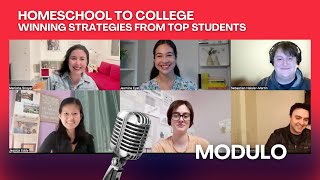
A Modulo podcast episode (hosted by Manisha Snoyer with co-host Jasmine) featuring four homeschool-to-college students — Henry, Jessica, Sylvie, and Sebastian — who share practical experiences and advice about applying to and attending college after homeschooling. Topics include diverse homeschooling structures, transitions to campus life (time-management, test-taking, socialization), leveraging dual enrollment and research opportunities, application tips (narrative coherence + external signifiers), and reflections on the value and future of college.
Chapters
What do you think is the true value of college?
The true value of college is the.
One piece of advice I would give.
Myself is I don't really view college as something people have to do. But because I knew I wanted to be a doctor, I knew I needed to go to college.
College didn't feel that different.
That was a huge transition for me. I had never had to do that.
Hi everyone, I'm Manisha, the founder of Modulo and this is the Modulo podcast. And I am thrilled to have with me today my favorite, most recurring podcast co host, Jasmine, doing a special episode. That was Jasmine's idea about getting into college as a homeschooler. And we have four incredible guests with us. We're going to ask them lots of questions and I will let you kick it off. Jasmine.
Great.
Thank you so much. Hi everyone, I'm Jasmine. Thank you all so much for joining us. A bit of background about me. I've been homeschooled since first grade and I'm going off to college soon. So yeah, like Manisha said, I asked to have this podcast to get some insider tips from all of you. So maybe we can start it off with just a quick popcorn round of where are you from? How was your homeschooling structured and what college did or do you attend?
Hi, I'm Sebastian. I'm from New York City, New York. Of course, my homeschooling was a little bit scattered. I would go around the city to take classes at museums and other colleges and a lot of the institutions they had available to to them. And I'm currently attending Oberlin.
My name is Jessica. I'm from Grand Rapids, Michigan. I actually was homeschooled through a program called Classical Conversations. So it was a curriculum that really focused on the great books. We learned Latin, spent a lot of time in history and the humanities, and I also dual enrolled at some local colleges during my time in high school. And then I attended Calvin University and actually just graduated this past May with my degrees in biochemistry, neuroscience and psychology.
Hi, I'm Sylvie. I was homeschooled all the way through until college. Similarly to Jessica, I had some dual enrollment for my high school years. One was Troy Community College, the other one was Bard College, where I got my degrees in biochemistry and Russian studies. And I'm currently a second year medical student at SUNY Downstate in Brooklyn, New York.
Hi, I'm Henry, a lifelong homeschooler, K12 from Madison, Wisconsin. Up and until probably like sixth grade, I was unschooled and then sixth grade through through high school, I did dual enrollment and co op classes, and then I did my undergrad at Stanford and then I stayed and I got my master's as well. And I just graduated.
Wow.
It's so incredible that people have such a diversity of homeschool experiences, from really unstructured to highly structured.
Yeah. How do you guys think that your homeschooling experience affected the college you chose, if at all?
For me, it's kind of funny. I only applied to one college, which is where I went. I didn't want to move away from home until later on in my academic career. And because I had already taken classes there, it helped kind of build my resume for applying. Like, I literally had recommendation letters from professors at the college. That's definitely one thing we worried about with homeschooling. Going to college is they want you to prove your academic ability to work in a classroom setting. So having that ahead of time, including college classes, was really helpful. And that was just like the good college nearby my home.
Do you think that there are any, like, values or things that you prioritized in your homeschooling that also influenced your experience?
Some things that attracted me to Bard College, which is a liberal arts college, is one. It's very small. You get to have more one on one relationship with your professors and office hours and stuff, which is something that's very helpful to me personally. Also, they have a lot of good music stuff. And there isn't this putting into boxes of people of you're either you just do science or you just do music, or you just do computing. It was normal to see someone bringing a violin with them into their chemistry class. And so I felt at home there being able to participate in different areas. I also was able to get a science scholarship, which helped because we didn't want to be dealing with a lot of debt for undergraduate education.
So it sounds like having a broad range of different things you can study all at once was really important.
Yeah, like I'm not going to be stuck in a library every day all day doing one thing. I don't know. Some people like that. For me, I wanted to branch out a little more.
I'm curious, maybe Sebastian. I think when I think about Oberlin, I do think of a little bit more of a progressive school. I mean, when you were looking at colleges, I'm curious if any of you kind of were looking for similar traits to what you'd had in your homeschooling experience in vetting schools and how was. Did that play a role for you? Sebastian?
It certainly did. I knew I didn't know exactly what I wanted to study going into college. I had so many different varieties of interests that finding like a liberal arts college was really, really important to me. So I applied to a lot of different, of those same kinds of liberal arts colleges with different specialties and different areas that I had interests in event I was, I was cutting down the list. It was difficult, it was hard to decide. I sort of ended up choosing Oberlin because it offered the most well rounded options for all of those things. And it's a very well regarded school. And I felt, I felt comfortable with, you know, a lot of the people there had less than standard, I'd say, educational practices. Not, not everybody is from high school and graduated and immediately went into college. There's tons of people from lots of different backgrounds and because my background is pretty unique, I felt I fel right at home among them.
And also, Henry, I'm curious because you had a very interesting experience in getting into one of the most elite colleges in the world and getting rejected from some state schools. What was, I mean, did that whole experience surprise you? I mean, did you choose Stanford for a reason? Were you just happy they let you in?
Yeah, yeah, that's a great, that's a great point. When I applied to school, I, similar to Sebastian, I was still trying to also figure out what I wanted to study. And I think, you know, coming from homeschooling, I could study whatever I wanted. Right. And so I felt a lot of pressure going into college admissions. And so I was kind of casting a really wide net. And I'm glad that I did because I also found that the admissions process was like all over the place. Right. So I got accepted to some colleges that were really hard to get into, whereas I got rejected at other colleges that were had almost 100% acceptance rates. Right. And I think, you know, it's in part, you know, these colleges are kind of all over the place in how they think about or evaluate homeschoolers. And so I'm really glad that I cast a wide net just because I was not, you know, expecting or didn't realize that that would be the case when I went into college admissions. Another thing too is, you know, Stanford was really helpful for me because once I actually got accepted, they were really generous in their financial aid and I was able to go back and forth.
With them as well.
And having applied to a ton of different colleges, that also helped me, you know, not just in the applications, but once I got accepted to different colleges, really being to compare and understand what that looked like as well. And so that was something that again, like, I didn't realize most of these things until I actually applied to college and you know, heard back from some. And then obviously there's the whole other side too, of like once you're on campus too, you know, what's the case there? And I'm sure we'll get into that. But I think casting a wide net to begin with really, really helped me.
And Jessica, what about you? Do you think that there is any particular attributes of homeschooling that influenced your college choice?
For sure. I loved the great books and I've always loved literature and I really didn't want to lose that in college, even though I knew I wanted to pursue the sciences and I didn't have phenomenal labs in my homeschool education just because we weren't equipped and didn't have the fancy microscopes, all of that. So I chose my school because it was small and about 3,000 students and they had incredible grants from the NIH, so I knew I'd be able to work under an NIH grant while also still being part of the honors program. They go through all of the great books, they go through all of the literature. They still had a classics major when I started there, so I actually started out with a classics major as well until they dropped it halfway through. But it was a way to really take this love for science and this love for humanities and combine them. And there were also so many opportunities for dance and music. I really, I really thought about going to a tech school for a while and just pursuing like the straight hard sciences. But I knew that if I didn't have that aspect of the humanities as well, I would probably go crazy in college, especially coming from such a humanities focused background.
Makes sense. So it sounds like for multiple of you, having the intersection of a lot of different fields is really important with your college experience.
Yes. And I think also your experience, your backgrounds really illustrate the huge diversity of homeschooling. I mean that it can look like much more structured environment where you're learning academics in a specific order to really a really deep inquiry based learning where you're following your interests and your curiosity. So Jasmine and I wanted to segue a little bit into talking about the pluses and minuses of being a homeschooler in college. Of course, I think it'll be quite different for each of you since you had such different homeschooling experiences. So I would be curious though, and maybe whoever has a really strong opinion about it. Let's, let's just start with the positive. What would you say? How did being a homeschooler help you in college?
So my style of homeschooling, which was taking a lot of different classes around the city at the time, it basically feels the same as going to college now where I set my own schedule, I know where I need to go, I got transportation to get there, I know my professors very well, and I'm basically in charge of managing everything for myself and having that as my normal schooling, as high schooling and middle schooling. Everything before that, college didn't feel that different. The biggest adjustment was the change of scenery from the big city to a small rural Ohio town. It was, it was a really seamless transition and I'm very grateful for like being able to manage everything on my own. I've developed a lot of good like self study habits because of that and I'm able to use those very well in college.
Yeah, best thing by far was the, the ability to research on my own. It was, I was very used to having a topic, having an essay prompt, being able to just go find the primary sources of primary literature, examine that and just go from there. There wasn't a ton of aggressive oversight. So transitioning into college, having a professor who just gave the assignment and some background, it was really easy. And honestly I prefer just taking that topic and going to the library and finding the information myself, which is something that I didn't realize was not a super normal skill to have starting college. Because there would be classes like my freshman writing class, like they would teach you how to like look for primary sources in a library, how to write essays. Well, and those are just things that came so naturally after just so many years of research and writing.
Wonderful. I'm curious to know some of the resources that your parents used or you used to to learn how to do research as a homeschooler.
Yeah, we used the, it was the Institute for Excellence in Writing and then the Lost Tools of Writing. One of them was very creative writing based. The other one was just straight like factual, persuasive essays and research essays. And my mom also had us do science fairs each year. And I learned to do all of my research writing reports that way. And then I took a phenomenal course actually through it's called edX. And a bunch of the Ivy League colleges put courses on there that are free access and then you can pay for like certificates or credits. But I normally just did them for fun. And Berkeley has a phenomenal business Writing course that I took so honestly, just writing all the time, it was very common to just have a new, a new essay every day or two just because it was exciting. And then I also was always doing courses through like, local curriculums and like local homeschool partnerships that were just very, very, very writing based.
Henry, known apparently as homeschool Henry on your campus, do you kind of agree along the same lines about research or is there anything else you would add about homeschooling that helped you in college?
Yeah, I, I agree with Sebastian. Jessica. Like, I think a lot of the life skills that go into being a successful college student right around managing your schedule, understanding, you know, how to get to and from classes, like really basic things that don't seem that crazy sometimes are coming from a really rigid high school environment. And so I think a lot of those, those life skills around that or like being able to like, do my laundry right. Like, that transition, I think was like, really, really seamless for me. I do think that there were, there were definitely some difficulties around like the academics a little bit, you know, in terms of, like being able to, I think, you know, high level academics. It was a pretty seamless transition too, around, you know, I think classes and homeschooling require a lot of motivation to be able to make happen. And I think that's also the case in high school or, sorry, in college, not in high school as much. And so I think that was a great transition. I think some of the things though, in day to day, like being able to like, do homework between, like little homework assignments between classes, that was a huge transition for me. I had, I never had to do that. And so I think, you know, it's this interesting thing where, you know, everything outside of the classroom was super, super easy. And then there were some skills that I had to learn with classes that a lot of high school students already had developed through the course of high school, but was interesting to me though is like once you get to college, it tends to be all of the work and the skills outside of the classroom are actually what make or break your college experience and your ability to execute in classes. And it's a little bit less like the nitty gritty academics between classes and so pros and cons. But that was definitely my experience and I think homeschooling prepared me well in that respect.
Were you surprised to hear about some of the challenges your peers had? Things that kind of just came naturally to you as a homeschooler that were difficult for them?
Yeah, yeah, definitely. I think I mean, I think the. The motivation part was the most surprising thing to me. Like, I think I feel I didn't even realize, I think in high school or earlier, even in homeschooling, that I was doing it because I was motivated and that that was a unique thing. You know, I think I was just excited and I, you know, I was able to pursue that excitement. And so I think it was surprising to me, once I got to college, that a lot of kids hadn't been operating from a place of motivation or excitement or enthusiasm before. And so I think when they got to the college where they could take so many different classes, it was incredibly overwhelming. Which, again, though, there's a flip side of it. I had to take certain classes for my major that I did not want to take, and I think those were harder than they necessarily maybe needed to be for my public school, my public school peers. But I was so surprised that they. It was operating from a place of good GPAs and not from a place of an excitement around what they were learning.
So interesting. Sylvie, maybe you could share with us a little bit about, you know, what really helped you, coming from a homeschool background, and maybe what some of the challenges were for you. And then maybe we can ask Jessica and Sebastian about some of the maybe challenges or obstacles or ways you needed to develop.
Yeah, I mean, one thing that a lot of people talk about with homeschooling is the socialization aspect, which I think is overblown, because even when I was homeschooling, I participated in different orchestras after school things. We had our own homeschool orchestra called Musette. But I also have anxiety issues. Sometimes. It's hard for me to get across to people that my anxiety issues are not because I was homeschooled. I happen to have anxiety issues and was home schooled. But it's definitely different being, I don't know, sometimes lab partners or something like that, kind of randomly stuck together with people in a class in a way that you haven't necessarily been before, depending on what kind of homeschooling you did and, you know, just getting along with everyone, different personalities, sometimes your relationships with classmates being a little more superficial than you're used to. But I think, as I mentioned, the fact that Bard was very small was something that definitely helped me because I was still able to have that kind of personal lifeline with my professors and able to open up with them about some of my struggles and some of my. Not exactly learning disabilities, but some quirks that are challenging to me with learning and they were very understanding about that, which I appreciate.
Sylvia, I just appreciate you sharing so honestly with us here in this public forum, because I think that a lot of people, including myself, struggle with social anxiety, but don't necessarily have the courage to share that with others. And because you are homeschooled, I can see how any challenge you might face could be attributed to your homeschool. Anything.
Which is why I didn't tell most people that I was homeschooled.
Yes. Yes. And it's hard. I mean, I think, you know, I went to both public school and private school, and I think didn't really start becoming a social person until I was in my, you know, early twenties and went. Spent my year abroad. So it's certainly not necessarily a cause of homeschooling. And it's good when we can find mentors and friends and people like you who are willing to express that. So thank you. And how about you, Jessica and Sebastian? Anything about homeschooling that made college harder for you? What were adjustments that you needed to make?
A big adjustment for me was being tested so often. I was used to not taking standardized tests, and I was not used to having to just, like, memorize information and, like, regurgitate it onto a test. And all my peers would be there, like, the night before an exam. Like, I just need to memorize this and spit it out, and then I can forget it. And I was horrified. I was like, I, like, a lot of you are pre med. Like, I really hope you don't, like, memorize, like, every organ in my body and then promptly forget it. Like, that could be a little bit problematic. And I was very used to learning for, like, the inherent love and value of learning. And it was a lot more, you're doing this because education is important versus you're doing this to get an A or you're doing this to regurgitate information. So I. It was a hard transition to realize that there are some courses that you won't be able to understand everything to the full depth that I wanted to be able to. It's just not realistic when you're taking a full course load. So I had to be okay with some concepts. I do just need to memorize this, regurgitate it. And some of them I just will be able to forget after this exam. And knowing when it was worth it to go down those fun research rabbit trails and, like, into the world of literature and, you know, the YouTube science, explaining rabbit trails. And when I had to just be like, okay, Jessica, like, suck it up. Memorize this. Go take the exam, and don't let your love and curiosity get out of hand.
I have a very similar personal problem within this. Similar to Jessica's in that I had. I struggled quite a bit with figuring out how to communicate that I understood and that I learned something in a way that would work for the class. So if we had a test coming up, I don't test particularly well, so it would look like I was falling behind in the class. But I felt like I knew a lot of the course material and it felt. I wasn't quite sure how to properly express that to the teacher. That, no, I do understand what's going on. I'm not. You don't need to worry about anything. I'm just not particularly good at this specific format. And then when another exam comes up or an essay or something, I can try a different method of showing, like, hey, I wrote an essay like this before, didn't quite do as well as I thought it would, even though I feel I understand material, try it again from a different point of like, creation, and then do a lot better.
In that regard, it almost sounds like you had to learn how to advocate for yourself in this institutional setting.
Yeah, that definitely sounds right. I had felt that a lot of the assignments and stuff that I'd done as a homeschooler were tailored towards a lot of the ways that I can express my understanding of a thing. And not having those specific assignments tailored to me in the same way proved a little bit of a challenge in figuring out exactly how the professor wanted me to demonstrate information and that sort of practice. Practices and stuff. So it involved a lot of talking to them in office hours, I'll tell you that much.
Okay, so it sounds like there's a few things that homeschooling has helped you with, like time management and some potential difficulties like testing. What do you think is one skill you wish you would have practiced before going to college?
Yeah, skills. I mean, I think test taking is definitely one of them. You know, I mean, I. My freshman year of college was like reading books on test taking just generally and how that works, you know, and that was on top of reading all these other books. Right. That I had to for my classes. And so I think test taking is something where I, you know, I think when you're in college, you want to be able to pursue whatever major or take whatever course that you, you want to be able to take. Right. And so I think being able to have some well rounded skills, I think matters in that respect. I think well rounded Skills in general matter less. You know, you should do whatever you want to do. But I think I definitely had some anxiety freshman year around taking classes that were super test heavy because I just, I had less experience in that. So I think some test taking prep beforehand would have been helpful for me. And then I think the other thing would have been developing strategies or maybe even researching more about all the resources that I had available to me while in college to be able to really fully take advantage of them. I think I was so used to being able to, like, have really small group sessions and be able to get help and support in the immediacy of whatever that classroom environment was, you know, for homeschooling. And, you know, I know that can be whatever, super broad. And so I think being able to develop strategies where, like, I. I didn't realize that I could go to the writing center really easily. Right. Or I could go and find other resources or even office hours, you know, and that I would need to do that because there are large classes and I can't just get all the support I need in the classroom itself. And so I think some, maybe less skills, but just even research around what those look like because I felt like I was just kind of slowly learning as issues arose throughout the year. And so I think that would have helped me as well.
Yeah, you know, it's a great question. There's so many little things that sort of came up during my first semester of college that I didn't even really consider before. But I think the biggest one is probably.
The.
The experience of being in college and what it means to succeed in college is very, very different than what it looks like to study on your own in homeschooling. So it would be good to sort of have. What's this? What's the proper way to communicate this? I think being okay. Henry mentioned this earlier, I'm pretty sure, but being okay with not. No, it was Jessica. Being okay with not understanding everything 100% to a way that would satisfy you and basing your expectations of what you're getting out of a course, more on what your professor is expecting a student to get out of it. Because if you want to spend 100 hours studying this one specific thing that's really interesting to you, you can, but you're probably going to fall behind in the rest of the course. So you need to understand sort of, okay, I can spend this amount of time on this assignment and it's good enough and it'll do well, and I can. I should probably move on because I'VE got other things to worry about.
It sounds like having a more personalized environment was a really big part of all of your homeschooling experiences. I know that it's really important for me. I had the same experience when I was, you know, doing microeconomics or something. If there's a topic that I really want to dive into, homeschooling has given me that opportunity to do that. But I'm sure it's not exactly the same with the college experience. Was there a way that you guys found to still foster curiosity and a love for learning despite these larger classroom sizes and more structured environments? Maybe, Jessica, you can go ahead and start us off.
Yes, the thing that I found that really fulfilled that deep desire for learning was professors office hours. And I was terrified of my professors at first. And like, you guys are brilliant. You have a PhD in your field, you are an expert in your field. But over the time in college, it was a reoccurring habit for me to just walk around, like this one building that I spent all my time in and just pop into literally every single professor's office with super duper detailed questions for them about their field of study. Half of them, like, I'd never even had as my exact professor. But I just loved talking to them. So I think that was, for me, a super easy way to get an expert answer on something I was super interested in. And honestly, like, I'm so grateful for the relationships with those professors. A lot of times a lot of my peers would look at their professors as like, wow, you are up on this pedestal and like, you're unapproachable and I can't talk to you, I can't ask you questions. But I mean, I had some of the most interesting conversations about like, Dostoevsky's philosophy with like my organic chemistry professor. And. And so many of them are very interdisciplinary themselves and have incredible knowledge and insight and truly do want to have conversations within their field of expertise and just conversations in general. So that was probably the primary way that I satisfied that desire for deeper conversation. And then beyond that, a lot of it was just genuinely conversations with friends as well. Bringing up the really interesting philosophical debates. Ethical debates, especially with the pre med crowd, was always a hit. And just being willing to ask the questions that I had because I found that honestly, more people than not had an interesting answer and also wanted to discuss it.
It's kind of funny because I don't really view college as something people have to do, but because I knew I wanted to be a doctor I knew I needed to go to college, so I did try to choose classes and activities that interested me the most. But I also knew there were things that I would have to take no matter what, in order to go the direction I wanted to go. And I've always loved science. I like creative things, too, but I really like getting scientific answers to things and highly specific answers, and you cannot always get those. And something that I coached myself through in some of my science classes or my math classes is reminding myself. I reminded myself of the fact that everything is an approximation, even in science. All the scientific facts that we have are not completely set in stone. So there isn't this finish line that you're going to reach with information for any topic, probably. So I would kind of figuratively calm myself down a little bit that it's okay that I don't fully understand this, because probably what the textbook is saying isn't fully what the situation is either. But all of these ideas are stepping stones for someone to find out more and get a better approximation in the future. And I can't do that all right now, but I can keep walking that path towards where I want to be later.
So kind of flagging your interests for later review when you had time?
Yeah, I mean, that's the same thing comes up, but even more in an even more pressing way in medical school, because we have way more information that we're supposed to be learning. And if I get hung up on, I want to know exactly why this thing happens, I will not be able to study the other two hours of things. And that might be something that no one knows the answer to yet. And maybe someday I or one of my colleagues or one of my current professors might figure that out, but there's a time and a place for all of it.
So kind of just holding those questions for a later time. How did you feel like if it. If you felt like something, it was. If you felt like your professor could help answer that question, what did you guys do? Like, if it wasn't something that it was immediately addressed, was immediately in the scope of what you're talking about, but you really want to know? Because this happens all the time for me. What do you guys do? Do you just research it later? Do you ask it anyways?
Ambush your professor in their office?
Okay. Office hours are, it sounds like, vital for sustaining that curiosity. Do you feel like. I know a really common concern about homeschooling is our ability to socialize. And you touched on this a little bit earlier, and I think what you said Was it was a little bit overblown with collaboration and things like that. So I was wondering, in what ways do you think homeschooling has shaped your ability to collaborate inside and outside of the classroom? And how did that affect your college experience? Maybe, Sebastian, you can start us off.
I absolutely can. So what I think was really interesting to me about socialization first in college is that a lot of the expectations about what socialization in college is going to be isn't always necessarily true. And homeschooling is very similar in that regard. Where oftentimes in college, at least, this is my experience. Of course, others may have different, but I would bond with one or two people in my classes, and then I would see them outside the class and we would talk about the class and discuss interesting things that we all enjoyed. And if there was a group project coming up, since we already knew each other, we would just sort of collaborate in that regard. I didn't really attend any parties with them. I didn't. I don't participate much in the drinking culture or the nightlife much. And it didn't really dampen our sense of closeness in any way. You don't really need to follow the strict conventions of what a college social life is in order to find connections among people that you want to spend time with. So it didn't. It didn't really feel too different to me or too hampering. Having such a different original schooling style.
You deviated a bit from the general culture of college, but were still able to generally socialize like the person. That's really great. And what about you, Henry? What was your experience?
Yeah, I think, you know, I think college relationships or adult relationships more generally just require a level of intention to be able to make happen. Right. Like you're not seeing people necessarily every day, or you're not seeing them in naturally social context. Right. Like, Sebastian, you're talking about classes. You know, sometimes classes are social. More often than not, they're not though, Right. And so it takes a little bit of work to make those. Those things happen. And so I think in homeschooling, you know, from a very young age, you have to be really intentional, right. And it takes a lot of work and be really motivated to make social interactions happen. And that's why I actually think, like, homeschoolers on average are actually far more socialized. They aren't necessarily doing as many social activities. Right. But they're developing really key skills to be able to make social interactions happen. Because everyone wants to be social, right? Everyone wants to Be with other people and in community. And so I think when I got to college, it took a lot more work to make relationships happen. Right. And to have a social life. But I think I already had a lot of skills around being able to actually be able to organize others. Right. Organize myself. Right. And be able to have that motivation and that intentionality. And so I think that was huge for me and incredibly helpful.
That's really interesting. So homeschooling kind of gave you those social skills. Even though it's not the classic social skills that people think of, it really helped you with adding others and forming those friendships. Jessica, did you have a similar experience?
Yeah, I found that my homeschooling experience really forced me to communicate with people of all ages and all levels of intelligence. And one thing I found very interesting in college is that the upperclassmen and the lower classmen really stuck together. And if you were in a class that was primarily juniors and seniors and you were a freshman, like, it would be that awkward. Like the freshman's just sitting there by themselves, kind of silent and like really awkward and feels the power dynamics. But something that I found is I was genuinely interested in everybody because I was used to talking to, you know, like the little four year olds who are at the same program as me and the adults. So I did find that I tended to get along better with professors than a lot of my peers simply because I think, like Sebastian. Yeah, like Sebastian said, I wasn't interested in the drinking culture. I wasn't interested in the traditional party culture. So I did tend to spend a lot more time in the library or at coffee shops studying. So part of that was my own choice and just who I naturally gravitated towards. But the one thing I do regret is not joining social groups and like, organizations sooner. So I do wish I had jumped into, like, our school has a huge dance program. And I wish I'd done that sooner or been willing to try some of like the non academic or non, like non traditional fun clubs and groups, because I think that would have been a really, really cool way to make connections with people with similar interests faster rather than having to seek them all out myself. But I did find incredible friendships. And honestly, a lot of them aren't even from my major. So I think that's kind of a myth or conception that you're just gonna be best friends with your entire major or your entire dorm, because honestly, that's like first semester freshman year. And after that, every single friend group changes. And by senior year you have like this mixed Match, friend, group of, like, who knows where it came from, but, like, you're bonded for life and you all just have different interests and hobbies, but that it works out somehow because, like, like you guys said, it is adult relationships, and they are intentional and there are shared interests and effort on both ends. So it's not the same as just through freshman high school clique.
This is all fascinating because it sounds like you guys are basically directly contrasting the view that homeschooling makes it really hard to socialize. This is all amazing about the college experience. I wanted to segue a little bit.
Into any point because I'm just, like, about to pop out of my skin because this is just such a gross misconception, both about homeschoolers and about how socializing happens, like how people actually develop social skills. So, first of all, I mean, it just has to be said for the thousandth time that homeschoolers are not sitting at home in their house alone. There are other homeschoolers in New York City besides Sebastian, you know, like, lots of them, hundreds of them. They're taking classes together. You know, Henry is on a soccer club. There's lots of people that homeschoolers are interacting with.
They're just not grocery shopping with our mom. And talk to all the employees in the store.
Exactly, exactly. So people, they're actually hanging out around other people, just not sitting in a desk for eight hours a day next to kids their own age. And the second thing is that a major way that people learn how to socialize is actually through having a secure attachment in their life. And I'm just kind of curious how many of you. But you don't have to say, but like, how many of you had a teen rebellion phase where, like, you just yelled at your parents for a year? Okay, so you did. But I mean, I would say one out of, you know, five, four. I mean, it's. It's not a lot. And a lot of homeschoolers actually don't have that phase because they have a more organic, fluid relationship with their parents. They don't necessarily have something that I have to fight back against. So, you know, I mean, it's just your ability to socialize is so apparent in the degree to which you are articulate and comfortable on this podcast. I mean, to Sylvie's just self awareness and honesty about her social anxiety and finding ways to work around that. And so, I mean, I think it's just, you know, you know, when we in school, there's these groups where you have, you know, you're supposed to do these group projects, and what always happens is that one person always ends up doing all the work, and then someone else does nothing and. Or someone's parent does the project. And. And here in homeschooling, you have this opportunity to collaborate more organically on projects that are interesting to you. So sorry for that, that little ranch, but it is. I'm sure we could have a whole other podcast on this topic, but I don't. I don't appreciate the. The misconceptions that are still existing around socializing homeschooler.
And you do definitely get those homeschoolers every now and then. Like, there were a couple on my campus. Like, it was like the classic stereotype, you know, like the ankle skirts, like, coarse sweaters, don't talk to anyone. Like, don't believe in science, and curled up in the corner. Like, there are, like, you do get those things every now and then. But quite frankly, there are also people who went to a public school or a private school who were right next to them. So it really is. Is such a myth and misconception that every single homeschooler cannot carry a conversation.
And everyone needs to find their own people. Like, different people socialize in different ways. We don't need to all do the same exact thing. We don't need to all be subjected to bullying for the formative years of our life, things like that.
I mean, I personally think that weird kids are wonderful. They're my favorites. But there are weird, antisocial people in school, and there are weird, antisocial homeschoolers. And, you know, it's just. It's not. No one says to someone in school, oh, you must be antisocial because you go to school. But that's probably more true than the homeschooling comment. Anyway, I'll let. I'll let you bring along.
Now that you're talking about it now, I have, like, an expansion question. I was wondering. I feel like with my homeschooling experience, I was able to talk very openly with, like, my professors and because of those, like, small group environments, also to make friends with people who are way younger or way older than me. Do you feel like that same experience carried on into college? Like, were you able to create kind of a broader friend and almost socialize easier because of that?
My professors are, like, some of my best friends. And I say that and, like, a lot of people are like, that's not possible. But it genuinely is. I graduated and actually, upon graduation, three professors that I work closely actually just Gave me their personal cell numbers and they're like, well, you're not my student anymore. Like, let's catch up. And I get, I get, I grab coffee with one of them every couple months, one of them. I go over to her house for Chinese hot pot all the time. And a lot of people are like, oh, it's just like, you know, being a suck up, being the teacher's pet. But it's genuinely, I love hearing their life experience, I love hearing their wisdom, their insight. One of my professors has strong opinions on my romantic dating life and they genuinely like, it's just like I'm used to talking to parents, to my friends parents and I have friends who are, you know, just like freshmen still in high school. And it really, homeschooling did foster that ability to jump in and see every single person as a unique person with a unique story and being willing just to engage with them and just talk to them. And while there is definitely a level of respect for professors, like there's still, yes, this is professional and I'm not going to make ridiculous jokes that I might make with my friend. There is still that level of friendship and mutual respect for one another.
So it sounds like far beyond the classic idea that homeschoolers can't socialize. It actually becomes an advantage in college to be able to chat openly with your professors or make friends with anyone and not have that initial barrier of age or qualification or anything like that. So I'm going to go ahead and segue because I know we have a little bit of limited time. What do you think? Do you have any advice for homeschoolers working on their application? Maybe Henry, you can start us off considering your business and everything.
Yeah, I have, I have a lot of advice and I mean, I think if I were to boil it down though, and I'd be really curious to hear others perspectives. I think college admissions relies on you being able to stand out and have a really coherent, cohesive idea of self. Right. And a cohesive narrative around who you are and what you're interested in. I think there's, you know, within college admissions people often talk about having a well rounded student, you know, and that you need to be able to show that you can do all these different things and that is like the worst advice possible. You know, like really what it is, is you need to, there are just so many people applying to college. College. Right. You need to stand out somehow. And you do that by like having really specific interests or ideas or activities or just like anything that's Specific. Right. And I think one of the beauties of homeschooling that we've, you know, talked about in a bunch of our answers is that, like, you can go really deep into what you're interested in for a variety of reasons, right? Just one, you have more time. Two, you have more freedom and flexibility. Right. And so I think being able to really lean into that in your application is super, super helpful and really, really important. And I think a lot of homeschoolers approach it the opposite, where they're like, we need to show that we, like, match up entirely to what the public school students down the street are doing. Right. And instead, I think you should acknowledge and lean into and celebrate the fact that your homeschooling was atypical. Right. And everything that comes with that. So I'd say that's my biggest. My biggest piece of advice. And then I think the other piece of advice is having one or two clear signifiers, though, that your homeschool was, like, structured and had some rigor, too, though, you know, Like, I spend all day talking to admissions officers about how they evaluate homeschoolers, right? And a really common thing is they're like, we love homeschoolers, and we love that they're doing really interesting, creative things, but we also have no idea if they actually got any real education at all. And so being able to, like, in it. I'm not a huge fan of standardized tests. I think none of us are. We mentioned that a couple times. But those things do come into play. So having one or two, like, community college classes or the ACT or the SAT or an ap, you don't need a ton, but just a couple of those kind of clear signifiers. Same thing with, like, letters of rec. If you can have one or two where it's like, here's someone who isn't my mom, who is, like, my, you know, my intern boss. Right. Or my soccer coach or these things, those go a long way as well. So I think you don't need to be well rounded, but I do think you need a couple of clear signifiers where they can compare you to others as well. Long answer to a short question, but, yeah, that's my. I think if I were to boil everything down, those are the big things.
Great. So lean into the fact that you're homeschooled and really make sure it sounds like to clarify what your homeschooling experience was like, because it sounds like there's a lot of different types of homeschooling. So breaking down a little bit of Those preconceived notions that the readers might have in the. And some kind of standardized test, no matter how much we may not like it because it doesn't foster our love of learning, but having some kind of external validation. Sebastian, what about you? Any thoughts?
Yes.
So, building off of what Henry said, it's one of the really beautiful things about homeschooling is that you can pursue what you're interested in early, ahead of before all the other high schoolers and things. And a lot of what? Oh, well, I suppose it isn't stereotypically. A lot of people go into college trying to figure out what they actually want to do in life and what. And they explore a lot of different topics and they explore a lot of different things. They try and figure out who they are. One of the best advantages of homeschooling is that you get to do that so much earlier than everyone else. If you can do that and explore your interests and prove and show that you can both succeed academically, foster a sense of self, and all the while exploring the things that you're interested in. The colleges are going to love to see that because that is the kind of thing that they're looking for somebody who can grow as a person, still is looking for things that attract them to them and can still perform well within the bounds of the system itself.
Just putting up my former test prep tutor hat here. You know, I think that you can really succeed at the exams if you approach them as a game, not as something that's being imposed upon you. And there can be a value in understanding systems because if you go get a job somewhere or if you travel to another country, you might want to understand what that system is like. And so that's how I always taught, you know, my students who approach the SAT or ssat, you know, this is a poorly designed test, get in someone else's brain and, and approach it like a game. And I, I do find that it's a lot easier for a homeschooler to transition to traditional school than for a traditional schooler to transition to homeschool, because homeschoolers are used to having a lot of freedom. They do understand systems thinking. So for a lot of them, some kids will say, I want to go to high school, just see what it's like, and it can be like a game for them. So I think that that can be a good approach to test taking. And seems like Jessica and Sylvie, you both regularly took tests throughout your, your homeschooling, maybe. Do you want to share a little bit about that.
So we took the California Achievement Test every year from some age when we were little to give proof to the local school district that we were proceeding in our education properly. My brain makes up words sometimes. The scary thing is like, as long as you're getting 33rd percentile or above, you're fine. And they won't take you out of your home into school, which is a really low bar. And I feel really sad that that's the bar that is set for public school. So we got like 98.99. And I still have test anxiety. That's something I'm still working on. We did the SAT because we were homeschooled because the college needed some kind of standardized stuff. What I didn't mention before is my mom actually was a public school teacher for many years prior to my brother, my older brother being born. And we took a lot of tests that were quizzes out of textbooks and occasionally took a peek at a Regents Exam, which I think are very poorly designed. But she wanted us to get a feel for what people are dealing with out there. And she taught me a lot of good skills that then me I have used as a tutor in tutoring high school students, other college students, how to read a question, how to figure out which information is valuable to answering the question or not, and going through kind of this flowchart process of what the test is looking for from you. So I'm grateful that she prepared me for that.
So Jasmine and I were having a little conversation about college itself, taking it on a meta level, and I was going to ask you, do you think college is going to end? Is it going to go extinct? What's the point? Why do you even change from this beautiful homeschooling to. To college? Jasmine, maybe you could phrase the question, you put it around the value of college.
There is the end of college idea. Is it still important? Is it still prevalent in our society now, especially with these online resources? Clearly you all have been able to facilitate a homeschooling experience without that traditional environment. But also in the positive lighting, what do you think is the true value of college? Maybe, Henry, you can start us off.
Yeah, I mean, this is a really hard question, right? I mean, I think the true value of college is it's entirely dependent on, you know, each person, right? So I think like Sylvie went to college to do pre med, to then go to med school, right? And so the value that she got out of college is very different than what I got out of college, which is very different than what. But you know, anyone, like everyone's getting different things out of college. Right. I think if I were to boil it down though, to a very general level, I think that they're the biggest value. Well, there are two, two primary buckets. One, they're literal skills and knowledge gained. Right. You know, whether that be for the job that you have, the grad school you go to, or just learning to be able to learn better. Right. Too. Like I studied philosophy, right. My day to day, I'm not drawing on like very literal texts that I read, you know, in school, but a lot of the understanding and skills developed and the ability to learn I'm definitely drawing on. I think more generally though, when I think of the value of college, I think it is the opportunity to be able to try a bunch of things and fail at a really unique point in your life and to be able to do that with few consequences. And so I think, you know, that I think is a huge, a huge benefit and opportunity. But it's also specific to, you know, people take college at very different times in their lives. All colleges look different. Right. And so it's again dependent on who's, you know, on each person. So I think it's, it's super, super hyper specific. But I think the most important thing then is people being able to understand what they want to get out of college when they're there, and then having the support and resources of both academic immediate classes and support around that to be able to help each student realize whatever value it is that they're trying to get out of college. So that's a long answer to a short question, but I don't have a shorter answer for you.
Yeah. So making college into a very personalized experience, almost a little bit homeschool esque, I dare to say, and having that freedom to experiment. What about you, Sebastian, what do you think? What was the main thing that you got out of college?
Well, I'm still well within my college, my undergraduate program. I'm still only a sophomore at this point, so I've got a lot more left to get out of college itself. But for me, the first, the first little while I spent in college was figuring out exactly what interested me that I wanted to pursue further. There were so many things I wanted to, wanted to try and getting the opportunity to explore all of those was wonderful. But at this point I've sort of honed down exactly what I'm really interested in doing. And for college, to me, the most value I'm getting out of college is building skills to do the kinds of things that I'm interested in at a professional level, say at current, I'm studying computer science and creative writing and being able to take classes about programming and the way computers work and systems and things like that. I'm getting a lot of value out of that that I'm appreciating quite a bit. It's also wonderful for, you know, meeting people in the same sort of step in their life as you. You can build lifelong connections and, you know, business side of me, let's say, like, networking was also very important. But being able to make connections with the people in the same life path as you, or at least in the same stage of their life relatively is another thing that's, I think, is an incredibly important aspect of college.
So socializing and having these specialized classes that you have access to. What about you, Jessica?
Yeah, so it was really interesting. My sister was also homeschooled and she actually chose not to go to college. So I found it really interesting that you posed that question. I do think for some careers there will, like, we will actually see a decrease in the traditional route being high school, college. My sister, she actually is in the film industry, so she did like a trade school, tech school type thing. And her husband's an electrician, so he also didn't go to college. I don't think that it's actually. I don't think college could ever fully go away at all. I mean, you're going to have your doctors, your lawyers, your engineers, your nurses who will just need that higher education. For me, the. I personally loved college because I knew there were skill sets that I would not be able to obtain elsewhere. Like, you're not going to go to a company like Pfizer and be like, hey, I really want to work for you. I've never done anything in the sciences, but, like, can you train me? They're going to roll their eyes and be like, you know, absolutely nothing, which would be completely true. So for any of those subjects or fields that really, really require technical skills, I think the college is essential. Like, I would not know how to use a flow cytometer, how to sort cells, how to do any of those things without college. And I think that that was one of the biggest takeaways for me was literally just having those on paper resume practical life skills specific to medicine and to the fields that I was interested in. And also, I agree with Sebastian completely, the connections. So I presented research at a bunch of different national conferences and have like those professional connections. So it's like, wow, applying to graduate school, shoot one of them an email. You know, loved presenting, love getting to meet you at this conference and being able to keep those professional connections because college really opens the door through your professors and through these conferences to just network and just stay in touch with classmates, with professors, with random people that you've met along the way. So a bit of both. I think that it's going to remain essential for a lot of careers. But I do think there are like, there are other routes, but in many ways they're still giving you the same skill set as college, just without the complete interdisciplinary side of things and just putting on a slightly different trajectory.
So it sounds like for professions it's a different answer. There may be maybe not the end of college, but it sounds like for some professions it might diminish slightly. Even so, benefits of meeting new professors and networking, but also just meeting, raising people is really important to you. How about you, Sylvie?
So I think one of the biggest issues is the societal context that college is occupying right now. And even graduate schools, a lot of places that used to take an undergraduate degree for an entry level position now want you to have a master's degree or a master's degree. And real world is experience, which is very impractical for someone who's trying to get a job in the first place. So I feel like a lot of people have been turning away from college partly because of that or because of this kind of rat race in a box feeling. And obviously there are technical schools, there are many standalone courses and things like software engineering you can take and then get hired for a company. I've had for friends do that. But I think if we got rid of college in basically the form that we have it today, something similar would eventually emerge again because it's about people having similar interests, coming together and trying to expand their knowledge. And like a college is a group of people pretty much literally. But I think in the same way that the public school system has been struggling with the quality of learning, I think colleges have started to struggle with that. So I would like to both see not going to college and either pursuing education elsewhere or pursuing non educational interests as more valid in society, but also like the college system and employment system itself to be more, how do I say this? More. More value focused and less about bidding people out through the system.
So it's very important for career goals, but maybe not so much if you don't want to go straight into that.
I think people are getting trapped in between. We need all these degrees, but we won't hire you even though you have these degrees. So something isn't matching up between the in of the pipeline and the out of the pipeline. Not that the individual pieces are like should not be there, but someone's planning has gotten out of sync.
You know, there are structural, inherent structural problems in moving into your vocation. What really strikes me about all of you, you might not feel it at all moments, but you just have such a high degree of intentionality compared to other learners I see of your age. I mean just how unique to be double majoring in coding and creative writing. I mean studying language in a way that makes so much sense but would not be intuitive to others and, and how Sylvie and Jessica have this path to become doctors. And Henry, who's an entrepreneur and kind of took a more eclectic major in college. But I think that a lot of people enter college and like, I don't know why I'm here, what I'm doing. It's just that's kind of what you're supposed to do. What do I want to major in? What do I want to be? I don't know. I guess I'll, you know, move into my parents house until I'm 40 or not. That's okay too, which is great too. I mean, back and forth myself. I'm not going to deny it. But yeah, I mean I think that family is great, but yeah, so, so I think that you guys are really, you know, you're focused and you're in tune with yourselves and your needs and desires and even, you know, Sylvie, you kind of reflecting, you know, some of the challenges that, you know, the system puts upon your desired career path and the desired career path of your friends, but not being a victim to that at the same time. So yeah, super, super interesting.
So we've covered a lot in here. We've talked about the pluses and minuses of being a homeschooler in college, the general college experience. Some advice for other homeschoolers. I wanted to kind of as a wrap up question, ask you guys, if you could give your college freshman self one piece of advice for success in college, what would it be? Maybe Jessica, you can start us off.
Yeah, the one piece of advice I would give myself, and it's not a piece I would give like all freshmen, specifically more of the homeschool freshmen, is don't like kill yourself over grades. Because for me I was like, I'm going in here, I'm going to graduate with, with Fluoro. Like I will be top of the honors class. Like it was My first time being in a traditional school setting where grades were given other, like, by someone other than like, my parents, with the exception of dual enrollment. And I was so stressed out freshman year, I was like, I will. I need to do every single thing. Like, I need, like my, my graded moodle to be 100. And then like, I was like, wait, 93 is an A. Like, I don't need to kill myself over this. Like, I can get a 95 or 94 or a 93 or even, you know, on a single test and it's not going to screw up the entire class. So I would tell them, yes, grades are important, but on average, the homeschoolers tend to be like, more stressed out about the grades than, like, not caring enough. So I would tell them to make sure that you're also fostering community and a social life, because if. Or in an outside activities, because if you don't have, have either sports, art, music, friends, whatever that thing is that keeps you going, you're going to burn yourself at both ends. And I've watched incoming freshmen do that. They just drive themselves to insanity trying to maintain this ideal of perfection. And it's like, you can be a straight A student. Like, I ended with like a 3.95 or something, like, without actually driving yourself to complete insanity.
So grades are very important, but maybe not as important as we think. What was some advice you'd give to your freshman self?
Well, I'm only one year distanced from my freshman self, so I may not have the most insightful take on this, but I think it's really important for a lot of freshmen to understand the difference between pushing a comfort zone and going off the deep end like you're experiencing something new with college. You're going to be there, it's going to be exciting, it's going to be fresh, it's going to be new. You should push your comfort zone a little bit. Find, find some things that you're maybe not super familiar with and try and learn from them. But if you go all the way down, if you, if you push yourself too far, sometimes it can be a little overwhelming and you won't really know what to do in that case, finding the right balance of that, I think as a freshman is going to be really important for informing the rest of your. Your time, the rest of your time at college and even higher education in the same way.
Okay, so balance is key.
This isn't so much specific to as a homeschooler. I wish I had known more about mental health when I was going into college at one point, touching on what Jessica said, I stopped being a straight A student in college, which was okay, but it was a hard adjustment. I wasn't used to failure. Someone mentioned that earlier, it's really important to realize you can fail and still you'll be okay and recover, and your path is not over yet. But I had a counselor in college have me set a goal of having a lower GPA by the end of the semester for mental health reasons, which sounds really bizarre, but it was exactly the right thing at the moment. The balance thing is also huge. You know, when I started out, all I wanted to do was study all the time. My friends were only people I had classes with. When I got to the end of college, I was spending a lot more time socializing, and it became a little harder for me to focus on studying. But realizing that you're in this developmental journey the whole time, and you don't have to stay the same and you can try different things and it's okay if something is a struggle now, that doesn't determine what. That doesn't determine where you will be in two weeks or two years. It's just where you are today.
So learn in the way that helps you the most, regardless of what letter grade or GPA that reflects.
I'm gonna go because I also went to college even though I wasn't homeschooled. And I have very strong opinion on this topic, which is, I think when I was in college, what I really did right was leverage the incredible network of professors. I participated in a lot of social activism. I interned at an institute for Disarmament studies. I had Brandeis fund a trip to research dialogue between Jews and Arabs in the West Bank. I did greening activities on my campus. And I leverage these connections and my grades and accomplishments in college for many, many years to come. I mean, and you're very right, Sebastian, when you say, like, these networks that we build in college will serve us through our entire careers. However, a big regret I have is that I always felt like I was in a rush and that I was behind. So, for example, like, I didn't really start dating until my mid-20s, and I felt like there was something really wrong with. And I always felt like I was kind of in a rush to, you know, do that timeline of get married, have kids, et cetera. And I really wish that I had slowed down and put more effort into making friends at college, especially with people who I felt less comfortable with, you know, like, for example, at that time, I felt really Uncomfortable around guys. Like, all my friends were females. And I think that it would have really served me to try to kind of practice being comfortable with making friends with someone of the opposite gender, you know, or someone who just, like, had a very different interest than me, like sports or something like that, without feeling any type of pressure around that. And so, you know, kind of coming from the library. Nerd geek. I mean, I'm happy that I stayed up till 5 in the morning studying and doing 10 million projects and actually, like, lobbying to get these awards and scholarships. But I just wish that even, you know, maybe if I'd been in the library talking with a friend or, you know, kind of didn't shut down when that person who I felt uncomfortable around came to speak to me, that that might have been a good. A little extra that I could have done at that time.
Yeah, for sure. I think it's really important to be able to step out of your comfort zone in all walks of life, but especially in college, when you have the opportunity to meet all these new people and do some networking that will help with your career, but also hopefully meet some lifelong friends. So kind of with that, I guess we'll wrap it up. Thank you all so much for coming. This has been amazing for me personally. I've received great tips.
Did you learn what you wanted to learn about applying to college?
I think I'm gonna have to watch this podcast over, like, 20 times because there is so much information here. I'm gonna be, like, taking notes and bringing this with me. This is amazing, guys, on that because.
I didn't say it out loud. Write down all the things you do, not all the things, but there are so many times I wished I had a file folder of certain things that I did. Because when you're applying for stuff during college, after college, like, I don't have the records that they're asking me for. So start now if you haven't already.
Yes. My mom actually made me do that from the time I was in, like, fourth grade. She was like, okay, like, every volunteer thing, every random, stupid thing that you are, like, rolling your eyes at me for, like, making you do. And it actually saved my life when I was applying. So keep a list of your extracurriculars, your jobs, your everything, even for, like.
A personal, selfish reason. My goal is, like, look back on my entire, like, call or high school and life experience and be like, wow, I actually did a lot of stuff, you know, because it's hard to remember day to day, like, every single little thing that you did. But kind of like, look, I have like a massive Google sheet of all the things that I've been working on. So I'm excited to at some point unveil it.
Yeah, that's going to be incredibly useful in the future. Keep it up.
You didn't even tell anybody about your company. Let's hear the 22nd pitch.
I'm building your Edu. It's a startup that. It's a homeschooling startup. And so we are building kind of homeschool management platform. So everything outside of the teaching or the curriculum itself. And so we have a bunch of things coming out. But one of the first things that we developed is we actually partnered with the Common app. We have a college application platform entirely for homeschoolers. So we help do all the record keeping that you guys are describing of kind of everything that you did, academic or not, before you graduate and then being able to help kind of synthesize that, put that into the documents necessary to be able to help you guys, another homeschoolers apply to college. And then we have a bunch of other things coming out in the next couple months as well.
Amazing. And I would just like to add and Jasmine, you can take us home. That for anyone listening who might feel overwhelmed or alone or where do I get started? They there are six awesome people here who are happy to help you, to talk to you, to direct you to resources. I mean leave a comment, you can email Manisha Modulo app or through the website. I can introduce you to anyone here. Henry has a lot of great resources and he's just getting started. So at this stage you might get some stuff for free and you know, everyone is here to help you for sure.
Thank you all so much for coming and yeah, of course to anyone listening, feel free to reach out. I'm sure we're all happy to help in any way we can.
Wonderful. Thank you so much, Jasmine. This has been so much fun. Such a great idea. We'll be sure to include all the resources in the show notes and hope to talk to all of you listeners soon.
Bye.
Thank you.
Take care. Thank you very much.
Bye.
More from Manisha

Contributing to Florida Prepaid Plans (2026–2027) | Step-by-Step Guide for FES-UA Families

Contribuyendo a los Planes Florida Prepago (2026–2027) | Guía Paso a Paso para Familias FES-UA



Finding Providers & Services in the Marketplace (Families) | Step Up For Students (2026–2027)

Encontrando Proveedores & Servicios en el Mercado (Familias) | Step Up For Students (2026–2027)




