Homeschooling: Naval ravikant, Nir eyal, rachel thomas & co: Part 2
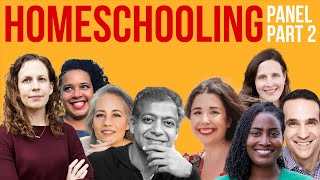
This is Part 2 of a YouTube conversation led by Manisha Snoyer on Naval Ravikant’s Air Chat about homeschooling. Speakers (including Naval Ravikant, Kerry McDonald, Rachel Thomas and others) discuss confidence as an outcome of applied competence, parental instincts and meditation, developmental readiness and neuroplasticity, concerns about extremist homeschool networks and potential need for safeguards, and the future of education — especially modular, decentralized options alongside public schooling. The tone mixes practical advice, philosophical reflection, and policy concerns.
Chapters
Foreign. Welcome back to our asynchronous conversation about homeschooling happening in four continents and six time zones on Naval Ravikant's new social media platform, Air Chat. I'm Manisha, teacher turned tech entrepreneur and host of the Teach youh Kids podcast and online homeschooling community for those tuning in for the first time. In Part one, we covered more of the nuts and bolts of homeschooling, why homeschooling skills kids need for the future, technology, socialization, and the role of parents as teachers. Now I want to go deeper to the core of our nature as humans and parents and then zoom far out to the role of education in a democratic society and ask our guests to share their views on the future of education. In Part one, we wrapped up by touching on the role of parents and teachers and considered that parents, regardless of their own educational background or income, might be uniquely qualified to teach their own kids and curate their children's education. And it's all happening on Naval's new social media platform, Air Chat. So what's air chat?
Naval AirChat is an asynchronous audio first platform for recording conversations. It lets you record conversations regardless of what time zone people are in or what time it is or where they are, and to bring in multiple voices into the conversations, including talking directly to your audience and then creating exports for your podcasts or for all the various social networks.
I'd like to add that anyone is welcome to join in on the conversation and ask questions to our guests. All you have to do is visit the homeschooling room on Air Chat. Many parents tell me that they would love to homeschool, but they don't think that they're qualified to teach their children and that they need to be taught by a trained teacher. I myself have struggled a lot with confidence, and my mentors, especially Eric Reese, has helped me learn about the nature of confidence and become a more confident person.
I feel like our confidence is rooted in our childhood. Often it really only takes one person to encourage or believe in or allow you to have an opportunity where you're successful for you to start building that internal confidence. In the same regard, it really only takes one person to be negative or, you know, critical to destroy confidence. I think once we become adults, if we haven't had those experiences of acceptance and being proud of ourselves and of our work, then it can be difficult to be confident confident in other areas. But I do think even as an adult, you can still have opportunities and experiences that allow you to grow that And I see it often, and I don't necessarily mean like the ugly duckling type thing, but I mean, that's a good example too, right?
Well, I think real confidence is just an output of true competence, which means you think through things for yourself, you figure them out, you put your best work into it, and then you get feedback from the real world, from nature or free markets, that it worked, and that slowly, slowly builds up your confidence. I don't think there are any shortcuts. And when people talk about imposter syndrome, I think it's because they often have hacked their way into a false sense of confidence when they haven't gotten the feedback of being correct, which comes through applied competence.
Are you saying that if people are unskilled, then they will have less confidence? What about people who are highly skilled but think very poorly of themselves? Or parents who are particularly qualified to teach their kids but don't have the courage to do it because they think they're not good enough?
They just haven't tried. They need to try and then they'll develop the confidence. They're just being scared. You don't know if you're competent or something or not until you do it. And actually you don't become competent until you do it.
I mean, I guess another way you could look at this is the byproduct of a traditional school system where, for example, you think you're good at writing because your teacher gives you an A on your essay, but you're actually just writing in a style that appeals to them. And when you want to write a blog and you want it to go viral and no one reads it, you start to wonder if you're actually good at writing.
That's right. The only test is nature and free markets. In this case, it's the free market of people deciding whether or not to read and spread your essay or not.
I guess I'm kind of thinking out loud here. Naval. So actually, if you could expand upon this thought, that would be really helpful. For me, I am someone who has become more confident, but I definitely have struggled with this a lot in the past and sometimes still struggle with it.
Sometimes low self confidence can come from just comparing your insight to somebody else's. Outside, you can see your own flaws very clearly, but you're looking at somebody else's Instagram or TikTok life, which is a fake caricature or a projection that they're trying to put on to appear better than they actually are. There's no test other than to do it. There's no test other than nature. Just go out there and do it and you'll know very quickly if you can or cannot. And the reality is the more you try to do it, the better you become at it through iteration. And so just the act of trying will make you more successful, which will make you more confident, Confident in turn.
You know, I think just even speaking about education requires us to work on some inner child healing. And that healing is what is going to bring forth the new education system that is better all around and serves children better. And I hope that we're going to be able to learn from some of our traumas as we build a much better system.
So I think the best thing that we can do as parents for young people, as mentioned earlier, are find meaningful opportunities for them to be successful and make it things that they actually had to work at, something that didn't come easy so that they understand the connection between persistence or given talent and success. And that sort of grows your confidence. I'm sure I'm missing other factors.
I think a lot of it begins with parents just recognizing that they actually have choices in education. For so long, for so many families, their only educational option was their assigned district school that they were compelled by law to send their children to unless they could somehow afford hefty private school tuition or make the time to homeschool. And for many families, that just wasn't feasible. And so now it's really just letting families know that there are so many more options in between all of those three things that micro schools and learning centers and hybrid homeschool programs, low cost private schools, are increasingly abundant and financially accessible to more families. And that's being driven by these permissionless innovators, these everyday entrepreneurs like you and Sherene and Alicia, who are building an education system that's suitable for the innovation era. And thankfully moving away from the one size fits all factory model schooling that we've been stuck with for well over a century.
I remember one time being at a big homeschooling conference, California homeschooling conference, and seeing a bunch of grown homeschoolers on a panel. And they were asked by curious and also worried parents what was the best thing they got from homeschooling. And I remember one young woman saying, the best thing I got from homeschooling was knowing and understanding that whatever it is, I want to learn, I'm capable of making that happen. Which I think speaks to the fact that homeschooling tends to produce kids who, or facilitate kids who are self led, who and Even if they're not self led, who have a fair amount of sovereignty and self esteem and also a sense of, of themselves as my husband.
And I have always not fit in and have often done things in ways that were weird or unconventional. And I think that those unconventional approaches.
Are what led us both to achieve.
Success academically and professionally. And so I think that unconventionality may be more the salient feature here that kind of gives us a confidence to take a more unconventional approach. With our daughter's education, you have to.
Be your own judge. All the great artists, chefs, creators, musicians, I think also have great taste. If you read Schopenhauer, for example, he knew that he was the smartest man alive at that time in his region and that nobody else would ever fully understand or appreciate him. But he made peace with that because he knew that his work would be remembered long after he was gone. So I do think there is an internal self confidence that can arise from your own judgment and taste. And sometimes that is enough, I guess.
For families that are on the borderline of taking the leap into home homeschooling, what I would probably advise and coach them into is just try and start. You just never know. And it's always, you can always go back to what you were doing before.
Do you think that people today are perhaps less confident than they've been at other points in history? What does confidence mean to you? I have my own way of defining confidence, but I'd be curious to know what you think. And is perhaps the lack of confidence due to traditional schooling? I don't know. Maybe that's too much of a leading question. But I'd be curious to know why you think people lack confidence and how we can cultivate this in ourselves and our children.
That's a great question. I think with the international and the very prestigious schools, they're interested in maintaining an insular environment. So they really, more than anything, it's not that their academics are any better, it's really that they do not need to mix with the regular population. And how they do that is through making sure that students are, I think their matrices of evaluating and their matrix of success are outdated. But I really think that these schools are really to maintain the rich and the elite. Stay with the rich and the elite.
Certainly the bar has been raised by traditional schooling. Oh my God. I have to train my kid in mathematics. I don't remember mathematics. Oh my God. I have to get my kid into Harvard. Everyone else's kid is getting into Harvard. How do I get them into Harvard? You Know, these kinds of situations, I think, are very intimidating for a home teacher. The external world also sets a lot of credence in credentials. And how do you know you're going to get your kid to the point where they will gather these credentials and pass these credentials? I think that's intimidating and scary.
So we're seeing a tyranny of metrics across a number of fields. You know, whether that's hospitals implementing these metrics to reduce emergency room wait times that then lead us to ambulances ramping or people canceling surgeries to get more doctors into the er, not actually improving patient care, but just kind of overly focusing on this, like, on metrics. I do think on an emotional level, there is something that can be falsely reassuring about what we. What we can measure and feeling like, oh, I must be okay, because my child is doing 10 extracurriculars and, you know, getting these. These scores on their exams. Whereas a lot of things that I think are deeply meaningful, whether that's just, you know, hours that my daughter spends kind of fiddling around making these art projects, either through coding or a lot of really, I think creative and thoughtful endeavors, intellectual endeavors are tough to measure. And so I think we don't kind of get that external reassurance of like, oh, this is. This is great that my child is spending kind of hours in their imag or hours reading. But we know that those times are so valuable naval.
I know you're interested in meditation and spirituality and thinking more on my own journey. Coming into confidence. I really don't think it would have been possible without practicing meditation and really taking a deep look at my own conditioning to see what I really wanted in life, what was important to me, and letting go of the things that weren't as important or that society had led me to believe were important, that didn't really matter. I was wondering if you have thoughts on this.
Meditation does really just help resolve problems and unlock lit and conviction that we might have within ourselves. At the very least, it gives us time to be with ourselves, think for ourselves, and figure out what it is that we truly want, and then articulate it to ourselves deep down in such a way that it becomes conviction.
Just one more cool tidbit on the confidence front. I recently did an interview with Rohan Mahimkar, who built Prodigy Game. It's an adaptive learning app. And when they give children problems, they're looking to keep them in the zone of proximal development, which means that the problem isn't too easy and it isn't too hard and Giving them just a level of the right level of challenge is what keeps the game fun and engaging for them. So that's something to think about when we're homeschooling our children. That zone of proximal development that's also.
The definition of flow. When you do something at the edge of your ability. Too hard and it's frustrating, too easy and you're not learning anything or having fun. So it's a definition of fun, it's a definition of flow, and it's the place for optimal learning.
Naval, I'm curious to hear your thoughts on neuroplasticity and how it relates to cognitive development. I will explain. For example, with a subject like foreign language, it's obvious that it's best to start as early as possible. Children's brains are sponges. However, with math and literacy, I'm not so sure. According to Jean Piaget's stages of cognitive development, children aren't capable of understanding abstract concepts at a certain age. And it might be frustrating and moreover, a waste of time to try to teach them before they're cognitively ready. By cognitive development stages, I don't mean their age. Some children's brains are ready before others. On the other side, it might be more about what you teach and how. For example, being in a literacy rich environment is very conducive for children learning how to read. But teaching phonics to a two year old might not be effective. The same might be true for math. If you're talking about math and excited about math, it can support a child's math learning right later on. But maybe not teaching them an abstract math concept.
I don't want to argue with academics about child development. In fact, there's always these novel theories that flow through that seem to get accepted for a long time that are just junk like things like, oh, formula is better than cow milk or breast milk. Oh, children should sleep alone so they don't get suffocated by parents. There's all this stuff that flies in the face of evolution and basic childhood and common sense that I just don't think academics have very good knowledge of how children developed.
You know, I feel bad for parents today with young children, I think there's a lot of pressure on parents, particularly as academic content gets pushed down to ever earlier ages. We now, you know, live in a society where we expect kindergarteners to be reading. And this was something that was not an expectation for earlier on. I think about, for example, research out of the University of Virginia where kindergarten teachers were asked whether or not Children should be reading by the end of kindergarten. And in 1998, only about 30% of teachers said that yes, children should be reading at the end of kindergarten. And jump fast forward 12 years to 2010, 80% of teachers said that children should be reading by the end of kindergarten. And all that really changed during that time was the shift, shift towards Common.
Core.
And curriculum frameworks and standardization and testing that I think changed a lot of parents and teachers views on what's appropriate and what's developmentally necessary. And so I think parents are really under a lot of pressure to make sure that their children are learning and ready for kindergarten. And so I feel for Those parents of 2 year olds who are looking for a tutor in math and reading, I'll just give an interesting anecdote or story from Daniel Greenberg, who's the co founder of Sudbury Valley School. He wrote this in his book Free at Last that he published about 20 years after Sudbury Valley's founding. So back in the kind of mid to late 1980s, he wrote this book and he said in the book, reflecting on 20 years at the school, again, that has no curriculum. Children are never coerced to learn any specific content and yet they all become highly literate and numerate. He said in his experience, it takes about 20 hours for a child who is motivated to learn the entire elementary school math curriculum. 20 hours. We can, we can kind of prod and provoke and cajole for six or seven years for them to do that and have it be very tedious and monotonous and forced. Or we can wait until they're ready and they can learn it in about 20 hours.
I think parents should trust their evolved instincts brought us here through billion years of evolution. And if you think the child is ready to learn something, teach it to them. In my own experience, you can teach things to children quote unquote too early and it looks like they're not getting it, not getting it, not getting it. And then suddenly a year later they start quoting back something you tried to teach them a year ago and you thought it never got through. But of course it depends on each child and each parent. So I think you should follow your own instincts and ignore the so called child rearing experts who often have no children of their own.
Yeah, I think you're right on the mark there. It's really about returning to trusting your gut and your instincts as a parent and also giving children time and space. Because I think that if you can share a concept with a child and then not have this, expect or Put pressure on them to spit it back to you. It's really amazing how much they retain. They retain everything. In fact, I would just add, be careful about differentiating between making fear based responses and gut responses. Naval, you tweeted something once which really had an impact on me, which is that every answer for everything I'm looking for could be found in my gut. I'm probably quoting you wrong. And it made me realize there was a big difference between my emotional response and my gut response, where a lot of information actually was, well, I just checked Naval and I quoted you wrong. You said it takes time to develop your gut, but once it's developed, don't trust anything else.
That's right. I think of gut as almost the opposite of emotional. So you can think of three different kinds of responses you may have. An emotional response is instant and it is the net present value of the evolved instinct of your genes. So, for example, when you evolved in a tribal environment of 150 people and you went through a relationship breakup, it felt like the end of the world, because it probably was. The odds of you finding another mate in your tribe are very low. And so your body generated emotions to give you all the future impact of that bad event at once, so you would go fix it right away. So emotional responses are kind of instant, thoughtless, and based on evolution. A reason response comes from your neocortex and is a more recent product of evolution. But here you can take the time to think through something and come up with a rational response. So instead of the evolved instincts generated by your genes, this is more the net present value of what you calculate based on memes, which are the ideas in your head. More rational, more recent. Something that we have to really think through for ourselves takes a lot of brain power, takes a lot of calories, takes a lot of energy, and it's hard to combat emotions with it. But it's really what separates us from the animals. And the way I think about a gut feeling is it is a combination of emotion and reason with experience added in. So once you have encountered something often enough that you have developed both a reasoned response as to why you should and should not do something. And you have this emotional intelligence from a long time ago, and you have seen data points often enough, then it becomes gut instinct. This is just ingrained judgment. It can be accelerated through meditation, through experience, through introspection, through journaling. And this helps, you know, oh, I shouldn't even date this person because it will turn out badly. I should not go in business with this person just because I've seen that I don't trust them. I should not take that job because it doesn't play to my strengths and I know eventually it will taper off. And so when you've developed your gut instinct, it is the most powerful thing. Once you've developed your gut instinct, trust nothing else. But it does take time to develop.
It kind of struck me because when I first saw you talking about the gut, I thought that was ridiculous because I don't feel like my gut is always right. And then I noticed that there was actually a big difference between my emotional responses and my gut responses and that the gut was quite unique and different than my emotional responses, which were often misguided. Naval I'd be curious to know if you have thoughts on why certain people have such a strong negative reaction to homeschooling. I don't see nearly the same response to parents sending their children to private school. Homeschoolers are antisocial. Parents aren't qualified to teach their kids. Homeschooling hurts public education. It seems so intense, this criticism, and I'm wondering why people are reacting so strongly to it.
I think it's because people associate homeschooling with radical beliefs or with Christianity or Catholicism or something of that nature. So there's just a set of people who believe that kids should be raised a certain way for the good of the state and that parents shouldn't be able to raise children with different beliefs or different ideas. It's sort of. It's a messianic belief on its own that we're all going to converge into one way of thinking. But it's essentially a religious belief that is combating other religious beliefs. I think it's some combination of the Christian left, which is non denominational and doesn't even realize how Christian it is. But you know, it doesn't have Jesus or God, but it definitely has man as devil and it has the earth as holy and sacred. And then you have the Christian right, which is a classic Christianity and Catholicism and old world values. And I think it's the two of them fighting each other. Even though one side doesn't think of itself as Christian at all, it has very much the same values.
How do you define education? How do you define learning, if at all different from education? And is education important? If so, why or why not?
How do you define education? And I think that's a really interesting question. I feel like, you know, there's two different things, right? I can memorize information. Young children can sing the Alphabet song but it doesn't mean they understand literacy, really, and understand how to read. I could memorize multiplication facts, but it doesn't mean that I can actually apply them or understand what that actually means in the world. And so. So there's two things, right? I feel like one might be to take in new information that maybe you didn't have before. But I think the other piece is having the skill and the ability to then transform or translate that information. Like there needs to be some sort of growth, and that comes in a number of ways. That's what I would think. When someone says that they are educated, I tend to think there's been a significant amount of growth somewhere.
Earlier this year, there was a neo Nazi homeschool network with thousands of members that was discovered in Ohio. And it really started to make me question whether there should be more accountability in homeschooling. Whereas before I really thought that homeschooling should just be whatever parents wanted. I mean, I'm actually really concerned that a cult like this that's distributing fascist curriculum and indoctrinating children into their ways could be a real threat to society. And that actually this behavior of educating children in this way is abusive. I would call it emotionally abusive.
The only solution to fight bad ideas is with good ideas. You just can't control people. In fact, half the time you try and tell a kid what to do, they'll do the opposite. So I'm not sure shielding them in any way helps. In any case, parents should be free to raise their kids however they want, because the history of states and institution having bad ideas is just as legion. What if the whole country was taken over by Nazis? Then you wouldn't want them to impose the curriculum.
I'm definitely in the camp of people are essentially good, people are essentially bad, and that it's usually only when people are hurt that they cause hurt. Usually people that are steeped in love and supported by and facilitated by and have a foundation of love want to share love too. I think that love and goodness is our essential human nature. And add to the top of that that as human beings, as a culture, together, we all have collectively good and bad.
I don't think that this neo fascist.
Racist.
Thing is new at all or surprising. We know that a lot of institutions in American education came about, private institutions in particular, came about because they did not want black, brown and Asian students attending during integration. And so these private schools, largely under the Christian umbrella, were created. We also know that homeschooling has a long history. Also in this racism is the purpose.
Of education to serve the child, or as part of the role of education, to uphold democratic values? Is education there to serve the community and democracy too? Is it a fiber that holds us together? And also, do most parents care enough to put intention into educational choices? And how do we keep track of those children who might be neglected?
Probably an unpopular belief, but I actually am in favor of accountability for homeschoolers. I've been around long enough to have seen several cases of what I would consider to be educational neglect. Even had to report a case of what I thought was physical abuse and neglect. And so I do think that for children who are vulnerable, although these same things can happen with children that are in public school and are just as likely, I do think as many safeguards as we can have is helpful.
Whoa, that is a really big bite. I'm gonna take a tiny nibble off of that. You know, I really believe firmly that the classroom is an agent of change and that what you see in society is reflected deeply into the classroom and that if we remain micro, we can really start to dive into some of these harder, difficult topics. I do fear, however, that not everybody's primary value is in education and that making sweeping legislation or sweeping decisions based on family's choices is actually going to create families who put education first. I don't know that that is the truth. I do, however, want to point to a little bit more division between what is at home parenting and what is the role of education. In the education system in the U.S. we do take on more responsibilities than I believe we should be. And that includes making sure that no child is neglected, every child is fed. We just keep piling on top of teachers and educators. More responsibilities naval.
The homeschooling population has grown three times since pre pandemic levels. And more and more people are in tech and teachers are curating their children's education. Do you think that modular learning is the future of K through 12th grade education? I say modular to differentiate it from school at home, school online, or no school, or in worst cases, total neglect.
If by modular you mean pick and choose, an a la carte, yeah, that should be the future of everything.
So you know, public schooling is one form of education. I don't believe public school schooling is going anywhere. It is an option that some families like and want, but it's not the only game in town. And I think a dynamic, diverse education ecosystem with all kinds of different educational models. Micro schools, homeschooling, charter schools, hybrid schooling, virtual schooling, all of these different models will really provide the greatest assortment of educational path possibilities for families so that they're able to find just the right educational fit for each of their children.
Manisha, you asked a great question about decentralization. If you think that's the future. I do believe the further we get along, go along in the 21st century and a few more generations, when we have generations of people that have grown up in Web 3.0 tools, that this idea of decentralization becomes more popular and more common. I think as of right now, there's still so many other pieces that play a part. But at the same time, I have to realize that I have a certain advantage. The fact that I can be on my smartphone right now, even participating in this Air chat when there are families that I know that still don't even have WI fi. And so, you know, those things make it extreme, extremely difficult to even introduce ideas of decentralized education to families where this is not their priority because there's so many other needs that still need to be met. But I do believe all families prioritize their children.
What I'm hoping for in the future of education is that there will be a paradigm shift where parents realize they are perfectly capable of educating their own children and curating their children's education. Education and the idea that we would outsource this to a homogenous school system seems almost absurd and incomprehensible.
I talked to a friend yesterday who homeschooled a couple of boys up to seventh grade, and he's very smart and very observant and very competitive. And I asked him what his main observation was and he said, I just wish I'd let them run around and play and scream more. He said whatever involves them running around and playing and screaming is the right thing and just let them do that all day long.
Thank you so much everyone for tuning in. If you'd like to join the conversation on homeschooling, you can tune in to the Air Chat Homeschooling Room. If you need advice, resources, and support for homeschooling, consider subscribing to our podcast or join the membership community@teachyourkidspod.com where you get direct access to me and other learning specialists on everything from emotional support to finding friends, choosing curriculum, and measuring learning outcomes. And remember, wherever you are, whatever you're struggling with, your child's best teacher is you.
More from Manisha

Contributing to Florida Prepaid Plans (2026–2027) | Step-by-Step Guide for FES-UA Families

Contribuyendo a los Planes Florida Prepago (2026–2027) | Guía Paso a Paso para Familias FES-UA



Finding Providers & Services in the Marketplace (Families) | Step Up For Students (2026–2027)

Encontrando Proveedores & Servicios en el Mercado (Familias) | Step Up For Students (2026–2027)




