Interview with Jasmine (Homeschooler and Python Engineer)
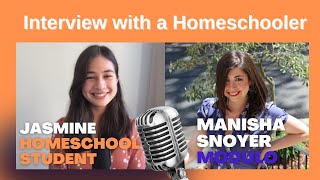
Jasmine, 14, has been homeschooled since kindergarten and is a certified Python engineer who tutors for Modulo. She takes AP Chemistry and AP History, spends 3 to 4 hours daily at a trampoline park, and plans to study data analytics in college.
Questions this video answers
14 years old.
December 9, 2022.
Around 8:00 AM.
Approximately 8:00 AM to 3:00 PM.
Thinkwell (pre-recorded lectures and practice questions).
Chapters
Hi, everyone. I'm Manisha, the founder of Modulo. We are a community that supports homeschooling families, and we are so excited today to be producing our first podcast with special guest, jasmine. Jasmine is 14 years old. She's a homeschooler, also a certified Python engineer and an expert in trampoline, and happens to be a tutor with Modulo. So we're really excited to have her here today and ask her some questions about her homeschooling experience. Thank you so much for being here, Jasmine.
Yeah, thank you for having me.
Wonderful. So, just to dive right in, I was wondering if you could tell us a little bit about your homeschooling origin story. What inspired your family to homeschool you and how it's been so far?
Yeah, sure. So I've been homeschooling since kindergarten. I think that I always kind of had these niche interests like programming and data analytics. So kind of being able to homeschool really allowed me to pursue those that, you know, wouldn't be taught in normal school.
That's so exciting. What's your favorite subject right now?
Oh, that's a good question. I would say I really enjoy data analytics, honestly. I think it's, like, fascinating to be able to take these kind of, like, numbers and responses and be able to turn it into, like, interesting visuals and, yeah, be able to, like, do something with that.
That is so cool. I am sure that you are better at data analytics than I am.
You know, practice is. Practice makes perfect, I guess.
It sure does. So a lot of families who are considering homeschooling ask us, what's a typical day look like for a homeschooler? And I usually tell them that there's a million different variations on what a homeschooling day looks like, because one of the beauties of homeschooling is you can customize your child's education. But I was wondering if you could just give us a flavor of what your week looks like when you wake up. What classes you do would be really curious.
Yeah, sure. So I usually wake up around seven, and then I eat breakfast, start school around eight, and then currently I am taking. I'm taking AP Chemistry. I'm taking. Well, right now, we're not doing too much analytics. We're more doing towards Python. So I have Python classes. I have AP History, and then so it's kind of broken up throughout the week. And then I have my honors algebra 2. So then I kind of have one or a few of those classes from 8 to 12. So some combination of Those and then I eat lunch and then after that I have some time to do homework or just do whatever is necessary to make sure I'm set up for the next day and the rest of the week.
Wonderful. And then what around what, when does your academic day end? Usually?
So usually I School from 8 to 3 and then after that I have time to trampoline or do whatever interests me in the afternoon.
I'm curious to hear more about the trampolining. Where do you go to trampoline? How, how much trampoline do every day?
Yeah, there's actually a trampoline park pretty close to my house, maybe like a 5 minute, 5, 10 minute walk. So yeah, I've been doing that for like two years. So yeah, it's really fun. I take classes there too. So I'm usually there for a good three, four hours a day. So yeah, it's a big chunk of time but it's, it's really fun.
That's so cool. So when you're doing your classes in the morning, I'm curious, so how much are your parents involved? I mean when I hear about chemistry and data analytics I, I think, well that's not something that I could teach Jasmine. How much of that is other tutors and how much of that is self directed study?
So I think when I was younger it was more centric around like my mom taught me almost all my subjects but then as I've gotten older it's kind of shifted away from that and I have more like private tutors. So for history, for chemistry, for basically actually everything other than math. I math, I have an online curriculum which my mom just is there to help facilitate if I have any questions. But I would say the vast, vast majority is independent or with other tutors.
Wonderful. So with the math curriculum, what curriculum are you using?
I'm currently using Think well to do, to do algebra. Yeah, we have a very good teacher. He's very enthusiastic. So it makes, it makes it really fun.
That's so great. So how does it work? I mean do you sign into an online class and is there a lecture?
So this particular one is pre recorded. So we have like the recorded lectures. Then after we watch those they have some notes and then some kind of practice questions we can do to make sure we've really remembered that information and then yeah, you just kind of keep going through that and then if you're confused you can always look for outside resources. So that's, that's kind of how we've been moving through the course so far.
That Sounds so interesting. And is it fun? Do you get bored?
It depends actually on the subject. You know, sometimes I think, you know, personally some subjects just are more interesting to me. Usually it's not too boring because I think we've really, I've been lucky enough to have some really great teachers. So yeah, I'm usually not, not too bored in classes. Also most of them are one on one. So that means that if I'm like confused or if there's anything I'm curious about, I can just feel free to ask the teacher.
So yeah, that's so great. And how much of it do you get to decide what you learn and how much of it is your parents deciding what you're going to learn next?
So my mom is kind of like my counselor, I want to say, so she kind of is able to kind of be like, okay, we can. These are the things you said you wanted to accomplish in the next four years. Because right now I'm in, I'm in high school, so. And then we kind of break it down into like, okay, so first year we'll do this, second year we'll do this. So we have like a whole plan for the next like four years? I think so, yeah. But I do have a say in if there are certain classes I'm more interested in. Certain tutors I feel like are better than others. I mean, at the end of the day the school is like, for me it's because, you know, it's to help me with my future. So if there's something that I feel like would be really beneficial or really interesting, then I do have a pretty good say in what we do.
Wonderful. It sounds like you're very driven to learn and to succeed.
Yes, I think that's one of like my, my core, core beliefs is that like, you know, you have to, you have to really work hard to get to your goals. And I think that also homeschooling really allows me to do that. It's a lot harder in normal school when there's other people in the class, like the teacher might be more focused on or you know, some subjects like Python and data are just not taught at all in normal school until like college or after. So yeah, I think it's really, it's been really, really nice homeschooling.
Very nice. So tell me a little bit more about Python. I, I don't know how to code in Python. What attracted you to that programming language in particular? What, what can you do with it?
So Python is like right now it's like the Main language, like, pretty much everyone uses it. It's like there's a bunch of different coding languages, right? You can have like Java and R and Python. So Python's kind of the one that people use the most. So I figured that's a good place to start. It also happens to be the one that's pretty much easiest to start coding in because their language is very similar to English. So I kind of started off by doing some like, just graphics and games, and then now I'm starting to do some, like, data analytics with it, so creating, like, visuals and, you know, statistical analysis, things like that.
Wow. Can you give me an example of a visual you created recently?
Let me think. I was doing kind of like a. Kind of like a heat map, but for. For numbers, basically. So you can kind of see like the correlations of different numbers with that kind of heat map. So it's like real little like blocks and each one will say the correlation of different variables. And then it'll basically color code in a certain way that is easier to see. Like, darker colors will be higher correlation. Lighter colors will be less of a correlation.
Very interesting. That is so exciting. And it just sounds like this formative homeschooling really allowed you to take your interests to their full potential, which is 100%.
I wouldn't have been able to do any of it in normal school.
Absolutely. So what do you think is next for you? I mean, do you plan on going to college? Do you have an idea about what future career you want besides being a modular tutor course?
Yeah, I definitely think I will go to college probably in. Somewhere. Somewhere in America, maybe in New York or something. And yeah, I think I would hopefully pursue something in data analytics. Something in. Yeah, data analytics or programming. Because those are like, those are like my strongest interests. I just find them really, really, really fascinating. So it'll be really cool to be able to make a career out of that.
Yeah. So you already are a certified Python engineer through Google, so. So what do you see as the advantage of getting a degree, a college degree?
I think that, well, one, it's a great experience, at least what I've heard from my parents, to, to go to a college. I think it's also a really good place to meet other people with similar interests. I think the only struggle is that when you're kind of pursuing homeschooling and pursuing these kind of niche topics is that you don't get to meet that many people who are similar to you. Recently I was fortunate enough to go to a camp and meet Some other girls who are interested in programming. But I think college would be a really great way to be able to meet other people who have my same interests and who are around my age. So, yeah, that. And also I think it's a great place to just further my knowledge because there's always more to learn. You know, you're never done learning. And there's some really great teachers and some really great courses that I would love to take.
That's wonderful. Who are some of the people that you admire in their career that we might aspire to be, like, either alive or historical?
Some people that I really admire. I don't want to sound cliche, but I think that people like Marie Curie, they're really fascinating. She was a scientist who was completely new in her field, and especially in that period, to be a woman in science is very uncommon. So I think it's really amazing to be able to kind of, like, push the boundaries. I think that's something that I would really aspire to. I mean, it'd be. I don't want to say my parents, but in a way, it's to. To build a career out of something that you're, you know, you're not necessarily exposed to, I think, is. It's really hard because, like, my mom does a lot of the kind of, like, web development, basically everything else to make sure that their company runs properly. And that's not really something you can, like, learn that much in normal school. So I really admire that because to be able to just kind of completely go into, like, this separate field that you didn't really learn much about and just kind of be willing to just dive in headfirst is, I think, is really, really hard. And I. I aspire to hopefully be like that someday.
Yeah. Wonderful. Okay, so changing gears. Friends. How to make friends as a homeschooler.
Yes. I think it's very common that people think that we're, like, antisocial, which I feel like is the exact opposite, because I'm very. As you can probably tell, I'm very extroverted. So I meet a lot of friends through trampolining. There are homeschool communities everywhere, pretty much, so I've met a lot of friends through that, too. I would say those are kind of like, my two main things. You know, your extracurriculars will usually be outside of, like, your home school. So I. Yeah, I meet people mainly through that. And, yeah, the homeschool communities, I would say.
What is your social, like, look? What does your social life look like?
Yeah, I mean, A lot of it is at the trampoline park because I go, I spend a lot of my time there. So I have a bunch of friends there that I kind of hang out with. And then on the weekends, I usually just kind of meet up with them and, you know, walk around, get coffee or whatever.
Nice. That sounds really fun. Do you have any? So I'm. I guess I'm curious to know about the homeschoolers versus the kids in traditional school and in. Within the homeschooling community. Have you seen ways that the homeschooling that your friends do is different than your homeschooling schooling? And what do you think are. I don't know if you can say better or worse ways of homeschooling that you've observed?
100. There's every. I think every person's homeschool curriculum is completely different because it's unique to that, that person and that person's interests. So one of my friends is already like, doing like, calculus and all this stuff and. Yeah. So everyone kind of has their own, like, niche they like to go into too. And I think. Yeah, so it's tailorable to each person. I don't think there's necessarily better or worse ways to homeschool.
Excellent. And is it hard for the parent to organize all of this homeschooling, do you think?
I. I mean, I wouldn't personally know. I do think that my mom puts in a good chunk of time, but I think as homeschooling, you know, continues to be more of a popular thing, I think that it's a lot easier. So I know, at least for like, my mom has helped other homeschooling parents figure out their curriculum because it sounds like once you've kind of like, done it once, there's some, like, universal classes that everyone has to take, and there's some classes that are just better than others like that I just have more interesting teachers or more interesting, just better, like course material. So, yeah, I mean, it definitely is. It definitely is hard, but I think that it will be easier in the future.
What are some of the things that you think will make it easier for families?
I think that, well, okay, there's a lot of kind of like tight knit homeschool communities where everyone's just kind of trying to help each other. They're all in the same boat. So as there's more people and more people who have gone through the homeschooling experience, I think there'll be kind of like some courses that will be like, okay, these are the Best courses for sixth to eighth graders. These are the best courses for high schoolers. You know, like there'll be certain, certain things that just this will be less work to like find those. Because I think the main struggle is to find great tutors and great classes. But then once they've kind of already found, then it'll be a lot easier for future homeschooling parents.
I think that a lot of parents are afraid that they're not qualified to teach their children. What would you say to those parents?
So I think people think that homeschool is like the parent has to teach everything. You really don't. I think the vast, vast majority is all taught by like online teachers. At least for me you can, the parent definitely can homeschool the child completely, but I don't think it's necessary. So that shouldn't be something that's like holding someone back because there are like tons and tons of great teachers that we've accessed. So yeah, I don't think that that's like the primary, the primary concern or needs to be the primary concern.
Yes. You've talked a lot about teachers and how some teachers are better than other teachers. And I'm curious to know if you're involved in selecting your teachers and what kind of qualities you look for and what in your mind makes an exceptional teacher.
For sure. Yeah, I do have a hand in choosing my teachers. Usually my mom does kind of like the first screening to see which ones are even like qualified to teach properly and then from there I'll meet once with the teacher and just. I usually it depends on which like subject, but usually I try to at least for like programming and things like that, I try to find people who really kind of let me like at least try, you know, because some teachers will kind of be super heavy handed and be like, okay, here's what you type. And that's personally just not great for me because I feel like how I learn is kind of by just trying. So I try to like look for people who really kind of just, just let me give it a shot and then kind of help me, help me from there.
I love that. So this, yeah, that's a really. It's so interesting how different teachers interact with us in different ways and how we respond to them. I'm also a fan of teachers who kind of let students lead and make their own mistakes and learn through those mistakes. I think a lot of teachers believe that you have to do a lot of direct instruction and then students understand. But I think sometimes just for lack of a better metaphor. Pushing the little bird off the trees is a better, fun way to learn. And children have amazing grit. I think we often underestimate their ability to problem solve. Not that you're for sure.
Yeah.
How would you say your homeschooling is different from when you were a child to now being a teen? Have there been any big shifts?
I think the biggest one is, like, so as I said before, my mom used to be my main teacher for, like, all of my subjects when I was kind of in earlier school. And then she kind of started to find people who were just like, experts in their field because it's really hard to be, like, an expert in everything. It's actually, I would say, impossible because you can only be like, okay at everything or really good at one thing. So kind of as we've shifted, as I've gotten older, we've kind of shifted from my mom being just my general teacher to kind of having people who are just experts in their field.
That's so interesting. And what about socially? Have you found that you've been craving a bigger group of kids to be around? I see that a lot.
Yeah, I've kind of like. Well, we've moved around a few times, so I think that the homeschool community, definitely, I've made a lot of friends through that. I think for a while I had, like, just a really close group of a few friends. And then kind of after I. Recently I've been having. Having a, like, much larger set of friends. So. Yeah, I mean, I was never bored. I don't think. I, I, yeah, I'm a very, like, social person, so even if I don't know someone, I would probably just walk up to them, just be like, hi. So.
So, yeah, that's great. I think I've been seeing a lot of posts in the Reddit groups and of teens who say they just started homeschooling or they don't have any friends. What would you. What advice would you. And this happens in regular school, too. I mean, I was very lonely as a teenager and didn't feel like I had any friends that I. A big school to another. Another homeschool teen who felt like they were lonely and didn't have friends. What advice would you give them, especially if they didn't have a lot of support from their parents and making connections?
Yeah, it definitely, it's, it's a different kind of, like, barrier that you have to cross because you can't just kind of socialize in the hallways. But I think that, you know, you Kind of have to be the one to like reach out first. Like, you kind of have to be like, you have, you have to like put it, put in some work first. And then once you kind of have like a few friends, I find that it just like builds from there. So yeah, I think just like, just if you see someone you think might be interesting to talk to, just kind of go for it and you know, that's, that's how you make friends.
I love that strategy that just say hi.
Yeah.
And I think, you know, a trampoline park seems like a great place to find cool people. Um, what about the homeschooling groups? How would you even go about finding the group to connect with?
So, okay, that's kind of like my mom's more expertise. There's certain like groups that I was just admitted into. Some of them are like, oh, for gifted homeschoolers or whatever. Like there's like a bunch of different like, criteria. I'm sure there's ones you can join without anything. Just be like, hi, I'm a new.
Homeschooler, Facebook or meetup or something like that.
You know, I'm not 100 sure. I would imagine there definitely are on those.
Your mom, how she found it. Yeah. So what kind of activities do they do? How do they get people kind of together and talking?
So there are like specific like homeschool kind of like meetups just for people where they'll be like, oh, you know, we're. When I was younger, at least it'd be like, oh, we're going to like the playground. And then like, you know, 10 different homeschoolers will show up and just hang out. And then sometimes you'll just meet like specific people who are like, oh, I have a, you know, 14 year old. Like for me, my mom would be like, oh, I have a 14 year old daughter. And then someone else might be like, oh, yeah, I also have a 13 year old daughter. And then, you know, we can meet up separately through that.
Cool, that's a great, that's a great. And are there any kind of certain activities that you find that work well on these early friend dates?
Oh, I mean, I think something low key, just kind of like, you know. Well, it used to be like, you know, going to the park or whatever, but you know, going for, going for a snack or whatever. Just something to really get to know the person, I would say, because I find if you do things like that are kind of like, like crazy, like, you know, I don't know, rock climbing or something, then you might not really get to like know the person. So I think that, you know, kind of, you know, going to a coffee shop or something, just really understanding who they are and like their opinions and. Yeah. Who they are as a person. I think that's the best way to start out.
I love that. And I think it's such a great point that you don't have to meet up in this huge group to make friends. You can just start off with these one on one connections and going out and having a delicious snack. For sure.
Yeah. I think in some ways having like a tight knit, like some really close friends is almost more valuable than having like a ton of friends. I've kind of gone back and forth, but I tend to kind of have like some, some really close friends. So yeah, I think that that's. You don't have to have like 20 different friends to still have fun and.
Yeah.
Have friends.
I agree. That's wonderful. So, okay, what else do I have here? So we talked a lot about curriculum and classes and how they're hard to find and you mentioned a few that you like. Like think well, what are some of your favorite curriculums you've used from your childhood or now that you'd recommend to other families?
Let's see. I did, I did like for math. I did like, I think Beast Academy. I really liked that. I found it really fun because it was kind of like, they almost combine like math of like a comic book kind of style. So I really enjoyed that. I also did. What else did I do? I'm trying to think when I was younger, recent classes I've taken, I really enjoyed like the Google Data analytics certification. It was like really fun. They had, they hired like really, really great teachers. So I think recently that's what I've enjoyed. I'm trying to think when I was younger, what classes I've been doing. Like think well for a while I would say I. Before Algebra two, I, you know, I took algebra one and I took biology. So yeah, I think Think well is a really, a really useful resource.
How about language arts? Literature, Language arts.
I've mostly done my classes on Outschool. I would say recently I just finished like a, I don't want to say book club. It was kind of like a. Somewhere in between like a literary thing and a book club. It was more just for fun where we just finished reading Frankenstein. So that was really fun. And I've been doing classes like that for a while. On Outschool. There's kind of like three main platforms. Basically there's there's Outschool, there's Wyzant. And I would say think, well, not many people know about, but I think it's pretty useful.
Yeah, I'm excited to dig in. And for, for listeners who don't know, Wyzant is a tutoring platform where you can find, yeah. Great tutors.
Yeah. Our school's like, for bigger group classes.
Okay. Do you find that there are some classes that work better one on one versus a group setting or some that work better in a group versus one on one?
Definitely. I think things like Python I think are best taught one on one because everywhere everyone's just at a different stage in their coding. Um, so personally I quite enjoy doing one on one classes. However, I think for things like, you know, I had to go like a philosophy kind of like discussion class that would be really hard with just two people. I think for things like that, having a variety of opinions and viewpoints is really valuable. So yeah, I think there's some of like the more STEM side, I would say is more useful to have one on one. And then so I don't want to call them like soft subjects because they're really not. They're still really hard. But kind of things that, not, not STEM subjects that you need kind of other people to, to talk to, I think are better in a big group environment.
Lovely. All right, let's see. Have you ever experienced kind of external judgment for being a homeschooler? What was that like? And how did you.
For sure, I think back to the kind of like not making friends. I think especially when I was younger, like pretty much the first question I would get asked or, you know, people will kind of like look at me and be like. And then look at my mom and be like, how does she make friends? Like, is she antisocial? But yeah, I mean, I kind of gotten used to it. I know that I'm not, so it doesn't really bother me. But yeah, people definitely, definitely think we're like antisocial creatures, which is quite ironic because I think I'm very, very social.
Yes, I, I think that you are very easy to talk to and very open as a person. Wonderful. Okay. I'm trying to think if I have anything else here to ask you. You really touched on a lot. Maybe tell us a little bit about your own experience teaching. I know you had your first experience teaching during the pandemic. Did you enjoy it? What was that like?
Yeah, I mean, recently tutor with module has been, has been really fun. The, the girl I Tutor. She's, she's really fun to work with. She's very bright and intelligent. It's really fun to work with her. It doesn't, doesn't even feel like work. It's just like kind of figuring out things together. So, yeah, I've really enjoyed it.
That's so great. Well, all right, let's. Let's ask you this one. Hopefully your parents won't mind. So they were really figuring out everything as they went along. I was just curious, do you think there's anything that they could have done better?
That's hard to say because I wouldn't know the alternative. I think that they, they really did a great job. I've really enjoyed my education. I think they've kind of made sure to facilitate an environment where, like, I'm truly interested in what I'm learning. I mean, there's some classes that I just haven't enjoyed just because they're just, just not my favorite, not my style or whatever, for whatever reason. But I think they, they did a, a very good job of, like, making sure that I could still find, you know, some interest in it and to make sure that I, I got through it and understood it and could move forward after.
Wonderful. Is there any advice you'd like to give to other homeschoolers your age or families who are considering homeschooling?
I think it's something definitely worth trying. I think during the pandemic, people kind of got a little bit of a taste of what it's like, but it's so much more than that. I think that it's really something really, really, really nice. I think it's worth trying for kids and for parents who are considering really allows you to pursue your true interests without having to pile that on top of your other eight hours of work. So, yeah, it's definitely, it's definitely worth a shot.
Wonderful. Well, Jasmine, you are such an incredible testament to the effectiveness of homeschooling. You're so graceful and poised and intelligent, and it's especially wonderful to see someone who is so passionate about learning and excited about taking everything to the limit. I am. We're really excited to have you as a tutor on modulo. Jasmine is really great. Python and also AP Chemistry. What are some other subjects that you tutor?
I can, like, tutor math. I've, you know, I've done, I've done a lot of math, maybe some biology. I've taken honors biology before. I would say those are, yeah, Python, Data analytics, chemistry, biology, math. I would say those are my co. Strong suits.
You're already a college level everything. I'm worried your parents are going to run out of courses for you to take.
I don't think that would be even possible. There's so many good courses out there.
Well, this has been an absolute treat. Is there anything else that you want to add that we didn't touch upon today?
I don't think so. I mean, yeah. I think, in summary, homeschooling is pretty awesome. Definitely worth trying. Yeah, I think that's, that's my all around. That's my summary of the past 40 minutes.
Wonderful. Well, thank you so much again. We're so grateful to have you as part of our community. And I can't wait to see what's next for you.
Thank you so much for having me. It's been, it's been really great.
Awesome.
More from Manisha

Contributing to Florida Prepaid Plans (2026–2027) | Step-by-Step Guide for FES-UA Families

Contribuyendo a los Planes Florida Prepago (2026–2027) | Guía Paso a Paso para Familias FES-UA



Finding Providers & Services in the Marketplace (Families) | Step Up For Students (2026–2027)

Encontrando Proveedores & Servicios en el Mercado (Familias) | Step Up For Students (2026–2027)




