Let’s make masks! A science, art and civic engagement workshop for kids!
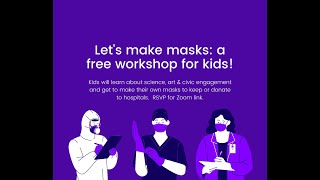
Jeremy Howard and Manisha Snoyer show kids and parents how to make effective masks at home using paper towels, T-shirts, and filter inserts. They explain how droplet size affects transmission, demonstrate fit tricks like the rubber-band technique, and explain how to heat-sanitize filters in a Ziploc bag at 170°F for 30 minutes.
Chapters
So, as Manisha said, I'm part of a group called Masks for All. And we're a bunch of scientists that want everybody to wear masks. So I'm not. I don't have a background in masks. I'm what's called a data scientist. So I'm a scientist who studies data. Data is like numbers. It's like measuring things. And believe it or not, in the newspaper this morning, there was a whole article about me and masks, which was super exciting because I've been working on this for like four months. But it's very strange for me because four months ago, I. This was not my life at all. I was doing totally different things. But what happened is my family and I, my wife and my daughter, we saw a video from somebody in the Czech Republic. The Czech Republic is a country in Europe, which is one of the continents, as you probably know. And this person in the Czech Republic is a scientist like me, and his name's Peter. And here's Peter. And this is Peter's video. And in his video, he talked about how he thought masks are really important. And he said that he thinks they're really important because he looked at countries that lots of people wore masks and found that in those countries hardly anybody was getting coronavirus. And he thought, well, that's really good because we don't want to get coronavirus, so maybe everybody should wear masks. And so I was very inspired by Peter because after he put out this video, do you know what happened? Everybody in the whole country of the Czech Republic wore masks. Within three days, three days later, everybody was wearing masks. It was amazing. And I thought, oh, I don't want people in America to get coronavirus either, so I should do the same thing. So Peter's original video was in Czech. That's the language that they speak in the Czech Republic. So I made my own video in English. And in the video, I talked about how Peter had been so successful in the Czech Republic in getting people to wear masks. And here are some pictures of people in the Czech Republic wearing masks. And you know what they did? Lots of people started making masks. And what they would do was they would make as many masks as they could, and then people would put these things they called mask trees out in the street. People would basically put up these posts with lots of places to hang masks. And then anybody in your community could go and pick up a mask. Isn't that a good idea? And so then all these people all around the Czech Republic started making masks for everybody in their community. So they were being so kind to each other to help make sure that other people in the Czech Republic didn't get coronavirus. And I thought, wow, this is such a good idea. So we should tell as many people as possible to wear masks. And I even talked to the government, so they're like the people that run the country. And I said, can you ask everybody to wear masks? And they said, we're not sure. We're not sure that's a good idea, because we haven't heard from scientists saying that the science is clear, that everybody should wear masks. So you know what you should do? If people say they don't know the answer to a question, you should try to help them answer it. So I don't know everything about all the science either. So I got together with 18 other people, and this is the names of the people that I got together with. And they're at lots of different universities, and they're from all around the world. And some of them are very good at something called statistics, which is where you learn about how to look at data and kind of add it together and see what it says. Some of them are very good at something called epidemiology, which is studying how diseases spread. Some of them were very good at something called sociology, which is understanding kind of how people behave and so forth. So we all got together and we wrote something called a paper. A paper is a way that scientists tell other scientists about what their science says. And so this is the paper that we wrote. And as you can see, it's got lots and lots of authors, and they're from lots of universities around the world. And we tried to find out, should people wear masks? And the answer was, as Peter in the Czech Republic thought, yes, they should. And so what do you do when you find out that something is really important? You try to tell everybody in the world about that thing. So if you want to tell people about something, the best way to do it is through the media. So the media refers to television, YouTube, newspapers, and so forth. So I contacted everybody I caught in the media and said, hey, people should wear masks. Can I tell all the people that watch your TV show about that? And they said, sure. So I got on lots of TV shows and told everybody I could in the whole world that they should wear masks and that what our science said. So lots and lots of people around the world started doing this. And you know what happened? Everybody in the world started wearing masks. This is a map of the whole world, and all of the countries that are green are countries where now the government Say, hey, everybody has to wear a mask. And the ones in yellow are where the government say, you don't have to, but we really think you should. And in fact, for example, in America, where I am, most of the states in America actually say, you have to. So for those of you that know about percentages, 70% of people in America have to wear masks. So that's seven out of ten. The country where I was born, Australia. Still, the government doesn't even say should wear masks, but nearly everybody in the world now is wearing masks. So it was very exciting for me to find that science can really get people to change their behavior in ways that will hopefully save lots of lives. So lots of scientists then started looking at this question of masks. And one of the cool things that happened was some scientists went to lots of households, lots of houses in Beijing, that's a place in China, and they said, oh, do any of you have coronavirus? And then they said, oh, do any of you wear masks? And what they found was that in the households where everybody wore a mask, there were five times less likely to get coronavirus. And so lots of scientists have been studying this to find out, like, how good is it when people wear masks? So for those of you who have learned about charts, this is a chart. For those of you that haven't, I'll explain it to you. Charts are very nice ways where you can get data, get numbers, and turn them into pictures. And this is a picture. The red line is a picture that shows you what happened over time, over the last few months in the countries where most people didn't wear masks. And it said, how many people get sick? And what it showed is that in the countries that most people didn't wear masks, people got very sick.
So.
So when the red is towards the top of the chart, it means lots of people got sick. And in the countries where most people wore masks, like this is the blue line, almost nobody got sick. So scientists look to find out what is happening in the places in these countries where people have to wear masks and compared it to the countries where people didn't have to wear masks. And they found that the places that people did wear masks, very, very few people got sick with coronavirus. So what else can I tell you about what the scientists discovered? Well, the other thing that scientists have discovered is it's much better to wear a mask if you might be sick to stop other people getting sick than it is to stop yourself from getting sick. So let me explain. When you breathe, you do two things. You breathe in and you breathe out, and both of those things could cause an infection, could cause somebody to get sick. If I breathe in, I could breathe in germs and make myself sick. When I breathe out, then if I'm sick, I could breathe out germs and make other people sick. And here's the thing. When we speak in particular, lots and lots of tiny little droplets come out of our mouth. You can't even see them normally, but these scientists used a special kind of laser beam to be able to see the little droplets that came out. And as you can see, lots and lots of droplets come out when you speak, and they're going to go flying out into the air. And then when somebody breathes in, those drop, those tiny droplets, which contain virus, they contain germs, you could breathe them in and get sick. And it turns out that those droplets are very small. These droplets that you're looking at here, on average, they're 27 microns. Now, this is something you probably haven't seen before. So let me show you. How big is a micron? So first of all, if you're in America, you're probably more used to feet and inches, but scientists normally use something called metric, where we talk about meters and microns or micrometers. So I'll show you a meter, That's one meter. Okay, now 1,000 times smaller than that is 1 millimeter. See the tiny, tiny, tiny lines there? Each of those tiny, tiny, tiny lines is 1 millimeter apart. Let me stop sharing my screen so you can see this better. Okay, so that's one meter. And I'll show you in a moment, Claire. Oh, okay. So there's one millimeter. Claire, do you want to come over and see?
I asked mom and then.
Yeah, there, those tiny lines are one millimeter apart. So I'm just showing my nearly five year old. Yeah. The smallest, smallest ones now. So that is the difference between a meter and a millimeter. A micrometer is 1,000 times smaller than these tiny lines. Can you even imagine how tiny, tiny, tiny that is? So the little droplets that come out of our mouth, 20. These things here, 27 can be 27 micrometers or 27 microns. But what happens after they come out of their mouth is they evaporate. Oh, I should scare my screen again. I keep forgetting. Share screen. Okay, so these tiny little, these little things here can be around 27 micrometers and they can still have germs in. So what happens after a second or two is they evaporate. So evaporate means that the water Dries up and turns into. Do you remember Claire? Gas. Gas. Good job, Claire. So for those of you that learn about the water cycle, this is part of the water cycle. Normally that happens like out of lakes and seas, but it also happens to the little droplets that come out of your mouth and at that point they become 5 micrometers or 5 microns, so even smaller. So the smaller something is, the harder it is for a mask to stop it. So that's why we say to people, you should wear a mask to stop other people getting sick because it's actually much easier to stop the little droplets coming out. So what can stop the droplets from coming out? Well, look, this guy here, a scientist named Adrian Bax, he's using a paper towel to cover his mouth. So a paper towel. We can see he's talking. He's saying the same thing in each of these two pictures. And yet only two tiny droplets got out. Where in this case there's 1, 2, 3, 4, 5, 6, 7, 8, 9. I don't have time. Too many, so many I can't count. So that's good, right? We can see. We can see using this special kind of laser beam that we can use paper towels to stop the droplets coming out. So we're going to make a mask. The first kind of mask we're going to make is one using a paper towel. So the first thing we can do is we can do our own scientific experiment. Okay, so let me wander over here and. Let's see. Okay, So for the scientific experiment. So Claire, I'll do it first and then you can do it. Okay. Why isn't this working? Okay, so for the scientific experiment, what you want is a spray bottle and this one's got a little cap that I can turn. And so if you turn it all the way clockwise, then it's going to be won't squish at all. Nothing comes out. If you turn it all the way anti clockwise, so the opposite direction to the way a clock goes, it goes like, look out Claire, I'm going to hit you. Splash. Just a big stream of water comes out. So if you go somewhere in between the two, you can get a very fine mist. Oh, like that. So that fine mist is of tiny little droplets. So if you spray that at a plate, for example, you'll be able to see the plate is covered. I don't know if you'll be able.
To see it in the camera.
The plate is covered in water. Yeah, absolutely. Just a moment, Claire. So what I want to know is will a paper Towel stop those smallest droplets from getting through. And so our mask is going to contain two layers of paper towel. So if you tear off two layers of paper, two pieces of paper towel, fold it and now, Clare, do you want to hold this for me? Thank you. So if I put this in front of my squeegee bottle and spray. All right, Clare, have a look at the paper towel. I mean, not the paper towel, the plate. What do you think? Is there any water there? Not really. So let's have a look. Finally get on the edge. All right, Clare, your turn to try. So take this over to Mama, your paper towel, and squeeze your bottle and see what you think. Okay, so, yeah, so take all that over to Mama. That's it. And she can do the scientific experiment with you. So we could make a mask just like that. So get your paper towel. And for putting a mask on, there's two main ways you can attach it. One is around your ear, or the other is around the back of your head. So I think the easiest is around your ear. So we're going to be putting this mask on, and then we want it around our ear. So one easy way to connect this to your ear is with a rubber band. So this is a big bag of rubber bands I got from Amazon. So you can pick out this. One of the nice things about these ones is that they've got all these different colors. So, Claire, what color do you think I should choose? I think I'm going to go with blue. Blue's nice. So I'm going to get two rubber bands, and then I'm just going to pop it on here and we'll just staple it. Don't staple your finger. So I'm going to put one staple there on one side. Hey, Claire, now you've done your scientific experiment, you can start making your mask. You want to try? Okay, so.
I want to play in the water.
So that's one side. Claire, we're all done spraying water right now. We're making a mask. Okay, but maybe make our masks first. Great. Okay, paper towels coming right up. Can you give those to Mama, please? I've got lots of rubber bands for you there, Claire. I got a whole lot. All right, one over there. One more. Oh, come on. I'm so clumsy sometimes. There we go. All right, so I can put that around my head. One ear. I hope it's big enough. I think I used rubber bands a little too small, so it's slightly uncomfortable. Looks like Manisha is having good progress. I'm watching. There we go. That's pretty good, huh? I'm going to show you. I've got a problem, though. The problem is I've got a big hole around my nose. So there's two things to look out for to make a good mask. The first thing is you need a good material. And paper towels are pretty good material. We've seen that it's effective at stopping droplets from coming out. But you also need good fit. Fit means you don't want big holes, big gaps. So how do we make the fit better? We can use something called a nose piece. So a nose piece is something that's going to fit to our nose. So I'm going to teach you how to make a nose piece. So to make a nose piece, you can use lots of different things. But the probably the thing that's going to be everybody's going to have at home is, well, what us Australians called aluminum foil, or Americans would call aluminum foil. Both the same thing. So I'll go get mine. All right, so here's my aluminium foil. So how much am I going to need? Well, let's just tear off a big bit first. Now, be careful because this is really sharp, right? So don't cut yourself. So I've got a big piece here. And so now I'm going to think about, like, how much do I need as a nose piece? So I'm going to just use my fingers to kind of say, like, okay, I'm going to need enough to go to the side, enough to go to this side. I want about four fingers worth. So I'm going to put four fingers here and I'll say, okay, that's four fingers, and then I'll cut.
Jeremy, can I ask you a question? My son wanted to use plastic wrap. Why are we using aluminum instead of plastic? I was just wondering why we're using aluminum instead of plastic wrap. Because my son wanted to use plastic wrap.
Okay, so why use aluminum instead of plastic? I will show you. You will see in just a minute. You'll see why in just a minute. Specifically, we're going to try to create. We're going to try to make it what's called moldable. We want it to fit to our nose. So watch this. You see, when you turn, when you move aluminum foil. Aluminum foil, it kind of keeps its shape. And so if you fold it. Oh, look, Claire's doing well. Yeah. Use smaller rubber bands on the right track. Oh, yeah. Cut the paper towel. That works too. Okay, so aluminium foil. So I cut. I folded it in half. Now here's the Cool thing about folding, when you fold something in half. Hey, Claire, check this out. When I fold this in half, after I fold it in half, it's half the size it used to be. Right. If I fold it in half again, how much smaller will it be than originally? A quarter. Good. If I fold it in half again. This is going to be tricky. If I fold it in half again, how much. How big will it be compared to the original one? So one divided by two is a half. A half divided by two is a quarter. A quarter divided by two is an eighth. And then an eighth divided by two is a 16th. This might ring a bell. Claire, remember yesterday we talked about powers of 2, 1, 2, 4, 8, 16. So this is like the opposite of that. This is like divided by powers of two. And look, this is getting more and more mouldable.
So.
So if I fold it again, it's getting so hard to fold. Oh, goodness me.
Can I try folding again?
Yeah, I'll give you your own piece. There you go.
Do you think it's even? Fine.
You could try. All right, so look at that. Now, here's why we didn't use plastic, is because this now will. I can mold it, but it stays nice and firm. And so what I can now do. Hey, Claire, have you seen this before? If I take this and I slip it into here, right. And then I put it on my face.
I think I've seen that.
Yeah, I think you've probably seen it before, too. Yeah, we've got masks that do that. Exactly. So then I've got some gaps coming up here, so we could just fold these in. We've got gaps down here, so we could fold these in. So let's go and do a little fit check here.
And we've.
Whoa. So much better. Okay.
Yes, Rachel, I should say we've used this technique with the foil strip on other masks, like cloth masks, that we had to help them fit even better.
Yeah.
So you can kind of add this to almost any mask.
Yeah, you can use this trick for nearly anything. Here's the thing, if you go to Amazon, Google for nose pieces, you'll find that you can buy these for 8 cents each. And these are actually stickers, but they're stickers that are nose pieces. So if you're, like, so busy, you don't have time to fold up a piece of foil or you need to want to stick it on permanently, that's what 8 cents can buy you. But they come in like a packet of a hundred. So $8 for a hundred because 8 cents. For those of you doing decimals is 0.08 dollars. So $8 for 100 means 8 cents each. Alright? We're talking about decimals and fractions a lot because that's what's happening in our house at the moment. So sorry if there's too many decimals and fractions for you, but we all love math here. Okay, so that is mask number one. So there is our first try. Now you can of course now draw or you know, or glue or whatever, anything you like on here. Well, Claire, now that's not gonna be much of a nose piece though because that I can't fit it on my nose, it's too many folds. So careful you don't over fold. Thanks Claire. Good folding. All right, so let me wander back over here. Okay, so did that satisfactorily answer the question about plastic versus aluminium initiative?
Yes, thank you so much, very helpful. Actually, I had another problem. I'm very not too handy and my paper towel broke when I tried to fold. Do you have any tips for not making it break?
You know, it depends a lot on the paper towel you buy. Um, so, you know, we, we, we're a bit of, we're real paper towel enthusiasts in this household, so strongly recommend Bounty paper towel. I am not sponsored in any way by Bounty, but they generally are pretty tough. The other thing about good paper towel is that it's actually got a better filtration level. Filtration level means it stops more virus and so forth from, from passing through. So, so we have now successfully built this scientist's mask. And you noticed he's actually just using his hands, so he's cheating. So we've gone a step further than this scientific paper that was published in the New England Journal of Medicine, which is just about the world's number one medical journal. So the interesting thing about these little droplets, what they did was they measured how long they stayed in the air for. This is really important. And here's another. So for those of you that haven't seen charts before, you might get the idea that for data scientists like me, for people who like looking at data, charts are really important. And there's lots of fun games and videos for kids showing how to learn about charts, if you're interested. And what this one shows again, which shows that over time, how many of these little droplets that fly out in the air when you speak fall to the ground, what it shows is that after about 20 minutes, there's still lots of them floating in the air. So that means that when Somebody's speaking and they don't have a mask on. It's not just if you're right in front of them that you could get coronavirus. But even if you walk into the room 20 minutes later, you could get coronavirus. So that's why it's really important that we wear a mask anytime. We're potentially particularly indoors, that there might be other people that aren't in our family or that live at our house. So this is more for the parents. But if your kids are looking at going back to school, we would strongly encourage you to tell your school district to make sure everybody at school is wearing a mask. Because at school people talk lots. So there's a lot of this going on. So the classrooms get filled up with these droplets hanging in the air. And we actually know now that in countries that didn't close schools that the kids got infected about as often as the adults did. Now, kids don't normally. This is a good news for children. Children don't normally actually feel sick when they get coronavirus. So that's good. But the bad news is that they can make their family sick. And so you don't want to do that. So that's why we want to make sure that children don't get sick. And so in some places around the world that have then opened up their schools, when they almost got rid of coronavirus, they had outbreaks. So in other words, at schools, lots and lots of children and teachers got sick and they passed the coronavirus onto their families and friends back home. And in fact, in children, even though they don't normally feel sick, when we actually look at how much of the virus do they have in their body, it's just as much as adults do. So that's something to be aware of. So now we're going to look at an even better mask. And this is better mask in a couple of ways. The first is it's going to look better because we can use any T shirt we like. And so that means we can have something with a pattern or a logo or so forth. It's going to be more comfortable because it's going to tie around the back of the head rather than be pulling on the ears. Okay. And it's also going to actually have better filtration. So it's going to stop more virus particles from coming through. And the reason it's going to have better filtration is it's going to have two different types of material. It's going to have cotton from a paper towel, from the T shirt and paper towel. And so scientists have actually studied lots and lots of different materials to find out how efficient they are. That is, how well do they stop particles from getting through. And they found that, generally speaking, more than one material is better than just one material. So paper towel and cotton. It's better than paper towel alone. Oh, I just did that whole thing without sharing my screen. Well, that was annoying. I'm so bad at this. So this was the chart that I thought I was showing you that shows that over time, you start off with lots and lots of droplets in the air. And then over time, you gradually get less and less, but after 20 minutes, there's still lots of droplets in the air. And here's a picture of those droplets in the air. Okay, so these are the six reasons I just mentioned for making sure that people have to wear masks at school. And here is the picture of the T shirt mask that we're going to make. So get an old T shirt that you don't want anymore. And this area here of the T shirt is the area that people are going to see on your face. So you should either make sure that it's got a very nice pattern that you want everybody to see or that maybe it doesn't have any pattern at all. And so you can then draw on it. Okay. So, Claire, do you want to try and make a mask out of a T shirt? I know you've done this before. All right, so mama's got one ready for you, and so let's do it. Now, cutting a T shirt means you probably want better scissors than you normally would use for children. So be careful of them because they're going to be super sharp so that.
We can see you. Or do you want to keep it on?
Sorry, did you say something?
I was just wondering if you wanted to keep sharing the screen or if you wanted to show you Now, I.
Did not want to keep sharing the screen, but this is just going to be my habit today. Oh, good. Okay. Thank you so much for telling me.
No, no problem. We're super excited.
All right, Claire, you've got yours over there. So, mama, can you show Claire her T shirt? Have you guys got scissors? Okay, all organized. So now my shirt, I'm just going to use a plain one so I can decorate it anyhow I want. And so get the best scissors you can find. And we're just going to cut from underneath one arm to underneath the other arm. So I don't practice arts and craft very much where I really should, so I'm better at it. So I'm a little bit slower than some people would be with this. So you, you guys might finish before I do. I do have some nice sharp scissors. So I'm going to go underneath one arm. If it's hard to cut, you could always do like one side of the T shirt and then the other. Or you could just get your help. You. Okay, what you could do, Rachel, is you could like cut one side and maybe help Claire guide her hands. You guys could do it together. Yes. Okay, so here is my very cut off T shirt. So that's, that's that. So then I'm going to cut off from the top of the arm. I'm just going to kind of cut off the neck area here. So let's go back and look at the picture. Okay, so you can see here we're going to go from just above the sleeve to just above the sleeve. All right, so just above the sleeve would be here. You going a bit crooked there, Claire? It's very hard to keep it straight. I think I might be going crooked sometimes too. Oh, could be. Good job, Claire. I think I'm going crooked too sometimes. Okay, and then go all the way through and look for the other sleeve and go above it. There we go. How's everybody going there? Manisha's nodding her head. That's good. All right, so not the best cut ever, but it's a start. You could always like clean it up afterwards a little bit. So then what we're going to do is we want to think about how much of the area. Oh, looking good, Claire. Okay, so now you can do from under one sleeve to under the other sleeve. So we kind of want to think how much area is going to be in her face. So maybe about a hands width inside the edge of the sleeve. And so we're going to cut. Starting from. So this is going to be the straps, right? So they're going to be thick enough to be usable as straps. And just cut through about a hands with inside the start of the sleeve. So Claire's mother is making sure she doesn't accidentally cut herself. Got to be very careful with these scissors. Normally we use much less sharp scissors at home. Okay, so here we go. That's going to be my straps. I could probably go in a little bit further. You're getting a little crooked, Claire. Is mama helping you get decrooked? Did you know I just invented that word? It doesn't even exist. I love inventing words. Okay, so then let's just cut across here. Do your parents ever invent words. Kind of silly, huh? Sometimes parents are a bit silly. All right, so there's our first pair of straps. You went crooked again. Whoopsie daisy. You know, one thing you can do. Last time we tried this was we actually got some of Claire's chalk that she uses for drawing on the sidewalk, and we drew the lines on the T shirt first. So if you have trouble going crooked like Claire is at the moment, and I think I might have slightly, you could always try it again. Drawings and chalk on. You know, dressmakers love using chalk to draw on fabric. It's something that real sewing experts do as well. Okay, there's my first trap on this side. Another one on this side. Well, you're so much faster than me, Claire. I've still got another one to do. Thanks, Mama. Mama's pretty fast, too. Oh, yeah. Aha. Okay, you didn't beat me then. All right, so here it is. So we can put this around her face and tie it at the back, as you can see. And then second one around the back. So you can see. One nice thing about this is that it really is very well fit. Right. It doesn't even have much of a gap. But what we could do is use some of the tricks we've already learned. So we could fasten a nose piece. All right, so I'll fasten a nose piece onto the top. So if you've got the foil, you could try stapling it on, sticky, taping it on, gluing it on, or even sewing it on. In this case, I'm just going to cheat by using these stickers. So there comes. Look, Claire. See, it's a sticker comes off there. And then I can stick it on here. There we go. So that's trick number one. And then, remember I said we wanted to put some paper towel in it? Rachel, can I have a piece of paper towel?
Can I cheat?
Yeah, absolutely. You can cheat. Good catch. Thanks, Claire. Yeah, you can cheat. Okay, give that to Mama. All right, so here's a piece of paper towel. It's going to be. Yeah, it's about the right size already. So what we're going to do is we're going to put the paper towel between the two pieces of fabric. Now, we don't want it to fall out the bottom. So what we could just do is staple the two bits of the bottom together. So fiddly. Anybody else finding this Very fiddly. Little bits of material everywhere. All right, So I put 2st. Yeah, I don't really mean cheating, Claire. It's Just a little joke. One staple here and one more staple here. And so now we can put this piece of paper in.
Some paper towels, please.
Oh, sure. There you go. All right, slide this in. So we now have. I'm so glad, Claire. I'm glad you think it's fun. I think it's fun too. It's a change from data science, that's for sure. Right, so slide that in. And now. I kind of fold this over my nose. I actually got. I didn't really want this on the front, but never mind. And then put this back on. You can kind of put it over your ears so that it won't fall down. There we go. And then around the back. So this should be a pretty effective mask. So you can see I really have no gap on the sides. No gap on the bottom. No gap. So. And I've got the paper towel as well as the cotton, so, yeah, I think this is going to be pretty good. And you can also, like. It feels comfortable. It feels comfortable. Oh, Claire's is falling down. Okay. It needs to be tied. Put the ties over Claire's ears and tuck them under the top of the ears like that. That's what I'm doing. All right, so we're not quite done yet, but this is a really good start. So now, you know, you can use. You can really make this as pretty as you want. You can tidy up the edges to make them nice and clean. You can put sequins on it. All right, let's turn this around. So maybe Manisha, after I finish talking a bit more about the science, you could show some examples of. Of ways we can make it prettier. Sure.
I just wanted to share that I. You noticed my little. Actually, he didn't want to put on.
Oh, just a moment, Claire. Sorry, Manisha.
He didn't want to put on his mask because it was too hot for him. Asked him if he would put it on so that he wouldn't get pop up Dennis sick because that's his grandpa. And he said, okay, I'll do it.
I'll tell you another trick for not getting too hot. You're right. You know, like, wearing a mask is a little uncomfortable. It is a little hot. If you're wearing glasses. It can fog them up. But yeah, the question is, what's, you know, is it worth feeling a little uncomfortable in order to avoid getting our community sick? You know? And the answer is probably yes. Sure thing, Claire. So you have to press the button so that it goes green. And what did you want to say?
Very kindly. My mommy wears glasses, so sometimes they got fog. I think that sometimes it helps to think about somebody that you love.
Yeah.
Really loves his grandpa. And I thought that was very kind. You know, he's only three and.
Hey, Claire, you gotta stop pulling my now. Otherwise I can't talk to Manisha.
He doesn't want to get his grandpa sick. I thought that was very sweet and very kind of him.
Thank you. That is very kind. You know, wearing a mask is a very kind thing to do. Very kind thing to do. Because it's taking.
Look at Finn's mask. Eat pizza. That looks great.
All right, so let's. I want to tell you about something really interesting. You might get the impression from what people are talking about masks that this is some new thing people have just started doing. But actually, really, it was back over a hundred years ago that people started wearing them a lot. And somebody in China named Wu Liante spent many, many years studying masks. And he actually came up with this mask that you see here that has, again, multiple materials. It's got this kind of thin outside, and on the middle, he used cotton wool. And he talked about all kinds of ways that over a hundred years ago, they made masks that worked particularly well. And I'm going to show you one based on his design from over 100 years ago that I still think is about the best we have. And it's here, and it's got some of the tricks I showed you. It's got the nose piece, but here's a cool thing. It's a balaclava. So this is a balaclava, Claire. It's something that fits. Yeah, I know you've seen that, but I don't think the people watching this, everybody's necessarily seen this. And the thing about a balaclava is that, look, it goes so far down, so it's going to stop my droplets or my. Even my breath from going out. And then what I normally do is I normally put a cap on or something. And also you can put glasses on. And not only is this going to protect the people around you, but it actually can do a great job of protecting yourself as well. And I'll tell you how I protected myself as well. I'm going to turn this inside out when I take it off. And you'll see what I've done is I've glued an extra piece of material here. This material is this stuff filthy. And this is what's called a nanomaterial. Remember I told you about how a meter is like that big and a millimeter is like that big, and a micrometer is a thousand times smaller, and nanometer is a thousand times smaller than that. And this material is a nanomaterial. It's made out of tiny, tiny, tiny, tiny, tiny threads that are really good at stopping the smallest particles from getting through. Even those five micron ones and smaller we talked about. So that's what I used. So you can buy these. It ends up costing about a dollar for one of these pieces. Or you can buy this stuff, Filtreat, which is really mainly designed. This is, this one here. It's mainly designed for air conditioners. You can buy this huge, long, big thing for like 30 or 40 bucks. So, like, often with these things, you kind of get so much if you buy one order that you can make 100 masks for your whole street, your whole community, your whole extended family. So you can really get mask making. So what scientists do, when they look at these kind of special materials that are good at protecting you as well as the people around you from coronavirus, they measure two things. They measure efficiency, which is how often does this stuff stop virus particles from getting through. And they also study something called resistance, which is how well can you breathe through it. So, for example, I'll show you something that would protect, which would stop things stop virus from getting through a book. But would I use this as a mask? No, I can't breathe through it. So that's got very bad resistance, even though it's very efficient.
AJ Had a great question, Jeremy. He wanted which mask material is best to use if you want to wash your mask. And.
So none of the best materials are washable. And that's why in this case, what we have in the insert is we have something that you can take out at the end of the day, you can throw it away. So this is great for that. So what you can actually do is, if you don't want to make your own, you can go to Etsy, where there are 70,000 choices of masks which include a nose wire, 70 different types, and a filter pocket. And so the filter pocket is where you can slide in your piece of paper towel or your piece of filti, or your piece of filt treat. And so then at the end of the day, you take it out, you wash the cotton mask, and then if you have the filthy or the filt treat, you can actually sanitize that. And the way you sanitize it is you put it in a Ziploc bag, then you put the Ziploc bag in your oven at 170 Fahrenheit for 30 minutes. So 170 Fahrenheit is not very hot at all. But that's actually what some scientists from a university called Stanford University, they actually studied the virus, and they looked to find out, hey, in our hospital, how can we reuse our masks? Because we keep running out. And so when they studied it, they discovered that the virus dies if you put it at that temperature for half an hour. And the reason we put it in the Ziploc bag first is so that as it's sanitizing, the virus, particles don't end up in the air. Okay, so that's a good trick for cleaning these things. So the last thing I'm going to show you is how to take any mask and make it fit better. And because, remember, I told you there are two ways to make a mask work. Well, the first is the material you make it from, and the second is the fit. And we've already learned that a nose piece can make the fit better. I'll show you another way to make the fit better. And it's with three rubber bands. And so this came from a scientific study where some scientists looked at this, and then they compared it to the kinds of masks that doctors use in hospitals. And those kinds of masks, they actually measure how the fit is, and A score of 100 is as good as the masks they use in hospitals. And they found that with three rubber bands, they tried it with three different approaches of attaching it, and they were found it was just as good as the ones they use in hospitals. This is. This is so cool. Check this out. It's so easy to do. All right, Clare, do you want to try this? So you need three rubber bands. Claire, you want probably two slightly smaller ones and two. And one slightly bigger one. Rachel, can you help Claire? So let's see. Three rubber bands. Now, I've got a bit of a bigger face, so I'm going to use five rubber bands, because I know that with three, it didn't work for me. All right, I'll tell you how you can join. Okay, good. Claire, I'll show you how you can join the rubber bands together. Can you do it over there with Mama? So what you can do is you can join two rubber bands together by taking them like this so that they overlap, and then you can grab one bit and put it through the hole in the middle and pull. Whoa, look at that. It's like magic. And then do the same thing on the other side. So maybe get your parents to show you the first One, and then see if you can do it yourself. So you'll end up like this with three rubber bands. I'm going to do two more just because my face is too big otherwise. But I think most children will be fine with just the three. How are you doing there, Claire?
I did it.
Oh, well done. Looks like what, a braid. It is a bit, isn't it? Okay, so you can see that this can fit over my face. And the key thing that it does is it means we can use this bit here to tighten the mask. Oh, and I'm not sharing my screen. Okay. So as usual, I did all that with my screen shared so you couldn't see very well. So just to show you again, we get our two overlapping rubber bands and we put it through and we pull. They call this the figure 8 approach. You can kind of see it's like a number eight. So you end up with. Three rubber bands. So the way you can use that is when you've got on any kind of mask, Okay. Is you can then add this on top. And we can grab the rubber band. Okay, Claire. Good, Claire. That's it. Now put that. Okay, so put that around your ears and then one side over your nose, one side under your chin. And you can see now that this is fitting super nicely. Right? There's no gaps. So the downside of this is it is a little uncomfortable. So there's a really cool trick you can use. The reason it's a little uncomfortable is it's because it's kind of going around my ears. So what you can do is you can get a paperclip. So this is the thing, right? Scientists and inventors, when you have something that, like, it's not quite the way you want it, it's not comfortable, too hot. It's not pretty. You know, we say, okay, well, let's fix it. So to fix this, what we can do is we can get a paperclip, right? And we can put our rubber band through the paperclip all the way through, like so. Like so, right? And then get the other side and put that through like so. Let me show you. And so now, rather than putting this around your ears, you can put the whole thing. Over your head, right? And then just do the same thing that we did before. People call this an ear saver. You can actually buy ear savers from Amazon. But a paperclip works just as well. So any kind of ear strap, if the parents that are watching, if your children are wearing masks with ear straps, it's better to use a Paperclip than to use their ears because otherwise their ears can actually bend, which you don't want that. And it's, you know, we don't want them feeling uncomfortable. It's already a bit warm and a bit uncomfortable wearing a mask, so may as well use a paperclip to make it a little bit more comfortable. All right, so the last thing I'm going to show you is let me share my screen. As you can. Also the more comfortable than the rubber band. And you can see here has also added a face shield. This is something you can try at home if you're interested. I won't do it today, but you can get a transparent file that would use for your file folders and you can weave a headband through it. And as you can see, I just weaved a headband through it and I made myself a face shield. Now the three rubber band thing, you can also do it with a piece of rubber. Like this. Right? And there's a. Some scientists who have a website called Fix the Mask where. Oh, very nice, Claire. Where you can actually download something that you can print out on your printer. And then what Claire and I did was we cut it and we cut out this piece of paper from the printout we got from Fix the Mask and then we put it on top of the piece of rubber and we then cut out the piece of rubber, Which I've now lost. Rachel, have you seen my. Oh, there it is. So I then ended up with a piece of rubber like this, which works the same way, But it's much more comfortable. So again, it can basically take any mask, turn it into something with about the same level of fit as the masks they use in hospitals. This is actually something that scientists have studied. So one bit goes over my nose and one bit goes under my mouth, and that's much more comfortable because it fits around my head. But you can see it's got that good fit, right? So you can buy the rubber sheet from Amazon. Again, it's like $20, but you'll get 10 of these. So, like, you could make them for all your family, have a little craft shop at home and teach. Teach your family and friends all these tricks. You know, because we're not used to wearing masks, so we don't. Most of us don't know how to make them work well and feel comfortable. So these are all good tricks to know about. Okay, so, Manisha, do you want to show some tricks for making.
We're heading towards the end of the hour, so I would love to see. Would Anybody like to share their mask with the group? Turn your video on and show us what you have done. I know that Finn made an awesome pizza mask, and if you don't want to share, that's all right too. Thank you so much, everyone, for coming today. It was. Oh, we have a mask. Fantastic. Beautiful. I love it. Let's see Cynthia's. I'm going to pin her so we can see her. Beautiful masks. Wow. Can you hold them up again, girls? Awesome. Those look so great. So if anybody would like to share their masks on Instagram or Facebook or Twitter, I think it'd be a really great way to. Oh, here, Finn, another mask. Fantastic. Eat pizza. I love it. Your masks are so great. So, yeah. So if anybody wants to share them, you can just hashtag masks for all or school closures and tell all your friends how important it is to wear masks. I think a lot of kids don't know that they can get infected by Covid because they don't show symptoms. But it's really important you wear masks so we can protect our grandparents and people who are vulnerable or sick. So we really would love if you guys can tell all of your friends to wear masks and maybe you can even show them how to make their own masks since you know how. Sound good? Awesome. Thank you so much, everyone, for coming today. And thank you, Jeremy, for an amazing workshop.
This has been my pleasure. Thanks for having me. Thanks for organizing.
More from Manisha

Contributing to Florida Prepaid Plans (2026–2027) | Step-by-Step Guide for FES-UA Families

Contribuyendo a los Planes Florida Prepago (2026–2027) | Guía Paso a Paso para Familias FES-UA



Finding Providers & Services in the Marketplace (Families) | Step Up For Students (2026–2027)

Encontrando Proveedores & Servicios en el Mercado (Familias) | Step Up For Students (2026–2027)




