Not School or Homeschooling, but Modular Learning with Manisha Snoyer
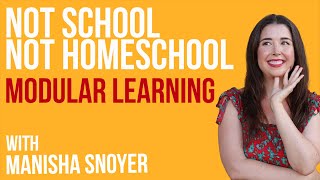
Manisha Snoyer, who has taught over 2,000 children across three countries, argues traditional schools are built for outdated jobs. She proposes modular learning instead: families mix tutors, apps, community experts, and travel into a custom education. She draws on Ivan Illich's 1970s vision of learning webs to show how this could work today.
Questions this video answers
Over 2,000 children in three countries.
Up to $60,000 a year.
Since 2015 (she's helped hundreds of parents start micro schools).
In 2019 she founded a virtual learning program and a hotline that served over 100,000 families impacted by school closures.
Over 20% of kids.
Chapters
Hi everyone, I'm Manisha and this is Teach youh Kids. Today we're going to meet the new wave of teachers, artists and techies who are reinventing education. One kid a time for the last 20 years, I've taught over 2,000 children in three countries of all socioeconomic backgrounds. I've pioneered an English language program in an impoverished area in the Middle East. I've worked as a public school teacher at some of the highest and lowest performing public schools in all five boroughs of New York City. I've tutored 18 subjects in three languages to some of the wealthiest families in New York, San Francisco, and Paris to make up for shortcomings they were seeing in private schools they were paying up to $60,000 a year to attend. Since 2015, I've helped hundreds of parents start micro schools way before micro schools were a household buzzword. In 2019, I founded a virtual learning program to help families through the pandemic, a free online math tutoring program, and a hotline that served over 100,000 families impacted by school closures. I've climbed trees with children in forest schools in San Francisco and tested new digital apps with kids in seven different countries. I've also coached dozens of families at different stages in their homeschooling journey. Most recently, I founded Teach youh Kids to help families curate their children's education, social and childcare experiences, drawing from a diverse array of in person and online resources. Based on what I've observed in my experience in this wide array of educational settings is that there are thousands of extraordinary people working diligently to fulfill very unambitious goals. We could be doing so much more with less exertion and more joy if we just expanded our vision to what's possible. If we woke up to all, childhood education could be what many of us I believe, already know intuitively but don't dare to trust. From what I've seen, the first goal of school is to do an adequate job preparing our future workforce to do jobs that were relevant yesterday. Though more often than not, school is actually still optimized to prepare kids to work in industrialized factories. Or at best, schools may aim to prepare kids for currently relevant jobs in tech, which are bound to also be obsolete when they actually join the workforce in five to 10 years, taking our inflexible school system another hundred years to catch up to prepare kids for what were our most needed careers today, which by that time will also be obsolete. The second goal of education appears to be to do the bare minimum to help parents in the current workforce take care of education, childcare, and all their children's social needs all at once, in one place, in one institution at one time, and miserably failing by trying to be all things to all people, serving active complainers at a bare minimum, and leaving the less vocalized, marginalized communities way behind. So many brilliant educational visionaries have tried to build the perfect school for all time, optimizing child care, social experiences and education in perfect harmony. But that is exactly why these initiatives fail. We need to stop building the perfect school for every child and start building the perfect learning system for each child at any given moment in time. A system that can evolve and evolve to fit individual needs. Building the perfect curriculum, social experience, or perfect childcare center for every family is bound to fail. Because what we need to do is create the perfect education, child care, social and academic experience for each individual child at any precise moment in time and continue to recreate it as each moment passes and they grow. Because children are different, families have different needs and communities are diverse. People are different. One system does not fit all. It will never fit all, or likely even two identical twins perfectly. And even if perfection for all people at this time was achieved, it would cease being perfect at the moment after it came into being. Because we live in a world that is changing all the time. To live and learn is to adapt to a world that changes around us as we change. While it would be wonderful to hear a parent say that school provided fantastic child care that allowed them to thrive at work, gave their children a vibrant, healthy, social, emotional life, or intellectually rigorous and engaging educational experience that made them love learning and prepared them to achieve any goal they set their minds to. These testimonials are few and far between, and we rarely see all three at the same time. What we see more often is parents who are scrambling to find after school activities or babysitters to fill childcare gaps, seeking counselors to heal emotional wounds from bullying and racism at school, or hiring tutors to help kids catch up with classwork or appeal to a learning style that deviates even a fraction of a degree from the norm? Over 20% of kids are diagnosed with a learning disability, and I have to ask if it's 20%, is that a learning disability or parents choosing not to homeschool even if it would provide better educational outcomes? Because I'm worried about socialization, almost all the decisions are based on lack, fear, and with the sense that something must be sacrificed to get it to just okay. Students may also benefit from free services at libraries or nonprofits but these programs are also generally structured to help them catch up with classwork, work sometimes and at best ensuring they perform well on standardized exams, graduate from high school, and attend college, but not necessarily correlating with the cultivation of skills like autonomy and creativity. In our own free tutoring platform, masteryhour.org, we've been criticized for allowing children diagnosed as gifted to participate alongside children who are struggling, with the implication that they don't deserve to accelerate because they're not behind. Some parents reach a breaking point with school and decide to homeschool, rarely out of a desire to innovate but out of sheer desperation or disgust with what's available. Unfortunately, parents who've reached their breaking point and opt out end up fearfully recreating the whole thing in their own home or learning pod, relying on standardized curriculum and a typical 9 to 3 schedule, assuming school must be doing something right, or at least have some correct underlying assumptions, all the while not quite able to pinpoint what that right thing is. Why do homeschoolers use curriculum aligned with state standards designed to prepare them for tests developed by large corporations with private interests? Why do micro schools meet from 9 to 3pm when this is a far cry from the modern parents childcare needs? After working at so many schools and with so many homeschoolers time and time again, I encounter parents who have been disempowered and told they don't know what's best for their kids, that the school does, the teacher does, the test does. They assume that schools just must know something they don't know, but they don't know what that thing is. That kind of conditioning is hard to break, but it's essential we break it if we want our kids to have the education they so deeply deserve. A quote from the Deschooling Society the current search for new educational funnels must be reversed into the search for their institutional inverse educational webs, which heighten the opportunity for each one to transform each moment of his living into one of learning and sharing and caring. That's Ivan Ilyich. In 1971, philosopher Ivan Ilyich advocated for a new education system. His argument was that education should be a fluid arrangement that took place through what he referred to as webs of learning, and he put out a call for advanced technology to facilitate these webs. This new system was to facilitate greater equity in education, promote lifelong learning and connections between those who wish to learn and those who had knowledge and resources to share. Here are the four main webs he described. 1. Resources a directory of curriculum and tools for learning 2 skills exchange mentors and experts willing to share knowledge, 3 peer matching, facilitating friendships and collaboration on learning projects and 4 a directory of professional experts professional teachers offering services on their own term Flash forward to 2023 and a new movement has begun to emerge. Parents and educational innovators have started to build exactly the webs Illich described, and this through years of experimentation and iteration with the highly motivating driving goal of providing the best educational and social emotional experience for their unique child and best child care situation for their unique family. Many chose this route because they looked at what was out there and this simple, bold thought occurred to them. I can do this better myself. The thought grew and grew and grew until they decided to take the leap. They set their own goals for education, socialization and childcare, optimizing for each one rather than taking place at one institution at one time using a standardized curriculum. But modular learners set their own goals for their children's education, the childcare and social life. Every single child's education is unique and customized. They create a unique mosaic of resources drawing from digital apps, workbooks, teachers, experts, other families, local classes, nature based curriculum, community groups, cultural organizations, and even world travel. The community is diverse and they unite around this shared value of education. It's a community of teachers, artists, makers, investors, healthcare workers, techies, community activists. The community influences each other. They share resources, they share skills, they share knowledge and they evolve together. So education evolves fluidly, not periodically. Nothing is stagnant. Their children's education is constantly evolving as they experiment with innovative education education technologies as they emerge, pioneering the future of education starting with their own kids. It's not school because most of the education happens outside the classroom and it's not homeschooling because much of the education happens outside the home and some of the children even have school as part of this mosaic. It's also not remote school because education is often a mix of in person and virtual experiences. Rather than isolate themselves, these families band together to share ideas, resources, skills and childcare too. They form robust, inclusive, diverse and exciting communities where new ideas are circulating all the time. Modular learning is an innovative, cutting edge approach to learning designed by families who are fed up with what's available to them or or deeply curious about exploring new models as they emerge. Some of these families have found their 4 year old does the entire pre K through 5th grade curriculum in 6 months using an adaptive digital learning app. Some of these families form cooperatives where a science professor teaches science, an engineer forms a makerspace an artist gives watercolor classes and they all pool together to hire a local college student to teach chess. Some of them travel the world visiting museums and historical sites complemented by workbooks and apps to give their child a well rounded education. Some of these families have no college education and others have PhDs. They are of all races, nationalities and income levels. Some are teachers and others have zero teaching experience, never having taught or even spent time with other kids than their own New tools and technologies are facilitating the rise in modular learning. However, as this new learning movement has emerged, so have the tools to support it. Workbooks, apps, parent guides, teacher scripts for anyone wanting to play a bigger role in their education. Many people were afraid to teach their child, but quickly found that they understood their child's learning approach and with the right tools were better able to support them than anybody else in the entire world. Furthermore, they found support from those with more teaching experience in their community. Some parents hire tutors, but they don't have to and they find there are so many experts and mentors in their community who are happy to step in and teach their child. What all of these families share in common is that their children learn quickly, at their own pace, grow their innate passion for learning, make friends with children of all different ages and adults of all different ages, and feel accepted and loved for who they are and build incredible projects like writing their own book, making a film or building a boat. And parents make lasting friendships too, based around a mutual excitement around education and genuine care and interest in each other's children. Are you interested in designing your child's education, your childcare and social life to meet your unique needs? What, if anything, is holding you back? We'd love to start a conversation with you in the comments. At Teach youh Kids, we're building a movement around modular learning and the technology to facilitate the connections Ilitch described in the deschooling society where families, teachers and local experts can share knowledge, resources and community. We want to make a new evolving educational system for every individual child and family. Not a one size fits all system for all children. We're just getting started and we're curious to learn how we can help to empower families and teachers to create new and innovative forms of education for their kids. Please reach out to help, to collaborate on building the platform or to join the community. Are you not sure where to begin? I have a step by step guide for getting started with modular learning or you can even see examples of what life looks like for a family doing modular learning in my blog. What's a typical day look like. Feel free to reach out anytime for resources or support. I am always happy to chat and that, my friends, is modular learning the future of education.
More from Manisha

Contributing to Florida Prepaid Plans (2026–2027) | Step-by-Step Guide for FES-UA Families

Contribuyendo a los Planes Florida Prepago (2026–2027) | Guía Paso a Paso para Familias FES-UA



Finding Providers & Services in the Marketplace (Families) | Step Up For Students (2026–2027)

Encontrando Proveedores & Servicios en el Mercado (Familias) | Step Up For Students (2026–2027)




