Radical Learning with Sari Gonzalez and Becka Koritz
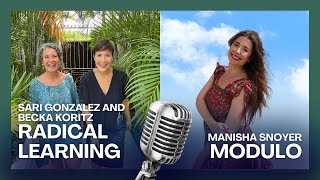
Sari Gonzalez and Becka Koritz discuss Radical Learning, a deschooling approach that treats learning as life and centers youth rights. They run The Shift, a seven-day intensive, and Deeply Deschooling, a four-month course. Their core advice: back off, model curiosity, and address parental fear.
Chapters
We see learning as just living life. We don't see it as something that needs to be even, you know, put into a box of school or this is how we learn and this is how it's supposed to look. We literally wake up every day and each time we take a breath that is an opportunity for us to learn something new.
Hi everyone. I am so happy to welcome my dear longtime friend Sari Gonzalez and her collaborator and co founder Becca Kores of Radical Learning to come and join us today on Modulo to talk about Radical Learning and so many other things. I hope I'll give you a little bit about their background. So Sari is the director of Explorer Explora, Agile Learning Community and also co founder of Radical Learning. She's a passionate advocate for youth liberation and rights and has participated in numerous efforts in the self directed education movement including being one of the founders of Cottonwood NYC and Summer Search and Farm School nyc. And she is committed to providing tools for both parents and educators to completely shift the way they think about how they relate to young people. Becca is an amazing educator with over 30 years of experience, including training teachers. She has a background in Montessori, she's founded two Waldorf initiatives and an agile learning center in Mexico. And Becca is a leading voice in the self directed education movement in Latin America and dedicated to youth rights. She is Sweden's main advocate against mandatory schooling and she also authored the Swedish book A School from Scratch. Did I leave anything essential about out? I know there's a lot more to say about you amazing women.
I think, I think all I would add in is that we're both mothers of two neurodivergent kids.
Incredible. That is so important and we're definitely going to dive into that today. So. So maybe could you just start by sharing how you met and how you both kind of arrived at this philosophy of using radical learning in your life and in your children's education. I may be sorry to start this story.
Yeah, I think you should go. Sorry.
Yeah, I love this story. And also just a quick, quick note, I didn't found Cottonwood. I just. It feels important to name that because I don't want to take anybody's credit away but I did. I was co directing like the next version of it. So it was from that project that I got into, into unschooling and self directed education through my young person and also through meeting you actually Manisha, you. You opened the door. I have to just shout out your work as well. You opened the door. This program that helped Me look at many different learning environments in New York City when my son was just a wee baby and found my way to self directed Agile learning through that. And the Pandora's box was open. And so long story short, I knew that I wasn't going to put my son into conventional schooling very early on. Having been a product of the New York City public school system myself, I knew that was not a system I wanted to put him in, especially as he grew. And I came to understand that he was neurodivergent, knew that that was a system that was going very much clip his wings and kind of keep him boxed in or at least try to. And so in this journey of looking for alternatives came to Agile Learning was a parent of an Agile Learning Center, New York. Then became the co director of a later version of that program. And I always knew that I wanted to leave New York. I always knew that I wanted to, you know, that the world was my classroom, you know, of sorts. And so I had traveled a lot and we traveled as a family a lot. And I always had a kind kind of passion for Mexico. And I heard that there was this wild Swedish woman because I was born in Sweden that was running an Agile Learning center on the coast of Mexico. And so on a trip, family trip here, I kind of stalked her and was like, hey, we're both youth rights advocates, we're both into self directed education. We both have these really radical ideas about like how to step away from the conventional systems. Let's meet. I finally convinced her to let me have a coffee or juice with her. And then we spent hours kind of just daydreaming about ways that we could support young people and families to do really essentially what is deschooling work, which is looking at particularly adults, looking at ourselves and the conditionings, things that we've internalized through our own schooling experience that have caused us to really replicate models that are really outdated and also don't work for, for to support young people to thrive. And so we just had a blast kind of talking about that. And then I went back to New York, I continued co directing Pandemic hit came to Mexico. We co directed Explore Agile Learning Community and then we started radical learning to really support parents and educators to humanize their approach to education.
Wonderful.
That's like the short of it.
That's such a great intro and sorry, our audience is quite broad. I mean I think there are people who definitely fall more in the radical learning circles, but we also have families who are embracing a more traditional approach to their Education. And I guess for me, my own kind of path in education feels almost like a. I don't want to use this word lightly, but almost kind of like a whole physical, mental, spiritual shift in. Almost as if I was standing on one side, and then now I'm standing on another side, looking back. And I was curious if it also had a sense of. Kind of almost like a spiritual awakening for you. And. And if you could try to describe, like, how you viewed education before and the way that you see it now.
What a beautiful question. And that question was for me.
Yes.
Okay. Okay. Because I'm sure Becca has a lot to say around it.
Yes.
You know, it's really fascinating, Manisha, that so many of us, parents and educators spend so much time trying to maintain a system that has only been. It was only established 200 something years ago. It is a speck in our human existence, and we're doing everything we can to hold on to this little speck of conventionality. And so when I listened. When I started listening to my kid and I started observing him and observing, like, what were his true needs, and I could compare that to what was being offered in a conventional system, he very much pushed me to this path of, like, questioning what. What we are all used to. And that path of questioning absolutely has been a spiritual journey. Absolutely has been a journey of recognizing how many parts of myself as a person that has gone through conventional schooling have been compartmentalized, have been shut down, have not been awakened, have not, you know, been nurtured. And so this. What started as a journey to support him in his learning, quote, unquote, learning became like a reclaiming of living, of life. So we see learning as just living life. We don't see it as something that needs to be even, you know, put into a box of school or. This is how we learn, and this is how it's supposed to look. We literally wake up every day, and each time we take a breath, that is an opportunity for us to learn something new. And so that shift in thinking about learning in and of itself and about life as being our classroom and our gateway to exploration and growth has been. Yeah, absolutely. It's been like a becoming. It's been a remembering. It's been a returning and like a shedding of many. Of many things that actually weren't mine, like these ideas of, you know, you know, how we learn and what we're supposed to do, and all these kids should be together because they're the certain age and be learning these same things. Like, the more I Question that, the more I realized how unnatural that was. And so, yeah, it's. It's like almost coming back to my true essence as, like, a human being and supporting my kid to do the same.
That's so wonderful. I love how you talked about just changing your focus from what the shoulds to listening to your child's needs and how that opened up everything else. Becca, do you have anything you want to add about, you know, how you. Or maybe just how you would frame this idea of radical learning to parents or if you want to talk about your own journey towards this perspective?
I can't go. I can go into all directions, but I can start by saying that radical comes from the Latin word radic, which means roots. And so when we say radical, most people interpret it as something extreme. And sure, it is extreme in comparison to what most people do, which is school. But actually we are just going back to the roots of our humanity to look at how we as human beings learn and how we thrive in community, how we are together. And by just being, as Sadi said, just living, we learn. It's impossible. Like, it doesn't matter what activity you are undertaking, you are going to leave that activity, even if it's just a coffee with a friend, with learnings like you will expand as a human being, because that's how we're wired. And I think that for me, growing up in Sweden, where it was only public school at the time, there were no private schools. I went to a public Montessori school and then crashed completely with the ordinary, traditional, like, conventional secondary school. Thinking, like, why does it have to be so boring? Led me little by little to this, like, yeah, questioning of the system. Why does it look like this? Why do we have to do everything in subjects? Why do we have to get grades? Like, why is it so different from how life functions? Why have we created this very artificial system? And in my own personal journey, the big shift for me was then what. What led up to this was when I decided I made a very, very conscious choice of, like, starting to live and make my decisions from a place of love, love for myself, love for others, instead of limiting myself because of my fears of everything that could go wrong, all the mistakes I could make. What if this, what if that? What would others? When I made that shift that coincided with me leaving Sweden 20 plus years ago and moving to Mexico. And from that moment, that's how I have been living. And so when, when my son was born, I was like, I don't want to limit him. I see what we do in the conventional system. I had become a teacher in Sweden. I had been working with a lot of young people, and I had seen how we. How we clip their wings, how we're trying to. We're pruning them. It's like those two. Those two. We're pruning them, we're clipping their wings so they can't fly and they can't grow as big as they could possibly be. And now we have internalized this as adults, and we think that this is the norm. I mean, it is. It has become the norm, but it's not normal and it's not natural. And so I saw my son and I was like, I need something different from him. I do not want to put him through the system like that. And so that led me to first co founding Oaxaca City's first alternative school that then later turned into a Waldorf initiative. And then I founded the second one here on the coast, same state, but different town, and ran into the limitations of Waldorf as well as a very predefined. It's progressive education, just like Montessori, but it's still predefined. There's still an agenda that is coming from the adult. This is what kids need to know. And I question that. Like, we do not know what the future looks like. We have no idea what it. What it holds for our kids. What I do absolutely firmly believe is that our kids have everything inside of them to grow into the humans they need to become. And that my job is not to prune. My job is not to clip any wings. My job is to make the soil fertile, put in a lot of composting, get some water until the roots are big enough to suck up the water themselves and be there as. As a. As a friend, as an ally, and support my kids growth. And so that is through love and not through fear. That is without, like, shedding those thoughts. But what if he doesn't?
Blah, blah, blah. What if others did it?
What if he never will get a job? And like, all those thoughts, all that noise that all of us adults carry, like, to be able to look at that noise and be like, this is not who I want to be. And I do not want to make my choices based upon that noise that I hear. I want to trust. I want to trust in my kids innate capacity, innate abilities, intelligences, talents, and I want to see him thrive.
And so, yeah, yes. And, you know, I want to highlight this word, love. It's a word I also used in a podcast with my mother, who is a Montessori teacher now. She's a pre med advisor. And we were talking about what, what is necessary for a child to learn. And some people might hear this group of women talking about love and think that it's a bit mushy, a mushy week perhaps. And yeah, and I, and I, and I think of love as something a bit more fierce, especially when it comes to education. And so I want to explore that word with you a bit. I. When I was a high end tutor on the Upper east side in New York City, I, you know, occasionally there would be a parent, I would meet with their child and they would say that I seemed a little bit too sweet to be their child's tutor. And yet I had the highest performing students of anyone in my, in my tutoring agency. I mean, kids would start their standardized test getting a 10% and leave with a 90%. And I don't want to say, you know, okay, well, if you approach this love thing, you're going to be able to enter into this capitalist world of hogging all the resources, but so be wary of making that leap. But I do think that there is something to building that secure foundation from which learning can flow. It's a place where there can be really deep listening that allows the tutor to understand how does this child learn, what motivates them, etc. So I guess without going too much about my own opinion on the topic of love, I'd love to, I would love to ask you, and maybe Becca, we could talk about a little bit about that fierce love. How is the love you describe different than enabling your child, for instance, and you know, entering a dynamic where the child is in charge and the parents are almost kind of servants to that child's will. What, what are your thoughts on that? Sorry?
Well, I'm super glad that you named the woo woo thinking because it's really easy for people to hit pause right now thinking like, oh, but what we're talking about is the future of education. What we are talking about is shifting paradigms from a very production, outcome oriented approach to supporting young people to moving into one that is focused on and centered on relationships. So when I hear you say love, I don't think about enabling. I don't think about, you know, power, which is kind of what you were talking about. This dynamic, you know, if kids just do whatever they want at the expense of other people and it's like a free for all, you know, and, you know, this kind of passive, passive parenting or permissive parenting or passive kind of Education, it's, it's about relationship, who we are as human beings, when we come together and we're in company and community with one another. It is the fact that I, yes, have more years on this planet. And so therefore I might have some information that young people don't have. Can I share who I am with them? Can I, can I share my lived experience with them, understanding that they can take it or they can leave it because they have free will? But you know, in doing that, excuse me, in doing that and sharing who I am as a human being, I'm doing so not because I believe that they, that I have something that they need or that I have something that they should be doing. I'm literally just building a relationship with them as a friend, as a companion, as a life companion. And I think that that's what I think about, like, I love that you said fierce love, because to me, it's, it's, it's about humanity. It's about we are human. At the end of the day, if we took school aside, if we took the concept of learning aside, we are human beings that are just moving through life having different lived experiences. And to me, as an educator, my role is to share my lived experience with other, with other humans and also learn from them. So it's like an exchange. I'm not here to just, you know, have power over young people and say, this is what you should learn, or this is what I think is best. It's, this is my lived experience. What do you think about it? What's your experience? What questions do you have? Let's explore this together. And so I really think that there's a huge shift that needs to happen where. It's one where we as educators see ourselves as more as partners and companions than almost even teachers, because that even puts too much power in our hands.
Becca and Sarai, you have so many great offerings. You do a deeply deschooling course. You have a course for rebuilding relationships with your kids, practice opportunities. I would love to know more about this program, the shift that you offer, who it's for and what happens during that experience and what people take away from it.
Wow, I'm so happy you asked.
The shift.
Yeah, yeah. The shift is in, in one way, it's like so hard to describe it because it's so different from, from everything else that I personally have experienced. It's a seven day intensive. And it is seven days because it has to be seven days. Because during that time we do a lot of examination of our own power Power in society, the power we have over kids, the power that others have over us, that make us, you know, fear. Fear the future or fear certain results. But we also come together to co create a culture that we believe is the culture that is needed for the world where we do exactly what you were talking about, Saadi. We take the productivity and the result focus and set it totally on the. And we focus on processes and building relationships. And so we start training and practicing, practicing a lot of tools that we need in order to be able to humanize ourselves. So it's basically a week where we reconnect to ourselves because we have been so profoundly disconnected and then we can connect to others and it is playful. There's plenty of dynamics, there is a lot of play, there's a lot of reflective work happening, a lot of conversations. And during this week, we see people transform and we do that too. For every shift, something in us shifts. That's why it's called the shift. So basically what we're trying to do is to take people on a ride from where we stand right now and do that paradigm shift and show them how it can be done and have that experience. So, yes, in a way, it's a little bit like a bubble. We're in this bubble and it's beautiful and precious and things happen and there are conflicts and we solve them in such different ways than people are normally used to. And we show how we can actually create a world that is not a fluffy world built. Oh, it's just peace and love. No, like, how can we do this together for real? Because every, like everyone that I meet, at least they're like, oh, they're so tired of the heaviness of this world and they want something different, but they don't have the tools. So most people tend to fall back into what is called tools of oppression, where we disempower others. And during this training, we shed those tools and we replace them by tools of liberation and connection so that we can empower ourselves and empower others. Sadie, I'm sure you can add tons of things to this.
No, I mean, it's. If I could love to understand a little bit more about the kinds of people who come to you, your target market, you know, who are the. You know, are they mostly teachers, parents, homeschooling their kids? I mean, I'm actually thinking about using your training program for our tutors for a variety of reasons, but in general, it's not something that you use to get a higher pay or a new job. I'm Assuming. So I'm curious, what motivates people to go through this training that's really about personal growth and, you know, what, where they are at their. In their life?
Yeah, I think we're. The way that I'd like to answer that question is to talk about what people do after the training. So we've had grandparents that all of a sudden have totally different relationships with their grandkids. They know how to support them. They know how to support their kids in supporting their grandkids. So that's like one. We've had grandmas. We've had educators that are in the conventional system that are just, like, pounding their heads against the walls because they're like, I know that I'm failing these children. I know that I'm not able to support them in the ways that I want to. What do I do? And we've had educators that then get tools to be able to create change within their current communities and structures and environments by focusing. By shifting focus from outcomes to relationships and getting tools to, like, communicate with their students differently. We've had educators that are fed up with the system and then end up going through the program, the training, and then they're like, I'm going to open up an alternative ed space. And they go and they do that. And then we still are in community with them through other programs that we offer to support them in, you know, building their culture and thinking about how to work with staff and thinking about parent support and thinking about communication and conflict resolution and all the things that come with, you know, holding space as a community leader. We've had parents that are like this. This system is not working for my kid. This school is not working for my kid. My kid is either neurodivergent, where it's just not working. Like, they're miserable. The fire that I saw in their eyes is dwindling every single day. They're depressed. They don't want to go to school. They're having conflicts. They're being bullied. And then parents come out of the program being able to identify, like, ways in which they can move forward with their young people, either outside of school through homeschooling or unschooling or by really, by connecting in our training with other people that are doing alternative ed projects. And then maybe even we've had people, like, start their own communities because they leave there with, like, this inspiration to do things differently in a language and tools to be able to do that. And so, I mean, there's so many different. So it's the Parents, it's the grandparents, it's the educators, it's you know, the educators that have started an alt ed's program and maybe they find themselves like repeating old patterns. Like they're like, I really, I started this program really wanting to do things differently and I'm just, I keep, keep arguing with students, I keep losing staff members. The culture is not what I wanted it to be. And folks that have really gone through the shift and then had this newfound perspective and understanding of what co creation is and how to share power with the people in their communities so that it's not top down and hierarchical, but so that it's horizontal and get parents involved. And so it's, there are a lot of different people that have gone through it. But I would say the kind of similarities between all are this curiosity to want to know how to do something different, this understanding and this listening to their own intuition in a way of like something is not right here, something does not feel good. And I want, want, I want to pursue something different either with my kid, my grandkid, with the students I work with, but I don't know how, you know. And then also there are a lot of people that are very much into youth rights and want to support young people to have more voice in our society and see this shift in paradigm as like an absolute necessity in order to be able to do that and just want to be surrounded with more around more people that are like minded. So yeah, I hope that answered your question.
I love it. Becca, did you have anything you wanted to add to that in terms of who's taking your program?
No, I think that really. Sadie, you mentioned it. What I do believe that people are very surprised by is that it ends up being a healing experience for many journey. And that is not something that we thought about when we started creating the shift, but we have come to understand that that is, that is what is happening for many people that do take the shift that they, they heal, they heal. And once you, you are more whole, you are going to look at yourself and your role and place in life in a very different way. And also you're going to look at other humans in a different way. And so yeah, it's, it's very powerful. I think it's one of my favorite things to do in life.
One other thing I will add, just because you said about your tutors, we have had communities like ask us to host the shift at their, in their spaces because you know, they're looking for different ways to, to do community differently and to co create their culture. And so we use a lot of art of hosting techniques, which means that the solutions to the problems that communities are having lie within the knowledge and within the people that make up that community. It's not something that comes from the outside. It is there. And so it's about holding space for those conversations to be had and facilitating those conversations and then having tools to be able to like put those conversations, move them from theory into action. And so yeah, it's, it's really powerful. It's really, really powerful.
Well, I feel healing every time I'm around the two of you, so there's certainly a transmission happening in the way that you relate. I mean, I, I truly feel that kind of grounding in what's essential and these, this network between all of us that, that exists. It's really powerful. And I could, you know, you know something that's a reality for a lot of homeschool cooperatives is that often people come together with very good intentions of raising and educating their children together. But sometimes it can devolve into infighting or a situation where the parents are kind of pitted against the lead teacher or against each other. And so it's really wonderful that there's a resource that people can bring into these communities to help bring them back to why they started and move forward in an even more powerful way. So it's just so wonderful that that exists. I also think about some people who might have difficulty relating to their child and that's something we don't talk a lot about because there's certainly an expectation that you're going to get along really well with your child and just love them all the time peacefully. But you know, I mean, think of one example, a very successful wealthy man and his, his child is choice excep. And it's just really hard. And diagnosed in the autism spectrum, which brought a lot of shame into their family and to his. And it just is hard for him to kind of, he wants to spend quality time with his son, but it's, it's just very difficult. But yeah, so I mean it's just so wonderful that, that you have that for families. I'd love to talk a little bit more about this word neurodivergent and, and maybe whoever wants to. Can you define that word for families?
Oh, that sounds like a really overwhelming task to define it. But maybe because I am not an expert, I'm just a mother of a 19 year old unschooler who has autism and I would say that his brain is wired differently. So he perceives the world very differently from me and. Yeah, he just perceives the world differently and he functions differently. And it becomes hard because our society is built around a specific norm and specific standards. So for instance, if you are in a wheelchair, you're going to have a hard time around because our society, well, most, most of us walk, so that works. So they're going to have a harder time. If you can't see or you can't hear, you will also run into difficulties because the norm is made for people that can see and that can hear. And the same goes for neurodivergent people. Society is not really made for them and has really high expectations on how they should behave and how they should perform when it's really unfair because they function differently.
Yeah, yeah.
I would add to that also as the mama to a neurodivergent human who we've never gotten any, you know, diagnoses or anything like that. It's more just an understanding that exactly his. He has needs that are. That are different than the typical, quote unquote, typical person. Right. And what does that even mean? My hope is that there is, there comes a day where there isn't a distinction. You know, there isn't like even a term neurodivergent because we're all, as a society used to the fact that there are different ways in which we operate. But I think neurodivergence is important to recognize right now because we're, you know, we're not at a place in our society yet where those norms of what should be and how it should look like and what are the boxes that everyone needs to fit into, those haven't been dismantled yet. Like, we're still very much operating from a place where it's like, okay, if you're going to school, you have to like sit down and if you don't sit down in your seat, then something's wrong with you. And so I think that it's helped.
Helpful.
It's helpful to know that basically neurology is about needs as well and just understanding that we humans have very different needs. And there are certain systems that are supportive of different needs and there are other systems that are not. And so thinking about that in education is really important because we all learn very differently. We all have very different situations that either support our growth and our learning or can hinder that have, you know, things that, that empower us. We have things that disempower us. And so keeping in mind that it's. There's not a one size Fits all approach is, is really what is at the heart of understanding.
Our.
Yeah, neurodivergence and how to support young people.
Thank you for saying that, Sadie. I would like to jump in here and just say that if we just look at our planet and we look at nature, nature thrives on diversity. Monoculture doesn't work. It kills the soil. And school kind of damages and harms kids too because they're forcing kids into this specific mold, like as if one size would fit all. But we as humanity, we also need diversity. And that is one of the reasons why I think that our work is important because we're not not putting any shame or blame on the fact that we are different as individuals. On the contrary, we find beauty in that and we want that diversity to exist and we want it to thrive. And then we need to really look at each individual to see what it is that they need so that we don't put a specific agenda on top of them that might not at all work for them.
So we talked about love and now I want to talk about the other side of the coin. Fear. And parents are just put under so much pressure, I think judged more than any other group in society in terms of what they're supposed to do and not supposed to do, not only by their immediate circle, grandparents, aunts and uncles, but just by, by random people watching a YouTube video. And so I, I want to ask a question about this, but I realize I'm having trouble framing the questions, so if I keep talking, maybe you'll get what I'm getting at. So I, I was recently on, I have a pet peeve which is parents pushing their children to read before they're ready or on the other side, not teaching them to read at all, ever, and not encouraging them. But reading is just a big kind of hotspot for me personally. And I, I guess a couple years ago there was a new startup that posted that they had figured out a way for two year olds to learn how to read. And I just got so mad, I ended up, I just spent all night arguing with this person in a tweet storm that I never met. I mean it would just looked quite, quite a bad looking color on me to be doing publicly. And, and I, and you know, I didn't, I wasn't coming from a place of love. I was coming from a place of very intense anger and judgment. But you know, to me, first of all, you know, what is the reason that any two year old would need to learn how to read? First of all, this assumption that reading equates to better reading earlier equates to better outcomes later in life for which there is absolutely no proof roof. And then all my concerns around, you know, if you push some child to do something before they're ready, they could develop a distaste for that and then there's pushing children altogether. You know, on the other hand, there are parents who come to me because they're very excited for their 3 year old or 4 year old to learn how to read and do math early. And I feel like, you know, coming back to radical learning, it's not my place to say you shouldn't be pushing your child, that's bad for them. And I'm not going to be complicit in that. Although I do want to support the child as well. So I guess my question, and you can answer a different question if you think there's another one underneath. What I'm trying to say is, you know, how do you relate to a parent who wants their child to learn to read before they're ready or learn a subject before they're ready. Like where is this coming from? And, and what do we do about it? And some cases it's issue of real economic security as middle income people who had access to an education. For some that is very urgent. It can feel very urgent. So yeah, what are your thoughts on my ramblings on fear? Whoever wants to dive in first?
Yeah, Sadi, you can go if you want to. I mean this is fascinating.
Love this.
I love it. I think that, yeah, it's, it's clear, you know that it is coming from fear. We, we, I think it's a fear of survival. If we look at our world, there's so much competition. There is like this idea of the survival of the strongest, you know, what is, what does strong mean in our society? Have a lot of money, you know, we have to have success. There is climate change happening. We have just gone through a pandemic. It's clear that we have no idea what life is going to look like even in five or 10 years. We don't know. I think it's a really normal reaction for parents to try to make sure that their kids will stand strong whatever happens. I just think that there is no, like, it's like it's not realistic. Like as you say, like trying to force a two year old to read is like trying to make a three month old baby walk. Like they are not neurologically adapted to do this yet and you might actually end up causing your, causing harm in your kid. And I think that there's a lot of ignorance within parents too. They just don't know. And then all the societal pressure and all these myths, like, without school, no future, you know, and so I can see it and I can definitely go into a very compassionate mode for these parents because I know they're struggling. It must be really awful to stand every day, wake up with this fear, like, what's gonna, what's gonna happen to my kid? And trying to figure out different ways of making sure that their kid is gonna survive. Whereas, like the, the antidote would be starting to understand that the baby made itself in your belly. Like when I was pregnant, I, I didn't make, I didn't make my baby. He made himself. And he's the one who's growing. He's the one who's doing all of these things. And that it comes to learning too, and kind of unlearn and look at the difference when you think that you are in charge. Because there's also the pressure on parents. Right? We have to be good parents. And what does that mean? We don't really know, but many times it's making sure we're on top of our game. And I'm not saying that negligence is the opposite of that, because it's not. But you can stand in that, that fierce love. I just love that expression, so much fierce love. I'm gonna adopt it and use it because it has to do with learning how to trust our kids and to be able to be there and meet them where they're at, not where we want them to be, because it's absurd. For me, trying to force a two year old to read is like trying to make an avocado plant that is this big egg produce avocados. Like, there's a time for everything. And there is so much rush, there's so much urgency and there's so much perfectionism ruling our society today. And I think we really need to look at that and how that affects us.
Yeah, I, I'll pick up from there, Becca, because I love the question of like, how to relate to parents that are wanting this for their kids. And I think I too, my initial reaction is always frustration because as a youth rights advocate, it's like, free the kids, let them, let them be kids and let them have fun. And like, life is, life is, you know, you're only a kid for so long. Like, can we just let kids be kids? They have so much time to figure out all the things, you know. But that relational piece, right, of why do you Feel that way. Like, what, what is really in the same way that you mentioned Manisha, like, maybe there's another question underneath this question. When people want their kids to read at age 2, there are so many things underneath of that desire. There's probably a lot of pain. Like, you know, we all, in one way or another have been affected by these systems, these power over systems, the school system. There are things that we call school wounds. You know, our desire to be perfect, perfect, our desire to never make mistakes. This idea that we have to push, this idea that success means, like, you know, fighting our way to the top and like, you know, being competitive. Like, these are all really learned behaviors and habits from these systems that we have to leave room to question. And so when parents come with this, of course there's a part of me that wants to be like, free the kids. And then there's another part that really leans into curiosity. Like, what happened to you? Like, what? Where do these beliefs come from? Because when you question them and it's like, well, the belief of, you know, kids need to learn to read by age 5. And you ask why? Like, really why? Why is that important? You know, and you keep digging. There's always like a need that is unmet there and there's always a wound that, that can be tended to. And there's a lot of, you know, you brought up the word shame. There's a lot of shame that parents and educators hold because, you know, this feeling like we're not successful or if young people fail, then it is a reflection of our failure. And there are a lot of belief systems that we have that aren't really even ours, that we have just internalized. And so, so a lot of the work we do is holding space to question those belief systems and to really ask, like, is that true? Is it true that a two year old needs to learn how to read in order to be successful? And then you bring up the part that Becca was talking about is like, nobody knows what the future is going to hold. Nobody knows. And so are we projecting that fear onto young people and limiting their opportunity to truly live their childhood because it's theirs? Like, I got news for folks, our kids are not ours. They are their own human beings. And we go through a lot of life thinking that they belong to us and we have to mold them. But, you know, again, those are, those are limiting beliefs. Those are beliefs that might not necessarily be true if we dig a little bit deeper. So that's kind of how we like to relate to parents in that sense because there is, at the end of the day, I think a lot of parents don't really want to be doing the things that they're doing. They want to have good relationships with their kids. But if you're drilling your kid to read at age 2, chances are that relationship might be strained. And so, yeah, it's just getting to the real reasons, the root of why.
Yeah, I mean, that really helps me understand why I was so annoyed with this startup founders because I felt like they were using a fear tactic to get parents to buy their product. And there's so much of that in education, like both on the side of, wow, you can learn earlier to, oh, your kid can be a genius. And then this kind of fear among parents of, oh my gosh, what if my kid is not a genius? Oh, or my kid will never be a genius. This is not for them. Which is also kind of gross in and of itself. And you know, but, but I, but I appreciate, you know, it shows me also a light on where I need to do my deep work. I think I also see a conflict in some parents where they come with this sense. What they express is all I want is for my child to be happy. But what I see is, is my child doesn't want to read to me. Why is my child on track? Is my child on track? How can I know that they're on track? And, and, and it's, it's really hard for me to show up for those families. You know, I find myself grumbling like another parent wants 12 hours of tutoring a day for their 6 month old, you know, and, and it's, it's, it's hard. It's. And, and it's something I, I want to, to, you know, understand how to meet better as opposed to just run away from. I mean there's even, I mean, you see in tech like Elon Musk, you know, it's so much is about optimizing. How can I optimize? I want to be competitive, I want my child to learn the most. And I guess the way I see it is, I mean, I don't have children on my own, but I would want them also to learn the most. And, but the way I would approach that is, is I think really trying to tune in to what they want to learn what they need and also be a model for learning, a model for growth. And, and I loved how you said learning is love, learning is life. Right? That life is learning. It's not, we don't have this compartmentalized of now. I'M learning and now I'm on tick tock and now I'm eating my pot roast. It's all, it's all part of the, the learning. Wow. Yeah.
And I think it's hilarious that there's so much emphasis on like, this small window of one's life that, like, this is the time that we're supposed to learn all these things. You know, kids need to read by this time, but then you look at like, and then what happens? And then they leave school and all of a sudden learning stops. Like, how many adults listening to this are learning something right now by listening to this?
You know, I hope that they're learning a lot. I'm certainly.
Or life, you know, like, yeah, learning through, through living their lives. So I think it's just such a fascinating belief that we've adopted. Like, oh, learning is only, only happens until this age and then it stops.
Right? Yeah.
Yeah.
Brain is so plastic when you're young. You just have to consume as much as possible. As many words, as many languages. It's all about. You know, it's funny, people think, you know, knowing more languages and I mean, there is definitely benefits in multilingualism, but it's not, you know, shoving more in the pot that makes you, you really want to quantify things so much. Wow. So good. Okay, let's, let's shift to a totally different area. Nuts and bolts. So I, I think I understand that both of you are homeschoolers with some combination of, of co ops and such. How does a parent who wants to exit the school system manage being an entrepreneur? I mean, you guys are working around the clock as an entrepreneur and also having your children with you. How do, how does that even work? I mean, so many people say, like, well, I would love to do that, it's obviously better, but I need school for childcare and therefore my child has to suffer six hours a day. And then, you know, I have some questions about, you know, how much support that actually gives to parents driving back and forth and dealing with that shift from school to unschool. But, but how do you, how do you two navigate it? What does your child care plan look like?
It's a great question. Becca, you.
No, you go first. No, you start.
You know, I literally like a week or two ago posted on Instagram this reel that was like, you know, how do I get everything done and unschool? And it's like, I don't, I don't. You know, it's so much of, of leaving conventional schooling behind is also leaving Ideas around productivity behind and like what that means, like what I, what I'm supposed to be doing in a day and what, you know, that to do list that I've always had like really leaning in and focusing on like what is absolutely necessary, what is absolutely enough. And so like de productivitying of myself, I just made up a word but you know, like thinking about productivity differently and so our days look very different. You know, it's. Some days, some days are just like, I gotta focus. You know, it's movie marathon day, go do your thing. You know, some days are my kid is, he's really into sports, sports and movement. You know, he started walking at nine and a half months, didn't crawl and so he's just on the move. And so, you know it's, he's moving all day. You know, some days he's online with group with his online international group of friends. And I know there's a lot of thoughts around screens in our house. Screens are a huge tool that has helped learning and helped connection incredibly. And of course you know, there always needs to be some balance in that and a lot of conversations which also also leans into the relational piece, right? Like how are we relating to each other around the things that are triggering and hard. But it very much is like this is, this is what's real for me. This is what mama needs right now. This is what, what is on my plate. How can we work together as a community to try to support these different needs to get things done. So it really is leaning into community. It really is leaning into others that are also doing similar things and where we can support one another. It's letting go of this idea of what needs to happen in a day. And also I do want to name that not everybody has access to support, not everybody has access to community. And so also there's a lot of dogma that happens in unschooling homeschooling. Like this is what it's supposed to look like. And I don't agree with that because, because maybe for one family it means being part of a center a few days a week and then they're home together one day a week. Maybe it means your kid is in an agile learning center and not at home with you. Maybe it looks different for each family. And so for me it's like really understanding what are the needs of all the family members and the people that are able to be of support to one another and then basing your life around that and then and really having a lot of self compassion when it doesn't look perfect and it's messy.
Yeah. And I would like to add on to that that I am one of those persons that did not have community. I was alone. I'm the sole provider of my family. And it was super challenging. It was really, really hard because first I had started those Waldorf initiatives and the first one worked more or less for my kid. But once he started, started primary school, it was clear that that was not the format that that suited him. And so once we left that at the end of 2015 and he started unschooling, started building Explora, the Agile Learning center, and I knew that it was not going to be his favorite thing to do. He would come in, in the afternoons because I, before Sadi got here, I was running it as a kindergarten in the mornings. And then like, what is it called, an after school, a couple of days per week in the afternoons. And so he would come in and first two years, fine. But the more school kids that school kids that would join, he would like it less because of the culture that is very, very different. And so it has always been a struggle for me how to navigate my professional life, pulling in enough resources, resources for us and also enough for him to be able to do what he needs to do and then have time together. So it has never been easy. But I think that I've had to just like deal with some radical acceptance around the circumstances that, that we have had to deal with. And also understanding that the. One of the biggest gifts I have gifted my son was not only like his freedom, it has been about time, wealth to give him the time that he needs and wants to do what he loves most and work as a parent on becoming an equitable parent where we connect deeply through our relationship. And I trust him, I confide in him. I see him as an integral part in my life. And of course it is mutual. So like, building that relationship has been crucial where we have been able to talk about things that aren't working, where he has been able to, to say, mom, like this, this doesn't, this doesn't work for me. Like I need this and that. How can we make that happen? And yeah, that's where we're still at now he's 19.
I mean, it's really quite extraordinary. Two of you alluded to, but didn't actually state that your, your children have really cultivated quite a bit of independence. You know, a lot of parents can't even conceive of not having to entertain their child every single minute or provide some type of Entertainment to them.
Maybe.
Could you, you share two or three quick tips for parents who want to encourage self directed learning in their children.
Yeah, back off. I'll just say the first one, like back off. A maximum support doesn't mean you're constantly there. To me, it's a combination of, yes, you support them when they want it and show you that they need it, but there's also a minimal of interference. Like you're not running the show for them. They need to learn how to do that. And sometimes they will be bored. Perfect. That won't kill them. Boredom is necessary also to figure out what it is you want to do.
Yeah. And not being bored might kill them.
Yeah, maybe.
I mean, just in terms of. It might seem extreme, but boredom, it really cultivates imagination and self direction. And if children are entertained all the time, it can lead to depression and addiction and all kinds of things. Yeah. So sorry, what are, what are your, your quick tips for?
Yeah, my, my thought is always, you know, parents are like, how can I support my kids to be self directed in their learning? And I'm like, how self directed are you in your learning? How self directed are you in your life? You know, so really, because I think that, that modeling is so important for our young people. You know, we're putting so much emphasis on what we want them to do that we're not paying attention to, to what we're doing. I mean, my son loves to remind me of this all the time with screens. He's like, you're telling me I'm spending too much time, like you're on Instagram, like how many hours a day? And I'm like, okay, but all to say that I think that when we lean into, you know, what is the quality of the life that we want to live? What are the things as parents, as adults, educators, that it like inspire us that, that spark our curiosity? Like our kids are watching, that they're, they're, they're learning about learning by seeing us. So it's like, are you self directed in your approach? Is always one thing that I like to ask parents. And then the other thing is, you know, when we have been in systems, in conventional schooling, where we've been told what to do, how to do it, when to do it, there is a period of time where, when folks leave those systems and they have a lot more spaciousness, that they kind of want to repeat those same patterns. So it's like this feeling of like, I have to pack my kid's day with activities. I have to make sure that my kid is learning all the time. And even kids themselves is like, tell me what you want me to do. What am I supposed to do? And you know, that is the term that we brought up earlier, which is deschooling. Because there is a mentality that comes with that conventional way of thinking that needs time. You need to untangle from that. And so a lot of times parents will be like, my kid says that they're bored. It's like, yeah, and they're going to be bored. And it's not your job to entertain them. And that's okay. Give them the space to figure it out. Give them the space to return to themselves again, to figure out what is it that they enjoy, what is it that they like. Because it is so exhausting for a parent to have to look like, schedule a million things a day. I mean, I. I did that for a while and my son was like, I'm burning out. Like, it's too much. Like, I just want to be home. And then I realized that I was just doing the very thing that I was walking away from. And so, yeah, just. We always like to tell families, like, what if you just took a year off, you know, like, what if you actually literally saw it as a year of just living and took out the learning components component and just observed what happened so that each. The parent and the end, the kid could return back to themselves. And then from there, like, so much happens. So much happens.
Yeah. I would like to add on to that that most of the time I see that server focused on the content and I would be like, ditch the content. It's not about the content. It is about the context. And Sadie, you pointed out this thing of being role models. We are our kids context. And so whatever we're wishing for them or whatever, we're dreaming for them. We need to model, we need to show them. If we want them to learn how to be empathetic, it has to start with us. And so it's not about what they're focusing on. It's not the content. Because content you can learn at any time of your life. Life. It is really about, like, what is the culture you're creating together with your kid.
Yes. I would say there are two main areas where families dramatically underestimate power. And one is in their connection with their child. That parent child bond is so powerful. I mean, everything my mom thinks and says still has such a profound impact on me. Me. And I think parents often forget that modeling is just, I mean, social learning theory. And that's why I mean, almost every question you have about your child, you really can turn back to yourself. My child is anxious. Well, are you anxious? Can you deal with that first? My child is depressed. Okay, are you depressed? What are you dealing doing to heal your own depression? My child is spending too much time on screens. Well, how long do you look at your screen every day? Can you address that? First, first, I mean, you can go on and on and on like this. I mean, and, and on the other side, you know, you have this. So the other number two thing was the, the curiosity of children. There's this huge fear that if we don't teach children things, they're not going to want to learn. There's this idea that a really great teacher inspires a child, that those are the best teachers who can inspire them. And they, as if that was an action that you do to a child. But if you do sit back for a moment, if you let your child be bored for more than 60 seconds, you might see that there's this incredible fire within them and that they have a natural tendency to want to learn, to want to be able to do that things themselves. And you can be their partner in that process. And on the flip side, having that connection with your child, you do have a certain intuition about what they need. And that's different from the things that society tells you they need, like learning how to read at age 5 or age 7 for that matter. You know, the thing, that pressure we have, it's that deep inner knowing about what they need, you know, and that deep inner knowing when you say you know what, you know. A parent came to me and said, I really feel like my son needs to learn handwriting. And I initially I kind of poo poo this parent, you know, my unschooling self directed approach. The more I listened to her, the more I realized that there was really, this was really a deep need for her that she intuitively felt and her son was having resistance towards and she got where she needed to go with him. You know, she was able to discover that he didn't want, in this case a tutor. He wanted her to do the lessons with him because there was some type of concern around that. And so, so yeah, so those two things like your connection with your child and their curiosity and ability to learn or, you know, giving attention to those and respect for those can, can take a parent a long way.
Yeah, I think it's so important that you mentioned that Manisha. And also thinking about that, parents sometimes have a really hard accepting their kids curiosities because they don't look like learning. They don't recognize the curiosity. The kids will start playing with something, they're starting to mess things up. And we don't see the creativity and the curiosity that is driving that. We see it as messy and like that. It has no worth. And so to be able to follow your kids curiosity, you also have to be able to look at learning from a different angle and maybe just ask yourself, yourself, if learning happens all the time, what, what is my kid learning right now? It might not be school subjects, but to be honest, the subjects that we learn in school are extremely limited. It represents a little piece of what life is. So if your kid has other curiosities, other things that they want to explore that don't fit into that very, very small mold of school, it doesn't mean that they're not learning, they're just learning other things for sure.
And it could be also a call for attention if a child throws food all over the kitchen. And that's a call for connection, you know, so they could be learning and they could be needing to connect, which helps them learn in turn. But you're absolutely right about that. Wow. Yeah.
I really appreciate Manisha that you brought up intuition because I feel like that is one of the, the skills being able to tap into our intuition that has gotten lost through conventional education. It's very much like head up, you know, like what are like intellect. And we've collectively lost not all cultures obviously, but you know, we've, we've lost this like deeper knowing that is related to our intuition, our sensing, our feelings, our emotions. And I think that one of, one of the things that I see with parents that freak out and want to like pack in everything because they can't, they don't want their kids to get bored because they feel like their kids might get left, you know, behind or be behind or they feel like they're going to be a terrible parent. Is this, this discomfort with what comes up for kids when they are leaning into these other things that are like from the neck down, which are the feelings, you know, the big emotions that come with being bored or you know, being now having spaciousness to actually experience the world through their senses and stuff like that. And so a lot of times parents don't know how to deal with those things. And so it's a lot easier to just be busy and plan things than to actually sit and hold space for your kid when they're upset, you know, or to learn, learn different ways to communicate when you're triggered and things like that. So it's not like we see this as like a holistic work. It's not just about learning. It's about, about like how we think, about how we speak to how we relate to and treat young people and ourselves in that, and developing those skills within ourselves and helping our young people to develop those skills, because those are the skills that they're going to need for the future. Like how, how do we relate to one another? Not whether or not, you know, we're reading at whatever level. Yes, that's important. I think reading is important. But I think, you know, I like supporting my kid to be able to navigate his emotions. That's a skill that I'm like, I really would, would like to support him in, you know, being able to communicate his needs, you know, being able to develop empathy, you know, for others and compassion. These are skills that, that I think are, is really what, what the world needs right now.
Yes. And it occurs to me some people might be listening to this and say, well, here are three women who are telling me how to raise my child and think they know me better. And really all we're saying is that, you know, you know, your intuition, the wisest part of you does know and inviting, encouraging you to listen to that voice, even if that voice is telling you Your kid needs 10 hours of online tutoring a day. You know, if that's what your intuition is telling you, great. Your intuition is telling you that your child needs more time playing in the forest or you need to listen to them more or less or something else that's great too. We're not, you know, trying to say that we know better than you. It's just that we are trying to call you home to your intuition as opposed to this place of fear that we so often live. And all these outside people kind of telling us that one way is better that conflicts with maybe what we, we actually believe deep within. So this has been just so rich. And I'm wondering, is there some way I'd like to give people a simple place to start so they don't feel overwhelmed? And obviously a great place to start is taking the shift, which is seven weeks in person. Right. Is it a seven day program? That's seven weeks. Seven days. I think I need seven weeks. That's why I, I said that I'm ready to move to Oaxaca. But you know, maybe if someone isn't. So you can sign up or submit your interest on the website radical-learning.org and, but I also would love to know, you know, What's. What's this? What's a very. What's the most kind of simple way to start? If you want to begin to discover this world and. And perhaps shift your own paradigm around learning, where would you suggest people get started?
I would point people to our podcast, Radical Learning Talks, which I find a very good start. You know, we cover so many different topics, and we always try to do it from a space of authenticity and from our lived experiences. And so I think it's a really good start because if you start resonating with that, then maybe you'll be like, oh, I want to take the shift.
Wonderful.
Yeah. Yeah. There are a lot of great resources out there. Definitely our podcast. You know, I think there are thought leaders as well to. To follow. You know, Akilah Richards is a friend and a mentor of sorts, and she's a great. She has a great perspective on how to. How to support young people. She has a book called Raising Free People. Blake Bowles also. There's just so many resources out there. You know, Blake Bowles is great as well. I don't know. The list goes on. Yeah, there's so many. But I think for us, like, if you're in a community and you're interested in doing this work in community right now, that's where we're, like, really, really wanting to lean into. It's been really powerful to see groups of people that know each other and that are wanting to kind of shift paradigms together, do this work. And doing it in community in that way seems to be, like, extremely, extremely support of people's journeys. And then I think, you know, just on a, like, very basic level, like, just beginning to question, just question, just, you know, question, like, why you think the things you think, you know, what are the beliefs and the assumptions that are being made. Is there anything talking about intuition that, like, doesn't feel quite right to you, that always felt a little off, you know, or that you're concerned about and really giving space to pause and to lean into, like, questioning those things. I think my journey definitely started with. With that questioning. And I know a lot of other people, too, the same. And so, yeah, just allowing yourself to question. You don't have to make any moves, but just allow yourself to begin questioning.
Yeah.
And I would. I would like to shout out our other program as well. Deeply deschooling, because not everyone can easily take off seven days in a row and come to the shift. And people ask us, but why seven days? Because it is the time it takes to. To go through that shift. Right. But we also have Deeply Deschooling, which is an online program, a four month program with bi weekly sessions and that is also for small communities. So if you are like a little community of parents that want to start studying together and start shedding many of these beliefs, I, I would suggest that too because we also host that for private groups of people.
And, and where is the in person program located? Is it in Mexico or do you go to people? How does that.
It shifts.
Yeah, we in a special domain of outer space that you rocket ship to.
We have them all over the world. You know, we've had last year we had two in the States, this, in 2025 where you know, there are some communities that are, that we're working with to bring it to different places in the world. And, and also so we, we travel, we travel a lot. We go, we'll go to you if you have a group of folks I'm in. And then the ones that we host, sometimes they're here in Mexico or in the States as well. Either west coast, east coast. We try to make them accessible to, to different folks depending on location.
We could probably do a whole other podcast on the question I'm about to ask you, but I just wanted to acknowledge that some people might be feeling a bit of pain after hearing this. Just deeply feeling that this is what they want for themselves and for their child, but hopeless about getting their partner on board with this approach. What kind of insights or encouragement can you offer.
That can be a whole other podcast to come back. But yeah, we're both, Becca and I are like shaking our heads.
Yeah, it's hard. I think acknowledging that that is reality for many people. I think it has to do a lot with, with on one hand values. We might be having like different values than our partners. That happens. And I also think it is about this fluffy thing about like are you living your life in fear with all these programming deciding for you where you're supposed to go and take your kid along or are you leaning into love and trust, wanting to support your kid differently? So I think that both like it has to do with value values and it also has to do with where you're standing in your life and that it's, it's, it's really hard to push someone into a process that they might not be ready for. And at the same time I know that there are ways to support people on that, on that journey. Specifically the person who's eager to, to do the shift and, or take like to start, to start the process of shifting into something different. Different because they need support too, when they're not getting it from their partner.
It occurs to me. Want to hear what you have to say? Sorry, but the impact of personal change is so profound and it can be very, very frustrating because you're trying to parent this person together. And I've built and broken up with co founders many, many times, so I'm hardly one to lecture. But I think that if that sending your partner a study study is not going to help, sending them a statistic is probably not going to help. But looking inward and beginning to question your own beliefs, you know, a little bit I felt like I learned today a little bit about my own relationship to these, you know, parents. You might have fear around reading and kind of starting there. It can be truly remarkable to watch how people shift. And you can also be supportive to your child in negotiating that different relationship they might have in their life, because that is part of life as well.
Which is such a beautiful skill. You know, not everybody is going to agree all the time. And how to navigate relationships with folks that think very differently than you. And I'll go back to that part just to add, you know, about the importance of modeling that happens within parental or co parent relationships as well. You know, co caring relationships where it might be that partners will never get on the same page about it. And then how within that are you modeling relationship communication trust to young people? And so I think, you know, everyone, like Becca says, everyone has their timing. And as somebody who had a partner that was always supportive, but in the beginning was like the weird thing you're doing, like was not, you know, was not a part of his own change. And I've received consent to share this, by the way. He told me I could share all this stuff, but yeah, he wasn't always on board in terms of the need to do his own personal work. And then as he could see how my relationship shifted with my son, then it became like there was more curiosity and desire for him to start working on himself, to be able to also shift that relationship. And then that brought change in terms of thinking about the school system. And then, you know, so it. I think compassion is really, really key in understanding that there's a reason why some people have the, the beliefs and the thoughts that they have. And then just being really patient and doing your own work to model. Model.
So lovely. It's. It's funny, you made me think about my early days of babysitting in New York City. And I think when you're A babysitter, you kind of have a smaller attachment to the outcome and to what the parents do. I mean, you know, you love the child so much, but you're not kind of trying to teach them to parent better. If you do, you're gonna have problems with your job. So, you know, so I. I had this. This little girl and her parents. Parents, wonderful people, super ambitious, super competitive, top of their field in the arts world. And I was just kind of this wacky person who was always doing silly things with their daughter. And I remember at one point, a couple years after I started babysitting her, we were. We all were on this trip together, and we met someone, and it was like, yeah, she gets her brains from her dad, her creativity from her mom, and her sense of humor from Manisha. And I could just see the dad sad, like his eyes were rolling, but there was a certain kind of joy, which is like, he never would have chosen that kind of weird wackiness that I brought to his child, but he saw, you know, the value in the end. So that was. That was a. Very meaningful for me that you brought.
Beautiful. Yeah, that's beautiful.
Well, this has been so wonderful. Oh, my gosh. It. It took us a long time to find the right moment in the right place, but so, so delicious. So. Oh, yeah, there's so much more to talk about. And I think also, you know, just this issue of. Complex issue of navigating family dynamics is also something that can be so supported by the SHIFT and your other courses and the podcast. So I definitely would love parents to know those resources are available to them. Is there anything really important I forgot to ask you about today that you want to add?
I think the only thing I'd like to add is, you know, Becca and I have thrown around this term youth rights, how we're youth rights advocates, and there is an organization called Right Centric Education that is looking. We're founding members of. And that is really looking to change a lot of the land language in the UN Charter around children's rights, because it was made at a time where children were kind of seen as like, property, you know, like education in general. And that it's something we need to update and we need to add, and we need to look at how we are supporting youth rights in education. And so it's just an invitation for folks to consider as well that as educators, as parents, we have a real important role to support the rights of young people and for them to be valued as humans, because they haven't always in history and so we're at a real, real important turning point in history right now where we can, as adults take active roles and really supporting young people to have the voice that they deserve in our society. And so that wasn't mentioned and it feels, it's like very interlaced into all of the work that we're all doing. So, yeah, if folks have a chance to check out that website, I think it's rightscentriceducation.org if I'm not mistaken. But there's real important work being done there. Great.
We'll make sure to include it in the show notes too. Becca, did you have any last words?
I think that if I say something, we're going to sit here for another hour.
That's all right. That's all right. I would look, look forward to it.
We have covered so many important topics and if people start listening and arrive till the end, I'm just really grateful.
Yes.
Yeah.
Thanks for listening.
Thank you. You get a special prize, an in person hug. Well, I mean, it's been just so lovely. I feel connected, I feel love, I feel, feel joy, presence. I just, I really appreciate the two of you and can't wait to see what's next and really hope some of the people listening are going to get to benefit from your, your offerings. So thanks for being here.
Thank you.
Thanks for having us.
More from Manisha

Contributing to Florida Prepaid Plans (2026–2027) | Step-by-Step Guide for FES-UA Families

Contribuyendo a los Planes Florida Prepago (2026–2027) | Guía Paso a Paso para Familias FES-UA



Finding Providers & Services in the Marketplace (Families) | Step Up For Students (2026–2027)

Encontrando Proveedores & Servicios en el Mercado (Familias) | Step Up For Students (2026–2027)




