Reimagining Public Education with Doug Tuthill: From Inequality to Customization
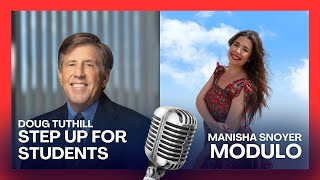
Conversation between Manisha Snoyer and Doug Tuthill about transitioning U.S. public education from a 19th/20th‑century industrial, one‑size‑fits‑all model to a decentralized, customizable 'third era'. Tuthill explains his path from teacher and union leader to chief vision officer at Step Up for Students (which grew from ~9,000 to ~500,000 students), describes how education savings and choice create market incentives for innovation, and discusses equity, teacher unions, accountability, assessment, and practical supports (choice navigators, information infrastructure, ESAs).
Chapters
A lot of teachers I worked with over the years had a lot of passion, and oftentimes they were frustrated because they couldn't act on that full passion. The way the world is changing in public education, increasingly you're going to be able to act on that.
Hi, everyone. I'm Manisha, the founder of Modulo. And I am just so honored and thrilled to have a guest I've been wanting to share with you so for a long time. This is Doug Tuthill, the chief vision officer of Step up for Students, the nation's most impactful scholarship organization in Florida, serving over 500,000 families. Doug began his career as a classroom teacher and union leader where his passion for addressing inequity in education was born. And as a former president of Step up for Students, he helped grow the organization. President from serving just 9,000 students to over 500,000 today. Doug has a master's in education and he has served on numerous boards addressing systemic inequities in education. He is reimagining how public education can be customized to meet the needs of every child. And we are just so grateful for your work and so excited to have you here today. Doug, thank you so much for being here.
Well, it's my pleasure. I'm excited for our conversation.
Yay. All right, Doug, so I just wanted to kind of kick this off with a little bit about your background. You've had such an impact, although I don't know if everyone has heard of you. You've had just a fascinating career in education. What first inspired you to get into this field, and how did you end up leading Step up for Students?
Well, I'm old, and so I grew up in a time of Jim Crow in, in St. Petersburg, Florida. And the racial segregation I saw as a kid growing up sort of radicalized me around the issue of inequality and the desire to create equality of opportunity. And so I looked around and said, I think education is the way to try to level the playing field. And so literally, pretty young as a high school student and then in college, I was really committed to looking at education as a vehicle through which to address all the inequalities and. And just horrific conditions I saw growing up. And that was caused by. By Jim Crow and racial segregation. So I also was raised in a family. My dad was a firefighter, and he was a firefighter union. My mom was a worked in a factory working on NASA stuff, but she was a member of the United Auto Workers. And so I was raised in, you know, sort of in a working class environment and Two parents who are members of unions. And early on in college, actually, I got involved in unionizing the graduate students at the University of Florida and around the state. So as a very young person, I was really lucky to have a deep involvement in teacher unionism in the United States. Both there's two major unions, the NEA and aft, and I was actually president of locals in both. But one of the things I Learned after about 15 years as a union leader is while I thought I could use the power of teacher unions to help create. Create greater equality of opportunity, I was actually doing the opposite. And I'll give you an example. It's common to be able to save the job of a bad teacher. I mean, it's really hard to fire a teacher. And so we would regularly save the jobs of teachers who are not that very. Not competent, really, to be honest with you. But when you put that teacher back in the classroom, you don't put that teacher in front of the kids whose parents are the mayor or the head of the editorial board of the paper or business leaders. You put that teacher in front of kids whose parents have no power. And so, ironically enough, those are the kids who probably need the very best teachers and ended up with the teachers that nobody else wanted. And so I find myself, as a teacher union leader, actually exacerbating inequality as opposed to trying to address it. And as a union leader, I tried a lot of things to give power to people that didn't have power in the system, and it just didn't work. I mean, you heard the phrase every education decision is a political decision and are driven by political power. And, you know, the most valuable asset a district has is quality of teaching. And the example I just gave shows that that asset tends to be distributed politically, and it disadvantages kids who need that resource the most. And so I thought for a while, how do I level the playing field from a power perspective? I said, you know, money is powerful. Maybe the way to do it is you give families control their public education dollars. They now have power, and the system will respond to that. And so I hooked up with a guy in Tampa named John Curtley, who had started a small startup nonprofit looking at tax credit scholarships. And John and I started working together, and I became president in 2008. And like you said then, we had about 9,000 kids that we were serving, and we just grew it. And what I had anticipated happening actually has happened, which is with these families having power, the system responds to that. And you're seeing in Florida right now, with 500,000 kids on scholarship, spending over $3 billion a year. You're seeing this virtuous cycle in the public education market. A lot of teachers are starting a lot of innovative education opportunities. Micro schools, hybrid schools, interesting virtual programs. And so you're seeing an expansion of innovation on the supply side, which actually has caused even more families to come in and get scholarships so they can access these innovations. Then as more families come in on the demand side, you get even more supply coming in, more innovative supply. So it's that virtuous cycle between supply and demand that we've reached in Florida. Now there's challenges that come along with that. You know, you have 500,000 kids all making purchases. You want to make sure all the purchases are appropriate. It's all about customization. And the reason we have a one size fits all industrial model is because it's scalable. But today the question is, can we go to a system that really honors the unique needs of each child and scale that up? And that's really the challenge that we're working on right now.
Incredible. I mean, there are just so many things you said that I want to explore deeper. And as someone, I think, I mean, I grew up in Ithaca, New York. There were a lot of progressive movements that were born there. And now I have been focused on homeschooling for the last 10 years. And I still feel a certain level of discomfort around some of these market driven models which I'm trying to reconcile myself. So perhaps maybe we could address. Just start with a small piece of it, a small, huge piece of it, which is the teacher unions. I mean, you were really going to bat for these teacher unions and found you ended up doing more harm than good. Do you think that teacher unions serve a purpose in helping to improve public education? Would you abandon them altogether or would you change how these teacher unions work?
Well, as you might imagine, this is something I've spent an enormous amount of time thinking about and working on. And when I was very active in a union movement, I led a movement within the NEA called the New Unionism. And I argued for a way to reconceptualize teacher unionisms that would be more addressed to the kind of challenges kids in public education system would face in the 21st century. I even had a friend of mine, a guy named Bob Chase, who got elected president of the NEA on a, on a new unionism model. But basically it all just petered out. Here's the basic challenge. I was actually started organizing teacher unions in the, in the late 70s and was actually union president in 1978, which again an example of how old I am. But back then when we started organizing unions, we looked around and said a school district and even a higher ed institution looks a lot like a huge industrial factory. And so we looked around for what's the union model that best fits large industrial centralized organizations, whether it's steel workers unions or auto worker unions, et cetera. And we basically said it's an industrial model that we need to use because I said school districts look a lot like automobile factories and steel factories in terms of how they're organized and how they're managed, very top down, command and control. And so that was the model that we adopted when we started organizing teacher unions. Well, the world has changed. And so when I talk about customization, it's all about decentralization, flexibility and sort of this one size fits all model of schooling and the one size fits all model of unionism which accompanies that is all sort of breaking down. Unfortunately, the unions right now aren't able right now to sit back and look at their business model and rethink. Reminds me sort of like the newspapers in the 80s where they said things aren't going to change, I'm going to be fine. And they made some really bad decisions, which is why a lot of the newspapers are gone now and they're all struggling at some level, except for a handful of the big ones. And so I think eventually there's going to come a day of reckoning for the teaching unions where as public education transitions from this one size fits all assembly line model to a much more decentralized model that's all about customization. I think the unions are going to have to eventually rethink their business model. It'll just take a while for them to have go through the same experience the newspapers went through, which is, you know, lose membership, lose financial power to eventually they have to sit down and rethink things. I wish it was sooner rather than later. I do think there's a role for organized teachers to help us in what I call the third way, third era of public education that we're transitioning into now. I think there's a role for them, but only if they change their business model. If they keep advocating a one size fits all, top down command and control model of unionism and advocate for that same kind of model of public education because their model fits that, they're going to increasingly become sort of, I don't know what the word is, maybe obsolete and actually doing more harm than good. In many ways right now, while I think they're all good people, they're well intentioned, they actually do well, are doing more harm than good right now.
I do want to ask you a little bit more about how you reimagine teacher unions in the future. But first, you did mention that you recently published fascinating article entitled the Third Era of Education about how public education is transitioning to this more personalized, market driven model that empowers families with greater choice and flexibility. For listeners who might be unfamiliar with this idea, could you explain what this shift means for families and educators?
Yeah, my basic idea is I did sort of a historical overview, a historical narrative. And public education has always served the needs of the larger society. And when the larger society changes and its needs changes, obviously public education needs to change also. And so when the country was first founded all the way through into the early 1800s, we were very a rural agrarian country. In 1800, about 90% of all the people lived in farms in rural areas. As a result, public education was very decentralized. Actually, most of the public education back then happened through the US Postal Service. The postal service would deliver magazines, books, reading materials, Bibles. And a lot of their education back then was very religiously oriented because people wanted to be literate to read the Bible. A lot of it, like homeschooling, to be honest with you, in homeschool co ops, kids were able to go to school when their chores would allow it. And so that was really what the system was, very decentralized and very religious based and basic literacy basis. So in order for people to be able to read the Bible, well then you go into the 1800s, you start to see the industrial revolution, transformations in communication, transformations in transportation, rail systems are developed, telegraph systems are developed, and you start to see a huge in country migration from rural areas to the urban areas. So I mentioned that about 90% of the US population in 1800 lived in farms. By 1900 it was less than 40, like 38%. So in 100 years, well over half the population moved from rural areas into urban areas. In addition, there was a huge influx of immigrants into the country in the early to mid-1800s. I think in the paper I mentioned, there was a 600% increase in migration over about 20 years leading into 1850. And that led to the educators in the urban area saying, we got a problem. We've got to assimilate all of these immigrants into our country. A lot of the immigrants were Catholic. Most of the country was run by Protestants. The Protestants, Catholic conflict was Real. And so you had people like Horace Mann in Massachusetts, who created the first mandatory school attendance law in 1852. And the purpose of this law was to help, you know, Catholic children learn how to become good Protestants. To be honest with you, there were other reasons that they were dealing with, but that was a major part of, part of it. And so now suddenly other states started also creating mandatory school attendance laws. And now the one room schoolhouse model, the decentralized model back then wasn't working. And they looked around and said, how do we scale up? How do we process? You know, now hundreds of thousands, if not millions of kids through a public education system where we never done it before. They looked around and said, who's processing large numbers of things? And you saw a whole industrial revolution going on in the late 1800s, early 1900s. Henry Ford comes out with the assembly line. He's able to create mass produced Model T Fords. All kinds of other mass production was happening in industry. And so educators said, look, that seems might be the model. We're not going to mass produce cars, but we're going to mass produce kids. And so the one schoolhouse became these large larger institutions and they basically created assembly line. In 1800, there wasn't first grade, second grade, third grade, fourth grade. That came as a part basically of an assembly line kind of concept. So kids in first grade, you know, you pour it in second grade, you pour it in third grade, you pour it in and they come out, they're supposed to be educated. So that was again, public education shifted as a larger society shifted. Well now as you move into the 21st century, you have the Internet, you have all kinds of things, digital communications, mobile communication. All aspects of our lives are being decentralized. And a lot of it's about customization. When I was a kid growing up in the 60s, there was, in early 70s, there were only three or four television stations for us to watch. Now there's a lot more.
Information is at our fingertips.
Information is everywhere. And so now public education is in a situation where customization is now normative. Decentralization of decision making is much more normative. So public education is having to adjust. And so that's when I talk about the third era. The first era being very much agrarian and agricultural, the second being much more industrialization. And now we're sort of going into a post industrial era in which information is ubiquitous, it's much more decentralized. People have power at their fingertips in ways they didn't have before. Customization is now normative. You can go Online and customize a car, and a truck dries up out front a month later, and they deliver a car that's been customized to your needs. And so now public education has to adjust. So I talk about the third era. This is the new era that we're in with Internet and with mobile computing, et cetera. And now public education is having to adjust to that, which is traumatic because I also talk in that paper how difficult. I talk about paradigm shifts. And this is really a paradigm shift. And the word is used inappropriate a lot. But paradigm shifts are big deals. They're huge transformations. They're oftentimes resisted by the status quo because there's so much change that's involved. And so what we're going through now is a very traumatic transformation in public education as we shift the paradigm and move into the third era. And that's basically what the paper is about that you mentioned.
It's extraordinary. So people who criticize school choice, and I have this concern as well, is that it often favors wealthier families. I mean, how do you respond to these concerns? And what is Step up doing in particular to ensure that educational choice remains something that promotes equity and benefits underserved families? And maybe what are some of the challenges in making sure that happens?
Well, obviously there's huge inequalities with the current system.
Then that must be pointed out, first of all.
Yeah, yeah. I mean, if you can afford a $2 million house in a particular neighborhood, and over in Tampa, you have our own little private. It's a public school, but it's basically made up of people who can afford $2 million houses on David's island in Tampa. So there's tremendous. And of course, I grew up in segregated schools, which also was against the law for me to attend the school with the black children until my junior year in high school. So the current system has historically also been generating tremendous amount of inequalities. So I started earlier talking about power. I mentioned every education decision is a political decision. And people who come into the current system without any political power tremendously disadvantaged. So one of the ways we're trying to level the playing field is, is giving all families, but particularly low income families, control their public education dollars. I think that's a critical change in the political dynamics. And you can see that happening in Florida. You can see the change in the politics in Florida as these families now have power. They're voting, advocating for their kids. It's changing the politics in Florida. It's changing the politics in public education. You're seeing school Districts, for example, being much more responsive to low income families in ways they haven't had before. So you're seeing a lot of change because people who historically haven't had power now have 8,000, $10,000 of public education dollars. And the system is responding to that. The other thing that's really critical as it relates to choice is information. We all know about sort of the research that says if you're giving more than six or seven choices, you sort of shut down because you don't have time to do the research, you don't make good choices. Well, now you have hundreds of thousands of choices between online courses. In Florida, there's just an explosion of options.
There's so many resources. It's unbelievable.
Unbelievable. So what we have to do is build an information infrastructure that helps people say, this is my child, this is the needs of my child, this is where I live. How can I access the most appropriate resources for my child given where my child is at this moment? So I think you're going to see a huge investment in information infrastructure. In Florida we have something called choice navigators that are available to families. Other states also are looking at having, you know, choice navigators, education advisors that are available. I think artificial intelligence machine learning is going to be a huge equity boost because families will be able to use those tools to get access to information they need to match their child with the education environment that best meets their needs. So really we're giving power to people, using information, using money, using other kinds of support systems. That's a huge part of what we're working on now is building the infrastructure to support the kind of customization that is necessary and that is equitable. Make sure that everybody has equitable access to that customization.
Yes, for sure. And as you know, at modulo, we're building a platform that can help families explore and navigate their educational experiences. I'd be curious. I mean, we did talk about this a little bit it on our previous call. But you know, what would you imagine would be features or services that would make a platform like ours most valuable to families?
I think it's a combination of it and humans. So obviously, I think the revolution in artificial intelligence and machine learning is such that in a lot of instances that software will be sufficient to provide consulting help for families to help them figure out what exactly is the best fit for my child in terms of schools, tutors, homeschooling, et cetera. That software will be able to help. But in many instances they're also going to need humans that also can be trained to sit down with families and help them make those decisions. I also think there's a huge social networking effect. In Florida, for example, we have Facebook groups with, you know, 20, 25,000 families in them, and they're really robust in terms of sharing information. Now, not all that information is always accurate, as you might imagine. There's a lot of misinformation in social media. But again, that's also another network that families are using. I can see us developing Yelp type of activities where families are evaluating how their child, what kind of experiences their child had with a particular tutorial or, you know, physical therapist or school or hybrid school, micro school, etc. And providing that aggregated data in order to help families make decisions. So I think the work that you're doing ought to involve a whole continuum of support systems. And again, it has to be customized. Some families will be fine just with an AI assistant. Some will need some human interaction. Some will be very interested in interacting with other parents. I think the more you can create a continuum of options for families and allow them to customize the kind of support systems they need and help them with that customization process, I think that's where everything is going.
Wonderful. And just to kind of return to the equity question, I work with so many amazing families who have chosen this homeschooling route because they're deeply passionate about their child's education and they have the resources or they create the resources to make that education really amazing. You know, ranging from single moms who are on welfare or people who one parent quits a job, or sometimes they even move to, you know, Mexico so that they can afford homeschooling. There's one single mom who went and worked on this farm in Guatemala with her kids so her kids could learn Spanish. It was a volunteer organization to protect, you know, the environment. And so parents are doing incredible things. But because I have been a teacher in the public education system and private education system system, it's not wealth related. And because I know other leaders in this space, I do know that that's not the situation for every child and that there are children who are not learning to read, who are not learning to write, who are badly neglected. I don't know the breakdown. I think overall, you know, people who choose to homeschool are putting more energy into their children's education. But my perspective is that our society does have some duty to provide education to every child. And I wonder, in a school choice system, how do you ensure that, you know, I guess for back of a Letter, better phrase, no child does get left behind, right?
And obviously a lot of kids are being left behind today. And so the question is, in a world of customization, part of the theory is that if the educational resources are able to be flexible enough to meet the needs of each kid, that's, that's an important improvement. You and I both taught, if you have a class with 35 kids, you aim for the middle and you lose some at the top and you lose them at the bottom. But that's kind of the, you know, the best you can do. And, you know, and, and the bell rings and those 35 leave, and then another 35 come in and you shoot for the middle again. And so, you know, that works for some kids, particularly those kids have a lot of social capital at home. And you, you kind of alluded to that. If one of the greatest sources of inequality today is the spending that's happening on out of school learning, families that have resources are able to spend money on violin lessons or sports programs or all kinds of after school and summer learning opportunities. And a lot of low income families don't have those activities, those opportunities. So all that together says, okay, how do we build a public education infrastructure? And by the way, in my mind, whether it's homeschooling, whether it's private schooling, whether it's charter schools, whether it's a district school, whatever it is, it's all part of public education. I mean, all those options allow you to satisfy a state's mandatory school attendance law. Those laws are designed to serve the, the public good. So the question is, how do we take all of these assets that are out there on this, on the supply side, and how do we manage that in ways that families can access those programs, those individual educators that they need to best meet their child's needs? And so I think in many ways, the one size fits all system, which, like I said earlier, I understand where that came from, given the rapid growth in urbanization in the 1800s, is no longer capable of delivering equality of opportunity. And so really what we're talking about is how do we make sure that families have all the information they need, the resources they need, and the support they need to make to make good decisions. Obviously, public education is a private good, but it's also a public good. And so you want to make sure that in this process that you serve the public good as well as helping families meet their child's individual needs. And again, that all goes back to the infrastructure we're building now. And really, we are literally building A new infrastructure for public education. And again, the goal is that if we're more focused and more able to meet the unique needs of each child, it increases the probability that we're going to create more equality of opportunity. We're early in the process. I send the paper that you mentioned, too. We're probably 50 years into this transition to the third era of public education. We probably have at least another 50 years to go. These kind of transformations are massive and disruptive and challenging, but we're not going to go back. The Internet's not going away. Digital computing is not going away. It's here. I know people are hanging on to 1950s education, saying, no, that's what public education is. It's the 1950s. No, it's not. We just can't go back. The question is, can we go forward in a way that serves the larger public good and does in a way that creates greater equality of opportunity and also greater excellence in education?
Yeah. And I think that some people are also just holding onto the ideal of what education was for them, you know, particularly if they went to a public school in a more affluent area and they remember good times they had with their friends. It, you know, So I ran school closures.org, which was the largest relief effort for families during the pandemic. And that was about five years into my rosy homeschooling adventures. And the biggest immediate discovery for me was how direly students depend on school for social services like meals and childcare. And, you know, we were just in our own budget, kind of ordering takeout and sending it to families because they didn't, they couldn't. And that's where their kids ate. And I, and I know Pandera Bread did a really wonderful effort to try to get some support for their families. But, you know, as we rethink every aspect of education, I mean, I know that a lot of schools with good reason feel like, you know, we're asking too much of school to be the food, to be the social emotional support, to be the welfare support. I mean, I've, you know, had mothers show up beaten and, you know, what do you do? Get them into a better women's resource center. So I'm curious, you know, how do you see, with a diverse educational model, how do you see us restructuring, feeding children, for example, or.
Yeah, I've written. Yeah, I've written some. I've written some about this. I wrote a piece talking about the transition from school districts to education districts. And the idea was that districts need to reconceptualize themselves also, as we move from sort of the late 1800s, early 1900s industrial model of education to one that's much more flexible and much more decentralized and much more organized around customization, I do think how we think about our physical infrastructure, how do we manage all that? That all has to be, you know, part of. Part of the mix. I mean, there's a lot of conversation to be had because you're literally. My best example is think of a paradigm. Think of a paradigm as the picture in the front of a jigsaw puzzle box. And imagine you've been working on that puzzle for decades. It's a very complex puzzle. And now suddenly people come around saying, you know what? I think the picture on the front of the box isn't the best fit for all the pieces that we're trying to put together. I think there's a picture on the front of the box that would be a better fit. Well, imagine how disruptive it is when you change that picture on the front of the box. I mean, and that's sort of what a paradigm shift is. It's very disruptive. And everything you've done in the past has to be reconceptualized. And so that's what we're going through right now is beginning to reconceptualize things. All the questions you're asking are exactly the right questions. No one is trying to disadvantage families. We're trying to do the opposite. We're trying to maximize our human capital, which is, families have wisdom about their children, we need to maximize that. Teachers have wisdom about kids, we need to maximize that. And I think a traditional sort of Henry Ford model of industrial education doesn't utilize our human capital in the way that we should. And so that's really what this is all about. But it does require an enormous amount of change, and it is disruptive, and a lot of people are going to be resistant. One of the examples I use in the paper you mentioned is Albert Einstein's general theory of relativity was a major paradigm shift in physics. It took over 40 years for the entire physics community to ultimately accept his new paradigm for physics. And in fact, Einstein never won a Nobel prize because the physicists at the time were threatened by his general theory of relativity. There's examples like that all over the place. So I'm not surprised that people are resisting changes, because that's normal. And in many ways, that resistance to change is healthy because it forces us to make sure the changes that we make are actually really great improvements. And not just small changes, but significant improvements. So I'm not whether it's teacher unions leaders or blue state progressives who are really married to a 1950s model of public education, in their mind, I'm not offended by that because it really forces us who are advocating for a 21st century model of public education. It forces us to answer all the questions that have to be answered. What's physical infrastructure look like in a more decentralized, customized system? What's transportation like? How do people get funded? What about after school programs, childcare programs? You just don't change 150 years of an institution, you know, overnight. It takes a lot of time, it takes a lot of patience. And that's what we're working on right now.
Amazing. I mean that, that's so helpful to hear. And you know where I, what I always tell parents is that the bottom line is, you know, if you care about public education, that shouldn't impact the choice you make for your own child. You know, you shouldn't sacrifice the well being of your child because you have this idealistic goal that you might be hurting public school by withdrawing your child. Withdraw your child and find other ways that you can by maybe tutoring a kid at the library or getting involved in equitable school choice. I mean, there are other ways to make an impact. But I think in some ways the best way to be a futurist is really just to meet the present moment. You know, what's the best education for kids right now? And how can we ensure that everyone has access to it and their other needs are met too?
And that's why I mentioned earlier that in my concept of public education, it's very pluralistic and it's very inclusive. And so we're basically expanding the definition of public education to include all these innovative options. Whether it's micro schools, whether it's hybrid programs, whether it's homeschooling, homeschool co ops, all the innovation that's happening is all part of a 21st century public education system. So I think that's an important point to make. The other thing that's really interesting, I'll break a little bit of news here on your podcast. We have, we're having great talks with school districts in Florida who are looking at how do they begin to restructure themselves in ways that allow them to serve kids using education savings accounts. We haven't talked too much about that, but that's really, you know, flexible spending accounts that are public, that are public dollars that families can use to buy all These various products and services in order to be able to customize their children, their children's education. So we're having great convers and we'll. School districts are thinking about how do we unbundle our services in order to be able to provide services to these families and maybe homeschool families for 75% of the day, but for 25% of the week, let's say that they want to be, they want to take a couple public school classes, they want to take a charter school class or we have. This is true all over the country when population shifts in neighborhoods. Oftentimes you have under enrolled schools and it's very difficult financially to maintain the school, it's only half full. Well, in Florida we're talking about if a school is half full, if a district school is half full, why not take these 50 seats and lease them out to homeschool co ops or to private schools, or to micro schools, et cetera. It's a win win situation. And so interesting enough, school board members in Florida who are tired of getting beat up about these conversations and having to close neighborhood schools are excited about the opportunity to monetize those seats by bringing in micro schools and hybrid programs. And once those programs are in their schools, a lot of times as families will say, you know what, I like the rest of the school, I'm happy with my micro program, but maybe I also want to take some more courses from the regular district school. So it becomes a win win opportunity. So that's the kind of, that's the kind of shift in thinking once it becomes, oh my God, you know, I need to protect my market share. And you shift to, oh my goodness, how do I help kids? And how do I deal with this changing environment, with this new paradigm, with this third era of public education? This changes people's ways of thinking. And so I think you're going to see that, I mean, lard is obviously on the cutting edge with 500,000 kids with essays. I mean, we serve three out of every four kids in the country. So that's why you're seeing, I think, public schools, you know, in school districts moving more rapidly than other places. But eventually, even in places like California, New York, et cetera, you're going to find even in those places which are very conservative actually when it comes to understanding public education, I think eventually you'll see them embracing the 21st century and embracing customization and understanding that, you know, families need the flexibility to customize an education that best meets the needs of each child.
That is so Incredibly exciting. I mean, I actually just kind of announced this tutoring program we've been working on for five years, and we've gotten really good unit economics in terms of hiring young tutors and training them and pairing them with adaptive learning apps. And I've been thinking about this idea of how can we help public schools make their education more modular and what the power that they have is this massive network. So most ed tech companies, if you want to build a successful ed tech company, you take your software and you sell it to school districts. And the idea that you could sell modular learning to a school district or school and allow them to make income and bring money back to the school through a partnership is just so exciting. I mean, there's just so much potential there.
Yeah. And I think it's starting to see, at least in Florida, sort of the education wars are kind of over. School districts aren't, you know, saying, you know, I'm going to stick to the 1950s model or the 1980s model. I mean, they are, I think, saying, okay, this is the future. How do we take our assets and maximize the qualities, assets that we have to help all kids? It's a beautiful thing to see. We're having great conversations. Obviously, I'm a longtime teacher, union leader, so I'm very appreciative and fond of the teachers in schools and district schools and school districts and the work they do. I believe in them, and there's a role for them in the 21st century, and we're helping them in Florida, at least find that, find that role. I think it'll be evolving over time as we'll all sort of feel our way through the future. But I'm really excited with the attitude of people saying, okay, instead of spending assets and resources fighting, let's spend assets and resources helping all kids. It's a beautiful change in thinking, and I hope eventually, again, it spreads around the country and other school districts. Join with everybody in your community and take a similar approach.
Wow. All right, Doug, I'm asking you all of my hardest questions, and you are handling them with such ease and grace. I mean, the depth of your knowledge and the depth of your thought on this topic is really extraordinary. I mean, this is one that I really lose sleep over, is the challenge families face in balancing their work, their child care, and their educational choice. You know, I mean, there is the option to send your child to a micro school, although, you know, and there are many wonderful micro schools. But in a way, it's like, okay, this is also a standard school schedule. I'm curious, like how you're seeing families balance child care and education and if there are any kind of innovative solutions that are cropping up that you might want to share.
Well, I know this is going to sound strange for a lifelong Democrat and former teacher union leader, but I may be the, there may be only three or four Democrats in the country who think like this, but I, I do believe that well regulated, well managed markets have a magical power to them. Because I've seen it, I've just seen it, you know, I mean, I. Sometimes you got to put ideology and tribalism aside and just deal with reality. It's in right in your face. And so there's so many amazing educators out there and people who care about kids, people like yourself, you know, who are, who are, you know, really smart and really motivated and creative and are going to generate solutions. So sometimes you just have to give people the space and the support and let them see your problem and they'll solve it. You don't need to have every, every problem doesn't have to be solved by Congress. Beautiful.
And so, and it should, it won't be sitting around for a long time. I mean that's like, I really want to kind of zone in on this word, well regulated markets though. You know what I've observed, there's this kind of spectrum where you look at the top, you know, six to ten billion dollar education companies and in my perspective they're pretty standardized. I mean, I don't want to call out names, but even some of the top apps, I mean it's a good app, it's a useful app, but I wouldn't say it's the most exciting dynamic app. And then in the other era you do have these kind of hundred million dollar charter schools and then, but then you also have some kind of cool companies in the middle and then some of them, you know, kind of can get crushed by the larger players, in my opinion. So when you use this word well regulated, could you share kind of some of the tenets of a well regulated market? How would you.
First of all, you want to, you know, you want to make sure that the consumers in this market, and particularly the public education market have access to resources. So if low income families who, who 10 years ago had no control to public education dollars, now we're controlling 8 to $10,000 of their public education dollars. That's a huge change that changes the market because now suddenly people who are on the supply side need to think about those families. A lot of the big tech companies, the Reason they're so conservative is they sell primarily the school districts because that's where all the money is. But what happens when that money increasing is in the hands of families? So that changes your business model, because now a lot of that money, and there's over $3 billion in Florida now controlled by over 500,000 families. Think of the business opportunities that provides for child care, after school programs, tutoring programs, various IT support systems, you know, and in a couple years, it's now 4 billion or 5 billion. That's where the market starts to. That's where the supply side of the market starts to change. If families don't control their public education dollars, all those dollars are controlled by school districts. You're going to develop software solutions and other kinds of solutions for the school districts. You're not going to worry about the families. But now if the families suddenly have control of those funds, it changes the whole dynamic of the market. So when I talk about a regulated market versus making sure that consumers have the resources they need to get the attention on the supply side, you also have the information issue. You want to make sure that people have access to the information and make good choices. Because when families make good choices, that's a signal to the supply side about what they're looking for. And so you want to make sure that they have the information to make really good choices. That also includes good information about how their child is performing. You know, the whole accountability issue historically has been focused on schools, but how do you hold a school accountable for a student when that school, when that student is attending three or four different institutions at the same time? So now maybe accountability switches from schools to individual kids and we start looking at each individual kid's progress and, and then think about, you know, is that child making adequate progress? And how do we ensure that child's making adequate, and what do we do when that child's not making adequate progress? Again, it's in the, in that paper that you saw that we could do.
A whole other interview on this topic of how to evaluate outcomes and.
Right, right, right.
That's incredible. I mean, I just have to ask you, what are people buying? I mean, in a way, you've kind of made, you have this, this fundamental trust that underlies everything, that parents are going to be making the best choices. And by the way, I would love to see some of this money going directly to kids, like for teens to be making some of their educational choices. I think that could start creating some really awesome products. But, yeah, so, so what are people buying? I Mean, how are they, how do you find that people are spending their money that they're getting from the.
It's all, they're all over the place. And again, one of the challenges we.
Have is, is it just trips to Disney? Are they making good choices? I mean, let's, I really envelope.
That's a, that's a wonderful example. So Busch Gardens is over in Tampa.
Okay.
And Busch Gardens is a theme park and has some of the coolest roller coasters in the country. Every, every year they have physics days where kids come, district schools, homeschool. They come to Busch Gardens to work with the engineers on the, on the roller coasters because you want to learn physics. Is there a better place to learn physics than working with the engineers on these roller coasters? Talk about G forces and the safety of those roller coasters, etc. But, but you know, the media says, oh my God, you're allowing people to go to theme parks. Yes, we are, but it's the most amazing learning experience that you can imagine. We have a big SeaWorld theme park here in Florida full of marine biologists go to the, you know, so when we approve somebody to go to a theme park, it's an educational experience, whether it's working with engineers on, on a roller coaster, learning physics, whether it's working with marine biologists at, at SeaWorld. Disney has an entire section called Animal Kingdom full of zoologists. You can go to Disney and, and have an extraordinarily interesting day talking to the zoologist about some of the things that they, they, they do, you know, as part of Animal Kingdom. So ironically enough, one of the challenges that people don't get past, oh, that's a theme park. They don't realize that these theme parks have very robust education programs. And we just don't send kids to theme parks to play.
Of course. And people are looking for reasons to not trust parents to undermine the program. I mean, I mean, this program has been around for 14 years though. I mean, and I know that evaluating outcomes is so complex, but are there people looking at the outcomes of Step up for students when parents are given that level of choice and kind of.
Yeah, they're required to be tested every year. And so every child who gets funded in Florida to step up for students has to take a nationally norm standardized test. And those tests results are shared with the families. And also they're aggregated at the school level. And schools with enough kids have to report their test results because families can see that when they make choices. Now having said that, I think those are really very primitive tools, to be honest with you, because as a parent, you're interested in your kids reading, writing, math, but you're also interested in a whole bunch of other things. How well they get along with other kids, what kind of empathy skills do they have, what kind of relationship management skills do they have? What kind of careers do they end up with? Because, I mean, I've hired a lot of people in my life and I can tell you there are things I look at when I hire people that aren't tested by standardized tests. How well do they get along with other people? You know, their ability to empathize with other people, you know, in work environments, their self management skills, their time management skills. There's a lot of things you look at in human development besides a score and a standardized test. So one of the things I hope happens as we move into the future is that we create much more robust assessments of human development in ways that are going to help families, educators, and their kids assess. What am I working on? What do I need to work on? And how do I use the flexibility that I now have with educational savings accounts, with my public education dollars, Can I use that flexibility to help address my holistic development? Just not my reading writing, which is important, but again, my time management skills, my internal motivation, my grit, my stick to itness, my determination, my ability to get along with others, my empathy skills, all the things that as a employer, I'm looking for in employees.
And there's so much software that helps you measure that in a big company. Yeah, there's no reason that we shouldn't be able to develop those kind of tools for kids.
Yeah, we need to move, we need to move towards more, you know, portfolio assessment's not a new idea. It's been around forever. But we need to really look at more robust assessment tools that gives families more feedback, gives kids more feedback, and gives the educators and other providers that are working with more feedback on how to develop that child holistically and just not in a very narrow way that's measured by paper and pencil. Standardized tests?
Yeah. Yeah. I mean, I'd really be curious to kind of see data on outcomes of Step up for students. You know, what, what would you say? Like, let's, let's talk about a parent who's considering Step up for students. Maybe like listening to the show, thinking about getting started. I mean, you have such a large overview of the program. What, what, what advice would you give to a new parent starting out? And maybe what are some pitfalls to avoid in your Opinion?
Well, the first thing you need to do is take a look at your own child and figure out, am I happy with what's happening right now in my child's education? Is my child happy? I mean, is my child getting up in the morning and enthusiastic about going to school? Is my child enthusiastic about learning? Is my child getting along well with other kids at school? What kind of feedback am I getting from the teachers at the school? How's my child doing in after school activities? Is my child getting along well with kids in the neighborhood? And other after school programs and things like, so really you start with your own child and assess where is my child today? And if there are things you're unhappy about, then you need to look at what are the opportunities to address the things that I'm unhappy about. So my child is crying every morning, refusing to go to school. That could be a situation, you know, maybe, maybe your child's being bullied, maybe, you know, etc. In that case you look around and say, okay, you know, there's a small private school down the street. Down, down the street. It only has, you know, 45 kids in it. I think my child is overwhelmed by the larger school at that point. I may not be able to afford that private school tuition. Now I need to look at Step up in Florida at least and see, can I get a scholarship and we'll call them education savings accounts. And maybe with an $8,000 ESA, I can afford that private school down the street. And then never, and then never stop doing that process of assessing how your child is doing. Because children go through different phases and they may be really happy at that private school for a couple years and then suddenly they're anxious for a larger environment. So maybe moving back to your neighborhood school, maybe moving to a charter school, or maybe there's another private school that's a better fit. Or maybe you're a family that has certain values that are really important and you want to find you're worried about your child hanging out with kids who do have different values that you're concerned about. Maybe it's a middle school kid who's being exposed to drugs or maybe, you know, sexual conversations that you're uncomfortable with. You may need to change that environment and maybe you end up in a, in another school and you need a scholarship because it's a, it's a non district school. And, and again, that would be an instance where you would use a scholarship to put a child in a different school. The number one reason families come to step up is safety And I just, I just don't mean physical safety, which is obviously important, but also emotional, psychological safety. When your child doesn't feel safe, that's your number one priority as a parent. First, your child has to feel safe. If your child doesn't feel safe, they aren't going to learn, they aren't going to be happy. So that's the number one reason that families make the choices they make based on our polling data. The second is values. You want your child to be safe, but you also want your child to be a person of ethical integrity that has a certain moral stance that's important for you. And so that's another reason that's the second reason. Now, families are also concerned about academics, but frankly, if your child's not safe, nothing else matters. If your child's ethical and moral framework is breaking down, you got to deal with that too. So those are the kind of things that families look at. And they have to look at it for their own child and look at it continuously because kids go through phases and just because your kids grade in fifth grade, they get to middle school and the train goes off the track. So you're going to have to really pay attention all the way through, look at your options. And hopefully we at stepup will do a good job getting you access to a scholarship and also making sure you have access to information you need to make good choices for your child using that money. Well, for your child.
Yeah. And it seemed pretty easy to join. There's a phone number on the website and you can just call and get someone to help you determine what the right scholarship is for your child.
Yeah, and we tried to make it pretty user friendly. And we're all, we're constantly trying to update our technology to make it very intuitive and very user friendly. The fact that we have over 500,000 families on scholarship means that it's probably somewhat intuitive. Otherwise over 500,000 people wouldn't have got through the system.
Right. I'm curious what your thoughts are on secularism and education and if you know the education. I mean, in France, this idea of laicite is really sacred to their public education system. And there's kind of a debate, you know, within the homeschooling community of funding materials that are secular versus non secular. And I just, I'd just be curious to hear your thoughts on the topic.
Well, I'm a big First Amendment guy. I really believe, I really believe in the First Amendment, which has two major wings of it as it relates to religion and education. One is the establishment clause. Which basically says government should not be coercing you in any way, shape or form as it relates to religion. And the second is the free exercise clause, which says that you have the freedom to make your own decisions about, about religion and they fit together. Because obviously if the government is coercing you, and we have a long history in this country of government coercing people in the area of religion. Like I mentioned before, the first mandatory school attendance law in 1852 in Massachusetts was, was driven in part by the need of Protestants to make sure that the Catholic immigrants turned into Protestants. And so that was clearly in my view, a violation of the establishment clause where government was trying to coerce people and using public education to do that. I remember as a kid in early elementary school having a Bible verse read in the morning, a King James version Bible verse read, you know, as part of, part of morning announcements, and you got a Bible verse and then you pledge the flag. Again, looking back on that, it seems to me that that was government, you know, tipping the scales in a way that's inappropriate. So the great thing about what we're doing in these, in our, in our choice programs is we're saying, look, you have a, you have a constitutional right to decide how you interact with religion. And the government has no ability, should not have any ability to influence that decision. Interestingly enough now, before we had these scholarships, if you went to a non religious district school, the government paid the entire cost. If you went to a Catholic school, you had to pay your own costs. Is that neutral? Of course not. If the government is saying you have to pay for religious school yourself, but if you go to a non religious school, we'll pay for it. It sounds to me like the government is tilting the scales. And so I believe that again in the First Amendment, which is, it's a freedom issue. And I might disagree with the decisions people make, but it's not my business. And the idea that, oh, I don't want my tax dollars being spent for giving people freedom of religion. Well, it's in the Constitution. And if you want to change that, you need to change the First Amendment to the U.S. constitution.
Yeah, I mean, it's definitely an issue that I lose sleep at night. I mean, there was a very large, not, I mean, I don't know, there was a considerably large Nazi homeschooling cult in Ohio. And I mean, I'm curious, like, let's say like Step, that was in Florida and Step up first people were paying to be part of that group through Step up for students Is that an acceptable use of state funds? Where do you draw the line? I mean, what about, you know, a religious school? And I'm asking these questions myself and I'm bringing, inviting you into my own process. You know, where a school says like being gay is morally wrong and you need to go through conversion therapy and public dollars are, you know, paying for that hurtful experience or there's a co op that, you know, denies black students entrance and public dollars are paying for that. Is, is there a line for what public dollars should be paying for? And, and with that said, I mean, I know just absolutely beautiful, wonderful Christian homeschool groups that are teaching about climate change and inclusivity too. But we also see, to see these trends alive and well.
Yeah, I mean, I think there's a lot of stereotypes and exaggeration about a lot of those issues because I visited a lot of schools and you know, sometimes you'll find one instance of somebody saying something stupid, in my view, inappropriate and suddenly that becomes the front page news and people assume that that refers to everybody. So you sort of have availability bias. My basic, I mean, I step up, we're obligated to follow the law. And so in Florida, for example, and it's just true, I think nationally there's, there's non discrimination laws that people have to follow. So if you, if you were to have a school and say we're not going to admit somebody because they're Muslim or because they're black or because they're fundamentally a fundamental Christian, you can't do that. It's against the law. And so, you know, we, we follow the law and, and so there are protective positions in the law and you can't, you can't discriminate against people who, based on the law that protects them.
And what are the, I mean, what are the basic vetting standards for educational materials or what do you think that they should be in terms of what, what can be?
There's sort of two levels. One is, I mean, a good example is, is it okay for a kid to go to a theme, to go to a physics day at Busch Gardens? I think there are two levels. One is there's state law that provides categories in which things are appropriate. Now those categories are broad, to be honest with you. And so part of the challenge that we have at Step up is sort of interpreting broad categories. The second thing I think is important, is this a legitimate educational activity and is it appropriate for a particular child? So for example, a big issue in Florida, at least in the media, is Kayaks So we've, we've allowed people to buy kayaks. So. Wow, they're just floating around in kayak, just having fun. No, that's not what happened. They would apparently say, my child is that. To me, my child is part of a marine biology program. And they're going out and testing water in the Gulf, which right now is a big deal after the hurricanes because our girls got a lot of pollution and sewage is terrible. Anyway, they're out testing the waters, you know, in the Gulf to see what the pollution levels are and how safe they are, et cetera. As part of a marine biology program. Am I going to approve that kayak for a high school? Absolutely. That's, that's a very legitimate exercise. And there are district schools that do something similar that they have kids going out because in Florida there's a lot of marine biology programs on the beaches and a lot of schools, you know, take advantage of that and they should. Now, would I approve a kayak for a, for a kindergarten child to do the same thing? Probably not, because it's not developmentally appropriate. It's not safe. So you have to look at is it legal under state law, which is very broad, but also is it an appropriate educational activity? And we require families to oftentimes give us an educational plan so we can see what you're planning to do with whether it's a theme park that you want to attend, whether it's a kayak, it's part of a biology program. You know, we ask for the details of that program and there's like somewhere.
This is all written down, or is it more on like a case by case basis or, you know, where is this, these kind of vetting standards articulated?
It's both. I mean, there's state law. We also have in state law something called purchasing guides, which provide more detail for families that say, okay, these are, you know, the purchasing guys. Try to get more specific, as specific as we can. But having said that, there's also a level of customization. And so our staff has to sit down and look at the educational plan that the family has, look at the individual child and all times make it, make a subjective decision. Now we have a lot of world class educators on our staff that help us with that. It's going to be an ongoing issue moving forward. But, but yeah, we, I mean there is some. But it's true, it's true in everything. I mean, district schools make subjective decisions about.
Absolutely.
They send kids to theme parks and they, they send kids out on the water on, on Boats that are paid for by public dollars. It's not a new thing. You know, we've been making these decisions forever, and it's more highlighted now because the families are involved in decision making process. But it's not like educators and parents haven't been making decisions about how to spend public education dollars. It's just now so interesting.
It just comes back to just this question of what is the fundamental nature of education and learning? You know, is it a tool to inspire, to prepare you for a future career, you know, develop? I mean, it's, it's really interesting. I think it's good for people listening to know, you know, the level of thought and care that's going into approving programs.
Yeah. Which is why I like doing podcasts like this. Because in, in the mainstream media, it's very hard to have a nuanced conversation.
Absolutely. And you are so. I feel like I keep, I keep interrupting you. I'm not.
I am.
I am. There's just so many little things you're saying that I want to know more about. But I, I think that, you know, we spend so much time in this field defending ourselves that we don't get a chance as much to like talk about this, you know, these thorough questions we're diving into. Because there's certainly families who would like just, I should be able to spend this money on whatever I want. I am unschooling and my kids should be able to learn whatever they want, and they're going to thrive by following their curiosity. And then there's, you know, the whole spectrum of they should only learn these certain standards. So it's fascinating.
Yeah. I mean, there's upsides and downsides to customization, obviously, and you know, particularly in a system that's been one size fits all for so long. But again, a lot of kids have been underserved by that. And so I think the more flexibility we have provided, it's well managed and well regulated, which is what we're trying to do. You want to have the pot, you want to try to maximize that customization, but do it within, within boundaries. And that's the, that's, that's what we're working on now.
And I guess that's where society comes in and deciding what are our values that we want to uphold in this education and system? The democratic values, the educational values. What, what keeps us together? What keeps us growing and strong? Who do we want to be and leave room for the freedom to grow?
We wouldn't have 500,000, over 500,000 kids in Florida using education savings accounts to get a customized education if a large percentage of the community wasn't happy with what they're seeing. And so I think, I think people are voting with their feet. And that, that goes a long way towards telling us if we're doing things right or wrong. Is, is you see, you see massive numbers of families coming into these programs and you're also seeing a ton of public school teachers starting their own, starting their own gigs, you know, starting their own schools, micro schools, et cetera. That by the way, is an undertold part of the story is the liberation and freedom that educators are experiencing, which is very exciting for me as a longtime advocate of teachers. It's very exciting to me to see the enthusiasm and just the. Well, you know yourself, it's your journey, right? Lots of people are taking your same journey and it's just exciting to see again with over $3 billion in the hands of the families, that's a lot of opportunities for educators to do their own thing. And it doesn't take more than 15 or 20 families for a teacher or two to be able to make a decent living and actually have the freedom to educate the way they've always wanted to do it. And that's a beautiful thing to see.
So, so much so. I mean, I think there's still this idea that the role of a teacher is to be like a copy editor or a behavior manager. And, and teachers, I mean people are people who come into that profession because they love children and they have so many interesting ideas about how to support children's development. To so to set that energy and care free is of course going to have just beautiful, outstanding results. And I think the teachers have a special ability to communicate that not a lot of others do. They have a specific weight. They tend to be very strong on executive functioning skills and organizing and just, you know, I've often thought in my public schools like, wow, if these people ran the world, it would just be a completely different situation because of that entrepreneurship and community building skills. Amazing. Oh my gosh, this is just incredible. And I, I'm. We're already over and I have a million more questions I want to ask you, but I think I'm going to ask you two more. Just first I just have one more political question which is that what I've observed is that school choice is perhaps one of the one areas where we've really moved beyond our two party system and are starting. I mean, I think climate is maybe another one, but especially school choice. There are very liberal Progressive people, extreme conservatives, and they're kind of forced to work together as Step up evolves. What are you thinking? What are some of the main arguments between progressives and conservatives in the new direction that it goes?
Well, I mean, part of it is tribalism. You know, we're all very tribal, particularly in our politics. And I think oftentimes, particularly people on the left, they're busy and they just sort of default to the tribal position. It's interesting, we've written a series of blog posts over several years under a category we call the voucher left. Now the word voucher is kind of an old word now, but there's a long history. There's a long history on the political left of educational freedom and education choice. The most famous, I guess, being that the freedom schools in the 60s where, you know, throughout the south in black communities, people started their own schools in order to educate kids because they weren't getting a good education in segregated public schools. But there's a long history of, of progressive people creating options that historically haven't been available in the traditional system. Certainly in the 60s when I was coming of age and in the early 70s, there was a ton of sort of left wing alternative schools. And part of the reason I was raised in a lot of stuff, when I went to college and got into graduate school, we read a lot about those alternative schools that were come out of the political left. And I was in Gainesville at the University of Florida. And there was a lot still in the community that had been created in the 60s where people were doing alternative education programs very child centered, really built on internal motivation. So I think it's just interesting that people don't know their own history because I think there's a strong case to be made on the political left for believing in people and investing in people and trusting people and supporting people to educate their kids. And there's a long history there that oftentimes people don't know. That's unfortunate. I also think that the business model of the teacher unions is problematic, as we talked about that before, because in many states the teacher unions are the primary foot soldiers the Democratic Party. And as long as the teacher union has an old sort of business model that comes out of steelworkers and an auto workers kind of unionism, and it doesn't have a 21st century Union model. It sort of drags the Democratic Party with them. Now in Florida, the American party has sort of been crushed because it's held on for so long to sort of these old concepts. And the union's been sort of is diminished, which is tragic from my perspective. I wish that the union would join the 21st century. And then I think, I wish the Democratic Party would, at least the remnants of it in Florida, for example, would, would embrace a more progressive approach to public education, which is what I think we're talking about. So I think it's all going to happen again. Paradigm shifts are difficult, but certainly in Florida, I think it wasn't that long ago where Florida was a purple state and now it's a deep red state. And I think part of that is because so many families are participating in education choice programs and the Democratic Party hasn't fully embraced it yet.
I think you really bring up a good point. And I mean, it's coming, it's here. People are already, you know, people like me are excited about it. I think that, you know, in Florida I've heard really interesting conversations. You know, when you do decide to embrace that third paradigm that's already here, I mean, you know, one of the micro schoolers I was talking about, she's having a conversation with someone who's very anti social emotional learning. And, and she says, well, you know, here's why we find benefits to social emotional learning in our school. And then this very right wing person, suddenly their mind is open up and they're listening because they're there together, face to face talking about school choice. So that, that kind of dialogue gives me the chills. Doug, you are just, I mean, you're, you're incredible. I think that, you know, Step up is the biggest program of this kind in the country. It's trailblazed the path for places like Arizona and Texas. I mean, id these programs are emerging everywhere in the new administration. We are going to see a lot more of this. And, and in many ways it's just completely inevitable. So I guess I'd love to end on a positive note and maybe if you could share for teacherpreneurs who are excited about building new things for the Step up students marketplace, what would you suggest? What's needed, what's valuable, or just anything else you'd like to add that we.
Haven'T touched upon, I would say follow your passion. I mean, that's true in anything in life. You know, to be good at something, you have to be passionate about it because you really have to dive in and put your, put everything into it. And so a lot of teachers I work with over the years had a lot of passion and oftentimes they were frustrated because they couldn't act on that full passion. But the way the world is changing in public education, increasingly you're going to be able to act on that. And some teachers aren't entrepreneurial. Some. Some teachers don't want to take that risk, but find a colleague who is. And, you know, you don't have to always be the. The person out front, but find yourself, follow your passion, and find colleagues who might have similar passions and find out where you fit in that. In that situation. But you have options now that you've never had before, ever, in the history of this country. And it's an amazing time to be a teacher right now, to be an educator. Don't be afraid to take a little bit of a risk. Be smart about it. But follow. Follow your passion. I think beautiful things will happen.
I love that. And just because you don't think of yourself as a business person doesn't mean you're not a creator and an artist. And you can write curriculum and you can tutor and you can participate in projects with others, build communities. There's so many options. Well, thank you so much for this conversation. I mean, I feel like I really grilled you, but I know that the questions I have are on the minds of others, and you responded so beautifully. And I'm sure that people are going to have more questions after this, so I'm excited to see what people's comments are, but just really thank you so much for your time and all your work, Doug.
All right, well, I appreciate you, too. You take care of yourself.
More from Manisha

Contributing to Florida Prepaid Plans (2026–2027) | Step-by-Step Guide for FES-UA Families

Contribuyendo a los Planes Florida Prepago (2026–2027) | Guía Paso a Paso para Familias FES-UA



Finding Providers & Services in the Marketplace (Families) | Step Up For Students (2026–2027)

Encontrando Proveedores & Servicios en el Mercado (Familias) | Step Up For Students (2026–2027)




