How to Attract and Keep Great People in 2025 with Kevandre (Dre) Thompson
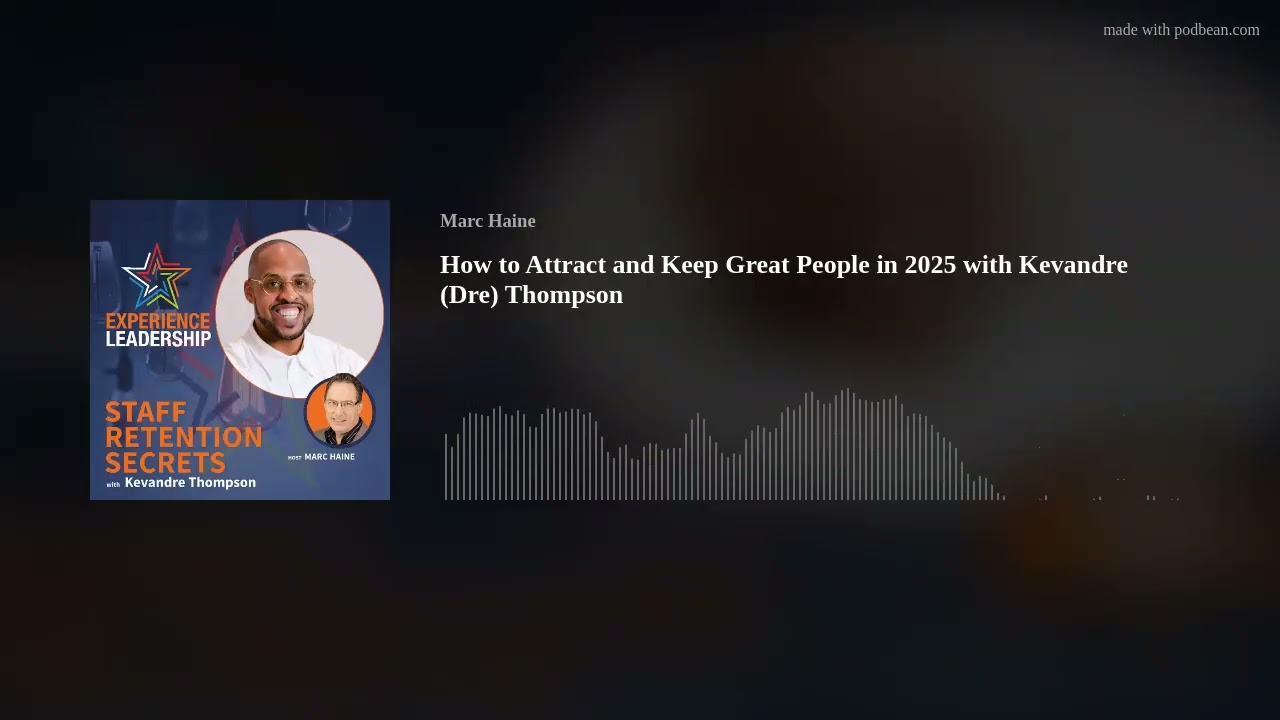
Kevandre Thompson discusses how to recruit and keep talent in 2025. He covers employer branding, why automation in hiring backfires, and how to tap alternative talent pools like veterans and people with disabilities. Leadership and culture problems, not just pay, drive people to leave.
Chapters
Let me ask you something. How many times have you hired someone only to realize 6 months later that you were basically auditioning the next person to leave?
You're not alone.
Businesses today are stuck in this rinse and repeat cycle of recruitment roulette. The job post goes up, a stack of resumes come in, you pick one, you onboard, you train, and just when you think you've got a rhythm, Poof! They're gone and you're back to square one. But here's the thing no one wants to admit. It's not just a hiring problem. It's a purpose problem. And it's eating away at your team, your culture, and your bottom line. And that's what we're talking about today on Experience Leadership.
Welcome to Experience Leadership, a podcast That challenges small business owners and entrepreneurs just like you to dare to be the exception. Join our host, customer experience expert Marc Haine, as he uncovers relevant and timely content to help you script and direct your business and teams to create jaw-dropping experiences your customers and staff deserve. Here is the host of Experience Leadership, author of Lights! Camera! Action!, customer experience expert Marc Haine. Hello, Marc.
Welcome to this episode of Experience Leadership. I am your host, Customer and Employee Experience Strategist Marc Haine. Thank you so much for joining me today. My guest for this episode is Talent Acquisition Expert Dray Thompson. And today, we are digging into why your hiring pipeline keeps springing leaks and how to build one that not only performs but actually keeps your best people sticking around. My one ask of you if you're tuning in today is if you know somebody who could use this information, please share a link to this episode. And please make sure you're subscribed to this podcast. That way, you'll get notifications when I bring you fresh new content each and every week. Okay, so here's a hard pill to swallow. The way you're hiring might be the reason You're constantly rehiring. If you're spending more time replacing people than retaining them, you're not just losing employees. You're bleeding money, morale, and momentum. And it's not just an HR problem. It's a business crisis. So that brings us to our Question of the Day. So how much is your broken talent pipeline really costing your business? What does that turnover cost you? I'd love for you to be part of this conversation. Go ahead and share a link to this episode on your favorite social media platform. Hashtag it #ExperienceLeadership. Put your comments down and let's be part of this conversation together. As I mentioned, my guest today is not just a recruiter. He is a Strategic Architect for Workplace Success. Dray Thompson is a Talent Acquisition Expert with an over a decade of experience transforming how organizations attract, hire, and retain their top talent. Whether it's rethinking diversity strategies, or leadership branding, or retention frameworks, Dray helps leaders build pipelines that perform and cultures where people actually want to stay. Dray, welcome to the show. It's so great to have you.
Thank you, Marc. Happy to be here. Happy to provide insight and value. And I'm excited for our conversation today.
Yeah, I'm so looking forward to it. You know, when we met, Probably about a month ago, give or take, maybe even 4 weeks, 3 weeks ago. As soon as I met you and I started hearing some of your topics, I thought, oh, I got to get Dre on this podcast. So I'm so glad you can make the time. Before we get too deep into today's topic, could you just tell us a little bit about who your clients are and how you serve them?
Awesome. So, yes. So a majority of my clients at this time are in the industrial manufacturing space. And so I serve my clients. Essentially, I work with organizations and hiring leaders to recruit and retain top talent. To drive long-term success and cultural change. So that deals with sourcing those hard-to-find candidates, recruitment across a multitude of different sectors in industrial manufacturing, from engineering, research and development, cybersecurity. High-volume hiring is my bread and butter from being in the automotive space here, being based here in the Midwest. And I've also worked with clients in the audiovisual space. In addition to the transportation industry, logistics and trucking. So I've been around, I've been in the game. And so I've got a lot of knowledge and I'm just here to share it.
Now I know having like my whole background has been in hospitality for decades. And I know that I get into marketplaces all the time where people will tell me and say, you don't understand, it's almost impossible to find people. Well, what do you say to that kind of a statement?
I would say that it's not impossible to find people. I think we have to frame the way we are approaching Finding talent. And I can say for the hospitality industry, I know that there's definitely a shortage there. I would say that that falls in the bucket in regards to hourly hiring. So you have a lot of— I don't want to say lower— I'd say lower wage positions, probably starting from entry points as low as like $9 to $15. And just with the way the economy is going, the cost of living has increased, but there are still people that want to work and we just have to get creative and make these opportunities enticing and provide pathways to growth to solicit individuals for those roles.
And it really is about finding ways to be able to kind of have a framework or a process for strategically attracting these people, isn't there?
Exactly. And so, for me, I think that all comes down to the employer branding that plays a big part of it because people always want to belong to something bigger. And so, I guess I'll stick with hospitality for a moment. So, when I think of a brand like Hilton, the first thing that comes to my head outside of Hilton is hotels, Paris Hilton. Just like, what is the brand saying in the marketplace? Is it— when you're looking to attract the candidate, is it, I'm a big name brand company and you should become— you should come work for me because I employ a lot of people? Or, you know, for Gen Z and millennials, it's definitely Growth is a big component of it. Like, how can I grow with the organization? What causes are you supporting? And then how well are you telling that brand story on social media? Because I'll be honest with you, Marc, I'm a guy that watches food reels. I watch those quick little 1 to 3 minute videos that pop on my phone that give me the snippet of information, and then I go about my day. And so that's how brands need to think now. Like, okay, whether it's 30 seconds, 1 minute, 2 minutes, or 3 minutes. I have this limited amount of time to give someone a snapshot of my company and entice them to want to apply for a role.
I love that. You know, I just this morning, as you were saying that, I just this morning saw a little snippet from Oodle Noodles, which is a franchise here in Canada. I don't know if it's in the States or not, but it was from, they had somebody from Sports Central, the broadcast sports channel. And she came in, she goes, hi, my name is, and what's this? Oh, it's a box from Oodle Noodle. And what's in it? And then she pulled out a card that said hope. And I thought it was such just a brilliant little 60-second thing because Oodle Noodle is doing something to raise money for children who can't play, uh, can't play sports. And I just thought this was just a brilliant way of somebody being able to highlight their brand and somebody who is able to then tell the world our mission is bigger than just selling boxed Chinese food.
Correct. And then you can be a part of the Oodle Noodle brand by applying here today, or Right. Something to that effect. Like, companies really have to— I'd say that after COVID, there was a shift in the labor market to where sometimes it'll favor job seekers and sometimes it'll favor employers. I'd say right now the job market does favor employers, but for the industries that have skill shortages, such as hospitality— me and you have talked in the past about air traffic controllers— there is an abundance of people that either lack skills or have the skill set. And we have to be very creative in regards to like, how are we gonna reach these people and get them to apply for our roles?
Yeah.
Yeah.
And so, so anybody tuning in who goes, oh, leadership branding, like that's not really gonna do anything to attract people. But the one thing I would say to push back to that is how many of you watching wanna buy a Tesla right now? And that's the power of the brand, right? That's the power of the brand. If you're not willing to buy a Tesla, how many of you actually wanna work for Tesla at this junction? Right. So it's, it's really interesting when you mentioned that kind of leadership brand, and we'll get a little bit deeper into it. But right now, you know, part of what you talk about, you, you use a certain phraseology. When you and I last talked, you talked about talent pipelines. Can you define what that is?
Absolutely. So a talent pipeline, the best example that I could give, so off the top of my head, I want you to think you have a position. That's— you have someone placed in a position, rather, and this person may either retire and you have the opportunity to build a pipeline around this talent before they retire because they told you about it, right? So, let's say for the sake of the argument, it's an automotive worker who's been loyal to the company 10 years or 20 years and they're slated to retire. You have the opportunity to do strategic workforce planning or pipelining, rather, to where I know one of my best employees is about to leave and I want to backfill this position. And I can do that by building a relationship with a trade school or working with an unemployment agency or a contract house to where you have a pipeline of talent that's flowing in. Now, with pipelining, it can be done a plethora of ways. Oftentimes what you see, what employers will do, Marc, is They're in a reactive mode and they're doing transactional hiring. They're like, okay, this person's about to quit or they quit. We got to put a body in the seat right away. And that reactive approach is usually no good because if your culture isn't succinct or you can have leadership issues, if you can't effectively convey what that candidate can expect from joining your team, are they on board day one? You spent all this money, then they're going to leave. And so, we have to be very— we got to think transformational pipelining or retention. And we want to attract candidates that align with the core values and beliefs of our organization and solicit those sorts of individuals. But be clear with that within the job posting and the advertisement on social media of the employer brand.
And so, what myths do you think when you talk to employers about kind of the recruitment or the talent pipeline. What myths do leaders have about building this talent pipeline?
I would say oftentimes the hiring manager is tasked with doing so much for the business already that they will sometimes try to shift that workload onto the talent acquisition team or partner, depending upon the size of the company, or like, oh, it's too much work, or we don't want to, you know, we can't train anyone. Just like, I don't want to say coming up with excuses, but really not taking to heart the opportunity that they have in front of them to bring future leaders into the organization, to not only succeed them, but accomplish business objectives and, you know, further the mission of the organization. Because when you frame it like that, again, people want to belong to something bigger. And I think that's just powerful in itself. When you can tell a candidate, when you join our company, When I think logistics, we're feeding food to the world. A good example, let's say Walmart. During COVID they were paying transportation truck drivers up to $100,000 in salary, and that was what was advertised. And so people thought about the money, but think about how much Walmart, Sam's Club, and the Walton family affect the world, the United States, and Canada in itself through trucking, whether it's food or clothing. Trucking runs the backbone of a lot of countries. And so, if you can tell that story and a hiring manager can make that impact, your pipelining will be easier and you'll solicit the right talent for the business versus just putting a body in a seat.
Yeah, because now you're not hiring a trucker, you're hiring somebody to help feed a nation.
Yes. And it's all going back to the storytelling. People know Walmart, but who, what, what does Walmart really stand for? And when you're attracting an employee or a future job candidate, what qualities do you want them to embed other than those bullet points in a job description? And I think hiring leaders at organizations need to think more in that regard.
Right. As we kicked off this show, we talked about this idea, kind of this revolving door of talent where somebody goes through all this work and obviously there's a cost to hiring people. And there's a cost to losing people. What are some of the early warning signs that somebody's talent pipeline is leaking their talent rather than attracting their talent?
Leaking talent versus attracting talent. So I will say this. I don't want to use— I like mergers and acquisitions, even though a lot of people don't. But I would say leaking signs are within 30 days of a new hire. And I'll take high-volume hiring out of this because In high-volume hiring, you're going to have a lot of high attrition because hourly talent will leave for a $0.25 to $0.50 to $1 increase. But let's say for salaried positions, if you have a specific manager and there is continuously a vacancy on that person's team, and within 3 months, 6 months, a month, you have a revolving door around that one specific position or multiple people, Under that leader's team, then you have a pipeline issue. And it could be deeper. It could go back to the leadership style of the manager. And so, that's why it's so important when you're doing the intake call, the strategic intake call with the hiring manager, when you're sourcing or recruiting the talent, you're not judging them only behaviorally, but do they mesh well with the current team that you have in place? Because Again, you never wanna bring someone on board for them to leave in that amount of time because there's just so much money that goes into onboarding a candidate. It can be half that person's salary within those limited days.
Yeah, it's interesting because as you were saying that, I was just, you know, reflecting back on episodes we've done on this show talking about doing stay interviews, right? Not only interviewing and not doing the parameter kind of interviews with the department heads, to find out what kind of people they want, but actually sitting down and talking with staff members to find out what their satisfaction is like. Why are they staying? What do they like about the company? And so on. Because I think if you have a trusted advisor kind of conducting that, you're going to find out quite a lot about what the culture internally is before you even start opening the door to the job hires.
Yes. And I'm a big proponent of employee feedback as well. I think sometimes what organizations run into is that When you do the employee surveys, they can sometimes come off as biased or you're— or there's fear from the internal, like, okay, that the manager potentially can read this and, you know, they don't want to be reprimanded. And then oftentimes, too, even though I'm in favor of employers, where I'm that intermediary in the middle between the employer and the job seeker, right, that oftentimes you see external candidates having more leverage than internal candidates, because oftentimes when you're internal, You're capped at a certain increase per year, whether that's the 3% or 4% salary increase year over year. And so when you want to move to a different department, you know, sometimes internals have to take laterals, just especially if you're a part of a publicly traded company versus someone that's external that could be casually looking or they're already working. They have more leeway to demand salary increases than those that are internal. So all that plays a part into it as well. But by talking to the team, a leader can learn so much. And then I feel like that's how you build that trust. And it goes back to that leadership style, right?
Mm-hmm.
Like, when you're talking to your team, you're thinking about, you know, future successors and how you could potentially backfill them when you're moving them up. That's the growth that job candidates are looking for. And that's, to be honest with you, Often why you see a lot of these job vacancies. Let's talk fast food, which is similar to the hospitality sector. In my younger days, I was in the fast food sector, and I remember being an hourly worker. Now, let's say if you're a cashier at a Burger King, do you want to be the cashier for the rest of your life? Absolutely not. You're looking— most people are looking for growth opportunities. Maybe it's being a manager. Maybe it's potentially owning a franchise one day. But the business is tasked with, again, showing job seekers and candidates that your mission or your personal brand aligns with our employer brand. You need to come work for us. And I'd say within the last 10 years, you've seen companies such as McDonald's, Burger King, and Wendy's do things such as offer tuition reimbursement. Like, we don't want to just offer you a paycheck. We want to be stimulated. We want to stimulate your education and finance that as well.
Childcare.
I often feel like veterans and let's say stay-at-home moms are often overlooked. And those could be your ideal potential candidate pools to solve your workplace shortage if you can be creative enough to attract them.
I love that. I've been saying that for years being in the hospitality. The more we can do for single moms to be able to help them create a work-life, not necessarily a Well, to create a work-life balance, right? To be able to have it actually not just a balance but have it inclusive. Be able to help them create a holistic kind of connection to the work and to their private lives. I'd like to get into some steps. You've mentioned a few already. But I'd love to really talk about how we can create a more transformative hiring process. And we'll get to that right after this. When the spotlight shines on your business, are customers applauding or yawning? In other words, how is your business performing? Make your business a star with a new book, Lights! Camera! Action!, business operational excellence through the lens of live theater by Marc Haine. Marc uses his business and acting experience to help you see your business like a live show so you can create a performance your customers will never forget.
Buy Lights!
Camera!
Action!
today at your favorite online retailer or directly at marchaine.com. Welcome back. I am talking with Dre Thompson and we're talking about this whole talent pipeline, recruiting, retention, and so on. And as we got into the break, the more I kept thinking about this. We're talking about a mind shift when it comes down to looking at our staff. Like, I do find that most organizations just keep doing the same thing they've always done, hoping that it's going to be different this time. But you have a different way. You have kind of a more creative approach. to hiring, this— along this idea of kind of transformational hiring. Can you talk to us a little bit about that, what that looks like?
Sure. So when I think transformational hiring, I think is really talent development and getting job seekers to understand, or potential candidates that are going to join your workforce, that we're not only going to hire you, we're going to develop you into being not only a better you, But a future leader in our organization. This reminded me, Marc, earlier I was thinking about this Hulu movie I watched last year. It's called Flamin' Hot. I don't know if you're familiar with it.
No.
But the synopsis of the movie is actually the inception of how Frito-Lay developed the Flamin' Hot Cheetos recipe. And it actually started from a gentleman. His name was Ricardo. Essentially, let's say, a hoodlum that ended up working as a janitor for Frito-Lay. And at the time, Frito-Lay wasn't doing good. And so the CEO put out a broadcast like, you know, bring your ideas to the company. And so one day, Ricardo noticed that his son was eating like some hot corn and that he liked the spice, which inspired him to bring the Hot Cheeto recipe to the CEO. And the CEO ended up implementing his idea, and he went from the janitor to the director of multicultural marketing for a global brand. And so I think today employers do not solicit ideas from their workforce enough. And that's one way that you have transformational hiring, by putting the people that you employ back in the driver's seat and giving them an opportunity and saying, hey, what are some ideas that you think could bring our organization to the forefront that you have and give them an actual seat at the table. That's one way when I think transformational hiring.
Goosebumps. I just got goosebumps, Dre, because I've been saying it forever that, you know, when I talk, when I talk at leadership conferences, I'll ask a question. How many of you in the audience feel that you have more talent in your workforce than their job description allows? And it's amazing how many hands go up. But then, when I say, how many of you are actually tapping into that talent? The hands go down. And so, it's so funny that we hire people into a job description because we have an immediate need. But once we have this human being now in this position, we're not doing enough to tap into what their superpowers are. Because I do believe everybody we bring on, they have strengths and weaknesses, right? And I think as employers, we kind of pigeonhole people into their positions. And the one thing that COVID taught us with remote workers and stuff was, oh my goodness, I could see into your house, Dre. That means you are a human being. You have a family, you have a life outside of work. And that was something I never considered when you had to come into work every single day.
And Marc, that was well said. And you made me think of something else just now too, kind of going back to COVID, which made me think about how when the entire world shut down for this global pandemic, We had to adjust. And then now that things have been— have gone back to quote unquote normal, we put the guardrails back up. And I think that we're just doing an injustice to ourselves to think that, why are we going to confine someone's capability to the experience in a job description? Or oftentimes when I'm dealing with hiring managers, it's, oh, this person doesn't have a degree, or we don't have the time to train them. You transform your hiring for your organization when you remove the bottlenecks and get really creative about how you can put talent into that position. One thing that has always bothered me, Marc, is businesses in manufacturing, specifically in the hourly sector. You have people that have worked, let's say, in the same job 10 to 20 years. They've demonstrated their loyalty. They know the business inside out, but they're often passed up for leadership or salary opportunities because they didn't serve in that capacity. Now, that may not be the case for like a group lead, group leader, or a team leader. But oftentimes I feel like when you develop your internal talent and again, you give them a seat at the table, you really start to see some transformational change in your workforce because then they say, okay, if Marc can do it, I can too. Or like, my company does value me. They're not— I'm not just a number or a check to them. And I really think employers and organizations really need to get back to that sort of mentality versus why we can't do it versus why we can, or how creative can we be to do it.
Yeah. And a lot of times, I think a lot of times it falls back on the leadership as well. I don't think that leadership still to this day has the level of humility I think that they need to be successful. They still— I think there's still a ton of managers out there that says, I'm the boss. Just listen to me. If I want your opinion, I'll tell you what it is. Don't ask me why. If I ask you to jump, ask me how high. We still have kind of this carrot-sticking mindset in our organizations because of course, those managers were brought up in those hierarchical kind of, you have to respect the manager. In fact, my wife and I were just at Costco and we had those sampling tables. And there was a supervisor walking around. There was obviously a conflict or something.
Yeah.
And the leader told the employee, you have to listen to me. I'm your boss. And I laughed as soon as I heard it because I've said for years that whenever anybody turns around and says, you have to listen to me. I'm your boss. Or listen to me. I'm your manager. It's because they've lost— they perceive that they have lost all respect and they're trying to reestablish their authority by saying that, right? Which tells you that right away, If that's the case, that's not an employee problem. That is a leadership problem because something about your behavior made people want to step up and push back to the point where now you feel you don't have any control. So I think, I think what we're talking about now spans more than just kind of the hiring. It's spanning kind of the leadership styles and leadership culture that is created because of the different people that we have in place. And to your point, not giving people the ability to reflect and to exude their moral authority, right? So like, I met with a— one time, I met with a hotel and we were doing a SWOT analysis. And he says, oh, I hear you're going to all the staff. And I said, yeah, I'm doing a SWOT analysis. He says, what can a dishwasher tell me about my business? And I said, you don't think that a dishwasher would have insight into what his bottlenecks are or what kind of chemicals are effective and not effective? what kind of things he struggles with. The only thing a dishwasher can tell me is what time is his break and when is payday. And I thought, wow, that's like putting the blinders on like this.
That's insane, Marc. And you hit it right on the head. It's usually like the leadership, but this is the problem with the leadership that the business often misses. Going, even going back to manufacturing, it sounds like hospitality too. You have these people that have been placed in a position or they come from a different period. And it's like, I command my respect or authority by my title.
Yes.
Not understanding that one, if you show your team or subordinates or employees that you're in the trenches with them and that you're willing to go above and beyond for them, they'll go above and beyond for you. And the business has to understand that just because this person has the title and is generating you a certain amount of dollars, that management or leadership style may not be sustainable for the long run and will cost the business money. And I call it the law of diminishing returns. The more bad managers that you have, the more people are going to assess the market and make that decision potentially to leave. And I hate to use the cliché that, you know, people don't leave jobs, they leave managers, but it's true in my opinion.
Yeah.
Just from being in the space 10 years, if an employee is bringing you new ideas and they're being shot down or your workforce doesn't feel supported, they are going to look externally. And in fact, I think I've read a percentage— I've read a statistic recently that said 80% of employees are open to new opportunities.
Right now.
Let me tell you. Yeah, right now. And I'm on LinkedIn every day. I'm the headhunter sourcer creeping into people's DMs that are already employed, soliciting them for other opportunities. I can tell you, even if people don't have that green open-to-work bubble on their profile, people are always open to have a conversation, whether it's because it's not just about pay, it's about benefits, your peace of mind, and all of that goes into play when someone is considering a new job opportunity.
Right. Well, having said that, for anybody tuning in who might want to get a hold of you, how can they reach you?
If someone wants to get a hold of me, definitely you can visit my website, www.draythompson.com. You can email me at talent@tsnhub.com. That's my email. Connect with me on LinkedIn. You can go to linkedin.com, type in Dre Thompson, and I'll pop up. Facebook as well, Dre Thompson. I'm Detroit, Michigan based, and feel free to visit my website. I'd love to offer a Purpose Pipeline checklist today. We can do— have a 30-minute Zoom call or conversation just to assess what your business is or what— or discuss any challenges or gaps in your potential workforce needs.
I love that. I love that. So the Purpose Pipeline, is that one of the tools that people can use to make sure that they're hiring right? What other tools do you have that you would recommend?
Well, it's funny that you mentioned that, Marc. So there I have DEI strategies. I know DEI is a hot topic right now, but I think DEI, or not even just diversity, equity, inclusion, but I think having diverse hiring strategies is something every organization can benefit from when it comes in regards to pipelining. Because again, veterans, military veterans, I don't care if it's the Navy, Canadian Air Force, the Army, or Marines, they have skill sets that are transferable to any organization. And I'm— and I'll even give you a hot take. I feel like if you can serve your country, there's no reason why you can't serve an employer or employer can't make accommodations for you to work for them. So veterans is one. Those with disabilities, maybe individuals that are in wheelchairs or suffer, that may need hearing aids, like those individuals still have value. Those can be solicited. We talked about stay-at-home moms developing programs for high schoolers. I think that could be a huge benefit for the hospitality space, right? Because when you talk about those entry-level positions, Not everybody is going to go to college. And so that's an opportunity to build partnerships and relationships with an education sector to make you an employer or brand of choice. But I feel like I'm giving away a little too much information here.
Not at all. Not at all. You know, it's interesting because I love that you have that spin on it because, you know, I have to say that I'm really pissed that DEI is getting a bad rap. I absolutely despise the context in which people are downplaying DEI because what they're equating it to is affirmative action, right? They're saying, oh, because you have DEI, that means if you have a person of color, if you have a person who has special needs, you have to hire them over everybody else. And the only people saying that are the people who are talking about how bad DEI happens. In reality, diversity, equity, and inclusion is exactly what you've been talking about. It's looking for the magic, the magic superpower that other people will bring into your culture that helps you think differently, act differently, and do differently. That's my soapbox, Dre. I'm sorry. I went on my soapbox.
It's okay. It all falls in line because the STAR framework is a tool that I've been working on and that I've implemented as well. So the STAR method, for those of you that are not in the HR space, is usually used in interviews in regards to behavioral assessments to see if someone is a fit. So you'll get a question, tell me about a time when you were in this situation. Well, with the STAR framework, I think employers as well as employees have the opportunity to use storytelling, transparency, authenticity to get the results that they're looking for in that particular situation. So the STAR framework is actually applicable outside of just interviewing, and that's why I'm a proponent of it so much. And again, we talked about the Frito-Lay story. When I think about brands like Nike, how much do they mean to, let's say, the basketball space? Or let's think tennis. How do you tell that story about how Nike, you know, we partner with the world's greatest athletes. And so we want to partner with you as a potential employee to expand upon the greatness that you have.
Yeah.
I always think about the Nike story of how they paid— I want to say her name was Clarissa— or they paid an individual $20,000 for that Nike checkmark logo, Just Do It, and they ran with that. And so put it again, giving the people power or putting the power in the hands of the employees or future employees, that because again, people always want to belong to something bigger and brands need to tap into that marketing and that messaging no matter what the product or service is. And I think Starbucks Does a good, a good job of that. We don't have people that just serve you coffee. They're baristas. They are the people that when you come into our store, they're knowledgeable about all the different drink options to service you every day. Like, when you— every employer, in my opinion, has that secret sauce. And once you're able to uncover your secret sauce, or for lack of a better word, that Krabby Patty secret formula, Doors will open up for you. Your bottom line will increase and shareholders will be more satisfied.
And you know, when you think about it, when people have skin in the game, when you tap into your employees' knowledge and experience and ideas, you won't lose those people. In fact, a lot of times what will happen is the minute that you realize that you have somebody more than you thought you had hired and you start investing in them, they're going to become a long-term employee who's going to be centered around Helping you get your business better. Not— and so it's, it really is such a mind shift in how we're thinking about this now, isn't it?
Absolutely. And that's— and loyalty is a thing. If you're loyal to me, I'm going to be loyal to you. But again, it's about building that trust when you're embedding your time, your energy, like when your leadership is showing that they actually care about the future development of you. That employee is going to say, you know what? You know, I'm okay. I get people sometimes that I reach out to on LinkedIn that tell me all the time, you know, thank you for reaching out, but I'm okay with where I'm at. And that sometimes to me, that's not necessarily a bad thing. That to me tells me that the company is doing a good job in regards to retaining them.
Right.
Because most people, the people who aren't doing well, the people who are working for those dysfunctional kind of workplaces will turn around and go, oh, Tell me more.
Correct.
Yeah.
Hey, when we come back, I'd like to talk about some pitfalls and cautionaries that we need to be aware of when we're addressing this issue. And that's going to come right after this.
Attention meeting and event planners! Is your company or association planning a live or virtual conference, seminar, or staff retreat? Are you looking For a fresh, energetic perspective on what it takes to put on a jaw-dropping experience for your customers or staff, book customer experience expert Marc Haine for your next group event. Past participants have said, Marc kept us in stitches while teaching us how important and powerful actually designing our customer experience can be. Read more testimonials And find out how Marc can serve you and your group at marchaine.com. That's M-A-R-C-H-A-I-N-E dot com.
Welcome back. As you could probably tell, Dre and I are just committed to serving business leaders just like you. So, if you would like to explore how we could be of benefit, especially if you're planning something like a leadership retreat or a conference, you're looking for breakout session, a keynote speaker, drop us a line. Our contact information is in the show notes. Please take advantage of us because that's— we're here to serve. That's what we do. It's, it's our jam. Dre, you mentioned the STAR framework and then you described it a little bit. I would like to do a formal definition of the STAR framework so that people are clear on what we're talking about.
Okay, awesome. So Clear definition of the STAR framework is storytelling over resume bullet points. If I were to be point blank frank with you, with, again, with the STAR method, it's very too textbook where a candidate is giving you— you have their resume, you're looking at the bullet points, and you're assessing their fit for the job based upon their respond if it suffices. But with the STAR framework, the candidate and the employer, again, depending upon the situation, because it has multipurpose uses, is utilizing storytelling in a way to where you're building authenticity, transparency, and you're looking for the relatability in the candidate. And so, it's going beyond just the bullet points because anybody can read or match a resume to a job description and say, you know, this is, this is who I am. But when you utilize that STAR framework, the actual storytelling, you're going in-depth into— in regards to when you led cross-functional teams, what did your subordinates say about you? Or what did clients say when they had the opportunity to work with you? Those stories speak volumes, and those are what need to be shared during a job interview. So from an employer perspective, I would say Glassdoor will give you a definite snapshot of what it's like to work for some of these organizations. And you have to know how to decipher the good from the bad, right? Because somebody will have a bad experience and, you know, just write something for the sake of that was their experience. So you have to kind of average it out. And but if you see a consistent theme there, that may be something worth targeting. But again, the STAR framework story, I think being a story seller versus a storyteller, whether you're an employer or a job seeker is game-changing for the opportunities that are beholden to you.
And so, as you were saying that, I was just trying to think about what role does automation play? Because the automation systems, when you submit resumes and apply online application forms and stuff, are so strict. How does that affect how we're going to be able to scope out our candidates?
Okay. All right, Marc, you didn't got me on— you've got me on my soapbox. So I'll be honest with you. When we talk automation, A lot of times when I talk to job seekers, they're like, the bots, the bots, and it's not the bots. The reality of it is you have knockout questions, and I got to be transparent with you. A lot of the times, one of the biggest knockout questions in the US specifically is, do you require sponsorship? Some employers will sponsor, some will not. So you have to do your research and decipher if that opportunity is for you. That's to the job seeker. On the employer end, When we talk automation, video interviews, I think that can be a huge turnoff for the employer. They're like, okay, we're saving time, we're saving money. For the candidate, you've already made me go through this erroneous and long resume process for like 30, 45 minutes. Now you want me to talk on camera, on video, like I'm a professional speaker for 1 to 3 minutes with these quick little bullet points? Oh no. That just means potentially you are not an employer of choice. Artificial intelligence can, depending on how it's used effectively, can be great for an organization. But we have to get back to putting people first, going back to phone calls, scheduling time to do interviews, whether in person, video, over the phone, to build that human connection. Because when we're connected, we're more relatable. And that's how you build that trust. And right now, with all these automation tools specifically, I'd say The video interviewing, huge turnoff for candidates, and I think does disservice to the brand of a company.
It's interesting because as you were saying that, I was thinking, you know, I was thinking from the role of somebody who is interviewing a new candidate and saying to that person, our values here is that we want to create relationships. But everything in the pipeline, everything in the resume process and the vetting process has done anything but create relationships.
Correct. And again, I think it depends on the size of the company, too. Like, let's say I've done some early career talent recruiting. So, internships, leadership development programs. If you're recruiting for an electrical engineer or let's say a software engineer, you could have, for internship, you could easily have 100, 300 people apply in a day. So, the video interview in that aspect would hone down the number of touchpoints that a recruiter would have to make. But again, it's about the leadership style and giving people a fair shake, right?
Yes.
The video interview—
And you don't know what you're missing. I mean, if you, if you turn around and if the resume bots look for people with college degrees, right? Does that mean that a college degree beats out anybody with 15 years hands-on experience doing the work? Right. And so if somebody has been 15 years doing the work and it says, and the bot has to filter out anybody who doesn't have a college degree, well, you've just missed out on somebody who could be pretty spectacular.
And that's where I would say it's really selective on the organization and the hiring manager, because oftentimes the hiring manager will say, I'll take someone in lieu that has the actual experience, which more than oftentimes is the internal. But again, I think hiring managers really, and organizations really need to consider the value people without degrees can bring to the organization and externals in general, because they have a fresh, clean insight coming into it without previous history.
Yeah.
Sometimes when you have people that have worked for you long enough too, they have feelings and emotions, and if they've been passed over, they can feel jaded. But with the external, if they are coming into the organization mirroring things that your internals have told you on performance reviews or that 360 feedback, I think organizations should take a second look at that and really reflect on, like, okay, especially if it's coming from a specific department or team or leadership, like continuously, that needs to be evaluated. And so, it's not all about the degree. It's because I'll tell you straight up, Marc, you can have a stellar resume and be a horrible interviewer and—
And a horrible employee.
Not even a horrible employee. Sometimes you have hiring managers that don't even know how to interview appropriately.
Oh, yeah.
And that's where the business needs to come into play and support their managers better versus just delegating them tasks.
Right.
Because when you just delegate someone a task, they could do it slapdash quick just to get it off their plate. So it really does vary, but I'm with you. I'm a big proponent of skills. I think we're moving to a skill-based society versus degrees. And so The degree will not be the end-all be-all, I believe, within the next 20 to 30 years because there's so many different sectors. We talked about air traffic controllers right now. There's a shortage there. The hospitality sector, there's a shortage there. Transportation logistics, we don't have enough truck drivers.
Yeah.
Nursing.
Yeah.
Healthcare is suffering. You're right. So many people are suffering. It's really interesting. As you were talking about this, I had applied to be an instructor to post-secondary. You know, with my 30 years experience in hospitality and leadership, I was applying to be an instructor in the hospitality program at the post-secondary. And they came back, they said, oh, your resume is awesome, but we can't hire you because you don't have a bachelor's. And it's like, really?
What?
It's the bachelor's is more important to you than the 30-plus years of experience and the fact that I coach leadership and I train hospitality? And they're like, it's our policy. It's like, okay.
You made me think of another great point right now. I was talking to someone here in Michigan, and they were asking me about, you know, filling vacancies for superintendents. So across the state, there's a shortage of superintendents right now. So in the education space, since you brought it up, the pathway usually is like a teacher, you can teach for a number of years, but ultimately you can either move into the assistant principal position to then a principal. And superintendent. We didn't even say— we didn't talk about the teacher shortage, but think about how many teachers have years of experience guiding young minds, whether that's elementary, middle school, or high school. You mean to tell me what we did during COVID where we got creative, we couldn't create pathways for teachers to climb and ascend into superintendent positions? You gotta be kidding me.
But to your point, it's a mindset thing, isn't it? It's again, hospital— education is the same like healthcare. It's fraught with old world thinking of how we— this is the way we've always done it. So, it's the way we're just going to continue to do it. As people are consuming this information, maybe I'm hoping that the audience will have had a few aha moments about kind of their businesses. If people want to transition to something that is more focused on that human being, on that human-focused kind of skill-based, talent-based? What kind of cautionaries should we be aware of? What are some of the pitfalls?
I would say one pitfall or cautionary is that it could come off a bit more manual, but I think the payoff is worth it in the long run because anytime we're adding someone to the organization, we have to think about the bottom line and how they'll add to recurring revenue in the future. We have to Not worry about just placing somebody in the position right away to continue business as usual and really be very strategic about what we're saying in the marketing, whether that be the job description. And I would, I would move away from that. A lot of job postings use, I'd say, acronyms or internal language that externals don't understand, which also frustrates the process. But just putting it in layman's terms, for lack of a better word, and making it very clear. In regards to what's the expectation someone can expect from joining your organization and what that experience will look like from joining that individual's team.
Yeah. You know, it really is to your point, this whole thing about making it more manual. Some people would be looking at this and go, but then that's going to cost me more. It's going to cost me more time. It's going to cost me more money. So I think another mindset shift is that we have to look at it from this, this frame of expense and start thinking about this frame of Investment.
Yes, you're making an investment for the future because the more strategic we are about the approach we take from the employer branding, the storytelling, the STAR framework, the less vacancies that you'll have in the future. Because now, truthfully, if you really think about it, Marc, now you got me comfortable in thinking that your employees really are the voice of the business. You want your employees, you want your team to go out in the marketplace saying good things about the work that you're doing so that they can attract talent to your business. Because then now you don't have to put so much into your marketing. Even if you had, let's say, an internal video team that could showcase— even if you had some proprietary things that you didn't want to disclose or show, even if you had an internal team showing the work that you're doing or following the stories of some of your internal workers and showcasing the value that your company has brought for them to maintain or excel in their lifestyle. That's what I'm talking about with the STAR framework and the storytelling, because people see those testimonials. Testimonials are gold in this society. But when people can fall in love with your story and what you're doing, people want— again, we said it earlier, people want to belong to something bigger. And the employer has to think from that mindset of, okay, Doing all this may cost me money in the beginning, but in the long term, the payoff is worth it because now I'm attracting the right talent that's going to stay, that's going to grow the bottom line, satisfy my shareholders, and increase the benefits of the workforce.
And be a contributing factor to your business.
100%.
Yeah. This has been such a great discussion, Drake. Do you have any last thoughts about what we've been talking about today? Have we missed anything?
One of my last thoughts, one of this, one of the foundational phrases that I've been using is people over profits. When you put people first, they will bring you the profits. So invest in your people, invest in pipelines, think about diverse strategies. You, you're friends with Marc, so now you're friends with me, and don't hesitate to reach out to me.
Love it. Could you remind everybody one more time, Dre, how they can get ahold of you?
You can get ahold of me via Email at talent@tsnhub.com. You can connect with me on LinkedIn, which is linkedin.com/dre-thompson, as well as going to my website, www.drethompson.com, to find out more information about me as far as speaking and talent acquisition consultant for your business.
Love it. Thank you, Dre. I want to thank you so much for sharing your passion, your expertise. It's been absolutely Brilliant today. Thank you so much for joining me.
I appreciate you having me, Marc. Thank you so much. This was a pleasure.
Why don't you let me know if this was of value to you? As always, my offer stands. If you would like 30 minutes of my time to help you brainstorm your business with you and your team, feel free to book yourself on my online calendar. The link is in the show notes. It's the one that's marked meetwith.marchaine.com. Pretty simple. It would be my honor to be of service to you. And while you're at it, why don't you go ahead and leave a comment or review about this episode? I'd love to get your feedback. Was this of value to you? Did you pick up any nuggets that you could use in your business today? And of course, if you haven't done so yet, please make sure that you click the subscribe button and make sure that you follow this podcast. Thank you so much for joining me today. I appreciate The fact that you invested your time today, I hope that value pays off for you in spades. My name is Marc Haine. I hope you stay safe, stay healthy, and I hope you dare to be the exception.
Thank you for joining us this week on Experience Leadership. Make sure you visit marchaine.com full directory of available episodes. While you're at it, if you found today's content valuable, please share it and tell your friends about the show. As Marc says, knowledge is power, but only if you share it. Be sure to tune in each week for the newest episode. Please stay safe, stay healthy, and Dare to be the exception.









