How To Make People Trust You Fast! with Carrolee Moore
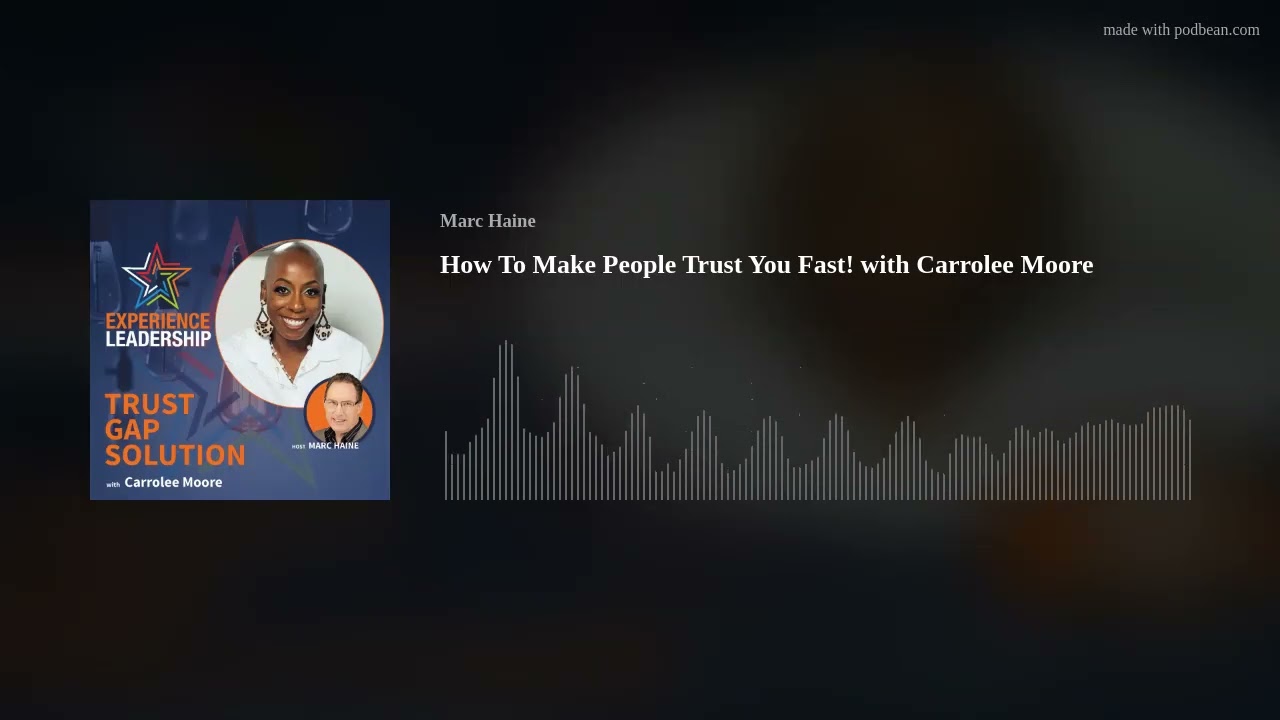
Carrolee Moore, a marketing strategist, explains how to build trust fast through podcast guesting. She covers pitching the right shows, repurposing interviews into content, and preparing your business systems before you get exposure.
Chapters
We live in a world where trust has become the most expensive currency in business. Customers take much longer now to make decisions and visibility often beats capability. But what if you could build trust twice as fast without dancing on social media or pouring money into ads? And that's exactly what we're going to be talking about today on Experience Leadership.
Welcome to Experience Leadership, A podcast that challenges small business owners and entrepreneurs just like you to dare to be the exception. Join our host, customer experience expert Marc Haine, as he uncovers relevant and timely content to help you script and direct your business and teams to create jaw-dropping experiences your customers and staff deserve. Here is the host of Experience Leadership, author of Lights! Camera! Action!, customer experience expert Marc Haine.
Welcome to this episode of Experience Leadership. I am your host, customer and employee experience strategist Marc Haine. And I'm thrilled that you're here with me today because my guest for this episode is Carolee Moore, the Visibility Fixer. And today, we are going to be pulling back the curtain On how overlooked experts can finally step into the spotlight. And yeah, I'm talking to you. We're going to explore how podcast guesting can help you build trust twice as fast, attract qualified leads without the social media grind, and turn every interview into a business-building opportunity. So stick around with us. My only ask is if you know somebody who could use this information, Maybe somebody is really struggling to get seen. Please share a link to this episode. And if you haven't done so yet, please make sure that you subscribe to this show. You know, you've probably noticed it. The loudest voices tend to get the most attention, even when the real experts are quietly grinding in the background. The problem? The business buying cycles slowing down and decision-makers are hiring who they see, Not necessarily who's best. And that brings us to our Question of the Day. So, are you tired of being the best-kept secret in your industry while other people with half your skill are getting the spotlight? They're getting bookings and it looks like they're getting the paydays. What have you tried thus far? I'd love to know what your experience is. Why don't you go ahead again, share the link to this episode on your favorite social media platform, hashtag it #ExperienceLeadership, and put down your comments so that we can make you part of this conversation as well. As I mentioned, today's guest is somebody who truly embodies the power of making yourself seen and known. Carolene Moore is an award-winning speaker and a marketing strategist with more than 15 years of experience helping professionals get found, chosen, and paid. She is the CEO of the Podcast Pitching Society, and she's helped countless entrepreneurs and service-based leaders land guest appearances that have led to 5-figure contracts, book deals, and a full pipeline of leads without the social media burnout. She's known in the industry as the Visibility Fixer, and today she's going to help us use podcast guesting to amplify our voice, shorten our sales cycle, and turn conversations into conversions. Caroli, welcome to the show. It's so great to have you.
Thank you so much for that lovely introduction, Marc. I'm gonna like snip that and carry it with me.
Snip it and digitally frame it.
Right.
So can you dig a little bit deeper into how you serve your clients? Who are they and how are you serving them right now?
So I always joke that we really serve like the nerdier the better. And so the person who's been doing all of the things in the background for the last 10, 15, 20, even 25 years, who is tired of being known for what they do, right? In their circles, they obviously have built enough trust to say, okay, I know what I'm doing. They now want to be known for what they think, right? They've done it enough. They understand their industry enough. They know where all the bones are buried, and now they're trying to change some things. Now they're trying to break through new walls. Trying to innovate, and also trying to help those who are maybe coming behind them, or maybe like, hey, don't make the same mistakes that I did, whatever it is, they're really wanting to become thought leaders in this, in their space. And we come along and say, hey, social media is great, but it is an influencer's game. And you're being taught to try to be an influencer when you're really not, you're an expert. You're a business owner and your visibility and your path to actually getting people to trust you and spend money with you is very different than someone who is peddling, you know, Jergens body lotion. Very different. If you're selling multi-five-figure and six-figure deals, there's a different way to get someone to understand, okay, yeah, this person, I definitely want them to come and lead a year-long project for our team. They understand what our unique struggles are, because I've heard them actually tell stories of similar companies that they've ushered into a different level of success, et cetera. Those people come to us, and we are not trying to create experts. They're already coming to us fully, you know, within themselves, knowing what they know.
Mm-hmm.
What is often the problem, and the thing that we solve, I would say, probably better than most in our industry, Is they don't understand how to turn that into captivating stories that takes people from one place of like, man, I have this problem, to, hey, now, after listening to 45 minutes in this interview, I am confident that this person could be my solution. And I say could be because most of the people, as you, you mentioned at the top of the show, They take a while to make a decision. Trust is definitely— I call it, we're in a trust epidemic. And so, we not only help people get on the podcast, prep you, make beautiful, awesome interview, but after that, we help you to turn all of that into content that they're going to go look for, right? They're going to want to make sure that what they heard, what they saw on that podcast was real.
Yeah.
And so, when they go and find you, we want to make sure that that matches What they were experiencing with you on that podcast. And so it's really a soup-to-nuts kind of experience. We help to research, find you really quality shows that have proper downloads, that has a producer or a host that is actually promoting the show. They have a community, they have like systems behind it. And so unfortunately there's millions of shows, but not a lot that are actually being taken seriously. And taken care of. And so, we try to find those for our clients through research. Then we actually prepare them. I, my background is in sales and marketing, heavier on the sales side. And so, even though, like, yes, these are conversations, there are ways for you to tell stories that get people engaged, that to like you, but also you're telling them something about yourself, what is unique about you and how They could potentially see themselves in the person that, you know, that you helped, right? Because you're being specific. So, we help you to actually transform your interviews into sales. And then, at the end of all of this, we help you to then, hey, bring this person along, whether that's through a funnel, through a freebie, or straight to a sales page to get them on your books, or to your social media, for them to see more of who you are and make a decision there. To again, still get on your sales funnel. So—
I imagine that people tuning in, there's some entrepreneurs who are tuning in going, yeah, I'm a welder, or I'm a— this show's not for me. But would it be fair to say that there is a podcast for every single industry out there?
There absolutely is. And I, for me in this space, the niche, which I don't know if that's—
The niche-iest.
The better, right? Generalists don't really do really well employing this strategy.
Right.
And if you are a generalist, getting an idea of what makes you unique, even in your— because technically I'm a marketer, I'm a brand strategist. All of these are very general ideas. Yeah.
It's like this big, right?
Exactly. And so, you have to kind of find what is the thing that you kind of stand on as That makes you unique. And for us, we work with experts, but not just any expert, introverted experts, the ones who a lot of times, like I said, have been in the back doing all the things.
All the ones that want to show up like this.
Right.
They've been doing all the things, but there is a point in your career, right? And that's why most of our clients are in their 30s or 40s or 50s or maybe early 60s. There's a point in your career where you're like, okay, I'm done. I'm done hiding. Like, I know for a fact I want to be Known, but not as like a celebrity, not as someone who's quote unquote popular. I really want to be respected. I want to be known for like what I think, how I think, to finally get the credit that I feel like I'm due, frankly, you know, for the things that I've, I've put into this industry. And so those are the folks that we help. But if you have been doing whatever you've been doing for a while, and even if you have not, check this out. If you are a service-based provider in any way, shape, or form, and you have been helping people solve a very unique problem, right? Say you are a photographer, and this is actually a real story. You're a photographer, and there's like, I don't know, millions of photographers in the world, especially in the United States. It's a very saturated market, but you've now figured out, well, I want to actually help people who have really elderly parents, grandparents, some kind of family member who are looking to tell their story before they pass, or they just passed and you're wanting to kind of preserve their history. That person— yes, you're a photographer, but now when you go on a podcast, you're talking about the power of preserving history, of preserving stories. You're talking about The power of storytelling, whatever it is, is no longer about photography, but through your, what we call visibility PowerPoint, which for that person would be, you know, the power of storytelling and really making sure that we're keeping our family history and legacy in place. You can talk about your photography business. You can talk about why you focus on like families that are going through that and therefore get people who are like, oh my God. My grandfather who was 98 years old, you know, he was, he was in World War II and doing all the things. We absolutely need to get this person to fly out so that they can, you know what I mean? And that's how you make business. So it's not just about someone who's like a B2B consultant. Yes, those people of course make money through podcast guesting, but all you need to do is focus on the messaging. And I think that's where people like trip up a lot, which is why we spend a lot of time with our clients.
It's interesting because when we think about the idea of marketing, you know, it's trying to reach people where they are when they need us. But when it comes down to this, this medium, especially on like social media and podcasting and blog writing and so on, it's more about being out there so that when people sit at the Google machine, that they're going to trip over you because some people might not know that a service exists to diarize, digitally diarize or video a legacy story from— they might not even consider it until something pops up somewhere and they go, oh, I never even knew this existed. Now I know that. Now I know I can explore something, right? And so why do so many businesses struggle to get noticed in what they're doing today? Like, what is the role of their trust building and their Like visibility strategy, how are they being handicapped?
I have 2 thoughts on that. The first one for me is a huge one. When everyone starts to sound the same, no one sounds unique. And so therefore no one really stands out. And then you start to see maybe 1 or 2 people that break out of whatever that mold is for that industry, and they become the most visible and known Or celebrated. And then eventually a bunch of people try to emulate that. And then that becomes the standard.
Everybody's like, oh, why didn't I think of it? Now I'm going to do it.
Right. And so I'm sure we've seen that. And so what your job is, is figuring out what is authentic to you and your brand and what is the language and messaging that the people who you want to serve are already using to describe what their problems are. Right? If you can feed back those same words to those same people, they are always going to choose you, which is why someone who is a generalist versus someone who is a specialist, the specialist is going to be able to charge more, and they're also going to be able to connect in a different way to someone who's having a particular problem or a particular experience. And too often, we tend to go with the generalist message because it's easier because we don't have to do the work that it takes. A part B to that is large corporations like McDonald's, Nike, et cetera. They're constantly doing some level of market research constantly. They want to know whether the colors in their restaurants actually make you feel the way that you need to feel in order to like buy more. They want to know, okay, if we say these words in these orders, Hey, okay. Is that all? Is that all? Is that all? Hey, that actually gets people to order more. Let's figure out some other ways that we can get— they're testing everything. And for small businesses, we're so scared of failing that we test almost nothing. What we would rather do is go and look at someone we consider to be successful.
And emulate.
And mimic whatever they're doing, because it's like, okay, it's working for them. It's going to work for me versus saying, let me go and talk to the people that I actually want to serve and hear what they want, understand what they need, understand how they actually talk about their problem. What words do they actually use to describe what they're going through? And then you can actually market in that way. You're always going to sound different than the rest of your market, like your competitors, when you are speaking your customer's language. And you will end up being that one or two that pops out of like the cacophony of mediocrity, I call it.
Which is—
it's just noise.
Sea of sameness. Sea of sameness, category language. We have all sorts of different labels for it, but it's all everybody sounding the same. And what, you know, uh, it's funny because when I reach out to some people, I say, you know, check your competition, check their websites, and are they speaking the same way you are? Because if you— then, then you're not different, right? Are there any myths about this idea, myths that we need to bust about This idea of being visible.
Yeah, I think the first myth to me is when we talk about visibility, we go straight into the channels. Meaning, when I say channels, marketing channels, say social media, email, those are considered just kind of vehicles for your message. Those are channels, right? We jump straight to that, but we were just talking about a very core part of visibility that I do think people hop, skip, and jump over. And unfortunately, that actually leads to just really boring content, boring brands, and kind of just fall into it. We are not trying to understand and fully gauge who we are. And if you're a solo entrepreneur, this is again, a thing of like, who am I? Who do I want to be? Who do I want this brand to be? What do I want it to actually sound like? Who do I want to serve? What do they need me to say? How are they describing their problems? Answering all of those questions first, because, and I used to say this all the time, it was a little harsh, but it's the truth. If you pour more attention on a hot mess, it doesn't now become like a really great, amazing thing. It just is a hot mess with more attention on it. And a lot of times that's what people are building is just a hot mess. And just to give you an example, you go viral, but if you're not ready for that, if your product And your backend is actually terrible and you don't have a way to deliver at a high level and you're not ready for the thing that you're saying you want, like, it's actually not going to do your business any good. So, visibility, we start at the, you know, the vehicles, we start at the, oh my God, I want like 100,000 followers. Oh, wouldn't it be awesome if I went viral tomorrow? Not really thinking about the other piece of this, right? The messaging. And also the systems behind it to make sure that you can, you can manage the weight of it and leverage the opportunity.
And it's interesting because what we talk about essentially with our marketing strategy is having a component of our business that really has nothing to do with our business, our actual day-to-day execution of the business. It's looking at the legacy component and building on what we do so that you're guaranteeing success later on. And so, the effort that people put into it, it becomes more of an afterthought because I'm too busy. Is that fair?
Yeah, which I think is so interesting to— that people in their minds separate what is happening with visibility with the rest of the business. And it's like, no, like I mentioned, if it doesn't matter if you get visibility and you don't leverage it, you You're still going to be having an issue with cash flow, right?
Yeah.
You're not going to really be able to do much with that. I knew someone who went on Good Morning America and made $0 from all of that exposure. And I'm sure if we, if you asked any business owner, hey, would you like the opportunity to go on Good Morning America? They would say yes. But are you actually ready to leverage those opportunities? And a lot of people Are just not, they're not. And we have to make sure that our business, our systems, all of the things that are like not sexy are ready. We got to make sure that we're tracking things and we have, you know, the behind the scenes steps and things that we know, okay, once this happens, this is how we actually leverage this. If this goes, if we have a piece of content that goes viral, Here are the things that we've done in the past that we can actually, you know, be able to do. If we get to go on a podcast like this one that has awesome, an awesome audience, here's how we're going to make sure that we leverage this opportunity and not just kind of like, okay, great. The podcast is over, you know, shake hands and walk away. There are things people either don't want to think about because like you said, it feels like an extra nice to have. And then things that people are terrified of. And so they, therefore they don't even try to do anything about it.
Is it fair to say that when people do like guesting on podcasts or get on national TV or go onto a radio show, the perception is I do A so that I must get B, as opposed to I'm gonna do A and I have all this work to do to get B? Because in my mind, I'm thinking that That's—
you hit it on the nail.
There you go. I think we're— I don't know what, what's with our mental economy, but it really seems to me when it comes down to like marketing strategies, marketing processes, and the different kinds of mediums by which we could do that, there— I'm always sitting down with CFOs and their one question is, what's the ROI? We're gonna do this one, one strategy. We're gonna do this. We'll put up a billboard. What's the ROI? How do we measure the ROI? And it's like, you know, this is not— this is like a seed in the ground. What is the ROI of putting a seed in the ground. The very next day, nothing. The day after that, nothing. The day after that, nothing, right? It takes time, right? And it's all part of a whole, isn't it?
Yeah, I think that's the reason why content marketing took so long for people to really get buy-in. Okay. Because advertising, you can understand, okay, I spend $500,000 on this ad campaign. I'm expecting this many clicks. I'm expecting Expecting this many purchases from these many clicks. That is kind of one way of looking at it. Whereas when you think about content marketing, there's, there's a compounding effect. There is the idea of virality now that was not the case when it first started, right? So, like, a piece of content can go viral. And so, now everybody's chasing viral content. It's like, but to what end? Because if something that has nothing to do with your business, like if you're dancing on TikTok pointing at corners, Mm-hmm. And it goes viral, that doesn't help your business if you weren't pointing to things that is connected to your business. Like, there's a lot that goes into this that I think when we try to simplify it into, well, I do this, like you said, I do A, and so therefore B is inevitable, we miss a whole lot in the middle. And I also really, really, I want to challenge anyone who is even thinking about podcast guesting. as a strategy to make sure that you understand the before and the after of it. So the before is the prep.
Yeah.
And I think a lot of people, whether it's social media and you're, no offense, hiring VAs to put out content. So they're putting out content, but it's not great content. So it's not doing anything because there was no plan before. There was no strategy before. You probably didn't give them that much guidance. Just said, hey, I want you to talk about healthcare or whatever the case is.
And— Because they said they know what they were doing, Karalee.
Yeah. Okay.
They should have known. They said, they said they knew what they were doing. The constant feedback I get, right, is like, oh, I hired this person who said they could do this. And, you know, I see that they're posting 4 or 5 times a week. Why is nothing happening?
Yeah, there is. And this is coming from someone who owned a marketing agency and had like managed social media campaigns, email campaigns, et cetera, for clients. For years. So, take what my opinion is for what it is. When you are a business owner, when you are the person who has a clear and deep understanding of what you do, your responsibility to someone who is working for you, doesn't matter in what capacity, is to make sure that they're clear on what the vision is, to make sure that they're clear on what the messaging is, to make sure that they're clear on like how you want to sound. How you want your brand voice to be, then it's their job to then go and do the thing. So whether you're using AI or you're using a live person, it's the same idea. And too many people, whether it's, again, it's AI or a VA or whoever, is they're ceding their creativity to someone else or to a bot and not taking full ownership for that. And what you will find is your brand just starts to sound like everybody else because there is no differentiator, because at the end of the day, you are the differentiator. That is. The core, like, point of this. So that's what I would say to that for sure.
So for the people who are tuning in saying, oh gosh, I, I, podcast guests, I, I don't think I could do that. I'd love to get into some specific strategies that the audience can use, and we'll get to that right after this.
When the spotlight shines on your business, are customers applauding or yawning? In other words, how is your business performing? Make your business A star with a new book, Lights! Camera! Action!, Business Operational Excellence Through the Lens of Live Theater by Marc Haine. Marc uses his business and acting experience to help you see your business like a live show so you can create a performance your customers will never forget. Buy Lights! Camera! Action! today at your favorite online retailer or directly at marchaine.com.
Welcome back. I am speaking with the Visibility Fixer, Karolee Moore. Caroli, what makes podcast guesting such a powerful visibility strategy compared to all the other traditional content marketing we've been talking about?
Sure.
So the first thing is we've been talking a lot about trust and the fact that building trust right now is really, really difficult, right? The core components of building trust is time and also this idea of like likability. And what happens a lot on social media is you either are able to get a lot of your personality in there, but it's hard to pull that in there with your expertise. It's very hard. And most business owners get that wrong because you want to give all the information, you want to give so much juice, all the whatever, and then you just sound like you're an encyclopedia.
Yeah.
And it was no personality, right? Or you find yourself doing TikTok dances and you're not talking about your business, right? Where people like you, you're— it's cool, but you're— it's hard for there to be kind of that combination. When you're on a podcast, you're able to show your personality. You're able to, especially for video, you're able to connect with people. So, they actually, by the end of the 45 minutes, they like you a lot more. But you also get an opportunity to show your expertise, something that is incredibly hard to do on social media for an extended period of time.
And so would it be fair to say that these are all like, so even with social media, or even when you take snippets from videos, these are all kind of add-ons to help create the whole picture. It's not just, I got a podcast and that's all I need to do now.
No, but so your question about why, why is this a better Kind of play when it comes to visibility than social media. I'm not saying to abandon social media. I'm saying if you can have someone's attention for 45 minutes straight, whether they're cleaning, cooking, whatever, when you're speaking on a podcast, and I've actually had this happen to me as a guest where someone told me, hey, I had to go grab a pen because I had to write it down. And I've also been the person who was like, oh my God, this is so good. Where's my— you know, I'm cooking in the middle of cooking. I'm listening to a podcast and it's like, no, this is really good information. I need to write this down. I need to get this book name. I like, I need to figure that out. That's what you want. And you have 45 minutes of that. Social media, you cannot get that unless someone is deciding, okay, I'm going to now stop the scrolling piece. And by the way, we talked about research, right? Social media apps and app developers have studied human psychology and how the brain works and all the things to know. Once you start doing this, it's incredibly difficult. For you to stop just scrolling and scrolling and scrolling. And so you as a business owner, now you're trying to figure out how to get this person to stop scrolling past your informational piece of video when they just finished watching a cat video and right underneath it is someone's uncle screaming about politics. You are stuck in between a whole bunch of mess. Whereas for a podcast, someone has decided After reading the title of the interview, oh, I'm interested in this topic. And so, now you have a captive audience for 45 minutes. So, that's the first one. The second one is, if you think about the most recent presidential campaigns, this was the first time that you saw both major, you know, candidates going on podcasts. There's a reason. And we talked about research again. I'm going to keep harping on this. I'm a little bit of a nerd. I don't do anything unless I can see like the numbers make sense. And for me, knowing that political scientists, they're not going to send their candidates to spend 45 minutes. And for Donald Trump, I think he was on a podcast for like 2 and a half hours. They're not going to do that unless they know, hey, this has currency, right? People are going to be influenced by the time spent in this space. And so it's worth it. To have these people sit down and talk. Not to mention, you're now having multi-billions spent on advertising on podcasts. Most of those advertisements are 30 seconds to a minute. They're spending billions, and you get an opportunity to be on a podcast for 40 to 45 minutes without, most of the time, paying a dime. Okay, that's the other piece. Lastly, and I think the most important one, is This can actually become your entire content marketing strategy if you do it correctly. This one piece of content, because you have audio, you have video, and you have a transcript. So, you can turn the audio into whatever you want. You can turn the video into social media content. We've actually used it as a part of our onboarding to kind of get people to understand what they're going to experience during their time with us, because there are times where I'm being introduced or interviewed on a podcast and I talk about the entire process that our client goes on. So, we snip that so they see it. We've also used it in our sales process. Once you get on our sales call funnel, we're showing you different podcasts that I've been on and you're hearing about podcast guesting and what you can actually do by the time you're on that sales call. You're now properly prepped. What else can you use just that video? People are thinking about social media, but social media as the only place that you're going to use this video on. If you've already planned out before you get on your podcast interview what you really want to use it for, then the answers that you give during the podcast interview, no matter what the question is, you're going to make sure That you're not having your hands here all the time. I had one of the clients that I, she realized that she was like always touching her face while she was answering questions and we had like cut that out, right? There wasn't a lot of like, um, uh, to make sure that, okay, I know I'm going to use this content for later, so I need to make sure that certain things are good and there are keywords that I want to keep, you know, reiterating throughout the entire piece. There are things that you're going to do for that. And then lastly, the transcript, blog posts, promotional emails, and you can also use snippets for the videos for both of those as well. And one of the things that people really have not done a really great job of is YouTube and Pinterest. Why am I singling out those 2? Because unlike an Instagram or a Facebook, et cetera, these are kind of like search engines. It doesn't matter when you go on, On YouTube and search for podcast guesting secrets, blah, blah, blah. If the video is properly optimized, could be 5 years from now, someone can be finding your video that you've recorded God knows how long ago, right? On a podcast. Same thing for Pinterest, which I think a lot of people don't even realize. And now, you know, you can kind of see the same thing happening for other platforms as well. So. There really is a lot, a lot to do, and I'm not even getting into the smaller pieces of advice that a lot of people don't do. Simple as just like sending a thank you or making sure that you're promoting the show after you're done with it, just as much as the host is, to make sure that they see that you were a good investment in having them on your show. Those are small pieces. Asking for a coffee chat, if you feel like you and the host could potentially be a good referral partner. There are pieces to this. It's not just kind of coming on and like looking cute and smiling and having a good conversation and being done, right? If you're really wanting to do this, and this goes back to your point from earlier where it's like, people think visibility is like, all right, I got the thing, I did the thing, and we're done. It's like, no, no.
So, before we start thinking about how we're going to do this, how important is that why? Before you reach out to a podcast host, my fear is always that somebody tuning in might think that we're talking about, oh, this is a great way to advertise, and they're thinking more about, if I can get on a podcast and talk all about me, it'll be great. So what mindset do we need to establish before we start kind of really looking at this as a viable strategy?
Yeah, I think so. I can give you my perspective and my philosophy that is built out of my own personal and professional ethos. Not everyone has the same thing. And, you know, fair enough. To each their own. For me, I consider myself a servant. I'm a service provider. And so therefore I serve, I serve people. And the way that I pitch, which by the way is how I got here, is by being very clear as to how my appearance on anyone's show is going to serve that person's audience. That is the aim, right? And so, whatever I'm talking about on the show, and we, again, we train our clients to do the same thing, whatever you're talking about on the show, being specific of like, hey, I've helped these kinds of people do these kinds of things. And this was the result. And these are the things that they've been able to do because of, you know, If you're talking about that, that is not you saying, well, I have 3 doctorate degrees and I've done blah, blah. You're showing people how you have helped. And if you can add personality and jokes and whatever in the middle of that, then it serves everyone, including the podcast hosts who, you know, they're more than likely interested in whatever the topic is as well. So, they're like, oh, really? This is awesome. That is the point.
Just like today. So, Carolyn, for the people tuning in right now, if this is resonating with them, I like to do a mid-episode check-in. How can people get in contact with you if this is really resonating and they could use your help?
Sure. So we have a few different ways for people to work with us. If you are in your DIY era, we have a DIY pitching system. It's actually the same system we use within our agency. We've just packaged it up for you to be able to do it on your own. And it's different from a template. This is really going to help you to do everything we do to create a truly customized letter so you can send it to folks like Marc and get on really reputable podcasts. We also have a Done With You, which is a media day offer, and that's also on our website, carolymoore.com. And then our Done For You, which is again, like the entire soup to nuts, that is a 6-month engagement. And we actually have a 30-minute— it's a free complimentary 30-minute strategy session that we're offering everyone who's listening right now. If you're interested in actually implementing podcast guesting, but you have like, I have no idea where to start, what this looks like, all the things, I would love to talk to you. I'm going to get all up in your business. I'm going to look at all your channels. I'm going to give you my honest opinion as to like what is happening for you, what people are probably seeing, and then kind of talk through what solutions could look like. And we do have, like I said, solutions for like anyone in any place within their business budgets and all the things.
In your notes, you talked about pitching without positioning. Can you unpack what that means?
So, we've actually been talking about that this entire time. I know if you don't, yeah, if you don't have a unique, what we call your visibility PowerPoint, the thing that people can come back and be like, okay, yeah, this is, this This is the hill I'm willing to die on.
Right.
If you are in organizational leadership and you are wanting to help corporations function better, and the hill you're willing to die on is to say happy people equal better or higher-performing teams, right? Then that is one, a fantastic way to pitch a podcast about leadership, and you can also then tell stories Maybe going back to like, hey, case studies of how someone brought you into an organization that they were at each other's throats and could not kind of get on the same page. And you were able to help them figure that out. And because of that, they were able to make multimillions or whatever. Like, it all started from this place of like, this is what I feel is the thing. This is the hill I'm willing to die on. That is the intro to Everything else, right? And that is, I think, the part that people often miss when they're pitching.
Some people looking at this and saying, yeah, you're absolutely right. This is something I need to do. How do they get— because you mentioned it, there are millions of podcasts. Like you go on to Spotify, there are so— how do you select the right podcast to guest on? And how do you define what right fit means?
Yeah.
So, we actually created a rubric for our clients. Again, going back to my nerdy side, which essentially is a number system. If you've never used a rubric before, I'm sure if you've been through like 4th or 5th grade writing, you've gotten there. I would strongly suggest that you understand what you value.
Well, your why.
Because if you're wanting to get on huge podcasts, then, you know, that's Cool. If you're wanting to get on a specific kind of niche podcast in a particular industry category, et cetera, then that's where you start. I would say a lot of times people focus on the big numbers of it all and don't really look more into like who's actually listening to this podcast because, no offense, you can go on a really large podcast like a Mel Robbins, et cetera, and if you're not clear on who you're speaking to, then it's just going to be an opportunity to say, I was on a Mel Robbins podcast. And like, that's it. That's your claim to fame, but you're not going to make any money. Like, you're not going to be able to say anything beyond, hey, I was on this thing.
Right.
And that is a waste of an opportunity. Right. And so, when you think about the why, think about like, what do you value? And can you actually get what it is that you would want from the experience? It's not just about how many people are watching you or looking at you, are these the right people? I would much rather be in a room with 15 to 20 right-fit people, people that are prime to actually take action on my offer, than be in front of thousands of people, honestly.
The people who are tire kickers who have nothing to do with what you're talking about. And that's always been my challenge with, you know, visibility. And, you know, when I talk to marketers and they'll say, oh, you know, we'll get you, we'll get you so many views. And it's like, but views, that's like saying you're going to expose me to the world. It doesn't matter. It's like, how do I know that you're going to be— that the views are going to be my clients?
And I think that's the power of podcast guesting beyond anything else that I've done personally. And when I say some of the stat lines about podcast guesting, I think people either be like, oh, she's lying, or that like, roll their eyes like, sure. But this is one of the most profitable marketing channels for experts, especially if you are charging 5 figures, multi-5 figures for your, your actual contracts, or if you're a professional speaker, someone who one contract would be, you know, 5 figures. This is a phenomenal way because I'm not talking about you selling socks. Right, where it's the $7 pack or whatever the case is. If you are able to just meet 3 solid leads and each of those leads will get you $50,000 in a contract, would that not be worth every single minute?
And really, to your point, the only investment that you're making is the time. It's the pre-prep time, it's the time to record the, the episode, and then it's the Using all the assets afterwards, right?
Yeah, it's the time. And that's why you have to be really, really— I mean, we're very, very brutal when it comes to our research process for our clients. There's not a moment where I'm like, oh, it's okay, just like throw it. No, you— if this podcast doesn't feel like to me it's going to be worth that person's time, and I literally mean like in dollars, then we're not doing it. And I feel the same way about myself. And I think that's the other piece of this too, is there are a lot of people trusting agency owners, podcast guesting agency owners who are not actually doing podcast guesting, which I think is wild to me. Yeah.
Well, and again, I get a sense that a lot of these agencies that flag themselves as podcast guesting agents will get you on You know, 5 podcasts a month. Again, I don't get a sense that these are targeted strategic placements. I think it becomes a let's throw the spaghetti on the wall and see what sticks strategy.
It is absolutely this right now. It reminds me of like early, like Facebook ads days, right? Where you had anyone who like went on the platform for 5 minutes. And was like, oh, I understand it now. And then they started selling Facebook ads management services to like everybody. It was like, yeah, I can help you. I see it happening now because not a lot of people understand how to even gauge what a good or right fit podcast is. So you have a lot of vultures, I call them, that are coming into the industry that have probably not even been on a podcast for very long. They have not even been in podcast spacing. For very long, Spaces for very long. And now they're trying to sell these services. I really, I made a post about it recently that, you know, you have people who are literally using AI to write the pitches for you. And then they have bots that are sending out these pitches to just a lot of different places. And what happens with that, and people don't realize what you're doing when you get with a VA, when you get with someone who's super cheap, you're getting what you pay for. Because they can only execute at the level at which you've paid them. So, if you're only paying them $100 a month, you're getting $100 a month worth of service, which has to be cheaper, less, not as polished, not as whatever, because they can't actually execute anything above that. That's what you're paid for. So, it's, I mean, in a lot of ways, people are starting to get bamboozled or have been, and we've had plenty of clients. I would say almost 50% of our clients are people who have already been kind of let down that I had to do extra work to convince, hey, I'm not one of these, like, I'm not, but you're fine. You don't know. And it's really unfortunate, but I do think it's really important to understand that AI is a tool. It is a benefit. It should not replace what I believe is truly a human-to-human connection. When we send pitches, like we sent you a pitch, right? That was my, my time. And then my assistant does the follow-up because she's in my, my inbox. That is our system for just me as a CEO wanting to get on more shows.
Yeah.
For our clients, we have multiple people who are pitching and sending reminders. Um, but these are folks that are hot. They're talking to our clients. They understand what they need. They know how to really go to bat for the folks that we represent. It's super important and we shouldn't be ceding this to technology so soon. I just don't believe in that.
Yeah. So, but it's like with any, with anything, before you can really delegate it, you should understand it. You should know exactly the service you're buying. Because if you do it yourself and you keep falling down, like I know when it comes to social media, workflow is my biggest headache. It's like I don't have a workflow to support being really good at social media. So then I work with somebody who is a specialist who understands my brand, who works with to make sure that the stuff I can't, I know how to do it. And I can guide it and I can review it and I can rubber stamp. the posts, but I don't have the time to sit down and do it myself. But at least I know how to do it. And I think all too often we fall back to people because we don't know how.
Yeah, I think, right. I think it's really important. That's one of the things, even with running ads, I started running my own ads just to understand like the idea of it, the steps in it, and then handed it off to someone else, right? I believe our, some of our best clients have been people who started to try and do the DIY, which is why we offer the DIY. It's like, I want you to try to do this on your own. If you don't have the finances, like, okay. Or if you're kind of skeptical about us or anybody else, like start here. And then when you're like, I don't want to be, I don't want to do this myself. This is a lot.
I understand it and I don't like it. Please do it for me.
Like, come here, come and do this. I'm done. Right. That is— those are my favorite people because you respect the work.
Yes.
You know that what we do is like hours and hours and hours of research and pitching. Who wants to— who has the time to do that and run a full-time business? You don't.
You know, we're talking about— we're already kind of jumping into cautionaries and pitfalls, but I'd love to dig in some more cautionaries and pitfalls, and we'll do that right after this.
Attention meeting and event planners. Is your company or association planning a live or virtual conference, seminar, Are you looking for a fresh, energetic perspective on what it takes to put on a jaw-dropping experience for your customers or staff? Book customer experience expert Marc Haine for your next group event. Past participants have said, Marc kept us in stitches while teaching us how important and powerful actually designing our customer experience can be. Read more testimonials and find out how Marc can serve you and your group at marchaine.com. That's M-A-R-C-H-A-I-N-E.com.
I hope you're getting tons of value today because we are talking about leveraging the power of podcasting for our businesses. And as we dive deep into today's episode, I wanted to take a moment to let you know that Carolee and I are not just voices behind the mic. We are here to help you take leadership of your business to the very next level. And so, whether you're looking to, I don't know, empower your team, enhance your customer and employee experiences, simply need fresh actionable insights to navigate today's business challenges, we're available for leadership retreats, conferences, and tailored workshops. I've spent years working with businesses just like yours, helping them transform underperforming leaders into influential, effective game changers. And Caroli brings a wealth of experience in leveraging podcasting and strategic content to drive real business results. Together, we offer a unique blend of expertise and practical strategies that can really make a difference for your organization. So, my pitch is if you are planning an event and you want to provide your team with impactful, high-energy sessions that leave them equipped and inspired, Let's connect. We'd love to bring our knowledge and our passion directly to your team, helping you not just work in your business but truly work on it. So feel free to reach out to us. Our contact information is in the show notes, so go ahead and leverage it. Caroli, what's one thing listeners can do today to start closing their visibility gap?
Well, we actually just said it. I think one of the things that I My favorite activity when someone comes up to me and says, I want to be more visible, I want more eyeballs on my business, I need more, and I start to talk to them. And what I find out is they've either done a TED Talk, they have plenty of features, whether it's local magazines, et cetera. They've done things already that they've never leveraged. What we will continue to do is want more and more and more. But if you're not taking care of your current house, if you're not taking care of your current business the way that it is, getting more of it, right, more eyes on it is not going to actually work the way that you think it will. The power of visibility is really how much you're able to leverage to get more. It is not just for you to get it. It is to leverage it.
Yeah.
And so, whatever you're doing already, Whatever you have done already, make sure that you're going back and repurposing the stuff that you've done, because you never know. Just by doing that, you might catch the eye of someone who's like, oh my gosh, I didn't even know that you were doing fill in the blank. I'd love to have you come and speak. I'd love to have you come and do a workshop. I'd love to have you on my podcast, right? You never know. And so start with what you've already gotten. And have not done anything with.
I can't tell you the number of times somebody will call me up and go, hey, I have a podcast. Would you like to be a guest? And it's like, hey, that's the easiest pitch I've ever had to make. So, so are there, so anybody stepping into this realm now, are there any other, we've talked a lot. We've talked about, you know, pairing up with people who might not have a proper track record, people who promise what they can do and don't really do it. You know, part of it is from the not knowing side of it. It's one thing to turn around and say, okay, I'll sign up for a month and see what you can do, or I'll sign up for 3 months and see what you can do. Are there any other pitfalls or cautionaries you would have for somebody stepping into this realm?
Absolutely. So, this is not advertising, right? You're not turning on the spigot and tomorrow, like, a bunch of leads fall out. And to be honest, that's not even advertising anymore anyways. Yeah, but this is a longer-term play. This is Public relations, essentially. And as much as I infuse story, strategic storytelling, which is essentially like sales psychology, et cetera, into the interviews, this is still PR. And so, it takes some time. You will find that 6 months after you've done a podcast, 3 months after you've done a podcast, I had a friend who had 2 years after she did a podcast, she became a client of ours and told me this story, 2 years. After she did a podcast, she got invited to do a paid panel feature at a large research university because they found her on that podcast 2 years later.
Right.
And so, it is a, it's a longer-term play. It is not a set it and forget it. And it absolutely is not like, oh, I'm gonna do this today and tomorrow. So, if you're looking for a cash infusion strategy because you're about to be out of business next week, probably not the best thing to do. But if you're looking for something that's going to eventually, as you do it over time, become the differentiator between you and your competition, because you'll have so much content, so much stuff out there. When someone researches any keyword that is related to your business, because you have done it so many times, it's going to be a lot easier for people to trust you, to think of you as the authority. It is fantastic, but it is a longer play.
This has been such a great discussion, Caroli. As we wrap up, do you have any last thoughts about what we've been talking about today?
Yeah, I do. So, one of the things I like to close out whenever I'm doing a workshop or anything, especially with corporate leaders, is talking about what is really important. And the thing that we miss, and we're kind of ending the way that we started, the thing that we miss a lot of times is that it starts with us. You really have to get clear on who you are. You have to get clear on why you're doing what you're doing. You have to get clear on who you actually want to serve. And once that work is done internally, once you are fully visible to yourself and you know who that is, it becomes exponentially easier for you to be okay with being visible to everyone else. So, in a lot of ways and a lot of times that I've seen people's visibility issues, meaning that they're having an issue getting more visible is actually not just because, oh, more people don't know that I exist, is that you haven't really figured out who you want to be in your space yet. And so, it's really hard because you sound like everybody else.
Mm-hmm.
Once you tap into who you truly are, how you truly sound, what you bring that is very different from anyone else, even if they do the exact same thing, Once you really do that, you will start to see that visibility becomes more enjoyable. Meaning the more eyes that come on you, you're not like, oh my God, don't look at me. It's like, hey friend, it's really good. Yes, it's exactly. And when you are fully okay with who you are, like all of that becomes a lot easier.
And it's so easy. It's so easy when you're just who you are. Yeah.
Yeah. So, and we don't start there.
Yeah.
We try to skip that because it's the hard part, but you can't skip that.
I love it. Could you remind everybody one more time how they can get ahold of you?
The best way for you to get ahold of me on social media is on LinkedIn, Carrrollee Moore, C-A-R-R-O-L-E-E M-O-O-R-E. And that is LinkedIn. Everything else that you'll need to know will be in the show notes for you to get that free 30-minute visibility strategy session. with me, um, and be able to walk through what you can actually do by the end of this year to completely change what you'll be able to do in 2026.
I love it.
Carly, thank you so much for your time today, your passion, your expertise. It's been brilliant. Thank you so much for doing this.
Thank you so much for the opportunity, Marc.
It's been awesome. Hey, why don't you let me know if this was of value to you? As always, my offer stands. If you would like 30 minutes of my time to brainstorm your business with you and your team, feel free to book yourself on my online calendar. The link is in the show notes. It's the one that's conveniently named meetwith.marchaine.com. It would be my absolute honor to be of service with you. And while you're at it, leave a comment or a review about this episode. I'd love to get your feedback. Was this of value to you? And of course, if you haven't done so yet, please make sure you subscribe to the podcast. That way, you get notifications. When I bring you brilliant, brilliant people just like Carol Lee, you'll get notifications and you'll stay connected if you subscribe. So I'd appreciate that. Thank you so much for joining me today. My name is Marc Haine. I hope you stay safe, stay healthy, and I hope you dare to be the exception. Bye for now.
Thank you. Thank you so much for joining us this week on Experience Leadership. Make sure you visit marchaine.com for a full directory of available episodes. While you're at it, if you found today's content invaluable, please share it and tell your friends about the show. As Marc says, knowledge is power, but only if you share it. Be sure to tune in each week for the newest episode. Please stay safe, stay healthy, and dare to be the exception.









