How This Former Freelance Producer Built A Thriving Hospitality Business
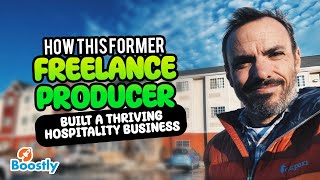
Josh Goldstein went from freelance producer to hospitality entrepreneur after a 2015 health scare pushed him toward financial independence. He bought his first rental in Kansas City for $70,000 cash, watched it appraise at $116,000, then purchased two Smoky Mountains cabins for $635,000 in March 2020. His first booking was a 28-day stay that covered all costs.
Questions this video answers
March 2020
$70,000
$116,000
$74,000
$635,000
Chapters
Hey, everybody, and welcome to the Boostly Podcast. This is the podcast that gives hosts the tactics, the tools and the training and the most importantly, the confidence on how you as a host can get more direct bookings. My name is Liam Carolan and I'm Mark Simpson's co host. Today we are going to go and dive behind the host on the miniseries on the Boostly podcast. And this is where we really dive into somebody else's business. This is successful and interesting host and hospitality owners across the world where we dive into their business and learn their tricks and their tips and things that you may be able to take away and action within your business. So today we're actually joined by Josh Goldstein. He's from Bunk House Worldwide and you can go and check out his his properties@ bunkhouseworldwide.com so welcome along. Josh. Thank you for joining us.
Thanks for having me.
So let's get started. Obviously, the word bunkhouse, you know, I love and that sort of has loads of sort of visuals of the type of places. But first of all, where does the name bunkhouse come from? Where are your properties in the world and what does the business look like, how many units and where so bunkhouse comes from?
We actually have a cabin in the Smoky Mountains and one of the rooms has two bunk beds. And my kids, it's probably their favorite cabin because they each get their own bunk bed even though they don't need it. They just think it's fun. They could have one bed to play in, one bottom bed that they sleep in, and it's their own. They don't have to fight over it. They think it's amazing. In general, our family likes to go on vacations that are almost adventures. And so we just try to make up these fun, even if it's just a little trip, it's an adventure for all of us. And so my kids have embraced that. They'll run out into the surrounding areas and just try to make forts and, you know, just their imagination goes wild. So it's fun. So I just feel like Bunkhouse evokes a just sense of fun and adventure and that's kind of why we chose that.
How? What happened from there? So that's 2015. So you've had the diagnosis and like you say, you've got fortunately great friends, great family, and they say, you know, your network and family around you is just so important. What happened from there? How? Sort of talk us through, obviously, you know, what happened from there and how you got started into hospitality.
Well, besides realizing I needed something else, Income wise, outside of my job, I was able to read Rich Dad, Poor dad during that year and you know, that year was a bit of a whirlwind. A lot of it is a blur. We, you know, our kids were much younger then but, but we were just getting by and we were trying to just focus on healing. So I read it, I was super inspired. I was actually almost frustrated with myself because I, I was, I was mad at myself that I didn't realize that this, this earlier. And it's, it's something where I've always liked real estate, I've always liked design, I've always liked values of houses. But I just never knew that I could be an investor myself. I just thought that was someone else that had tons of money and you know, I don't know, just seemed out of reach. So I read that book and it was like a brick to the head. During that year I couldn't really do much with it because I was just focused on healing. But I always had a back. Yeah, I always had in the back of my head that this was the plan when I recovered and kind of got back on my feet, that that's what I was going to do and that's kind of was my turning point.
Well, first of all, let me just say, you know, sort of congratulations on the recovery and you know, sort of be in it and, and for being here to talk to us today. I'm sure there's a lot of people listening to this who first of all are inspired by the story. Can you talk us through the kind of looking back, the steps and the challenges that you had to go through to get where you are now. You just mentioned that you never expected to be an investor in general. So what, looking back, changed and why?
Well, I'm sure you and most of your listeners have read Rich Dad, Poor Dad. To me it's more of a mindset book versus an actual real estate book. So it doesn't teach you how to do it. So once I did recover, I jumped back into work pretty hard to get out of debt and kind of get back on my feet. But while I was doing that in la, even a short commute is an hour with traffic. So I was in the car a lot. I found bigger pockets. I started listening to every podcast, I could sort of listen to audiobooks. I was just dove in as hard as I could. And you know, as I learned more and more and more, I started to realize that it was obtainable and that was, that was the main thing. And the whole while I was working, I was trying to save, I was being as aggressive as I possibly could so that I could financially start putting money towards these investments. And so that's, that's what really dropped me off was, was being in the car a lot.
You know, it resonates with me what you're saying there, because if it wasn't for audiobooks, podcasts, I wouldn't have got started on the journey. And there must be so many people who have been inspired by this information that, let's face it, 30 years ago we may not have discovered in the ways that we've discovered it, which has put us on this path now. So it's really amazing that, you know, people can truthfully change the mindset, change their beliefs and then actually start to take action when you get the how actually it's giving you that why beforehand. And like you say being in, you know, sort of the health condition that you was that you needed to make a change and to do that, which is really awesome. So yeah, when it came down to getting your first one, what, what year did you get your first one and what was it like?
So I actually got my first. I was an analysis paralysis for several years, I gotta say, while I was learning and I was looking at different markets. I kind of had shiny object syndrome. And I finally landed on my first deal was a long term rental and it was turnkey. And it was after I had listened to a podcast. I was kind of adverse to turnkey because I wanted the equity, I wanted everything. But then when they broke it down, it kind of made sense. And I was like, for a first deal especially, let's just jump in and let's do this. And it was, I got, I remember getting the email from a property management company in Kansas City and it was a holiday special. It was a $70,000 house, three bedroom house in Kansas City, Missouri. And I did the comps and it looked like it was worth around 90. So I was like, hey, there is some equity in there. There was already a renter in there for 800 bucks a month. And I decided to go for it. The lender actually wound up backing out two weeks into the, into escrow. And it was because the underwriter said they didn't feel comfortable because it was a property management company selling it versus a traditional real estate avenues. And instead of backing out, I actually had some money saved up at the time and I wound up buying it for cash, which was the biggest blessing in disguise because when I went to go pull money out and refinance It I. A month and a half went by, I got an appraisal, and it appraised for 116. And so I was able to pull out $74,000, which is my initial capital, plus closing costs. And yeah, I mean, I got a free house. And as soon as that happen, I was supercharged. I was like, I can't believe this actually works. I have a free house. I know is, you know, I was cash flowing maybe 150 bucks a month or something, but I looked at that as like a savings account that was worth now $116,000 that someone else was paying into. And I have no money into at this point.
I mean, it's even now when I hear it, and I get to hear it more than I used to about people who can pull their money out of property investing. And it's one of those things which I still look at it and just go, wow, as if this is a thing that we can all go off and do and you're basically getting paid to invest. It's just amazing, isn't it? What was the moment where you looked at it and you went, hey, I've got a couple of long term rentals. Obviously at some stage you got the hospitality bug. What would you say is your favorite? First of all, why did you move into more the hospitality side of things? And what would you say your favorite thing is about being a host?
So it was another podcast I listened to. I listened to Avery Carle, which I'm sure you and your listeners have heard of. And this was still. It was early 2020. Listened to her schedule, the call, like to talk to her for probably like an hour and a half, just about cabins and Smoky Mountains. I had never been to the Smoky Mountains before, but everything that she was saying just made so much sense. So my wife and I started looking at the MLS and we found two cabins on two acres of land. It was a 3, 3 and a 2, 2 for $635,000, which was a much bigger investment than my first $70,000 house. But, you know, I believe that it was going to work. So we went out there for the very first time during inspections in February, and we did like a whirlwind tour. It was my wife and my two kids. So we tried to do and see as many things as we could in that weekend. And, you know, we. We got to closing time, which was March 2020. And as everyone knows, that's the. The day I was closing was the day everything shut down. And I texted Avery saying, I don't even know if I could sign, because I don't know if I could find a notary that's open. And so she said she, you know, everyone would understand. She also mentioned that a lot of people were backing out at this time, and if I wanted to back out, I probably could, and no one would be upset about it. And I thought about it, but I decided, you know what? I don't mind taking some time learning this business and figuring it out before guests start coming in. And, you know, it's a little scary because I didn't know when everything was going to open back up and, you know, everything. Like, what kind of event ever happens when everything just shuts down and there's no travel, there's nothing. It was crazy, right? So I was kind of running towards the fire, but I mentally said, I'm okay with paying a mortgage for a while. Let's just learn this. Let's interview cleaners, let's interview maintenance people. We'll swap out the linens that we have to, swap out some furniture that we need to and kind of go from there. And that's what I did. And my very first booking was the 22 cabin. And I. I did lower rates quite a bit, and it was in April, but the first family rented it for 28 days, and that covered all my costs. And then right after that, the 33 started renting, and it was profit. And immediately I was. I was hooked up. And I think your second part of the question, in terms of, like, what, you know, what do I like about hospitality? In my job as producing, I feel like I'm kind of in the hospitality business. I know that seems weird, but I'm catering to many different parties. Like, I work with the director closely, I work with the ad agency closely, and then I work with the clients closely. And it's like there's three different entities that might have conflicting ideas that I need to kind of manage and make sure that everyone's getting what they want out of the whole entire process. So I almost feel like my career prepped me for the hospitality business and. And the craziness of some guests and the. The pleasantries of other guests and stuff like that, because, you know, it's like not every job in. In production is going to go the way you think it's going to go. So you just have to approach it and figure out how to solve it.
Thank you so much, Josh, for sharing your journey. And I really feel that what I've taken away from this podcast is the mindset, the positivity and actually just going, hey, if you, you know, let's figure it out. I think you've said it best. You know, let's just. Okay, let's figure this out. So is there any questions I've missed or any final thoughts before we bring things to a close?
Not that I could think of. No. I think we. We covered a good amount. Yeah.
Awesome. Well, thank you so much for your time, Josh, and thank you. Thank you, too. For you. If you're listening in on the Boostly podcast, we know there's lots of places you can put your attention, and we thank you for putting it with Boostly. Hopefully you've picked up some good tips and been inspired by Josh's story today. And thank you very much for listening. We'll see you on the next one. Bye for now.
Having a blast. Gonna get it on the Bruce Lee podcast. Bruce Lee like Bruce Lee? Cause it's so hard and the tea is loose leaf Making up those rhymes don't write it just to eluse.
More from Mark







I Tested AI Search SEO for Rental Hosts... Here Is What Happened [Live Training]



