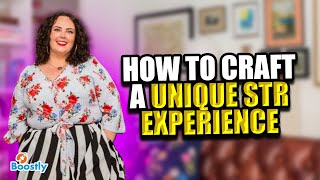
Podcast interview on the Boostly podcast (host Lee) with Moira — founder/CEO of Mocha Interiors and The Chalet Collective. Moira describes her background in hospitality, explains the businesses (hospitality-focused interior design + short‑term rental management), and recounts starting in 2013 with a first Poconos chalet. The collective currently manages eight properties across the Poconos, upstate New York, and Baltimore. She outlines guest avatars (nature-seeking families and weekend mountain guests in the Poconos; traveling medical professionals and families near Johns Hopkins in Baltimore), and emphasizes a design philosophy of telling the property’s story, using distinctive pieces (anti-IKEA-everywhere rule), salvaging bad flips, and making small spaces feel special (example: a compact Baltimore kitchen with blue European-style appliances). Practical advice: use IKEA selectively (seek designer collaborations and unique pieces), avoid ubiquitous items (e.g., Malm), and add conversation pieces to help listings stand out.
Questions this video answers
2013
Eight properties
The Poconos (Pennsylvania), upstate New York, and Baltimore (Maryland)
Close proximity to the Johns Hopkins campus (medical-related stays)
Chapters
Look for things that are that design push. So a good rule of thumb for a place like Ikea, if you've seen this piece everywhere, it's not the one for you.
Having a blast. Gonna get it on the Bruce Lee podcast. Bruce Lee, like Bruce Lee. Cause it's so hard on the T is loose leaf making up those rhymes. Don't write it, just do it loosely. If you want my respect, you're better but direct. Here are the words in the podcast. That's what comes next.
Hi everyone. Welcome back to the Boostly podcast. This is a podcast that gives host the tools, the tactics, the training, most importantly the confidence. So you can go out there and get yourselves direct bookings. We do a mini series where we intro introduce you to interesting and successful hosts from all over the world. And today we've got a very special guest. We've got Moira from. She's the CEO and founder of a chalet collective. It's amazing business. We're going to be talking interior design, we're going to be talking how you can grow your business and I'm really excited to have her on the Boostly behind the host episode. So welcome along. Moira, thank you for being here.
Hi. Thank you so much, Lee. I'm happy to be with you today.
So first question, what would you say to somebody if they have never heard of your business?
I would say they could get out of this conversation an opportunity to connect with a brand who can elevate their short term rental either by design and or management of their property.
Tell us a little bit more about the chalet collective. What is the elevator pitch for the business?
Yes. So thank you for asking. So I am an interior designer and a short term rental host and together we have two businesses that merge and they come together seamlessly. So I am the founder and CEO of both Mocha Interiors and a chalet collective and with over 20 years experience experience in the hospitality industry, I've had time as the awards director of the James Beard foundation and have produced many large scale food and wine events for thousands of people. We really have that experiential side dialed into our business and we like to connect our design to hospitality. So we think of ourselves specifically as hospitality designers.
When it comes down to the history of your business, how, how is this a new business, an old business? How long has this been running and what does the, what does it look like at the moment? How many units and whereabouts in the world? Because I know there's going to be people listening to this and they like to Connect to hosts locally to them. But in a world where we can online, you know, have masterminds and stuff like that, it's always good to. To pinpoint.
Absolutely. And we've worked with hosts all over the country in the US and my partner is from Ecuador in Italy. So we like to keep the idea that we live everywhere and nowhere and can really connect with anyone with these basic elements of hospitality. We started in 2013 with the first property in the Poconos in Pennsylvania, and that was before anyone knew about the Poconos. And now they've had a huge boom and there's tons of properties there, lots of property management companies, and we like to think that we still stand out with our unique designs. But we currently manage eight properties, both in the Poconos in Pennsylvania, some in upstate New York, and then also in the city of Baltimore, where we do short and midterm rentals.
Who tends to stay? What kind of avatar do you get that tends to stay in the properties?
So we get different ones depending on the market. In the Poconos, we get a lot of people that are looking to get away into nature. And luckily the Poconos is a four season location. So in the winter, they're looking to ski. In the springtime, we're not actually sure what they're doing because it's very muddy there, but people do come to enjoy the solace that being in the woods provides. But in the summertime, it's gorgeous. As you can imagine, we have a lot of lakes and hiking trails, so we get a lot of families that travel. And then in our smaller properties, just people getting away for the weekend or for a week retreat in the mountains. And in Baltimore, it's a completely different market. We get a lot of traveling medical professionals and or folks that are here for medical services. We are very close to the John Hopkins campus, and we find that we're serving a lot of people that are here supporting family members that are in the hospital and. Or they're a doctor or a nurse.
What has been the most significant kind of wow moment of your journey so far and why?
That is a great question. And I think what stood out to us is the first chalet that we designed. We really leaned into the story of the property, and in this particular case, it was a Bavarian gothic chalet that was built in the late 60s in the Poconos, which is kind of the heydays of the Poconos, when, like, families were going away, they were enjoying their summer, they weren't thinking about Europe. And we really wanted to lean into that and highlight that, like mid century glam, which is very popular at this time. But for this house, it really worked because it was made in that time. Like, it has these small details that calls back to that era. And since we've had a resurgence of mid century themed design, it was easier to execute. But what we saw was that people really took to the details and it isn't just like, okay, we're going to put an Eames chair here, we're going to go to the next step. And we put in a baby grand piano from the late 60s. We put in a lot of really cool antique lights just throughout the property. Things that had a conversation piece just in and of themselves, like smaller pieces as well. And that has been the most interesting piece of feedback we've had. People ask us to either sell them the property whole and or wanting to buy pieces of decor or furniture just, you know, in the property because they spoke to them. But what we find really important is learning the story of the property itself and then connecting all of the furniture, all of the decor to that to really build up a full story that we can pass on to our guests so they can enjoy that.
When it comes down to that design on the first one, how has that helped the rest of your journey? Has that influenced the rest of the homes you've taken on?
Yeah, and I think my answer goes back to your previous point. Sometimes you do work with a client who does have just an ordinary build, and there are new builds and we don't want to discount those folks. So it gives us more of an opportunity to build a story. So, for example, we bought a very small townhouse here in Baltimore that really was nothing to write home about. We love to buy buildings with interesting characteristics and this didn't really have any other than the fact that it was tiny. So we wanted to lean into that. And one of the good examples we have from this project was the kitchen. The people that we bought it from had flipped the house and put in some things that are not ideal. And we're really good at taking out those flip mistakes. So the kitchen was tiny and had full size appliances, cabinets all along the upper wall. And it just felt like the space was really small and you were just going to get crushed inside of it. So we wanted to take everything out, redevelop this kitchen, which was tiny. Like I can't even. It feels like a small little box. And we opened it up, removed all the upper cabinets, which of course, like open shelving is very popular. At the time, but we went with one ledge over the oven. We put in really fun appliances that were blue, so they were all tiny appliances, like those European style. And to this day, everyone writes to us about that kitchen being the most fabulous. And it was the biggest problem when we first got this property. We're like, this kitchen's horrible. If you're standing at the sink, you can't even open the dishwasher door. So we leaned into the fact that it was small and it was tiny and that we had to come up with a compact, creative solution. And I think sometimes that's what's required. There was no real story to lean into other than what existed, whereas the people who flipped it were trying to make something work that were not cohesive to the space. So we think about that as well, even in a very plain space. Like, how can we make it interesting? Is it beyond just putting colorful appliances? Do they fit with the space? And how do we make really fun pops of color happen? A lot of times we like to think about putting in elements that make people excited, but they wouldn't necessarily have the gumption to put it in their own property. So things that are a little bit more edgy as well.
What would you say to me and to those people listening to this if we was to go back and put into some practice some of the tips of interior design? What should we have? What should we have already considered? And what could we go back and make changes to if we want to?
I think that is a great point and a great question, and also giving a shout out to Ikea. There is nothing wrong. We were just designing a place this weekend in the Boston area, and we did a big IKEA shop. And the thing is, is you need to have an eye for the pieces that are functional and pops of design. So it's absolutely achievable, not the best to have everything done from ikea, but a lot of the kitchens that we implement in spaces are from Ikea. And it is a great opportunity to harness the fun design. Like they do a lot of collaborations with designers. Those are the pieces you should seek out, see who they're working with for that border and look at those unique pieces. Even looking on social media, there are literally worldwide influencers that are promoting these unique things at ikea. Good luck finding them, which is the only downside of it. But IKEA does have so many wonderful, cool things. So if you do have the opportunity to work with a designer who has the eye to pick those things out, obviously call us at Mocha interiors. However, if you're going it alone, look for things that are that design push. So a good rule of thumb for a place like Ikea, if you've seen this piece everywhere, it's not the one for you. So cease and desist on buying anything in the Malm collection because it's just been seen before. To me, it's a lack of design. I don't know design skill, and there are so many other things that you could really lean into that are at ikea. So my rule of thumb is if I've seen it before, it's not for me. I want something that's unique and this goes to anything from artwork, things on the wall. You should not be buying artwork at Ikea. You can make your own super affordably and you should be looking for things that have the fun pop of color, the unique design collaboration that's going to go out of circulation pretty soon, and things that are just really fun. So if you think something is safe and bland, that's not what you want to put into your vacation rental because you want things that are going to excite people and help you stand out in this really crowded marketplace.
So thank you so much and thank you too for listening to this on the Boostly podcast. We know there's a lot of places you can put your attention, and I really thank you for putting it with us here. If you want to carry on the conversation, you can do so if you go on Facebook into the hospitality community and you can come and talk about your what you're doing for interior design and share with us there and we'll carry on that conversation. So thank you so much for joining me today and we'll see you on the next one.
Having a blast. Going to get it on the Bruce Lee podcast. Bruce Lee. Like Bruce Lee because it's so hard and the tea is loose leaf. Making up those rhymes. Don't write it, just do it loosely.