In the Mind of a Mentor: Conversations with Robin Waite the Fearless Business Coach
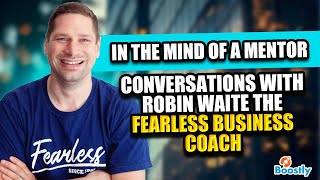
Robin Waite, a former agency founder turned coach, discusses his book Take Your Shot, a parable about a client named Russ. He covers why entrepreneurs struggle with pricing, why joy and focus beat grinding discipline, and how to test small ideas before scaling them.
Questions this video answers
May 27, 2024.
Over 200,000 views.
Fearless Biz / Tys (FearlessBiz/tys).
About an hour-and-a-half to two hours (short read).
To get past 1.5 million downloads.
Chapters
One of the things is just being prepared to sort of. Well, it's the cliched one, isn't it? Sort of fail fast, fail forward. So if there's something you're thinking about doing, there's no point in just being sat on that for like three months or six months. Just go and give it a go. And typically there's like a. There's what they call like a minimum viable version of that idea that you can launch. And you can launch it within like 48 hours and just try it and see whether it makes a difference.
Having a blast. Gonna get it on the Bruce Lee podcast. Bruce Lee, like Bruce Lee. Cause it's so hard and the tea is loose leaf. Licking up those rhymes. Don't write it, just do it loosely. If you want my respect, you're better, but direct. Here are the words in the podcast. That's what comes next.
From time to time in the podcast, we like to go out of the world of hospitality and drag an expert in to share their knowledge. Because it's always, always good to dip out. Because when you dip out is when you learn some cool stuff and you can bring it back. Today is no different.
So I've.
I've known this chapter for quite a while. We've been in Facebook groups together. He's a business coach. He is an ex website designer, had an agency, sold it, took a chill out and now is coaching. But he's a. He's a published author. He did a video last year with Ali Abdaal, who is a fantastic YouTuber that went just bananas. It had over 200,000 views. And that's why I rekindled and just sort of restarted chatting to him after vax. I said, oh, you're an Ali's channel. I love Ali. Yada, yada, yada. And then he told me about the book and the speaking events and I was just like, hey, do you want to come on the podcast? Because this would be cool. And I really focused on three important questions. About hospitality, about productivity, and everything else in between. He did also give me a link to a free book, but you have to watch the full duration of this to find out the link for that free book.
Yeah, so I've always had an interest in business, like right from the early years. But I won't bore everybody by going sort of way, all the way back. But the short version of it is I was a systems analyst for several years at a company and learned everything about that I liked about business, but also learned everything about how not to run a business and did that stupid thing that you do as a sort of naive 21 year old, thinking, well, I can do it better. So set up my first business in 2004, which was doing marketing primarily. So we did web design and branding and we heavily productized those towards the latter end of the 12 years of running that business. And then in between children. So my wife was quite heavily pregnant with the second. Our second daughter, Sophie. I decided that was a really great time to sell my business. So I just reached a point where, you know, and you've got sort of. We probably kind of get this, you know, 200 plus clients, which means you've got 200 bosses that you're. That you're at the beck and call of. Had a small, slightly dysfunctional team of, you know, four people working for me. Probably dysfunctional because they were working for me. But it just became a bit too much as my response, like personal, you know, family responsibilities were starting to grow. So made the decision to, to sell the agent. Well, I didn't initially go to sell it. I initially, I just went to. I was going to close it down. And then I was very fortunate. Somebody came in and heard about it and made me an offer and then kind of went on a bit of a hiatus. I had several people that heard that I'd sold a business and were curious. They were like, oh, you sold a business, could you help us with that? And I was like, yeah, probably. So just did a bit of informal mentoring over coffee. And then it just reached a point where I was having so many conversations I had to formalize it and sort of figure out how to weed out the tire kickers and the time wasters from the ones who are actually sort of serious business owners. So founded Fearless Business, the coaching program, eight years ago. And yeah, haven't looked back.
Can you just a little blurb, a little like a little synopsis of that book, if you don't mind.
Yeah, sure. So. So I. Very early on in, in my coaching days, I. I did a webinar that was. Well, really it was for web designers. So that's what I'd done previously. So we had about 50 people on it. And about five minutes after the end of this webinar, I get this call from this really excitable young man, Robin.
Robin.
That's absolutely brilliant. Like, you know, I'd love to know more about. And I was like, oh, cool. So tell me about your web design business. He's like, web design? I'm a golf pro. And I was like, okay, right, interesting. How did you get onto the webinar then? And he, he said, oh well, a good friend of mine knows you and recommended that greater business. I should jump onto this webinar. Anyway, Russ became my first official coaching client off the back of that webinar and that conversation. And so the story of take your shot and it's told as a parable of story. It's only a short book as well, but we, we go on Russ's journey effectively through sort of the, the challenges and troubles he has in his business. And then he meets a business coach. The business coach gives him five really, you know, great pieces of advice which he rolls out into his business and then obviously the rest then is sort of history beyond that.
So let's get into the questions. I've got three questions that I have put down. One, the first one is a fearless based question or a fear based question. I tried to do a little bit of pun on that one. So you've discussed how fear can be a significant obstacle for entrepreneurs. Can you share a story about someone you've coached who overcame their fear and achieve something great in their business and maybe try and tie it in with older Rusta golf coach?
Yeah, of course. So I mean, well, one of, one of the biggest fears which, which Russ had. So Russ actually shared a very similar sort of background to me. I don't want to do too many spoiler alerts for the book actually, but it's, it's very relevant. Russ's biggest fear was around because he knew that he wasn't charging enough. He kind of had to have all of the, you know, as working like, you know, 12 clients a day with his golf lessons and six days a week and absolutely run down and exhausted. And he was just afraid to put his prices up because ultimately that's what it came down to. He had to increase his prices in order to be able to buy back the time to be able to then spend with his family and, and put into holidays and things like that. And the, the, the real version of the story is we, Russ was really resistant. He had a very deep sort of every, well, everybody does money mindset money story that had been given to him, you know, unfortunately by his parents and 99 of human beings experience this. So we grow up with those stories that our parents, you know, their arguments really rather than stories, oh, we can't go on holiday this year because we can't afford it. You can't have those new trainers robbing because we don't have the money or you know, we can't we can't help you out with your car. You've got to go out and get a job so you can buy the car yourself. Like, everything's very, like, scarcity mindset driven. And Russ shared this and many of my clients actually share this. The. And what it comes down to is that when they ask for more money, their greatest fear is rejection with tribe animals. At the end of the day, we, we don't like people to not like us. We like to be liked. It's why, you know, for the parents amongst us, when you stood at the school gates and you're the one in the, you know, waiting to pick your kids up and you're still in the. Waiting outside the school for your kids and you stood on your own. Like, we don't like that. We want the other dads to come up and accept us into their pack and, you know, have a bit of banter and a bit of fun and things like that. We want to, we want people to like us. And pricing, unfortunately, is very much attached to that. Well, one, we've got that story of scarcity which has been given to us, so that's the only blueprint we know. But secondly, when, when we give our prices to somebody and then they say no to us, it's like massive rejection. How dare they? Why don't they understand, like, how great I am and how much money, you know, what I'm, what I'm worth and what value I can bring to their business. But the reality is like, and I don't know how much you want to dig into this, Mark, but like in business, you know, and I'm in business day in and day out. So it's the simplest example. So we have yourself, you know, Robin with his money and issues and mindset issues and fears and things like that going off over here. But a business is like, it's not an entity. It's not, it's not like a human, it's not a living thing, right? So, but the business, what it needs is strong, stable foundations in order to be profitable and sustainable and things like that. So if Robin comes in, into his business and he's got this, all this crazy going on and then we do that, well, the business is naturally on rocky foundations all of a sudden. So where I, what I try and help, say, business owners to see, and actually this is true in life as well, that when somebody rejects you, they're not necessarily rejecting you directly. What, what they're rejecting is the idea or the concept or the thoughts that they have about the thing and they may not align and actually it's just, it's okay to be okay about that.
I want to talk about productivity. So productivity is one, but I know a lot of entrepreneurs and business owners or just people they struggle with and I was intrigued by your mention that joy, not discipline, is a critical key to productivity. Productivity. How have you seen this play out in real life with clients or even like your own work habits? Have you got any stories around that?
Well, you know, let's talk about discipline first. Right? If, if you're David Goggins and you're like you've, you know, ex Navy SEAL and all of that, like your whole mindset is predicated around discipline, like doing the hard stuff. Unfortunately, I think a majority of human beings are like they pro, they, we shift towards comfort. So discipline and comfort don't tend to go together. Like discipline means getting out there, it being a painful or uncomfortable journey. And yes, there is growth through that. And I, I think there are times when you've got to push yourself into that, you know, be disciplined and push yourself through that discomfort. And I, I remember like, you know, just a really simple example of this. I, I, I'm a keen cyclist and near us there's this categorized, it's the only local categorized climb in Gloucestershire called Froster Hill. And my brother had bought me this when I first started cycling. He went, bought it, built me this like steel framed bike that was too small for me, had a triple speed gear on it and try and get, try and to get up this hill was nigh on impossible. I stopped the first one up, I stopped three times, you know, to catch my breath. So, and one of the time I'm going up this hill, I'm just thinking how the am I doing this? Like this is just so hot. I might, I'm not sure if I'm allowed to swear, but why am I doing this? And this guy comes past me in the, you know, the light crook hit the all, you know, everything, all singing or dancing carbon bike. And I shouted at him just out of frustration, oh God, you're making this look and easy. And I didn't hear what he shouted back because he was so far gone at that point. Anyway, top of the hill because there's a great community in cycling. Top of the hilly weights. And he starts talking to me and he's like that thing you said about, you know, I'm making it look easy. He said it never gets any easier, you just move faster. And that has been such a great mantra for me through through life and through business as well. It wasn't until I started going faster that I, because I was fitter and had practiced it more. So a bit of discipline at the start to get started. But then when I got better at it, I started to enjoy it more. And you can, I can cruise around the countryside now doing 20 plus miles an hour on my push bike, you know, on the flat, 52 miles and a half, 52 and a half miles an hour down the hills, on the hills, because I like, like going downhill fast. But cruise around the countryside and you can start to like, take notice of the scenery around you. And I think so many people are, so, they take on too many, too much stuff. So imagine if you took on another three activities like cycling to do them all at the same time. You're constantly having to dip into the discipline reserves because you're so busy. It's so frenetic all the time. And business owners, entrepreneurs, I'd say, are probably the worst at this because it's like, oh, shiny every five minutes trying to bring new stuff in. But every time you dip into new, it requires more discipline. You've got to learn how to do it and before you get to the fun part of it. And I think if you can just choose far fewer things to do but do them really, really well, you can have a lot more fun. And especially I've discovered this in business. You know, I'm quite a capable guy, Mark. And I said this to my wife, like, you know, and my therapist as well. It feels like a curse sometimes because not only can I coach business owners, I can run successful businesses myself. I, it just so happens I have the brain that can fix cars and bikes. I can. The studio I'm in, I managed to build myself. So I'm pretty handy when it comes to diy. I know how to work a washing machine, I can cook good food. I, you know, I can do so many things really, really well that everybody leans on me to do it. So I have to be quite conscious about the sorts of things which I say yes and no to. And where I start to have more fun on my daily life is predicated around what I'm saying no to, not what I'm saying yes to, because I have more time to focus on the stuff that I enjoy and therefore it comes more easily and more naturally.
I wanted to finish with a hospitality ish related question because obviously this is a hospitality podcast. So as an entrepreneur in hospitality, embracing change and innovation is critical. What strategy would you recommend for our hospitality entrepreneurs? Our hospitality host looking to refresh or expand their business model in today's market.
Yeah, I mean, so I'm. I'm gonna be, like I mentioned all the things that I'm good at. Hospitality is not something I've invested, you know, huge amounts of time into my learning. But I think one of the things is just being prepared to sort of. Well, it's the cliched one, isn't it? Sort of fail fast, fail forward. So if there's something you're thinking about doing, there's no point in just being sat on that for like three months or six months. Just go and give it a go. And typically there's like a. There's what they call, like a minimum viable version of that idea that you can launch, and you can launch it within, like, 48 hours and just try it and see whether it makes a difference. So, for example, if there. Where you were talking, Mark, about adding in extra value, you know, and maybe starting to look at the cleaning side of it, and this is where people kind of have to push through the discomfort a little bit. My view is rather than go out and set up a cleaning business, for example, to work alongside your hospitality business, your, you, you, you. It might be that for the first two weeks, the next two stays, rather than pay a cleaning company, you go in and clean it yourself. And probably a lot. I know a lot of people may have started out doing that, for example, with Airbnbs and things like that, just to see whether the model works and whether there's a way to draw some profitability out of it. And part of that is about being able to. I see too many business owners who delegate responsibility rather than delegate responsibly. So what I mean by that, that in order to understand what it takes to bolt a cleaning business onto your existing property business, for example, you've got to understand the inner workings of how to clean houses. Otherwise it's just not going to work because you're not going to be able to tell other people how to do it. So there's a slightly clunky version, which is imperfect, that you just go out and give it a shot yourself first, learn about it, all of the ins and outs, and then you can go away and then build a business model around it. And the faster you do that, the better, because you might give it a go and go. Do you know what? No. The company we were using, they were doing it much better. I can understand why we were paying them that much in the first place. Actually. Let's focus on you know fixing a different part of part of our business.
All right, we teased the book earlier. Now can you please just tell us a little bit more about it and where can people go and grab a free copy from, please?
Yeah, of course. So. So it's only a short read as well because sometimes people are like, oh, not another book because there's tons out there. But I designed it to be a very like an hour and a half, like two hour short film flight read basically. And, and within it there's five very simple business models around sort of pricing, a goal setting which again, it's remarkable how many business owners skip over the goal setting piece and like that's, that's the bit, the bit which is like business by design, which I think, you know, it's probably something for another episode altogether, I'd imagine. So we go into goal setting, pricing, packaging up your offer and things like that and just understanding your numbers a bit better. But yeah, I, I've got some. A stack of copies ready to be signed and sent out and the place to get them is Fearless Biz Forward slash Tys for take your shot.
Which is your best social media to sort of get in touch with you and like follow your journey if there is 1.
Yeah, LinkedIn is probably the best bet. If you've got any questions off the back of this that you want to fire across to me, by all means. And I always accept the connection requests and answer questions. I know there's lots of people out there who are like Johnny Big Bollocks who don't bother replying to anything, but I'm like, no, I like to reply to people when they've got got an interesting question and I've got a newsletter on LinkedIn as well which is worth subscribing to where all of the concepts that we've talked about today, you know, regularly I post a newsletter up there as well.
So without further ado, we'll be back very soon with another edition of the Boostly podcast. Make sure that wherever you are tuning in from you, like you subscribe, you share, you download and tell loads of people about it. We are on a mission this year to get past 1.5 million downloads, see if we can beat 2023 and the only way we'll do that is through your help. So thank you very much. We're back again very soon, having a blast.
Gonna get it on the Bruce Lee podcast. Bruce Lee like Bruce Lee Cuz it's so hard and the T is loose leaf making up those rhymes. Don't write it. Just do it loosely.
More from Mark







I Tested AI Search SEO for Rental Hosts... Here Is What Happened [Live Training]



