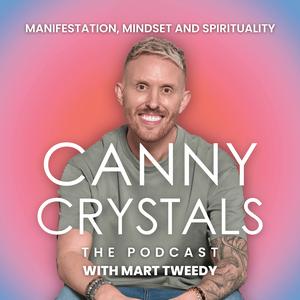
141: Enhancing manifestation through awareness
27 Jun 2024 · 32 min
In this episode of the Canny Crystals podcast, host Mart Tweedy blends personal entrepreneurship updates with a deep dive into how cognitive biases affect manifestation practices. The episode opens with a Wayfair ad before Mart announces the creation of "Manny Fest," a manifestation‑focused festival in Newcastle, detailing the rapid steps he took to launch it, the challenges around venue and date selection, and his excitement about securing speakers. He then shifts to an educational segment, explaining eight common cognitive biases—confirmation, anchoring, availability heuristic, self‑serving, hindsight, optimism, overconfidence, and status‑quo—and illustrates each with personal anecdotes and how they can either help or hinder manifestation. Mart offers practical strategies to mitigate these biases, including self‑reflection, seeking diverse viewpoints, setting realistic goals, data‑driven decisions, mindfulness, accountability, growth mindset, and gratitude practices. The episode concludes with calls to action: subscribing, following on social media, using discount codes, and signing up for the Manny Fest waitlist via mani‑fest.uk and mani‑fest.nuke, interspersed with repeated Wayfair promotional spots.
You wanna get your backyard summer ready, but you don't wanna break the bank? Wayfair gets it. Planning on dining alfresco or relaxing poolside? Wayfair has everything you need to prep your space. Shop now and save up to 70% off during Wayfair's Fourth of July Clearance. Score huge deals on outdoor furniture, area rugs, and more. We're talking thousands of products for every style and budget. Plus, surprise flash deals July 6th. Don't wait. Shop Wayfair's Fourth of July Clearance now through July 6th at wayfair.com.
Wayfair. Every style, every home. Hello everyone, and thanks so much for joining me again, listening to Connie Crystals, the podcast. As you know by now, my name is Mart Tweedy. I am your host, and this week I was loving the weather until today. It's been raining in Newcastle again, but I'm not complaining because yesterday I burnt all my neck and shoulders just being sat in the garden. It was absolutely beautiful. It almost felt tropical. I was sat in my garden on Saturday, in fact, and the sun was just belting down on us. And after I did my little summer solstice meditation, I kept getting this image in my head, and I just went with my gut And guess what? I did a thing. Yes, you might have already heard, or you might have already seen this if you follow me on Instagram or Facebook or TikTok, but get excited because I only went and did it. I have created a festival. When I say festival, it might not be a festival as in like, you know, outdoor toilets and stuff like that, because we don't want any of that jazz, do we? But I have created something, okay? It's a play on words, so I've called it Manny Fest. Do you get it? Do you get it? Manifest. Although a couple of you didn't get it because two people actually messaged me to ask why it wasn't in Manchester and why it was in Newcastle. And I was like, what? And they went, well, it's called Manifest. I don't think they got it. But as I mentioned on last week's pod anyway, this is something that I have been thinking about for so long now and I just did it. I took that inspired action. I bit the bullet, I chewed the frog, I did everything, whatever you want to call it. And as I had a free weekend, I went and registered the company under HMRC. I set meself up a business bank account. I created meself some branding. I messaged a few big names in the manifestation realm. I created social media accounts. I drafted up artist booking agreements. I contacted venues. The lot. Everything that you could think of, you know, when you are starting a business that would normally take the average person a week or so, I just did within a day because I was too goddamn excited. And quite honestly, I'm chuffed with myself. I am. I'm actually like really impressed with myself. So I've booked 5 of the 10 speakers already, and there's a couple of names in there which I can't tell you, but I'm really, really excited about. But a couple of them just said yes to me instantly without me even having to pitch the festival itself. And whenever anything goes on like this in the UK, it's always down south or London or Birmingham mainly. So this is for all you northerners. Obviously anyone can attend, it doesn't matter where you're from, but this is especially for you northern lot because we don't get anything up here. When do we ever get anything in Newcastle? Don't say I never do anything for you. But I can really see this being the next evolution of Canicrystals, you know. Like, I love it so much, it's taken over pretty much my entire week scouting venues big enough to hold everyone, thinking about companies that fit the bill to sponsor the event, have market stalls at the event, and even activities to do over the lunch period, you know, such as yoga, meditation, breathwork. I'm thinking about having a teepee outside with like meditation and sound healing. And as I'm sat here right now recording this episode, I am surrounded by huge piles of flyers because I thought it would be a good idea to get 5,000 flyers printed so that I can put them in your orders and stuff like that, so that, you know, everyone's aware of it with a QR code on for the waitlist. And I thought I'll also take some Happy Place Festival because we're allowed a flyer there as well. And then kind of disaster struck. In hindsight, I probably shouldn't have announced the date because I saw Friday the 13th of June, and at the minute I'm reading The Goddess Path by Kirstie Gallagher, and in that she talks about how Friday the 13th is just something that's made up by men to scare women and to keep them playing small, um, almost saying like it's an unlucky day and things like that. But really, Friday the 13th is all about breaking free from your shackles, empowering yourself, and saying fuck you to the patriarchy. So I saw Friday 13th of June, and I was like, yes, this is the date that I'm going to have this event. But then I went to this amazing venue, totally fell in love with it. Can't tell you any more than that, it's just an incredible venue, and you'll see why when we get there next year. Um, but unfortunately Friday the 13th of June is taken with them, so it was either switch the date around, which I really didn't want to do, or switch the venue. Now I'm looking at hosting 1,500 people here there ain't a lot of places in Newcastle that will host 1,500 people. Oh, so it's like, do I change it from Friday the 13th? Do I keep it Friday the 13th and look for a different venue? I think I'm going to have to change the date, guys, but I'm sat here surrounded by 5,000 flyers that have the date on. So in hindsight, I got too excited. I shouldn't have announced the date yet, so please don't go ahead and like book any travel or accommodation or anything like that just yet. Hang fire, hang fire, because I will announce a proper date soon, and then I'll be able to announce some of the lineup as well. So obviously there'll be a couple of people that you're probably expecting from me, but I want to get 2 huge names at least. And when I say 2 huge names, I'll tell you one of them that I was thinking of because unfortunately she, she can't do it because she doesn't do public speaking, but I wanted to get Rhonda Byrne. Rhonda Byrne, the author of The Secret, the woman who kind of brought this to the forefront of the agenda back in the late '90s and exploded the law of attraction and manifestation across our TV screens, across, you know, libraries and stuff like that. And I thought, how amazing would it be to fly Rhonda in and, you know, have her speak, have her talk about the law of attraction, manifestation, The Secret, all of that jazz. And then I received an email from her PA to say that unfortunately Rhonda hates public speaking. She never public speaks, and the only thing that she ever does is radio or TV to promote her books. So unfortunately Rhonda Byrne won't be there, but that's the caliber of people that I'm thinking of. I'm not just thinking of Brenda down the street that does tarot readings. I am going to bring you the best lineup ever. I can't wait for you all to see what's going down and start announcing that lineup soon. So if you haven't already, head to mani-fest.uk. That's M-A-N-I-F-E-S-T.UK. You can sign up for the early bird waitlist there, or you can follow us on social media. We are mani-fest.nuke. And when I say nuke, not nuke as in nuclear bomb or anything like that, nuke as in N-E-W-C for Newcastle. I tried to just get mani-fest.uk, but it's apparently taken by some goth punk rock band, so unfortunately I couldn't. Um, but yeah, I'll be announcing everything over the coming weeks by email, by social media, so check that out. That venue is just chef's kiss, honestly. It's incredible. You're all going to love it, and there's something really unique about it that— oh my God, I just wish I could tell you everything. I really will do the absolute most to make it the best that it could ever be. And I really think that this could be the next big thing for the UK because so many of us out there are interested in manifestation, mindset, spirituality. And other than Happy Place Festival, which is mainly about more health and general well-being and meditation, that kind of thing, there's not a great deal out there But anyway, I'll shut up about it all now before I drop myself in it and reveal something that I shouldn't, because I just said someone's name and I've had to edit it out because I was like, "No, I really shouldn't say that name because she's now confirmed." But yeah, I just can't help myself. Anyway, what am I talking about today? Let's move the subject swiftly on. So last week I was at Atomic Con, and while I was there, previous podcast guest and Hay House author Susie Ashworth was on stage, and she mentioned something about cognitive bias in her talk., and it made me really sit and think about what this meant to me. So as always, I did a little research, and I was absolutely fascinated reading about all the different types of cognitive bias. So I wanted to talk to you all today about how they all have such a huge role in manifestation and kind of create an easy-to-understand interpretation of them and make it easier for you to think about too. So some of you might be sat there right now thinking, what the heck is cognitive bias? What does that have to do with manifesting what I want in life? Well, I'll tell you. So I see cognitive bias as— it's quite intriguing actually, and I see it as, you know, that it's got so many concepts that delve into all the ways that our brain can lead us astray, and it can even influence our decisions and our perceptions in ways that aren't always logical or rational as well. So in a nutshell, these biases, they're deeply embedded in our brains and the way that they work, and they often operate at a subconscious level. So they're a bit like limiting beliefs. You know how we develop all these limiting beliefs by what we're told, that kind of thing. So these play a significant role in shaping our thoughts, our beliefs, and our behaviors. So basically anything that you have an opinion on will have been affected by this, okay? So maybe it's that you don't think that you're, you know, good enough to start your own business, or maybe you don't feel worthy of having more money in the bank than what you actually need. Or maybe you don't like the way that you look. Yeah, when it comes to manifestation, you know, being the idea that our thoughts and intentions can shape our reality, understanding cognitive biases becomes particularly important. So what is cognitive bias? So it means that people often make decisions or form opinions in ways that aren't logical or normal. That's what it is in a nutshell. So it happens because our brains have patterns that lead us to think incorrectly about other people or different situations. And these biases that have can affect our perceptions, can affect our memory, and potentially even our thinking processes, actually. And that'll lead us to make decisions that aren't always based on true reality. So unlike random mistakes in thinking, cognitive biases happen in predictable and consistent ways. And it shows that our brains naturally try to make processing information easier by using shortcuts. And we're going to refer to these as heuristics as well, because that's what shortcuts are. To do with your brain, the heuristics. So cognitive biases come up because of the brain's effort to process such large amounts of information quickly. So our brains are constantly bombarded with more information than they can handle, so they develop shortcuts or heuristics to make sense of the world. Remember in a past episode I was talking about our brains processing something ridiculous like, what was it, 27,000 bits of information per second? That's wild. And this is exactly why this happens. This is why it creates these shortcuts. And while these shortcuts can be helpful in making quick decisions, they can often lead to errors in our thinking. So there are a few different types of cognitive biases, and I've wrote them all down. I've got them in a list beside me because I'll never remember this. My brain doesn't have that as a shortcut. Um, but they each affect our thinking in different ways. So I've made a list of 8 of them, okay? So I'm going to talk through each one, what it is, and how it affects us in manifestation. So all I want you to do is to listen out and to see which you feel mostly affects you. So the first one is confirmation bias. So this is the tendency to search for or interpret and remember information that confirms our pre-existing beliefs and opinions. So for instance, if you believe that you're always unlucky, you might selectively notice and remember every single little misfortune in life. But then you're ignoring all the times when things go well. So you might be a bit pessimistic, you might always be looking at the doom and gloom of what could happen, and as soon as something else happens, you're like, yep, told ya, that's happened in the past. That's it, that's confirmation bias. It's like when I always used to affirm to myself that whenever something good happened to me, that something bad would follow. And true to form, if you know my backstory, July 29th, 2019, my friend at the time won Love Island on the Monday night. We got the keys to our house when our mortgage had actually cleared. That exact same day, I was on such a high, and I thought, what's gonna go wrong? Whenever I'm this happy, something goes wrong. The next day, my mom rings us and tells us that my granddad died on the way to hospital. That's what kickstarted this whole journey for me. Something good happened, something bad followed, and that's why I used to really connect with confirmation bias. So in terms of manifestation with confirmation bias, when we practice manifestation, if we use confirmation bias on the flip side it can make you more likely to notice and remember events that confirm positive thoughts and desires. So for example, if you're visualising a successful career, you might pay more attention to job opportunities or positive feedback or networking events that align with your goals, because that selective attention can reinforce your belief in the effectiveness of those practices. So if you have negative expectations or beliefs, confirmation bias might cause you to focus on setbacks or rejections or obstacles and that's going to reinforce that belief that success is out of reach. And over time, that's just going to create a self-fulfilling prophecy where your beliefs shape your reality. So if you're thinking negatively, negative things will happen because you're constantly looking for it with the confirmation bias. So that's the first one. The second one is anchoring bias. So this occurs when we rely too heavily on the first piece of information that we receive. And that's called the anchor. And it comes up when we make decisions. For example, if I saw a pair of trainers that cost £10,000 and then I saw another pair of trainers that cost £100, I might see the second pair of trainers as a bargain regardless of its actual value or my need for it. Does that make sense? So anchoring can significantly impact our judgment and decisions, often without us even realizing it. So when we use anchoring bias in terms of achieving our goals, It can influence how we set our goals in the manifestation process because if you anchor on a particularly high or low benchmark, that's going to skew your whole perception of what's achievable. For instance, if you hear about someone making £1 million from a side business, you might then go in and set a similarly high financial goal for yourself, even if a more modest goal would be more realistic to you or manageable initially. And then on the other hand, if you anchor on a lower benchmark, you might set goals that are then too easy and not challenging enough to push you towards that significant growth that you want. So just being aware of anchoring bias, that can help you set more balanced and realistic goals that are both aspirational and achievable to yourself. It's kind of like not comparing your chapter 1 to someone else's chapter 100. Does that make sense? The third one is availability heuristic. So this bias involves making decisions based on how easily examples come to mind. So if you frequently you hear about airplane crashes in the news, for example, you might overestimate their frequency and you might perceive flying as more dangerous than it actually is. So the availability heuristic can lead to skewed perceptions of reality because the more dramatic or the more memorable events tend to be the ones, you know, that are more memorable to us. So if we think of all the airplane crashes and we're like, oh my God, airplanes crash all the time, and that's because we see on things like the news and stuff. Like, my mom is the worst for this. Every week when she comes over, it's, eh, guess who's been murdered? Guess who's gone missing? Guess who's died? As though all these things are happening 24/7. I mean, they probably are worldwide, but that shouldn't be affecting us personally. So availability heuristic in kind of opportunities, it can affect how you assess different opportunities related to your manifestations. So if you frequently read success stories of entrepreneurs, you might overestimate the ease of starting a business. Yeah, because all we see, it's like, you know, when you look at someone's Instagram and you're like, oh my God, they have such a good life. Life. They seem to have it all. That's not the truth. It's because you're seeing one little portion of that person. So I'm not gonna lie, it can be both motivating, but it can be misleading as well, okay? Because it might cause you to overlook the challenges, the hard work that's involved. It's like me sat here right now. You might think, oh my God, he's got it all. He's got a podcast, he's got a business, he's starting a festival. Do you realize how hard I work? Nobody sees like all the late nights, all the times that I cry into my pillow when customers are nasty to me and stuff like that. I mean, I don't often do that because I, I do have a bit of a thick skin, but in the early days especially, like, I would get a nasty message on Instagram and I would sit crying for an hour over it. I need to toughen up, I know. But it's, it's like that kind of message, okay? So if you often hear about business failures, for example, you might become a bit overly cautious and hesitant to kind of create a business of your own because you hear of so many horror stories. So you need to seek out that balanced view and understand in the full spectrum of experiences so you can make more informed decisions about opportunities that you fancy if you know the pros and the cons. Okay, so number 4 is the self-serving bias. So this is the tendency to kind of attribute positive outcomes to our own actions but negative outcomes to external factors. And I used to do this all the time in the NHS, so I really relate to this one. For example, if you've got a promotion at work, you might attribute it to all your hard work all your studying, all your dedication. But then if you don't get promoted, you might blame office politics or an unfair boss, or, you know, oh, it was earmarked for someone else. And that bias helps to protect our self-esteem, but it can also prevent us from learning from our mistakes. So I used to get knocked back left, right, and center for jobs all the time, and I'd be like, oh, it's because so-and-so got it because they're licking the boss's ass, blah blah blah. And it is such a powerful thing to do, to learn from mistakes. So By me blaming different people in the office all those years, I wasn't learning anything about myself, okay? I wasn't learning an absolute thing about myself. Because ultimately, mistakes make us who we are, and they shape our realities. So when things go well, self-serving bias can lead us to attribute our success to manifestation practices, and that's going to reinforce our belief in their effectiveness. Because when we start manifesting, you know, we start with something small like a car parking space or a cup of coffee. When that works, you're like, okay, I did this, it works. That puts your belief in yourself, and it puts the belief in your effectiveness. For example, if you achieve a personal or professional goal, you might credit your positive thinking and visualisation and affirmations and crystals and all that jazz. However, if things don't go as planned, that self-serving bias can turn around, and it might lead you to blame external circumstances or even just bad luck. Rather than just reevaluating your approach or mindset. Because in all in all, it might just be you. Yeah, and some people can't take that. It's a hard pill to swallow, but that can prevent you from learning valuable lessons from setbacks and making necessary changes and adjustments to your manifestation practices. Number 5 on my list is hindsight bias. So this is the tendency to see events as having been predictable after they've already occurred. For example, after the UK went into a financial crisis and, you know, we had that bit of recession— people claimed that they knew it was going to happen all along, even if there were no clear indicators beforehand. So hindsight bias can distort our memory and understanding of events because it leads us to overestimate our ability to predict future outcomes. Now, this can be positive and negative, just like all the biases, but it can really affect how you learn from your manifestation experiences. So after achieving a goal, you might convince yourself that the outcome was inevitable and that you were always going to achieve this goal. And you might overlook all the specific actions and efforts and mindset shifts that actually contributed to that success. So that can lead to a bit of complacency and a bit of an overestimation of your ability to manifest future goals without effort. And on the flip side as well, if you experience a failure, hindsight bias might then cause you to believe that, you know, the negative outcome was inevitable and that your efforts were futile and that they were pointless. It was pointless even putting that effort in in the first place. So to counteract hindsight bias, it's important to kind of objectively analyze our experiences and acknowledge the factors that contributed to the outcomes. Just identify areas for improvement. Then we've got number 6 on my list, which is optimism bias. So this is the tendency to overestimate the likelihood of positive outcomes and underestimate the likelihood of negative ones. So people with optimism bias might believe that they are less likely to experience these challenges or illnesses or accidents compared to other people. And while optimism can be beneficial in maintaining motivation and resilience, it can also lead to risky behavior and kind of that feeling of being unprepared for something. So it can play a dual role in manifestation because on one hand it can help you maintain a positive outlook and keep you motivated to pursue your goals even in the face of challenges, but on the other hand, excessive optimism can lead to unrealistic expectations or underestimating those obstacles, and that can then result in disappointment and a lack of preparedness for setbacks. So you've got to balance that optimism with a realistic assessment of challenges that can help you stay motivated whilst remaining grounded and adaptable. Okay, so number 7 on my list is overconfidence bias, and that bias refers to the tendency to overestimate our own abilities or our knowledge or our judgments. So overconfidence can lead us to take on tasks or make decisions even without that preparation or consideration of the challenges that we're going to face. So it can result in the dismissal of advice or information from other people because you just think, you know, I can do this, I'm amazing. I'm overconfident. That's what this is about. So it can lead you to take these bold actions towards your manifestation goals, driven by that inflated belief in your abilities and judgment. And whilst confidence can be empowering, overconfidence can then result in taking on tasks or making decisions without that preparation or consideration of the challenges that's going to set you back even further. So this is all about just seeking feedback and remaining open to learning, just acknowledging areas for improvement. You don't want to be overconfident and just think, I know it all. Listen to what people are telling you, okay? That's what this one is all about. And then the last one on my list is the status quo bias. So this is the preference for the current state of affairs right now and the resistance to change. So people with status quo bias tend to favor options that you know, maintain the existing situation over any that involve change, even if the change could lead to better outcomes. This bias can lead to missed opportunities and to a bit of a reluctance to innovate or adapt. So it can impact your willingness to embrace new opportunities, make changes that align with your manifestation goals, all that jazz. And a preference for maintaining the current state of affairs can then lead to all those missed opportunities and that's going to hinder your progress. That's going to limit your ability to achieve that growth that you want. So we need to overcome that status quo bias, and that involves recognizing the potential benefits of change, you know, challenging your comfort zone, stepping out of it, and just being open to new experiences and perspectives. So those are the 8 biases that I wrote down. Okay, so now that we know all of that, which of those jumped out for you? For me, it was definitely that last one and the first one as well, because I have such a huge resistance to change, you know. Which is wild because no two days are ever the same for me in business, in Canny Crystals, or the podcast, or the academy. That scares me. And like, I'm putting myself out there now with this festival, for example, but I know that I have to overcome that way of thinking because I honestly think that the scariest place that I could be in 10 years' time is in this exact same place that I am right now. I have goals and dreams just like everyone else. I would rather be sitting on a beach in Bali sipping a cocktail and working from there as well, just like any normal person. Living. It's not wrong to want that, but I don't want to be slogging my guts doing, you know, 70+ hours a week in business in 10 years' time. I couldn't think of anything worse. And that's what pushed me to break free from the NHS in the first place as well. So just like, imagine not growing as a person. Like, imagine not learning anything by sticking to those comfort zones. My family are the worst for this. They're an absolute nightmare for it, in fact. And that's why they're the mindset that they are. They all live in the same village that they've lived in since I was born. I mean, no hate to them or anything like that, I love them all to pieces, but they've all lived in the same village that they've lived in since I was born, all within a 2-minute walk of each other's houses. And when I told them that I was moving to central Newcastle about 8 years ago, you would have thought that I told them that I was migrating to Australia, bearing in mind I'm less than a 30-minute drive away from them.
Them.
It's wild. That last bias keeps people feeling so stuck, not able to develop, not able to grow, and stagnant for the rest of their lives. So I hear you all shouting away right now at me like, you know, how do I overcome these cognitive biases in manifestation? So I think the first step is to recognize it. Which one stood out for you the most? And then we need to reduce cognitive biases because that's going to make your manifestation practice work better. So I've got some super simple strategies to help you overcome these biases and align your mindset and efforts with your goals. So the first is to be aware and reflect. So just knowing about cognitive biases, they're going to help you be able to fight their effects. Regularly think about your thoughts and your beliefs and your actions. Just find patterns of biased thinking. You might want to keep a journal because that can be a powerful tool for this. That's going to allow you to track your progress find recurring biases, and just develop ways to address them. And when we become self-aware, we can be more mindful of how biases influence our perceptions and our decisions. Number 2 is to seek different people's views. So engaging with different viewpoints, that's going to challenge your preconceptions, and that's going to reduce the impact of confirmation bias. You know, it can include reading different books, seeking feedback from other people, being open to new ideas, because when we expose ourselves to various perspectives, we gain a more balanced understanding of our goals and factors that influence their success. And that's going to help you find and address all the blind spots in your thinking. Number 3 is to set yourself with realistic goals. So as I always say, when setting goals, use realistic benchmarks instead of extreme examples. So research the usual outcomes and challenges associated with your goals and then set achievable and motivating targets. That's gonna help you avoid all the pitfalls of anchoring bias. It's gonna create a clear actionable plan for achieving your objectives. By setting small goals and celebrating small wins, you can then maintain that momentum and then you can build that confidence from then on out. Number 4 is to make data-driven decisions. So base your decisions on data rather than personal stories because that's gonna help you counteract the availability heuristic. And that's going to provide a more accurate picture of what actually is possible. So if we gather and we analyze relevant information, we can make more informed choices that align with our goals, and that's going to increase our chance of success. The fifth thing on my list is to practice mindfulness. I know I bang on about this all the time, but mindfulness and meditation can really help you to stay present, and that's going to reduce the influence of these biases on your life. Life. So these practices can enhance your self-awareness, they can improve your ability to respond thoughtfully rather than react impulsively. And when we're being mindful, we can then become more attuned to our thoughts and emotions, and that's going to allow us to identify and address cognitive biases as they arise. Number 6 is to seek feedback and accountability. So engage with a mentor or a coach or even just an accountability partner, one of your friends, because that's going to provide you with valuable feedback and help you stay on track with your goals. So invite others to challenge your thinking, you know, offer constructive criticism to your friends. You can identify and address cognitive biases that might be holding you back by doing this. Number 7 is to develop a growth mindset. So embrace that growth mindset because it can help you overcome cognitive biases and achieve your goals. When we focus on growth and improvement rather than fixed outcomes, we can then cultivate that resilience and adaptability when facing challenges. And then the last one on my list is to practice gratitude and positivity. So develop that gratitude practice that can help you maintain a positive outlook and counteract all the negativity biases. And when we regularly acknowledge and appreciate the positive aspects of our lives, we can shift our focus away from setbacks and challenges. That's going to help us maintain motivation, it's going to reinforce our belief in the effectiveness of your manifestation practice. Okay, so cognitive biases are a natural part of human thinking, okay? And it does affect our perceptions, does affect our judgments. Everyone has them. But when we understand these biases and their impact on our thoughts and actions, it's crucial for anyone that's wanting to, you know, harness that power of manifestation, so to speak, because we need to recognize how biases shape our beliefs and our behaviors. And we can take proactive steps to reduce their effects and align our mindset more effectively with our goals. So in the context of manifestation, cognitive biases, they can either help or they can hinder, as I've just talked through them all there. They can help or hinder us. They can go one of two ways, okay? So biases aren't always bad. They can help us, but sometimes they can help us too much, okay? And it'll tip us right over the top and we come sliding down the other side of that But just by being aware of these biases and using strategies to overcome them, we can improve the effectiveness of manifestation. So something that I want you to remember is that the power to shape your reality lies within you, okay? By cultivating that self-awareness and seeking other people's, you know, perspectives, setting yourself realistic goals, you can achieve anything. You can unlock your full potential. We just need that dedication. You just need that persistence. But you can create the life that you desire, and ultimately you can achieve your wildest dreams. So I hope that this episode landed exactly where it needed to with you all today. If you've enjoyed it or you've learned something new, please drop me a subscribe, follow, rate, and/or review wherever you're listening to this episode. Screenshot it, stick it on your Instagram or your Facebook, tag me. I am @cannycrystals on Instagram, Facebook, TikTok. And also don't forget that you can use the word podcast at cannycrystals.co.uk or cannycrystalsacademy.co.uk in the discount code box for 10% off everything. And go and check out me festival and get signed up to that waitlist. Honestly, please do it because I'm putting a lot on the line here by doing this. Please come to my festival. The details are manny.fest.nuke, or you can come on the website which is manny-fest.uk. And I will see you all next Friday for another episode. Thank you so much for listening, guys. Enjoy the rest of this beautiful weather and I'll see you all again soon. Bye.
You want to get your backyard summer ready, but you don't want to break the bank? Wayfair gets it. Planning on dining alfresco or relaxing poolside? Wayfair has everything you need to prep your space. Shop now and save up to 70% off during Wayfair's Fourth of July Clearance. Score huge deals on outdoor furniture, area rugs, and more. We're talking thousands of products for every style and budget. Plus, surprise flash deals July 6th. Don't wait. Shop Wayfair's Fourth of July Clearance now through July 6th at wayfair.com.
Wayfair.
Every style. Every home.