Dr Martyn Newman - Putting Humans at the Heart of Business Transformation. MSL UK
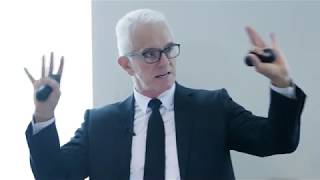
Dr Martyn Newman presents a keynote arguing that emotional intelligence (EI) is central to individual and organisational success and cannot be fully replicated by current AI. He traces foundational science (Paul Ekman's cross-cultural work on facial microexpressions and universality of emotions), highlights Daniel Goleman's popularisation of EI and two decades of empirical research, and summarises a cluster of roughly ten emotional skills (measured via an Emotional Capital report on ~8,000 leaders) that predict leadership, engagement and innovation. Newman illustrates key points with studies on optimism and Duchenne smiles, Alex Pentland's team/eyes-reading findings relating empathy to innovation, business examples (ExxonMobil talent constraints), and Montessori education's role in fostering social-emotional learning (citing later achievements of alumni like Larry Page, Sergey Brin, Jeff Bezos).
Chapters
Thank you, Priscilla. Now I'm aware of why you invited me along. How are you feeling? The room is divided between fear and excitement after that. Harry, it's extraordinary. Well, we're way ahead of ourselves on that one. Let's have a look. There we go. Great. Lovely to be here. I've just got a few minutes to talk to you about this remarkable topic. Really, they're both remarkable, aren't they? Really? The whole idea of emotional intelligence, which we all take for granted. Now, it's old hat in a way, but its relationship to the new challenge of AI not that long ago, a really good friend of mine by the name of Eve Ekman, I was in San Francisco and she invited me home to. To meet her family for dinner. And Eve is the daughter of one of the most famous and cited psychologists in history, Paul Ekman. How many of you have heard of Paul Ekman? Okay, yeah. Time magazine regards him as one of the most influential psychologists in history. And Paul became famous because he discovered microexpressions, these remarkable idea that your face is made up of 43 different sets of muscles. And when emotions erupt onto your face, you contract them in a sequence of around 3,000 different combinations. And Paul spent his entire Life examining these 3,000 combinations and could predict exactly what you're feeling. You see, even though you might try to suppress emotion, emotion appears on your face for a fleeting moment. And Paul, they used to call him the mind reader, is the sort of guy who can read exactly what you're feeling. Now, Paul was famous because of his ability to detect people who were lying. Some of you may remember the TV show by sky called Lie to Me, which was based on the life of a forensic psychologist, which was actually modeled on Paul Ekman himself. Well, you can imagine sitting across the table, he makes a quite unnerving gig. Dinner guest, particularly when he asks you questions about what you think, about his wife's cooking and things like that. But in 1967, Paul had some cash from the US government to go down and conduct the first examination, the first experiment really, examining cross cultural impacts of emotions. And so in 1967, he flew down to the highlands of New guinea to meet the South Fort tribe. Now, the prevailing wisdom at the time, you see, was that emotions were culturally relative. These were things that you would learn depending on which culture you lived in. Paul wasn't so convinced. And so he went to meet a group of people who'd never seen anyone outside of their culture. These people lived in sort of pre industrialized states. They were hunter gatherer, communities. And he arrived with his Cessna into a jungle clearing, managed to land the thing, and tumbled out with a bagload of film, Kodak film, and some photographs that he'd taken about these particularly six base emotions that we can measure as they erupt on people's faces. And he was intent on showing them to these people to see whether they would recognize the same emotions that you and I would, for example, which was extraordinary. And what Paul discovered was these people who lived in hunter gatherer communities actually had an identical set of emotions and recognized exactly the same facial expressions as people expressed emotions, as we did in the Western world. And so the fabulous discovery that Paul made was that emotions are universal. They exist in every culture, and they're expressed in exactly the same way in, in every human context. And then, of course, it was companies like Google, for example, that developed the technology to begin to help recognize emotions as they express themselves through these facial muscles. And if you come through Heathrow Terminal 5 and you go through that facial recognition, that's all based on Paul Ekman's work. And of course, if you put on a pair of Google glasses, it will feed you data on the emotional experience of the person that you're actually engaged with. And yes, you might notice that very often the emotion that you're encountering is contempt for wearing Google glasses. But also, he had no idea that he would upset an entire time honored tradition that assumed that when a newborn human infant came into the world, they existed as a tablet rasa, as a blank slate. And that all over the course of their life as they developed that everything you ever feel would be written on this slate as you grew up. And Paul overturned this tradition and had made it very, very clear that in fact, we don't arrive in the world as blank slates at all, but that emotions are biologically driven, that they're deeply inherited and emotionally wired into us in our nervous systems. And rather than being rational creatures that are driven by reason, we're far more emotionally driven and driven by our emotions than ever we could have imagined. And Ekman's work catalyzed an entire field of affective science that has really explored the deep dimensions of how we make decisions, how we build relationships with people, how we invent new products and so on. In business and in love, just about everything we do seems to be driven by our emotional experiences. You know, if I asked you why you're with your spouse, you know, was that to do with price or productivity? Did you go out and give him or her an IQ test before he decided to get married, for example, you know, in order to check that the IQ was sufficient, you know, to match yours. And no, the reason you are with your spouse is fundamentally because you love them. And what we notice is that human relationships, fundamentally all of the important things in our lives are driven by love. We love our hobbies, we love our friends, we love our family. And the question for those of us who now live and work in organisations is do we love our employees? Do we love our suppliers? What we do know is that people make decisions based on emotion far more than we could ever have imagined. Now, so much so that this led one of the world's leading neuroscientists, Michael Gazzaniga, to make the comment that our brains really are all about social interaction. And there's no way around the fact, says Gazzaniga, that our big brains are there primarily to deal with social matters, not to cogitate about the second law of thermodynamics. Emotions are the deepest signs that we have of our commitments and they're wired into our nervous systems. Now, if that's true, then artificial intelligence has got some catching up to do. That isn't to say that it hasn't made some useful progress. I mean, if you're trying to find your way across a busy city and you want the quickest route, artificial intelligence will quickly give you and provide for you the quickest route across the city. If you're looking to get through a call center. And in voice recognition technology, artificial intelligence will help direct your call to the appropriate service provider. But there's some things that artificial intelligence can't do that even a three year old child can do. For example, it can't determine the difference between a dog and a cat. And it certainly isn't very clever at understanding the nuances of language. So, for example, AI doesn't know that the corporate question that your partner asks you, have you taken the rubbish out? Is actually a question. Take the rubbish out. And neither can it possibly understand the implications of failing to take the rubbish out. And this isn't just a theory. In fact, when you ask employers around the world the sorts of qualities they now look for in employees to bring into their organizations to keep up with the pace of change and the diversification which is taking place right across our organizations, they're looking for people with social skills, the ability to build and manage and sustain relationships, to understand diversity and gender differences and cultural differences, the ability to bounce back from setbacks, the ability to be able to look over the horizon and imagine the future and get together with people to come up with creative and innovative solutions. And many people are worried because these skills appear to be diminishing. For a number of years, I worked for and consulted to one of the largest organizations in the world, ExxonMobil. And ExxonMobil at any one time has got something like $20 billion invested in various projects around the world. It's a heavily capitalized business. And not that long ago, in fact, twice was Rex Tillerson in his previous job when he was CEO of ExxonMobil, gave back to investors and stakeholders of various kinds $33 billion in buybacks and dividends. And when he was asked why did he do that, surely that was an act of fiscal irresponsibility, that that money should have been reinvested back in the growth and development of Exxon Mobil as a business. This is what he said. He said the constraint in our business is not money, it's people. He said, we can't find enough of the right kind of people. People who can solve the problems that we face as a business today, who can work cross culturally, who can work across generations, who know how to imagine the future and have the courage to take the risks necessary to invest in the right processes to create that future. So much so, and this is a challenge that so many businesses are facing around the world today. And one of the leading economists in the world, Robert Reich, says, we're entering a new economy and we have no idea where new leadership insights will come from. Well, I'm glad to say tonight in the few minutes we have together, that in fact Robert's wrong because nobody saw this coming. When Dan Goldman, a struggling journalist and a young psychologist, was looking for an opportunity to get some extra cash to put his child through college, he stumbled across some manuscripts buried in the basement on the east coast of the United States, written by two academic psychologists who were intent on following and examining this proposition that instead of thought being the primary driver of human behavior, these two psychologists believe that in fact it was emotions that drove human behavior at a very profound level. And Dan discovered this literature and read it thoroughly and it took his breath away. And he came out and he wrote this extraordinary book, Emotional Intelligence. How many of you have got that book or have read it? Let's just have a quick look. Well, quite a few of you. You know, I asked that question of three 340 hr directors not that long ago in the Middle east, and we were there to talk about emotional intelligence of 340 HR directors. How many hands do you Think went up just about everyone about 320. You can't be a self respecting HR director and not have read that book. That book went on to be the biggest selling book in the history of the social sciences and remains that way today. You can't go into a bookshop in London and not find that book on the shelf 20 years later. The second question I asked them was more interesting. I asked them, how many of you got past chapter one? How many hands do you think went up? 10. How do you write the biggest selling book in the history of the social sciences? Hardly anyone that's past chapter one. Isn't that extraordinary? So what Dan put his finger on, if I was to summarize it for you, to save you wading through 500 pages is essentially this. Everything we thought we knew about what constitutes human performance and what drives human behavior for over 100 years, we were dead wrong about. We used to think it was sticks or carrots. See, and if you went to the school I went to, they'd never heard of carrots. Some of you went to that school. What an extraordinary idea that the thing to drive human behavior is the way to. The way you do that is through fear and shame. And to its credit, most of the corporate world, with a few exceptions like Enron and others, had suggested all this nonsense. The way you really drive human behavior is through carrots. Now, I don't know whether you've read the paper since 2008. I work at the top end of the financial sector and some of these people are paid extraordinary amounts of money for the work that they do. But you know, it doesn't really drive performance. What the data tells us is after a certain threshold, no matter how much money you throw at people, it won't lead to an improvement in performance at all. And Dan comes out with his book and he says, it's not sticks, it's not carrots. He says, I'll tell you what it is. It's emotions, it's values. It's when you tap into the things that people really believe, the things that they feel. That's what enables people to step up to the opportunities that life throws at them and respond with extraordinary nobility and creativity to the most challenging opportunities and demands that life throws at them. Now that book was written 20 years ago. I had the opportunity to sit down with Dan over lunch just a few months ago and I asked him because he made a lot of big claims in that book, especially in the article he wrote following it that went on to be the Harvard Business Review's most requested article, the relationship of emotional intelligence to leadership. And he told me, yeah, look, the science was young and we were enthusiastic. So what's it like 20 years later? Well, in order for. If we were here tonight for the few minutes we had together, and I was to distribute to you all of the good scientific peer reviewed journal articles that have examined that question closely, what is the relationship between emotional intelligence, leadership excellence, productivity, innovation, and so on? If we were to examine that literature, we'd have to look at at least 117 scholarly articles, and that doesn't include unpublished doctoral dissertations. If we put them into the mix, and some of them are this fat, it would turn out to be about 141 articles you'd have to wade through. And if we came back into this room with a highlighter and we summarized all of the findings, Let me tell you what emerges from the last 20 years of literature over and over again. 10 skills. 10 skills show up as highly definitive of the most successful men and women on the planet and leading some of the most successful organizations on the planet. And we built a technology to measure that called the emotional Capital report, Primarily because organizations don't have time for psychological theory. We need to understand how do these things really add value to what it is we're trying to achieve. And these 10 skills separate the good from the great. Now, if you've got kids, how many of you have kids in the room? Most of you have seen them, I assume, as well, Once you've told your kids you love them and they mustn't doubt the value of their lives for a single moment, these are the 10 skills to teach them. Because these are the 10 skills that the behavioral sciences have now pulled the curtain back and given us a backstage pass to understand how they work, to set people up for their talent, to dance, for their most productive selves to emerge. We published a report on this on 8,000 leaders around the world in 11 different geographies, geographical regions, and looked at the relationship between emotional intelligence and emotional labor. That is, the jobs that require you to manage emotion to be successful, Whether you've got to be in law enforcement, and you've got to show some self control and restraint as you challenge people who break the law. Whether you're in social work and you've got to show compassion and care or clinical psychology, as Harry mentioned, But if you're in frontline customer service or if you're in a leadership role and you've got to inspire a generation of young people to step up and perform and you have to manage your own emotions and engage the emotions of other people. We call this emotional labor. That's where the real work is done. And what we found is that a strong correlation between emotional intelligence and those, particularly in leadership responsibility, to deploy emotional labor to be successful in what they do, almost one standard deviation above the mean. But it gets really interesting when we start to pull back the curtain and look beneath it and look at these 10 skills. It turns out they score extraordinarily well on things like self confidence, self reliance. These two are the reactor cores of your personality. They go very, very deep inside the structure of your emotional experience and your personality. And they're all. They're very, very difficult to change. You can go out to WH Smith and pick up a book on, you know, I Can make youe self confidence in 30 minutes. And it's all nonsense. In fact, there's only two bits of literature in the whole of psychology that say you can do much to shift that. But we know that self confidence becomes one of those reactive calls that enables people to step up and back their judgment and take risk and grasp the opportunity. We know that things like self reliance. Bruce Barton said it this way. Nothing splendid has ever been achieved except by those who dare to believe something inside themselves was superior to circumstance. Don't you love that? That tapping into that emotional energy is the key to driving out your opportunities to take initiative and back your judgment and take responsibility. And in the last decade, we've been systematically building these skills right across Fortune 500 organizations around the world. But what's really interesting is this one here, I think on optimism. Optimism is the single biggest predictor of how well people do in life by a long way and almost one standard deviation above the mean. When I was at the University of California, there were two psychologists looking for a research paper. One of them was Dasha Keltner and Leanne Hartner, the other. And they stumbled across a yearbook of 141 women in their first year university. And as they flipped through the images, they noticed that all of these women were smiling, apart from three. I was not content without being good psychologists. They wanted to categorize the smiles. Now you laugh at that, but that's. Paul Ekman has demonstrated to us there are 18 different kinds of smiles, smiles that you form when you form a smile in response to a stimulus. But only one of them is real, and it's called the Duchenne smile. So when there's a joy that erupts inside you, that spills onto your face. You contract these 43 muscles around the mandibular region of your face, but you also engage the orbicularis oculi, which are the muscles around your eyes, and they give you crow's feet. And the thing about that is it's controlled by the autonomic nerves, nervous system. In other words, you can't fake it. And so they put these smiles into two big buckets, one they called the Duchenne smile, and the other one they clubbed together and called them Pan American after the failed airline. You know, would you like fries with that kind of smile? You know? And then the data on these women was extraordinary. That spanned over 30 years. And it asked them the rudest and most invasive questions that you can't possibly ask people in the corporate world. How happy are you? How's your marriage? How's your mental health? How's your physical health? How much money are you making? All these sorts of. And it turned out, as they put it into a regression analysis and span it round, the single biggest predictor of how well those women were doing in midlife was that smile on their university photograph, deeply linked to a deep emotional commitment. The world is conspiring to do me good instead of the worlds against me. Now, I wouldn't share that data with you unless it had been replicated many times in psychology. We've taken the data of nuns who wrote journal entries every night. Turned out that those nuns that wrote optimistic language in their diaries at the end of each day lived an extra 10 years compared to the nuns who used pessimistic language over and over again. We find the smile. Now, here's Paul Ekman. Here's a challenge for you. Here's Paul Ekman as a young man. See if you can pick the Duchenne smile. That's right, the middle one. What about these two? That's contempt, by the way. That's what it looks like. You can see the cheeks just rise and the eyes glisten a bit. What about these two? See the Thai smiles? Both fake smiles. And in the service industry, we know from research over and over again that the smile is highly correlated with a person's capacity to engage. A customer greatly increases the chance that somebody will buy your product or service. And we know from studies with children that when parents are told to maintain stony faces very, very quickly, the child begins to stop playing with toys. That innovation begins to dry up and ultimately the child becomes agitated and distressed and withdraws from the parent and begins to provoke the parent. We know this is true, too. In passive Aggressive people inside organizations who don't feel validated, who don't feel rewarded for the contribution that they make. And so the smile, as innocent as it looks, becomes highly predictive of levels of engagement, productivity and so on. So finally, because my time is gone and we could talk about all of them if we had time. But I did want to talk to you about one more self actualization. That's the closest we get in the emotional intelligence framework to passion. You know, it's the show up. And when you show up at work, you're going to have one of three, you know, when Priscilla shows up at work in this business, she's going to have one of three impacts. People are going to shit, Priscilla's here. Or they're going to say Priscilla's here. Or they're going to say, oh, Priscilla's here. And the difference in the subtlety of those reactions will tell us a lot about Priscilla's capacity to influence and inspire. Whether she intimidates people, bores people senseless, or inspires them to new work has a lot to do with the subtleties of the way she deploys that energy and the fun. The final bit of data I wanted to show you was this. When you think of mit, we usually think of pretty geeky kind of people who technically oriented, at least I do anyway, some of the best mathematicians and scientists in the world. Well, Professor Alex Pentland has been fascinated by one question all his life and it's this, what makes teams work? And so we went in search of it on a large data study, examined all the different variables that things like rewards, things like incentives, a whole bunch of things like IQ and so on. But one factor, this factor here stood out over and over again in thousands of pieces of data and hundreds of groups that he looked at as highly predictive as the most successful groups at generating new ideas and innovation across a business. And it turns out that all of these groups were shown, it turned out that they were shown 36 black and white photographs of just the eye region of people's faces. This is reading the mind in the eyes. It's a psychometric piece of work developed by the University of Cambridge and it measures the ability of a person to recognize the emotions in another people. So have a look at this and tell me, what's this person feeling? Not bad, not bad. What about this? Good. Ooh, keep this one to yourself. There you go. And it turned out that people's scores on this particular test was the strongest predictor of how well those groups work together. And more importantly, the kind of innovative products that they produced going forward. And of course, it's a lot more than just your ability to read eyes. It's deeply connected to the emotional intelligence, confidence of empathy. And it turned out that those people were who could recognize the furrowed brow and the silent wish to join a conversation and create the psychologically safe place for people to contribute. That built bonds of friendship and mutual understanding and shared experiences that created idea flow. People took risks, they shared ideas and as a consequence generated so much more innovation, innovative ideas and successful products. He went on Alex, to publish this in the Harvard Business Review. So empathy becomes one of these deep human emotional skills that is extraordinarily difficult for machinery to replicate because it is so complex and so profoundly wired into our nervous systems and a part of our DNA. And I want to finish with this story. This woman, some years ago, Maria Montessori arrived in the US from Italy. And she was at the time one of the most famous women in the world. Against the odds, she'd become the first female doctor in Italy at 26 years old. But that's not what she was famous for. What Maria noticed was on the streets of Rome, there were kids who had fallen out of the educational system because they were poor. And she set up a school for 50 orphaned children to begin to school them and educate them and give them a future and a chance in life. But she had a particular approach to education. She believed that these kids potential would be drawn out if the environment was psychologically safe. That would foster rather than governing people with lots of rules and regulations and discipline and demands. She created the space for kids to be self directed, to begin by discussing discovery, by tapping into the things they were passionate about and learning through attending to the things that really matter to them. And over the course of time, she developed extraordinary academic success with these kids. And she came to America in front of a packed house at Carnegie hall where some of the most innovative people on the planet were there. Thomas Edison was there, Margaret Woodrow Wilson was there, Helen Keller was there, there. Alexander Graham Bell was there. But rather than talk to them, she talked to the parents and she told them about the environment that their kids needed in order to be the best they could possibly be. And then she died in 1952, before she saw the full implications of her work. But late in the 70s, 1970, a poor Russian immigrant family came to the United States and they enrolled their son Sergei in one of Maria's schools in Maryland. And a few years earlier, some other parents enrolled their son Larry into a similar school. Because they believed in social emotional learning. And when Sergey Brin and Larry Page met 12 years later, they'll tell you that they owe all of their creative genius to the environment that the Montessori school system built around emotional and social learning created in them. And they went on to build one of the most successful corporations in history, developing a culture built around the same principles that Maria Montessori, through the system of education, had exposed them to. And did I mention Jeff Bezos from Amazon also went through the same system? And Jimmy Wales from Wikipedia also went through the same system. And Gabriel Garcia Marquez, a great literary poet and writer, also was a product of the same system. Men and women, the environment in which we cultivate these skills, self reliance, self competence, optimism, self actualization, the capacity to build meaningful connections with other people, and empathy. If you want innovation, you need interaction. Now, John McCarthy, in 1956, who gave us the term AI, launched a research study, and he promised that every aspect of learning and intelligence can be described so that a machine can stimulate it. And he ended up by saying, we think that a significant advance can be made if a group of scientists can work on it for just a summer. He's got to be congratulated. I think he's a little optimistic. Thank you.
More from Dr
Inspirational Thought Of The Day with Dr. Martyn Newman: Leading With Emotional Intelligence